Pricing Policies/Strategies
• Pricing Policies constitute the general framework within which
pricing decisions are made. They provide the guidelines within
which management formulates and carries out pricing policies.
• It means that Pricing Strategies are the adaptation of Pricing
policies
• A firm does not follow a single price policy, rather it needs a
bundle of price policies to suit not only the firm and its pricing
objectives but its overall marketing situation.
• As a general rule, pricing policy should aim at promoting long
term welfare of the enterprise and maximising profit for the
entire operation over the long run
• Premium Pricing
Use a high price where there is a uniqueness about the product
or service. This approach is used where a substantial
competitive advantage exists. Such high prices are charge for
luxuries such as Cunard Cruises, Savoy Hotel rooms, and
Concorde flights
• Penetration Pricing
The price charged for products and services is set artificially
low in order to gain market share. Once this is achieved, the
price is increased. This approach was used by RCom in order
to attract new customers.
• Economy Pricing
This is a no frills low price. The cost of marketing and
manufacture are kept at a minimum. Supermarkets often have
economy brands for soups, spaghetti, etc.
• Price Skimming
 Charge a high price because you have a substantial competitive
advantage.
 However, the advantage is not sustainable. The high price tends
to attract new competitors into the market, and the price
inevitably falls due to increased supply.
 Manufacturers of digital watches used a skimming approach in
the 1970s.
 Once other manufacturers were tempted into the market and the
watches were produced at a lower unit cost, other marketing
strategies and pricing approaches are implemented.
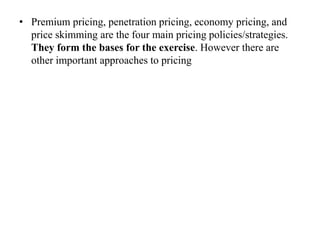
• Premium pricing, penetration pricing, economy pricing, and
price skimming are the four main pricing policies/strategies.
They form the bases for the exercise. However there are
other important approaches to pricing
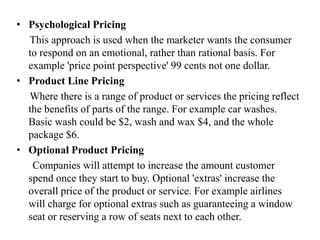
• Psychological Pricing
This approach is used when the marketer wants the consumer
to respond on an emotional, rather than rational basis. For
example 'price point perspective' 99 cents not one dollar.
• Product Line Pricing
Where there is a range of product or services the pricing reflect
the benefits of parts of the range. For example car washes.
Basic wash could be $2, wash and wax $4, and the whole
package $6.
• Optional Product Pricing
Companies will attempt to increase the amount customer
spend once they start to buy. Optional 'extras' increase the
overall price of the product or service. For example airlines
will charge for optional extras such as guaranteeing a window
seat or reserving a row of seats next to each other.
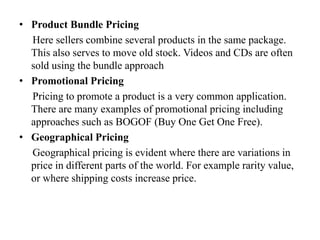
• Product Bundle Pricing
Here sellers combine several products in the same package.
This also serves to move old stock. Videos and CDs are often
sold using the bundle approach
• Promotional Pricing
Pricing to promote a product is a very common application.
There are many examples of promotional pricing including
approaches such as BOGOF (Buy One Get One Free).
• Geographical Pricing
Geographical pricing is evident where there are variations in
price in different parts of the world. For example rarity value,
or where shipping costs increase price.
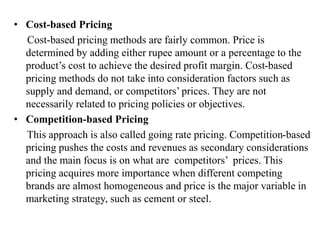
• Cost-based Pricing
Cost-based pricing methods are fairly common. Price is
determined by adding either rupee amount or a percentage to the
product’s cost to achieve the desired profit margin. Cost-based
pricing methods do not take into consideration factors such as
supply and demand, or competitors’ prices. They are not
necessarily related to pricing policies or objectives.
• Competition-based Pricing
This approach is also called going rate pricing. Competition-based
pricing pushes the costs and revenues as secondary considerations
and the main focus is on what are competitors’ prices. This
pricing acquires more importance when different competing
brands are almost homogeneous and price is the major variable in
marketing strategy, such as cement or steel.
• Demand-based Pricing
Companies using this method mainly consider the level of
demand. The price is high when the product demand is strong
and low price when the demand is weak. This approach is fairly
common with hotels, telephone service companies, and
museums etc.
• Perceived-value Pricing
Many companies perceived-value pricing. In this approach the
price is based on customer’s perceived value of a product or
service. The company must deliver the promised value
proposition it communicates to its target customers. And of
course, it is important that customers must perceive this value.
Marketers carefully use different elements of promotion mix to
effectively communicate and enhance customers’ perception of
product or service’s perceived value

Pricing policy

  • 1.
  • 2.
    • Pricing Policiesconstitute the general framework within which pricing decisions are made. They provide the guidelines within which management formulates and carries out pricing policies. • It means that Pricing Strategies are the adaptation of Pricing policies • A firm does not follow a single price policy, rather it needs a bundle of price policies to suit not only the firm and its pricing objectives but its overall marketing situation. • As a general rule, pricing policy should aim at promoting long term welfare of the enterprise and maximising profit for the entire operation over the long run
  • 3.
    • Premium Pricing Usea high price where there is a uniqueness about the product or service. This approach is used where a substantial competitive advantage exists. Such high prices are charge for luxuries such as Cunard Cruises, Savoy Hotel rooms, and Concorde flights • Penetration Pricing The price charged for products and services is set artificially low in order to gain market share. Once this is achieved, the price is increased. This approach was used by RCom in order to attract new customers.
  • 4.
    • Economy Pricing Thisis a no frills low price. The cost of marketing and manufacture are kept at a minimum. Supermarkets often have economy brands for soups, spaghetti, etc. • Price Skimming  Charge a high price because you have a substantial competitive advantage.  However, the advantage is not sustainable. The high price tends to attract new competitors into the market, and the price inevitably falls due to increased supply.  Manufacturers of digital watches used a skimming approach in the 1970s.  Once other manufacturers were tempted into the market and the watches were produced at a lower unit cost, other marketing strategies and pricing approaches are implemented.
  • 5.
    • Premium pricing,penetration pricing, economy pricing, and price skimming are the four main pricing policies/strategies. They form the bases for the exercise. However there are other important approaches to pricing
  • 6.
    • Psychological Pricing Thisapproach is used when the marketer wants the consumer to respond on an emotional, rather than rational basis. For example 'price point perspective' 99 cents not one dollar. • Product Line Pricing Where there is a range of product or services the pricing reflect the benefits of parts of the range. For example car washes. Basic wash could be $2, wash and wax $4, and the whole package $6. • Optional Product Pricing Companies will attempt to increase the amount customer spend once they start to buy. Optional 'extras' increase the overall price of the product or service. For example airlines will charge for optional extras such as guaranteeing a window seat or reserving a row of seats next to each other.
  • 7.
    • Product BundlePricing Here sellers combine several products in the same package. This also serves to move old stock. Videos and CDs are often sold using the bundle approach • Promotional Pricing Pricing to promote a product is a very common application. There are many examples of promotional pricing including approaches such as BOGOF (Buy One Get One Free). • Geographical Pricing Geographical pricing is evident where there are variations in price in different parts of the world. For example rarity value, or where shipping costs increase price.
  • 8.
    • Cost-based Pricing Cost-basedpricing methods are fairly common. Price is determined by adding either rupee amount or a percentage to the product’s cost to achieve the desired profit margin. Cost-based pricing methods do not take into consideration factors such as supply and demand, or competitors’ prices. They are not necessarily related to pricing policies or objectives. • Competition-based Pricing This approach is also called going rate pricing. Competition-based pricing pushes the costs and revenues as secondary considerations and the main focus is on what are competitors’ prices. This pricing acquires more importance when different competing brands are almost homogeneous and price is the major variable in marketing strategy, such as cement or steel.
  • 9.
    • Demand-based Pricing Companiesusing this method mainly consider the level of demand. The price is high when the product demand is strong and low price when the demand is weak. This approach is fairly common with hotels, telephone service companies, and museums etc. • Perceived-value Pricing Many companies perceived-value pricing. In this approach the price is based on customer’s perceived value of a product or service. The company must deliver the promised value proposition it communicates to its target customers. And of course, it is important that customers must perceive this value. Marketers carefully use different elements of promotion mix to effectively communicate and enhance customers’ perception of product or service’s perceived value