PRICING STRATEGIES
Submitted To: Sir Muhammad Farrukh Aslam
Date of Submission: May 15, 2014
Group Members
Iffat Ashfaq, Kinza Rashid, Syeda Muniba Mehtab,
Muhammad Osama Ali and Shah Raza
M.Com. (Previous)
Department of Commerce
University of Karachi
2 | P a g e
Table of Contents
Conducted By Syeda Muniba Mehtab
Introduction to Price pg. 3
Factors That Influence Prices pg. 3-4
 MAJOR PRICING STRATEGIES
Customer Value-Based Pricing pg. 5
 Good Value Pricing pg. 5
 Value Added Pricing pg. 5
Competition Based pricing pg. 5
Conducted By Muhammad Osama Ali
Cost Based Pricing pg. 6
 Cost plus Pricing pg. 6
 Break Even Pricing pg. 7
Price Skimming pg. 7
Price Penetration pg. 7
Conducted By Kinza Rashid
 PRODUCT MIX PRICING STRATEGIES
 Product Line Pricing pg. 8
 Optional Product Pricing pg. 9
 Captive Product Pricing pg. 9
 By-Product Pricing pg. 9
 Product Bundle Pricing pg. 9
Conducted By Shah Raza Hammad
 PRICE ADJUSTMENT STRATEGIES
 Discount And Allowance Pricing pg.10
 Segmented Pricing pg.10
 Psychological Pricing pg.11
 Promotional Pricing pg.11
Conducted By Iffat Ashfaq
 Geographical Pricing pg.11
 FOB-origin Pricing pg.12
 Uniform-delivered Pricing pg.13
 Zone Pricing pg.13
 Basing-point Pricing pg.13
 Freight-absorption Pricing pg.13
 Dynamic Pricing pg.14
 International Pricing pg.15
CONCLUSION pg.15
3 | P a g e
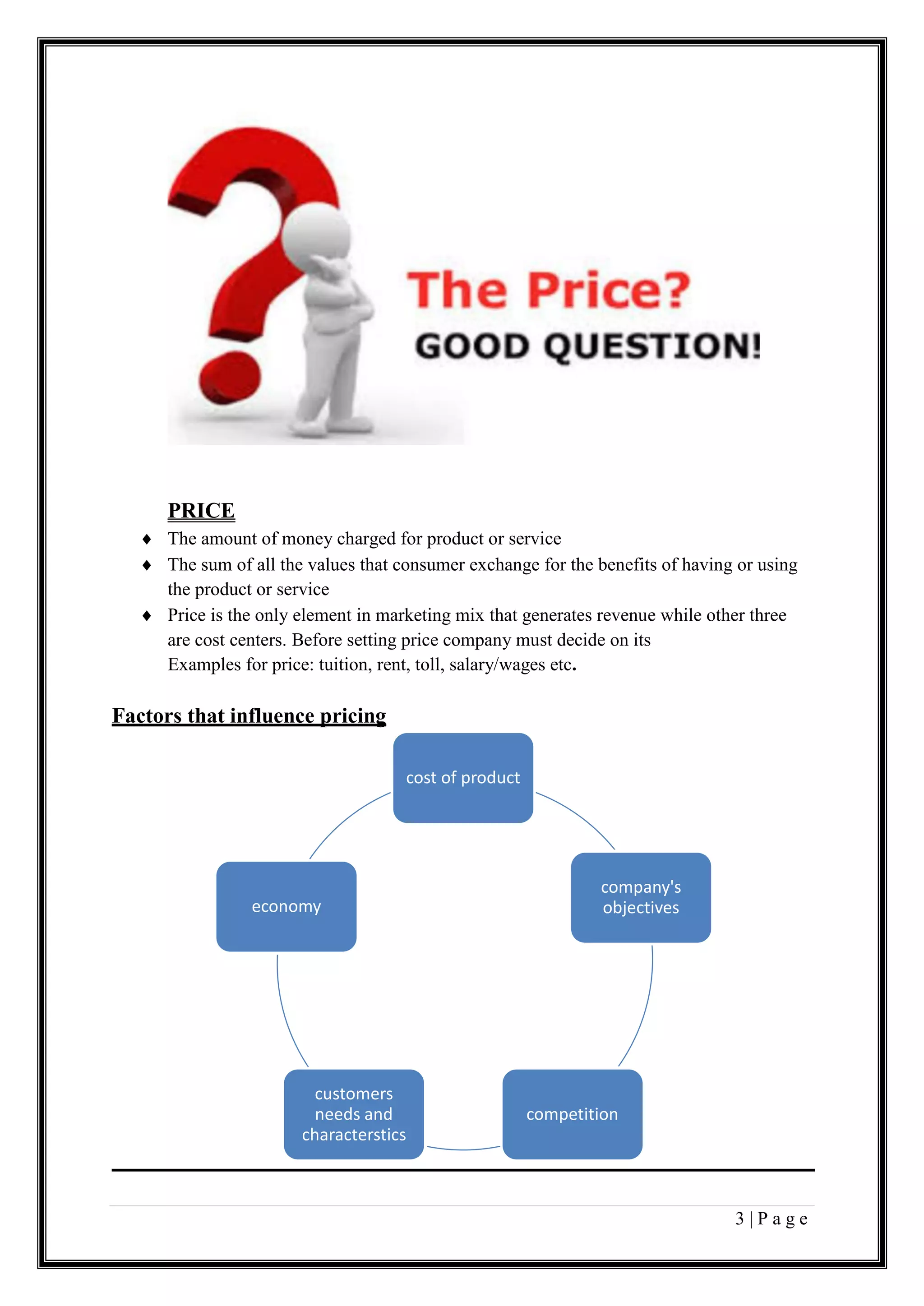
PRICE
 The amount of money charged for product or service
 The sum of all the values that consumer exchange for the benefits of having or using
the product or service
 Price is the only element in marketing mix that generates revenue while other three
are cost centers. Before setting price company must decide on its
Examples for price: tuition, rent, toll, salary/wages etc.
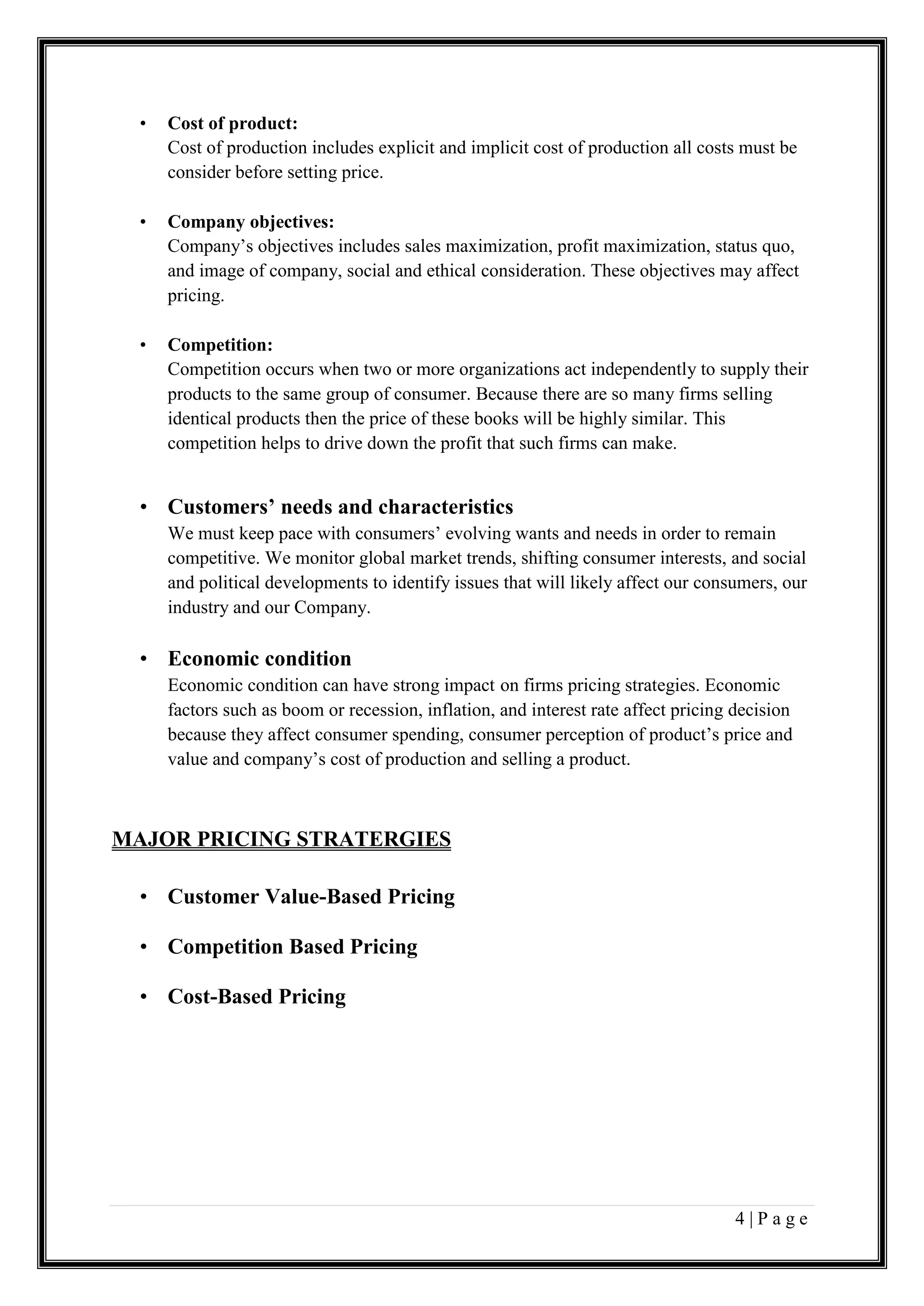
Factors that influence pricing
cost of product
company's
objectives
competition
customers
needs and
characterstics
economy
4 | P a g e
• Cost of product:
Cost of production includes explicit and implicit cost of production all costs must be
consider before setting price.
• Company objectives:
Company’s objectives includes sales maximization, profit maximization, status quo,
and image of company, social and ethical consideration. These objectives may affect
pricing.
• Competition:
Competition occurs when two or more organizations act independently to supply their
products to the same group of consumer. Because there are so many firms selling
identical products then the price of these books will be highly similar. This
competition helps to drive down the profit that such firms can make.
• Customers’ needs and characteristics
We must keep pace with consumers’ evolving wants and needs in order to remain
competitive. We monitor global market trends, shifting consumer interests, and social
and political developments to identify issues that will likely affect our consumers, our
industry and our Company.
• Economic condition
Economic condition can have strong impact on firms pricing strategies. Economic
factors such as boom or recession, inflation, and interest rate affect pricing decision
because they affect consumer spending, consumer perception of product’s price and
value and company’s cost of production and selling a product.
MAJOR PRICING STRATERGIES
• Customer Value-Based Pricing
• Competition Based Pricing
• Cost-Based Pricing
5 | P a g e
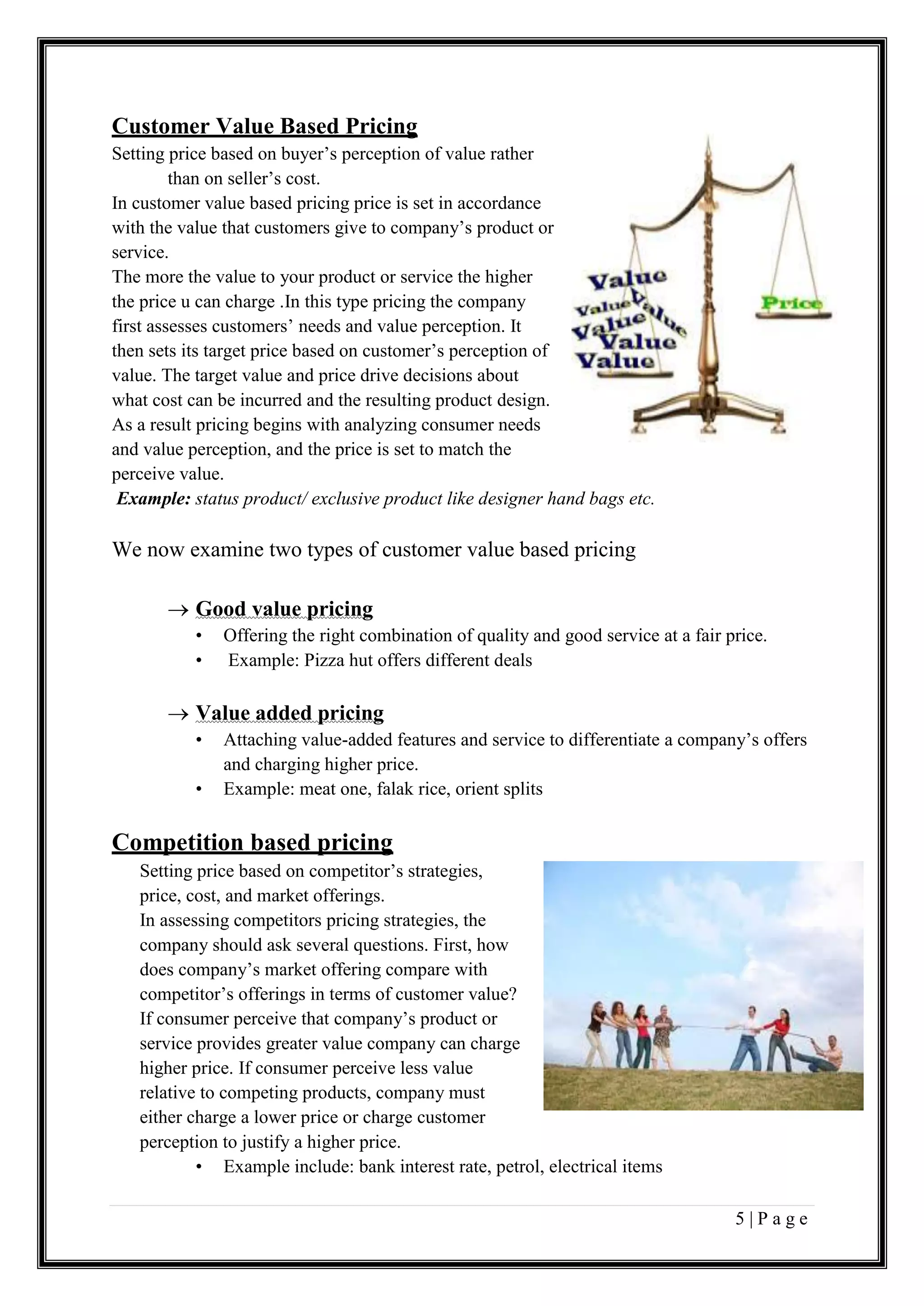
Customer Value Based Pricing
Setting price based on buyer’s perception of value rather
than on seller’s cost.
In customer value based pricing price is set in accordance
with the value that customers give to company’s product or
service.
The more the value to your product or service the higher
the price u can charge .In this type pricing the company
first assesses customers’ needs and value perception. It
then sets its target price based on customer’s perception of
value. The target value and price drive decisions about
what cost can be incurred and the resulting product design.
As a result pricing begins with analyzing consumer needs
and value perception, and the price is set to match the
perceive value.
Example: status product/ exclusive product like designer hand bags etc.
We now examine two types of customer value based pricing
 Good value pricing
• Offering the right combination of quality and good service at a fair price.
• Example: Pizza hut offers different deals
 Value added pricing
• Attaching value-added features and service to differentiate a company’s offers
and charging higher price.
• Example: meat one, falak rice, orient splits
Competition based pricing
Setting price based on competitor’s strategies,
price, cost, and market offerings.
In assessing competitors pricing strategies, the
company should ask several questions. First, how
does company’s market offering compare with
competitor’s offerings in terms of customer value?
If consumer perceive that company’s product or
service provides greater value company can charge
higher price. If consumer perceive less value
relative to competing products, company must
either charge a lower price or charge customer
perception to justify a higher price.
• Example include: bank interest rate, petrol, electrical items
6 | P a g e
Cost Based Pricing
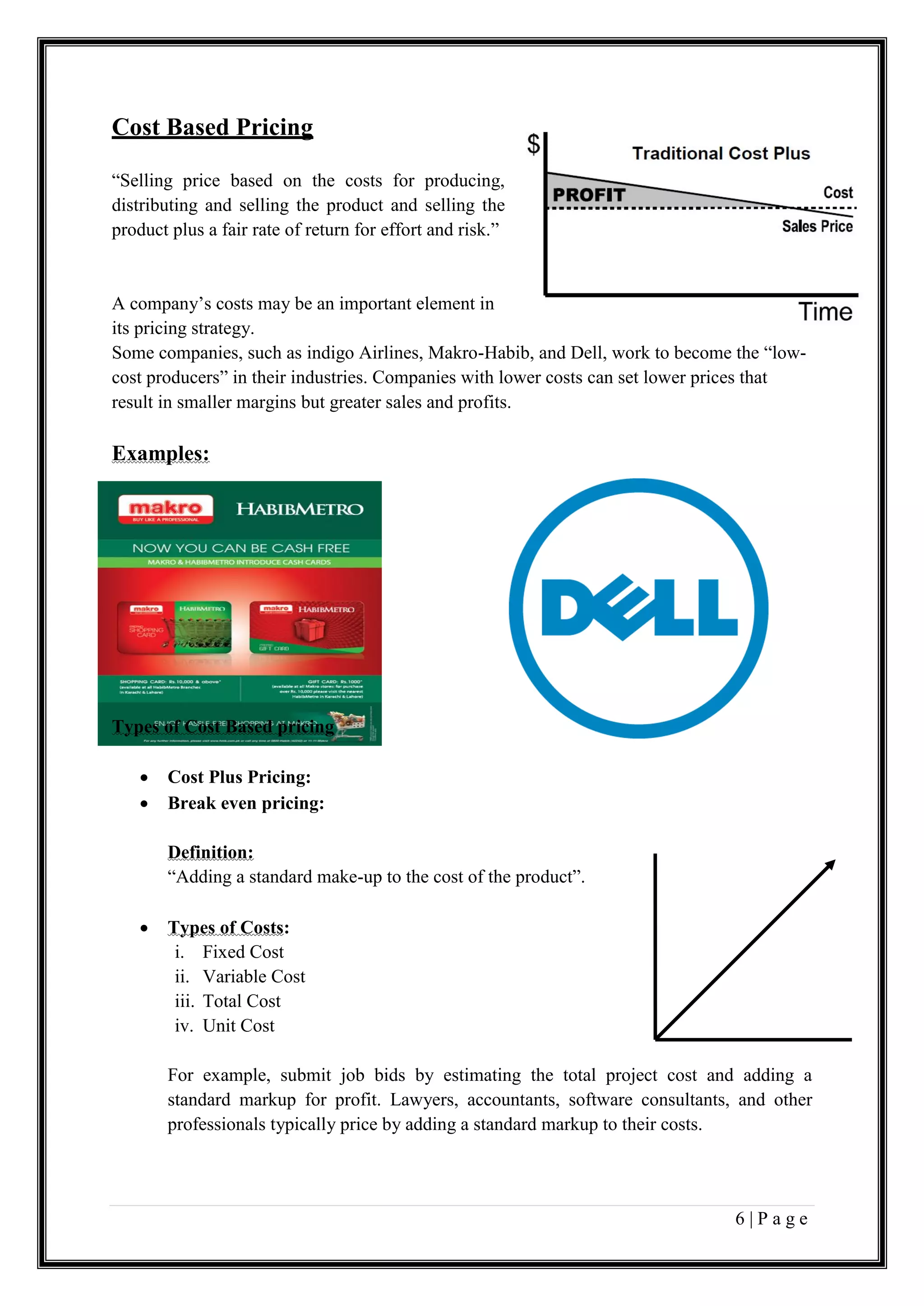
“Selling price based on the costs for producing,
distributing and selling the product and selling the
product plus a fair rate of return for effort and risk.”
A company’s costs may be an important element in
its pricing strategy.
Some companies, such as indigo Airlines, Makro-Habib, and Dell, work to become the “low-
cost producers” in their industries. Companies with lower costs can set lower prices that
result in smaller margins but greater sales and profits.
Examples:
Types of Cost Based pricing
 Cost Plus Pricing:
 Break even pricing:
Definition:
“Adding a standard make-up to the cost of the product”.
 Types of Costs:
i. Fixed Cost
ii. Variable Cost
iii. Total Cost
iv. Unit Cost
For example, submit job bids by estimating the total project cost and adding a
standard markup for profit. Lawyers, accountants, software consultants, and other
professionals typically price by adding a standard markup to their costs.
7 | P a g e
 Break Even Pricing:
Definition:
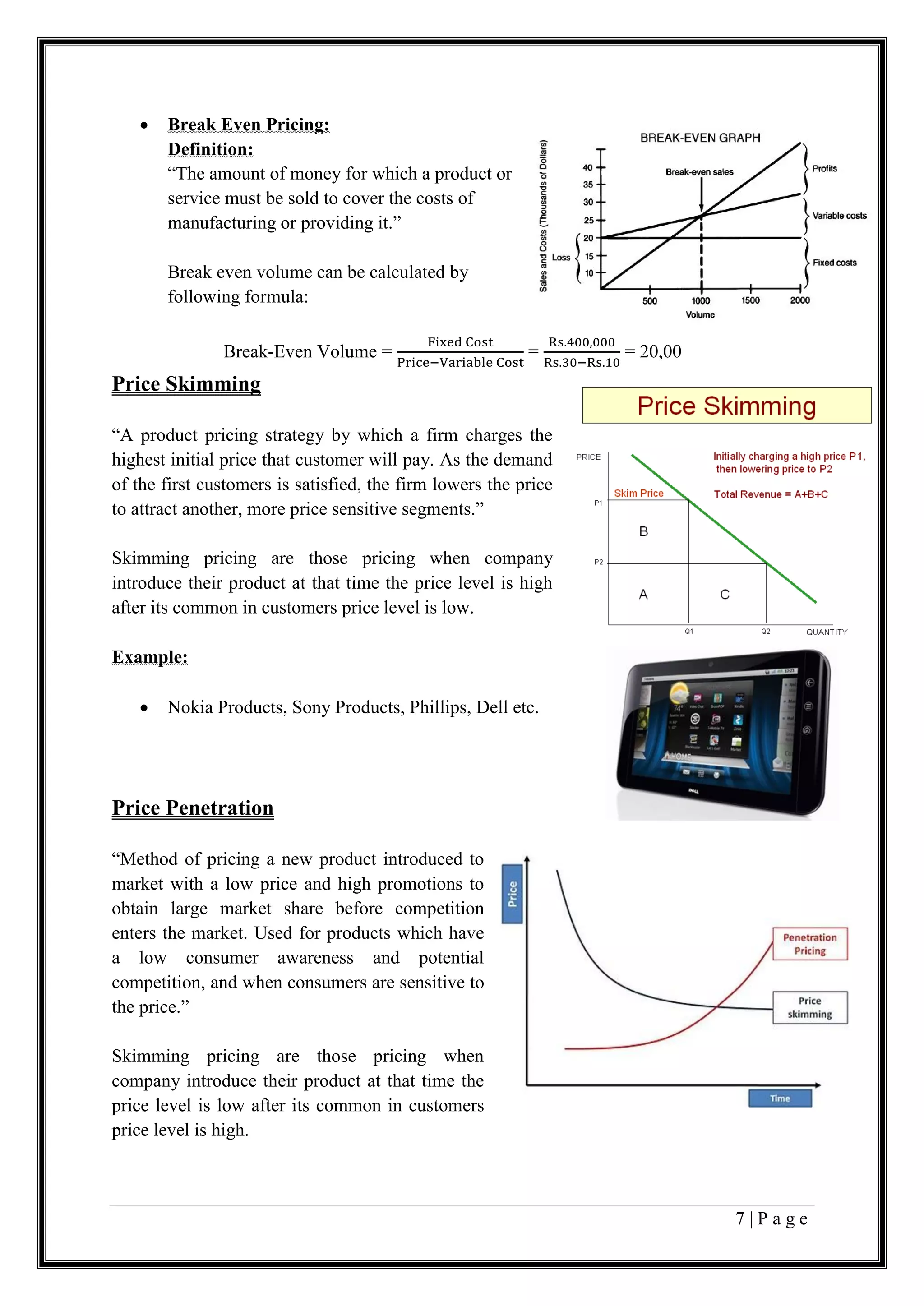
“The amount of money for which a product or
service must be sold to cover the costs of
manufacturing or providing it.”
Break even volume can be calculated by
following formula:
Break-Even Volume =
Fixed Cost
Price−Variable Cost
=
Rs.400,000
Rs.30−Rs.10
= 20,00
Price Skimming
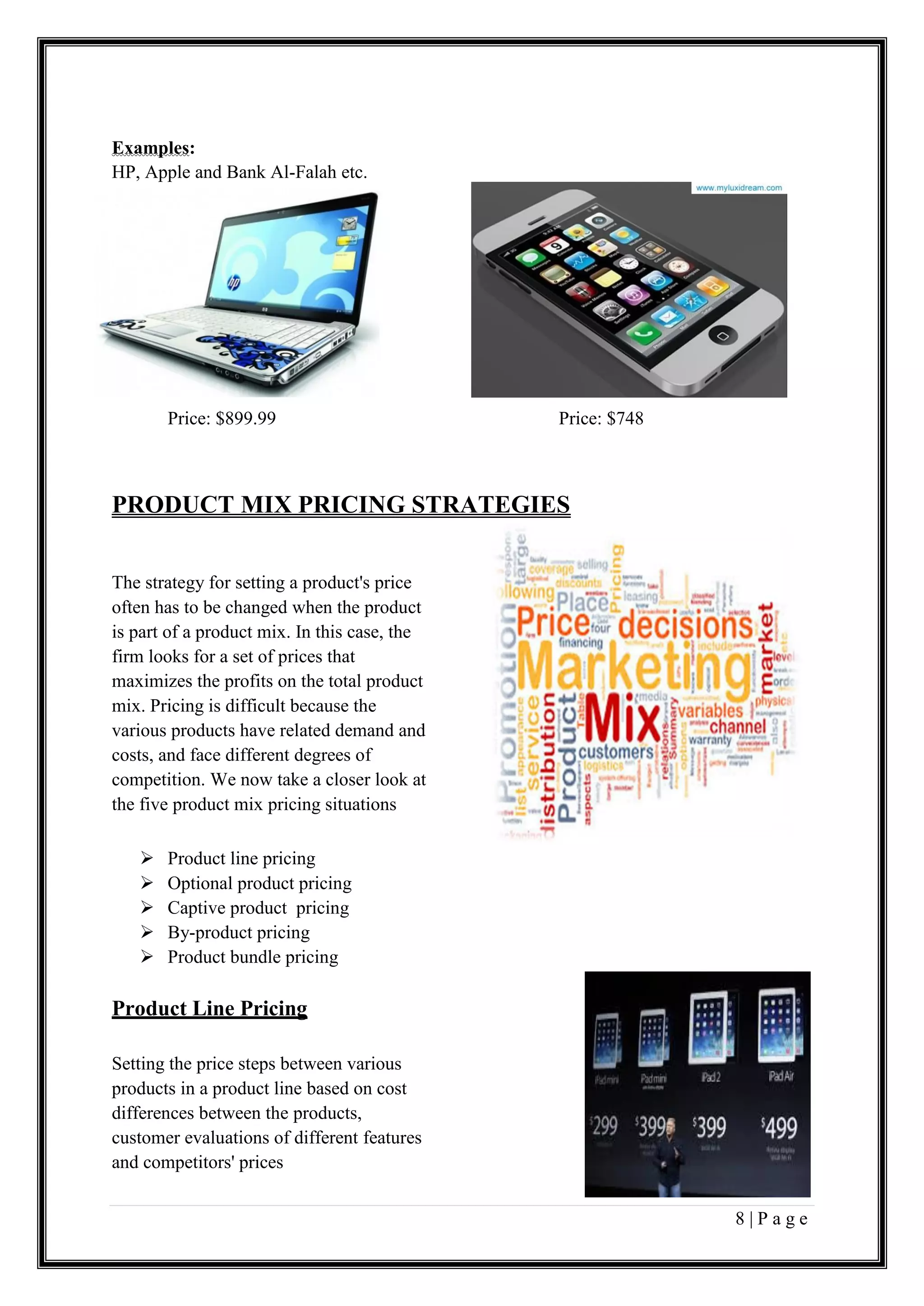
“A product pricing strategy by which a firm charges the
highest initial price that customer will pay. As the demand
of the first customers is satisfied, the firm lowers the price
to attract another, more price sensitive segments.”
Skimming pricing are those pricing when company
introduce their product at that time the price level is high
after its common in customers price level is low.
Example:
 Nokia Products, Sony Products, Phillips, Dell etc.
Price Penetration
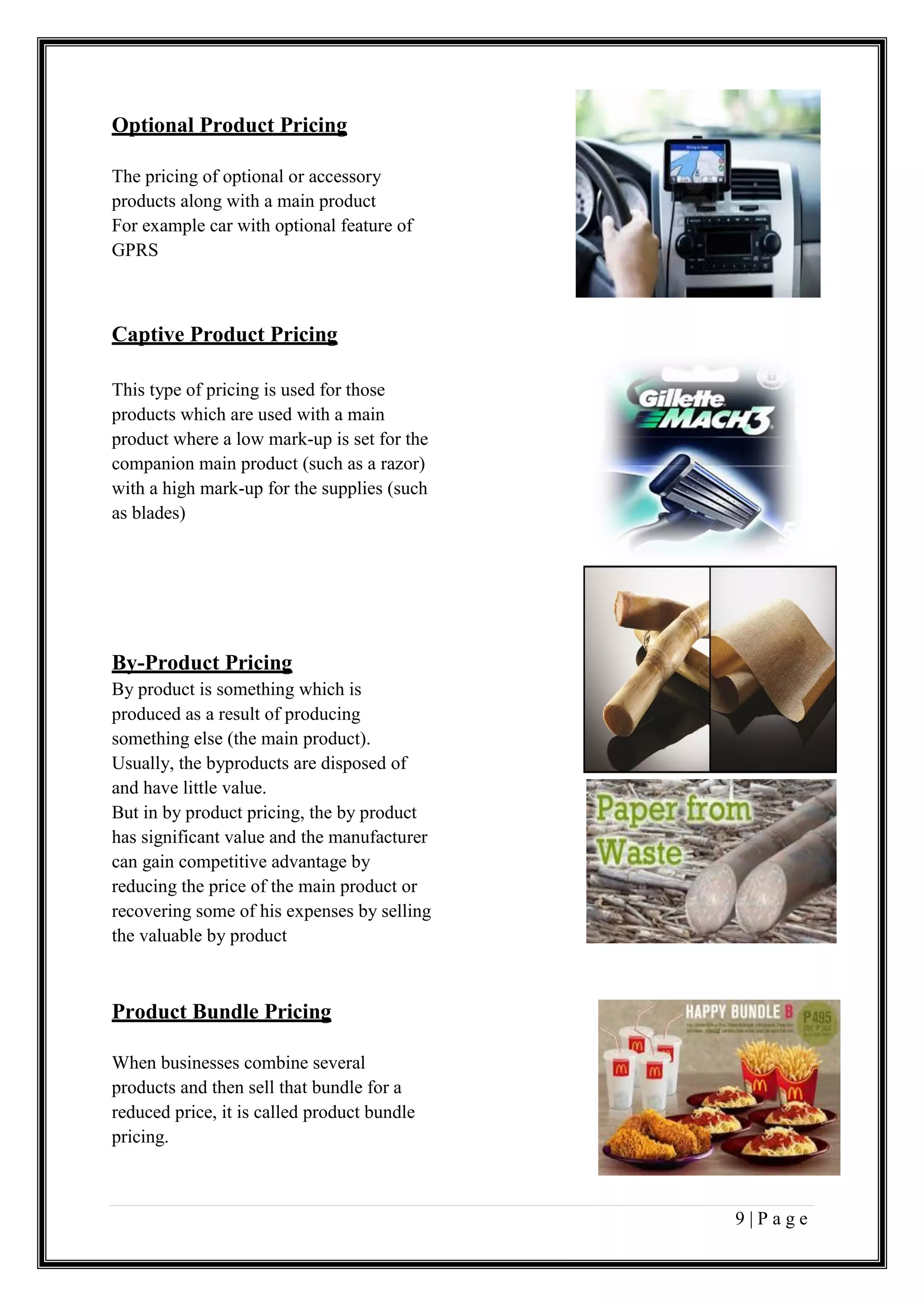
“Method of pricing a new product introduced to
market with a low price and high promotions to
obtain large market share before competition
enters the market. Used for products which have
a low consumer awareness and potential
competition, and when consumers are sensitive to
the price.”
Skimming pricing are those pricing when
company introduce their product at that time the
price level is low after its common in customers
price level is high.
8 | P a g e
Examples:
HP, Apple and Bank Al-Falah etc.
Price: $899.99 Price: $748
PRODUCT MIX PRICING STRATEGIES
The strategy for setting a product's price
often has to be changed when the product
is part of a product mix. In this case, the
firm looks for a set of prices that
maximizes the profits on the total product
mix. Pricing is difficult because the
various products have related demand and
costs, and face different degrees of
competition. We now take a closer look at
the five product mix pricing situations
 Product line pricing
 Optional product pricing
 Captive product pricing
 By-product pricing
 Product bundle pricing
Product Line Pricing
Setting the price steps between various
products in a product line based on cost
differences between the products,
customer evaluations of different features
and competitors' prices
9 | P a g e
Optional Product Pricing
The pricing of optional or accessory
products along with a main product
For example car with optional feature of
GPRS
Captive Product Pricing
This type of pricing is used for those
products which are used with a main
product where a low mark-up is set for the
companion main product (such as a razor)
with a high mark-up for the supplies (such
as blades)
By-Product Pricing
By product is something which is
produced as a result of producing
something else (the main product).
Usually, the byproducts are disposed of
and have little value.
But in by product pricing, the by product
has significant value and the manufacturer
can gain competitive advantage by
reducing the price of the main product or
recovering some of his expenses by selling
the valuable by product
Product Bundle Pricing
When businesses combine several
products and then sell that bundle for a
reduced price, it is called product bundle
pricing.
10 | P a g e
Price Adjustment Strategies
His price adjustment strategies relate to all the strategies implemented by an organization that
takes into account the differences between customers and rapidly changing. The price
adjustment strategies are: geographical pricing, psychological prices, segmented prices,
promotional prices, international prices, supply and pricing of allowances. The explanation of
these strategies is as follows:
Discount and Allowance Pricing
Discount
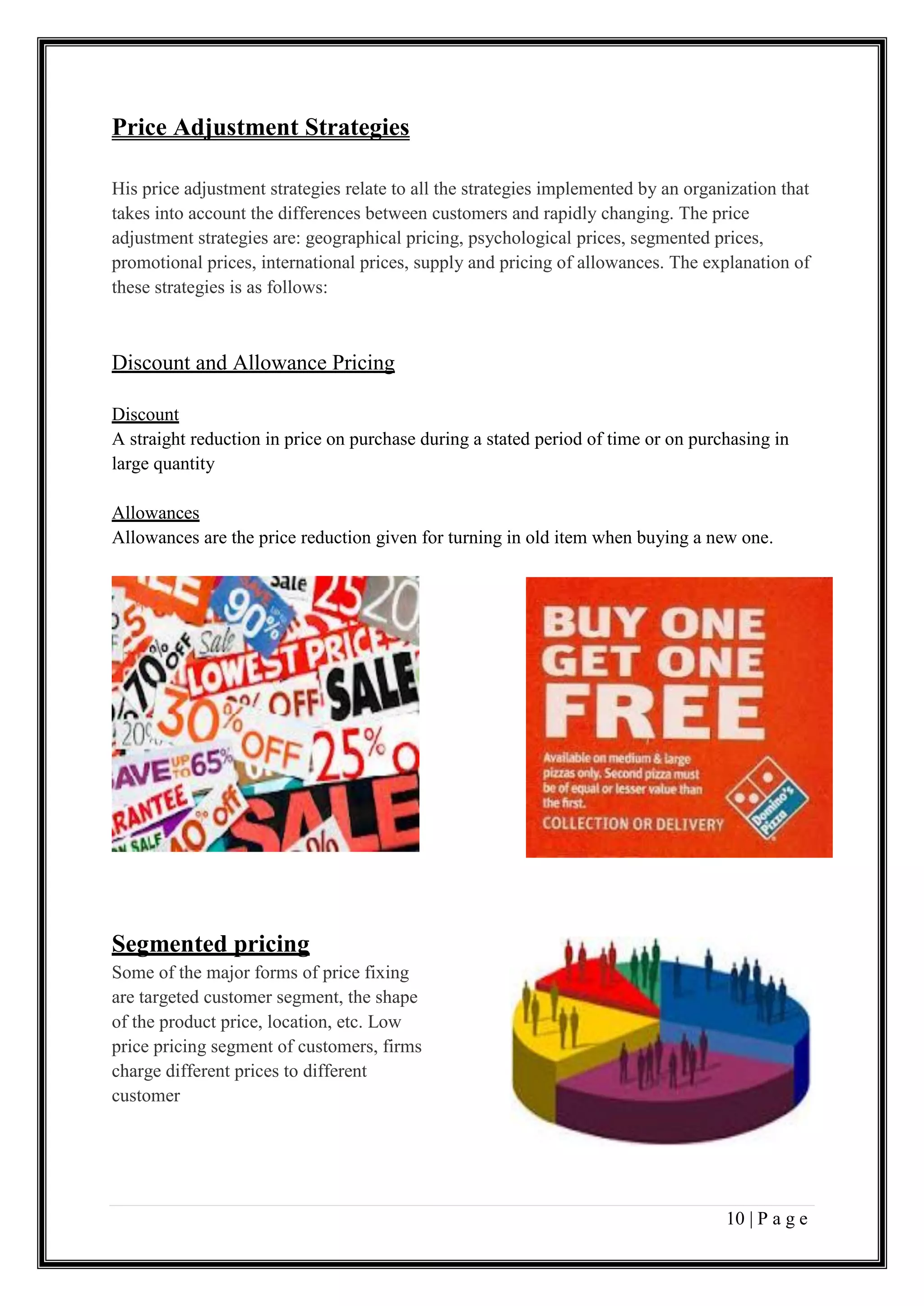
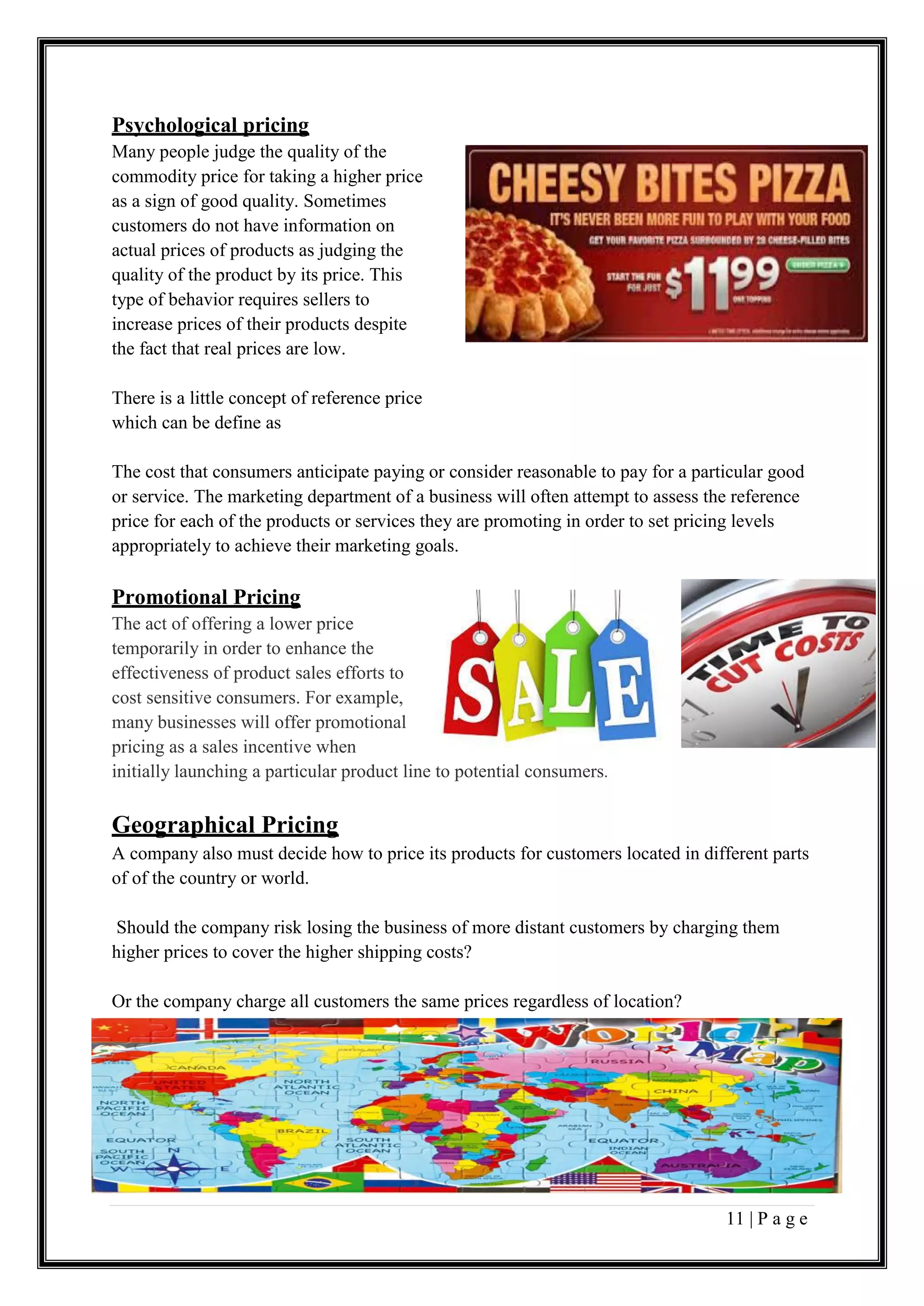
A straight reduction in price on purchase during a stated period of time or on purchasing in
large quantity
Allowances
Allowances are the price reduction given for turning in old item when buying a new one.
Segmented pricing
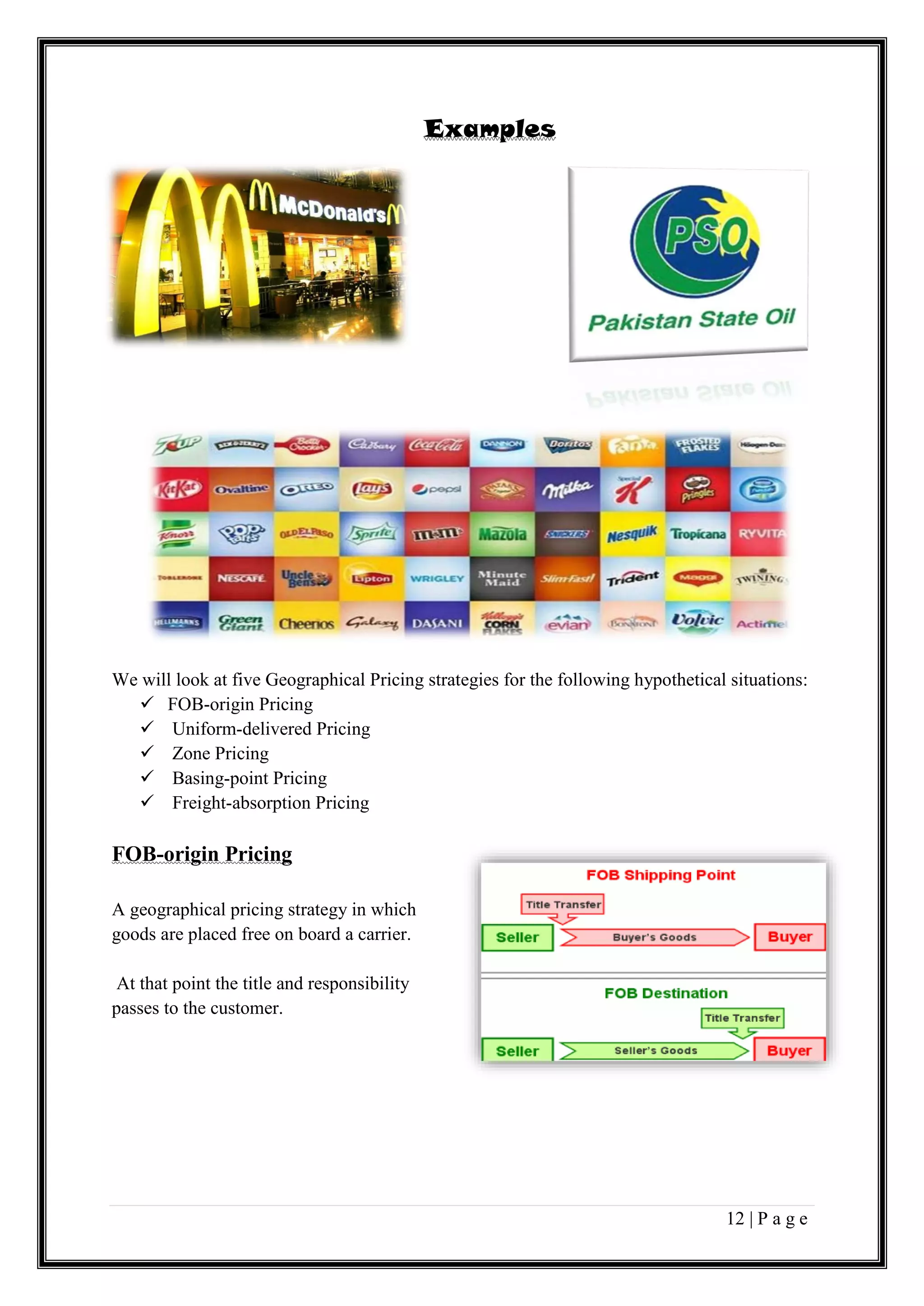
Some of the major forms of price fixing
are targeted customer segment, the shape
of the product price, location, etc. Low
price pricing segment of customers, firms
charge different prices to different
customer
11 | P a g e
Psychological pricing
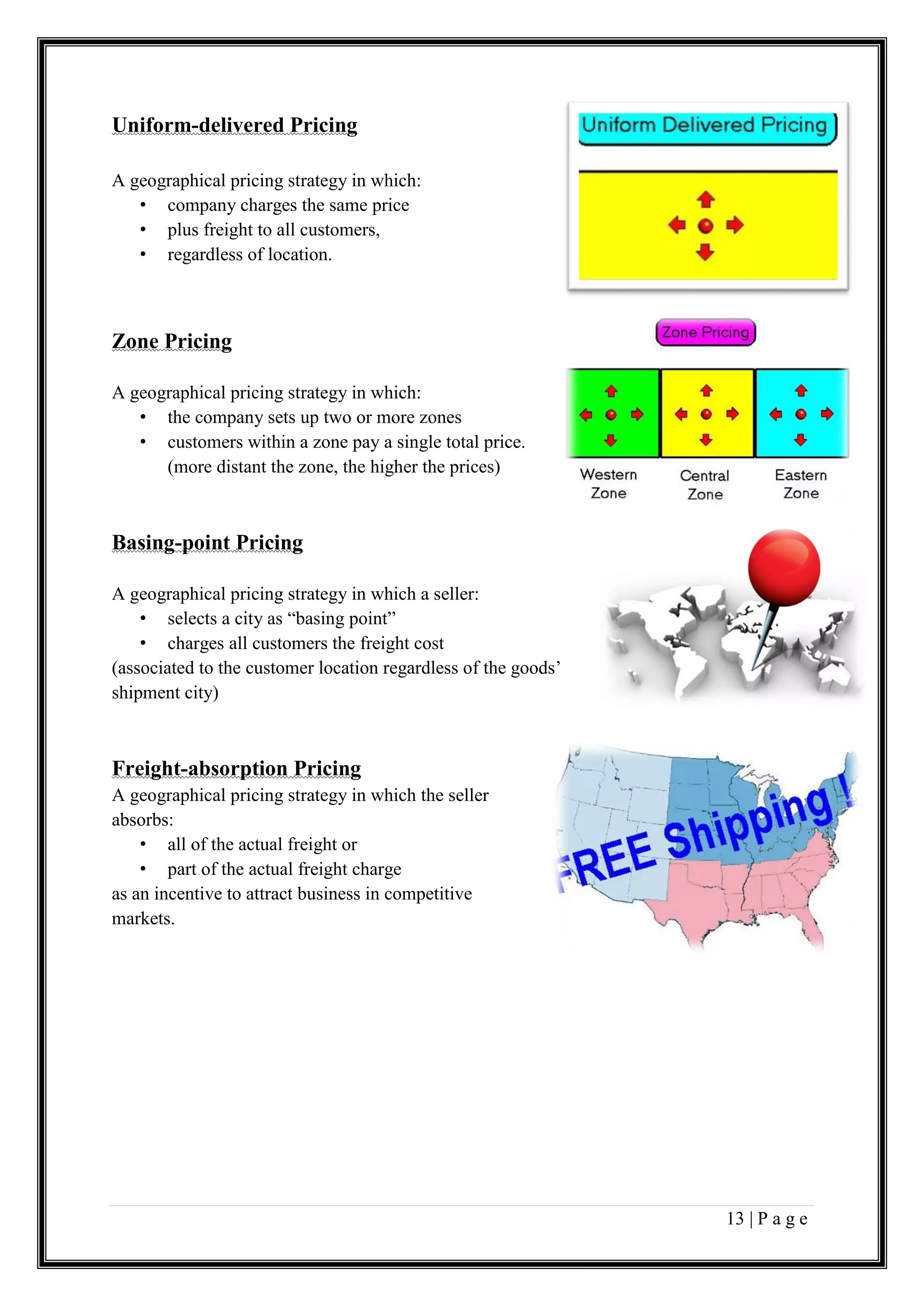
Many people judge the quality of the
commodity price for taking a higher price
as a sign of good quality. Sometimes
customers do not have information on
actual prices of products as judging the
quality of the product by its price. This
type of behavior requires sellers to
increase prices of their products despite
the fact that real prices are low.
There is a little concept of reference price
which can be define as
The cost that consumers anticipate paying or consider reasonable to pay for a particular good
or service. The marketing department of a business will often attempt to assess the reference
price for each of the products or services they are promoting in order to set pricing levels
appropriately to achieve their marketing goals.
Promotional Pricing
The act of offering a lower price
temporarily in order to enhance the
effectiveness of product sales efforts to
cost sensitive consumers. For example,
many businesses will offer promotional
pricing as a sales incentive when
initially launching a particular product line to potential consumers.
Geographical Pricing
A company also must decide how to price its products for customers located in different parts
of of the country or world.
Should the company risk losing the business of more distant customers by charging them
higher prices to cover the higher shipping costs?
Or the company charge all customers the same prices regardless of location?
12 | P a g e
Examples
We will look at five Geographical Pricing strategies for the following hypothetical situations:
 FOB-origin Pricing
 Uniform-delivered Pricing
 Zone Pricing
 Basing-point Pricing
 Freight-absorption Pricing
FOB-origin Pricing
A geographical pricing strategy in which
goods are placed free on board a carrier.
At that point the title and responsibility
passes to the customer.
13 | P a g e
Uniform-delivered Pricing
A geographical pricing strategy in which:
• company charges the same price
• plus freight to all customers,
• regardless of location.
Zone Pricing
A geographical pricing strategy in which:
• the company sets up two or more zones
• customers within a zone pay a single total price.
(more distant the zone, the higher the prices)
Basing-point Pricing
A geographical pricing strategy in which a seller:
• selects a city as “basing point”
• charges all customers the freight cost
(associated to the customer location regardless of the goods’
shipment city)
Freight-absorption Pricing
A geographical pricing strategy in which the seller
absorbs:
• all of the actual freight or
• part of the actual freight charge
as an incentive to attract business in competitive
markets.
14 | P a g e
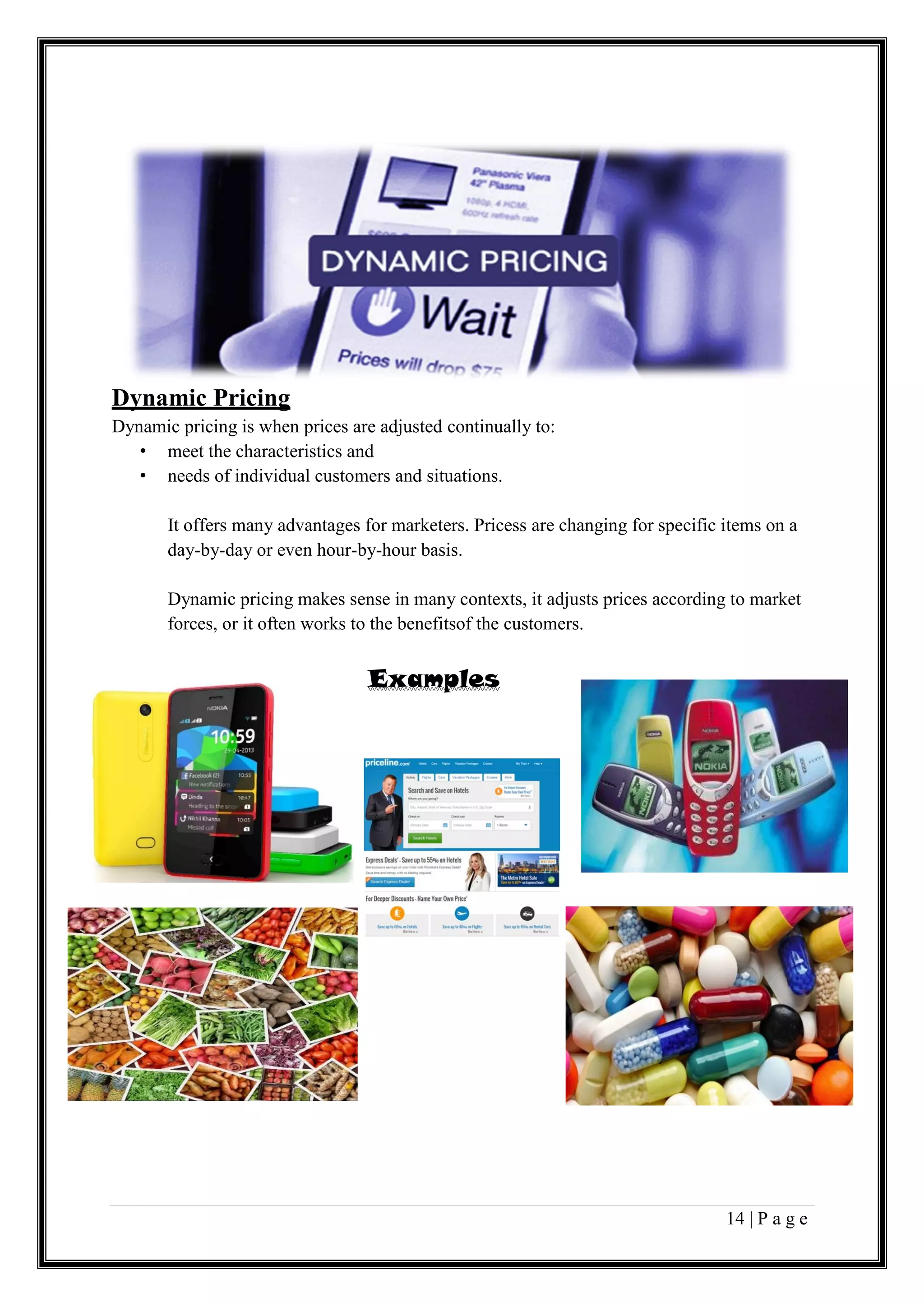
Dynamic Pricing
Dynamic pricing is when prices are adjusted continually to:
• meet the characteristics and
• needs of individual customers and situations.
It offers many advantages for marketers. Pricess are changing for specific items on a
day-by-day or even hour-by-hour basis.
Dynamic pricing makes sense in many contexts, it adjusts prices according to market
forces, or it often works to the benefitsof the customers.
Examples
15 | P a g e
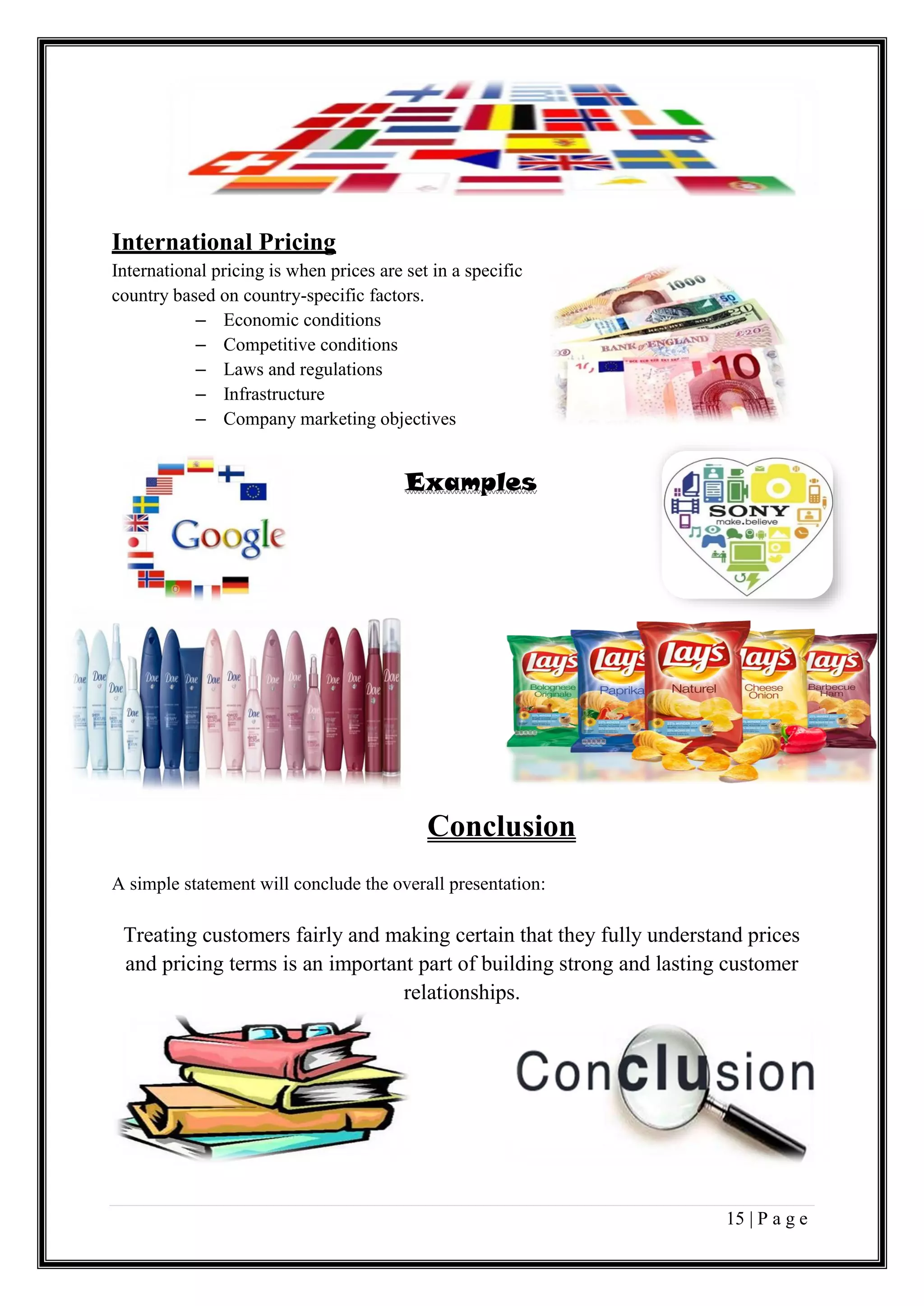
International Pricing
International pricing is when prices are set in a specific
country based on country-specific factors.
– Economic conditions
– Competitive conditions
– Laws and regulations
– Infrastructure
– Company marketing objectives
Examples
Conclusion
A simple statement will conclude the overall presentation:
Treating customers fairly and making certain that they fully understand prices
and pricing terms is an important part of building strong and lasting customer
relationships.

Pricing strategies

  • 1.
    PRICING STRATEGIES Submitted To:Sir Muhammad Farrukh Aslam Date of Submission: May 15, 2014 Group Members Iffat Ashfaq, Kinza Rashid, Syeda Muniba Mehtab, Muhammad Osama Ali and Shah Raza M.Com. (Previous) Department of Commerce University of Karachi
  • 2.
    2 | Pa g e Table of Contents Conducted By Syeda Muniba Mehtab Introduction to Price pg. 3 Factors That Influence Prices pg. 3-4  MAJOR PRICING STRATEGIES Customer Value-Based Pricing pg. 5  Good Value Pricing pg. 5  Value Added Pricing pg. 5 Competition Based pricing pg. 5 Conducted By Muhammad Osama Ali Cost Based Pricing pg. 6  Cost plus Pricing pg. 6  Break Even Pricing pg. 7 Price Skimming pg. 7 Price Penetration pg. 7 Conducted By Kinza Rashid  PRODUCT MIX PRICING STRATEGIES  Product Line Pricing pg. 8  Optional Product Pricing pg. 9  Captive Product Pricing pg. 9  By-Product Pricing pg. 9  Product Bundle Pricing pg. 9 Conducted By Shah Raza Hammad  PRICE ADJUSTMENT STRATEGIES  Discount And Allowance Pricing pg.10  Segmented Pricing pg.10  Psychological Pricing pg.11  Promotional Pricing pg.11 Conducted By Iffat Ashfaq  Geographical Pricing pg.11  FOB-origin Pricing pg.12  Uniform-delivered Pricing pg.13  Zone Pricing pg.13  Basing-point Pricing pg.13  Freight-absorption Pricing pg.13  Dynamic Pricing pg.14  International Pricing pg.15 CONCLUSION pg.15
  • 3.
    3 | Pa g e PRICE  The amount of money charged for product or service  The sum of all the values that consumer exchange for the benefits of having or using the product or service  Price is the only element in marketing mix that generates revenue while other three are cost centers. Before setting price company must decide on its Examples for price: tuition, rent, toll, salary/wages etc. Factors that influence pricing cost of product company's objectives competition customers needs and characterstics economy
  • 4.
    4 | Pa g e • Cost of product: Cost of production includes explicit and implicit cost of production all costs must be consider before setting price. • Company objectives: Company’s objectives includes sales maximization, profit maximization, status quo, and image of company, social and ethical consideration. These objectives may affect pricing. • Competition: Competition occurs when two or more organizations act independently to supply their products to the same group of consumer. Because there are so many firms selling identical products then the price of these books will be highly similar. This competition helps to drive down the profit that such firms can make. • Customers’ needs and characteristics We must keep pace with consumers’ evolving wants and needs in order to remain competitive. We monitor global market trends, shifting consumer interests, and social and political developments to identify issues that will likely affect our consumers, our industry and our Company. • Economic condition Economic condition can have strong impact on firms pricing strategies. Economic factors such as boom or recession, inflation, and interest rate affect pricing decision because they affect consumer spending, consumer perception of product’s price and value and company’s cost of production and selling a product. MAJOR PRICING STRATERGIES • Customer Value-Based Pricing • Competition Based Pricing • Cost-Based Pricing
  • 5.
    5 | Pa g e Customer Value Based Pricing Setting price based on buyer’s perception of value rather than on seller’s cost. In customer value based pricing price is set in accordance with the value that customers give to company’s product or service. The more the value to your product or service the higher the price u can charge .In this type pricing the company first assesses customers’ needs and value perception. It then sets its target price based on customer’s perception of value. The target value and price drive decisions about what cost can be incurred and the resulting product design. As a result pricing begins with analyzing consumer needs and value perception, and the price is set to match the perceive value. Example: status product/ exclusive product like designer hand bags etc. We now examine two types of customer value based pricing  Good value pricing • Offering the right combination of quality and good service at a fair price. • Example: Pizza hut offers different deals  Value added pricing • Attaching value-added features and service to differentiate a company’s offers and charging higher price. • Example: meat one, falak rice, orient splits Competition based pricing Setting price based on competitor’s strategies, price, cost, and market offerings. In assessing competitors pricing strategies, the company should ask several questions. First, how does company’s market offering compare with competitor’s offerings in terms of customer value? If consumer perceive that company’s product or service provides greater value company can charge higher price. If consumer perceive less value relative to competing products, company must either charge a lower price or charge customer perception to justify a higher price. • Example include: bank interest rate, petrol, electrical items
  • 6.
    6 | Pa g e Cost Based Pricing “Selling price based on the costs for producing, distributing and selling the product and selling the product plus a fair rate of return for effort and risk.” A company’s costs may be an important element in its pricing strategy. Some companies, such as indigo Airlines, Makro-Habib, and Dell, work to become the “low- cost producers” in their industries. Companies with lower costs can set lower prices that result in smaller margins but greater sales and profits. Examples: Types of Cost Based pricing  Cost Plus Pricing:  Break even pricing: Definition: “Adding a standard make-up to the cost of the product”.  Types of Costs: i. Fixed Cost ii. Variable Cost iii. Total Cost iv. Unit Cost For example, submit job bids by estimating the total project cost and adding a standard markup for profit. Lawyers, accountants, software consultants, and other professionals typically price by adding a standard markup to their costs.
  • 7.
    7 | Pa g e  Break Even Pricing: Definition: “The amount of money for which a product or service must be sold to cover the costs of manufacturing or providing it.” Break even volume can be calculated by following formula: Break-Even Volume = Fixed Cost Price−Variable Cost = Rs.400,000 Rs.30−Rs.10 = 20,00 Price Skimming “A product pricing strategy by which a firm charges the highest initial price that customer will pay. As the demand of the first customers is satisfied, the firm lowers the price to attract another, more price sensitive segments.” Skimming pricing are those pricing when company introduce their product at that time the price level is high after its common in customers price level is low. Example:  Nokia Products, Sony Products, Phillips, Dell etc. Price Penetration “Method of pricing a new product introduced to market with a low price and high promotions to obtain large market share before competition enters the market. Used for products which have a low consumer awareness and potential competition, and when consumers are sensitive to the price.” Skimming pricing are those pricing when company introduce their product at that time the price level is low after its common in customers price level is high.
  • 8.
    8 | Pa g e Examples: HP, Apple and Bank Al-Falah etc. Price: $899.99 Price: $748 PRODUCT MIX PRICING STRATEGIES The strategy for setting a product's price often has to be changed when the product is part of a product mix. In this case, the firm looks for a set of prices that maximizes the profits on the total product mix. Pricing is difficult because the various products have related demand and costs, and face different degrees of competition. We now take a closer look at the five product mix pricing situations  Product line pricing  Optional product pricing  Captive product pricing  By-product pricing  Product bundle pricing Product Line Pricing Setting the price steps between various products in a product line based on cost differences between the products, customer evaluations of different features and competitors' prices
  • 9.
    9 | Pa g e Optional Product Pricing The pricing of optional or accessory products along with a main product For example car with optional feature of GPRS Captive Product Pricing This type of pricing is used for those products which are used with a main product where a low mark-up is set for the companion main product (such as a razor) with a high mark-up for the supplies (such as blades) By-Product Pricing By product is something which is produced as a result of producing something else (the main product). Usually, the byproducts are disposed of and have little value. But in by product pricing, the by product has significant value and the manufacturer can gain competitive advantage by reducing the price of the main product or recovering some of his expenses by selling the valuable by product Product Bundle Pricing When businesses combine several products and then sell that bundle for a reduced price, it is called product bundle pricing.
  • 10.
    10 | Pa g e Price Adjustment Strategies His price adjustment strategies relate to all the strategies implemented by an organization that takes into account the differences between customers and rapidly changing. The price adjustment strategies are: geographical pricing, psychological prices, segmented prices, promotional prices, international prices, supply and pricing of allowances. The explanation of these strategies is as follows: Discount and Allowance Pricing Discount A straight reduction in price on purchase during a stated period of time or on purchasing in large quantity Allowances Allowances are the price reduction given for turning in old item when buying a new one. Segmented pricing Some of the major forms of price fixing are targeted customer segment, the shape of the product price, location, etc. Low price pricing segment of customers, firms charge different prices to different customer
  • 11.
    11 | Pa g e Psychological pricing Many people judge the quality of the commodity price for taking a higher price as a sign of good quality. Sometimes customers do not have information on actual prices of products as judging the quality of the product by its price. This type of behavior requires sellers to increase prices of their products despite the fact that real prices are low. There is a little concept of reference price which can be define as The cost that consumers anticipate paying or consider reasonable to pay for a particular good or service. The marketing department of a business will often attempt to assess the reference price for each of the products or services they are promoting in order to set pricing levels appropriately to achieve their marketing goals. Promotional Pricing The act of offering a lower price temporarily in order to enhance the effectiveness of product sales efforts to cost sensitive consumers. For example, many businesses will offer promotional pricing as a sales incentive when initially launching a particular product line to potential consumers. Geographical Pricing A company also must decide how to price its products for customers located in different parts of of the country or world. Should the company risk losing the business of more distant customers by charging them higher prices to cover the higher shipping costs? Or the company charge all customers the same prices regardless of location?
  • 12.
    12 | Pa g e Examples We will look at five Geographical Pricing strategies for the following hypothetical situations:  FOB-origin Pricing  Uniform-delivered Pricing  Zone Pricing  Basing-point Pricing  Freight-absorption Pricing FOB-origin Pricing A geographical pricing strategy in which goods are placed free on board a carrier. At that point the title and responsibility passes to the customer.
  • 13.
    13 | Pa g e Uniform-delivered Pricing A geographical pricing strategy in which: • company charges the same price • plus freight to all customers, • regardless of location. Zone Pricing A geographical pricing strategy in which: • the company sets up two or more zones • customers within a zone pay a single total price. (more distant the zone, the higher the prices) Basing-point Pricing A geographical pricing strategy in which a seller: • selects a city as “basing point” • charges all customers the freight cost (associated to the customer location regardless of the goods’ shipment city) Freight-absorption Pricing A geographical pricing strategy in which the seller absorbs: • all of the actual freight or • part of the actual freight charge as an incentive to attract business in competitive markets.
  • 14.
    14 | Pa g e Dynamic Pricing Dynamic pricing is when prices are adjusted continually to: • meet the characteristics and • needs of individual customers and situations. It offers many advantages for marketers. Pricess are changing for specific items on a day-by-day or even hour-by-hour basis. Dynamic pricing makes sense in many contexts, it adjusts prices according to market forces, or it often works to the benefitsof the customers. Examples
  • 15.
    15 | Pa g e International Pricing International pricing is when prices are set in a specific country based on country-specific factors. – Economic conditions – Competitive conditions – Laws and regulations – Infrastructure – Company marketing objectives Examples Conclusion A simple statement will conclude the overall presentation: Treating customers fairly and making certain that they fully understand prices and pricing terms is an important part of building strong and lasting customer relationships.