Miss. Rahee B Chougule
Assistant Professor
Department of Pharmaceutical Chemistry
Standards:-
In Pharmaceutical Analysis, the word standard means a
material containing a substance of our interest with a known
concentration. We can express this with definite numbers
with proper units.
 Functions
• To provide a reference using which we can determine
unknown concentration of solution
• To standardization of volumetric solutions
• Preparation of secondary standard
• To calibrate an instrument
Standards
Primary
Standards
Secondary
Standards
Primary and Secondary Standards
Primary Standards
A solution with accurately known concentration is called
as standard solutions
Highly pure reagents or chemicals are used to prepare
standard solutions which dose not require further
standardization, is known as primary standard
solutions
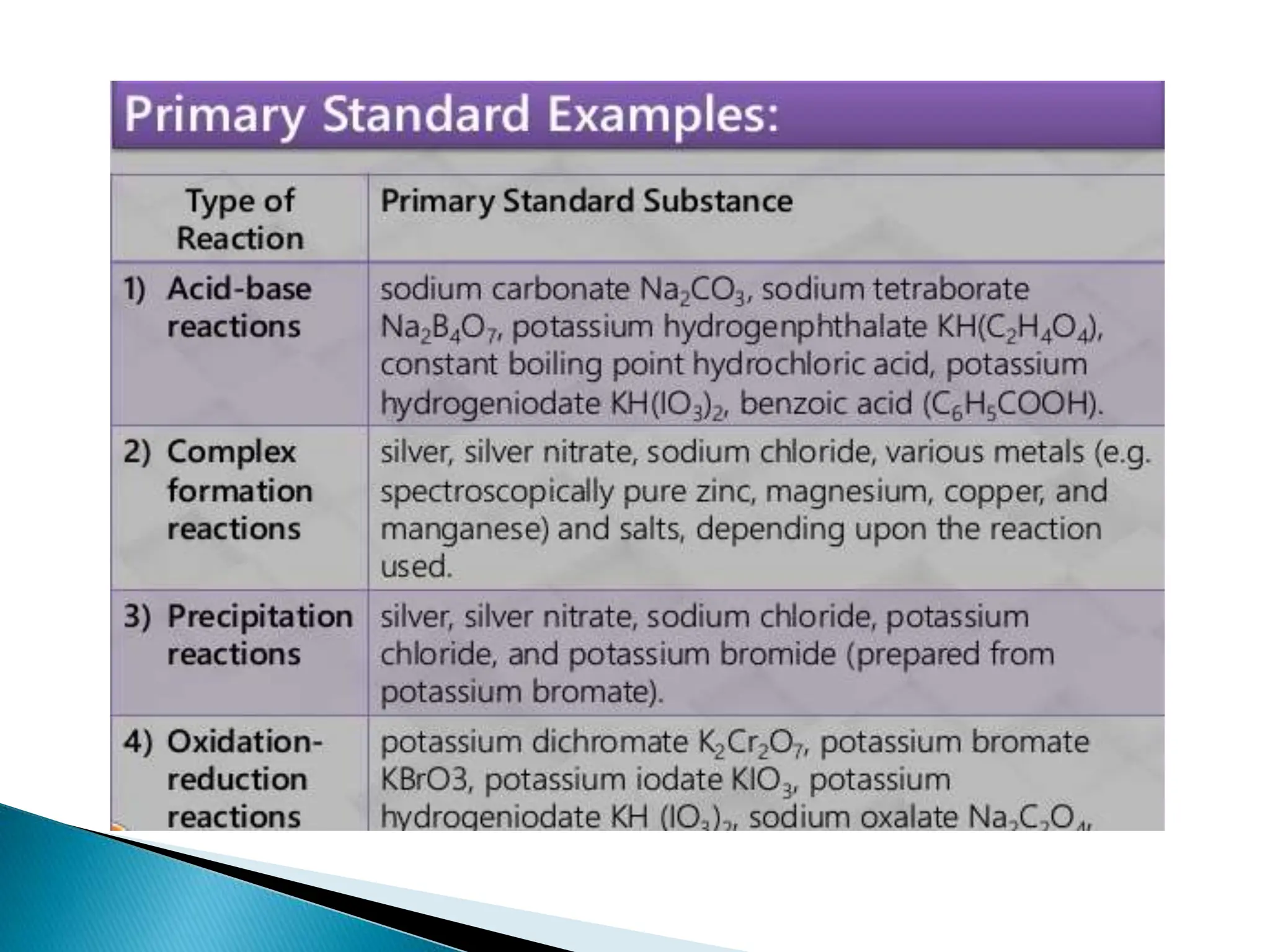
 A primary standard is a chemical or reagent
which has certain properties such a
1. primary standard substances should be easily available,
purified and dried.
2. It should be almost 100% pure.
3. The total amount impurities should not exceed 0.01 to 0.02%
4. Primary standard substances should be stable at normal
atmospheric conditions.
5. It should not be hygroscopic.
6. Equivalent weight and molecular weight to these substances
should be high to reduce the weighing errors as higher weight leads
to reduction in the weighing error.
7. Reaction of the standard solution with the reactant should be
instant and stoichiometric for easy calculations.
8. Theoretical equivalence point and practical end point should be
equal
9. Primary standard substances should be completely soluble under
the experimental conditions
10. It should be free from any hydrated water moiety
11. Titration error with it should be negligible.
 Secondary standards
These are the substances used for the standardization and
whose concentration has been determined by comparison
with the primary standard
 A secondary standard is a chemical or reagent
which has certain properties such as
(a)It has less purity than primary standard
(b)Less stable and more reactive than primary standard
(c)But its solution remains stable for a long time
(d)Titrated against primary standard
Books Referred:-
1. Dr. H. N. More, Dr. K. R. Mahadik et al., “Pharmaceutical Analysis” volume – I.
2. Dr. K. S. Jain, Ms. D. K. Kadam et al., “Pharmaceutical Analysis” Niral Publication.
primary and secondary standards.pptx

primary and secondary standards.pptx

  • 1.
    Miss. Rahee BChougule Assistant Professor Department of Pharmaceutical Chemistry
  • 2.
    Standards:- In Pharmaceutical Analysis,the word standard means a material containing a substance of our interest with a known concentration. We can express this with definite numbers with proper units.  Functions • To provide a reference using which we can determine unknown concentration of solution • To standardization of volumetric solutions • Preparation of secondary standard • To calibrate an instrument
  • 3.
  • 4.
    Primary Standards A solutionwith accurately known concentration is called as standard solutions Highly pure reagents or chemicals are used to prepare standard solutions which dose not require further standardization, is known as primary standard solutions  A primary standard is a chemical or reagent which has certain properties such a 1. primary standard substances should be easily available, purified and dried. 2. It should be almost 100% pure. 3. The total amount impurities should not exceed 0.01 to 0.02%
  • 5.
    4. Primary standardsubstances should be stable at normal atmospheric conditions. 5. It should not be hygroscopic. 6. Equivalent weight and molecular weight to these substances should be high to reduce the weighing errors as higher weight leads to reduction in the weighing error. 7. Reaction of the standard solution with the reactant should be instant and stoichiometric for easy calculations. 8. Theoretical equivalence point and practical end point should be equal
  • 6.
    9. Primary standardsubstances should be completely soluble under the experimental conditions 10. It should be free from any hydrated water moiety 11. Titration error with it should be negligible.
  • 8.
     Secondary standards Theseare the substances used for the standardization and whose concentration has been determined by comparison with the primary standard  A secondary standard is a chemical or reagent which has certain properties such as (a)It has less purity than primary standard (b)Less stable and more reactive than primary standard (c)But its solution remains stable for a long time (d)Titrated against primary standard
  • 10.
    Books Referred:- 1. Dr.H. N. More, Dr. K. R. Mahadik et al., “Pharmaceutical Analysis” volume – I. 2. Dr. K. S. Jain, Ms. D. K. Kadam et al., “Pharmaceutical Analysis” Niral Publication.