PAIN MANAGEMENT DURING
LABOR
INTRODUCTION
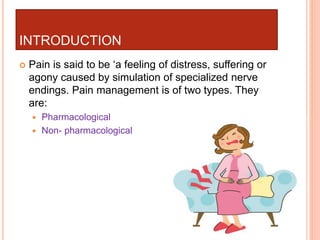
 Pain is said to be ‘a feeling of distress, suffering or
agony caused by simulation of specialized nerve
endings. Pain management is of two types. They
are:
 Pharmacological
 Non- pharmacological
NON- PHARMACOLOGICAL
 Continuous labour support
 Hydrotherapy
 Intradermal water blocks
 Movement and positioning
 Touch and massage
 Acupuncture
 Hypnosis
 TENS
 Aromatherapy
 Heat and cold
 Childbirth education
 Self help techniques- breathing and relaxation
 Music and audio analgesia.
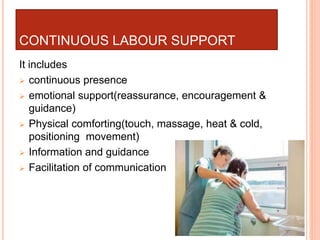
CONTINUOUS LABOUR SUPPORT
It includes
 continuous presence
 emotional support(reassurance, encouragement &
guidance)
 Physical comforting(touch, massage, heat & cold,
positioning movement)
 Information and guidance
 Facilitation of communication
BATHS IN LABOUR
 Use of water requires special equipment in the form
of bath tubs.
 Practical and safety consideration
 Water temperature to be at body temperature
 Labour progress can be slowed if the woman enters the
bath tub before active labour or stays in for more than 1
or 2 hours.
INTRADERMAL WATER BLOCKS
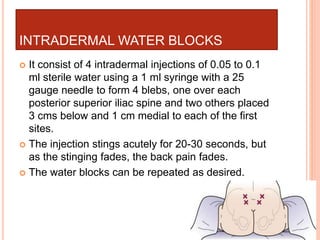
 It consist of 4 intradermal injections of 0.05 to 0.1
ml sterile water using a 1 ml syringe with a 25
gauge needle to form 4 blebs, one over each
posterior superior iliac spine and two others placed
3 cms below and 1 cm medial to each of the first
sites.
 The injection stings acutely for 20-30 seconds, but
as the stinging fades, the back pain fades.
 The water blocks can be repeated as desired.
TOUCH AND MASSAGE
 Touching another human being can communicate
positive messages such as caring, concern,
reassurance, or love.
 Massage, “the intentional and systematic
manipulation of the soft tissues of the body to
enhance health and healing is used during labour to
enhance relaxation and reduce pain and suffering.
ACCUPUNCTURE & ACCUPRESSURE
 It is used for numerous ailments and discomforts in
pregnancy, as well as for labour pain.
 As acupressure ca be done with minimal instruction
by the woman’s partner, it may be desired by some
labouring women.
HYPNOSIS
 Hypnosis is “a state of deep
physical relaxation with an
alert mind producing alpha
waves, and it is in this state
that critical faculties are
suspended and the
subconscious mind can be
more readily accessed.
 Hypnosis for child birth is
almost always self-hypnosis,
in other words, the
hypnotherapist teaches the
woman to induce the hypnotic
state in herself during labour.
The partner is also taught to
signal her into hypnotic state.
HYPNOSIS
 Common hypnotic pain relief techniques are “glove
anaesthesia” in which the woman imagines that her
hand is numb and that it can spread numbness to
other areas by placing her hand on painful areas.
 “Time distortion” which enables the woman to
perceive the time between painful contractions as
longer and the painful period as shorter than it
really is.
 “imaginative transformation” in which the pain is
interpreted as benign and acceptable, and
contraction are seen as surges of energy that
cause only a light pressure sensation.
TENS
 Transcutaneous Electrical Nerve Stimulation is the
transmission of low voltage electrical impulses from
a hand held battery- powered generator to the skin
through surface electrodes.
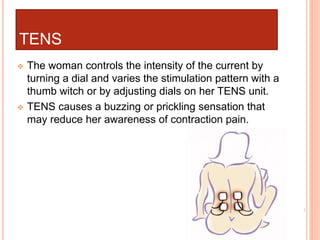
 To relieve labour pain, one pair of electrode is
placed paravertebrally at the level of T10-L1 and
another at the level of S2 to S4.
TENS
 The woman controls the intensity of the current by
turning a dial and varies the stimulation pattern with a
thumb witch or by adjusting dials on her TENS unit.
 TENS causes a buzzing or prickling sensation that
may reduce her awareness of contraction pain.
AROMATHERAPY
 It is “the science of using highly concentrated
essential oils or essences distilled from plants in
order to utilize their therapeutic properties.
HEAT AND COLD
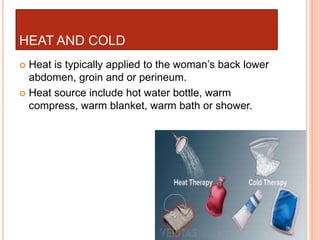
 Heat is typically applied to the woman’s back lower
abdomen, groin and or perineum.
 Heat source include hot water bottle, warm
compress, warm blanket, warm bath or shower.
HEAT AND COLD
 Cold or cryotherapy is usually applied on woman’s
back, chest and or face during labour.
 Forms of cold include a bag or surgical glove filled
with ice, frozen gel pack, bottle filled wit ice.
 Cold application is contraindicated in case of
hypersensitivity, hypertension, Raynaud’s
phenomena.
HEAT AND COLD
 Because a women can tolerate more extreme
temperatures during labour than usual, partners or
caregivers should test the temperature of the hot or
cold pack first on themselves.
 If they ca comfortably tolerate hot or cold pack
pressing on their forearm for several seconds, then
it is safe to apply it t the mother with intact
sensation.
CHILDBIRTH EDUCATION
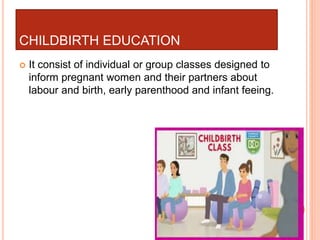
 It consist of individual or group classes designed to
inform pregnant women and their partners about
labour and birth, early parenthood and infant feeing.
RELAXATION AND BREATHING
 Most childbirth education classes present relaxation
techniques along with a variety of rhythmic
breathing patterns intended to promote relaxation
or to provide distraction from labour pain.
 They are used to enhance a woman’s sense off
control.
MUSIC & AUDIO ANALESIA
 It is the use of auditory stimulation such as music,
white noise or environmental sounds to decrease
pain perception.
PHARMACOLOGICAL MANAGEMENT
 Opioid analgesics
 Pethidine
 Meptazinol
 Pentazocin (Fortwin)
 Tranquilizers
 Diazepam
 Midazolam
 Combination of narcotics
and tranquilizers
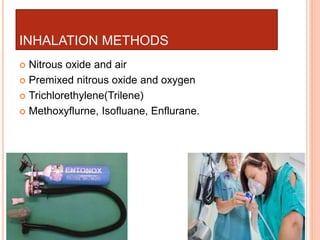
INHALATION METHODS
 Nitrous oxide and air
 Premixed nitrous oxide and oxygen
 Trichlorethylene(Trilene)
 Methoxyflurne, Isofluane, Enflurane.
REGIONAL ANALGESIA
 More women are now requesting a pain- free labour
and ask for epidural analgesia as soon as labour is
established.
 The pain relief from epidural is obtained by blocking
the conduction of impulses along sensory nerves as
they enter the spinal cord.
ADVANTAGES
 Effective pain relief
 Tendency of lowering blood pressure can be an
advantage in PIH
 If labour is prolonged, gives effective pain relief
allowing mother to rest
 Does not depress the respiratory centre of the fetus
DISADVANTAGES
 Ineffective blocks
 More frequent monitoring of vital signs
 Lengthens first stage of labour
 Less able to adopt different birth positions
 Less sensation of expulsive efforts and lengthens
second stage of labour ; increase in instrumental
vaginal delivery.
THANK YOU

PAIN MANAGEMENT DURING LABOR.pptx

  • 1.
  • 2.
    INTRODUCTION  Pain issaid to be ‘a feeling of distress, suffering or agony caused by simulation of specialized nerve endings. Pain management is of two types. They are:  Pharmacological  Non- pharmacological
  • 3.
    NON- PHARMACOLOGICAL  Continuouslabour support  Hydrotherapy  Intradermal water blocks  Movement and positioning  Touch and massage  Acupuncture  Hypnosis  TENS  Aromatherapy  Heat and cold  Childbirth education  Self help techniques- breathing and relaxation  Music and audio analgesia.
  • 4.
    CONTINUOUS LABOUR SUPPORT Itincludes  continuous presence  emotional support(reassurance, encouragement & guidance)  Physical comforting(touch, massage, heat & cold, positioning movement)  Information and guidance  Facilitation of communication
  • 5.
    BATHS IN LABOUR Use of water requires special equipment in the form of bath tubs.  Practical and safety consideration  Water temperature to be at body temperature  Labour progress can be slowed if the woman enters the bath tub before active labour or stays in for more than 1 or 2 hours.
  • 6.
    INTRADERMAL WATER BLOCKS It consist of 4 intradermal injections of 0.05 to 0.1 ml sterile water using a 1 ml syringe with a 25 gauge needle to form 4 blebs, one over each posterior superior iliac spine and two others placed 3 cms below and 1 cm medial to each of the first sites.  The injection stings acutely for 20-30 seconds, but as the stinging fades, the back pain fades.  The water blocks can be repeated as desired.
  • 7.
    TOUCH AND MASSAGE Touching another human being can communicate positive messages such as caring, concern, reassurance, or love.  Massage, “the intentional and systematic manipulation of the soft tissues of the body to enhance health and healing is used during labour to enhance relaxation and reduce pain and suffering.
  • 8.
    ACCUPUNCTURE & ACCUPRESSURE It is used for numerous ailments and discomforts in pregnancy, as well as for labour pain.  As acupressure ca be done with minimal instruction by the woman’s partner, it may be desired by some labouring women.
  • 9.
    HYPNOSIS  Hypnosis is“a state of deep physical relaxation with an alert mind producing alpha waves, and it is in this state that critical faculties are suspended and the subconscious mind can be more readily accessed.  Hypnosis for child birth is almost always self-hypnosis, in other words, the hypnotherapist teaches the woman to induce the hypnotic state in herself during labour. The partner is also taught to signal her into hypnotic state.
  • 10.
    HYPNOSIS  Common hypnoticpain relief techniques are “glove anaesthesia” in which the woman imagines that her hand is numb and that it can spread numbness to other areas by placing her hand on painful areas.  “Time distortion” which enables the woman to perceive the time between painful contractions as longer and the painful period as shorter than it really is.  “imaginative transformation” in which the pain is interpreted as benign and acceptable, and contraction are seen as surges of energy that cause only a light pressure sensation.
  • 11.
    TENS  Transcutaneous ElectricalNerve Stimulation is the transmission of low voltage electrical impulses from a hand held battery- powered generator to the skin through surface electrodes.  To relieve labour pain, one pair of electrode is placed paravertebrally at the level of T10-L1 and another at the level of S2 to S4.
  • 12.
    TENS  The womancontrols the intensity of the current by turning a dial and varies the stimulation pattern with a thumb witch or by adjusting dials on her TENS unit.  TENS causes a buzzing or prickling sensation that may reduce her awareness of contraction pain.
  • 13.
    AROMATHERAPY  It is“the science of using highly concentrated essential oils or essences distilled from plants in order to utilize their therapeutic properties.
  • 14.
    HEAT AND COLD Heat is typically applied to the woman’s back lower abdomen, groin and or perineum.  Heat source include hot water bottle, warm compress, warm blanket, warm bath or shower.
  • 15.
    HEAT AND COLD Cold or cryotherapy is usually applied on woman’s back, chest and or face during labour.  Forms of cold include a bag or surgical glove filled with ice, frozen gel pack, bottle filled wit ice.  Cold application is contraindicated in case of hypersensitivity, hypertension, Raynaud’s phenomena.
  • 16.
    HEAT AND COLD Because a women can tolerate more extreme temperatures during labour than usual, partners or caregivers should test the temperature of the hot or cold pack first on themselves.  If they ca comfortably tolerate hot or cold pack pressing on their forearm for several seconds, then it is safe to apply it t the mother with intact sensation.
  • 17.
    CHILDBIRTH EDUCATION  Itconsist of individual or group classes designed to inform pregnant women and their partners about labour and birth, early parenthood and infant feeing.
  • 18.
    RELAXATION AND BREATHING Most childbirth education classes present relaxation techniques along with a variety of rhythmic breathing patterns intended to promote relaxation or to provide distraction from labour pain.  They are used to enhance a woman’s sense off control.
  • 19.
    MUSIC & AUDIOANALESIA  It is the use of auditory stimulation such as music, white noise or environmental sounds to decrease pain perception.
  • 20.
    PHARMACOLOGICAL MANAGEMENT  Opioidanalgesics  Pethidine  Meptazinol  Pentazocin (Fortwin)  Tranquilizers  Diazepam  Midazolam  Combination of narcotics and tranquilizers
  • 21.
    INHALATION METHODS  Nitrousoxide and air  Premixed nitrous oxide and oxygen  Trichlorethylene(Trilene)  Methoxyflurne, Isofluane, Enflurane.
  • 22.
    REGIONAL ANALGESIA  Morewomen are now requesting a pain- free labour and ask for epidural analgesia as soon as labour is established.  The pain relief from epidural is obtained by blocking the conduction of impulses along sensory nerves as they enter the spinal cord.
  • 23.
    ADVANTAGES  Effective painrelief  Tendency of lowering blood pressure can be an advantage in PIH  If labour is prolonged, gives effective pain relief allowing mother to rest  Does not depress the respiratory centre of the fetus
  • 24.
    DISADVANTAGES  Ineffective blocks More frequent monitoring of vital signs  Lengthens first stage of labour  Less able to adopt different birth positions  Less sensation of expulsive efforts and lengthens second stage of labour ; increase in instrumental vaginal delivery.
  • 25.