MITTAL COLLEGE OF NURSING
PRESENTATI ON
PREMATURE LABOR
SUBJECT :- OBSTETRIC $ GYNECOLOGY
SUBMITTED TO, SUBMITTED BY
MRS SNEHLATA PARASHAR Miss SAVITA HINDUNIYA
M.SC LECTURER B.Sc Nursing
(OBG $ GYN) IVth Year
SUBRITTETED
DATE :- 11/ 02/2019
SPECIFIC OBJECTIVE:-
At end at the class presentation, students will able
to :-
1 To define the premature labour.
2 To explain the incidence & etiology at PTL.
3To discuss the diagnosis & complication.
4 To describe the pathophysiology of PTL.
5 To discuss the management of PTL.
LABOR –
Series of event that take place in
the genital organ in an effort to
expel the viable product of
conception out of the womb
through the vagina into the
outer world is called labor .
PREMATURE LABOR -
Preterm labor can be defind as regular
uterine contraction that couse
progressive dilation of the cervix after
20 wk of gestation and 37 wk of
gestation .
Premature labor is one of the leading
couse of perinatal morbidity and
mortality .
INCIDENCE-
The premature labor effect almost 23%
pregnancies in india
Recent in india 5-18 % of developing
country in india
 pregnancies in developing countries i n
india
Africa and south asia 60 % premature
babies develop
Europe 5-9%
TYPES -
1. late preterm labor = 34-37 wks.
71.2%
2.very preterm labor =30-34 wks.
12.7%
3. Extremely preterm labor = 24-30
wks. 16.0%
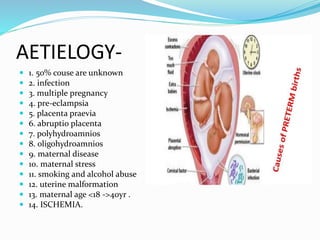
AETIELOGY-
 1. 50% couse are unknown
 2. infection
 3. multiple pregnancy
 4. pre-eclampsia
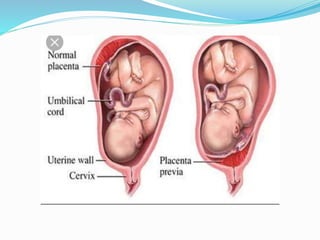
 5. placenta praevia
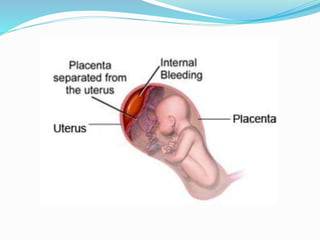
 6. abruptio placenta
 7. polyhydroamnios
 8. oligohydroamnios
 9. maternal disease
 10. maternal stress
 11. smoking and alcohol abuse
 12. uterine malformation
 13. maternal age <18 ->40yr .
 14. ISCHEMIA.
RISK FECTOR -
1. short maternal ht. And wt.
2. long working hr.
3. short cervical length
4. low socio – economic status
5. racial
6. previouse abortion
7.Poor nutrition
8.domestic violence
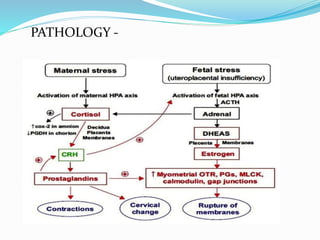
PATHOLOGY -
SIGN / SYMPTOM-
1. back ache [lower back pain ]
2. contraction [every 10 min.]
3. cramping
4. fluid leaking from vagina
5.flu like symptom –Nousea ,
vomiting ,diarrhoea .
INVESTIGATION -
 1. history collection
 2. physical examination
 3. blood study
 4. urine analysis
 5. cervical culture
 6. trans vaginal ultrasound
 7. fetal fibro nectin evaluation
 8. fetal survillance study
 9. drug screening
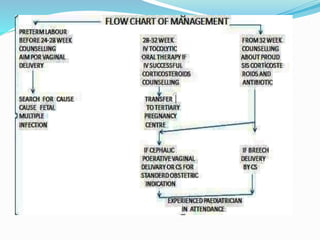
MANAGEMENT -
Pharmacological management :-
1. maternal administration of corticosteroid is
advocated in the pregnancy is less then 34
wks
 A. Beta methasone -2 dose :-12mg |IM |24 hr
 B. Dexa methasone -4 dose:-6mg|IM|12 hr.
 2.magnisium sulphate mgso4:- 4-6mg|IV
[20% solution]brain development
 3. Antibiotic to reduce the infection .
4 .Initially use of tocolytic agent to supress the
uterine contraction for an acute episode of the
premature labor
a. NEFEDIPINE –
dose ;- 20-30 mg/ orally / 4- 6hourly
b. TURBUTALINE :-
dose:-dissolve 5mg of turbutaline in
500ml RL /IV infusion
c. RITRODINE :-
dose-50ug/IV/10-20 min
maximum dose :-350 ug
D.ISOXSURINE:-
DOSE-=0.2-0.5mg/iv/min-
12hr.
10mg/IM/6-8hr.
E.INDOMETHACINE:-
DOS=25-50mg/orally.
F.NITROGIYCERIN:-
DOSE=0.1-0.4mg/iv/hr.
EXPACTANCE TREATMENT:-
Progestrone given patient with history of premature
labor .progestrone injection administration weekly
10 -20 wks of gestation .
.
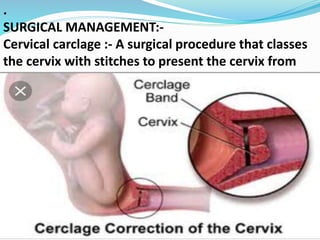
SURGICAL MANAGEMENT:-
Cervical carclage :- A surgical procedure that classes
the cervix with stitches to present the cervix from
opening and abnormal dilatation
NURSING MANAGEMENT :-
 1.Assess the mother condition to evaluate sign
of labor .
 2.obtain the obstetric history .
 3. determine the frequency ,duration and
intensity of uterine contraction .
 4.determine the cervical dilatation and
effacement of the patient
 5. assess the status of membrane and bloody
show .
6.Place the client on bed rest in the side lying
position.
7. prepare for possible ultrasonography
,amniocentesis ,tocolytic therapy or steroid therapy
8.administer tocolytic agent as prescribe .
9. assess the patient level of anxiety .
IMMEDIATE MANAGEMENT :-
 1.The cord is to be clamped quickly .
 2.the Airway should be cleared .
 3.provide adequate oxygenation .
 4.aqeouse solution of vitamin . 1mg given IM to
prevent hemarrhage
 5.the baby should be wrapped in sterile warm
towel .
 6. fetous are death for hand over the relatives.
 7. provide NICU care of the baby .
PREVENTION :-
 1.identification of the risk fector from history and
employing measure .
 2 provide nutritional supplement
 3. avoidance the substance abuse and smoking
 4. detect the medical risk .
 5.provide adequate rest .
 6 assess the domestic voilence .
 7.Avoide the heavy burden during pregnancy .
COMPLICATION :-
• MATERNAL COMPLICAATION
1 Sevier preeclampsia
2 heart disease
3 placenta preavia
4 abruptio placenta
5 intra amniotic infection
6 uterine malformation
B.FETAL COMPLICATION
1 fetal death
2 respiratory distress syndrome
3 intraventricular hemorrhage
4 neurological problem /cerebral palsy.
5 growth restriction
6 fetal anomaly incompatible with life.
7 neonatal jaundice
8 brain injury.
“THANKING YOU”

premature labor

  • 1.
    MITTAL COLLEGE OFNURSING PRESENTATI ON PREMATURE LABOR SUBJECT :- OBSTETRIC $ GYNECOLOGY SUBMITTED TO, SUBMITTED BY MRS SNEHLATA PARASHAR Miss SAVITA HINDUNIYA M.SC LECTURER B.Sc Nursing (OBG $ GYN) IVth Year SUBRITTETED DATE :- 11/ 02/2019
  • 2.
    SPECIFIC OBJECTIVE:- At endat the class presentation, students will able to :- 1 To define the premature labour. 2 To explain the incidence & etiology at PTL. 3To discuss the diagnosis & complication. 4 To describe the pathophysiology of PTL. 5 To discuss the management of PTL.
  • 3.
    LABOR – Series ofevent that take place in the genital organ in an effort to expel the viable product of conception out of the womb through the vagina into the outer world is called labor .
  • 4.
    PREMATURE LABOR - Pretermlabor can be defind as regular uterine contraction that couse progressive dilation of the cervix after 20 wk of gestation and 37 wk of gestation . Premature labor is one of the leading couse of perinatal morbidity and mortality .
  • 5.
    INCIDENCE- The premature laboreffect almost 23% pregnancies in india Recent in india 5-18 % of developing country in india  pregnancies in developing countries i n india Africa and south asia 60 % premature babies develop Europe 5-9%
  • 6.
    TYPES - 1. latepreterm labor = 34-37 wks. 71.2% 2.very preterm labor =30-34 wks. 12.7% 3. Extremely preterm labor = 24-30 wks. 16.0%
  • 7.
    AETIELOGY-  1. 50%couse are unknown  2. infection  3. multiple pregnancy  4. pre-eclampsia  5. placenta praevia  6. abruptio placenta  7. polyhydroamnios  8. oligohydroamnios  9. maternal disease  10. maternal stress  11. smoking and alcohol abuse  12. uterine malformation  13. maternal age <18 ->40yr .  14. ISCHEMIA.
  • 10.
    RISK FECTOR - 1.short maternal ht. And wt. 2. long working hr. 3. short cervical length 4. low socio – economic status 5. racial 6. previouse abortion 7.Poor nutrition 8.domestic violence
  • 11.
  • 12.
    SIGN / SYMPTOM- 1.back ache [lower back pain ] 2. contraction [every 10 min.] 3. cramping 4. fluid leaking from vagina 5.flu like symptom –Nousea , vomiting ,diarrhoea .
  • 13.
    INVESTIGATION -  1.history collection  2. physical examination  3. blood study  4. urine analysis  5. cervical culture  6. trans vaginal ultrasound  7. fetal fibro nectin evaluation  8. fetal survillance study  9. drug screening
  • 14.
    MANAGEMENT - Pharmacological management:- 1. maternal administration of corticosteroid is advocated in the pregnancy is less then 34 wks  A. Beta methasone -2 dose :-12mg |IM |24 hr  B. Dexa methasone -4 dose:-6mg|IM|12 hr.  2.magnisium sulphate mgso4:- 4-6mg|IV [20% solution]brain development  3. Antibiotic to reduce the infection .
  • 15.
    4 .Initially useof tocolytic agent to supress the uterine contraction for an acute episode of the premature labor a. NEFEDIPINE – dose ;- 20-30 mg/ orally / 4- 6hourly b. TURBUTALINE :- dose:-dissolve 5mg of turbutaline in 500ml RL /IV infusion c. RITRODINE :- dose-50ug/IV/10-20 min maximum dose :-350 ug
  • 16.
  • 17.
    EXPACTANCE TREATMENT:- Progestrone givenpatient with history of premature labor .progestrone injection administration weekly 10 -20 wks of gestation .
  • 18.
    . SURGICAL MANAGEMENT:- Cervical carclage:- A surgical procedure that classes the cervix with stitches to present the cervix from opening and abnormal dilatation
  • 19.
    NURSING MANAGEMENT :- 1.Assess the mother condition to evaluate sign of labor .  2.obtain the obstetric history .  3. determine the frequency ,duration and intensity of uterine contraction .  4.determine the cervical dilatation and effacement of the patient  5. assess the status of membrane and bloody show .
  • 20.
    6.Place the clienton bed rest in the side lying position. 7. prepare for possible ultrasonography ,amniocentesis ,tocolytic therapy or steroid therapy 8.administer tocolytic agent as prescribe . 9. assess the patient level of anxiety .
  • 21.
    IMMEDIATE MANAGEMENT :- 1.The cord is to be clamped quickly .  2.the Airway should be cleared .  3.provide adequate oxygenation .  4.aqeouse solution of vitamin . 1mg given IM to prevent hemarrhage  5.the baby should be wrapped in sterile warm towel .  6. fetous are death for hand over the relatives.  7. provide NICU care of the baby .
  • 23.
    PREVENTION :-  1.identificationof the risk fector from history and employing measure .  2 provide nutritional supplement  3. avoidance the substance abuse and smoking  4. detect the medical risk .  5.provide adequate rest .  6 assess the domestic voilence .  7.Avoide the heavy burden during pregnancy .
  • 24.
    COMPLICATION :- • MATERNALCOMPLICAATION 1 Sevier preeclampsia 2 heart disease 3 placenta preavia 4 abruptio placenta 5 intra amniotic infection 6 uterine malformation
  • 25.
    B.FETAL COMPLICATION 1 fetaldeath 2 respiratory distress syndrome 3 intraventricular hemorrhage 4 neurological problem /cerebral palsy. 5 growth restriction 6 fetal anomaly incompatible with life. 7 neonatal jaundice 8 brain injury.
  • 26.