Smart Charging for Electric Vehicles: A Survey
From the Algorithmic Perspective
Authors: Qinglong Wang, Xue Liu, Jian Du, and Fanxin Kong
presenter: Aydin Ayanzadeh
Agenda
• Background
❑rechargeable batteries
❑EVs Interacting With Smart Grid
❑EVs Communication With the Smart Grid
• Smart Grid Oriented EV Smart Charging
❑Load Flattening
❑Frequency Regulation
❑Voltage Regulation
❑Smart Grid Oriented Uncertainty
2
Agenda
• AGGREGATOR ORIENTED EV SMART CHARGING
❑Direct Coordinated Control
❑Indirect Coordinated Control
❑Aggregator Oriented Uncertainty
• CUSTOMER ORIENTED EV SMART CHARGING
❑Individual Charging Cost Reduction
❑Customer Oriented Uncertainty
• FUTURE WORK
• CONCLUSION
• References
3
Introduction
popularity of electric vehicles (EVs) is rising :
• Fossil energy depletion
• city noise
4
Background
• Electric Vehicles
• plug-in EVs (PEVs):
1. plug-in hybrid electric vehicle(PHEVs)
2. battery electric vehicles(BEVs)
• Smart Grid
5
Continue…
Difference between BEV and PHEV:
✓PHEVs uses fossil fuel and an internal combustion engine (ICE).
✓PHEVs has CS(charge-sustaining) and CD (charge-depleting) mode.
6
Interaction between EVs and Smart Grid
7
Fig1.Interaction between EVs and the smart grid.
• Li-ion batteries
✓high energy density
✓slow self-discharge
✓less environmental influence
• Charging Power Controllability
✓minimizing electricity cost
✓Maximizing overall welfare
8
Properties of Rechargeable Batteries
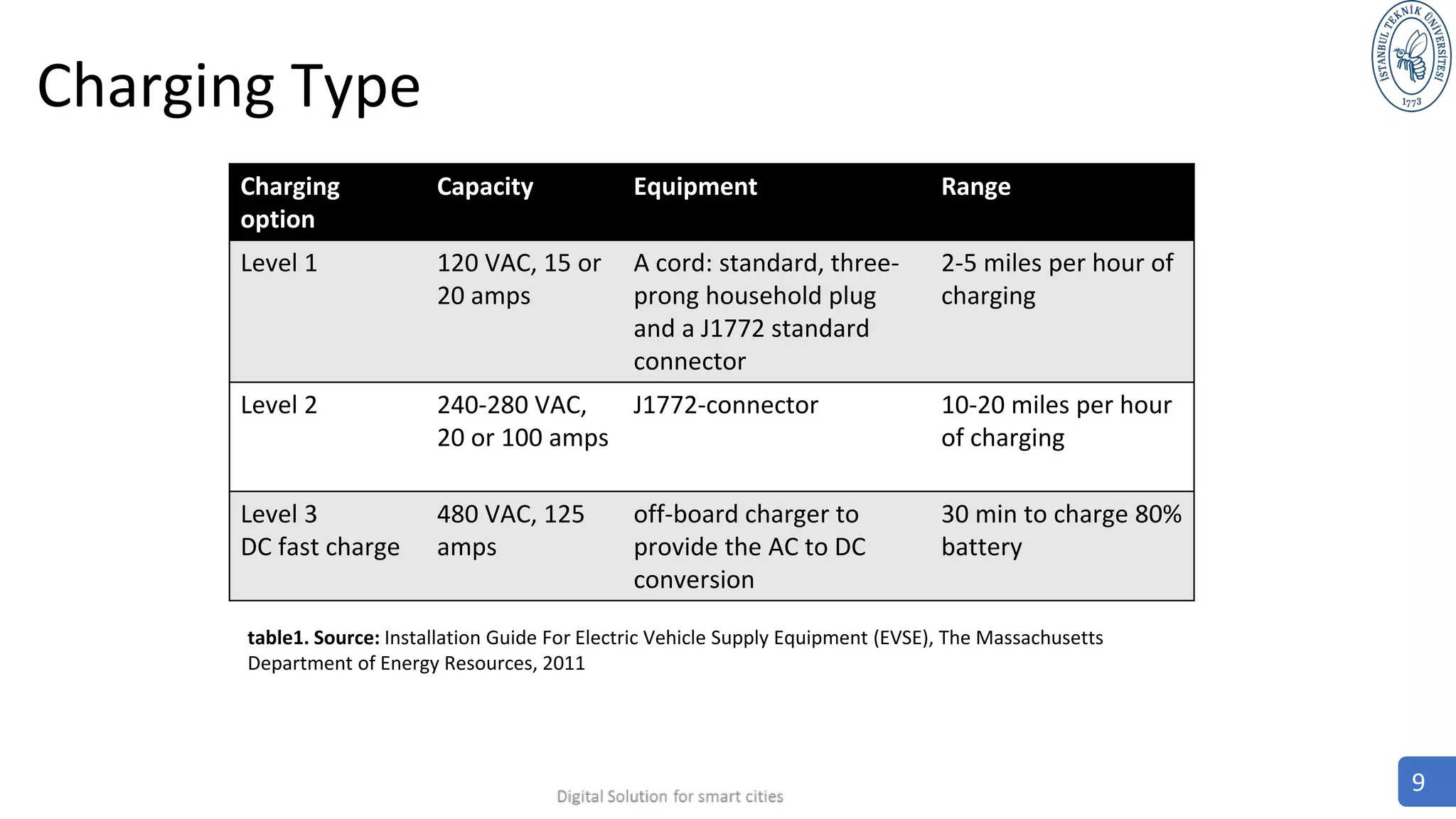
Charging Type
Charging
option
Capacity Equipment Range
Level 1 120 VAC, 15 or
20 amps
A cord: standard, three-
prong household plug
and a J1772 standard
connector
2-5 miles per hour of
charging
Level 2 240-280 VAC,
20 or 100 amps
J1772-connector 10-20 miles per hour
of charging
Level 3
DC fast charge
480 VAC, 125
amps
off-board charger to
provide the AC to DC
conversion
30 min to charge 80%
battery
table1. Source: Installation Guide For Electric Vehicle Supply Equipment (EVSE), The Massachusetts
Department of Energy Resources, 2011
9
Level 1
Level 2 Level 3
10
Battery Charging Rate
Fig2. Battery SOC obtained versus charging time spent of a Li-ion
battery
charging an EV is the nonlinearity between relation the
charging time spent and the state of charge (SOC).
11
Continue…
Battery Aging
➢ Calendar Life: the elapsed time before a battery becomes unusable.
➢ Cycle Life: number of complete battery charge-discharge cycles before its nominal capacity falls
below certain threshold.
➢Battery life is commonly regarded as the minimum between Calendar Life and Cycle Life.
12
Coordinated EV Charging
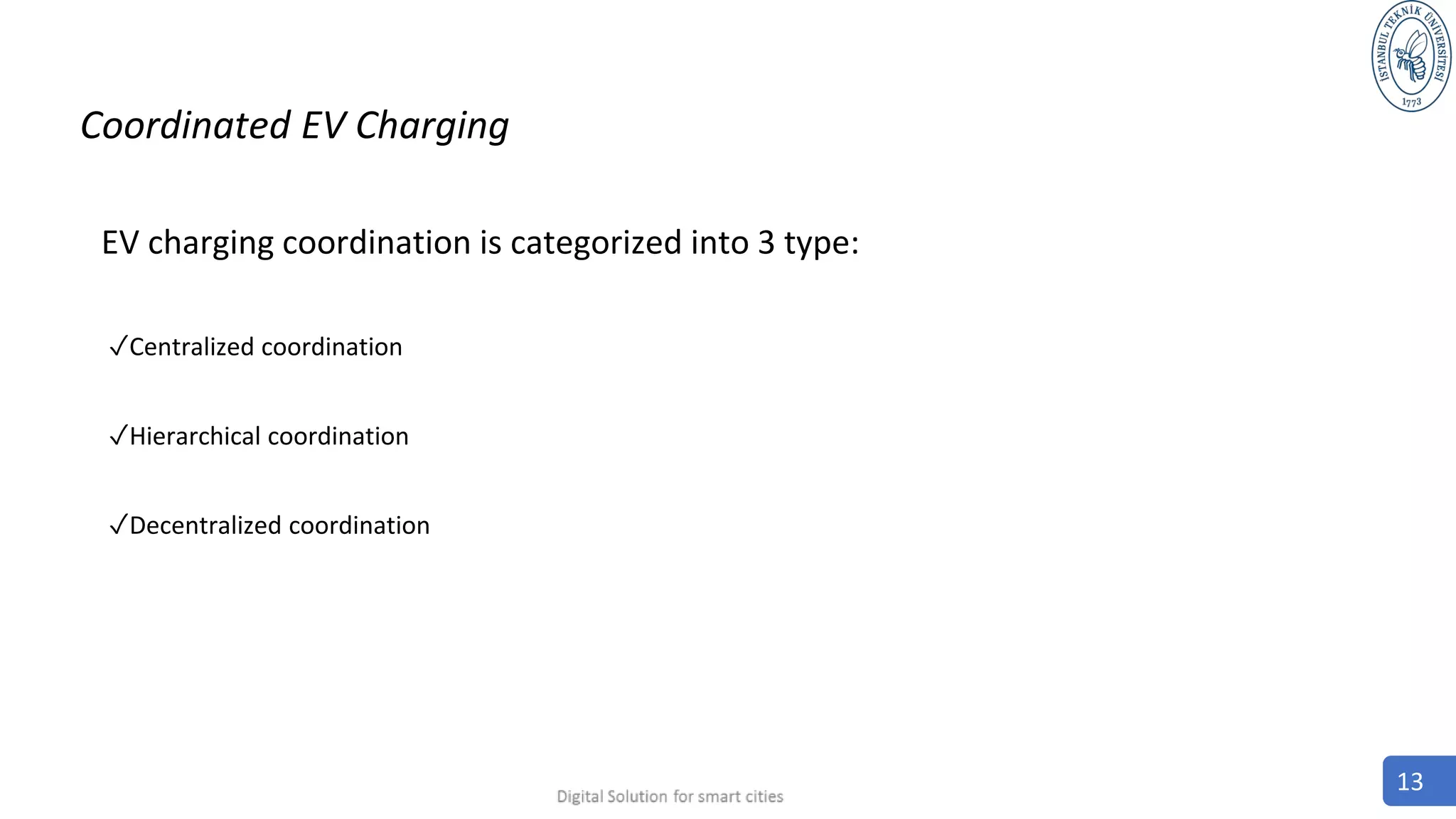
EV charging coordination is categorized into 3 type:
✓Centralized coordination
✓Hierarchical coordination
✓Decentralized coordination
13
EVs Communication With the Smart Grid
❑Vehicular Ad-hoc Networks
❑Communication Protocols and Standards
14
Vehicular Ad-hoc Networks
vehicular ad-hoc networks(VANETs) is designed for vehicular information exchange
and has the following advantages:
• proper deployment of RSUs
• Expand the rang of real-time information transmission.
• Reduce the amount of real-time transmission failure.
15
Communication Protocols and Standards
VANETs combined with DSRC protocol can bring many adavantages:
➢Improve the accuracy, transmission range and transmission reliability for vehicular information collection
and communication delay will Delayed control information can leads unexpected driving cost.
➢ control information dissemination can lead to unexpected driving cost.
16
Continue…
other communication protocols that are utilized in vehicular communication network
is :
✓ZigBee in smart grid residential networks
✓RF mesh-based in Smart-Meter system
✓WiMAX technology in wireless communication networks
17
Communication Requirement for Smart Charging
•Requirements for communications between smart grid and aggregator.
•Requirements for communications between aggregator to EV customers
18
EVs interacting With the Smart Grid
❑Coordinated EV Charging
❑EV Aggregation
19
SMART GRID ORIENTED EV SMART CHARGING
a) Load Flattening
a) Frequency Regulation
a) Voltage Regulation
a) Smart Grid Oriented Uncertainty
20
continue
21
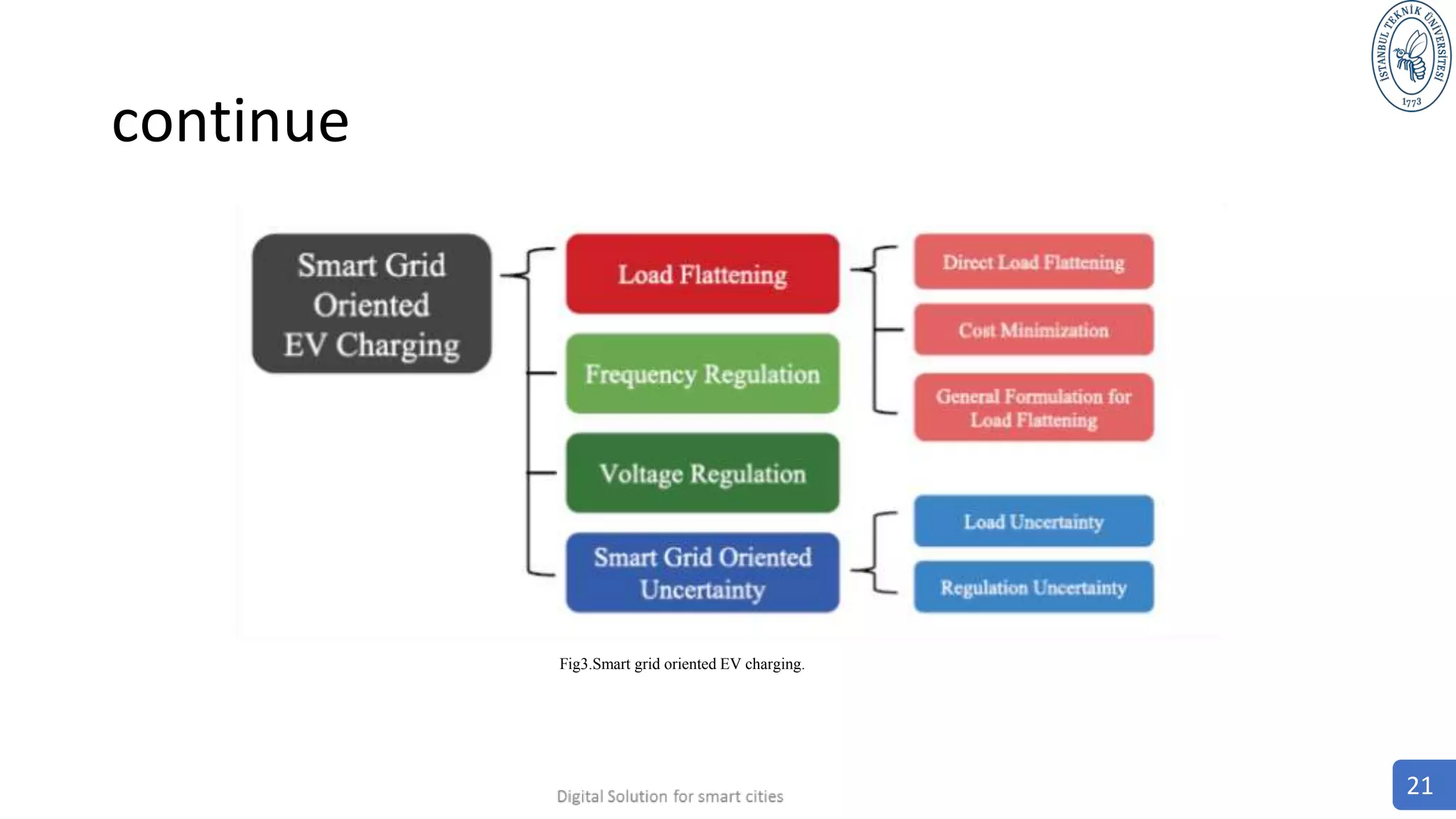
Fig3.Smart grid oriented EV charging.
SMART GRID ORIENTED EV SMART CHARGING
22
Load Flattening
• direct load flattening
Smart grid operator directly manages the charging loads of Evs.
• Indirect load flattening
smart grid operator concerns more about reducing the cost (energy generation cost and consumption cost)
caused by EV charging.
• Frequency Regulation
frequency regulation is useful for balancing the supply and demand of active power.
• Voltage regulation
voltage regulation is important for maintaining the balance of reactive power.
23
Smart Grid Oriented Uncertainty
24
The main uncertainty for the smart grid operator is originated from:
1. load uncertainty
1. regulation uncertainty
Both uncertainty factors are actually inherited from the same mobility uncertainty of an EV fleet, which consists
of various arrival time and departing time, status of EVs when arrived for charging
AGGREGATOR ORIENTED EV SMART CHARGING
• Direct Coordinated Control
• Indirect Coordinated Control
• Aggregator Oriented Uncertainty
25
continue
26
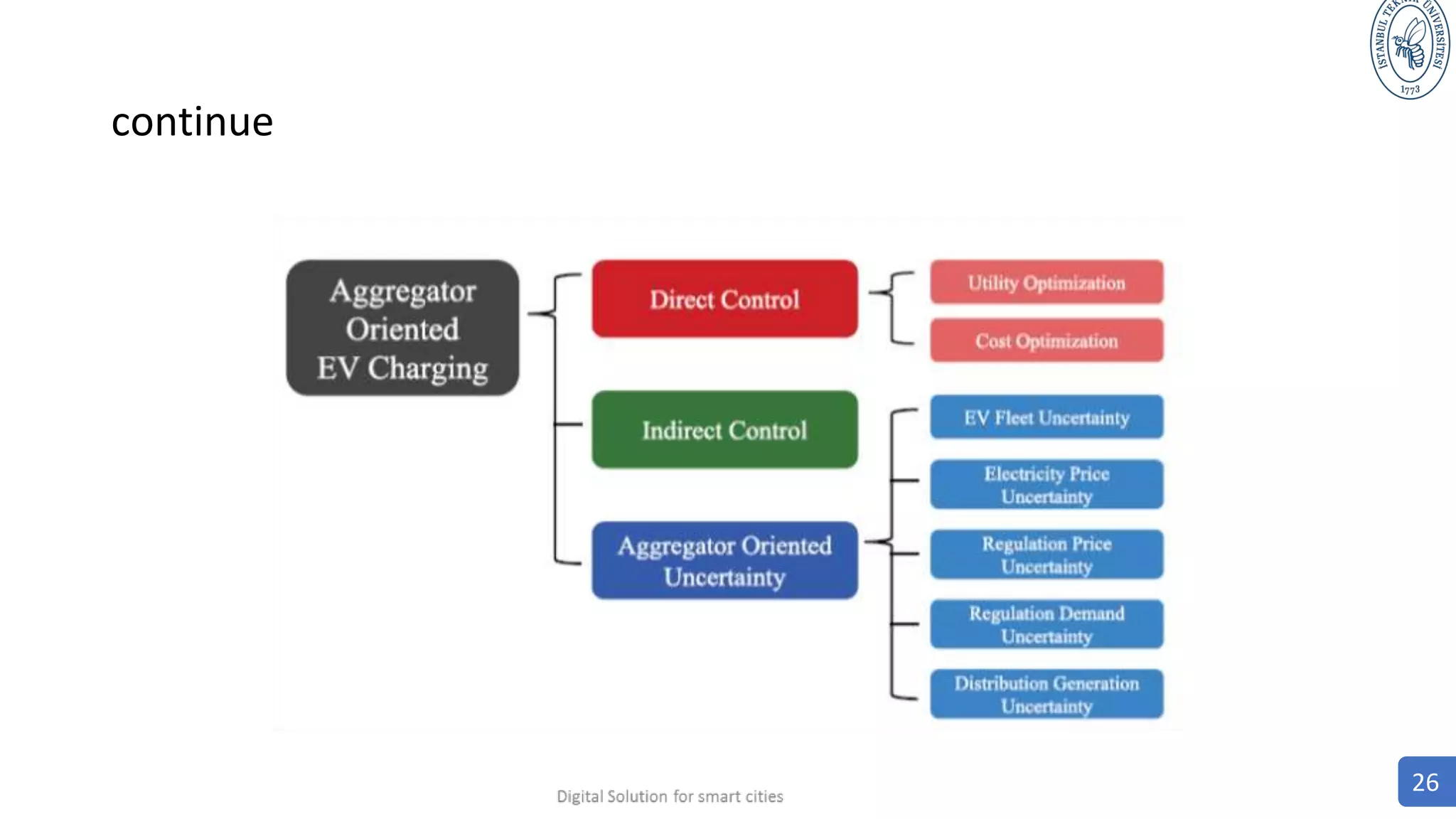
Aggregator Oriented Uncertainty
27
The uncertainty factors for aggregator is
1. EV fleet uncertainty
1. Electricity price uncertainty
1. Regulation demand uncertainty
1. Regulation price uncertainty
1. Distribution generation uncertainty
CUSTOMER ORIENTED EV SMART CHARGING
a) Individual Charging Cost Reduction
a) Customer Oriented Uncertainty
28
continue
Customer oriented EV charging.
29
Continue…
30
Customer Oriented Uncertainty
1. EV mobility uncertainty
1. electricity price uncertainty
1. regulation price uncertainty
1. regulation demand uncertainty.
FUTURE WORK
Charging concerns due to battery properties
• Both the lifespan and available capacity of a battery pack can be shorten and degraded due to a long
time of having the battery pack recharged and maintained near its full capacity.
•Using a linear model for battery charging can incur extra charging cost and charging time spent for an EV
customer
31
FUTURE WORK
• Range estimation, which is critical for an EV customer who suffers from range anxiety.
• EV smart routing for discovering minimum energy consumed or minimum time need more exploration.
Communication requirements
• communication bandwidth, latency and reliability
Communication delay disadvantages:
• Incorrect routing and scheduling designs for Evs.
• Extra energy cost as well as travelling time spent.
• Instability or reduce the security of the smart grid.
32
Continue
Two-way communication :
• It can also in turn bring severe threats to the stability and safety of the smart grid.it will cause that EV
customers transmit their private information to third parties. Privacy leakage can be arisen if this
information is exposed to unauthorized third parties.
33
CONCLUSION
This survey has reviewed research works focusing on the smart interactions among the smart grid, aggregators
and Evs from an algorithmic perspective.
For smart grid oriented EV smart charging, this article have investigated the load flattening problems
(approximately equivalent problems of minimizing power losses and increasing load factor) solved via
optimization-based approaches.
In future work, we point out several potential research directions based on the crucial and unique properties
of both EV rechargeable batteries and communication networks. Researches on these topics can help
accelerate the realization of the smart interaction between EVs and the smart grid.
34
References
[1] C. Chan, “The state of the art of electric, hybrid, and fuel cell vehicles,” Proc. IEEE, vol. 95, no. 4, pp. 704–718, Apr. 2007.
[2] A. Emadi, Y. J. Lee, and K. Rajashekara, “Power electronics and motor drives in electric, hybrid electric, and plug-in hybrid
electric vehicles,” IEEE Trans. Ind. Electron., vol. 55, no. 6, pp. 2237–2245, Jun. 2008.
[3] N. Tanaka et al., “Technology roadmap: Electric and plug-in hybrid electric vehicles,” International Energy Agency, Paris,
France, Tech. Rep., 2011 [Online]. Available:
http:www.iea.org/publications/freepublications/publication/EVPHEV_Roadmap.pdf
[4] Electric Drive Transportation Association. (2015). Electric Drive Sales,Dashboard [Online].
Available:http://electricdrive.org/index.php?ht=d/ sp/i/20952/pid/20952, accessed on Aug. 11, 2015.
[5] M. Yilmaz and P. Krein, “Review of battery charger topologies, charging power levels, and infrastructure for plug-in
electric and hybrid vehicles,”IEEE Trans. Power Electron., vol. 28, no. 5, pp. 2151–2169, May 2013.
35
References
[6] O. Ardakanian, C. Rosenberg, and S. Keshav, “Distributed control ofelectric vehicle charging,” in Proc. 4th Int. Conf. Future
Energy Syst., New York, NY, USA, 2013, pp. 101–112.
[7] X. Fang, S. Misra, G. Xue, and D. Yang, “Smart grid-the new and improved power grid: A survey,” IEEE Commun. Surveys
Tuts., vol. 14, no. 4, pp. 944–980, Dec. 2012.
[8] R. C. Green, II, L. Wang, and M. Alam, “The impact of plug-in hybrid electric vehicles on distribution networks: A review
and outlook,” Renew. Sustain. Energy Rev., vol. 15, no. 1, pp. 544–553, Jan. 2011.
[9] W. Su, H. Eichi, W. Zeng, and M.-Y. Chow, “A survey on the electrification of transportation in a smart grid environment,”
IEEE Trans. Ind. Informat., vol. 8, no. 1, pp. 1–10, Feb. 2012.
[10] D. B. Richardson, “Electric vehicles and the electric grid: A review of modeling approaches, impacts, and renewable
energy integration, "Renew. Sustain. Energy Rev., vol. 19, pp. 247–254, Mar. 2013.
[11] F. Mwasilu, J. J. Justo, E.-K. Kim, T. D. Do, and J.W. Jung, “Electric vehicles and smart grid interaction: A review on vehicle
to grid and renewable energy sources integration,” Renew. Sustain. Energy Rev., vol. 34, pp. 501–516, Jun. 2014.
36
Reference
[12] L. James and L. John, “Electric vehicle technology explained,” 2nd ed.,West Sussex, UK: John Wiley & Sons Ltd., 2003.
[13] D. Tuttle and R. Baldick, “The evolution of plug-in electric vehicle-grid interactions,” IEEE Trans. Smart Grid, vol. 3, no. 1,
pp. 500–505, Mar. 2012.
[14] A. McCrone, “Electric vehicle battery prices down 14% year on year,” Bloomberg New Energy Finance, 2012 [Online].
Available:https://www.newenergyfinance.com/PressReleases/view/210, accessedAug. 11, 2015.
[15] T. Markel, “Plug-in electric vehicle infrastructure: A foundation forelectrified transportation,” presented at the MIT
Energy InitiativeTransp. Electrif. Symp., Cambridge, MA, 2010.
[16] L. Dickerman and J. Harrison, “A new car, a new grid,” IEEE PowerEnergy Mag., vol. 8, no. 2, pp. 55–61, Mar. 2010.
[17] T.-K. Lee, Z. Bareket, T. Gordon, and Z. Filipi, “Stochastic modeling forstudies of real-world phev usage: Driving schedule
and daily temporal
distributions,” IEEE Trans. Veh. Technol., vol. 61, no. 4, pp. 1493–1502,May 2012.
[18] S. Vagropoulos and A. Bakirtzis, “Optimal bidding strategy for electric
37
38

presntation about smart charging for the vehicles

  • 1.
    Smart Charging forElectric Vehicles: A Survey From the Algorithmic Perspective Authors: Qinglong Wang, Xue Liu, Jian Du, and Fanxin Kong presenter: Aydin Ayanzadeh
  • 2.
    Agenda • Background ❑rechargeable batteries ❑EVsInteracting With Smart Grid ❑EVs Communication With the Smart Grid • Smart Grid Oriented EV Smart Charging ❑Load Flattening ❑Frequency Regulation ❑Voltage Regulation ❑Smart Grid Oriented Uncertainty 2
  • 3.
    Agenda • AGGREGATOR ORIENTEDEV SMART CHARGING ❑Direct Coordinated Control ❑Indirect Coordinated Control ❑Aggregator Oriented Uncertainty • CUSTOMER ORIENTED EV SMART CHARGING ❑Individual Charging Cost Reduction ❑Customer Oriented Uncertainty • FUTURE WORK • CONCLUSION • References 3
  • 4.
    Introduction popularity of electricvehicles (EVs) is rising : • Fossil energy depletion • city noise 4
  • 5.
    Background • Electric Vehicles •plug-in EVs (PEVs): 1. plug-in hybrid electric vehicle(PHEVs) 2. battery electric vehicles(BEVs) • Smart Grid 5
  • 6.
    Continue… Difference between BEVand PHEV: ✓PHEVs uses fossil fuel and an internal combustion engine (ICE). ✓PHEVs has CS(charge-sustaining) and CD (charge-depleting) mode. 6
  • 7.
    Interaction between EVsand Smart Grid 7 Fig1.Interaction between EVs and the smart grid.
  • 8.
    • Li-ion batteries ✓highenergy density ✓slow self-discharge ✓less environmental influence • Charging Power Controllability ✓minimizing electricity cost ✓Maximizing overall welfare 8 Properties of Rechargeable Batteries
  • 9.
    Charging Type Charging option Capacity EquipmentRange Level 1 120 VAC, 15 or 20 amps A cord: standard, three- prong household plug and a J1772 standard connector 2-5 miles per hour of charging Level 2 240-280 VAC, 20 or 100 amps J1772-connector 10-20 miles per hour of charging Level 3 DC fast charge 480 VAC, 125 amps off-board charger to provide the AC to DC conversion 30 min to charge 80% battery table1. Source: Installation Guide For Electric Vehicle Supply Equipment (EVSE), The Massachusetts Department of Energy Resources, 2011 9
  • 10.
    Level 1 Level 2Level 3 10
  • 11.
    Battery Charging Rate Fig2.Battery SOC obtained versus charging time spent of a Li-ion battery charging an EV is the nonlinearity between relation the charging time spent and the state of charge (SOC). 11 Continue…
  • 12.
    Battery Aging ➢ CalendarLife: the elapsed time before a battery becomes unusable. ➢ Cycle Life: number of complete battery charge-discharge cycles before its nominal capacity falls below certain threshold. ➢Battery life is commonly regarded as the minimum between Calendar Life and Cycle Life. 12
  • 13.
    Coordinated EV Charging EVcharging coordination is categorized into 3 type: ✓Centralized coordination ✓Hierarchical coordination ✓Decentralized coordination 13
  • 14.
    EVs Communication Withthe Smart Grid ❑Vehicular Ad-hoc Networks ❑Communication Protocols and Standards 14
  • 15.
    Vehicular Ad-hoc Networks vehicularad-hoc networks(VANETs) is designed for vehicular information exchange and has the following advantages: • proper deployment of RSUs • Expand the rang of real-time information transmission. • Reduce the amount of real-time transmission failure. 15
  • 16.
    Communication Protocols andStandards VANETs combined with DSRC protocol can bring many adavantages: ➢Improve the accuracy, transmission range and transmission reliability for vehicular information collection and communication delay will Delayed control information can leads unexpected driving cost. ➢ control information dissemination can lead to unexpected driving cost. 16
  • 17.
    Continue… other communication protocolsthat are utilized in vehicular communication network is : ✓ZigBee in smart grid residential networks ✓RF mesh-based in Smart-Meter system ✓WiMAX technology in wireless communication networks 17
  • 18.
    Communication Requirement forSmart Charging •Requirements for communications between smart grid and aggregator. •Requirements for communications between aggregator to EV customers 18
  • 19.
    EVs interacting Withthe Smart Grid ❑Coordinated EV Charging ❑EV Aggregation 19
  • 20.
    SMART GRID ORIENTEDEV SMART CHARGING a) Load Flattening a) Frequency Regulation a) Voltage Regulation a) Smart Grid Oriented Uncertainty 20
  • 21.
  • 22.
    SMART GRID ORIENTEDEV SMART CHARGING 22 Load Flattening • direct load flattening Smart grid operator directly manages the charging loads of Evs. • Indirect load flattening smart grid operator concerns more about reducing the cost (energy generation cost and consumption cost) caused by EV charging.
  • 23.
    • Frequency Regulation frequencyregulation is useful for balancing the supply and demand of active power. • Voltage regulation voltage regulation is important for maintaining the balance of reactive power. 23
  • 24.
    Smart Grid OrientedUncertainty 24 The main uncertainty for the smart grid operator is originated from: 1. load uncertainty 1. regulation uncertainty Both uncertainty factors are actually inherited from the same mobility uncertainty of an EV fleet, which consists of various arrival time and departing time, status of EVs when arrived for charging
  • 25.
    AGGREGATOR ORIENTED EVSMART CHARGING • Direct Coordinated Control • Indirect Coordinated Control • Aggregator Oriented Uncertainty 25
  • 26.
  • 27.
    Aggregator Oriented Uncertainty 27 Theuncertainty factors for aggregator is 1. EV fleet uncertainty 1. Electricity price uncertainty 1. Regulation demand uncertainty 1. Regulation price uncertainty 1. Distribution generation uncertainty
  • 28.
    CUSTOMER ORIENTED EVSMART CHARGING a) Individual Charging Cost Reduction a) Customer Oriented Uncertainty 28
  • 29.
  • 30.
    Continue… 30 Customer Oriented Uncertainty 1.EV mobility uncertainty 1. electricity price uncertainty 1. regulation price uncertainty 1. regulation demand uncertainty.
  • 31.
    FUTURE WORK Charging concernsdue to battery properties • Both the lifespan and available capacity of a battery pack can be shorten and degraded due to a long time of having the battery pack recharged and maintained near its full capacity. •Using a linear model for battery charging can incur extra charging cost and charging time spent for an EV customer 31
  • 32.
    FUTURE WORK • Rangeestimation, which is critical for an EV customer who suffers from range anxiety. • EV smart routing for discovering minimum energy consumed or minimum time need more exploration. Communication requirements • communication bandwidth, latency and reliability Communication delay disadvantages: • Incorrect routing and scheduling designs for Evs. • Extra energy cost as well as travelling time spent. • Instability or reduce the security of the smart grid. 32
  • 33.
    Continue Two-way communication : •It can also in turn bring severe threats to the stability and safety of the smart grid.it will cause that EV customers transmit their private information to third parties. Privacy leakage can be arisen if this information is exposed to unauthorized third parties. 33
  • 34.
    CONCLUSION This survey hasreviewed research works focusing on the smart interactions among the smart grid, aggregators and Evs from an algorithmic perspective. For smart grid oriented EV smart charging, this article have investigated the load flattening problems (approximately equivalent problems of minimizing power losses and increasing load factor) solved via optimization-based approaches. In future work, we point out several potential research directions based on the crucial and unique properties of both EV rechargeable batteries and communication networks. Researches on these topics can help accelerate the realization of the smart interaction between EVs and the smart grid. 34
  • 35.
    References [1] C. Chan,“The state of the art of electric, hybrid, and fuel cell vehicles,” Proc. IEEE, vol. 95, no. 4, pp. 704–718, Apr. 2007. [2] A. Emadi, Y. J. Lee, and K. Rajashekara, “Power electronics and motor drives in electric, hybrid electric, and plug-in hybrid electric vehicles,” IEEE Trans. Ind. Electron., vol. 55, no. 6, pp. 2237–2245, Jun. 2008. [3] N. Tanaka et al., “Technology roadmap: Electric and plug-in hybrid electric vehicles,” International Energy Agency, Paris, France, Tech. Rep., 2011 [Online]. Available: http:www.iea.org/publications/freepublications/publication/EVPHEV_Roadmap.pdf [4] Electric Drive Transportation Association. (2015). Electric Drive Sales,Dashboard [Online]. Available:http://electricdrive.org/index.php?ht=d/ sp/i/20952/pid/20952, accessed on Aug. 11, 2015. [5] M. Yilmaz and P. Krein, “Review of battery charger topologies, charging power levels, and infrastructure for plug-in electric and hybrid vehicles,”IEEE Trans. Power Electron., vol. 28, no. 5, pp. 2151–2169, May 2013. 35
  • 36.
    References [6] O. Ardakanian,C. Rosenberg, and S. Keshav, “Distributed control ofelectric vehicle charging,” in Proc. 4th Int. Conf. Future Energy Syst., New York, NY, USA, 2013, pp. 101–112. [7] X. Fang, S. Misra, G. Xue, and D. Yang, “Smart grid-the new and improved power grid: A survey,” IEEE Commun. Surveys Tuts., vol. 14, no. 4, pp. 944–980, Dec. 2012. [8] R. C. Green, II, L. Wang, and M. Alam, “The impact of plug-in hybrid electric vehicles on distribution networks: A review and outlook,” Renew. Sustain. Energy Rev., vol. 15, no. 1, pp. 544–553, Jan. 2011. [9] W. Su, H. Eichi, W. Zeng, and M.-Y. Chow, “A survey on the electrification of transportation in a smart grid environment,” IEEE Trans. Ind. Informat., vol. 8, no. 1, pp. 1–10, Feb. 2012. [10] D. B. Richardson, “Electric vehicles and the electric grid: A review of modeling approaches, impacts, and renewable energy integration, "Renew. Sustain. Energy Rev., vol. 19, pp. 247–254, Mar. 2013. [11] F. Mwasilu, J. J. Justo, E.-K. Kim, T. D. Do, and J.W. Jung, “Electric vehicles and smart grid interaction: A review on vehicle to grid and renewable energy sources integration,” Renew. Sustain. Energy Rev., vol. 34, pp. 501–516, Jun. 2014. 36
  • 37.
    Reference [12] L. Jamesand L. John, “Electric vehicle technology explained,” 2nd ed.,West Sussex, UK: John Wiley & Sons Ltd., 2003. [13] D. Tuttle and R. Baldick, “The evolution of plug-in electric vehicle-grid interactions,” IEEE Trans. Smart Grid, vol. 3, no. 1, pp. 500–505, Mar. 2012. [14] A. McCrone, “Electric vehicle battery prices down 14% year on year,” Bloomberg New Energy Finance, 2012 [Online]. Available:https://www.newenergyfinance.com/PressReleases/view/210, accessedAug. 11, 2015. [15] T. Markel, “Plug-in electric vehicle infrastructure: A foundation forelectrified transportation,” presented at the MIT Energy InitiativeTransp. Electrif. Symp., Cambridge, MA, 2010. [16] L. Dickerman and J. Harrison, “A new car, a new grid,” IEEE PowerEnergy Mag., vol. 8, no. 2, pp. 55–61, Mar. 2010. [17] T.-K. Lee, Z. Bareket, T. Gordon, and Z. Filipi, “Stochastic modeling forstudies of real-world phev usage: Driving schedule and daily temporal distributions,” IEEE Trans. Veh. Technol., vol. 61, no. 4, pp. 1493–1502,May 2012. [18] S. Vagropoulos and A. Bakirtzis, “Optimal bidding strategy for electric 37
  • 38.