The document proposes a priority-based charging and discharging coordination method for electric vehicles (EVs) in smart parking lots. EVs entering the parking lot are assigned scores based on their initial state of charge, required charge amount, and desired departure time, which determines their priority for charging. EVs are monitored every 15 minutes, and any EV with a charge exceeding its required amount following an epoch will have its excess power discharged to charge other EVs parked locally, bypassing the power grid. This method is found to improve performance over other methods in reducing total power consumption and demand spikes on the grid.
![Priority based Charging/Discharging coordination of
Electric Vehicles in Smart Parking Lots
Pujitha Galla, Manikanta Ragi, Stephen W. Turner, and Suleyman Uludag
Department of Computer Science, University of Michigan - Flint, MI, USA
Abstract—This paper proposes a method of using discharging
of Electric Vehicles (EVs) as a supplemental charging mechanism
in future smart parking lots. EVs with excess capacity are
exploited to assist in the charging of other EVs in the parking
lot using a mechanism that bypasses the power grid.
The mechanism proposed uses a scoring system, in which
all EVs entering a parking lot are charged based on scores
assigned to them. The scores determine a priority, which is used
to determine the order of charging of the vehicles. Vehicles are
monitored in 15-minute epochs, in which charging beyond the
required charge results in an EVs being subsequently discharged
back to its required charge state. The discharging decision is
taken based on the analysis of output of a fuzzy expert system.
The discharge power is stored locally and used to charge other
locally parked EVs.
The mechanism is compared with that of several other methods
and found to improve performance in terms of reducing total
power consumption, as well as by reducing the intensity of
power demand spikes. Thus, this priority based charge scheduling
method holds the potential to reduce the overload on the power
grid.
I. INTRODUCTION AND LITERATURE REVIEW
Increasing urbanization with denser population in major
metropolitan areas has been raising challenges to improve
standards of living, increase efficiency, provide convenience,
or decrease harmful carbon emissions. Yet this trend with its
myriad of problems is by and in itself a facilitator of inno-
vation. One promising conceptualization to cope with these
challenges is the notion of the smart city, in which technology
plays a key role to achieve the goals of improving standards of
living and facilitate thriving in the growing global economy,
while simultaneously improving sustainability through more
efficient use of resources.
An important constituency of smart cities is the Electric
Vehicles (EVs). A study reported in [1] found that 98% of
U.S. commuters travel fewer than 50 miles one-way. A U.S.
Census Bureau American Community Survey report [2] also
shows that on average, 70% or more of commuters drive by
themselves to work, instead of using mass transit or other
means, such as bicycling or walking. There have been many
studies suggesting that the purchase of EVs can provide
a significant return on investment if they are used to the
benefit of the electrical grid [3]–[5]. These factors all support
the assertion that the smart city of the future will contain
significant numbers of consumer-owned independent EVs.
It is expected that a large number of EVs will be introduced
into the market, with hybrid, plug-in hybrid, and battery
electric vehicles comprising 2.4 percent (6.4 million yearly)
of global light-duty vehicle sales by 2023 [6]. This has the
potential to cause a significant additional strain on the power
distribution system as suggested by certain studies [7]–[10],
but there are also opportunities to take advantage of the
presence of large numbers of EVs concentrated in the smart
city of the future.
The previous arguments regarding EV range and typical
commuting distance suggest that after being driven into the
city, EV’s batteries are able to provide charging/exchanging
services to the grid. In smart cities, EVs will encounter
commercial charging environments, such as a smart parking
lots or parking decks.
As arrival and departure times of EVs to the parking lot
are uncertain,the demand for power from EVs to the electric
grid may overload it if there is correlation in the charging
behavior of the EVs. Statistical measurements suggest that in
the United States, the integrated demand for power from EVs
is high at certain times of day [11]. Thus, scheduling of EVs
for the purpose of charging serves as an intelligent technique
that builds a coordination among EVs for charging in order
to monitor the demand for power from EVs. Aggregators can
play a crucial role in communication between the grid and
EVs. Electrification of vehicles also plays a very important role
in contributing to sustainability, as well as in providing a flex-
ible experience in transportation to the users. The uncertainty
in power demand from EVs is a primary contributing factor
toward power fluctuations and shortage of power. Therefore
EVs, being storage units of energy, should support the electric
grid by preventing it from getting overloaded. The paper
discusses about the the discharging mechanism among EVs
but not to the electric grid.
As EVs receive the power from the electric grid.Overloading
of electric grid occurs when the power demand from EVs is
high.Therefore, there is a need to prevent the overloading of
grid which is caused by set of EVs .This is measured in terms
of the aggregated power demand of EVs.Scheduling the EVs
Akhavan-Rezai et al [12],for charging EVs is an intelligent
scheme that enables aggregator to monitor the integrated
power demand of EVs and gains customer satisfaction. Con-
sidering th grid operatonal limits and customer satisfaction,the
goal of the study presented here is to identify a mechanism
which regualtes the power demand on grid efficiently that
reduces the electricity price at high demand periods and
ensures customer satisfaction.The paper proposed an effective](https://image.slidesharecdn.com/a18a7d6e-3599-447d-bfbe-3691f6868952-160711013033/85/EV-Charging-1-320.jpg)
![Priority based Charging/Discharging coordination of
Electric Vehicles in Smart Parking Lots
Pujitha Galla, Manikanta Ragi, Stephen W. Turner, and Suleyman Uludag
Department of Computer Science, University of Michigan - Flint, MI, USA
Abstract—This paper proposes a method of using discharging
of Electric Vehicles (EVs) as a supplemental charging mechanism
in future smart parking lots. EVs with excess capacity are
exploited to assist in the charging of other EVs in the parking
lot using a mechanism that bypasses the power grid.
The mechanism proposed uses a scoring system, in which
all EVs entering a parking lot are charged based on scores
assigned to them. The scores determine a priority, which is used
to determine the order of charging of the vehicles. Vehicles are
monitored in 15-minute epochs, in which charging beyond the
required charge results in an EVs being subsequently discharged
back to its required charge state. The discharging decision is
taken based on the analysis of output of a fuzzy expert system.
The discharge power is stored locally and used to charge other
locally parked EVs.
The mechanism is compared with that of several other methods
and found to improve performance in terms of reducing total
power consumption, as well as by reducing the intensity of
power demand spikes. Thus, this priority based charge scheduling
method holds the potential to reduce the overload on the power
grid.
I. INTRODUCTION AND LITERATURE REVIEW
Increasing urbanization with denser population in major
metropolitan areas has been raising challenges to improve
standards of living, increase efficiency, provide convenience,
or decrease harmful carbon emissions. Yet this trend with its
myriad of problems is by and in itself a facilitator of inno-
vation. One promising conceptualization to cope with these
challenges is the notion of the smart city, in which technology
plays a key role to achieve the goals of improving standards of
living and facilitate thriving in the growing global economy,
while simultaneously improving sustainability through more
efficient use of resources.
An important constituency of smart cities is the Electric
Vehicles (EVs). A study reported in [1] found that 98% of
U.S. commuters travel fewer than 50 miles one-way. A U.S.
Census Bureau American Community Survey report [2] also
shows that on average, 70% or more of commuters drive by
themselves to work, instead of using mass transit or other
means, such as bicycling or walking. There have been many
studies suggesting that the purchase of EVs can provide
a significant return on investment if they are used to the
benefit of the electrical grid [3]–[5]. These factors all support
the assertion that the smart city of the future will contain
significant numbers of consumer-owned independent EVs.
It is expected that a large number of EVs will be introduced
into the market, with hybrid, plug-in hybrid, and battery
electric vehicles comprising 2.4 percent (6.4 million yearly)
of global light-duty vehicle sales by 2023 [6]. This has the
potential to cause a significant additional strain on the power
distribution system as suggested by certain studies [7]–[10],
but there are also opportunities to take advantage of the
presence of large numbers of EVs concentrated in the smart
city of the future.
The previous arguments regarding EV range and typical
commuting distance suggest that after being driven into the
city, EV’s batteries are able to provide charging/exchanging
services to the grid. In smart cities, EVs will encounter
commercial charging environments, such as a smart parking
lots or parking decks.
As arrival and departure times of EVs to the parking lot
are uncertain,the demand for power from EVs to the electric
grid may overload it if there is correlation in the charging
behavior of the EVs. Statistical measurements suggest that in
the United States, the integrated demand for power from EVs
is high at certain times of day [11]. Thus, scheduling of EVs
for the purpose of charging serves as an intelligent technique
that builds a coordination among EVs for charging in order
to monitor the demand for power from EVs. Aggregators can
play a crucial role in communication between the grid and
EVs. Electrification of vehicles also plays a very important role
in contributing to sustainability, as well as in providing a flex-
ible experience in transportation to the users. The uncertainty
in power demand from EVs is a primary contributing factor
toward power fluctuations and shortage of power. Therefore
EVs, being storage units of energy, should support the electric
grid by preventing it from getting overloaded. The paper
discusses about the the discharging mechanism among EVs
but not to the electric grid.
As EVs receive the power from the electric grid.Overloading
of electric grid occurs when the power demand from EVs is
high.Therefore, there is a need to prevent the overloading of
grid which is caused by set of EVs .This is measured in terms
of the aggregated power demand of EVs.Scheduling the EVs
Akhavan-Rezai et al [12],for charging EVs is an intelligent
scheme that enables aggregator to monitor the integrated
power demand of EVs and gains customer satisfaction. Con-
sidering th grid operatonal limits and customer satisfaction,the
goal of the study presented here is to identify a mechanism
which regualtes the power demand on grid efficiently that
reduces the electricity price at high demand periods and
ensures customer satisfaction.The paper proposed an effective](https://image.slidesharecdn.com/a18a7d6e-3599-447d-bfbe-3691f6868952-160711013033/75/EV-Charging-1-2048.jpg)
![discharging mechanism among EVs with the existing charging
service. The objective of the study is to divert the portion of
aggregate power demand at peak times to other other EVs
through discharging mechanism.
Related studies have primarily investigated the optimization
of charging strategies to reduce peak electricity costs by
monitoring the demand on power grid in addition to the
customer satisfaction. In [12], priority based scheduling of
EVs for charging is based on the use of a fuzzy expert
system. Here, the system accepts inputs from passengers and
through inference logic assigns scores to PEVs.The scoring
mechanism enables the system to prioritize PEVs, in which
only high priority vehicles are allowed to charge and worked
on optimiziation of scores.A modification to the existing work
is defined in [13], which considered the required power in
KW/hr, max charger power rate, and charging duration as
inputs for scoring and accordingly assigned scores to the EVs
but the method of discharging has not discussed in [13].
Thus,the work presented in the current paper proposes a
coordinated charging/discharging method, in which vehicle to
vehicle discharging is facilitated through a smart parking lot
infrastructure that includes local storage (i.e. battery banks).
II. PRIORITIZATION OF EVS
Prioritization process includes the sub process, scoring of
EVs.EVs are assigned scores based on certain inputs.For the
subprocess be sucdcessful,we assume aggregator has built in
fuzzy expert system as shown in the Fig. 1.The fuzzy logic
based scoring take initial state of charge (IOC), required
amount of charge (RC), desired Departure Time (DT) as inputs
to the fuzzification block through an interface . Electronic
vehicle (EV) initial state of charge (IOC) determines the initial
charge in EV when entered parking lot. Here the Required
amount of charge (RC) represents the satisfactory point of the
customer.
Fig. 1. Scoring of EVs through Fuzzy Expert System.
Fuzzification block accepts IOC of range 0-100%,Departure
time of (0-500min) and the maximum required charge re-
quested by an EV is 120kw and can be considered as 0-100%
for the study. assuming all the EVs in the parking lot are
equipped with Li-ion battery technology. EVs initial state of
charge(IOC) is not considered as 0are assumed to have their
batteries charged to 50%. The membership function variables
are High(H), Medium(M) and Low(L).EVs are assigned prior-
ities based on the computed scores. The Scores are calculated
as follows:
Score=(IOC+RC)/ DT
The priorities are assigned to the EVs based on the calcu-
lated scores.Scores of the values greater than 1 is equated to
1.The scores of range [0,0.4) are prioritized as low.[0.4,0.5) as
medium priority and [0.5,1] are assigned to high priority.The
figure 2 assumed 22 EVs in a parking lot prioritized them as
per the range of scores.
Fig. 2. Scores and Priorities.
Process of priotization depends on the scores.EVs fall under
high priority if the score range is (0,1] and ¿=1 fall under
medium priority and below 0 i.e. the negatve values is defined
to be low
The Evs are allowed for charging based on the priorities as-
signed to the EVs . These EV’s prioirty reperesents its position
in the charging queue.All the Evs that enter the parking lot will
undergo the Scoring process and are placed in charging queue
unitll the higher priority EVs finish charging. Updating scores
is a dynamic process and aggregator dynamically updates the
values every 15minutes.
A discharging mechanism is included as part of the smart
parking lot, enabling it to act like a virtual power plant (VPP).
The method assumes there is a storage unit (i.e. battery) at the
parking lot, used for storing power extracted from EVs.
III. COMPUTATION OF EXTRA CHARGE
Considering the fact that EV status updates occur every 15
minutes, it is straightforward to periodically compare an EV’s
current charge with the value of RC. The time an EV stays in
the parking lot is computed based on measured arrival time and
departure time given by the customer. This duration is divided
into 15 minute epocsh.Each EV’s status is checked at the end
of every epoch, and the system updates recomputed scores
accordingly. At the end of each epoch, each EV’s current
charge which have one of three relative values: less than, equal
to, or greater than RC.
If an EV’s charge is greater than RC at the end of an
epoch, the system computes an extra charge by subtracting
RC from the current charge value. This amount of power is
considered by the aggregator to be extra charge (Figure 2),
and the aggregator discharges that amount from the vehicle](https://image.slidesharecdn.com/a18a7d6e-3599-447d-bfbe-3691f6868952-160711013033/85/EV-Charging-2-320.jpg)
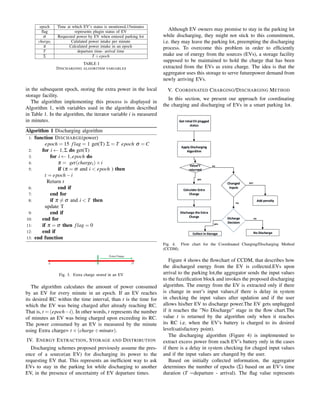
![the plugin status of the EV. Considering an epoch, the power
consumption is monitored at every instant. If the calculated
power intake (π) is equivalent to the required power(σ) at
particular instant of time within an epoch, then the time for
which the EV gets charged subsequently is computed. If the
EV hasn’t reached its RC and it did not exceed its computed T,
the aggregator will increment the Σ value (adding 15 minutes
and allowing the EV to charge). If neither of the above two
possibilities occur, the EV is removed from the charger.
The decision box “value t returned” represents measuring
the amount of time an EV may have been allowed to charge
beyond its RC. Thus, the discharging algorithm calculates
this value and the CCDM algorithm checks for a positive
value of t. If the value is positive, then the amount of power
that is consumed by an EV for the time t is computed and
accordingly, that amount of power is discharged from that EV
and diverted to storage. If the algorithm returns no value,
then the aggregator examines the EV’s inputs to identify
the changes in the input values. If these are changed, then
the aggregator penalizes the owner; otherwise it determines
owner’s charging decision . If the owner chooses to discharge
the power, then the discharged power is stored. Since owner’s
opinions change dynamically, there is need to verify the inputs
for changed values.
VI. INCENTIVES AND PENALTIES
As arrival and departure times of EVs are uncertain, there
is a chance that customers change their opinion on departure
times. Thus, there is a need to dynamically update EV status
in every fixed epoch. This would be problem for the system
if the change in opinion is frequent. To gain control over this,
Customers are penalized based on a cost factor:
Penalty= (ir)×(unit cost)
ir = pt ÷at
pt = promised departure time
at = Actual departure time
Customers are allowed to make a charging decision. They
are provided with different incentives for the power they allow
their EVs to discharge. They are paid for the discharged power
based on the unit cost of the power in the market.
VII. SIMULATION
To evaluate the proposed method, the algorithm was simu-
lated using Java and MATLAB.We considered the case of a
parking lot allowing 100EVs to simultaneously recharge their
batteries assuming all the EVs are charged at same rate. The
proposed method works efficiently when applied to a parking
lot with capacity of 500EVs. the system assumes the minimum
time that an EV saty in the parking lot is 1 hour and the power
that EV requests to recharge is 120KW
The proposed algorithm, called coordinated
charging/discharging method (CCDM), was compared
with the scored priority rating (SCR) charging scheme
described in [13], as well as a first-come first-served (FCFS)
discipline, as well as uncoordinated charging (UCR). Thes
Set EV Plugged in
status
Set Σ,T
Set flag = 1
Set epoch = 15
Update π in each ‘i’
σ = π
And
i < epoch
π! = σ
and
i < T
Return
(epoch – i) flag = 0
Yes
No
No
Yes
Fig. 5. Discharging Algorithm
mechanisms were compared based on overall power demand
created by a set of EVs in a day’s operation.
Figure 5 presents a graph showing the various demands from
EVs when using the charging schemes being compared. As the
figure shows, uncoordinated charging (UCR) clearly places the
highest demand on the grid. Using UCR, EVs are allowed
to charge without any constraints imposed. Thus, the overall
demand from EVs is high and potentially can overload the
power grid, as suggested by the high demand peaks at certain
times of day in the graph.
The FCFS charging scheme is used as follows: the first EVs
to arrive are given charging preference, and charging stations
are filled in that fashion. Later-arriving EVs are kept on hold
and only get swapped into charging mode if the prioritized
(early arriving) EVs are finished charging. Demand from the
EVs in the FCFS charging scheme is low compared to other
schemes at certain times of day, although we also observe that
its demand peaks approach that of UCR. Additionally, FCFS
suffers in that it does not ensure customer satisfaction.
The SCR scheme typically performs considerably better
than either UCR or FCFS. In this scheme, EVs are prioritized
such that higher priority EVs may charge while remaining EVs
are queued until high priority EVs finish charging. The CCDM
mechanism integrates the described EV discharging scheme
with the SCR mechanism. The graph clearly shows that, due
to power being extracted from nearby EVs, the CCDM mech-
anism improves on the SCR scheme. Additionally, overall
demand is lower and the peak demand remains consistently
lower than that of the other mechanisms.
Table II shows the aggregate power demand of all the
compared charging schemes. As expected, UCR uses the most
power, with FCFS using less but also using a considerable
amount of power. The SCR clearly optimizes power consump-
tion over either of the “unintelligent” charging stragegies, with](https://image.slidesharecdn.com/a18a7d6e-3599-447d-bfbe-3691f6868952-160711013033/85/EV-Charging-4-320.jpg)
![day(hour)
2 4 6 8 10 12 14 16 18 20 22 24
demand(Kw)
50
100
150
200
CCDM
UCR
FCFS
SCR
Fig. 6. Time Graph of Charging Schemes
charging
scheme
demand
CCDM 2323
UCR 3785
FCFS 3156
SCR 2713
TABLE II
POWER DEMAND OF CHARGING SCHEMES
an improvement of approximately 14% over the aggregate con-
sumption of FCFS. The addition of the discharging algorithm
implemented by CCDM represents a further improvement of
14.4% over that of SCR.
VIII. CONCLUSION
The mechanism described in this paper was implemented
in recognition of the idea that scheduling of charging and
discharging of power among EVs have the potential to regulate
the power demand on the grid. Thus, the paper proposed a
dynamic charging and discharging methods. Considering the
feasibility of charging stations locations,CCDM method is ap-
plicable for both EVs and PHEVs.PHEVs are preferred if the
charging stations are less frequent for recharging purpose. The
proposed method will shift the future power demand from EVs
when the power grid is identified to get overloaded in advance.
Regulating the EVs for charging their batteries and satisfying
their future demand from the storage will decrease tye demand
on power grid at peak times and thereby reduces the electricity
rates at peak times.THe proposed CCDM method ensures
the customer satisfaction through prioritization and it also
manages the crtical situations i.e. when an EV is in need of
maximum amount of power and wishes to stay for very short
interval of time.
REFERENCES
[1] R. van Haaren, “Assessment of electric cars range require-
ments and usage patterns based on driving behavior recorded
in the national household travel survey of 2009,” July 2012,
http://www.solarjourneyusa.com/EVdistanceAnalysisFullText.php.
[2] B. McKenzie and M. Rapino, “Commuting in the United States: 2009.
American Community Survey Reports,” 2011.
[3] W. Kempton, J. Tomi´c, S. Letendre, A. Brooks, and T. Lipman,
“Vehicle-to-grid power: Battery, hybrid, and fuel cell vehicles as
resources for distributed electric power in california,” 2001, Institute
of Transportation Studies. UC Davis: Institute of Transportation
Studies (UCD). Accessed March 25, 2015. [Online]. Available:
https://escholarship.org/uc/item/0qp6s4mb
[4] W. Kempton, V. Udo, K. Huber, K. Komara, S. Letendre, S. Baker,
D. Brunner, and N. Pearre, “A test of vehicle-to-grid (v2g) for energy
storage and frequency regulation in the pjm system,” 2008, Accessed
March 25, 2015. [Online]. Available: http://www.udel.edu/V2G/.../test-
v2g-in-pjm-jan09.pdf
[5] W. Kempton and J. Tomi´c, “Vehicle-to-grid power fundamentals:
Calculating capacity and net revenue,” Journal of Power Sources,
vol. 144, no. 1, pp. 268 – 279, 2005. [Online]. Available:
http://www.sciencedirect.com/science/article/pii/S0378775305000352
[6] “Navigant research electric vehicle market fore-
casts,” Accessed February 22, 2015. [Online].
Available: https://www.navigantresearch.com/research/electric-vehicle-
market-forecasts
[7] S. Rahman and G. Shrestha, “An investigation into the impact of
electric vehicle load on the electric utility distribution system,” IEEE
Transactions on Power Delivery, vol. 8, no. 2, pp. 591–597, Apr 1993.
[8] P. Fairley, “Speed bumps ahead for electric-vehicle charging,” Spectrum,
IEEE, vol. 47, no. 1, pp. 13–14, Jan 2010.
[9] S. Babaei, D. Steen, L. A. Tuan, O. Carlson, and L. Bertling, “Effects
of plug-in electric vehicles on distribution systems: A real case of
gothenburg,” in 2010 IEEE PES Innovative Smart Grid Technologies
Conference Europe (ISGT Europe 2010), Oct 2010, pp. 1–8.
[10] D. Steen, L. Tuan, O. Carlson, and L. Bertling, “Assessment of electric
vehicle charging scenarios based on demographical data,” IEEE Trans-
actions on Smart Grid, vol. 3, no. 3, pp. 1457–1468, Sept 2012.
[11] http://www.eia.gov/todayinenergy/detail.cfm?id=22532, accessed: 2010-
09-30.
[12] E. Akhavan-Rezai, M. Shaaban, E. El-Saadany, and F. Karray, “Priority-
based charging coordination of plug-in electric vehicles in smart parking
lots,” in PES General Meeting — Conference Exposition, 2014 IEEE,
July 2014, pp. 1–5.
[13] E. Akhavan-Rezai, M. F. Shaaban, E. F. El-Saadany, and
F. Karray, “Online Intelligent Demand Management of Plug-In
Electric Vehicles in Future Smart Parking Lots,” IEEE Systems
Journal, vol. PP, no. 99, pp. 1–12, 2015. [Online]. Available:
http://ieeexplore.ieee.org/lpdocs/epic03/wrapper.htm?arnumber=7078950](https://image.slidesharecdn.com/a18a7d6e-3599-447d-bfbe-3691f6868952-160711013033/85/EV-Charging-5-320.jpg)


