A Teacher- Librarians Guide to Neuro-Linguistic Programming (NLP) Rose Holley Senior Librarian, Bay of Plenty Polytechnic June 2000
What is NLP? N euro = How the brain works L inguistic = Language skills used P rogramming = Behaviour patterns
What is it for? To excel at communication A psychological model to follow Enables teachers to achieve results with learners
History of Theory -1970’s Richard Bandler Psychologist John Grindler Linguist Study best communicators and therapists in world
Who uses it? Teachers Trainers Psychologists Counsellors Therapists Human Resources Managers Facilitators Sports Coaches Negotiators COMMUNICATORS!
In the classroom Apply the operating principles Follow the model Use NLP skills
NLP Key skills Create Rapport State Anchors Calibration Congruency Eye movements Language Patterns Flexibility
V A K Language Styles Visual….. I see what you mean It’s clear now I get the picture Let’s look on the bright side I have a vision of how it could be
Auditory….. I hear what you’re saying That sounds good It rings a bell for me It fell on deaf ears I didn’t like the tone of it It struck a chord
Kinesthetic…. That feels right I can grasp the idea I can’t put my finger on it It’s as solid as a rock I can tackle the situation I’ve got a bad feeling about it
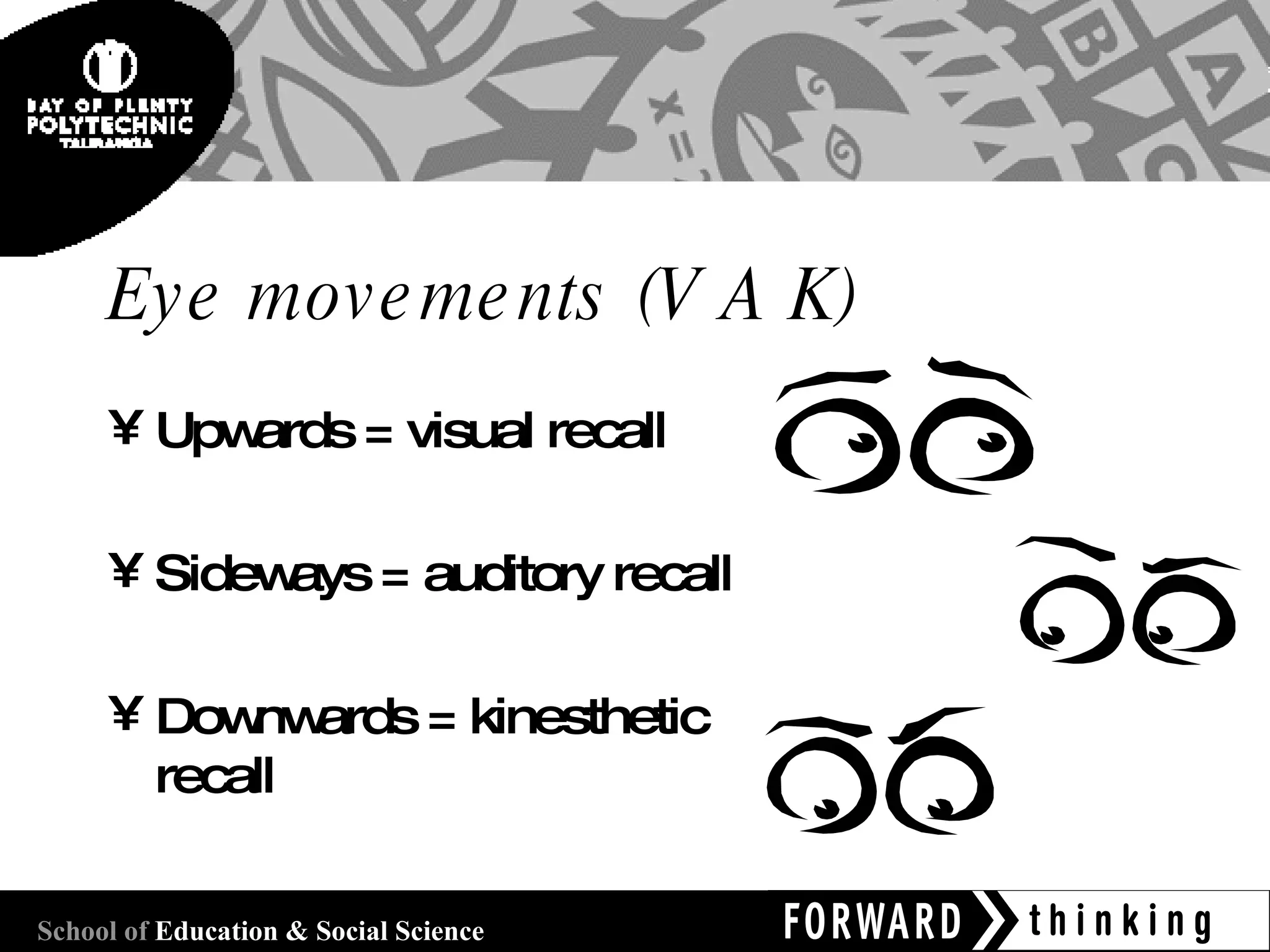
Eye movements (V A K) Upwards = visual recall Sideways = auditory recall Downwards = kinesthetic recall
Congruency 55%  Body Language 38%  Voice 7%  Words “ What you do speaks so loud that I cannot hear what you say!” Ralph Waldo Emerson
Calibrate Match - breathing, voice tone, gestures, posture, eye movements. Pace Lead
States Use anchors to put students and yourself into the right state An anchor is “ any specific stimulus that consistently produces a specific response” V - Blue flashing light! A - Favourite song K - A certain touch
Summary NLP is great NLP improves your skills as a teacher NLP helps students learn better NLP = communication excellence!

A Teacher-Librarians Guide to Neuro-Linguistic Programming (NLP) 2000

  • 1.
    A Teacher- LibrariansGuide to Neuro-Linguistic Programming (NLP) Rose Holley Senior Librarian, Bay of Plenty Polytechnic June 2000
  • 2.
    What is NLP?N euro = How the brain works L inguistic = Language skills used P rogramming = Behaviour patterns
  • 3.
    What is itfor? To excel at communication A psychological model to follow Enables teachers to achieve results with learners
  • 4.
    History of Theory-1970’s Richard Bandler Psychologist John Grindler Linguist Study best communicators and therapists in world
  • 5.
    Who uses it?Teachers Trainers Psychologists Counsellors Therapists Human Resources Managers Facilitators Sports Coaches Negotiators COMMUNICATORS!
  • 6.
    In the classroomApply the operating principles Follow the model Use NLP skills
  • 7.
    NLP Key skillsCreate Rapport State Anchors Calibration Congruency Eye movements Language Patterns Flexibility
  • 8.
    V A KLanguage Styles Visual….. I see what you mean It’s clear now I get the picture Let’s look on the bright side I have a vision of how it could be
  • 9.
    Auditory….. I hearwhat you’re saying That sounds good It rings a bell for me It fell on deaf ears I didn’t like the tone of it It struck a chord
  • 10.
    Kinesthetic…. That feelsright I can grasp the idea I can’t put my finger on it It’s as solid as a rock I can tackle the situation I’ve got a bad feeling about it
  • 11.
    Eye movements (VA K) Upwards = visual recall Sideways = auditory recall Downwards = kinesthetic recall
  • 12.
    Congruency 55% Body Language 38% Voice 7% Words “ What you do speaks so loud that I cannot hear what you say!” Ralph Waldo Emerson
  • 13.
    Calibrate Match -breathing, voice tone, gestures, posture, eye movements. Pace Lead
  • 14.
    States Use anchorsto put students and yourself into the right state An anchor is “ any specific stimulus that consistently produces a specific response” V - Blue flashing light! A - Favourite song K - A certain touch
  • 15.
    Summary NLP isgreat NLP improves your skills as a teacher NLP helps students learn better NLP = communication excellence!