
S.ANITA RAJIBA
II-M.ED
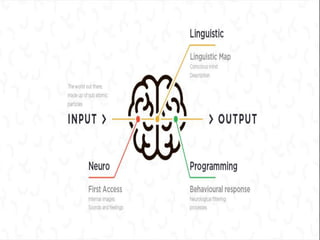
The nerve communication network in
the human body
NEURO
NEURO
Each individual has established their own unique
mental filtering system for processing the millions of
bits of data being absorbed through the senses. Our first
mental map of the world is constituted of internal
images, sounds, tactile awareness, internal sensations,
tastes and smells that form as result of the neurological
filtering process. The first mental map is called ‘First
Access’ in NLP.
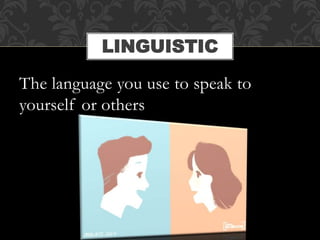
The language you use to speak to
yourself or others
LINGUISTIC
We then assign personal meaning to the
information being received from the world
outside. We form our second mental map by
assigning language to the internal images,
sounds and feelings, tastes and smells, thus
forming everyday conscious awareness. The
second mental map is called the Linguistic Map
(sometimes known as Linguistic
Representation)
LINGUISTIC
The operating instructions that
create an outcome
PROGRAMMING
The behavioural response
that occurs as a result of
neurological filtering
processes and the
subsequent linguistic map.
PROGRAMMING
NLP stands for Neuro-Linguistic
Programming. Neuro refers to your
neurology; Linguistic refers to language;
programming refers to how that neural
language functions. In other words,
learning NLP is like learning the
language of your own mind!
MEANING OF NLP
Neuro Linguistic Programming began
it’s life early in the 1970s when an Associate
Professor of linguistics from the University of
California, John Grinder, teamed up with an
undergraduate Richard Bandler. Both men had
a fascination with human excellence which
charted a path for them to model behavioural
patterns of selected geniuses.
NLP ORIGIN
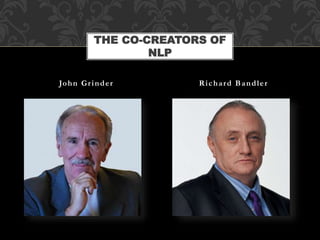
John Grinder Richard Bandler
THE CO-CREATORS OF
NLP
They and their research team
spent time deconstructing how people
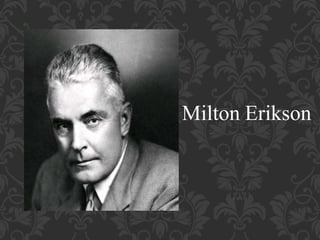
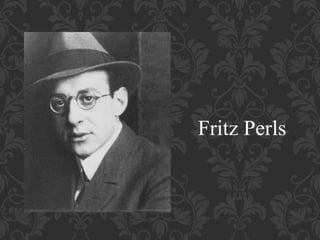
such as Virginia Satir, Milton Erikson
and Fritz Perls achieved their
consistent success with their clients.
.
Virginia Satir
Milton Erikson
Fritz Perls
What they identified was :
The words they used
What questions they asked
Changes in voice tone
Changes is body posture and physiology
What they listened out for when taking to
someone
How they structured their language.
Through this work and subsequently, the
work of many others, the methodology of NLP
developed. Today NLP techniques are used in
many different areas such as therapy, health,
education and sport.
Our brain then processes the information
and here is the first problem. We receive about
2,000,000 bits of information per second through
our senses and our brain can only cope with
about 7 of those bits. So in order to complete the
processing of the information our brain filters the
information down to seven bits. Obviously this
means that 1,999,993 bits must be deleted. This is
why two people experiencing the same event may
have completely different recollections of it.
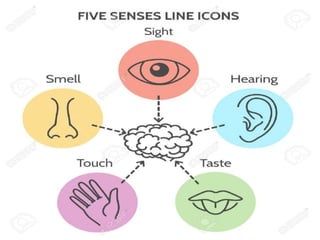
We each have one or two
preferred senses that we use to take
in and recall events. So, some of us
may store most of our memories in
picture format, some in sounds, and
some in feelings. We all use all of
our senses but we prefer to use some
of our senses more than others.
What can NLP help with?
Changing habits
Eliminating phobias
Improving confidence and self esteem
Developing Leadership skills
Removing stress and depression
Self-control from frustrations or other emotions
Exam stress
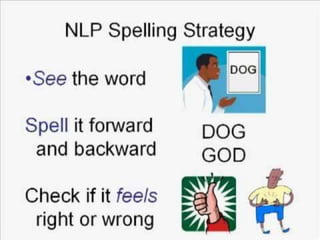
Spelling trouble
Improving negotiation skills
THANK YOU
Blessy Mam and Friends

Neuro-linguistic programming (NLP)

  • 1.
  • 2.
    The nerve communicationnetwork in the human body NEURO
  • 3.
    NEURO Each individual hasestablished their own unique mental filtering system for processing the millions of bits of data being absorbed through the senses. Our first mental map of the world is constituted of internal images, sounds, tactile awareness, internal sensations, tastes and smells that form as result of the neurological filtering process. The first mental map is called ‘First Access’ in NLP.
  • 4.
    The language youuse to speak to yourself or others LINGUISTIC
  • 5.
    We then assignpersonal meaning to the information being received from the world outside. We form our second mental map by assigning language to the internal images, sounds and feelings, tastes and smells, thus forming everyday conscious awareness. The second mental map is called the Linguistic Map (sometimes known as Linguistic Representation) LINGUISTIC
  • 6.
    The operating instructionsthat create an outcome PROGRAMMING
  • 7.
    The behavioural response thatoccurs as a result of neurological filtering processes and the subsequent linguistic map. PROGRAMMING
  • 8.
    NLP stands forNeuro-Linguistic Programming. Neuro refers to your neurology; Linguistic refers to language; programming refers to how that neural language functions. In other words, learning NLP is like learning the language of your own mind! MEANING OF NLP
  • 9.
    Neuro Linguistic Programmingbegan it’s life early in the 1970s when an Associate Professor of linguistics from the University of California, John Grinder, teamed up with an undergraduate Richard Bandler. Both men had a fascination with human excellence which charted a path for them to model behavioural patterns of selected geniuses. NLP ORIGIN
  • 10.
    John Grinder RichardBandler THE CO-CREATORS OF NLP
  • 11.
    They and theirresearch team spent time deconstructing how people such as Virginia Satir, Milton Erikson and Fritz Perls achieved their consistent success with their clients. .
  • 12.
  • 13.
  • 14.
  • 15.
    What they identifiedwas : The words they used What questions they asked Changes in voice tone Changes is body posture and physiology What they listened out for when taking to someone How they structured their language.
  • 16.
    Through this workand subsequently, the work of many others, the methodology of NLP developed. Today NLP techniques are used in many different areas such as therapy, health, education and sport.
  • 17.
    Our brain thenprocesses the information and here is the first problem. We receive about 2,000,000 bits of information per second through our senses and our brain can only cope with about 7 of those bits. So in order to complete the processing of the information our brain filters the information down to seven bits. Obviously this means that 1,999,993 bits must be deleted. This is why two people experiencing the same event may have completely different recollections of it.
  • 19.
    We each haveone or two preferred senses that we use to take in and recall events. So, some of us may store most of our memories in picture format, some in sounds, and some in feelings. We all use all of our senses but we prefer to use some of our senses more than others.
  • 20.
    What can NLPhelp with? Changing habits Eliminating phobias Improving confidence and self esteem Developing Leadership skills Removing stress and depression Self-control from frustrations or other emotions Exam stress Spelling trouble Improving negotiation skills
  • 25.