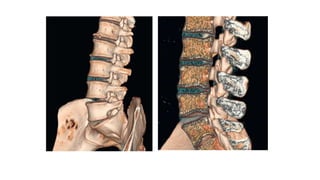
BASICS OF CT-SPINE
PRESENTED BY : DR.B.BORTHAKUR
PROFESSOR AND HEAD, DEPT.OF ORTHOPAEDICS
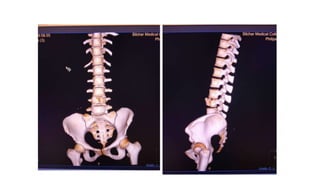
ANATOMY OF THE VERTEBRAL COLUMN
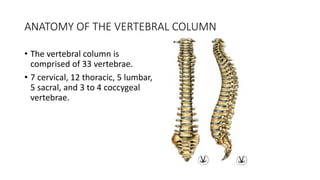
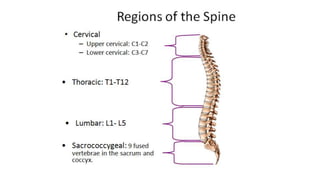
• The vertebral column is
comprised of 33 vertebrae.
• 7 cervical, 12 thoracic, 5 lumbar,
5 sacral, and 3 to 4 coccygeal
vertebrae.
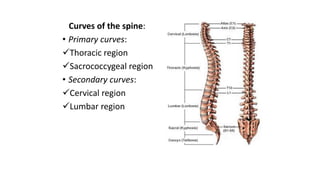
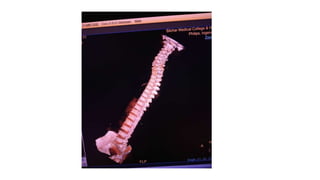
Curves of the spine:
• Primary curves:
Thoracic region
Sacrococcygeal region
• Secondary curves:
Cervical region
Lumbar region
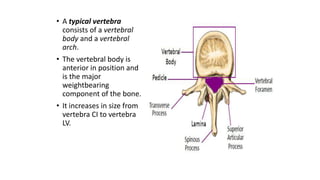
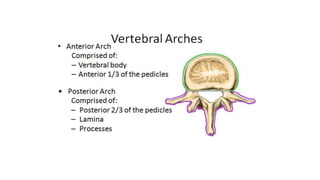
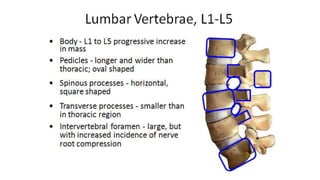
• A typical vertebra
consists of a vertebral
body and a vertebral
arch.
• The vertebral body is
anterior in position and
is the major
weightbearing
component of the bone.
• It increases in size from
vertebra CI to vertebra
LV.
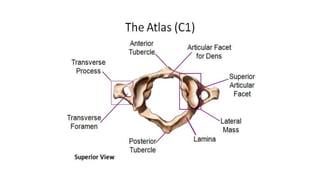
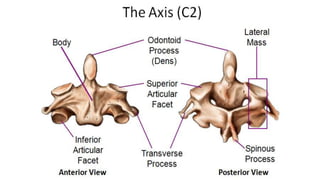
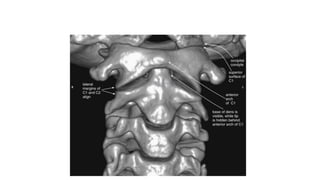
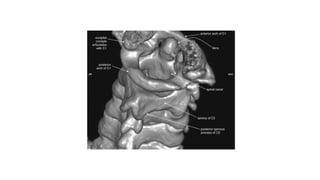
This three-dimensional reconstruction from computed tomography (CT) axial images focuses on the occipital–
cervical junction and the C1-2 (atlantoaxial) junction
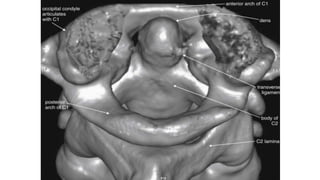
The skull base has been cut away nearly completely in this
CT model, allowing the ring of C1 and its relationship to the
dens of C2 to be seen in detail.
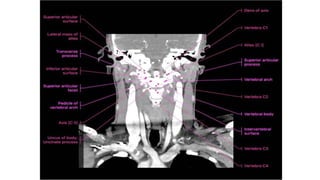
C1 and C2 view of the normal cervical spine
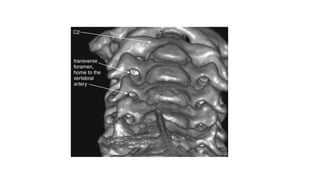
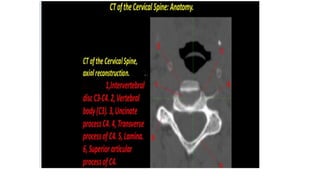
This three-dimensional CT model is oriented with the observer looking cephalad along the anterior
surface of the cervical spine. A series of holes perforating the transverse processes of each vertebra
can be seen—the transverse foramen.
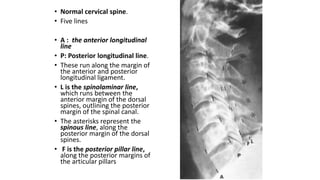
• Normal cervical spine.
• Five lines
• A : the anterior longitudinal
line
• P: Posterior longitudinal line.
• These run along the margin of
the anterior and posterior
longitudinal ligament.
• L is the spinolaminar line,
which runs between the
anterior margin of the dorsal
spines, outlining the posterior
margin of the spinal canal.
• The asterisks represent the
spinous line, along the
posterior margin of the dorsal
spines.
• F is the posterior pillar line,
along the posterior margins of
the articular pillars
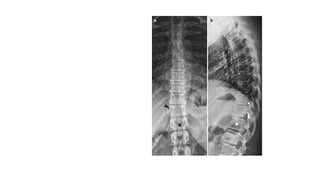
Thoracic spine
X-ray in AP and Lateral
projections.
Vertebral body (star ) of
T12 with rib hypoplasia;
T10–T11 intervertebral
foramina (circle ); T11
right pedicle(arrowhead )
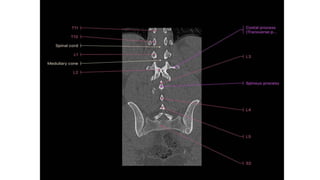
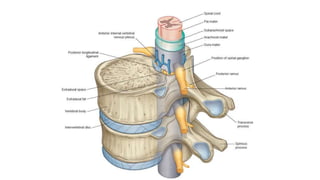
VERTEBRAL CANAL
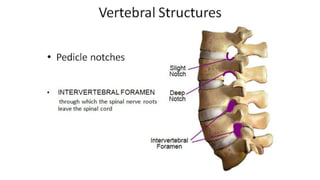
• The spinal cord lies within a bony canal formed by adjacent vertebrae
and soft tissue elements, the vertebral canal.
• Anterior wall: the vertebral bodies of the vertebrae, intervertebral
discs, and associated ligaments,
• Lateral walls and roof: the vertebral arches and ligaments.
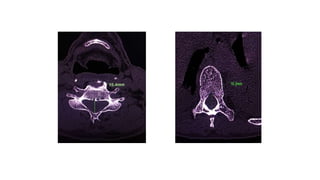
Normal Spinal canal diameters
THORACIC SPINE
CERVICAL SPINE
At the cervical levels C4–C7 the average antero-
posterior diameter is 17 mm and values below 14 mm
are considered critical.
At the lumbar level a classification of spinal stenosis was
suggested by Benoist:
• Severe stenosis (< 10 mm)
• Moderate stenosis (10–12 mm)
• Mild stenosis (12–14 mm)
PLAIN RADIOGRAPHY
• Conventional X-ray imaging is a fast, easy and inexpensive
technique which offers a good overview of a large segment
of the spine.
• Plain radiography still has the advantage over CT and MRI
for the evaluation of structural malformations
• The main disadvantage of plain radiographs is the
superimposition of soft tissue and bony structures, making
the interpretation difficult.
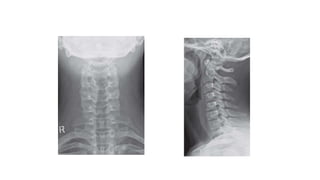
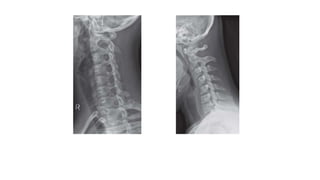
Normal plain radiography of the cervical spine
ANTERIOR POSTERIOR
VIEW
LATERAL VIEW
Right oblique view Dynamic flexion view
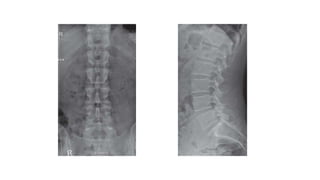
Normal plain radiography of the lumbar spine
POSTERIOR ANTERIOR VIEW LATERAL VIEW
COMPUTED TOMOGRAPHY
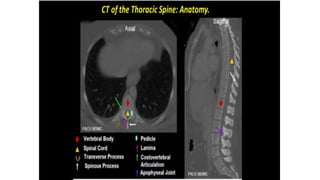
• Computed tomography of the spine is the first choice of
examination in trauma patients with a high sensitivity in
detecting fractures.
• Although MRI has become more common for the evaluation of
the disc space and the spinal canal, CT is still adequate enough
to---
• visualize the spinal cord
• exclude compression (e.g. haematoma or disc herniation)
• evaluating the posterior elements and bony changes as facet
joint pathology
• After surgery, CT can visualize the surgical materials and
evaluate possible loosening.
Technique
• The patient is placed in supine position on the CT table
• Modern spiral CT allows a fast and continuous
acquisition of data to obtain a full data set which makes
reconstructions in all anatomical planes as well as 3D
reconstruction possible
• A digital radiograph, also known as “Topogram”, of the
region of interest is performed to make a selection of
the volume to be imaged.
Technique
• After the acquisition of the data reconstructions in the
sagittal and axial planes are performed, the slice thickness
depends on the region of interest and the indication of the
examination.
• A soft-tissue and bone algorithm is used.
• The multislice volume imaging allows reconstructions in
virtually every plane as well as curved reconstructions in
patients with scoliosis.
• Three-dimensional volumetric reconstructions can be made
to make illustrative images for the clinicians.
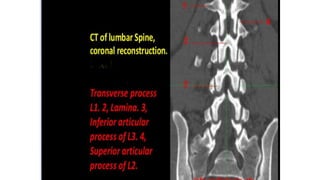
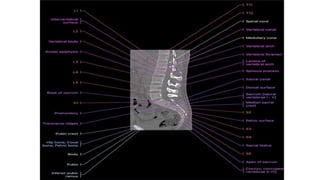
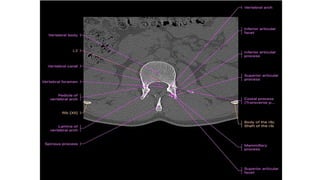
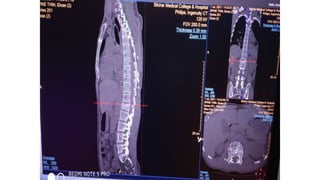
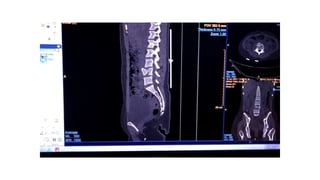
Multiplanar reconstructions/reformats:
• Sagittal images,
• Coronal images,
• Axial images:.
• Curved reformats
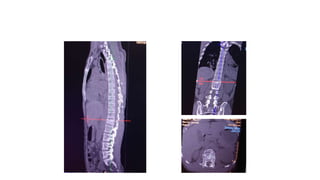
Burst fracture of L1 vertebrae
Saggital, Coronal and Axial
ANATOMY OF PELVIS
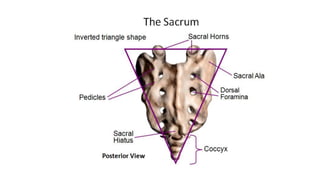
• The bony pelvis consists of innominate bones, each
with three parts (ilium, ischium and pubis), sacrum
and coccyx.
• It protects the pelvic viscera, provides attachment
for the muscles of the trunk and lower limb, and
enables stable transfer of the body weight from the
spine to the femur.
• Its divided into false (major) and true (minior)
pelvis, by the ileopectineal line: the smaller inferior
part is the true pelvis and the larger superior part is
the false pelvis.
• The false pelvis is formed mainly by the iliac fossae and
is largely filled by the iliopsoas muscles.
• The true pelvis is bounded posteriorly by the sacrum
and coccyx, laterally by the obturator membranes,
sacrospinous ligaments, and anteriorly by the pubic
bones.
THANK YOU

CT SCAN spine

  • 1.
    BASICS OF CT-SPINE PRESENTEDBY : DR.B.BORTHAKUR PROFESSOR AND HEAD, DEPT.OF ORTHOPAEDICS
  • 2.
    ANATOMY OF THEVERTEBRAL COLUMN • The vertebral column is comprised of 33 vertebrae. • 7 cervical, 12 thoracic, 5 lumbar, 5 sacral, and 3 to 4 coccygeal vertebrae.
  • 4.
    Curves of thespine: • Primary curves: Thoracic region Sacrococcygeal region • Secondary curves: Cervical region Lumbar region
  • 5.
    • A typicalvertebra consists of a vertebral body and a vertebral arch. • The vertebral body is anterior in position and is the major weightbearing component of the bone. • It increases in size from vertebra CI to vertebra LV.
  • 12.
    This three-dimensional reconstructionfrom computed tomography (CT) axial images focuses on the occipital– cervical junction and the C1-2 (atlantoaxial) junction
  • 13.
    The skull basehas been cut away nearly completely in this CT model, allowing the ring of C1 and its relationship to the dens of C2 to be seen in detail. C1 and C2 view of the normal cervical spine
  • 15.
    This three-dimensional CTmodel is oriented with the observer looking cephalad along the anterior surface of the cervical spine. A series of holes perforating the transverse processes of each vertebra can be seen—the transverse foramen.
  • 19.
    • Normal cervicalspine. • Five lines • A : the anterior longitudinal line • P: Posterior longitudinal line. • These run along the margin of the anterior and posterior longitudinal ligament. • L is the spinolaminar line, which runs between the anterior margin of the dorsal spines, outlining the posterior margin of the spinal canal. • The asterisks represent the spinous line, along the posterior margin of the dorsal spines. • F is the posterior pillar line, along the posterior margins of the articular pillars
  • 29.
    Thoracic spine X-ray inAP and Lateral projections. Vertebral body (star ) of T12 with rib hypoplasia; T10–T11 intervertebral foramina (circle ); T11 right pedicle(arrowhead )
  • 39.
    VERTEBRAL CANAL • Thespinal cord lies within a bony canal formed by adjacent vertebrae and soft tissue elements, the vertebral canal. • Anterior wall: the vertebral bodies of the vertebrae, intervertebral discs, and associated ligaments, • Lateral walls and roof: the vertebral arches and ligaments.
  • 41.
    Normal Spinal canaldiameters THORACIC SPINE CERVICAL SPINE
  • 42.
    At the cervicallevels C4–C7 the average antero- posterior diameter is 17 mm and values below 14 mm are considered critical. At the lumbar level a classification of spinal stenosis was suggested by Benoist: • Severe stenosis (< 10 mm) • Moderate stenosis (10–12 mm) • Mild stenosis (12–14 mm)
  • 43.
    PLAIN RADIOGRAPHY • ConventionalX-ray imaging is a fast, easy and inexpensive technique which offers a good overview of a large segment of the spine. • Plain radiography still has the advantage over CT and MRI for the evaluation of structural malformations • The main disadvantage of plain radiographs is the superimposition of soft tissue and bony structures, making the interpretation difficult.
  • 44.
    Normal plain radiographyof the cervical spine ANTERIOR POSTERIOR VIEW LATERAL VIEW
  • 45.
    Right oblique viewDynamic flexion view
  • 46.
    Normal plain radiographyof the lumbar spine POSTERIOR ANTERIOR VIEW LATERAL VIEW
  • 47.
    COMPUTED TOMOGRAPHY • Computedtomography of the spine is the first choice of examination in trauma patients with a high sensitivity in detecting fractures. • Although MRI has become more common for the evaluation of the disc space and the spinal canal, CT is still adequate enough to--- • visualize the spinal cord • exclude compression (e.g. haematoma or disc herniation) • evaluating the posterior elements and bony changes as facet joint pathology • After surgery, CT can visualize the surgical materials and evaluate possible loosening.
  • 48.
    Technique • The patientis placed in supine position on the CT table • Modern spiral CT allows a fast and continuous acquisition of data to obtain a full data set which makes reconstructions in all anatomical planes as well as 3D reconstruction possible • A digital radiograph, also known as “Topogram”, of the region of interest is performed to make a selection of the volume to be imaged.
  • 49.
    Technique • After theacquisition of the data reconstructions in the sagittal and axial planes are performed, the slice thickness depends on the region of interest and the indication of the examination. • A soft-tissue and bone algorithm is used. • The multislice volume imaging allows reconstructions in virtually every plane as well as curved reconstructions in patients with scoliosis. • Three-dimensional volumetric reconstructions can be made to make illustrative images for the clinicians.
  • 50.
    Multiplanar reconstructions/reformats: • Sagittalimages, • Coronal images, • Axial images:. • Curved reformats
  • 52.
    Burst fracture ofL1 vertebrae Saggital, Coronal and Axial
  • 55.
    ANATOMY OF PELVIS •The bony pelvis consists of innominate bones, each with three parts (ilium, ischium and pubis), sacrum and coccyx. • It protects the pelvic viscera, provides attachment for the muscles of the trunk and lower limb, and enables stable transfer of the body weight from the spine to the femur. • Its divided into false (major) and true (minior) pelvis, by the ileopectineal line: the smaller inferior part is the true pelvis and the larger superior part is the false pelvis.
  • 56.
    • The falsepelvis is formed mainly by the iliac fossae and is largely filled by the iliopsoas muscles. • The true pelvis is bounded posteriorly by the sacrum and coccyx, laterally by the obturator membranes, sacrospinous ligaments, and anteriorly by the pubic bones.
  • 57.