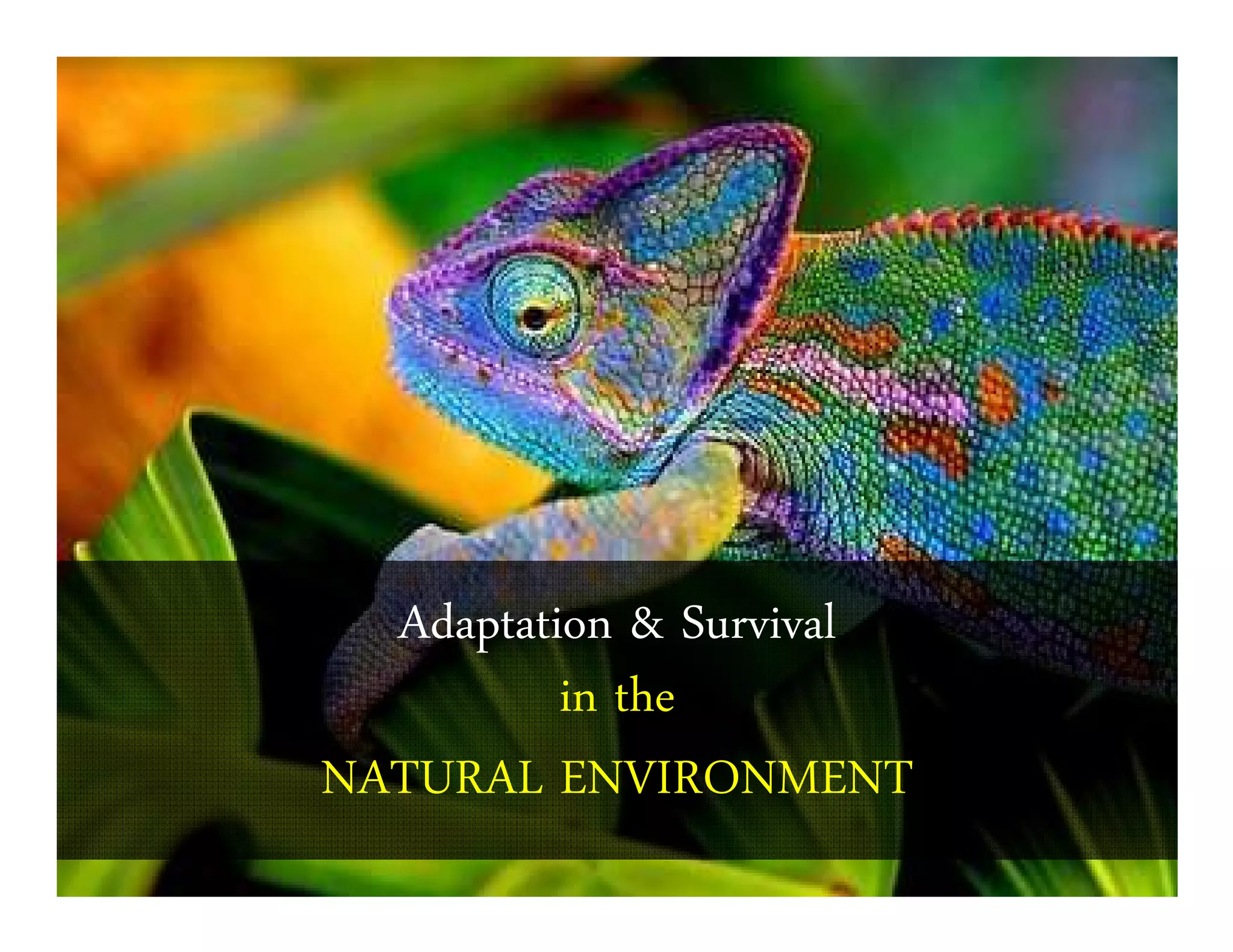
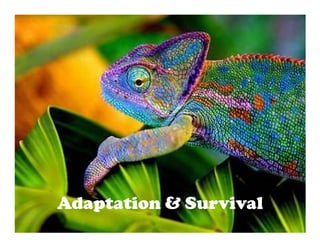
Adaptation & Survival
in the
NATURAL ENVIRONMENT
ANIMAL
ADAPTATION
how animals survive
in their respective environments
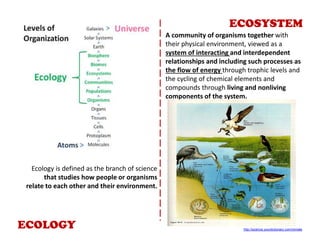
ECOLOGY
A community of organisms together with
their physical environment, viewed as a
system of interacting and interdependent
relationships and including such processes as
the flow of energy through trophic levels and
the cycling of chemical elements and
compounds through living and nonliving
components of the system.
ECOSYSTEM
http://science.yourdictionary.com/climate
Ecology is defined as the branch of science
that studies how people or organisms
relate to each other and their environment.
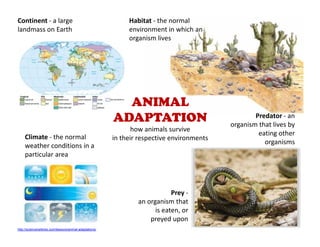
Habitat - the normal
environment in which an
organism lives
ANIMAL
ADAPTATION
how animals survive
in their respective environments
Predator - an
organism that lives by
eating other
organisms
Prey -
an organism that
is eaten, or
preyed upon
Continent - a large
landmass on Earth
Climate - the normal
weather conditions in a
particular area
http://sciencenetlinks.com/lessons/animal-adaptations/
Climate
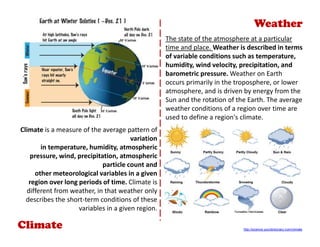
Climate is a measure of the average pattern of
variation
in temperature, humidity, atmospheric
pressure, wind, precipitation, atmospheric
particle count and
other meteorological variables in a given
region over long periods of time. Climate is
different from weather, in that weather only
describes the short-term conditions of these
variables in a given region.
The state of the atmosphere at a particular
time and place. Weather is described in terms
of variable conditions such as temperature,
humidity, wind velocity, precipitation, and
barometric pressure. Weather on Earth
occurs primarily in the troposphere, or lower
atmosphere, and is driven by energy from the
Sun and the rotation of the Earth. The average
weather conditions of a region over time are
used to define a region's climate.
Weather
http://science.yourdictionary.com/climate
ANIMAL
ARCHITECT
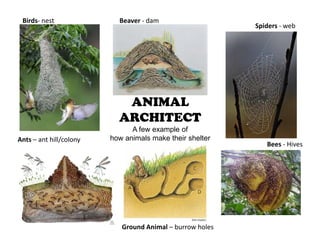
A few example of
how animals make their shelter
Bees - Hives
Ants – ant hill/colony
Ground Animal – burrow holes
Beaver - damBirds- nest
Spiders - web
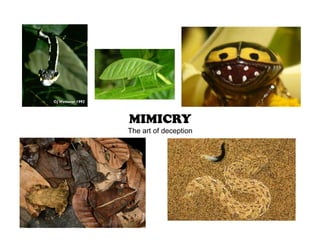
MIMICRY
The art of deception
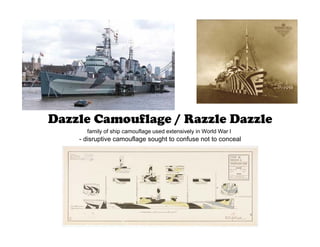
Dazzle Camouflage / Razzle Dazzle
family of ship camouflage used extensively in World War I
- disruptive camouflage sought to confuse not to conceal
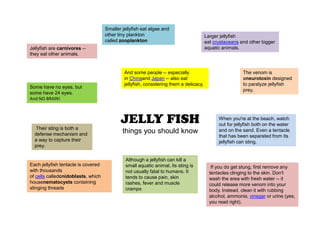
JELLY FISH
things you should know
Jellyfish are carnivores --
they eat other animals.
Smaller jellyfish eat algae and
other tiny plankton
called zooplankton
Larger jellyfish
eat crustaceans and other bigger
aquatic animals.
Their sting is both a
defense mechanism and
a way to capture their
prey.
Each jellyfish tentacle is covered
with thousands
of cells calledcnidoblasts, which
housenematocysts containing
stinging threads
The venom is
aneurotoxin designed
to paralyze jellyfish
prey.
Although a jellyfish can kill a
small aquatic animal, its sting is
not usually fatal to humans. It
tends to cause pain, skin
rashes, fever and muscle
cramps
When you're at the beach, watch
out for jellyfish both on the water
and on the sand. Even a tentacle
that has been separated from its
jellyfish can sting.
If you do get stung, first remove any
tentacles clinging to the skin. Don't
wash the area with fresh water -- it
could release more venom into your
body. Instead, clean it with rubbing
alcohol, ammonia, vinegar or urine (yes,
you read right).
And some people -- especially
in Chinaand Japan -- also eat
jellyfish, considering them a delicacy.
Some have no eyes, but
some have 24 eyes.
And NO BRAIN!
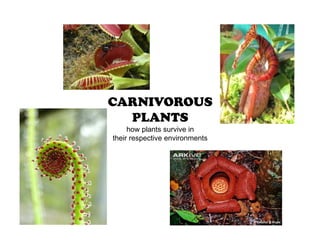
CARNIVOROUS
PLANTS
how plants survive in
their respective environments
Adaptation & Survival
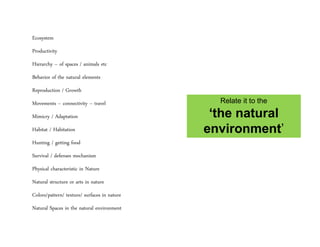
Ecosystem
Productivity
Hierarchy – of spaces / animals etc
Behavior of the natural elements
Reproduction / Growth
Movements – connectivity – travel
Mimicry / Adaptation
Habitat / Habitation
Hunting / getting food
Survival / defenses mechanism
Physical characteristic in Nature
Natural structure or arts in nature
Colors/pattern/ texture/ surfaces in nature
Natural Spaces in the natural environment
Relate it to the
‘the natural
environment’

Presentation1 enbe

  • 1.
    Adaptation & Survival inthe NATURAL ENVIRONMENT
  • 2.
    ANIMAL ADAPTATION how animals survive intheir respective environments
  • 3.
    ECOLOGY A community oforganisms together with their physical environment, viewed as a system of interacting and interdependent relationships and including such processes as the flow of energy through trophic levels and the cycling of chemical elements and compounds through living and nonliving components of the system. ECOSYSTEM http://science.yourdictionary.com/climate Ecology is defined as the branch of science that studies how people or organisms relate to each other and their environment.
  • 4.
    Habitat - thenormal environment in which an organism lives ANIMAL ADAPTATION how animals survive in their respective environments Predator - an organism that lives by eating other organisms Prey - an organism that is eaten, or preyed upon Continent - a large landmass on Earth Climate - the normal weather conditions in a particular area http://sciencenetlinks.com/lessons/animal-adaptations/
  • 5.
    Climate Climate is ameasure of the average pattern of variation in temperature, humidity, atmospheric pressure, wind, precipitation, atmospheric particle count and other meteorological variables in a given region over long periods of time. Climate is different from weather, in that weather only describes the short-term conditions of these variables in a given region. The state of the atmosphere at a particular time and place. Weather is described in terms of variable conditions such as temperature, humidity, wind velocity, precipitation, and barometric pressure. Weather on Earth occurs primarily in the troposphere, or lower atmosphere, and is driven by energy from the Sun and the rotation of the Earth. The average weather conditions of a region over time are used to define a region's climate. Weather http://science.yourdictionary.com/climate
  • 6.
    ANIMAL ARCHITECT A few exampleof how animals make their shelter Bees - Hives Ants – ant hill/colony Ground Animal – burrow holes Beaver - damBirds- nest Spiders - web
  • 7.
  • 8.
    Dazzle Camouflage /Razzle Dazzle family of ship camouflage used extensively in World War I - disruptive camouflage sought to confuse not to conceal
  • 9.
    JELLY FISH things youshould know Jellyfish are carnivores -- they eat other animals. Smaller jellyfish eat algae and other tiny plankton called zooplankton Larger jellyfish eat crustaceans and other bigger aquatic animals. Their sting is both a defense mechanism and a way to capture their prey. Each jellyfish tentacle is covered with thousands of cells calledcnidoblasts, which housenematocysts containing stinging threads The venom is aneurotoxin designed to paralyze jellyfish prey. Although a jellyfish can kill a small aquatic animal, its sting is not usually fatal to humans. It tends to cause pain, skin rashes, fever and muscle cramps When you're at the beach, watch out for jellyfish both on the water and on the sand. Even a tentacle that has been separated from its jellyfish can sting. If you do get stung, first remove any tentacles clinging to the skin. Don't wash the area with fresh water -- it could release more venom into your body. Instead, clean it with rubbing alcohol, ammonia, vinegar or urine (yes, you read right). And some people -- especially in Chinaand Japan -- also eat jellyfish, considering them a delicacy. Some have no eyes, but some have 24 eyes. And NO BRAIN!
  • 10.
    CARNIVOROUS PLANTS how plants survivein their respective environments
  • 11.
  • 12.
    Ecosystem Productivity Hierarchy – ofspaces / animals etc Behavior of the natural elements Reproduction / Growth Movements – connectivity – travel Mimicry / Adaptation Habitat / Habitation Hunting / getting food Survival / defenses mechanism Physical characteristic in Nature Natural structure or arts in nature Colors/pattern/ texture/ surfaces in nature Natural Spaces in the natural environment Relate it to the ‘the natural environment’