Defining Place
Attachment
.
A Tripartite Organizing
Framework
ENVIRONMENT BEHAVIOR STUDIES
Authors: Leila Scannell, Robert Gifford
ENVIRONMENT BEHAVIOR STUDIES
• Place attachment is
defined as a
multifaceted concept
that characterizes the
bonding between
individuals and their
important places.
• However, variations in this definition are vast.
• different studies consider different aspects in its analysis.
ENVIRONMENT BEHAVIOR STUDIES
Why Study Place Attachment????
•Place attachment as an emotional bond has shed
light on the distress and grief expressed by those
who are forced to relocate. Place attachment has
thus been applied to disaster psychology,
immigration and mobility.
• Place meaning and attachment can be used to
plan and encourage the use of public spaces, such
as national parks.
• Attached individuals experience a heightened
sense of safety, even when their place is situated
in a war zone. On a smaller scale, attachment to
one’s neighborhood is associated with fewer
perceived incivilities (e.g., drug dealing, gang
activity, traffic, etc.) on one’s block and less fear of
neighborhood
Crime.
ENVIRONMENT BEHAVIOR STUDIES
The Tripartite Organizing Framework
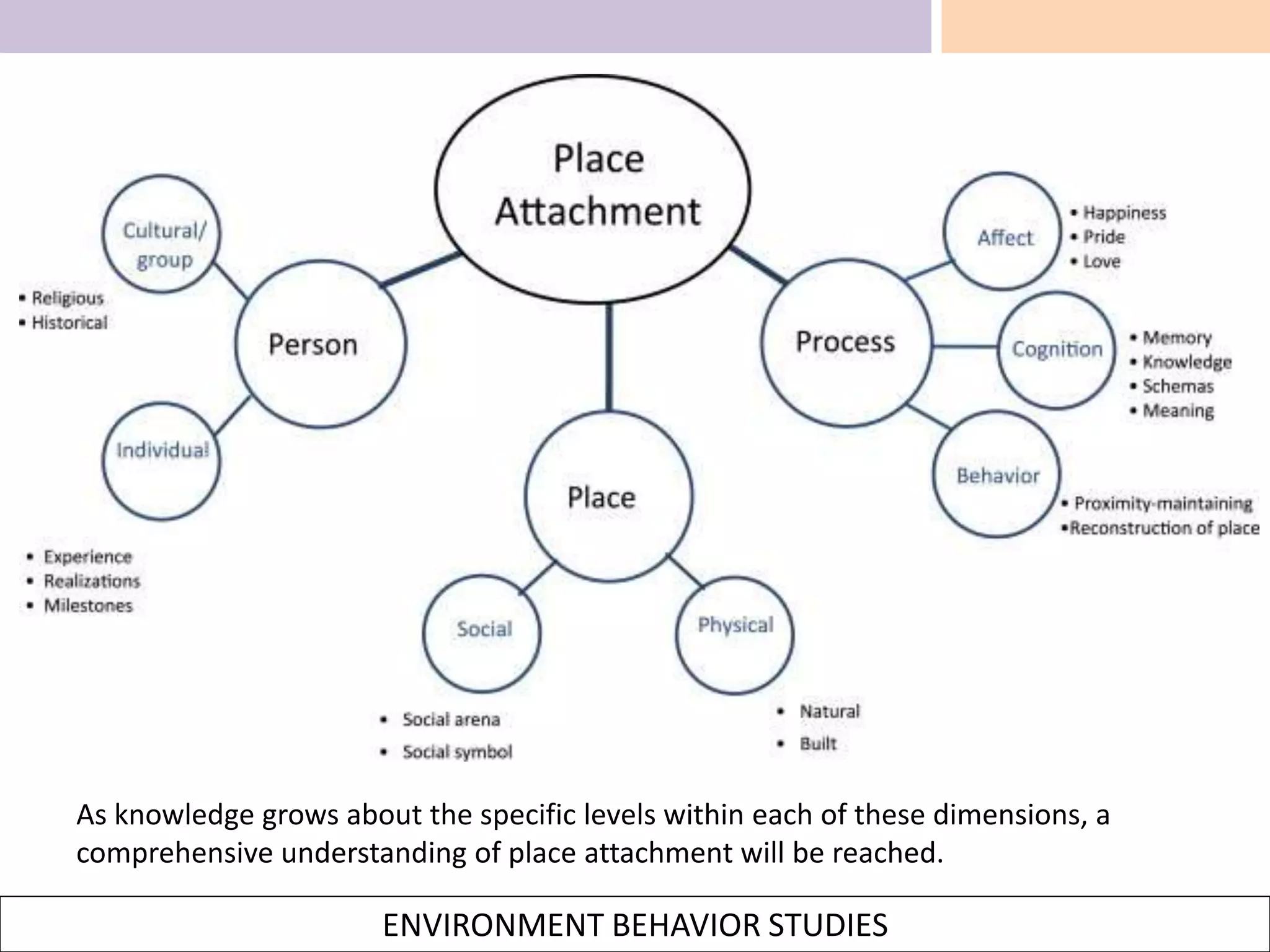
•Its a three-dimensional framework of place attachment that usefully
structures the varied definitions in the literature of place attachment.
•This framework proposes that place attachment is a multidimensional
concept with person, psychological process, and place dimensions.
•The first dimension is the actor: who is attached?
•The second dimension is the psychological process: how are affect,
cognition, and behavior manifested in the attachment?
•The third dimension is the object of the attachment, including place
characteristics: what is the attachment to, and what is the nature of, this
place?
ENVIRONMENT BEHAVIOR STUDIES
As knowledge grows about the specific levels within each of these dimensions, a
comprehensive understanding of place attachment will be reached.
ENVIRONMENT BEHAVIOR STUDIES
Person as dimension
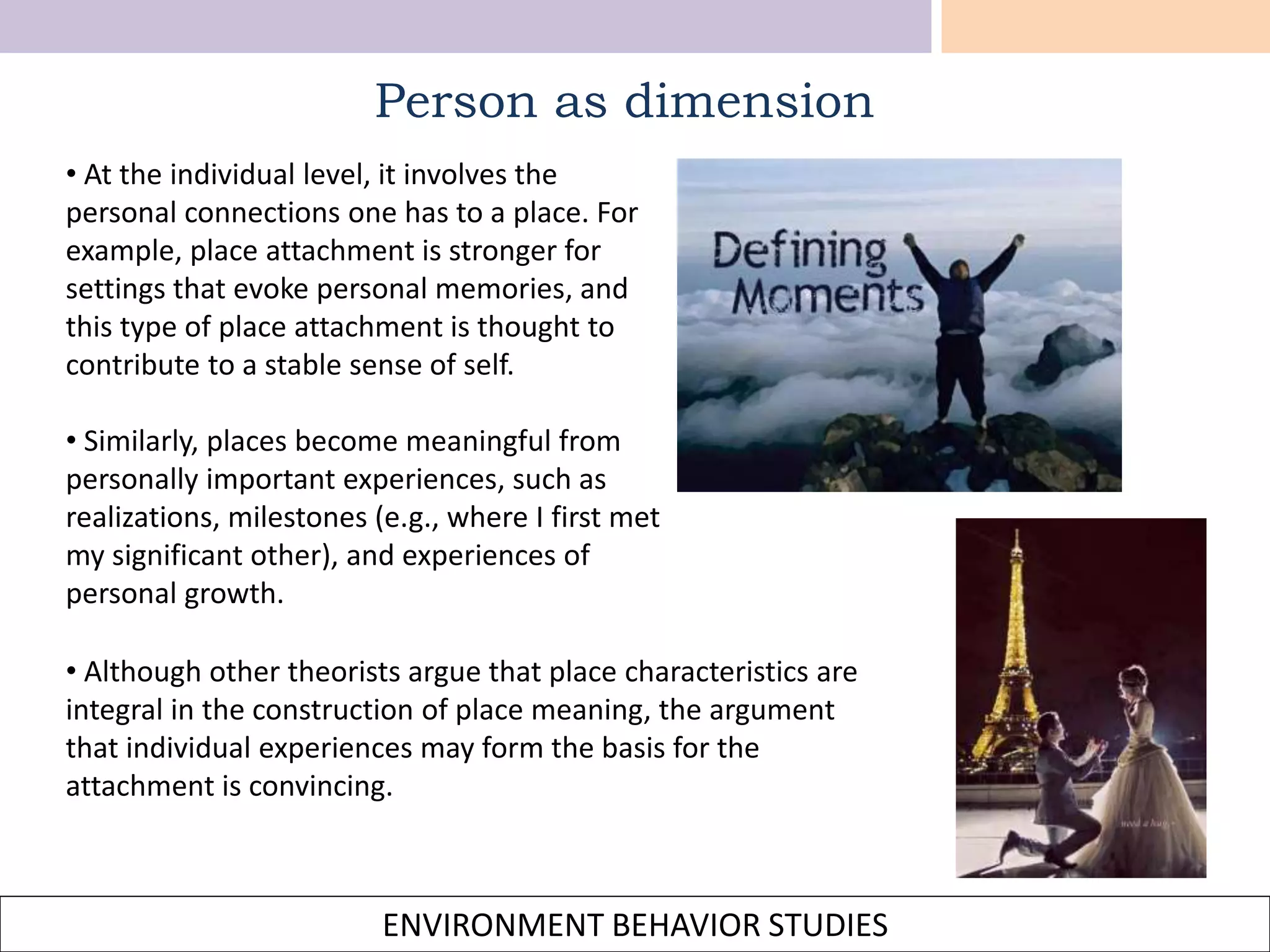
• At the individual level, it involves the
personal connections one has to a place. For
example, place attachment is stronger for
settings that evoke personal memories, and
this type of place attachment is thought to
contribute to a stable sense of self.
• Similarly, places become meaningful from
personally important experiences, such as
realizations, milestones (e.g., where I first met
my significant other), and experiences of
personal growth.
• Although other theorists argue that place characteristics are
integral in the construction of place meaning, the argument
that individual experiences may form the basis for the
attachment is convincing.
ENVIRONMENT BEHAVIOR STUDIES
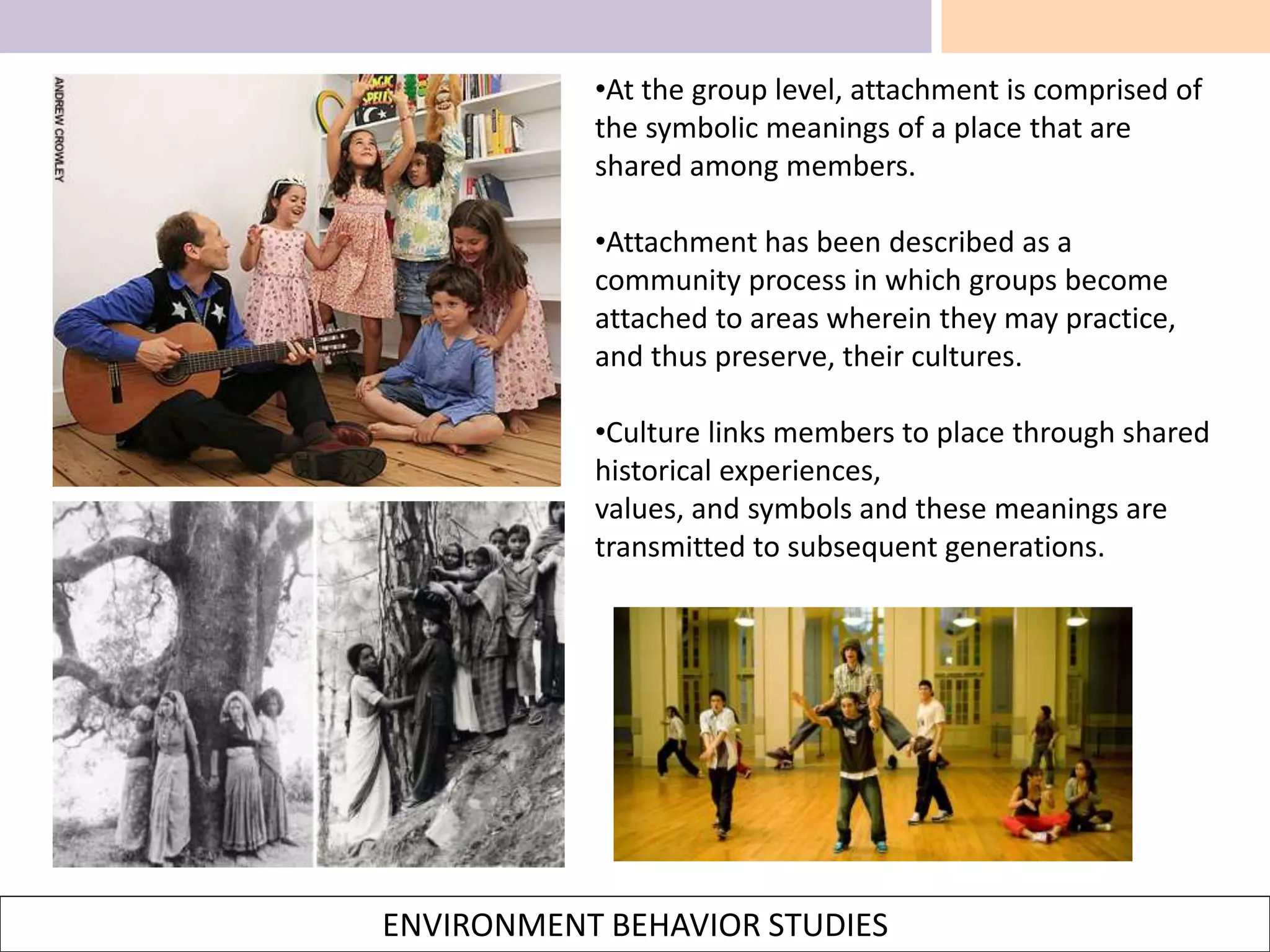
•At the group level, attachment is comprised of
the symbolic meanings of a place that are
shared among members.
•Attachment has been described as a
community process in which groups become
attached to areas wherein they may practice,
and thus preserve, their cultures.
•Culture links members to place through shared
historical experiences,
values, and symbols and these meanings are
transmitted to subsequent generations.
ENVIRONMENT BEHAVIOR STUDIES
•In addition, place attachment may be
religiously based. Through religion, the
meanings of certain places become elevated to
the status of sacred and their scared meanings
are shared among worshippers.
•A place may gain spiritual significance through
personal experiences. Cultural place meanings
and values influence the extent of individual
place attachment, and individual experiences
within a place, if positive, can maintain and
possibly strengthen cultural place attachment.
ENVIRONMENT BEHAVIOR STUDIES
The second dimension of place attachment concerns the way
that individuals and groups relate to a place, and the nature of the
psychological interactions that occur in the environments that are
important to them. Three parameters of analysis of this dimension are
affect, cognition, and behavior.
Psychological Process
ENVIRONMENT BEHAVIOR STUDIES
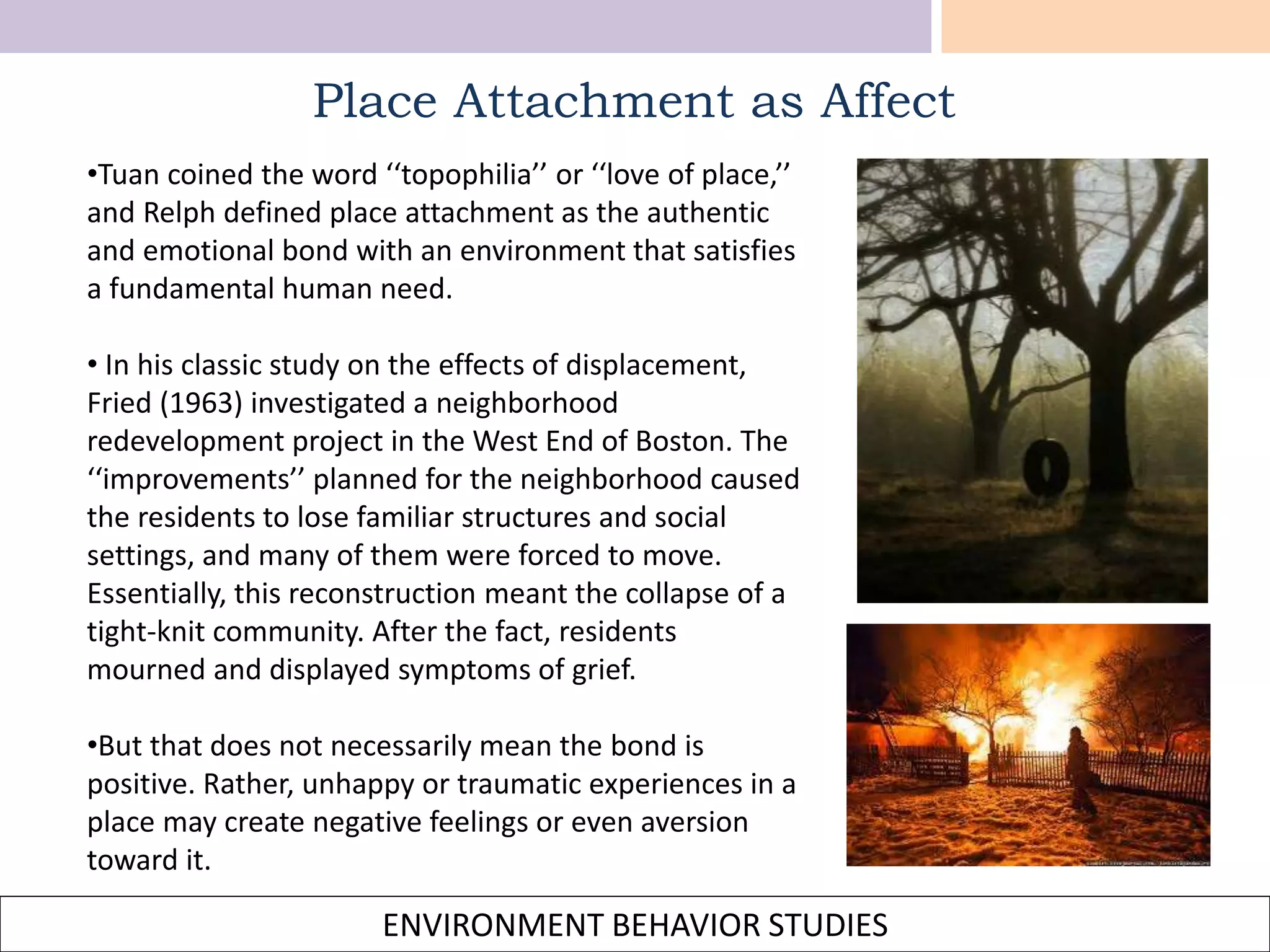
•Tuan coined the word ‘‘topophilia’’ or ‘‘love of place,’’
and Relph defined place attachment as the authentic
and emotional bond with an environment that satisfies
a fundamental human need.
• In his classic study on the effects of displacement,
Fried (1963) investigated a neighborhood
redevelopment project in the West End of Boston. The
‘‘improvements’’ planned for the neighborhood caused
the residents to lose familiar structures and social
settings, and many of them were forced to move.
Essentially, this reconstruction meant the collapse of a
tight-knit community. After the fact, residents
mourned and displayed symptoms of grief.
•But that does not necessarily mean the bond is
positive. Rather, unhappy or traumatic experiences in a
place may create negative feelings or even aversion
toward it.
Place Attachment as Affect
ENVIRONMENT BEHAVIOR STUDIES
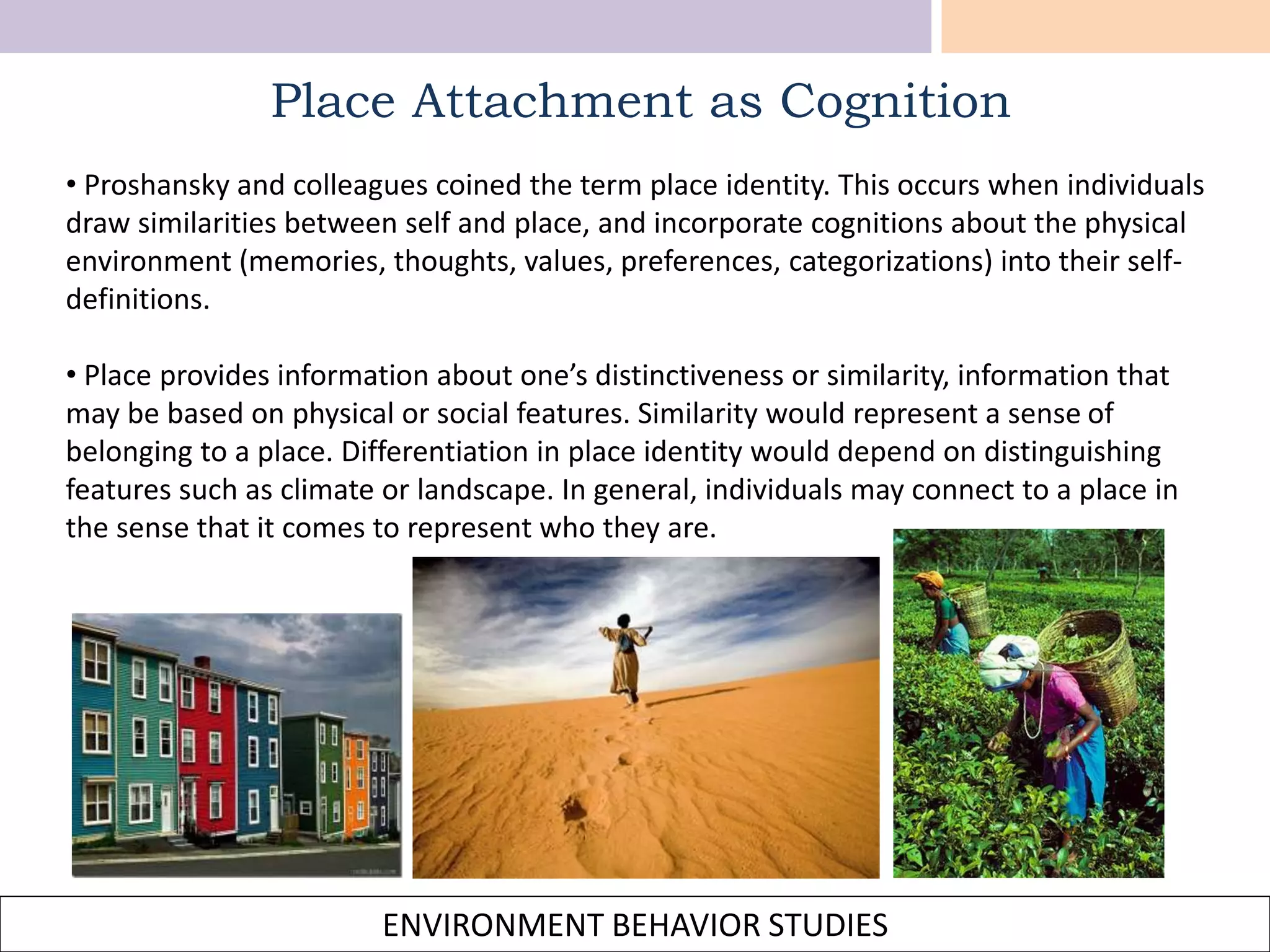
• Proshansky and colleagues coined the term place identity. This occurs when individuals
draw similarities between self and place, and incorporate cognitions about the physical
environment (memories, thoughts, values, preferences, categorizations) into their self-
definitions.
• Place provides information about one’s distinctiveness or similarity, information that
may be based on physical or social features. Similarity would represent a sense of
belonging to a place. Differentiation in place identity would depend on distinguishing
features such as climate or landscape. In general, individuals may connect to a place in
the sense that it comes to represent who they are.
Place Attachment as Cognition
ENVIRONMENT BEHAVIOR STUDIES
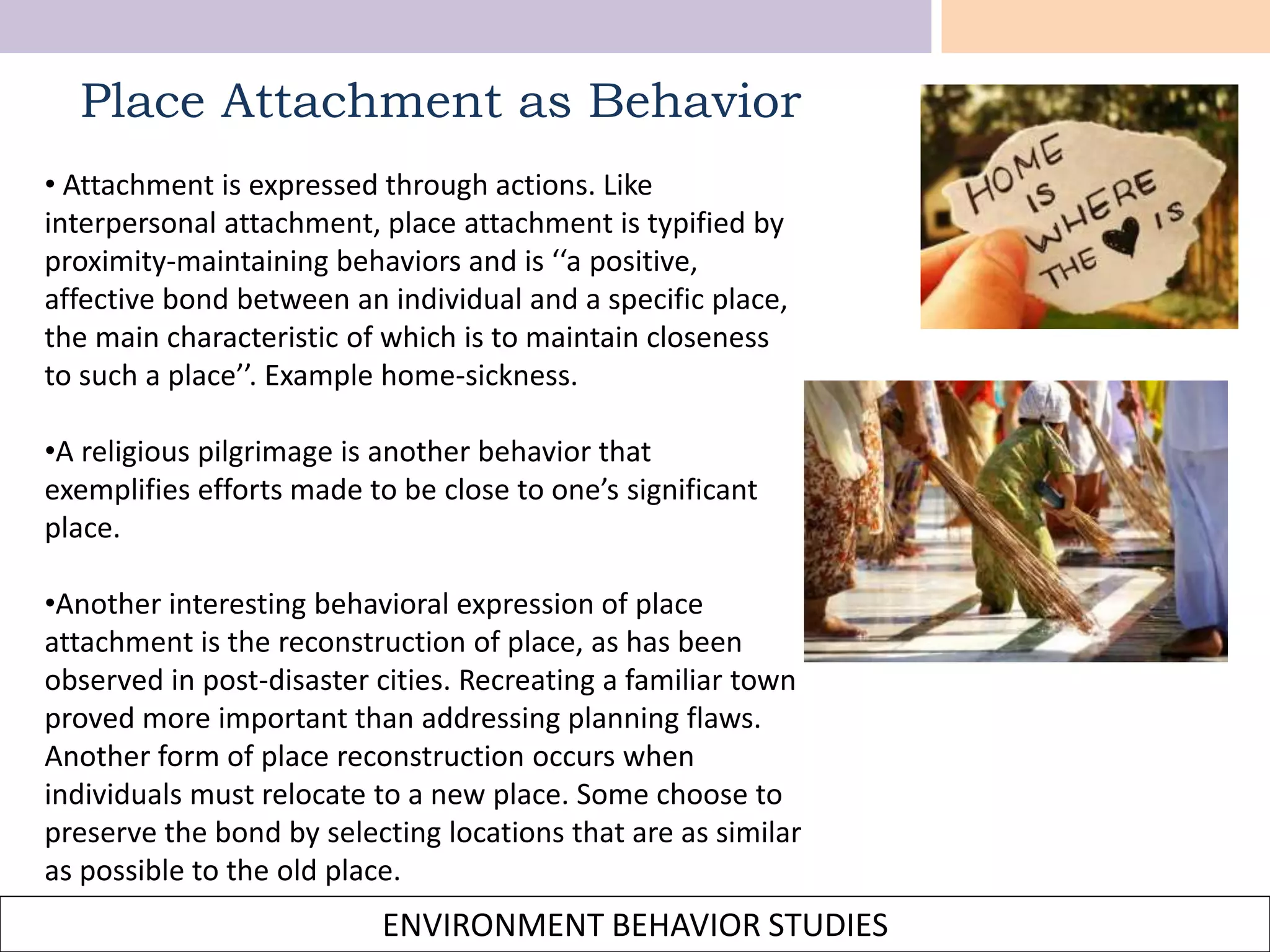
• Attachment is expressed through actions. Like
interpersonal attachment, place attachment is typified by
proximity-maintaining behaviors and is ‘‘a positive,
affective bond between an individual and a specific place,
the main characteristic of which is to maintain closeness
to such a place’’. Example home-sickness.
•A religious pilgrimage is another behavior that
exemplifies efforts made to be close to one’s significant
place.
•Another interesting behavioral expression of place
attachment is the reconstruction of place, as has been
observed in post-disaster cities. Recreating a familiar town
proved more important than addressing planning flaws.
Another form of place reconstruction occurs when
individuals must relocate to a new place. Some choose to
preserve the bond by selecting locations that are as similar
as possible to the old place.
Place Attachment as Behavior
ENVIRONMENT BEHAVIOR STUDIES
• Place attachment behaviors are not necessarily territorial,
although the two may overlap, given that place use is an
element of both.
• Territoriality is based on ownership, control of space, but
attachment to places is an affective, proximity-maintaining bond
that can be expressed without an underlying purpose of control,
especially for public spaces such as parks or cafe´ s, or sacred
spaces.
• Further, territorial behaviors include marking, personalization
and territorial defense, whereas place attachment behaviors
include pilgrimages, social support, and place restoration.
• The behavioral level of place attachment, therefore, is founded
on the desire to remain close to a place, and can be expressed
in part, by proximity-maintaining in concert with journeys away,
place reconstruction, and relocation to similar places.
ENVIRONMENT BEHAVIOR STUDIES
Place as a dimension
Perhaps the most important dimension of place attachment is the place
itself. What is it about the place to which we connect?
Place as a dimension has typically been divided into two levels: social and
physical place attachment. While social attachment, or ‘‘bondedness’’
consists of social ties, belongingness to the neighborhood, and familiarity
with fellow residents and neighborhood children, and that physical
attachment, or ‘‘rootedness’’ is predicted by length of residence and
ownership.
ENVIRONMENT BEHAVIOR STUDIES
• People are attached to places that facilitate
social relationships and group identity. In a
study, attachment in a London neighborhood
was based on the ability to frequently interact
with relatives.
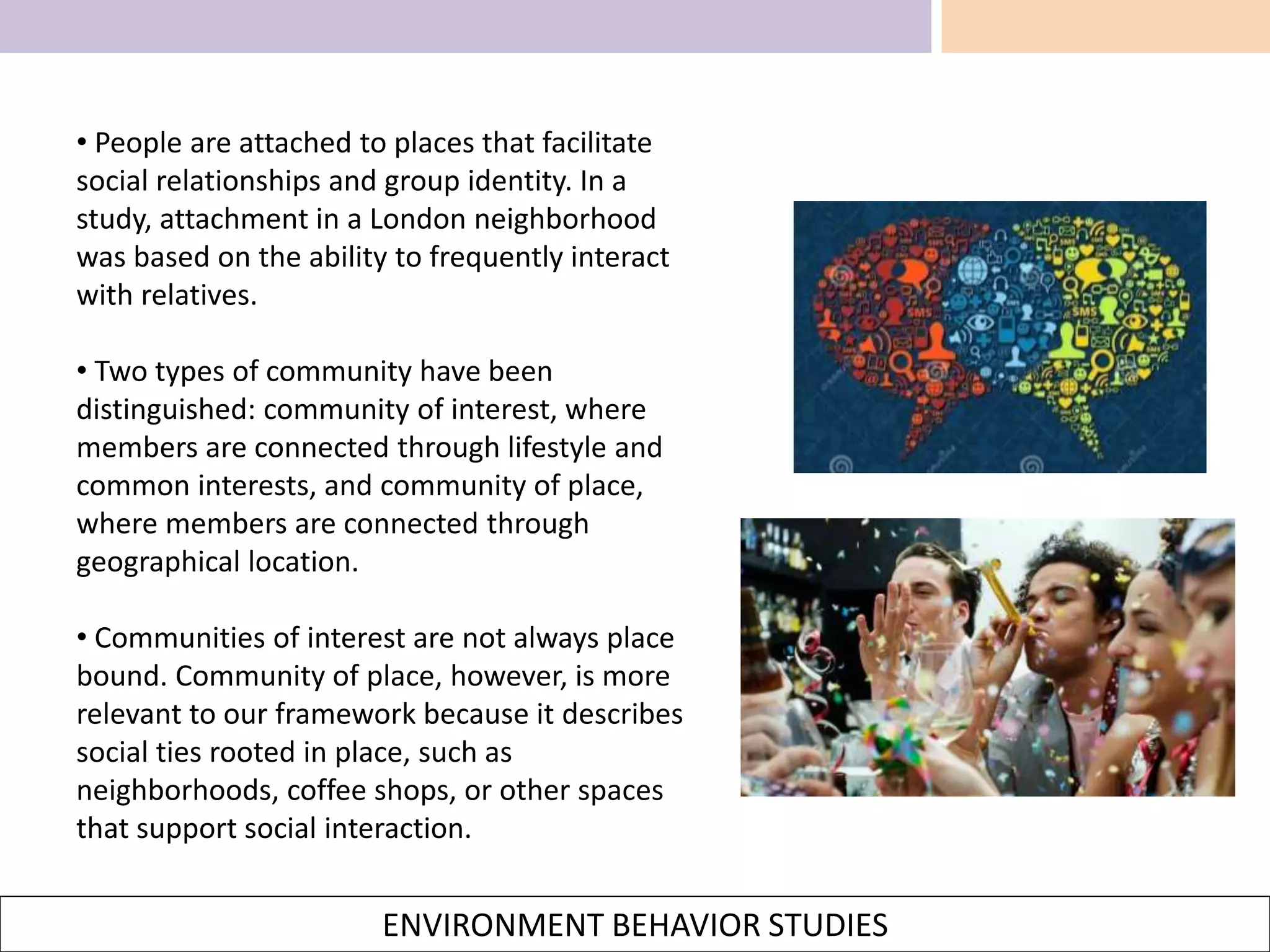
• Two types of community have been
distinguished: community of interest, where
members are connected through lifestyle and
common interests, and community of place,
where members are connected through
geographical location.
• Communities of interest are not always place
bound. Community of place, however, is more
relevant to our framework because it describes
social ties rooted in place, such as
neighborhoods, coffee shops, or other spaces
that support social interaction.
ENVIRONMENT BEHAVIOR STUDIES
Civic place attachment is an instance of group symbolic place attachment that occurs at
the city level. Nationalism is another example of attachment to, and identification with,
a place representative of one’s group, but on a broader scale.
The types of places that individuals find meaningful represent a broad range of physical
settings, from built environments such as houses, streets, certain buildings to natural
environments such as lakes, parks, trails, forests, and mountains
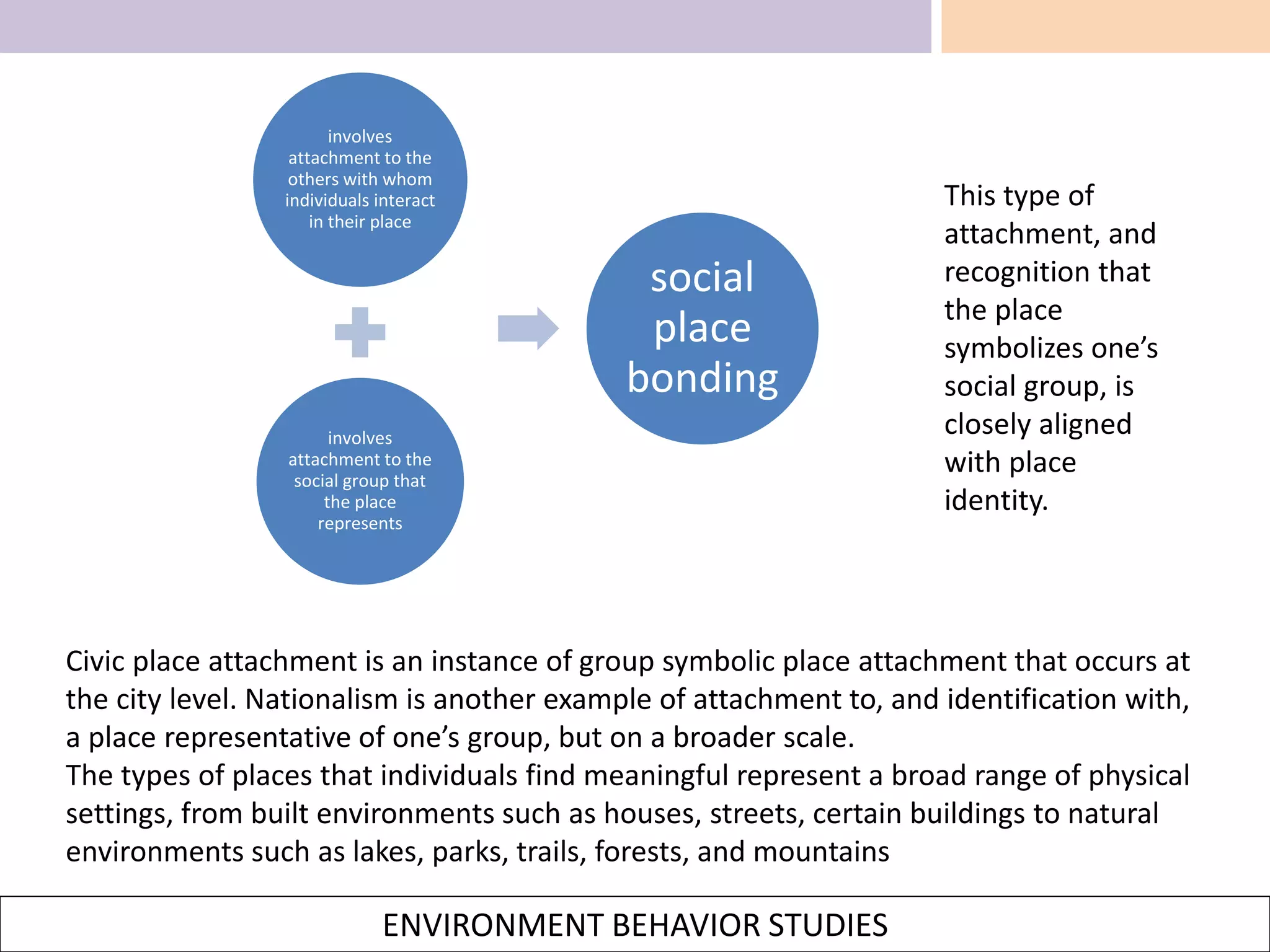
involves
attachment to the
others with whom
individuals interact
in their place
involves
attachment to the
social group that
the place
represents
social
place
bonding
This type of
attachment, and
recognition that
the place
symbolizes one’s
social group, is
closely aligned
with place
identity.
ENVIRONMENT BEHAVIOR STUDIES
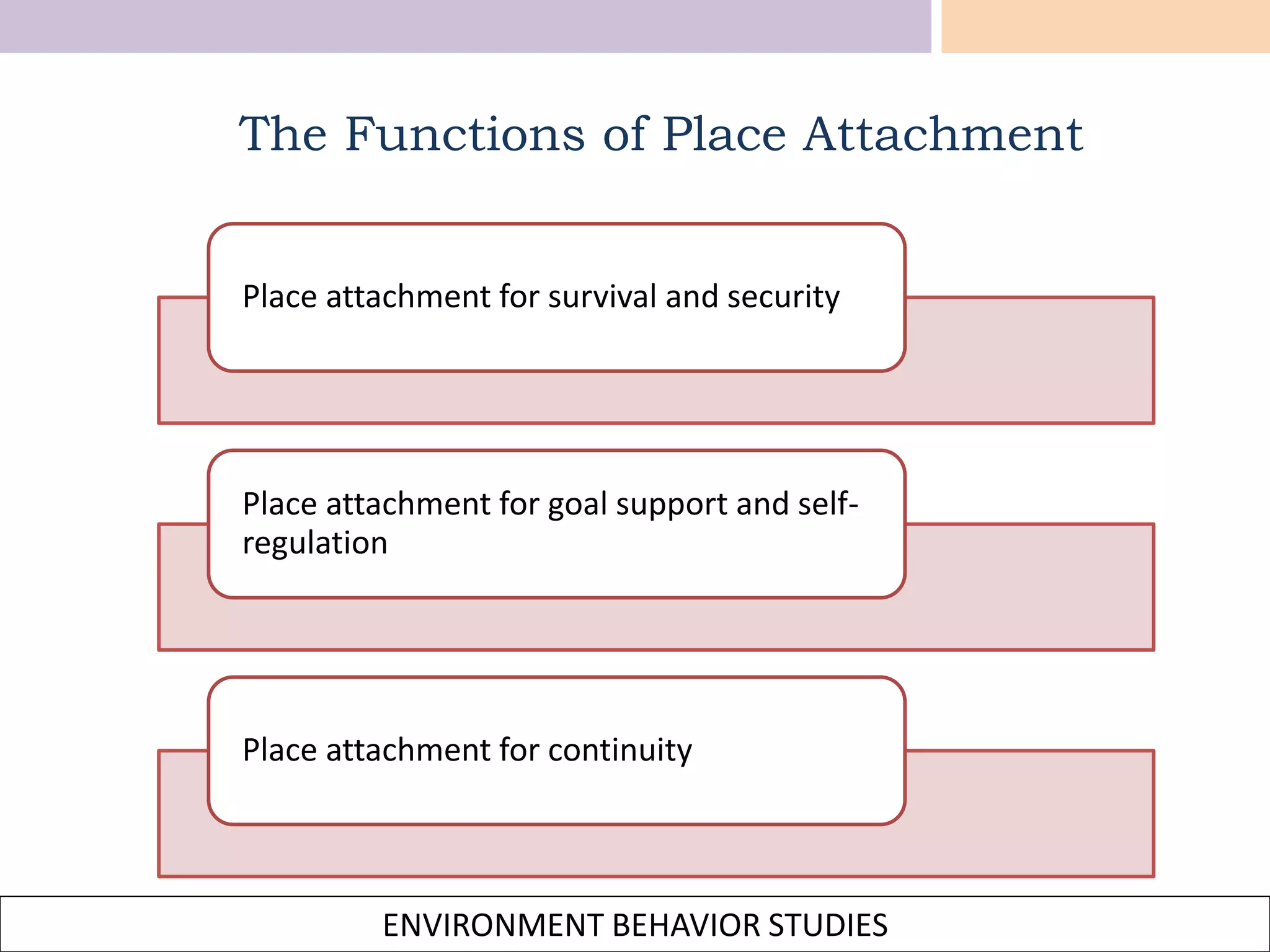
The Functions of Place Attachment
Place attachment for survival and security
Place attachment for goal support and self-
regulation
Place attachment for continuity
ENVIRONMENT BEHAVIOR STUDIES
Place Attachment for Survival and Security
• Security perspectives on place attachment describe the
bond as one of positive affect, cognitions of reduced risk,
and proximity-maintaining behaviors.
• In the event of a personal threat, individuals may exhibit a
sort of ‘‘clinging’’ behavior by reducing their range and
remaining close to home.
• Furthermore, just as attachment behaviors are stronger
among vulnerable individuals (e.g., someone who is
pregnant or sick), Fried suggested that place bonds are
often more intense among vulnerable populations (e.g.,
immigrants).
• Thus, the strong emotional bonds of place attachment,
and its proximity-maintaining behaviors as well as
contrasting journeys away, result from the sense of
safety and security that a place imparts.
ENVIRONMENT BEHAVIOR STUDIES
Place attachment for goal support and self-regulation
• Individuals also become attached to
places that support the pursuit of
their goals.
• This perspective suggests that the
positive affective content of the bond
results from successful goal pursuit,
the cognitions consist of expectations
of goal attainment based on past
experiences, the behavior expressed
is repeated place use, and the place
focus is social or physical, depending
on the particular goals sought.
• This can lead to place dependence,
a type of attachment in which
individuals value a place for the
specific activities that it supports or
facilitates
ENVIRONMENT BEHAVIOR STUDIES
• Self-regulation is the process in which current
behavior is compared to one’s greater goals and
standards in order to evaluate progress
towards the goal.
• Place Attachment serves self-regulation
because favorite places have restorative
qualities. A favorite place is a safe haven, where
individuals can plan for the implementation of
their goals, and can
evaluate their progress.
ENVIRONMENT BEHAVIOR STUDIES
Place attachment for continuity
This function stems from individual attachment to a
place that is symbolically meaningful through
memories and connections to the past. For instance,
childhood homes, ancestral villages that seem to link
us to those people we have lost.
The place serves as a physical representation of
important events, and seems to contain their essence,
or preserve them. In this sense, a setting represents
part of an individual’s personal history.
The continuity function can also exist at the cultural or
religious
Level. Places where important cultural events have
transpired become meaningful for that group.
Behaviors at this level include pilgrimages to a sacred
place, designations that the place is an historic site, or
stories and myths that convey the significance of the
place.
ENVIRONMENT BEHAVIOR STUDIES
According to our person–process–place (PPP) framework, place
attachment is a bond between an individual or group and a place
that can vary in terms of spatial level, degree of specificity, and
social or physical features of the place, and is manifested through
affective, cognitive, and behavioral psychological processes.
However, the question of why people develop such enduring
psychological bonds with place remains. Most likely, place
attachment bonds exist because they serve several functions as
discussed above.
The goal is to plan successful and meaningful places. Conflicts can
arise from planning when places mean different things to different
people. The end goals are to create shared values and social
capital among the factions, but the unique place meanings held by
each must first be unearthed.
Conclusion

Defining place attachment

  • 1.
    Defining Place Attachment . A TripartiteOrganizing Framework ENVIRONMENT BEHAVIOR STUDIES Authors: Leila Scannell, Robert Gifford
  • 2.
    ENVIRONMENT BEHAVIOR STUDIES •Place attachment is defined as a multifaceted concept that characterizes the bonding between individuals and their important places. • However, variations in this definition are vast. • different studies consider different aspects in its analysis.
  • 3.
    ENVIRONMENT BEHAVIOR STUDIES WhyStudy Place Attachment???? •Place attachment as an emotional bond has shed light on the distress and grief expressed by those who are forced to relocate. Place attachment has thus been applied to disaster psychology, immigration and mobility. • Place meaning and attachment can be used to plan and encourage the use of public spaces, such as national parks. • Attached individuals experience a heightened sense of safety, even when their place is situated in a war zone. On a smaller scale, attachment to one’s neighborhood is associated with fewer perceived incivilities (e.g., drug dealing, gang activity, traffic, etc.) on one’s block and less fear of neighborhood Crime.
  • 4.
    ENVIRONMENT BEHAVIOR STUDIES TheTripartite Organizing Framework •Its a three-dimensional framework of place attachment that usefully structures the varied definitions in the literature of place attachment. •This framework proposes that place attachment is a multidimensional concept with person, psychological process, and place dimensions. •The first dimension is the actor: who is attached? •The second dimension is the psychological process: how are affect, cognition, and behavior manifested in the attachment? •The third dimension is the object of the attachment, including place characteristics: what is the attachment to, and what is the nature of, this place?
  • 5.
    ENVIRONMENT BEHAVIOR STUDIES Asknowledge grows about the specific levels within each of these dimensions, a comprehensive understanding of place attachment will be reached.
  • 6.
    ENVIRONMENT BEHAVIOR STUDIES Personas dimension • At the individual level, it involves the personal connections one has to a place. For example, place attachment is stronger for settings that evoke personal memories, and this type of place attachment is thought to contribute to a stable sense of self. • Similarly, places become meaningful from personally important experiences, such as realizations, milestones (e.g., where I first met my significant other), and experiences of personal growth. • Although other theorists argue that place characteristics are integral in the construction of place meaning, the argument that individual experiences may form the basis for the attachment is convincing.
  • 7.
    ENVIRONMENT BEHAVIOR STUDIES •Atthe group level, attachment is comprised of the symbolic meanings of a place that are shared among members. •Attachment has been described as a community process in which groups become attached to areas wherein they may practice, and thus preserve, their cultures. •Culture links members to place through shared historical experiences, values, and symbols and these meanings are transmitted to subsequent generations.
  • 8.
    ENVIRONMENT BEHAVIOR STUDIES •Inaddition, place attachment may be religiously based. Through religion, the meanings of certain places become elevated to the status of sacred and their scared meanings are shared among worshippers. •A place may gain spiritual significance through personal experiences. Cultural place meanings and values influence the extent of individual place attachment, and individual experiences within a place, if positive, can maintain and possibly strengthen cultural place attachment.
  • 9.
    ENVIRONMENT BEHAVIOR STUDIES Thesecond dimension of place attachment concerns the way that individuals and groups relate to a place, and the nature of the psychological interactions that occur in the environments that are important to them. Three parameters of analysis of this dimension are affect, cognition, and behavior. Psychological Process
  • 10.
    ENVIRONMENT BEHAVIOR STUDIES •Tuancoined the word ‘‘topophilia’’ or ‘‘love of place,’’ and Relph defined place attachment as the authentic and emotional bond with an environment that satisfies a fundamental human need. • In his classic study on the effects of displacement, Fried (1963) investigated a neighborhood redevelopment project in the West End of Boston. The ‘‘improvements’’ planned for the neighborhood caused the residents to lose familiar structures and social settings, and many of them were forced to move. Essentially, this reconstruction meant the collapse of a tight-knit community. After the fact, residents mourned and displayed symptoms of grief. •But that does not necessarily mean the bond is positive. Rather, unhappy or traumatic experiences in a place may create negative feelings or even aversion toward it. Place Attachment as Affect
  • 11.
    ENVIRONMENT BEHAVIOR STUDIES •Proshansky and colleagues coined the term place identity. This occurs when individuals draw similarities between self and place, and incorporate cognitions about the physical environment (memories, thoughts, values, preferences, categorizations) into their self- definitions. • Place provides information about one’s distinctiveness or similarity, information that may be based on physical or social features. Similarity would represent a sense of belonging to a place. Differentiation in place identity would depend on distinguishing features such as climate or landscape. In general, individuals may connect to a place in the sense that it comes to represent who they are. Place Attachment as Cognition
  • 12.
    ENVIRONMENT BEHAVIOR STUDIES •Attachment is expressed through actions. Like interpersonal attachment, place attachment is typified by proximity-maintaining behaviors and is ‘‘a positive, affective bond between an individual and a specific place, the main characteristic of which is to maintain closeness to such a place’’. Example home-sickness. •A religious pilgrimage is another behavior that exemplifies efforts made to be close to one’s significant place. •Another interesting behavioral expression of place attachment is the reconstruction of place, as has been observed in post-disaster cities. Recreating a familiar town proved more important than addressing planning flaws. Another form of place reconstruction occurs when individuals must relocate to a new place. Some choose to preserve the bond by selecting locations that are as similar as possible to the old place. Place Attachment as Behavior
  • 13.
    ENVIRONMENT BEHAVIOR STUDIES •Place attachment behaviors are not necessarily territorial, although the two may overlap, given that place use is an element of both. • Territoriality is based on ownership, control of space, but attachment to places is an affective, proximity-maintaining bond that can be expressed without an underlying purpose of control, especially for public spaces such as parks or cafe´ s, or sacred spaces. • Further, territorial behaviors include marking, personalization and territorial defense, whereas place attachment behaviors include pilgrimages, social support, and place restoration. • The behavioral level of place attachment, therefore, is founded on the desire to remain close to a place, and can be expressed in part, by proximity-maintaining in concert with journeys away, place reconstruction, and relocation to similar places.
  • 14.
    ENVIRONMENT BEHAVIOR STUDIES Placeas a dimension Perhaps the most important dimension of place attachment is the place itself. What is it about the place to which we connect? Place as a dimension has typically been divided into two levels: social and physical place attachment. While social attachment, or ‘‘bondedness’’ consists of social ties, belongingness to the neighborhood, and familiarity with fellow residents and neighborhood children, and that physical attachment, or ‘‘rootedness’’ is predicted by length of residence and ownership.
  • 15.
    ENVIRONMENT BEHAVIOR STUDIES •People are attached to places that facilitate social relationships and group identity. In a study, attachment in a London neighborhood was based on the ability to frequently interact with relatives. • Two types of community have been distinguished: community of interest, where members are connected through lifestyle and common interests, and community of place, where members are connected through geographical location. • Communities of interest are not always place bound. Community of place, however, is more relevant to our framework because it describes social ties rooted in place, such as neighborhoods, coffee shops, or other spaces that support social interaction.
  • 16.
    ENVIRONMENT BEHAVIOR STUDIES Civicplace attachment is an instance of group symbolic place attachment that occurs at the city level. Nationalism is another example of attachment to, and identification with, a place representative of one’s group, but on a broader scale. The types of places that individuals find meaningful represent a broad range of physical settings, from built environments such as houses, streets, certain buildings to natural environments such as lakes, parks, trails, forests, and mountains involves attachment to the others with whom individuals interact in their place involves attachment to the social group that the place represents social place bonding This type of attachment, and recognition that the place symbolizes one’s social group, is closely aligned with place identity.
  • 17.
    ENVIRONMENT BEHAVIOR STUDIES TheFunctions of Place Attachment Place attachment for survival and security Place attachment for goal support and self- regulation Place attachment for continuity
  • 18.
    ENVIRONMENT BEHAVIOR STUDIES PlaceAttachment for Survival and Security • Security perspectives on place attachment describe the bond as one of positive affect, cognitions of reduced risk, and proximity-maintaining behaviors. • In the event of a personal threat, individuals may exhibit a sort of ‘‘clinging’’ behavior by reducing their range and remaining close to home. • Furthermore, just as attachment behaviors are stronger among vulnerable individuals (e.g., someone who is pregnant or sick), Fried suggested that place bonds are often more intense among vulnerable populations (e.g., immigrants). • Thus, the strong emotional bonds of place attachment, and its proximity-maintaining behaviors as well as contrasting journeys away, result from the sense of safety and security that a place imparts.
  • 19.
    ENVIRONMENT BEHAVIOR STUDIES Placeattachment for goal support and self-regulation • Individuals also become attached to places that support the pursuit of their goals. • This perspective suggests that the positive affective content of the bond results from successful goal pursuit, the cognitions consist of expectations of goal attainment based on past experiences, the behavior expressed is repeated place use, and the place focus is social or physical, depending on the particular goals sought. • This can lead to place dependence, a type of attachment in which individuals value a place for the specific activities that it supports or facilitates
  • 20.
    ENVIRONMENT BEHAVIOR STUDIES •Self-regulation is the process in which current behavior is compared to one’s greater goals and standards in order to evaluate progress towards the goal. • Place Attachment serves self-regulation because favorite places have restorative qualities. A favorite place is a safe haven, where individuals can plan for the implementation of their goals, and can evaluate their progress.
  • 21.
    ENVIRONMENT BEHAVIOR STUDIES Placeattachment for continuity This function stems from individual attachment to a place that is symbolically meaningful through memories and connections to the past. For instance, childhood homes, ancestral villages that seem to link us to those people we have lost. The place serves as a physical representation of important events, and seems to contain their essence, or preserve them. In this sense, a setting represents part of an individual’s personal history. The continuity function can also exist at the cultural or religious Level. Places where important cultural events have transpired become meaningful for that group. Behaviors at this level include pilgrimages to a sacred place, designations that the place is an historic site, or stories and myths that convey the significance of the place.
  • 22.
    ENVIRONMENT BEHAVIOR STUDIES Accordingto our person–process–place (PPP) framework, place attachment is a bond between an individual or group and a place that can vary in terms of spatial level, degree of specificity, and social or physical features of the place, and is manifested through affective, cognitive, and behavioral psychological processes. However, the question of why people develop such enduring psychological bonds with place remains. Most likely, place attachment bonds exist because they serve several functions as discussed above. The goal is to plan successful and meaningful places. Conflicts can arise from planning when places mean different things to different people. The end goals are to create shared values and social capital among the factions, but the unique place meanings held by each must first be unearthed. Conclusion