ANDROID BASED
COLOURED LINE FOLLOWER
ROBOT
Presented by >DEEPAK POUL
R NO=09
USN =1NT14LVS09
contents
 Introduction
 Block diagram
 Sensors
 Line sensor
 Obstacle sensor
 Comparator
 Rfid reader
 Driver ic
 Android control
 Applications
 conclusion
 References
Introduction
 Line follower robots are monotype mobile robot having the ability to follow a
line very accurately which has an on board hardwired control circuit.
 Robot having the ability to choose a desired line among multiple coloured
lines
 It has the ability of avoiding collision.
 From the android mobile, instructions are given to the robot that senses a
line and endeavours itself accordingly towards the desired target by
correcting the wrong moves using a simple feedback mechanism but yet very
effective closed loop system.
Block diagram
 The Android mobile sends commands to the PIC Microcontroller
using Bluetooth and UART communication.
 The proposed system consists of a PIC controller interfaced
with three IR sensors for detecting the direction of movement
for the robot.
 obstacle detector prevents the robot from hitting any obstacles
by stopping the robot once any object is detected.
 RFID reader detect the desired target by detecting RFID tag
placed at the destination.
Sensors
The robot uses two different types of sensors
 line sensor and
 IR obstacle sensor
these sensors gather all the necessary information
Line Sensor
 An infrared emitter is an LED made from
gallium arsenide, which emits near infrared energy at
About 880nm.
 IR reflectance sensors contain a matched infrared
transmitter and infrared receiver pair.
 IR reflectance sensors are often used to detect white
and black surfaces.
 White surfaces generally reflect well, while black surfaces
reflect poorly.
 All the other colours have voltage drops in between white and
black colour.
Line sensor arrangement and working
Obstacle Sensor
 An IR sensor is used for detecting presence of an obstacle.
 The sensor consists of an IR transmitter and receiver.
There is an IR LED.
 The receiver of the IR sensor picks up the reflected IR
light and produces a logic '1' which then forces the robot
to stop. Otherwise the output of the IR sensor is logic '0'.
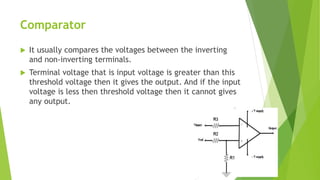
Comparator
 It usually compares the voltages between the inverting
and non-inverting terminals.
 Terminal voltage that is input voltage is greater than this
threshold voltage then it gives the output. And if the input
voltage is less then threshold voltage then it cannot gives
any output.
RFID Reader
 RFID is a method of identifying unique items using radio
waves.
 RFID reader reads the desired tag only when instructions
given to the robot through android mobile.
 suppose ambient light interfacing with sensor, it disturb
the transitions of data at that time sensors are not going
to identify the colour lines. In these conditions RFID
reader detect the desired target by detecting RFID tag
placed at the destination.
Motor Driver Ic
 Motor driver act like the current amplifier. It is use
for controlling the current in the motor.
 ULN2003 IC can control the two dc motor
simultaneously.
 It can rotate the motor in the forward and reverse
direction.
ANDROID CONTROL
 Android is a mobile operating system that is based on modified version
of Linux.
 The robot is controlled via Bluetooth, that receives the data from the
mobile and also can transmit the data.
 Android smart phone is used as a remote control for operating the
Robot, DC motors.
Applications
 guidance system for industrial robots moving on shop
floors.
 In restaurant it is used as robotic waiter (downtown
Harbin, China, employs 20 robots )
 In library to carry books from one place to another place
.
CONCLUSIONS
 This robot can follow not only black and white colours but
also some other different colours.
 It makes the use of instructions from sensors and on board
PIC Microcontroller, which performs the physical
movements.
 The robot is succeeded to locate and follow the target by
giving instruction through android mobile.
 If the conditions are properly set and calculations are
accurately done, then performance rate and accuracy will
be more than ever.
REFERENCES
 [1].Ramshetty sure,Savita patil “ANDROID BASED AUTONOMOUS COLOURED LINE
FOLLOWER ROBOT ” NCRIET 2014 ,Bhalki.
 [2]Pakdaman,M.Sanaatiyan,M.M.,"Design and Implementation of Line Follower
Robot,", Second International Conference on Computer and Electrical Engineering
TCCEE '09, vol.2, pp.585-590,Dec.2009.
 [3]. PriyankPatil,"AVR Line Following Robot,” Department of Information
Technology K. 1. Somaiya College of Engineering Mumbai, India. Mar 5, 2010.
 [4]. Dean A. Pomerleau; Jay Gowdy; Charles E. Thorpe, “Combining Artificial
Neural Networks and Symbolic Processing for Autonomous Robot Guidance," Engng
Applic. Artif. Intell. Vol. 4, No. 4, pp. 279-285, 1991.
 [5]. L1U Shi-Cai,L1U Guang-Jun, "Formation Control of Mobile Robots with Active
Obstacle Avoidance," Acta Automatica Sinica, Vol. 33, No. 5, 2007.
 [6]. YANG Tian-Tian; L1U Zhi-Yuan; CHEN Hong; PEl Run, "Formation Control and
Obstacle Avoidance for Multiple Mobile Robots," Acta Automatica Sinica, Vol. 34,
No. 5, 2008.
Deepak ppt

Deepak ppt

  • 1.
    ANDROID BASED COLOURED LINEFOLLOWER ROBOT Presented by >DEEPAK POUL R NO=09 USN =1NT14LVS09
  • 2.
    contents  Introduction  Blockdiagram  Sensors  Line sensor  Obstacle sensor  Comparator  Rfid reader  Driver ic  Android control  Applications  conclusion  References
  • 3.
    Introduction  Line followerrobots are monotype mobile robot having the ability to follow a line very accurately which has an on board hardwired control circuit.  Robot having the ability to choose a desired line among multiple coloured lines  It has the ability of avoiding collision.  From the android mobile, instructions are given to the robot that senses a line and endeavours itself accordingly towards the desired target by correcting the wrong moves using a simple feedback mechanism but yet very effective closed loop system.
  • 4.
  • 5.
     The Androidmobile sends commands to the PIC Microcontroller using Bluetooth and UART communication.  The proposed system consists of a PIC controller interfaced with three IR sensors for detecting the direction of movement for the robot.  obstacle detector prevents the robot from hitting any obstacles by stopping the robot once any object is detected.  RFID reader detect the desired target by detecting RFID tag placed at the destination.
  • 6.
    Sensors The robot usestwo different types of sensors  line sensor and  IR obstacle sensor these sensors gather all the necessary information
  • 7.
    Line Sensor  Aninfrared emitter is an LED made from gallium arsenide, which emits near infrared energy at About 880nm.  IR reflectance sensors contain a matched infrared transmitter and infrared receiver pair.  IR reflectance sensors are often used to detect white and black surfaces.
  • 8.
     White surfacesgenerally reflect well, while black surfaces reflect poorly.  All the other colours have voltage drops in between white and black colour. Line sensor arrangement and working
  • 9.
    Obstacle Sensor  AnIR sensor is used for detecting presence of an obstacle.  The sensor consists of an IR transmitter and receiver. There is an IR LED.  The receiver of the IR sensor picks up the reflected IR light and produces a logic '1' which then forces the robot to stop. Otherwise the output of the IR sensor is logic '0'.
  • 10.
    Comparator  It usuallycompares the voltages between the inverting and non-inverting terminals.  Terminal voltage that is input voltage is greater than this threshold voltage then it gives the output. And if the input voltage is less then threshold voltage then it cannot gives any output.
  • 11.
    RFID Reader  RFIDis a method of identifying unique items using radio waves.  RFID reader reads the desired tag only when instructions given to the robot through android mobile.  suppose ambient light interfacing with sensor, it disturb the transitions of data at that time sensors are not going to identify the colour lines. In these conditions RFID reader detect the desired target by detecting RFID tag placed at the destination.
  • 12.
    Motor Driver Ic Motor driver act like the current amplifier. It is use for controlling the current in the motor.  ULN2003 IC can control the two dc motor simultaneously.  It can rotate the motor in the forward and reverse direction.
  • 13.
    ANDROID CONTROL  Androidis a mobile operating system that is based on modified version of Linux.  The robot is controlled via Bluetooth, that receives the data from the mobile and also can transmit the data.  Android smart phone is used as a remote control for operating the Robot, DC motors.
  • 14.
    Applications  guidance systemfor industrial robots moving on shop floors.  In restaurant it is used as robotic waiter (downtown Harbin, China, employs 20 robots )  In library to carry books from one place to another place .
  • 15.
    CONCLUSIONS  This robotcan follow not only black and white colours but also some other different colours.  It makes the use of instructions from sensors and on board PIC Microcontroller, which performs the physical movements.  The robot is succeeded to locate and follow the target by giving instruction through android mobile.  If the conditions are properly set and calculations are accurately done, then performance rate and accuracy will be more than ever.
  • 16.
    REFERENCES  [1].Ramshetty sure,Savitapatil “ANDROID BASED AUTONOMOUS COLOURED LINE FOLLOWER ROBOT ” NCRIET 2014 ,Bhalki.  [2]Pakdaman,M.Sanaatiyan,M.M.,"Design and Implementation of Line Follower Robot,", Second International Conference on Computer and Electrical Engineering TCCEE '09, vol.2, pp.585-590,Dec.2009.  [3]. PriyankPatil,"AVR Line Following Robot,” Department of Information Technology K. 1. Somaiya College of Engineering Mumbai, India. Mar 5, 2010.  [4]. Dean A. Pomerleau; Jay Gowdy; Charles E. Thorpe, “Combining Artificial Neural Networks and Symbolic Processing for Autonomous Robot Guidance," Engng Applic. Artif. Intell. Vol. 4, No. 4, pp. 279-285, 1991.  [5]. L1U Shi-Cai,L1U Guang-Jun, "Formation Control of Mobile Robots with Active Obstacle Avoidance," Acta Automatica Sinica, Vol. 33, No. 5, 2007.  [6]. YANG Tian-Tian; L1U Zhi-Yuan; CHEN Hong; PEl Run, "Formation Control and Obstacle Avoidance for Multiple Mobile Robots," Acta Automatica Sinica, Vol. 34, No. 5, 2008.