Q1-
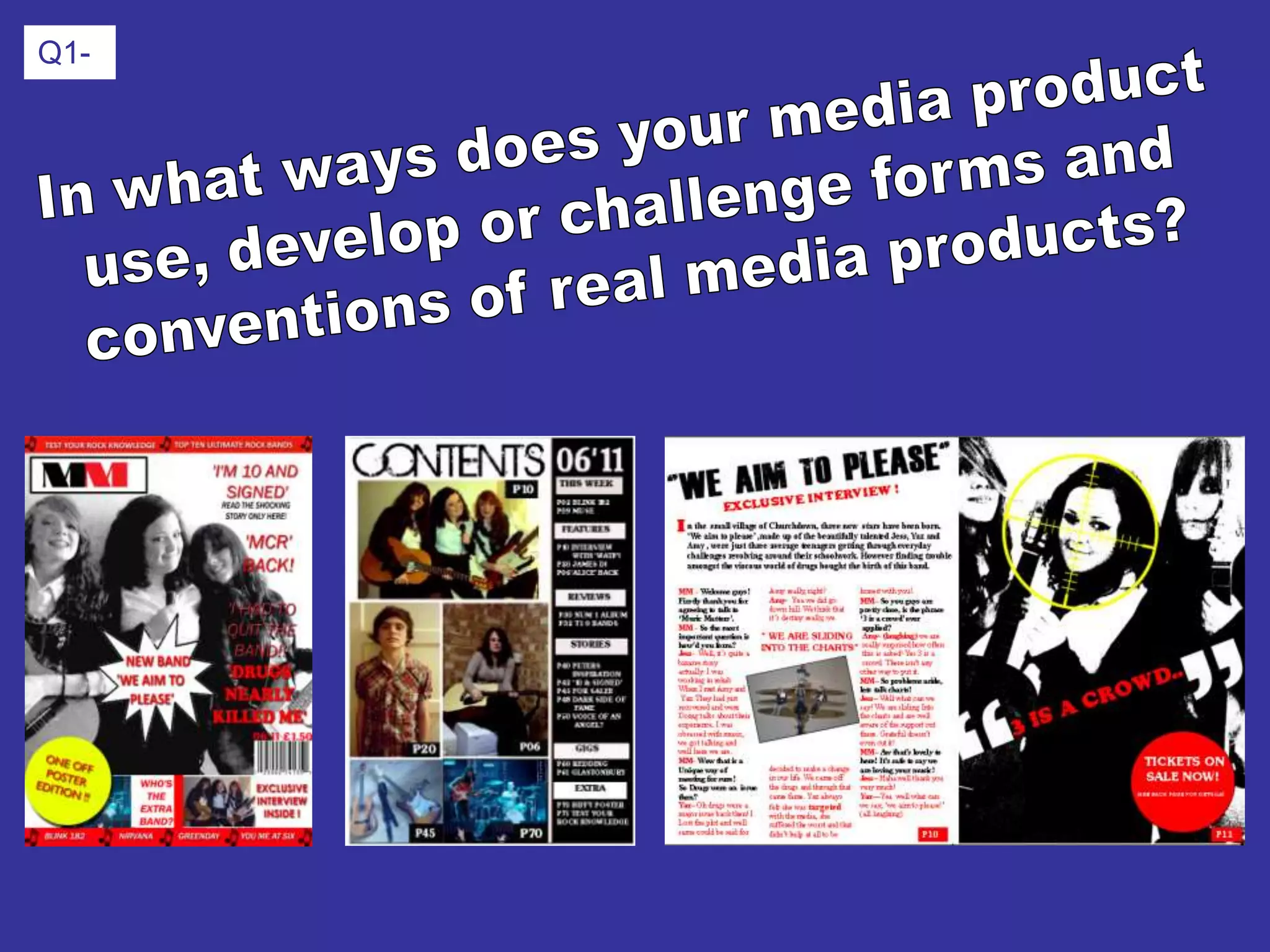
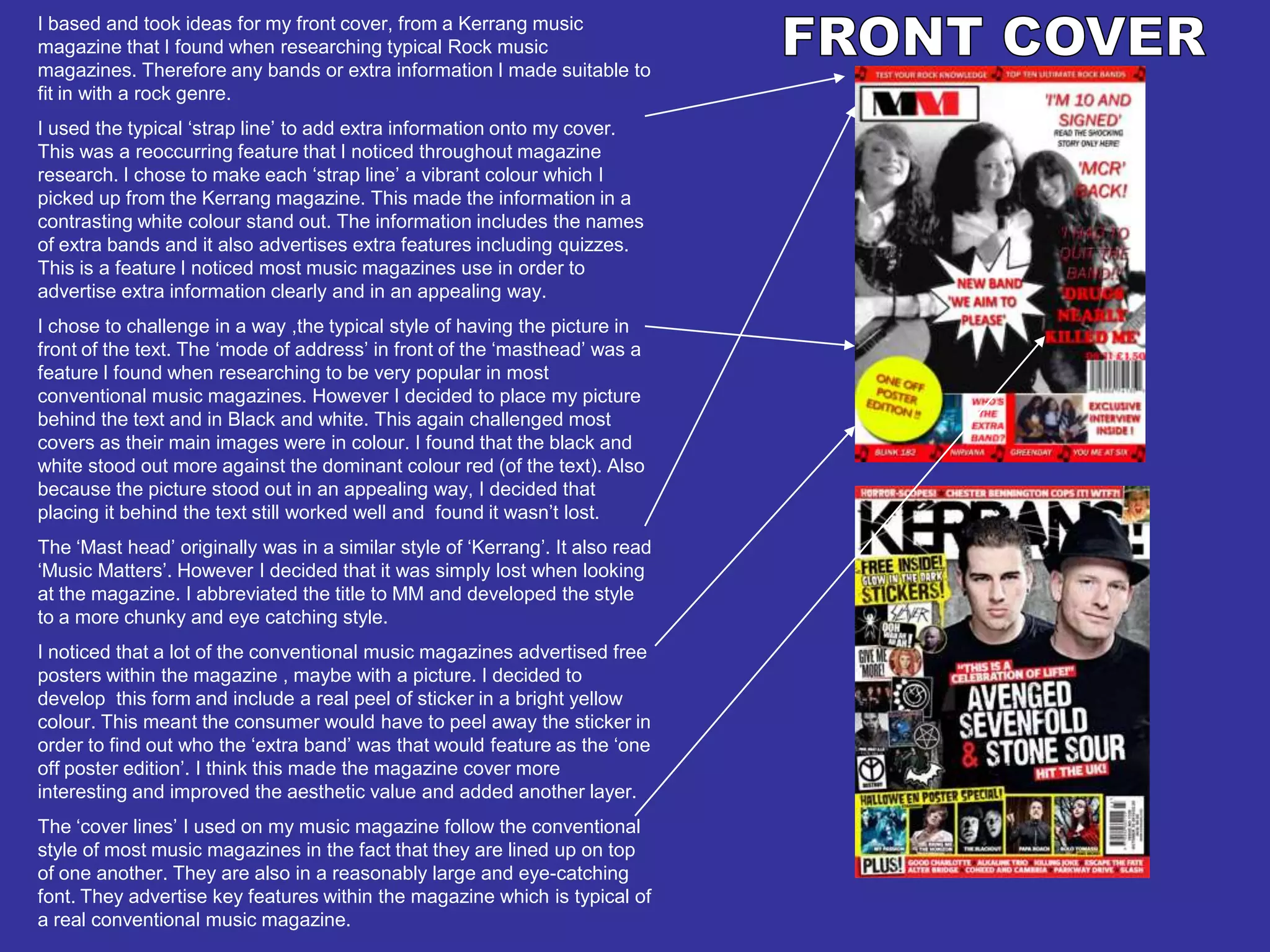
I based and took ideas for my front cover, from a Kerrang music
magazine that I found when researching typical Rock music
magazines. Therefore any bands or extra information I made suitable to
fit in with a rock genre.
I used the typical ‘strap line’ to add extra information onto my cover.
This was a reoccurring feature that I noticed throughout magazine
research. I chose to make each ‘strap line’ a vibrant colour which I
picked up from the Kerrang magazine. This made the information in a
contrasting white colour stand out. The information includes the names
of extra bands and it also advertises extra features including quizzes.
This is a feature I noticed most music magazines use in order to
advertise extra information clearly and in an appealing way.
I chose to challenge in a way ,the typical style of having the picture in
front of the text. The ‘mode of address’ in front of the ‘masthead’ was a
feature I found when researching to be very popular in most
conventional music magazines. However I decided to place my picture
behind the text and in Black and white. This again challenged most
covers as their main images were in colour. I found that the black and
white stood out more against the dominant colour red (of the text). Also
because the picture stood out in an appealing way, I decided that
placing it behind the text still worked well and found it wasn’t lost.
The ‘Mast head’ originally was in a similar style of ‘Kerrang’. It also read
‘Music Matters’. However I decided that it was simply lost when looking
at the magazine. I abbreviated the title to MM and developed the style
to a more chunky and eye catching style.
I noticed that a lot of the conventional music magazines advertised free
posters within the magazine , maybe with a picture. I decided to
develop this form and include a real peel of sticker in a bright yellow
colour. This meant the consumer would have to peel away the sticker in
order to find out who the ‘extra band’ was that would feature as the ‘one
off poster edition’. I think this made the magazine cover more
interesting and improved the aesthetic value and added another layer.
The ‘cover lines’ I used on my music magazine follow the conventional
style of most music magazines in the fact that they are lined up on top
of one another. They are also in a reasonably large and eye-catching
font. They advertise key features within the magazine which is typical of
a real conventional music magazine.
Presentation1
Presentation1

Presentation1

  • 1.
  • 2.
    I based andtook ideas for my front cover, from a Kerrang music magazine that I found when researching typical Rock music magazines. Therefore any bands or extra information I made suitable to fit in with a rock genre. I used the typical ‘strap line’ to add extra information onto my cover. This was a reoccurring feature that I noticed throughout magazine research. I chose to make each ‘strap line’ a vibrant colour which I picked up from the Kerrang magazine. This made the information in a contrasting white colour stand out. The information includes the names of extra bands and it also advertises extra features including quizzes. This is a feature I noticed most music magazines use in order to advertise extra information clearly and in an appealing way. I chose to challenge in a way ,the typical style of having the picture in front of the text. The ‘mode of address’ in front of the ‘masthead’ was a feature I found when researching to be very popular in most conventional music magazines. However I decided to place my picture behind the text and in Black and white. This again challenged most covers as their main images were in colour. I found that the black and white stood out more against the dominant colour red (of the text). Also because the picture stood out in an appealing way, I decided that placing it behind the text still worked well and found it wasn’t lost. The ‘Mast head’ originally was in a similar style of ‘Kerrang’. It also read ‘Music Matters’. However I decided that it was simply lost when looking at the magazine. I abbreviated the title to MM and developed the style to a more chunky and eye catching style. I noticed that a lot of the conventional music magazines advertised free posters within the magazine , maybe with a picture. I decided to develop this form and include a real peel of sticker in a bright yellow colour. This meant the consumer would have to peel away the sticker in order to find out who the ‘extra band’ was that would feature as the ‘one off poster edition’. I think this made the magazine cover more interesting and improved the aesthetic value and added another layer. The ‘cover lines’ I used on my music magazine follow the conventional style of most music magazines in the fact that they are lined up on top of one another. They are also in a reasonably large and eye-catching font. They advertise key features within the magazine which is typical of a real conventional music magazine.