1) In what ways does your media product use, develop
or challenge forms and conventions of real media
products?
Title
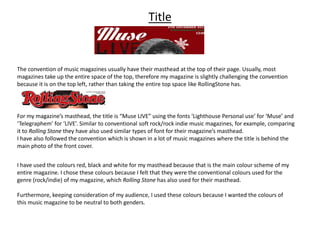
The convention of music magazines usually have their masthead at the top of their page. Usually, most
magazines take up the entire space of the top, therefore my magazine is slightly challenging the convention
because it is on the top left, rather than taking the entire top space like RollingStone has.
For my magazine’s masthead, the title is “Muse LIVE” using the fonts ‘Lighthouse Personal use’ for ‘Muse’ and
‘Telegraphem’ for ‘LIVE’. Similar to conventional soft rock/rock indie music magazines, for example, comparing
it to Rolling Stone they have also used similar types of font for their magazine’s masthead.
I have also followed the convention which is shown in a lot of music magazines where the title is behind the
main photo of the front cover.
I have used the colours red, black and white for my masthead because that is the main colour scheme of my
entire magazine. I chose these colours because I felt that they were the conventional colours used for the
genre (rock/indie) of my magazine, which Rolling Stone has also used for their masthead.
Furthermore, keeping consideration of my audience, I used these colours because I wanted the colours of
this music magazine to be neutral to both genders.
Mis-en-scene
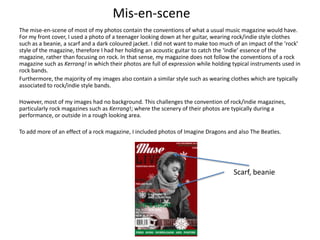
The mise-en-scene of most of my photos contain the conventions of what a usual music magazine would have.
For my front cover, I used a photo of a teenager looking down at her guitar, wearing rock/indie style clothes
such as a beanie, a scarf and a dark coloured jacket. I did not want to make too much of an impact of the ‘rock’
style of the magazine, therefore I had her holding an acoustic guitar to catch the ‘indie’ essence of the
magazine, rather than focusing on rock. In that sense, my magazine does not follow the conventions of a rock
magazine such as Kerrang! in which their photos are full of expression while holding typical instruments used in
rock bands.
Furthermore, the majority of my images also contain a similar style such as wearing clothes which are typically
associated to rock/indie style bands.
However, most of my images had no background. This challenges the convention of rock/indie magazines,
particularly rock magazines such as Kerrang!; where the scenery of their photos are typically during a
performance, or outside in a rough looking area.
To add more of an effect of a rock magazine, I included photos of Imagine Dragons and also The Beatles.
Scarf, beanie
Costumes and props
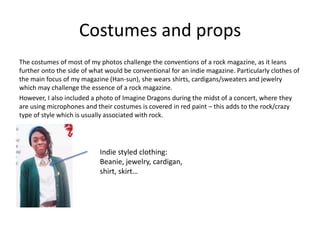
The costumes of most of my photos challenge the conventions of a rock magazine, as it leans
further onto the side of what would be conventional for an indie magazine. Particularly clothes of
the main focus of my magazine (Han-sun), she wears shirts, cardigans/sweaters and jewelry
which may challenge the essence of a rock magazine.
However, I also included a photo of Imagine Dragons during the midst of a concert, where they
are using microphones and their costumes is covered in red paint – this adds to the rock/crazy
type of style which is usually associated with rock.
Indie styled clothing:
Beanie, jewelry, cardigan,
shirt, skirt…
People
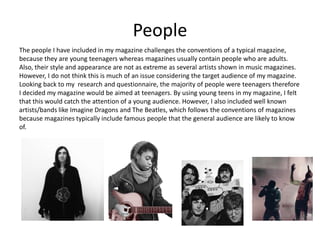
The people I have included in my magazine challenges the conventions of a typical magazine,
because they are young teenagers whereas magazines usually contain people who are adults.
Also, their style and appearance are not as extreme as several artists shown in music magazines.
However, I do not think this is much of an issue considering the target audience of my magazine.
Looking back to my research and questionnaire, the majority of people were teenagers therefore
I decided my magazine would be aimed at teenagers. By using young teens in my magazine, I felt
that this would catch the attention of a young audience. However, I also included well known
artists/bands like Imagine Dragons and The Beatles, which follows the conventions of magazines
because magazines typically include famous people that the general audience are likely to know
of.
Written Content
The written content of my music magazine follows the conventions of a real music magazine as it
includes aspects of what a music magazine would usually have. For example, I have included an
interview from the main person on the front cover, which is a usual rule that music magazines go
by. Specifically, in the interview it contained questions that are typically used in interviews in
music magazines such as questions about their upcoming music/tour dates.
Layout + Style
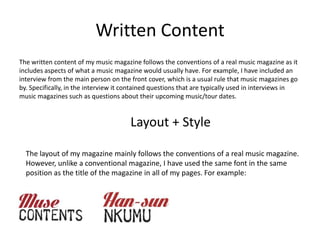
The layout of my magazine mainly follows the conventions of a real music magazine.
However, unlike a conventional magazine, I have used the same font in the same
position as the title of the magazine in all of my pages. For example:
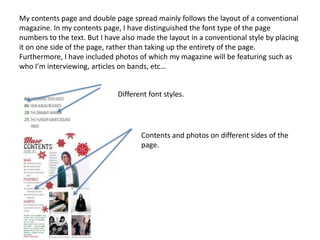
My contents page and double page spread mainly follows the layout of a conventional
magazine. In my contents page, I have distinguished the font type of the page
numbers to the text. But I have also made the layout in a conventional style by placing
it on one side of the page, rather than taking up the entirety of the page.
Furthermore, I have included photos of which my magazine will be featuring such as
who I’m interviewing, articles on bands, etc…
Different font styles.
Contents and photos on different sides of the
page.
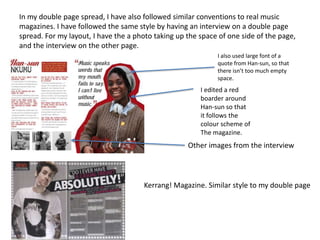
In my double page spread, I have also followed similar conventions to real music
magazines. I have followed the same style by having an interview on a double page
spread. For my layout, I have the a photo taking up the space of one side of the page,
and the interview on the other page.
I also used large font of a
quote from Han-sun, so that
there isn’t too much empty
space.
I edited a red
boarder around
Han-sun so that
it follows the
colour scheme of
The magazine.
Other images from the interview
Kerrang! Magazine. Similar style to my double page

Music magazine evaluation

  • 1.
    1) In whatways does your media product use, develop or challenge forms and conventions of real media products?
  • 2.
    Title The convention ofmusic magazines usually have their masthead at the top of their page. Usually, most magazines take up the entire space of the top, therefore my magazine is slightly challenging the convention because it is on the top left, rather than taking the entire top space like RollingStone has. For my magazine’s masthead, the title is “Muse LIVE” using the fonts ‘Lighthouse Personal use’ for ‘Muse’ and ‘Telegraphem’ for ‘LIVE’. Similar to conventional soft rock/rock indie music magazines, for example, comparing it to Rolling Stone they have also used similar types of font for their magazine’s masthead. I have also followed the convention which is shown in a lot of music magazines where the title is behind the main photo of the front cover. I have used the colours red, black and white for my masthead because that is the main colour scheme of my entire magazine. I chose these colours because I felt that they were the conventional colours used for the genre (rock/indie) of my magazine, which Rolling Stone has also used for their masthead. Furthermore, keeping consideration of my audience, I used these colours because I wanted the colours of this music magazine to be neutral to both genders.
  • 3.
    Mis-en-scene The mise-en-scene ofmost of my photos contain the conventions of what a usual music magazine would have. For my front cover, I used a photo of a teenager looking down at her guitar, wearing rock/indie style clothes such as a beanie, a scarf and a dark coloured jacket. I did not want to make too much of an impact of the ‘rock’ style of the magazine, therefore I had her holding an acoustic guitar to catch the ‘indie’ essence of the magazine, rather than focusing on rock. In that sense, my magazine does not follow the conventions of a rock magazine such as Kerrang! in which their photos are full of expression while holding typical instruments used in rock bands. Furthermore, the majority of my images also contain a similar style such as wearing clothes which are typically associated to rock/indie style bands. However, most of my images had no background. This challenges the convention of rock/indie magazines, particularly rock magazines such as Kerrang!; where the scenery of their photos are typically during a performance, or outside in a rough looking area. To add more of an effect of a rock magazine, I included photos of Imagine Dragons and also The Beatles. Scarf, beanie
  • 4.
    Costumes and props Thecostumes of most of my photos challenge the conventions of a rock magazine, as it leans further onto the side of what would be conventional for an indie magazine. Particularly clothes of the main focus of my magazine (Han-sun), she wears shirts, cardigans/sweaters and jewelry which may challenge the essence of a rock magazine. However, I also included a photo of Imagine Dragons during the midst of a concert, where they are using microphones and their costumes is covered in red paint – this adds to the rock/crazy type of style which is usually associated with rock. Indie styled clothing: Beanie, jewelry, cardigan, shirt, skirt…
  • 5.
    People The people Ihave included in my magazine challenges the conventions of a typical magazine, because they are young teenagers whereas magazines usually contain people who are adults. Also, their style and appearance are not as extreme as several artists shown in music magazines. However, I do not think this is much of an issue considering the target audience of my magazine. Looking back to my research and questionnaire, the majority of people were teenagers therefore I decided my magazine would be aimed at teenagers. By using young teens in my magazine, I felt that this would catch the attention of a young audience. However, I also included well known artists/bands like Imagine Dragons and The Beatles, which follows the conventions of magazines because magazines typically include famous people that the general audience are likely to know of.
  • 6.
    Written Content The writtencontent of my music magazine follows the conventions of a real music magazine as it includes aspects of what a music magazine would usually have. For example, I have included an interview from the main person on the front cover, which is a usual rule that music magazines go by. Specifically, in the interview it contained questions that are typically used in interviews in music magazines such as questions about their upcoming music/tour dates. Layout + Style The layout of my magazine mainly follows the conventions of a real music magazine. However, unlike a conventional magazine, I have used the same font in the same position as the title of the magazine in all of my pages. For example:
  • 7.
    My contents pageand double page spread mainly follows the layout of a conventional magazine. In my contents page, I have distinguished the font type of the page numbers to the text. But I have also made the layout in a conventional style by placing it on one side of the page, rather than taking up the entirety of the page. Furthermore, I have included photos of which my magazine will be featuring such as who I’m interviewing, articles on bands, etc… Different font styles. Contents and photos on different sides of the page.
  • 8.
    In my doublepage spread, I have also followed similar conventions to real music magazines. I have followed the same style by having an interview on a double page spread. For my layout, I have the a photo taking up the space of one side of the page, and the interview on the other page. I also used large font of a quote from Han-sun, so that there isn’t too much empty space. I edited a red boarder around Han-sun so that it follows the colour scheme of The magazine. Other images from the interview Kerrang! Magazine. Similar style to my double page