Q1: In what ways does your media
product use, develop or challenge
forms and conventions of real media
products?
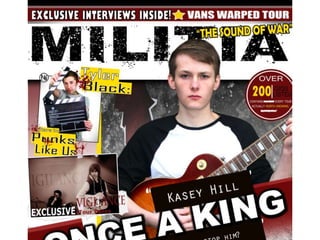
Throughout the process of designing my music magazine front
cover, contents page and double page spread I was constantly referring
and looking at numerous current popular, generally they where within the
rock genre as that is the audience which I was targeting. But I did
however look at other magazines from other genres like NME and Q by
doing this I had a wider range of inspirations and ideas for my magazine.
Anyways, my magazine first of all has both used and developed the
conventional colour scheme for a rock magazine. The colours that I chose
to use were black, red, white and yellow.
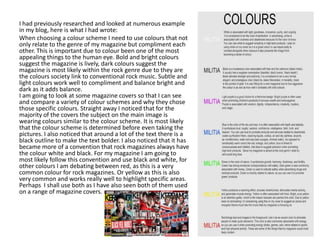
I had previously researched and looked at numerous example
in my blog, here is what I had wrote:
When choosing a colour scheme I need to use colours that not
only relate to the genre of my magazine but compliment each
other. This is important due to colour been one of the most
appealing things to the human eye. Bold and bright colours
suggest the magazine is lively, dark colours suggest the
magazine is most likely within the rock genre due to they are
the colours society link to conventional rock music. Subtle and
light colours work well to compliment and balance bright and
dark as it adds balance.
I am going to look at some magazine covers so that I can see
and compare a variety of colour schemes and why they chose
those specific colours. Straight away I noticed that for the
majority of the covers the subject on the main image is
wearing colours similar to the colour scheme. It is most likely
that the colour scheme is determined before even taking the
pictures. I also noticed that around a lot of the text there is a
black outline to make the text bolder. I also noticed that it has
became more of a convention that rock magazines always have
the colour white and black. For my magazine I am going to
most likely follow this convention and use black and white, for
other colours I am debating between red, as this is a very
common colour for rock magazines. Or yellow as this is also
very common and works really well to highlight specific areas.
Perhaps I shall use both as I have also seen both of them used
on a range of magazine covers.
The reason for choosing those colours was primarily due to how conventional they
were within rock magazines that I had researched. Not only do the colours represent
the bold style that is rock music but they are also very aesthetically appealing as the
colours compliment each other. In terms of developing the conventions of the rock
magazine I tended to use colours with less saturation so they wasn’t too bright and
represented the style of a pop magazine. I continued these colours on each of my
products, therefore creating a theme and to also maintain continuity. The colours that
I had chosen also was ideal when it was necessary to take images for my magazine.
Not only were the colours easily acquired in terms of clothing they also are very
conventional coloured items of clothing for a musician within the rock genre especially
black. Once I had enough successful images of my models I decided to use one specific
model throughout my front cover, contents page and double page spread. The reason
for this was to reinforce his importance throughout the magazine as well as to
maintain the genre to the reader. I also noticed that it made my magazine seem more
realistic and professional to a consumer as the conventional magazine tends to
emphasise a particular story, known as the main story.; throughout the magazine. This
means they will feature as the main image in both the cover and contents page and
have a complete double page spread story. I feel that by using continuity it prevents
the audience from doubting the consistency and quality of the magazine. In terms of
fonts i used an extensive range of fonts each of which portray a bold and powerful
expression throughout my magazine again using the general conventions of most
music magazines. By using a variety of font styles like serifs for example can not only
suggest a particular feature like a bold text without serifs is going to be very
prominent also a thin and delicate text with serifs will be a lot more subtle and soft. I
also included a specific form of type to refer to specific brands like my masthead for
example, I used the same font that I created for my masthead
throughout both my front cover and my contents page. I did however
change the colour as I felt it looked more aesthetically pleasing. It
was also featured on some of the Kerrang magazines that I was
referring to.
Front cover(Below): Contents page(Below):
I created some conventions analysis’ of my magazine and the
continuity and conventional features that it contains...
To design numerous features within my magazine I used real, existing media
products as a heavy reference, I used numerous examples but mainly from
two particular magazines Kerrang and Rock Sound. Here is an example of the
barcode I created and an existing barcode within an existing Kerrang music
magazine.
As you can see I essentially created an identical barcode, not only is the
consumers/ audience familiar with the existing bar code it is very minute and
practical as the scale of the code is small compared to the front cover.
However I have seen other magazines feature more aesthetic barcode like
this example from Vibe magazine. Having seen this although it looks
significantly more appealing and professional i figured it isn’t a significant
feature and the consumers in general are appealed to the Kerrang product
just as much.
Kerrang’s barcode: My (Militia’s) barcode: Vibe’s barcode:
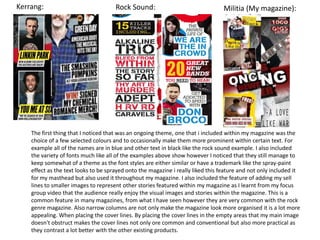
The first thing that I noticed that was an ongoing theme, one that i included within my magazine was the
choice of a few selected colours and to occasionally make them more prominent within certain text. For
example all of the names are in blue and other text in black like the rock sound example. I also included
the variety of fonts much like all of the examples above show however I noticed that they still manage to
keep somewhat of a theme as the font styles are either similar or have a trademark like the spray-paint
effect as the text looks to be sprayed onto the magazine i really liked this feature and not only included it
for my masthead but also used it throughout my magazine. I also included the feature of adding my sell
lines to smaller images to represent other stories featured within my magazine as I learnt from my focus
group video that the audience really enjoy the visual images and stories within the magazine. This is a
common feature in many magazines, from what I have seen however they are very common with the rock
genre magazine. Also narrow columns are not only make the magazine look more organised it is a lot more
appealing. When placing the cover lines. By placing the cover lines in the empty areas that my main image
doesn't obstruct makes the cover lines not only ore common and conventional but also more practical as
they contrast a lot better with the other existing products.
Kerrang: Rock Sound: Militia (My magazine):
One of the unconventional features that my magazine has is that it doesn’t
include a puff. I had originally designed a puff but felt like it didn’t look
very appealing with the rest of my front cover so I replaced it for an added
cover line. As you can see the puff which I had created doesn’t look very
professional or organised. I recently created a new puff using a more
traditional and organised style as i used a simpler font and a basic shape
design. After designing the puff i think that it looks more appropriate and
appealing than I expected.
Kerrang:
Militia (My magazine):
Here are a group of skyline from existing media products, music
magazines. I feel as though in comparison to my magazine I was fairly
successful however I now noticed that my current skyline was slightly too
large, I could also layer things over it to show signs of clipping as it tends
to add variation and depth to the magazine cover. Once I had changed the
scale of both the text on the skyline and the height of the boarder it looks
significantly better.
Militia (My magazine):
When creating the masthead for my contents page I referred to numerous existing
Kerrang contents pages as I really liked the design and style that they portrayed
throughout the page. I really like how they invert the colours of the masthead on
the contents page as it adds variation but doesn’t take away from brand
recognition as the font is still the same. Also by inverting the white background to
black and text from black to white it adds contrast between the two pages. This is
very important since they are so close together too. By using the same font for the
magazine name it shows continuity and allows the audience to recognize your
product for an iconic feature. The masthead that I used also maintains the theme
of colours that i had chosen to use throughout my magazine as they are iconic and
conventional colours of a rock magazine. Plus the text on the masthead to
introduce my magazines name, ‘This time on..’ is displayed in the same type of
font as the brand as it looks more effective. So the audience recognises the Militia
brand even more I changed the colour of the text just mentioned to yellow so
there is a clear contrast.
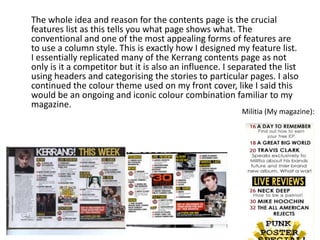
The whole idea and reason for the contents page is the crucial
features list as this tells you what page shows what. The
conventional and one of the most appealing forms of features are
to use a column style. This is exactly how I designed my feature list.
I essentially replicated many of the Kerrang contents page as not
only is it a competitor but it is also an influence. I separated the list
using headers and categorising the stories to particular pages. I also
continued the colour theme used on my front cover, like I said this
would be an ongoing and iconic colour combination familiar to my
magazine.
Militia (My magazine):
Pull quotes another of the many conventions that my magazine
includes. When choosing the font for the quote I had to ensure that
it didn’t detract from the whole look of the actual feature so by
decreasing the font size and disabling the ‘bold’ feature it makes it
easier for the reader to interpret the quote as something from that
specific story and not a separate feature. Also for user readability I
created the page number to be the same size as the feature line I
did however ensure that the page number was in red. Again to
make the page more readable for the user.
Militia (My magazine):
Kerrang:
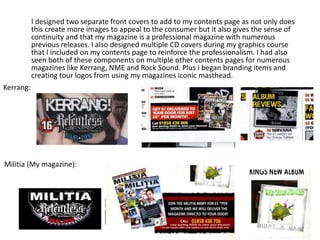
I designed two separate front covers to add to my contents page as not only does
this create more images to appeal to the consumer but it also gives the sense of
continuity and that my magazine is a professional magazine with numerous
previous releases. I also designed multiple CD covers during my graphics course
that I included on my contents page to reinforce the professionalism. I had also
seen both of these components on multiple other contents pages for numerous
magazines like Kerrang, NME and Rock Sound. Plus i began branding items and
creating tour logos from using my magazines iconic masthead.
Kerrang:
Militia (My magazine):
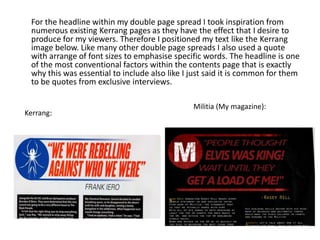
For the headline within my double page spread I took inspiration from
numerous existing Kerrang pages as they have the effect that I desire to
produce for my viewers. Therefore I positioned my text like the Kerrang
image below. Like many other double page spreads I also used a quote
with arrange of font sizes to emphasise specific words. The headline is one
of the most conventional factors within the contents page that is exactly
why this was essential to include also like I just said it is common for them
to be quotes from exclusive interviews.
Militia (My magazine):
Kerrang:
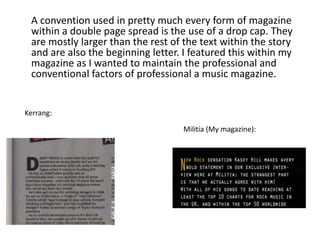
A convention used in pretty much every form of magazine
within a double page spread is the use of a drop cap. They
are mostly larger than the rest of the text within the story
and are also the beginning letter. I featured this within my
magazine as I wanted to maintain the professional and
conventional factors of professional a music magazine.
Militia (My magazine):
Kerrang:
Finally, as a sense of professionalism I included a caption
for my image. Captions often include information about the
photographer responsible for the image featured as well as
others who deserve credibility. I placed mine within a small
text box with a small font as they need to be visible but
they aren’t there as entertaining information.
Militia (My magazine):
Kerrang:
Q1 evaluation

Q1 evaluation

  • 1.
    Q1: In whatways does your media product use, develop or challenge forms and conventions of real media products? Throughout the process of designing my music magazine front cover, contents page and double page spread I was constantly referring and looking at numerous current popular, generally they where within the rock genre as that is the audience which I was targeting. But I did however look at other magazines from other genres like NME and Q by doing this I had a wider range of inspirations and ideas for my magazine. Anyways, my magazine first of all has both used and developed the conventional colour scheme for a rock magazine. The colours that I chose to use were black, red, white and yellow.
  • 2.
    I had previouslyresearched and looked at numerous example in my blog, here is what I had wrote: When choosing a colour scheme I need to use colours that not only relate to the genre of my magazine but compliment each other. This is important due to colour been one of the most appealing things to the human eye. Bold and bright colours suggest the magazine is lively, dark colours suggest the magazine is most likely within the rock genre due to they are the colours society link to conventional rock music. Subtle and light colours work well to compliment and balance bright and dark as it adds balance. I am going to look at some magazine covers so that I can see and compare a variety of colour schemes and why they chose those specific colours. Straight away I noticed that for the majority of the covers the subject on the main image is wearing colours similar to the colour scheme. It is most likely that the colour scheme is determined before even taking the pictures. I also noticed that around a lot of the text there is a black outline to make the text bolder. I also noticed that it has became more of a convention that rock magazines always have the colour white and black. For my magazine I am going to most likely follow this convention and use black and white, for other colours I am debating between red, as this is a very common colour for rock magazines. Or yellow as this is also very common and works really well to highlight specific areas. Perhaps I shall use both as I have also seen both of them used on a range of magazine covers.
  • 3.
    The reason forchoosing those colours was primarily due to how conventional they were within rock magazines that I had researched. Not only do the colours represent the bold style that is rock music but they are also very aesthetically appealing as the colours compliment each other. In terms of developing the conventions of the rock magazine I tended to use colours with less saturation so they wasn’t too bright and represented the style of a pop magazine. I continued these colours on each of my products, therefore creating a theme and to also maintain continuity. The colours that I had chosen also was ideal when it was necessary to take images for my magazine. Not only were the colours easily acquired in terms of clothing they also are very conventional coloured items of clothing for a musician within the rock genre especially black. Once I had enough successful images of my models I decided to use one specific model throughout my front cover, contents page and double page spread. The reason for this was to reinforce his importance throughout the magazine as well as to maintain the genre to the reader. I also noticed that it made my magazine seem more realistic and professional to a consumer as the conventional magazine tends to emphasise a particular story, known as the main story.; throughout the magazine. This means they will feature as the main image in both the cover and contents page and have a complete double page spread story. I feel that by using continuity it prevents the audience from doubting the consistency and quality of the magazine. In terms of fonts i used an extensive range of fonts each of which portray a bold and powerful expression throughout my magazine again using the general conventions of most music magazines. By using a variety of font styles like serifs for example can not only suggest a particular feature like a bold text without serifs is going to be very prominent also a thin and delicate text with serifs will be a lot more subtle and soft. I also included a specific form of type to refer to specific brands like my masthead for
  • 4.
    example, I usedthe same font that I created for my masthead throughout both my front cover and my contents page. I did however change the colour as I felt it looked more aesthetically pleasing. It was also featured on some of the Kerrang magazines that I was referring to. Front cover(Below): Contents page(Below): I created some conventions analysis’ of my magazine and the continuity and conventional features that it contains...
  • 5.
    To design numerousfeatures within my magazine I used real, existing media products as a heavy reference, I used numerous examples but mainly from two particular magazines Kerrang and Rock Sound. Here is an example of the barcode I created and an existing barcode within an existing Kerrang music magazine. As you can see I essentially created an identical barcode, not only is the consumers/ audience familiar with the existing bar code it is very minute and practical as the scale of the code is small compared to the front cover. However I have seen other magazines feature more aesthetic barcode like this example from Vibe magazine. Having seen this although it looks significantly more appealing and professional i figured it isn’t a significant feature and the consumers in general are appealed to the Kerrang product just as much. Kerrang’s barcode: My (Militia’s) barcode: Vibe’s barcode:
  • 6.
    The first thingthat I noticed that was an ongoing theme, one that i included within my magazine was the choice of a few selected colours and to occasionally make them more prominent within certain text. For example all of the names are in blue and other text in black like the rock sound example. I also included the variety of fonts much like all of the examples above show however I noticed that they still manage to keep somewhat of a theme as the font styles are either similar or have a trademark like the spray-paint effect as the text looks to be sprayed onto the magazine i really liked this feature and not only included it for my masthead but also used it throughout my magazine. I also included the feature of adding my sell lines to smaller images to represent other stories featured within my magazine as I learnt from my focus group video that the audience really enjoy the visual images and stories within the magazine. This is a common feature in many magazines, from what I have seen however they are very common with the rock genre magazine. Also narrow columns are not only make the magazine look more organised it is a lot more appealing. When placing the cover lines. By placing the cover lines in the empty areas that my main image doesn't obstruct makes the cover lines not only ore common and conventional but also more practical as they contrast a lot better with the other existing products. Kerrang: Rock Sound: Militia (My magazine):
  • 7.
    One of theunconventional features that my magazine has is that it doesn’t include a puff. I had originally designed a puff but felt like it didn’t look very appealing with the rest of my front cover so I replaced it for an added cover line. As you can see the puff which I had created doesn’t look very professional or organised. I recently created a new puff using a more traditional and organised style as i used a simpler font and a basic shape design. After designing the puff i think that it looks more appropriate and appealing than I expected. Kerrang: Militia (My magazine):
  • 8.
    Here are agroup of skyline from existing media products, music magazines. I feel as though in comparison to my magazine I was fairly successful however I now noticed that my current skyline was slightly too large, I could also layer things over it to show signs of clipping as it tends to add variation and depth to the magazine cover. Once I had changed the scale of both the text on the skyline and the height of the boarder it looks significantly better. Militia (My magazine):
  • 9.
    When creating themasthead for my contents page I referred to numerous existing Kerrang contents pages as I really liked the design and style that they portrayed throughout the page. I really like how they invert the colours of the masthead on the contents page as it adds variation but doesn’t take away from brand recognition as the font is still the same. Also by inverting the white background to black and text from black to white it adds contrast between the two pages. This is very important since they are so close together too. By using the same font for the magazine name it shows continuity and allows the audience to recognize your product for an iconic feature. The masthead that I used also maintains the theme of colours that i had chosen to use throughout my magazine as they are iconic and conventional colours of a rock magazine. Plus the text on the masthead to introduce my magazines name, ‘This time on..’ is displayed in the same type of font as the brand as it looks more effective. So the audience recognises the Militia brand even more I changed the colour of the text just mentioned to yellow so there is a clear contrast.
  • 10.
    The whole ideaand reason for the contents page is the crucial features list as this tells you what page shows what. The conventional and one of the most appealing forms of features are to use a column style. This is exactly how I designed my feature list. I essentially replicated many of the Kerrang contents page as not only is it a competitor but it is also an influence. I separated the list using headers and categorising the stories to particular pages. I also continued the colour theme used on my front cover, like I said this would be an ongoing and iconic colour combination familiar to my magazine. Militia (My magazine):
  • 11.
    Pull quotes anotherof the many conventions that my magazine includes. When choosing the font for the quote I had to ensure that it didn’t detract from the whole look of the actual feature so by decreasing the font size and disabling the ‘bold’ feature it makes it easier for the reader to interpret the quote as something from that specific story and not a separate feature. Also for user readability I created the page number to be the same size as the feature line I did however ensure that the page number was in red. Again to make the page more readable for the user. Militia (My magazine): Kerrang:
  • 12.
    I designed twoseparate front covers to add to my contents page as not only does this create more images to appeal to the consumer but it also gives the sense of continuity and that my magazine is a professional magazine with numerous previous releases. I also designed multiple CD covers during my graphics course that I included on my contents page to reinforce the professionalism. I had also seen both of these components on multiple other contents pages for numerous magazines like Kerrang, NME and Rock Sound. Plus i began branding items and creating tour logos from using my magazines iconic masthead. Kerrang: Militia (My magazine):
  • 13.
    For the headlinewithin my double page spread I took inspiration from numerous existing Kerrang pages as they have the effect that I desire to produce for my viewers. Therefore I positioned my text like the Kerrang image below. Like many other double page spreads I also used a quote with arrange of font sizes to emphasise specific words. The headline is one of the most conventional factors within the contents page that is exactly why this was essential to include also like I just said it is common for them to be quotes from exclusive interviews. Militia (My magazine): Kerrang:
  • 14.
    A convention usedin pretty much every form of magazine within a double page spread is the use of a drop cap. They are mostly larger than the rest of the text within the story and are also the beginning letter. I featured this within my magazine as I wanted to maintain the professional and conventional factors of professional a music magazine. Militia (My magazine): Kerrang:
  • 15.
    Finally, as asense of professionalism I included a caption for my image. Captions often include information about the photographer responsible for the image featured as well as others who deserve credibility. I placed mine within a small text box with a small font as they need to be visible but they aren’t there as entertaining information. Militia (My magazine): Kerrang: