Q1. In what ways does your media
product use, develop or challenge
forms and conventions of real media
products?
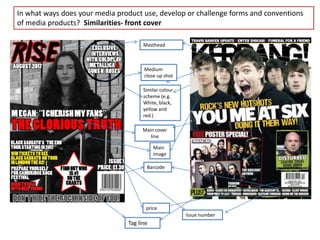
In what ways does your media product use, develop or challenge forms and conventions
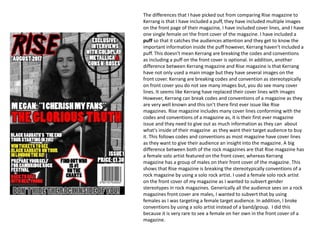
of media products? Similarities- front cover
Masthead
Barcode
Similar colour
scheme (e.g.
White, black,
yellow and
red.)
Main cover
line
price
Medium
close up shot
Main
image
Issue number
Tag line
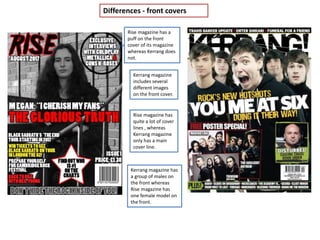
Differences - front covers
Rise magazine has a
puff on the front
cover of its magazine
whereas Kerrang does
not.
Rise magazine has
quite a lot of cover
lines , whereas
Kerrang magazine
only has a main
cover line.
Kerrang magazine
includes several
different images
on the front cover.
Kerrang magazine has
a group of males on
the front whereas
Rise magazine has
one female model on
the front.
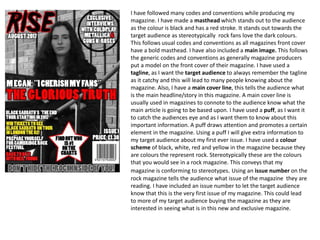
I have followed many codes and conventions while producing my
magazine. I have made a masthead which stands out to the audience
as the colour is black and has a red stroke. It stands out towards the
target audience as stereotypically rock fans love the dark colours.
This follows usual codes and conventions as all magazines front cover
have a bold masthead. I have also included a main image. This follows
the generic codes and conventions as generally magazine producers
put a model on the front cover of their magazine. I have used a
tagline, as I want the target audience to always remember the tagline
as it catchy and this will lead to many people knowing about the
magazine. Also, I have a main cover line, this tells the audience what
is the main headline/story in this magazine. A main cover line is
usually used in magazines to connote to the audience know what the
main article is going to be based upon. I have used a puff, as I want it
to catch the audiences eye and as I want them to know about this
important information. A puff draws attention and promotes a certain
element in the magazine. Using a puff I will give extra information to
my target audience about my first ever issue. I have used a colour
scheme of black, white, red and yellow in the magazine because they
are colours the represent rock. Stereotypically these are the colours
that you would see in a rock magazine. This conveys that my
magazine is conforming to stereotypes. Using an issue number on the
rock magazine tells the audience what issue of the magazine they are
reading. I have included an issue number to let the target audience
know that this is the very first issue of my magazine. This could lead
to more of my target audience buying the magazine as they are
interested in seeing what is in this new and exclusive magazine.
The differences that I have picked out from comparing Rise magazine to
Kerrang is that I have included a puff, they have included multiple images
on the front page of their magazine, I have included cover lines, and I have
one single female on the front cover of the magazine. I have included a
puff so that it catches the audiences attention and they get to know the
important information inside the puff however, Kerrang haven't included a
puff. This doesn't mean Kerrang are breaking the codes and conventions
as including a puff on the front cover is optional. In addition, another
difference between Kerrang magazine and Rise magazine is that Kerrang
have not only used a main image but they have several images on the
front cover. Kerrang are breaking codes and convention as stereotypically
on front cover you do not see many images but, you do see many cover
lines. It seems like Kerrang have replaced their cover lines with images
However, Kerrang can break codes and conventions of a magazine as they
are very well known and this isn’t there first ever issue like Rise
magazines. Rise magazine includes many cover lines conforming with the
codes and conventions of a magazine as, it is their first ever magazine
issue and they need to give out as much information as they can about
what's inside of their magazine as they want their target audience to buy
it. This follows codes and conventions as most magazine have cover lines
as they want to give their audience an insight into the magazine. A big
difference between both of the rock magazines are that Rise magazine has
a female solo artist featured on the front cover, whereas Kerrang
magazine has a group of males on their front cover of the magazine. This
shows that Rise magazine is breaking the stereotypically conventions of a
rock magazine by using a solo rock artist. I used a female solo rock artist
on the front cover of my magazine as I wanted to subvert gender
stereotypes in rock magazines. Generically all the audience sees on a rock
magazines front cover are males, I wanted to subvert that by using
females as I was targeting a female target audience. In addition, I broke
conventions by using a solo artist instead of a band/group. I did this
because it is very rare to see a female on her own in the front cover of a
magazine.
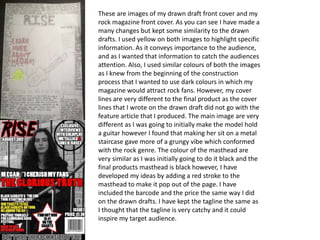
These are images of my drawn draft front cover and my
rock magazine front cover. As you can see I have made a
many changes but kept some similarity to the drawn
drafts. I used yellow on both images to highlight specific
information. As it conveys importance to the audience,
and as I wanted that information to catch the audiences
attention. Also, I used similar colours of both the images
as I knew from the beginning of the construction
process that I wanted to use dark colours in which my
magazine would attract rock fans. However, my cover
lines are very different to the final product as the cover
lines that I wrote on the drawn draft did not go with the
feature article that I produced. The main image are very
different as I was going to initially make the model hold
a guitar however I found that making her sit on a metal
staircase gave more of a grungy vibe which conformed
with the rock genre. The colour of the masthead are
very similar as I was initially going to do it black and the
final products masthead is black however, I have
developed my ideas by adding a red stroke to the
masthead to make it pop out of the page. I have
included the barcode and the price the same way I did
on the drawn drafts. I have kept the tagline the same as
I thought that the tagline is very catchy and it could
inspire my target audience.
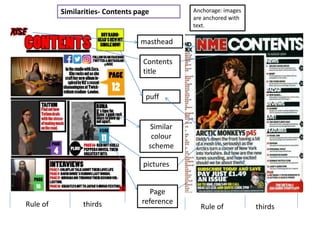
Similarities- Contents page
masthead
Contents
title
puff
pictures
Page
reference
Similar
colour
scheme
Rule of thirds Rule of thirds
Anchorage: images
are anchored with
text.
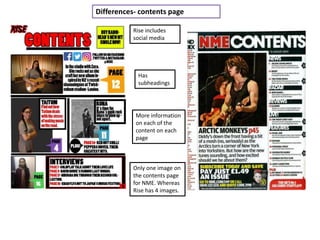
Differences- contents page
Only one image on
the contents page
for NME. Whereas
Rise has 4 images.
Has
subheadings
More information
on each of the
content on each
page
Rise includes
social media
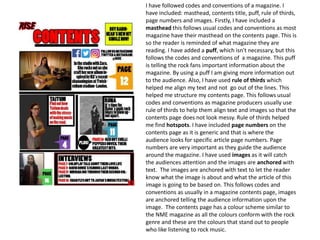
I have followed codes and conventions of a magazine. I
have included: masthead, contents title, puff, rule of thirds,
page numbers and images. Firstly, I have included a
masthead this follows usual codes and conventions as most
magazine have their masthead on the contents page. This is
so the reader is reminded of what magazine they are
reading. I have added a puff, which isn't necessary, but this
follows the codes and conventions of a magazine. This puff
is telling the rock fans important information about the
magazine. By using a puff I am giving more information out
to the audience. Also, I have used rule of thirds which
helped me align my text and not go out of the lines. This
helped me structure my contents page. This follows usual
codes and conventions as magazine producers usually use
rule of thirds to help them align text and images so that the
contents page does not look messy. Rule of thirds helped
me find hotspots. I have included page numbers on the
contents page as it is generic and that is where the
audience looks for specific article page numbers. Page
numbers are very important as they guide the audience
around the magazine. I have used images as it will catch
the audiences attention and the images are anchored with
text. The images are anchored with text to let the reader
know what the image is about and what the article of this
image is going to be based on. This follows codes and
conventions as usually in a magazine contents page, images
are anchored telling the audience information upon the
image. The contents page has a colour scheme similar to
the NME magazine as all the colours conform with the rock
genre and these are the colours that stand out to people
who like listening to rock music.
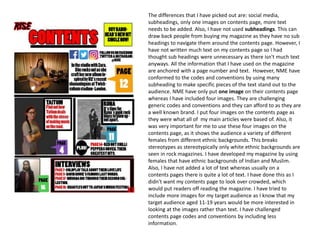
The differences that I have picked out are: social media,
subheadings, only one images on contents page, more text
needs to be added. Also, I have not used subheadings. This can
draw back people from buying my magazine as they have no sub
headings to navigate them around the contents page. However, I
have not written much text on my contents page so I had
thought sub headings were unnecessary as there isn't much text
anyways. All the information that I have used on the magazine
are anchored with a page number and text. However, NME have
conformed to the codes and conventions by using many
subheading to make specific pieces of the text stand out to the
audience. NME have only put one image on their contents page
whereas I have included four images. They are challenging
generic codes and conventions and they can afford to as they are
a well known brand. I put four images on the contents page as
they were what all of my main articles were based of. Also, it
was very important for me to use these four images on the
contents page, as it shows the audience a variety of different
females from different ethnic backgrounds. This breaks
stereotypes as stereotypically only white ethnic backgrounds are
seen in rock magazines. I have developed my magazine by using
females that have ethnic backgrounds of Indian and Muslim.
Also, I have not added a lot of text whereas usually on a
contents pages there is quite a lot of text. I have done this as I
didn't want my contents page to look over crowded, which
would put readers off reading the magazine. I have tried to
include more images for my target audience as I know that my
target audience aged 11-19 years would be more interested in
looking at the images rather than text. I have challenged
contents page codes and conventions by including less
information.
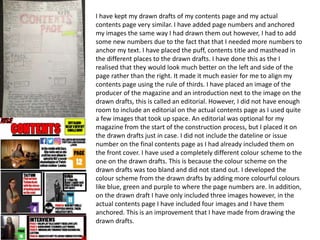
I have kept my drawn drafts of my contents page and my actual
contents page very similar. I have added page numbers and anchored
my images the same way I had drawn them out however, I had to add
some new numbers due to the fact that that I needed more numbers to
anchor my text. I have placed the puff, contents title and masthead in
the different places to the drawn drafts. I have done this as the I
realised that they would look much better on the left and side of the
page rather than the right. It made it much easier for me to align my
contents page using the rule of thirds. I have placed an image of the
producer of the magazine and an introduction next to the image on the
drawn drafts, this is called an editorial. However, I did not have enough
room to include an editorial on the actual contents page as I used quite
a few images that took up space. An editorial was optional for my
magazine from the start of the construction process, but I placed it on
the drawn drafts just in case. I did not include the dateline or issue
number on the final contents page as I had already included them on
the front cover. I have used a completely different colour scheme to the
one on the drawn drafts. This is because the colour scheme on the
drawn drafts was too bland and did not stand out. I developed the
colour scheme from the drawn drafts by adding more colourful colours
like blue, green and purple to where the page numbers are. In addition,
on the drawn draft I have only included three images however, in the
actual contents page I have included four images and I have them
anchored. This is an improvement that I have made from drawing the
drawn drafts.
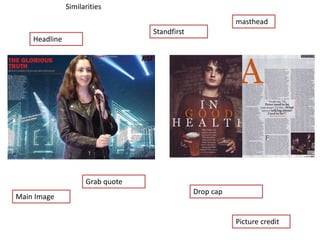
Similarities
Headline
Standfirst
masthead
Grab quote
Drop cap
Main Image
Picture credit
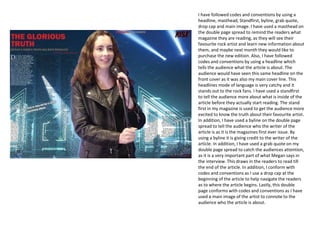
I have followed codes and conventions by using a
headline, masthead, Standfirst, byline, grab quote,
drop cap and main image. I have used a masthead on
the double page spread to remind the readers what
magazine they are reading, as they will see their
favourite rock artist and learn new information about
them, and maybe next month they would like to
purchase the new edition. Also, I have followed
codes and conventions by using a headline which
tells the audience what the article is about. The
audience would have seen this same headline on the
front cover as it was also my main cover line. This
headlines mode of language is very catchy and it
stands out to the rock fans. I have used a standfirst
to tell the audience more about what is inside of the
article before they actually start reading. The stand
first in my magazine is used to get the audience more
excited to know the truth about their favourite artist.
In addition, I have used a byline on the double page
spread to tell the audience who the writer of the
article is as it is the magazines first ever issue. By
using a byline it is giving credit to the writer of the
article. In addition, I have used a grab quote on my
double page spread to catch the audiences attention,
as it is a very important part of what Megan says in
the interview. This draws in the readers to read till
the end of the article. In addition, I conform with
codes and conventions as I use a drop cap at the
beginning of the article to help navigate the readers
as to where the article begins. Lastly, this double
page conforms with codes and conventions as I have
used a main image of the artist to connote to the
audience who the article is about.
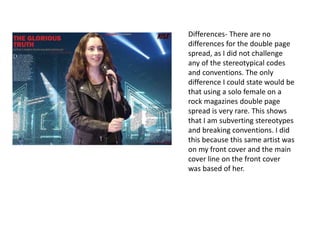
Differences- There are no
differences for the double page
spread, as I did not challenge
any of the stereotypical codes
and conventions. The only
difference I could state would be
that using a solo female on a
rock magazines double page
spread is very rare. This shows
that I am subverting stereotypes
and breaking conventions. I did
this because this same artist was
on my front cover and the main
cover line on the front cover
was based of her.
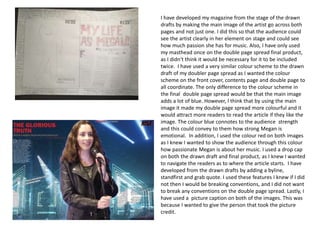
I have developed my magazine from the stage of the drawn
drafts by making the main image of the artist go across both
pages and not just one. I did this so that the audience could
see the artist clearly in her element on stage and could see
how much passion she has for music. Also, I have only used
my masthead once on the double page spread final product,
as I didn't think it would be necessary for it to be included
twice. I have used a very similar colour scheme to the drawn
draft of my doubler page spread as I wanted the colour
scheme on the front cover, contents page and double page to
all coordinate. The only difference to the colour scheme in
the final double page spread would be that the main image
adds a lot of blue. However, I think that by using the main
image it made my double page spread more colourful and it
would attract more readers to read the article if they like the
image. The colour blue connotes to the audience strength
and this could convey to them how strong Megan is
emotional. In addition, I used the colour red on both images
as I knew I wanted to show the audience through this colour
how passionate Megan is about her music. I used a drop cap
on both the drawn draft and final product, as I knew I wanted
to navigate the readers as to where the article starts. I have
developed from the drawn drafts by adding a byline,
standfirst and grab quote. I used these features I knew if I did
not then I would be breaking conventions, and I did not want
to break any conventions on the double page spread. Lastly, I
have used a picture caption on both of the images. This was
because I wanted to give the person that took the picture
credit.

Evaluation

  • 1.
    Q1. In whatways does your media product use, develop or challenge forms and conventions of real media products?
  • 2.
    In what waysdoes your media product use, develop or challenge forms and conventions of media products? Similarities- front cover Masthead Barcode Similar colour scheme (e.g. White, black, yellow and red.) Main cover line price Medium close up shot Main image Issue number Tag line
  • 3.
    Differences - frontcovers Rise magazine has a puff on the front cover of its magazine whereas Kerrang does not. Rise magazine has quite a lot of cover lines , whereas Kerrang magazine only has a main cover line. Kerrang magazine includes several different images on the front cover. Kerrang magazine has a group of males on the front whereas Rise magazine has one female model on the front.
  • 4.
    I have followedmany codes and conventions while producing my magazine. I have made a masthead which stands out to the audience as the colour is black and has a red stroke. It stands out towards the target audience as stereotypically rock fans love the dark colours. This follows usual codes and conventions as all magazines front cover have a bold masthead. I have also included a main image. This follows the generic codes and conventions as generally magazine producers put a model on the front cover of their magazine. I have used a tagline, as I want the target audience to always remember the tagline as it catchy and this will lead to many people knowing about the magazine. Also, I have a main cover line, this tells the audience what is the main headline/story in this magazine. A main cover line is usually used in magazines to connote to the audience know what the main article is going to be based upon. I have used a puff, as I want it to catch the audiences eye and as I want them to know about this important information. A puff draws attention and promotes a certain element in the magazine. Using a puff I will give extra information to my target audience about my first ever issue. I have used a colour scheme of black, white, red and yellow in the magazine because they are colours the represent rock. Stereotypically these are the colours that you would see in a rock magazine. This conveys that my magazine is conforming to stereotypes. Using an issue number on the rock magazine tells the audience what issue of the magazine they are reading. I have included an issue number to let the target audience know that this is the very first issue of my magazine. This could lead to more of my target audience buying the magazine as they are interested in seeing what is in this new and exclusive magazine.
  • 5.
    The differences thatI have picked out from comparing Rise magazine to Kerrang is that I have included a puff, they have included multiple images on the front page of their magazine, I have included cover lines, and I have one single female on the front cover of the magazine. I have included a puff so that it catches the audiences attention and they get to know the important information inside the puff however, Kerrang haven't included a puff. This doesn't mean Kerrang are breaking the codes and conventions as including a puff on the front cover is optional. In addition, another difference between Kerrang magazine and Rise magazine is that Kerrang have not only used a main image but they have several images on the front cover. Kerrang are breaking codes and convention as stereotypically on front cover you do not see many images but, you do see many cover lines. It seems like Kerrang have replaced their cover lines with images However, Kerrang can break codes and conventions of a magazine as they are very well known and this isn’t there first ever issue like Rise magazines. Rise magazine includes many cover lines conforming with the codes and conventions of a magazine as, it is their first ever magazine issue and they need to give out as much information as they can about what's inside of their magazine as they want their target audience to buy it. This follows codes and conventions as most magazine have cover lines as they want to give their audience an insight into the magazine. A big difference between both of the rock magazines are that Rise magazine has a female solo artist featured on the front cover, whereas Kerrang magazine has a group of males on their front cover of the magazine. This shows that Rise magazine is breaking the stereotypically conventions of a rock magazine by using a solo rock artist. I used a female solo rock artist on the front cover of my magazine as I wanted to subvert gender stereotypes in rock magazines. Generically all the audience sees on a rock magazines front cover are males, I wanted to subvert that by using females as I was targeting a female target audience. In addition, I broke conventions by using a solo artist instead of a band/group. I did this because it is very rare to see a female on her own in the front cover of a magazine.
  • 6.
    These are imagesof my drawn draft front cover and my rock magazine front cover. As you can see I have made a many changes but kept some similarity to the drawn drafts. I used yellow on both images to highlight specific information. As it conveys importance to the audience, and as I wanted that information to catch the audiences attention. Also, I used similar colours of both the images as I knew from the beginning of the construction process that I wanted to use dark colours in which my magazine would attract rock fans. However, my cover lines are very different to the final product as the cover lines that I wrote on the drawn draft did not go with the feature article that I produced. The main image are very different as I was going to initially make the model hold a guitar however I found that making her sit on a metal staircase gave more of a grungy vibe which conformed with the rock genre. The colour of the masthead are very similar as I was initially going to do it black and the final products masthead is black however, I have developed my ideas by adding a red stroke to the masthead to make it pop out of the page. I have included the barcode and the price the same way I did on the drawn drafts. I have kept the tagline the same as I thought that the tagline is very catchy and it could inspire my target audience.
  • 7.
  • 8.
    Differences- contents page Onlyone image on the contents page for NME. Whereas Rise has 4 images. Has subheadings More information on each of the content on each page Rise includes social media
  • 9.
    I have followedcodes and conventions of a magazine. I have included: masthead, contents title, puff, rule of thirds, page numbers and images. Firstly, I have included a masthead this follows usual codes and conventions as most magazine have their masthead on the contents page. This is so the reader is reminded of what magazine they are reading. I have added a puff, which isn't necessary, but this follows the codes and conventions of a magazine. This puff is telling the rock fans important information about the magazine. By using a puff I am giving more information out to the audience. Also, I have used rule of thirds which helped me align my text and not go out of the lines. This helped me structure my contents page. This follows usual codes and conventions as magazine producers usually use rule of thirds to help them align text and images so that the contents page does not look messy. Rule of thirds helped me find hotspots. I have included page numbers on the contents page as it is generic and that is where the audience looks for specific article page numbers. Page numbers are very important as they guide the audience around the magazine. I have used images as it will catch the audiences attention and the images are anchored with text. The images are anchored with text to let the reader know what the image is about and what the article of this image is going to be based on. This follows codes and conventions as usually in a magazine contents page, images are anchored telling the audience information upon the image. The contents page has a colour scheme similar to the NME magazine as all the colours conform with the rock genre and these are the colours that stand out to people who like listening to rock music.
  • 10.
    The differences thatI have picked out are: social media, subheadings, only one images on contents page, more text needs to be added. Also, I have not used subheadings. This can draw back people from buying my magazine as they have no sub headings to navigate them around the contents page. However, I have not written much text on my contents page so I had thought sub headings were unnecessary as there isn't much text anyways. All the information that I have used on the magazine are anchored with a page number and text. However, NME have conformed to the codes and conventions by using many subheading to make specific pieces of the text stand out to the audience. NME have only put one image on their contents page whereas I have included four images. They are challenging generic codes and conventions and they can afford to as they are a well known brand. I put four images on the contents page as they were what all of my main articles were based of. Also, it was very important for me to use these four images on the contents page, as it shows the audience a variety of different females from different ethnic backgrounds. This breaks stereotypes as stereotypically only white ethnic backgrounds are seen in rock magazines. I have developed my magazine by using females that have ethnic backgrounds of Indian and Muslim. Also, I have not added a lot of text whereas usually on a contents pages there is quite a lot of text. I have done this as I didn't want my contents page to look over crowded, which would put readers off reading the magazine. I have tried to include more images for my target audience as I know that my target audience aged 11-19 years would be more interested in looking at the images rather than text. I have challenged contents page codes and conventions by including less information.
  • 11.
    I have keptmy drawn drafts of my contents page and my actual contents page very similar. I have added page numbers and anchored my images the same way I had drawn them out however, I had to add some new numbers due to the fact that that I needed more numbers to anchor my text. I have placed the puff, contents title and masthead in the different places to the drawn drafts. I have done this as the I realised that they would look much better on the left and side of the page rather than the right. It made it much easier for me to align my contents page using the rule of thirds. I have placed an image of the producer of the magazine and an introduction next to the image on the drawn drafts, this is called an editorial. However, I did not have enough room to include an editorial on the actual contents page as I used quite a few images that took up space. An editorial was optional for my magazine from the start of the construction process, but I placed it on the drawn drafts just in case. I did not include the dateline or issue number on the final contents page as I had already included them on the front cover. I have used a completely different colour scheme to the one on the drawn drafts. This is because the colour scheme on the drawn drafts was too bland and did not stand out. I developed the colour scheme from the drawn drafts by adding more colourful colours like blue, green and purple to where the page numbers are. In addition, on the drawn draft I have only included three images however, in the actual contents page I have included four images and I have them anchored. This is an improvement that I have made from drawing the drawn drafts.
  • 12.
  • 13.
    I have followedcodes and conventions by using a headline, masthead, Standfirst, byline, grab quote, drop cap and main image. I have used a masthead on the double page spread to remind the readers what magazine they are reading, as they will see their favourite rock artist and learn new information about them, and maybe next month they would like to purchase the new edition. Also, I have followed codes and conventions by using a headline which tells the audience what the article is about. The audience would have seen this same headline on the front cover as it was also my main cover line. This headlines mode of language is very catchy and it stands out to the rock fans. I have used a standfirst to tell the audience more about what is inside of the article before they actually start reading. The stand first in my magazine is used to get the audience more excited to know the truth about their favourite artist. In addition, I have used a byline on the double page spread to tell the audience who the writer of the article is as it is the magazines first ever issue. By using a byline it is giving credit to the writer of the article. In addition, I have used a grab quote on my double page spread to catch the audiences attention, as it is a very important part of what Megan says in the interview. This draws in the readers to read till the end of the article. In addition, I conform with codes and conventions as I use a drop cap at the beginning of the article to help navigate the readers as to where the article begins. Lastly, this double page conforms with codes and conventions as I have used a main image of the artist to connote to the audience who the article is about.
  • 14.
    Differences- There areno differences for the double page spread, as I did not challenge any of the stereotypical codes and conventions. The only difference I could state would be that using a solo female on a rock magazines double page spread is very rare. This shows that I am subverting stereotypes and breaking conventions. I did this because this same artist was on my front cover and the main cover line on the front cover was based of her.
  • 15.
    I have developedmy magazine from the stage of the drawn drafts by making the main image of the artist go across both pages and not just one. I did this so that the audience could see the artist clearly in her element on stage and could see how much passion she has for music. Also, I have only used my masthead once on the double page spread final product, as I didn't think it would be necessary for it to be included twice. I have used a very similar colour scheme to the drawn draft of my doubler page spread as I wanted the colour scheme on the front cover, contents page and double page to all coordinate. The only difference to the colour scheme in the final double page spread would be that the main image adds a lot of blue. However, I think that by using the main image it made my double page spread more colourful and it would attract more readers to read the article if they like the image. The colour blue connotes to the audience strength and this could convey to them how strong Megan is emotional. In addition, I used the colour red on both images as I knew I wanted to show the audience through this colour how passionate Megan is about her music. I used a drop cap on both the drawn draft and final product, as I knew I wanted to navigate the readers as to where the article starts. I have developed from the drawn drafts by adding a byline, standfirst and grab quote. I used these features I knew if I did not then I would be breaking conventions, and I did not want to break any conventions on the double page spread. Lastly, I have used a picture caption on both of the images. This was because I wanted to give the person that took the picture credit.