COMMUNITY
LANDSCAPING
(PART I)
Dr. Laura Atuah
INTRODUCTION
Dictionary Definition of Landscape:
■ An area of land that has a particular quality or appearance
■ A portion of land or territory which the eye can comprehend in a single
view, including all objects it contains.
■ A landscape is part of the Earths surface that can be viewed at one time
from one place. It consists of the geographic features that mark, or are
characteristic of, a particular area. (National geographic)
■ Dictionary Definition of Community;
A group of people who live in the same area (Such as a city, town,
or neighbourhood)
A group of people who have the same interests, religion, race etc.
■ Landscaping implies the creation of a particular quality or appearance of
an area of land based on a concept (conceived idea in mind/thought)
INTRO. CONTINUED
■ Landscaping is one of the simplest ways that a community establishes its
identity.
■ Landscaping of a community should therefore not be on the basis of the singular
ideas of a landscape professional. Plans and designs are to be user-friendly by
all groups of persons.
A strong factor in community landscaping is sustainability.
(Is there what it takes to create, maintain and put to use the landscape plans
and design now and maintain it for generations to come?)
■ Sustainable development has been explained in simple terms as development
that meets the needs of the present without compromising the ability of future
generations to meet their own needs. (UN commission on environment & Development,
1987)
■ Society, economy and environmental principles are key/strong influences in
developing a sustainable design for a community and should be considered in
the design process.
INTRO. CONTINUED
■ To satisfy the social aspect of sustainability, there should be community
participation.
(Importance / benefits of community participation – List as many as
possible)
■ With the understanding this far, community landscaping may cover
landscape projects to do with Hospitals, a new school, a church or even
a park, sports arena, hotel etc. ( places in the landscape to be used by a
group of persons)
■ All the respective communities must appear as properly integrated union
of land and man-made features. (Explain)
COMMUNITY LANDSCAPE – Best
planning principles
■ Have a clear understanding of the general principles and
objectives of site planning.
■ Structures, roads, parking areas, walls and landscape elements
have a pleasing and efficient relationship to the land on which the
area is located. All should appear as an integrated union of land
and man-made features.
COMMUNITY LANDSCAPE – Best
planning principles
■ In order to achieve the aforementioned point, a site analysis plan
must be prepared. In the analysis the location of existing physical
features such as views, buildings, utilities, and wind direction is
noted and put in a plan.
■ This can be achieved by conducting an initial survey and taking
note of all features that can be an asset for the design. Soil
samples for test in the lab is taken during such surveys.
■ As much as possible the natural topographical and landscape
features of the land must be maintained.
COMMUNITY LANDSCAPE – Best
planning principles
■ A landscape designer may identify the location to be plane and
having the tendency of giving a flat monotonous effect on the
proposed project. Should that occur the designer can solve that by
creating mounds and undulations at strategic places on the site.
(Refer to ‘Capability’ Brown design concepts).
■ The entire layout should allow for adequate light penetration and
air circulation. Streets, walkways should be roomy enough. All
utilities placed to facilitate maintenance.
COMMUNITY LANDSCAPE – Best
planning principles
■ Landscape features that may be considered depending on the
particular project are: enclosures such as fences, walls and
screening plants; plantings, including shrubs, hedges, ground
covers and trees.
■ Surface improvements including patios, plazas, walks, steps and
terraces.
■ Various landscape accessories such as outdoor furniture, water
fountains, portable planters, sculpture, and light fixtures. These
features can be included in the plan depending on the design
concept for the project
COMMUNITY LANDSCAPE – Best
planning principles
■ The amount of open space available will largely determine the
extent to which landscape elements can be used in a design.
■ Always the architecture of the building should be kept in mind
when choosing structural materials used as landscape elements.
■ Economy of maintenance should be borne in mind when choosing
landscape elements.
■ Plantings must not be haphazard. There should be a planting plan
which will allow for showing of an obelisk, specimen plant, unique
view etc.
COMMUNITY LANDSCAPE – Best
planning principles
■ Texture, colour and form of plantings must harmoniously blend
with the rest of the site.
■ An area must be located for car parking but it should not dominate
the site. They must be planned for and made to blend with the rest
of the project.
■ Pedestrian walk to serve the parking facility will have to be
provided. These should be planned so that they do not interfere
with automobile traffic.
Summary of main benefits to health and
wellbeing that arise from contact with natureis
Biological and mental wellbeing:
■ Provides a sense of wellbeing and positively influences immunity and cardiovascular
function.
■ Reduces the magnitude of the physiological response to stress and enhances the
ability to cope with and recover from stressful episodes.
■ Some positive physiological effects of viewing nature include reduction of heart rate,
muscle tension, blood pressure and skin conductance.
■ Views of nature also improves psychological health, particularly emotional and
cognitive.
■ For children, views of nature also assists cognitive function and also reduces
symptoms of attention deficit disorder.
Summary of main benefits to health and
wellbeing that arise from contact with nature
■ Views of nature improves performance in attention demanding tasks and can
restore concentration.
■ Improves overall wellbeing.
■ Improves self-awareness, self-esteem, self-concept and positively affects mood
state, which have positive flow-on effects to physiological state.
■ Effective in alleviating the symptoms of anxiety, depression and psychosomatic
illness (irritability, restlessness, insomnia, tension, headaches and indigestion)
Plants and Gardens in Social Context
■ Plants and Gardens in a community have diverse influence on the inhabitants of that
community. This could be social, economical, psychological, health etc
■ This aspect of well being focuses on non-material benefits that can be hard to
quantify such as
a) Improved social network
b) Community cohesion – the sense of community, foster a sense of belonging or
sense of place and enhance social ties.
c) Reduced vulnerability
d) Freedom from violence and conflict.
e) Provides social capital within neighbourhoods by providing settings for groups to
meet.
Plants and Gardens in Social Context
■ Nature in a high density urban living can reduce vandalism,
violence, crime rate, ease racial tension or prejudices and result in
neighbourhood and personal development.
■ Contact with nature can foster a sense of identity and ownership
and provide a sense of integration rather than isolation for newly
arrived migrants.
Economic wellbeing
■ Contact with nature improves job satisfaction and reduces job
stress in the workforce.
■ Parks and natural features attract businesses.
■ Trees in urban streets attract consumers and tourists to business
districts and are seen to increase appeal.
■ Tourism is the third largest industry worldwide, with growth
occurring particularly in wilderness or nature-based tourism
GREEN SPACE
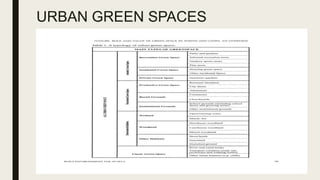
URBAN GREEN SPACES
GREEN SPACE
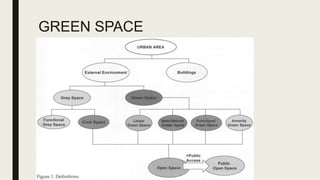
■ The external environment is defined as consisting firstly
of 'green space', which is land that consists
predominantly of unsealed, permeable, 'soft' surfaces
such as soil, grass, shrubs and trees.
■ Urban green space therefore includes all areas of parks,
play areas and other green spaces specifically intended
for recreational use, as well as other green spaces with
other origins.
■ The external environment also includes what can be
termed 'grey space', which is land that consists
predominantly of sealed, impermeable, 'hard' surfaces
such as concrete, paving or tarmac.
Discussion
■ What factors will be taken into consideration for
landscaping a public or botanical garden
This can be discussed based on all the information
thus far on community landscaping. The next slide
tells what a public/botanical garden is.
Botanical/Public/University Gardens
■ These are gardens open to the public. Usually such gardens are created on
purpose to cultivate and display a wide range of plants (collection).
■ Such a catalogued collection of plants is maintained for conservation, research,
education, teaching, recreation and display.
■ Botanical gardens were also established to display new plants from the
European colonies and newly visited lands as trophies. They were also
important learning laboratories for research.
■ Public gardens were set up initially for growing medicinal herbs. Such gardens
later expanded due to explorations and trade expansions.

community landscaping 2023 a.pptx advance

  • 1.
  • 2.
    INTRODUCTION Dictionary Definition ofLandscape: ■ An area of land that has a particular quality or appearance ■ A portion of land or territory which the eye can comprehend in a single view, including all objects it contains. ■ A landscape is part of the Earths surface that can be viewed at one time from one place. It consists of the geographic features that mark, or are characteristic of, a particular area. (National geographic) ■ Dictionary Definition of Community; A group of people who live in the same area (Such as a city, town, or neighbourhood) A group of people who have the same interests, religion, race etc. ■ Landscaping implies the creation of a particular quality or appearance of an area of land based on a concept (conceived idea in mind/thought)
  • 3.
    INTRO. CONTINUED ■ Landscapingis one of the simplest ways that a community establishes its identity. ■ Landscaping of a community should therefore not be on the basis of the singular ideas of a landscape professional. Plans and designs are to be user-friendly by all groups of persons. A strong factor in community landscaping is sustainability. (Is there what it takes to create, maintain and put to use the landscape plans and design now and maintain it for generations to come?) ■ Sustainable development has been explained in simple terms as development that meets the needs of the present without compromising the ability of future generations to meet their own needs. (UN commission on environment & Development, 1987) ■ Society, economy and environmental principles are key/strong influences in developing a sustainable design for a community and should be considered in the design process.
  • 4.
    INTRO. CONTINUED ■ Tosatisfy the social aspect of sustainability, there should be community participation. (Importance / benefits of community participation – List as many as possible) ■ With the understanding this far, community landscaping may cover landscape projects to do with Hospitals, a new school, a church or even a park, sports arena, hotel etc. ( places in the landscape to be used by a group of persons) ■ All the respective communities must appear as properly integrated union of land and man-made features. (Explain)
  • 5.
    COMMUNITY LANDSCAPE –Best planning principles ■ Have a clear understanding of the general principles and objectives of site planning. ■ Structures, roads, parking areas, walls and landscape elements have a pleasing and efficient relationship to the land on which the area is located. All should appear as an integrated union of land and man-made features.
  • 6.
    COMMUNITY LANDSCAPE –Best planning principles ■ In order to achieve the aforementioned point, a site analysis plan must be prepared. In the analysis the location of existing physical features such as views, buildings, utilities, and wind direction is noted and put in a plan. ■ This can be achieved by conducting an initial survey and taking note of all features that can be an asset for the design. Soil samples for test in the lab is taken during such surveys. ■ As much as possible the natural topographical and landscape features of the land must be maintained.
  • 7.
    COMMUNITY LANDSCAPE –Best planning principles ■ A landscape designer may identify the location to be plane and having the tendency of giving a flat monotonous effect on the proposed project. Should that occur the designer can solve that by creating mounds and undulations at strategic places on the site. (Refer to ‘Capability’ Brown design concepts). ■ The entire layout should allow for adequate light penetration and air circulation. Streets, walkways should be roomy enough. All utilities placed to facilitate maintenance.
  • 8.
    COMMUNITY LANDSCAPE –Best planning principles ■ Landscape features that may be considered depending on the particular project are: enclosures such as fences, walls and screening plants; plantings, including shrubs, hedges, ground covers and trees. ■ Surface improvements including patios, plazas, walks, steps and terraces. ■ Various landscape accessories such as outdoor furniture, water fountains, portable planters, sculpture, and light fixtures. These features can be included in the plan depending on the design concept for the project
  • 9.
    COMMUNITY LANDSCAPE –Best planning principles ■ The amount of open space available will largely determine the extent to which landscape elements can be used in a design. ■ Always the architecture of the building should be kept in mind when choosing structural materials used as landscape elements. ■ Economy of maintenance should be borne in mind when choosing landscape elements. ■ Plantings must not be haphazard. There should be a planting plan which will allow for showing of an obelisk, specimen plant, unique view etc.
  • 10.
    COMMUNITY LANDSCAPE –Best planning principles ■ Texture, colour and form of plantings must harmoniously blend with the rest of the site. ■ An area must be located for car parking but it should not dominate the site. They must be planned for and made to blend with the rest of the project. ■ Pedestrian walk to serve the parking facility will have to be provided. These should be planned so that they do not interfere with automobile traffic.
  • 11.
    Summary of mainbenefits to health and wellbeing that arise from contact with natureis Biological and mental wellbeing: ■ Provides a sense of wellbeing and positively influences immunity and cardiovascular function. ■ Reduces the magnitude of the physiological response to stress and enhances the ability to cope with and recover from stressful episodes. ■ Some positive physiological effects of viewing nature include reduction of heart rate, muscle tension, blood pressure and skin conductance. ■ Views of nature also improves psychological health, particularly emotional and cognitive. ■ For children, views of nature also assists cognitive function and also reduces symptoms of attention deficit disorder.
  • 12.
    Summary of mainbenefits to health and wellbeing that arise from contact with nature ■ Views of nature improves performance in attention demanding tasks and can restore concentration. ■ Improves overall wellbeing. ■ Improves self-awareness, self-esteem, self-concept and positively affects mood state, which have positive flow-on effects to physiological state. ■ Effective in alleviating the symptoms of anxiety, depression and psychosomatic illness (irritability, restlessness, insomnia, tension, headaches and indigestion)
  • 13.
    Plants and Gardensin Social Context ■ Plants and Gardens in a community have diverse influence on the inhabitants of that community. This could be social, economical, psychological, health etc ■ This aspect of well being focuses on non-material benefits that can be hard to quantify such as a) Improved social network b) Community cohesion – the sense of community, foster a sense of belonging or sense of place and enhance social ties. c) Reduced vulnerability d) Freedom from violence and conflict. e) Provides social capital within neighbourhoods by providing settings for groups to meet.
  • 14.
    Plants and Gardensin Social Context ■ Nature in a high density urban living can reduce vandalism, violence, crime rate, ease racial tension or prejudices and result in neighbourhood and personal development. ■ Contact with nature can foster a sense of identity and ownership and provide a sense of integration rather than isolation for newly arrived migrants.
  • 15.
    Economic wellbeing ■ Contactwith nature improves job satisfaction and reduces job stress in the workforce. ■ Parks and natural features attract businesses. ■ Trees in urban streets attract consumers and tourists to business districts and are seen to increase appeal. ■ Tourism is the third largest industry worldwide, with growth occurring particularly in wilderness or nature-based tourism
  • 16.
  • 17.
  • 18.
    GREEN SPACE ■ Theexternal environment is defined as consisting firstly of 'green space', which is land that consists predominantly of unsealed, permeable, 'soft' surfaces such as soil, grass, shrubs and trees. ■ Urban green space therefore includes all areas of parks, play areas and other green spaces specifically intended for recreational use, as well as other green spaces with other origins. ■ The external environment also includes what can be termed 'grey space', which is land that consists predominantly of sealed, impermeable, 'hard' surfaces such as concrete, paving or tarmac.
  • 19.
    Discussion ■ What factorswill be taken into consideration for landscaping a public or botanical garden This can be discussed based on all the information thus far on community landscaping. The next slide tells what a public/botanical garden is.
  • 20.
    Botanical/Public/University Gardens ■ Theseare gardens open to the public. Usually such gardens are created on purpose to cultivate and display a wide range of plants (collection). ■ Such a catalogued collection of plants is maintained for conservation, research, education, teaching, recreation and display. ■ Botanical gardens were also established to display new plants from the European colonies and newly visited lands as trophies. They were also important learning laboratories for research. ■ Public gardens were set up initially for growing medicinal herbs. Such gardens later expanded due to explorations and trade expansions.