ARCH 405 - LANDSCAPE DESIGN
AR. ZEHRA WAZIR - 3(2-1)
Video Resource:
I want to be a landscape architect...
https://www.youtube.com/watch?v=zbx3FDDNeQM
LEARNING OUTCOMES
 What is Landscape?
 What is Landscape Architecture”
 What is Landscape Design?
 What is Landscape Design process?
 What are elements of landscape Design
Architects design interior and outdoor spaces (3D)
Planners plan and design Neighborhood /city (2D)
Landscape architects design Enclosures (4D)
Urban Designers creates Place (3D)
ARCHITECTS, URBAN PLANNING & DESIGN , LANDSCAPE DESIGN
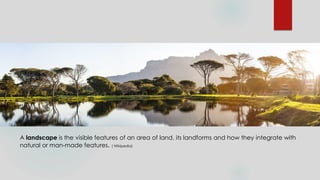
A landscape is the visible features of an area of land, its landforms and how they integrate with
natural or man-made features. ( Wikipedia)
LANDSCAPE IS MORE THAN WHAT MEETS THE EYE!
 “LAND” means both a place and the people living there.
 “SCAPE” means “to shape”, and also mean association, partnership.
 Landscape is the result of the action and interaction of natural and/or human
factors.
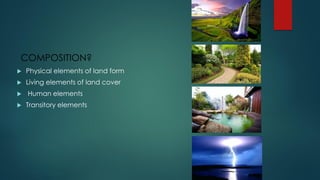
COMPOSITION?
 Physical elements of land form
 Living elements of land cover
 Human elements
 Transitory elements
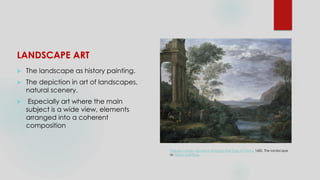
LANDSCAPE ART
 The landscape as history painting.
 The depiction in art of landscapes,
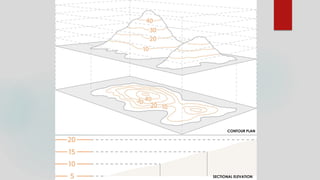
natural scenery.
 Especially art where the main
subject is a wide view, elements
arranged into a coherent
composition
Claude Lorrain, Ascanius Shooting the Stag of Sylvia, 1682. The landscape
as history painting.
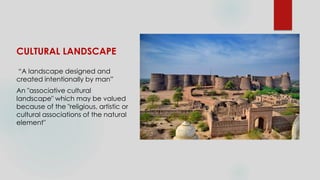
CULTURAL LANDSCAPE
“A landscape designed and
created intentionally by man”
An "associative cultural
landscape" which may be valued
because of the "religious, artistic or
cultural associations of the natural
element"
LANDSCAPE ECOLOGY
The science of studying and improving relationships between ecological
processes in the environment and particular ecosystems
LANDSCAPE PLANNING
 A branch of landscape architecture
 An activity concerned with reconciling competing land uses while protecting
natural processes, significant cultural, natural resources
LANDSCAPE DESIGN
 An independent profession and a design & art tradition
 Practiced by landscape designers
 Combining nature and culture
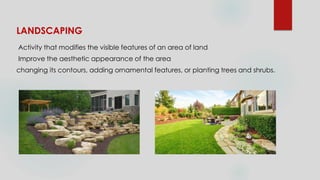
LANDSCAPING
Activity that modifies the visible features of an area of land
Improve the aesthetic appearance of the area
changing its contours, adding ornamental features, or planting trees and shrubs.
IMPORTANCE OF LANDSCAPE DESIGN
 Psychology of users
 Value of real estate
 On the environment
 on Tourism
 On the Identity of a place
 Eco-Tourism
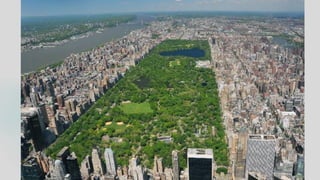
Frederick Law Olmsted, Sr., and Calvert Vaux’s “Greensward” plan was chosen
for New York’s precedent-setting, publicly funded, urban park in the 1857 design
competition.
“ Visually isolated from the city by perimeter walls and plantings, the park’s water features (including the city’s first reservoir) increased
the sense of distance from the edge. The intersection of grade-separated carriage, equestrian, and pedestrian circulation routes
prompted the building of numerous bridges, each unique. Designed to thwart class self-segregation, several of the most magnetic
landscapes were reachable only on foot. The formal Mall, its cathedral-like ambience created by quadruple rows of American elms
surrounding a central promenade, was set askew from the urban grid, aligned instead on the distant Belvedere Castle.”
Additional notable figures associated with the park’s nineteenth-century
development include architect Jacob Wrey Mould, horticulturist Ignatz Pilat,
sanitarian George E. Waring, and landscape architect Samuel Parsons, Jr.
CASE STUDY
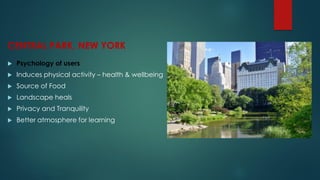
CENTRAL PARK, NEW YORK
 Psychology of users
 Induces physical activity – health & wellbeing
 Source of Food
 Landscape heals
 Privacy and Tranquility
 Better atmosphere for learning
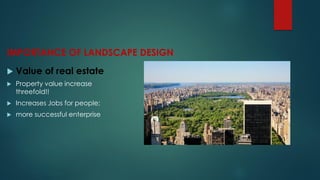
IMPORTANCE OF LANDSCAPE DESIGN
 Value of real estate
 Property value increase
threefold!!
 Increases Jobs for people;
 more successful enterprise
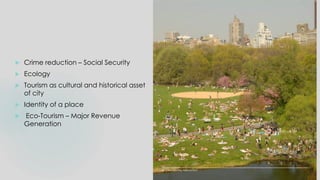
 Crime reduction – Social Security
 Ecology
 Tourism as cultural and historical asset
of city
 Identity of a place
 Eco-Tourism – Major Revenue
Generation
LANDSCAPE ARCHITECTURE
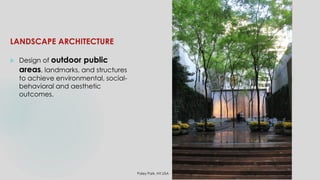
 Design of outdoor public
areas, landmarks, and structures
to achieve environmental, social-
behavioral and aesthetic
outcomes.
Paley Park, NY,USA
LANDSCAPE ARCHITECTURE
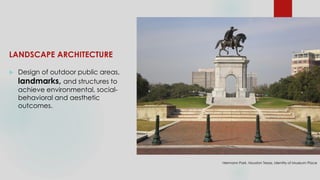
 Design of outdoor public areas,
landmarks, and structures to
achieve environmental, social-
behavioral and aesthetic
outcomes.
Hermann Park. Houston Texas, Identity of Museum Place
LANDSCAPE ARCHITECTURE
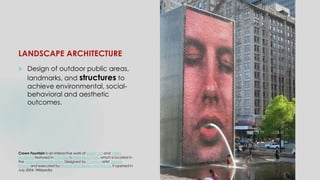
 Design of outdoor public areas,
landmarks, and structures to
achieve environmental, social-
behavioral and aesthetic
outcomes.
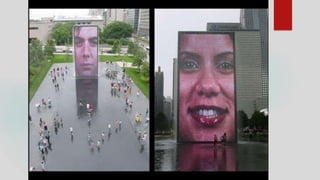
Crown Fountain is an interactive work of public art and video
sculpture featured in Chicago's Millennium Park, which is located in
the Loop community area. Designed by Catalan artist Jaume
Plensa and executed by Krueck and Sexton Architects, it opened in
July 2004. Wikipedia
LD INCORPORATES
FOLLOWING FIELDS:
 Botany
 Horticulture
 Fine arts
 Architecture
 Industrial design
 Geology
 Earth sciences
 Environmental
psychology
 Geography
 Ecology
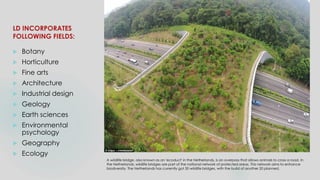
A wildlife bridge, also known as an 'ecoduct' in the Netherlands, is an overpass that allows animals to cross a road. In
the Netherlands, wildlife bridges are part of the national network of protected areas. This network aims to enhance
biodiversity. The Netherlands has currently got 30 wildlife bridges, with the build of another 20 planned.
LANDSCAPE ARCHITECT
Apply creative and technical skill, scientific,
cultural and political knowledge in the planned
arrangement of natural and constructed
elements on the land integrating
ecological sustainability.
Resulting environments shall serve useful,
aesthetic, safe and enjoyable purposes
Video Resource:
Architectural careers - A day in the work life of a landscape architect
https://www.youtube.com/watch?v=OVSAh5aKjAg
LANDSCAPE ARCHITECT – SCOPE OVERVIEW
 urban design and site planning
 storm water management
 parks and recreation planning
 green infrastructure planning and provision
 private estate and residence landscape
master planning and design Landscape
Architect
LANDSCAPE ARCHITECT – SCOPE OVERVIEW
 urban design and site planning
 storm water management
 parks and recreation planning
 green infrastructure planning and provision
 private estate and residence landscape
master planning and design Landscape
Architect
COMPONENTS OF LANDSCAPE DESIGN
 Landform
 Hardscape
 Planting
 Water
 Site Furniture
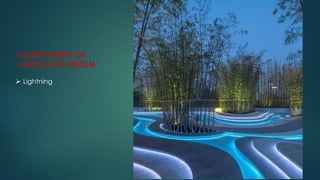
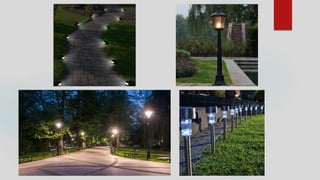
 Lightning
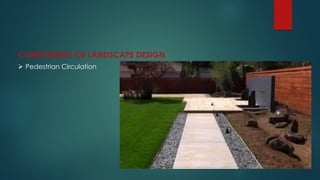
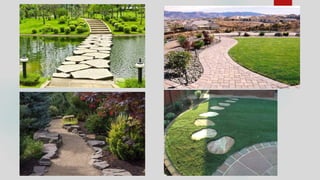
 Pedestrian Circulation
 Utilities Network
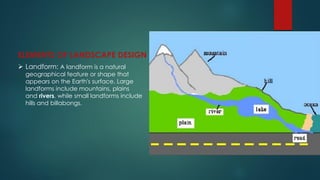
ELEMENTS OF LANDSCAPE DESIGN
 Landform: A landform is a natural
geographical feature or shape that
appears on the Earth's surface. Large
landforms include mountains, plains
and rivers, while small landforms include
hills and billabongs.
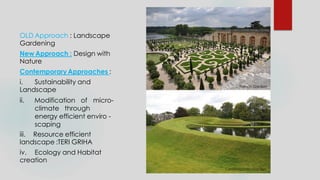
OLD Approach : Landscape
Gardening
New Approach : Design with
Nature
ContemporaryApproaches :
i. Sustainability and
Landscape
ii. Modification of micro-
climate through
energy efficient enviro -
scaping
iii. Resource efficient
landscape :TERI GRIHA
iv. Ecology and Habitat
creation
French Garden
Contemporary Garden
CONTOUR PLAN
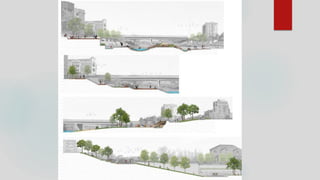
SECTIONAL ELEVATION
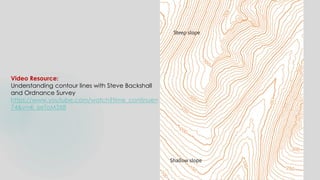
Video Resource:
Understanding contour lines with Steve Backshall
and Ordnance Survey
https://www.youtube.com/watch?time_continue=
74&v=4i_6eToM3X8
ELEMENTS OF LANDSCAPE DESIGN
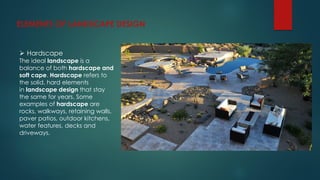
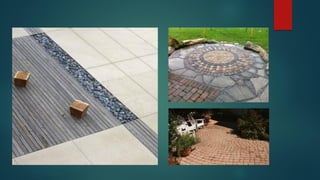
 Hardscape
The ideal landscape is a
balance of both hardscape and
soft cape. Hardscape refers to
the solid, hard elements
in landscape design that stay
the same for years. Some
examples of hardscape are
rocks, walkways, retaining walls,
paver patios, outdoor kitchens,
water features, decks and
driveways.
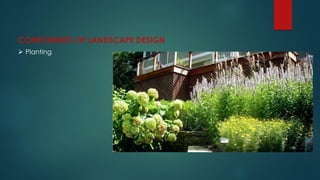
COMPONENTS OF LANDSCAPE DESIGN
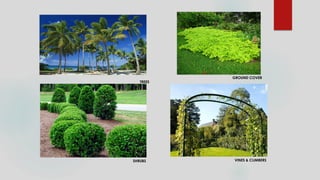
 Planting
SHRUBS
TREES
GROUND COVER
VINES & CLIMBERS
COMPONENTS OF LANDSCAPE DESIGN
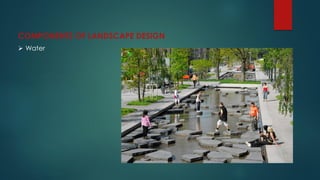
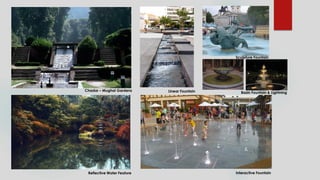
 Water
Chadar – Mughal Gardens
Interactive FountainReflective Water Feature
Linear Fountain Basin Fountain & Lightning
Sculpture Fountain
COMPONENTS OF LANDSCAPE DESIGN
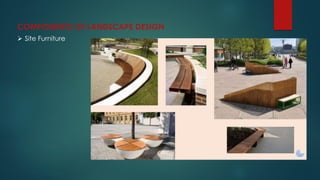
 Site Furniture
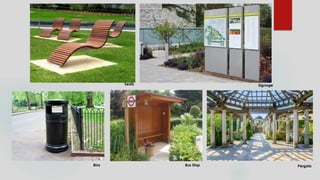
Seats
Bus StopBins
Linear Fountain
Signage
Pergola
COMPONENTS OF
LANDSCAPE DESIGN
 Lightning
COMPONENTS OF LANDSCAPE DESIGN
 Pedestrian Circulation
Theory ASSIGNMENT 1 – LAYERS OF ELEMENT
 Deconstruct a landscape (public park, historic garden, public
square ) into elements of landscape design; elaborating types, and
importance of each elements in terms of theme and
environmental sustainability.
 Use of A3 sheets ( Tracing or Drawing). Max no. 4 sheets.
 Use of Analytical sketches and diagrams with hand written notes;
composed across blank space.
 Submission: 10:00 am on 11/11/2018.
THANK YOU!

Arch 405 landscape design - lecture one

  • 1.
    ARCH 405 -LANDSCAPE DESIGN AR. ZEHRA WAZIR - 3(2-1)
  • 2.
    Video Resource: I wantto be a landscape architect... https://www.youtube.com/watch?v=zbx3FDDNeQM
  • 3.
    LEARNING OUTCOMES  Whatis Landscape?  What is Landscape Architecture”  What is Landscape Design?  What is Landscape Design process?  What are elements of landscape Design
  • 4.
    Architects design interiorand outdoor spaces (3D) Planners plan and design Neighborhood /city (2D) Landscape architects design Enclosures (4D) Urban Designers creates Place (3D) ARCHITECTS, URBAN PLANNING & DESIGN , LANDSCAPE DESIGN
  • 5.
    A landscape isthe visible features of an area of land, its landforms and how they integrate with natural or man-made features. ( Wikipedia)
  • 6.
    LANDSCAPE IS MORETHAN WHAT MEETS THE EYE!  “LAND” means both a place and the people living there.  “SCAPE” means “to shape”, and also mean association, partnership.  Landscape is the result of the action and interaction of natural and/or human factors.
  • 7.
    COMPOSITION?  Physical elementsof land form  Living elements of land cover  Human elements  Transitory elements
  • 8.
    LANDSCAPE ART  Thelandscape as history painting.  The depiction in art of landscapes, natural scenery.  Especially art where the main subject is a wide view, elements arranged into a coherent composition Claude Lorrain, Ascanius Shooting the Stag of Sylvia, 1682. The landscape as history painting.
  • 9.
    CULTURAL LANDSCAPE “A landscapedesigned and created intentionally by man” An "associative cultural landscape" which may be valued because of the "religious, artistic or cultural associations of the natural element"
  • 10.
    LANDSCAPE ECOLOGY The scienceof studying and improving relationships between ecological processes in the environment and particular ecosystems LANDSCAPE PLANNING  A branch of landscape architecture  An activity concerned with reconciling competing land uses while protecting natural processes, significant cultural, natural resources
  • 11.
    LANDSCAPE DESIGN  Anindependent profession and a design & art tradition  Practiced by landscape designers  Combining nature and culture
  • 16.
    LANDSCAPING Activity that modifiesthe visible features of an area of land Improve the aesthetic appearance of the area changing its contours, adding ornamental features, or planting trees and shrubs.
  • 17.
    IMPORTANCE OF LANDSCAPEDESIGN  Psychology of users  Value of real estate  On the environment  on Tourism  On the Identity of a place  Eco-Tourism
  • 19.
    Frederick Law Olmsted,Sr., and Calvert Vaux’s “Greensward” plan was chosen for New York’s precedent-setting, publicly funded, urban park in the 1857 design competition. “ Visually isolated from the city by perimeter walls and plantings, the park’s water features (including the city’s first reservoir) increased the sense of distance from the edge. The intersection of grade-separated carriage, equestrian, and pedestrian circulation routes prompted the building of numerous bridges, each unique. Designed to thwart class self-segregation, several of the most magnetic landscapes were reachable only on foot. The formal Mall, its cathedral-like ambience created by quadruple rows of American elms surrounding a central promenade, was set askew from the urban grid, aligned instead on the distant Belvedere Castle.” Additional notable figures associated with the park’s nineteenth-century development include architect Jacob Wrey Mould, horticulturist Ignatz Pilat, sanitarian George E. Waring, and landscape architect Samuel Parsons, Jr. CASE STUDY CENTRAL PARK, NEW YORK
  • 20.
    CENTRAL PARK, NEWYORK  Psychology of users  Induces physical activity – health & wellbeing  Source of Food  Landscape heals  Privacy and Tranquility  Better atmosphere for learning
  • 21.
    IMPORTANCE OF LANDSCAPEDESIGN  Value of real estate  Property value increase threefold!!  Increases Jobs for people;  more successful enterprise
  • 22.
     Crime reduction– Social Security  Ecology  Tourism as cultural and historical asset of city  Identity of a place  Eco-Tourism – Major Revenue Generation
  • 23.
    LANDSCAPE ARCHITECTURE  Designof outdoor public areas, landmarks, and structures to achieve environmental, social- behavioral and aesthetic outcomes. Paley Park, NY,USA
  • 24.
    LANDSCAPE ARCHITECTURE  Designof outdoor public areas, landmarks, and structures to achieve environmental, social- behavioral and aesthetic outcomes. Hermann Park. Houston Texas, Identity of Museum Place
  • 25.
    LANDSCAPE ARCHITECTURE  Designof outdoor public areas, landmarks, and structures to achieve environmental, social- behavioral and aesthetic outcomes. Crown Fountain is an interactive work of public art and video sculpture featured in Chicago's Millennium Park, which is located in the Loop community area. Designed by Catalan artist Jaume Plensa and executed by Krueck and Sexton Architects, it opened in July 2004. Wikipedia
  • 26.
    LD INCORPORATES FOLLOWING FIELDS: Botany  Horticulture  Fine arts  Architecture  Industrial design  Geology  Earth sciences  Environmental psychology  Geography  Ecology A wildlife bridge, also known as an 'ecoduct' in the Netherlands, is an overpass that allows animals to cross a road. In the Netherlands, wildlife bridges are part of the national network of protected areas. This network aims to enhance biodiversity. The Netherlands has currently got 30 wildlife bridges, with the build of another 20 planned.
  • 27.
    LANDSCAPE ARCHITECT Apply creativeand technical skill, scientific, cultural and political knowledge in the planned arrangement of natural and constructed elements on the land integrating ecological sustainability. Resulting environments shall serve useful, aesthetic, safe and enjoyable purposes Video Resource: Architectural careers - A day in the work life of a landscape architect https://www.youtube.com/watch?v=OVSAh5aKjAg
  • 28.
    LANDSCAPE ARCHITECT –SCOPE OVERVIEW  urban design and site planning  storm water management  parks and recreation planning  green infrastructure planning and provision  private estate and residence landscape master planning and design Landscape Architect
  • 29.
    LANDSCAPE ARCHITECT –SCOPE OVERVIEW  urban design and site planning  storm water management  parks and recreation planning  green infrastructure planning and provision  private estate and residence landscape master planning and design Landscape Architect
  • 30.
    COMPONENTS OF LANDSCAPEDESIGN  Landform  Hardscape  Planting  Water  Site Furniture  Lightning  Pedestrian Circulation  Utilities Network
  • 31.
    ELEMENTS OF LANDSCAPEDESIGN  Landform: A landform is a natural geographical feature or shape that appears on the Earth's surface. Large landforms include mountains, plains and rivers, while small landforms include hills and billabongs.
  • 32.
    OLD Approach :Landscape Gardening New Approach : Design with Nature ContemporaryApproaches : i. Sustainability and Landscape ii. Modification of micro- climate through energy efficient enviro - scaping iii. Resource efficient landscape :TERI GRIHA iv. Ecology and Habitat creation French Garden Contemporary Garden
  • 34.
  • 35.
    Video Resource: Understanding contourlines with Steve Backshall and Ordnance Survey https://www.youtube.com/watch?time_continue= 74&v=4i_6eToM3X8
  • 36.
    ELEMENTS OF LANDSCAPEDESIGN  Hardscape The ideal landscape is a balance of both hardscape and soft cape. Hardscape refers to the solid, hard elements in landscape design that stay the same for years. Some examples of hardscape are rocks, walkways, retaining walls, paver patios, outdoor kitchens, water features, decks and driveways.
  • 38.
    COMPONENTS OF LANDSCAPEDESIGN  Planting
  • 39.
  • 40.
    COMPONENTS OF LANDSCAPEDESIGN  Water
  • 41.
    Chadar – MughalGardens Interactive FountainReflective Water Feature Linear Fountain Basin Fountain & Lightning Sculpture Fountain
  • 42.
    COMPONENTS OF LANDSCAPEDESIGN  Site Furniture
  • 43.
  • 44.
  • 46.
    COMPONENTS OF LANDSCAPEDESIGN  Pedestrian Circulation
  • 48.
    Theory ASSIGNMENT 1– LAYERS OF ELEMENT  Deconstruct a landscape (public park, historic garden, public square ) into elements of landscape design; elaborating types, and importance of each elements in terms of theme and environmental sustainability.  Use of A3 sheets ( Tracing or Drawing). Max no. 4 sheets.  Use of Analytical sketches and diagrams with hand written notes; composed across blank space.  Submission: 10:00 am on 11/11/2018.
  • 49.