EDU 702
RESEARCH METHODOLOGY
SURVEY, CORRELATION & CAUSAL
COMPARITIVE RESEARCH
Prepared for:
DR. JOHAN @ EDDY LUARAN
Prepared by:
Akmal Binti Ahamed Kamal 2013518657
Fatin Athirah Binti Ismail 2013374739
Maryam Solehah Binti Zakaria 2013932773
Nor Nadia Bt Abdul Razak 2013168885
Nur Nabihah Binti Mohd Nizar 2013151033
Nurul Aina Binti Che Arifin 2013110407
What?
Determine specific
characteristic.
Descriptive survey
Interview
SURVEY RESEARCH
Describe characteristic of
a population
Distribute themselves on
one or more variables
Why are survey conducted?
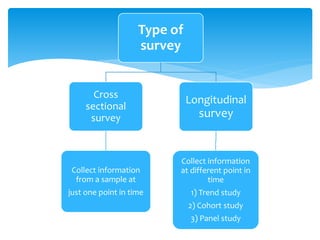
Type of
survey
Cross
sectional
survey
Collect information
from a sample at
just one point in time
Longitudinal
survey
Collect information
at different point in
time
1) Trend study
2) Cohort study
3) Panel study
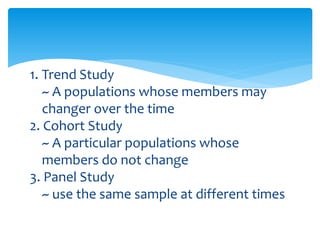
1. Trend Study
~ A populations whose members may
changer over the time
2. Cohort Study
~ A particular populations whose
members do not change
3. Panel Study
~ use the same sample at different times
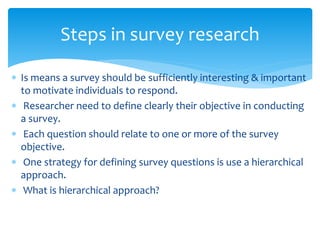
 Is means a survey should be sufficiently interesting & important
to motivate individuals to respond.
 Researcher need to define clearly their objective in conducting
a survey.
 Each question should relate to one or more of the survey
objective.
 One strategy for defining survey questions is use a hierarchical
approach.
 What is hierarchical approach?
Steps in survey research
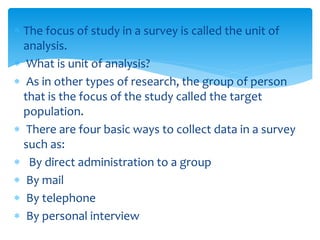
 The focus of study in a survey is called the unit of
analysis.
 What is unit of analysis?
 As in other types of research, the group of person
that is the focus of the study called the target
population.
 There are four basic ways to collect data in a survey
such as:
 By direct administration to a group
 By mail
 By telephone
 By personal interview
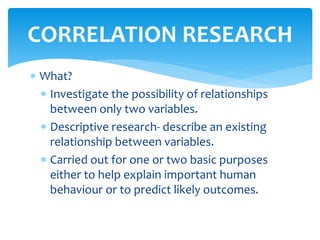
 What?
 Investigate the possibility of relationships
between only two variables.
 Descriptive research- describe an existing
relationship between variables.
 Carried out for one or two basic purposes
either to help explain important human
behaviour or to predict likely outcomes.
CORRELATION RESEARCH
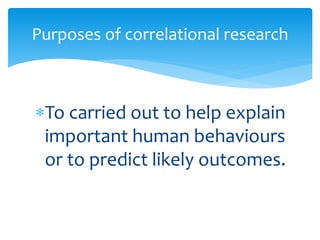
To carried out to help explain
important human behaviours
or to predict likely outcomes.
Purposes of correlational research
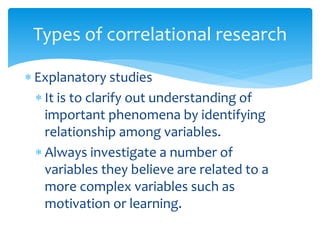
 Explanatory studies
 It is to clarify out understanding of
important phenomena by identifying
relationship among variables.
 Always investigate a number of
variables they believe are related to a
more complex variables such as
motivation or learning.
Types of correlational research
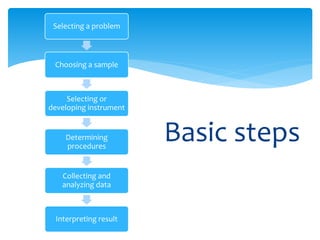
Selecting a problem
Choosing a sample
Selecting or
developing instrument
Determining
procedures
Collecting and
analyzing data
Interpreting result
Basic steps
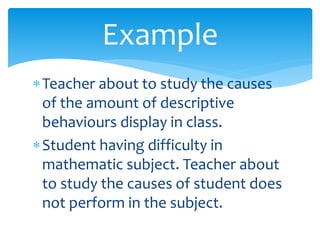
Teacher about to study the causes
of the amount of descriptive
behaviours display in class.
Student having difficulty in
mathematic subject. Teacher about
to study the causes of student does
not perform in the subject.
Example
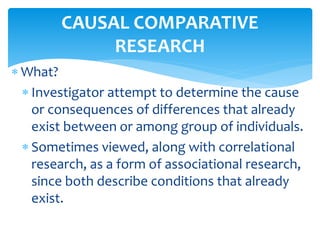
 What?
 Investigator attempt to determine the cause
or consequences of differences that already
exist between or among group of individuals.
 Sometimes viewed, along with correlational
research, as a form of associational research,
since both describe conditions that already
exist.
CAUSAL COMPARATIVE
RESEARCH
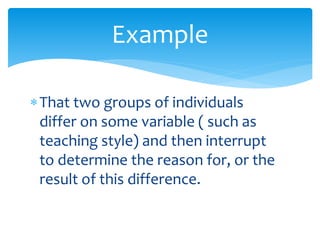
That two groups of individuals
differ on some variable ( such as
teaching style) and then interrupt
to determine the reason for, or the
result of this difference.
Example
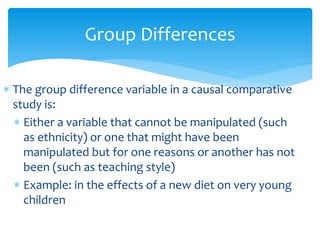
Group Differences
 The group difference variable in a causal comparative
study is:
 Either a variable that cannot be manipulated (such
as ethnicity) or one that might have been
manipulated but for one reasons or another has not
been (such as teaching style)
 Example: in the effects of a new diet on very young
children
 It is about one of the type of research method that using
comparison between cause and effect. Comparisons can
establish whether something can be explained by the same
causes or not. The difference can be a conclusion but not for
the cause of difference. Interpretation of this kind of method is
limited because these studies are of value in identified possible
causes of observed variation in the behaviour pattern of
students.
 This kind of research can be used in prediction about problem
such as, the different achievements of student in the class. If it
about teaching methods, it can be research either it is related
with art multimedia method or the self-learning methods.
Type Of Research
 Research objectives are:
 To identify the meaning of survey, correlation and
causal comparative research.
 To examine the types of survey, correlation and
causal comparative research.
 To identify the purposes of this three research
method.
Example Of Research Objectives
 Research questions are:
 What are the meaning of survey, correlation and
causal comparative research?
 What are the types of survey, correlation and causal
comparative research?
 What are the purposes of this three research
method?
Example Of Research Questions
 What are three (3) longitdinal designed are
commonly employed in survey research?
 What are advantages and disadvantages to
collect data in a survey by web- based survey ?
 What will you find when you handle correlational
research?
 What is purpose of correlational research?
 What differences in abilities are caused by
gender?
 Do you think casual comparative-research can
avoid the bias judgement?
Question

Presentation1

  • 1.
    EDU 702 RESEARCH METHODOLOGY SURVEY,CORRELATION & CAUSAL COMPARITIVE RESEARCH Prepared for: DR. JOHAN @ EDDY LUARAN Prepared by: Akmal Binti Ahamed Kamal 2013518657 Fatin Athirah Binti Ismail 2013374739 Maryam Solehah Binti Zakaria 2013932773 Nor Nadia Bt Abdul Razak 2013168885 Nur Nabihah Binti Mohd Nizar 2013151033 Nurul Aina Binti Che Arifin 2013110407
  • 2.
  • 3.
    Describe characteristic of apopulation Distribute themselves on one or more variables Why are survey conducted?
  • 4.
    Type of survey Cross sectional survey Collect information froma sample at just one point in time Longitudinal survey Collect information at different point in time 1) Trend study 2) Cohort study 3) Panel study
  • 5.
    1. Trend Study ~A populations whose members may changer over the time 2. Cohort Study ~ A particular populations whose members do not change 3. Panel Study ~ use the same sample at different times
  • 6.
     Is meansa survey should be sufficiently interesting & important to motivate individuals to respond.  Researcher need to define clearly their objective in conducting a survey.  Each question should relate to one or more of the survey objective.  One strategy for defining survey questions is use a hierarchical approach.  What is hierarchical approach? Steps in survey research
  • 7.
     The focusof study in a survey is called the unit of analysis.  What is unit of analysis?  As in other types of research, the group of person that is the focus of the study called the target population.  There are four basic ways to collect data in a survey such as:  By direct administration to a group  By mail  By telephone  By personal interview
  • 8.
     What?  Investigatethe possibility of relationships between only two variables.  Descriptive research- describe an existing relationship between variables.  Carried out for one or two basic purposes either to help explain important human behaviour or to predict likely outcomes. CORRELATION RESEARCH
  • 9.
    To carried outto help explain important human behaviours or to predict likely outcomes. Purposes of correlational research
  • 10.
     Explanatory studies It is to clarify out understanding of important phenomena by identifying relationship among variables.  Always investigate a number of variables they believe are related to a more complex variables such as motivation or learning. Types of correlational research
  • 11.
    Selecting a problem Choosinga sample Selecting or developing instrument Determining procedures Collecting and analyzing data Interpreting result Basic steps
  • 12.
    Teacher about tostudy the causes of the amount of descriptive behaviours display in class. Student having difficulty in mathematic subject. Teacher about to study the causes of student does not perform in the subject. Example
  • 13.
     What?  Investigatorattempt to determine the cause or consequences of differences that already exist between or among group of individuals.  Sometimes viewed, along with correlational research, as a form of associational research, since both describe conditions that already exist. CAUSAL COMPARATIVE RESEARCH
  • 14.
    That two groupsof individuals differ on some variable ( such as teaching style) and then interrupt to determine the reason for, or the result of this difference. Example
  • 15.
    Group Differences  Thegroup difference variable in a causal comparative study is:  Either a variable that cannot be manipulated (such as ethnicity) or one that might have been manipulated but for one reasons or another has not been (such as teaching style)  Example: in the effects of a new diet on very young children
  • 16.
     It isabout one of the type of research method that using comparison between cause and effect. Comparisons can establish whether something can be explained by the same causes or not. The difference can be a conclusion but not for the cause of difference. Interpretation of this kind of method is limited because these studies are of value in identified possible causes of observed variation in the behaviour pattern of students.  This kind of research can be used in prediction about problem such as, the different achievements of student in the class. If it about teaching methods, it can be research either it is related with art multimedia method or the self-learning methods. Type Of Research
  • 17.
     Research objectivesare:  To identify the meaning of survey, correlation and causal comparative research.  To examine the types of survey, correlation and causal comparative research.  To identify the purposes of this three research method. Example Of Research Objectives
  • 18.
     Research questionsare:  What are the meaning of survey, correlation and causal comparative research?  What are the types of survey, correlation and causal comparative research?  What are the purposes of this three research method? Example Of Research Questions
  • 19.
     What arethree (3) longitdinal designed are commonly employed in survey research?  What are advantages and disadvantages to collect data in a survey by web- based survey ?  What will you find when you handle correlational research?  What is purpose of correlational research?  What differences in abilities are caused by gender?  Do you think casual comparative-research can avoid the bias judgement? Question