QUANTITATIVE
RESEARCH
DESIGNS
Sophia Rien N. Mendoza, RPm
2.DESCRIPTIVE (non-experimental)
1.EXPERIMENTAL
true experimental
quasi-experimental
According to purpose
according to time
Survey research
correlationalresearch
cross-sectional research
longitudinal research
1.EXPERIMENTAL
1.1 QUASI-EXPERIMENTAL
The prefix quasi means "resembling." =research
that resembles experimental research but is not
true experimental research.
Although the IV is manipulated, participants are
not randomly assigned to conditions or orders
of conditions.
EXPERIMENTAL
2. TRUE EXPERIMENTAL
A type of experimental design and is
thought to be the most accurate type
of experimental research because of
its main characteristic of random
assignment
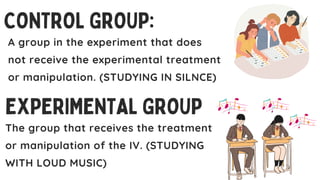
CONTROL GROUP:
EXPERIMENTAL GROUP
The group that receives the treatment
or manipulation of the IV. (STUDYING
WITH LOUD MUSIC)
A group in the experiment that does
not receive the experimental treatment
or manipulation. (STUDYING IN SILNCE)
IF YOU ARE STUDYING THE EFFECT OF SLEEP ON
MEMORY RECALL, WHAT IS THE IV?
INDEPENDENT VARIABLE (IV)
THE AMOUNT OF SLEEP PARTICIPANTS GET
4 HOURS 6 HOURS 8 HOURS
IF YOU ARE STUDYING THE EFFECT OF SLEEP ON
MEMORY RECALL, WHAT IS THE IV?
DEPENDENT VARIABLE (DV)
THE NUMBER OF WORDS PARTICIPANTS
CORRECTLY RECALL FROM A LIST AFTER
DIFFERENT AMOUNTS OF SLEEP.
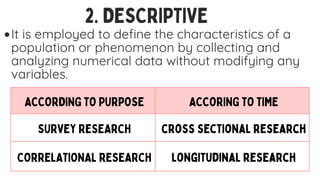
ACCORDING TO PURPOSE
SURVEY RESEARCH
CORRELATIONAL RESEARCH
ACCORING TO TIME
cross sectional research
longitudinal research
2. DESCRIPTIVE
It is employed to define the characteristics of a
population or phenomenon by collecting and
analyzing numerical data without modifying any
variables.
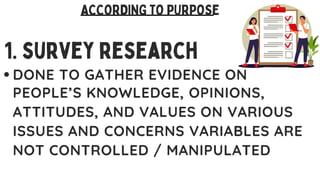
DONE TO GATHER EVIDENCE ON
PEOPLE’S KNOWLEDGE, OPINIONS,
ATTITUDES, AND VALUES ON VARIOUS
ISSUES AND CONCERNS VARIABLES ARE
NOT CONTROLLED / MANIPULATED
1. survey research
ACCORDING TO PURPOSE
Structured Questionnaire
Surveys typically use
structured questionnaires
with closed-ended questions.
The questions are designed
to be clear and objective,
reducing the chances of bias.
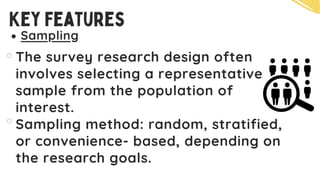
Key Features
Sampling
The survey research design often
involves selecting a representative
sample from the population of
interest.
Sampling method: random, stratified,
or convenience- based, depending on
the research goals.
Key Features
Data Collection
Online Surveys
Telephone Surveys
Face-to-Face Interviews
Mail Surveys
Key Features
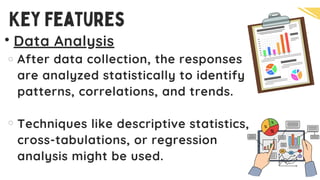
Data Analysis
After data collection, the responses
are analyzed statistically to identify
patterns, correlations, and trends.
Techniques like descriptive statistics,
cross-tabulations, or regression
analysis might be used.
Key Features
advantages:
Cost-Effective: Surveys can reach a large
number of respondents quickly and at a
relatively low cost.
Generalizable: If the sample is representative,
the results can be generalized to the broader
population.
Versatile: Can be used to collect data on a
wide range of topics.
Ex. “Survey on Smartphone Usage Among
High School Students”
Descriptive statistics (mean, median,
mode, standard deviation) are
calculated to describe the central
tendencies and variability of smartphone
usage.
Data Collection:
"How many hours per day do you spend on your
smartphone?" "What types of apps do you use the
most (e.g., social media, games, educational
apps)?" "What is your GPA?"
survey research
A Survey Research Study on Millennial Parenting
“Exploring Millennial Parenting Styles: A Survey
on Parenting Practices, Attitudes, and Influences”
1.How often do you set specific rules for your child?
2.How often do you allow your child to make their own decisions?
3.How frequently do you discuss the consequences of your child’s
actions with them?
(Likert scale: Never, Rarely, Sometimes, Often, Always)
Population:Millennial parentsaged27-42,residinginmetromanila,withatleast
one child under the age of 18.
REJECT OR ACCEPT HYPOTHESIS
A type of nonexperimental research in which the
researcher measures two or more variables and
assesses the statistical relationship between them.
Focuses on Significant Relationship Statistical
Treatment:
Pearson Correlation Coefficient (r)
Spearman’s Rank Order Coefficient
2. CORRELATIONal research
ACCORDING TO PURPOSE
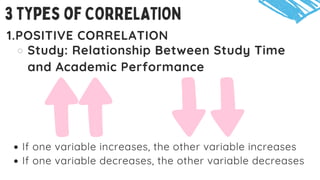
1.POSITIVE CORRELATION
Study: Relationship Between Study Time
and Academic Performance
3 types of CORRELATION
If one variable increases, the other variable increases
If one variable decreases, the other variable decreases
2. NEGATIVE CORRELATION
Study: The Relationship Between Stress
Levels and Sleep Quality
If one variable increases, the other variable decreases
If one variable decreases, the other variable increases
3 types of CORRELATION
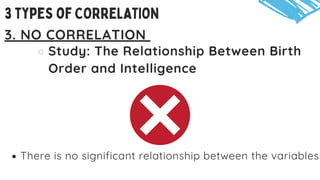
3. NO CORRELATION
Study: The Relationship Between Birth
Order and Intelligence
3 types of CORRELATION
There is no significant relationship between the variables
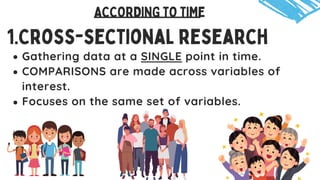
Gathering data at a SINGLE point in time.
COMPARISONS are made across variables of
interest.
Focuses on the same set of variables.
1.Cross-sectional research
ACCORDING TO TIME
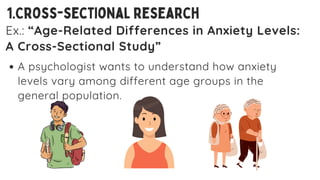
Ex.: “Age-Related Differences in Anxiety Levels:
A Cross-Sectional Study”
1.Cross-sectional research
A psychologist wants to understand how anxiety
levels vary among different age groups in the
general population.
“Age-Related Differences in Anxiety Levels: A Cross-
Sectional Study”
Conduct a survey & measure the anxiety levels using
a standardized scale among three distinct age
groups: teenagers (13-19 years), adults (20-40
years), and older adults (60+ years).
1.Cross-sectional research
Data is collected at MULTIPLE points in time.
Collects data from the PRESENT and again in the
FUTURE.
Done for the purpose of comparing data sets.
2.LONGITUDINAL research
ACCORDING TO TIME
Ex.: “Long-Term Impact of Childhood Trauma on Adult
Mental Health: A Longitudinal Study in Abnormal
Psychology”
2.longitudinal research
Recruited a group of children aged 8-10 who have been
identified as having experienced significant trauma,
such as abuse or neglect.
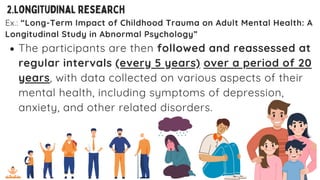
The participants are then followed and reassessed at
regular intervals (every 5 years) over a period of 20
years, with data collected on various aspects of their
mental health, including symptoms of depression,
anxiety, and other related disorders.
Ex.: “Long-Term Impact of Childhood Trauma on Adult Mental Health: A
Longitudinal Study in Abnormal Psychology”
2.longitudinal research
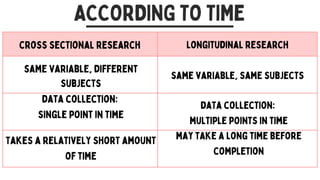
ACCORDING TO TIME
cross sectional research
same variable, different
subjects
data collection:
single point in time
takes a relatively short amount
of time
longitudinal research
same variable, same subjects
data collection:
multiple points in time
may take a long time before
completion

L4-QUANTITATIVE RESEARCH DESIGNS.pdf.pdf

  • 1.
  • 2.
    2.DESCRIPTIVE (non-experimental) 1.EXPERIMENTAL true experimental quasi-experimental Accordingto purpose according to time Survey research correlationalresearch cross-sectional research longitudinal research
  • 3.
    1.EXPERIMENTAL 1.1 QUASI-EXPERIMENTAL The prefixquasi means "resembling." =research that resembles experimental research but is not true experimental research. Although the IV is manipulated, participants are not randomly assigned to conditions or orders of conditions.
  • 4.
    EXPERIMENTAL 2. TRUE EXPERIMENTAL Atype of experimental design and is thought to be the most accurate type of experimental research because of its main characteristic of random assignment
  • 5.
    CONTROL GROUP: EXPERIMENTAL GROUP Thegroup that receives the treatment or manipulation of the IV. (STUDYING WITH LOUD MUSIC) A group in the experiment that does not receive the experimental treatment or manipulation. (STUDYING IN SILNCE)
  • 6.
    IF YOU ARESTUDYING THE EFFECT OF SLEEP ON MEMORY RECALL, WHAT IS THE IV? INDEPENDENT VARIABLE (IV) THE AMOUNT OF SLEEP PARTICIPANTS GET 4 HOURS 6 HOURS 8 HOURS
  • 7.
    IF YOU ARESTUDYING THE EFFECT OF SLEEP ON MEMORY RECALL, WHAT IS THE IV? DEPENDENT VARIABLE (DV) THE NUMBER OF WORDS PARTICIPANTS CORRECTLY RECALL FROM A LIST AFTER DIFFERENT AMOUNTS OF SLEEP.
  • 8.
    ACCORDING TO PURPOSE SURVEYRESEARCH CORRELATIONAL RESEARCH ACCORING TO TIME cross sectional research longitudinal research 2. DESCRIPTIVE It is employed to define the characteristics of a population or phenomenon by collecting and analyzing numerical data without modifying any variables.
  • 9.
    DONE TO GATHEREVIDENCE ON PEOPLE’S KNOWLEDGE, OPINIONS, ATTITUDES, AND VALUES ON VARIOUS ISSUES AND CONCERNS VARIABLES ARE NOT CONTROLLED / MANIPULATED 1. survey research ACCORDING TO PURPOSE
  • 10.
    Structured Questionnaire Surveys typicallyuse structured questionnaires with closed-ended questions. The questions are designed to be clear and objective, reducing the chances of bias. Key Features
  • 11.
    Sampling The survey researchdesign often involves selecting a representative sample from the population of interest. Sampling method: random, stratified, or convenience- based, depending on the research goals. Key Features
  • 12.
    Data Collection Online Surveys TelephoneSurveys Face-to-Face Interviews Mail Surveys Key Features
  • 13.
    Data Analysis After datacollection, the responses are analyzed statistically to identify patterns, correlations, and trends. Techniques like descriptive statistics, cross-tabulations, or regression analysis might be used. Key Features
  • 14.
    advantages: Cost-Effective: Surveys canreach a large number of respondents quickly and at a relatively low cost. Generalizable: If the sample is representative, the results can be generalized to the broader population. Versatile: Can be used to collect data on a wide range of topics.
  • 15.
    Ex. “Survey onSmartphone Usage Among High School Students” Descriptive statistics (mean, median, mode, standard deviation) are calculated to describe the central tendencies and variability of smartphone usage. Data Collection: "How many hours per day do you spend on your smartphone?" "What types of apps do you use the most (e.g., social media, games, educational apps)?" "What is your GPA?" survey research
  • 16.
    A Survey ResearchStudy on Millennial Parenting “Exploring Millennial Parenting Styles: A Survey on Parenting Practices, Attitudes, and Influences” 1.How often do you set specific rules for your child? 2.How often do you allow your child to make their own decisions? 3.How frequently do you discuss the consequences of your child’s actions with them? (Likert scale: Never, Rarely, Sometimes, Often, Always) Population:Millennial parentsaged27-42,residinginmetromanila,withatleast one child under the age of 18.
  • 17.
    REJECT OR ACCEPTHYPOTHESIS A type of nonexperimental research in which the researcher measures two or more variables and assesses the statistical relationship between them. Focuses on Significant Relationship Statistical Treatment: Pearson Correlation Coefficient (r) Spearman’s Rank Order Coefficient 2. CORRELATIONal research ACCORDING TO PURPOSE
  • 18.
    1.POSITIVE CORRELATION Study: RelationshipBetween Study Time and Academic Performance 3 types of CORRELATION If one variable increases, the other variable increases If one variable decreases, the other variable decreases
  • 19.
    2. NEGATIVE CORRELATION Study:The Relationship Between Stress Levels and Sleep Quality If one variable increases, the other variable decreases If one variable decreases, the other variable increases 3 types of CORRELATION
  • 20.
    3. NO CORRELATION Study:The Relationship Between Birth Order and Intelligence 3 types of CORRELATION There is no significant relationship between the variables
  • 21.
    Gathering data ata SINGLE point in time. COMPARISONS are made across variables of interest. Focuses on the same set of variables. 1.Cross-sectional research ACCORDING TO TIME
  • 22.
    Ex.: “Age-Related Differencesin Anxiety Levels: A Cross-Sectional Study” 1.Cross-sectional research A psychologist wants to understand how anxiety levels vary among different age groups in the general population.
  • 23.
    “Age-Related Differences inAnxiety Levels: A Cross- Sectional Study” Conduct a survey & measure the anxiety levels using a standardized scale among three distinct age groups: teenagers (13-19 years), adults (20-40 years), and older adults (60+ years). 1.Cross-sectional research
  • 24.
    Data is collectedat MULTIPLE points in time. Collects data from the PRESENT and again in the FUTURE. Done for the purpose of comparing data sets. 2.LONGITUDINAL research ACCORDING TO TIME
  • 25.
    Ex.: “Long-Term Impactof Childhood Trauma on Adult Mental Health: A Longitudinal Study in Abnormal Psychology” 2.longitudinal research Recruited a group of children aged 8-10 who have been identified as having experienced significant trauma, such as abuse or neglect.
  • 26.
    The participants arethen followed and reassessed at regular intervals (every 5 years) over a period of 20 years, with data collected on various aspects of their mental health, including symptoms of depression, anxiety, and other related disorders. Ex.: “Long-Term Impact of Childhood Trauma on Adult Mental Health: A Longitudinal Study in Abnormal Psychology” 2.longitudinal research
  • 27.
    ACCORDING TO TIME crosssectional research same variable, different subjects data collection: single point in time takes a relatively short amount of time longitudinal research same variable, same subjects data collection: multiple points in time may take a long time before completion