PREPARED BY:
NURUL IFFAH
AZLIN
DABNEY
NORDALILAH
ELNIZIANA
AINUL ZAKIRAH
EDU 702
RESEARCH METHODOLOGY
(DR JOHAN EDDY LUARAN)
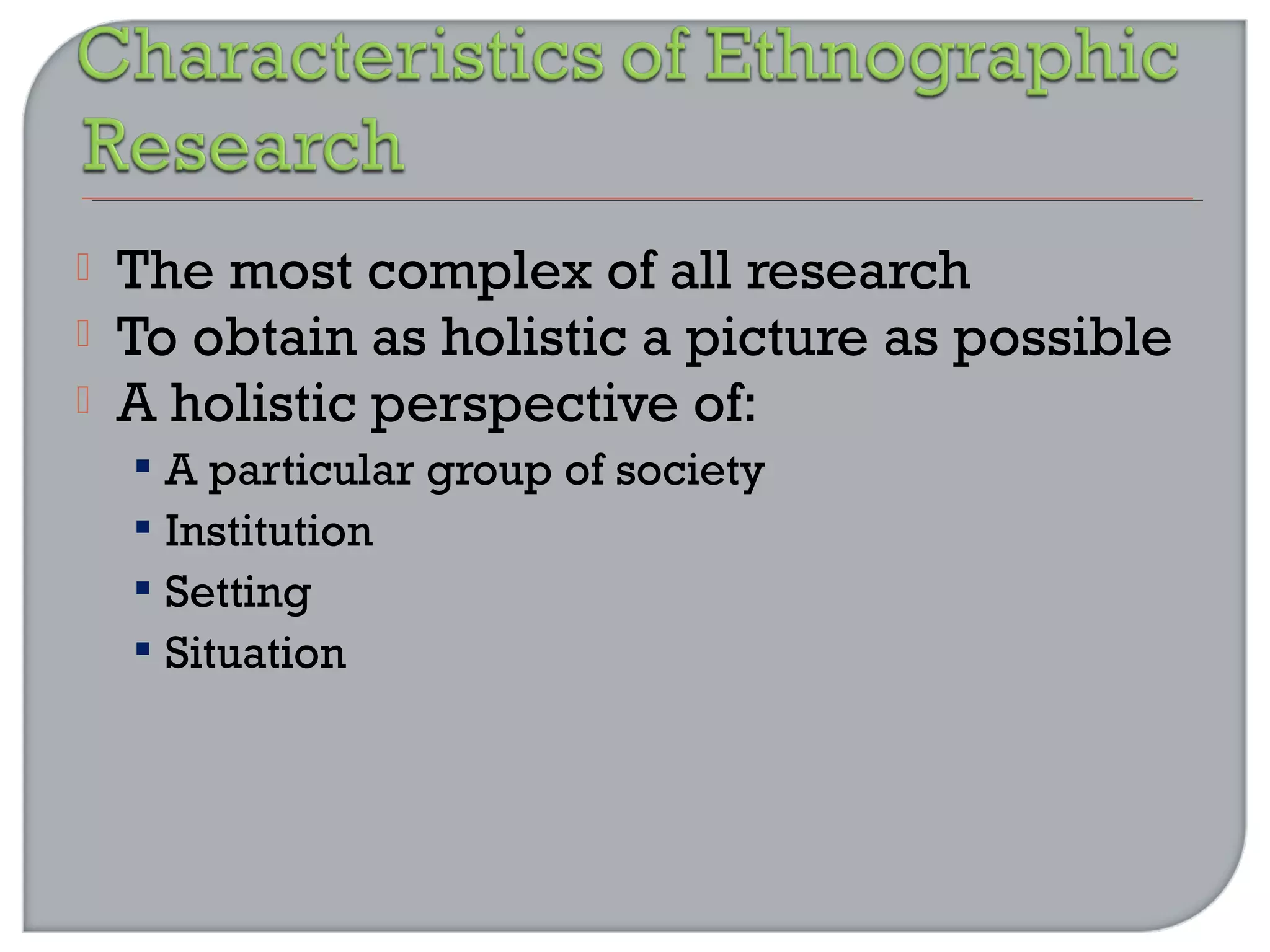
 The most complex of all research
 To obtain as holistic a picture as possible
 A holistic perspective of:
 A particular group of society
 Institution
 Setting
 Situation
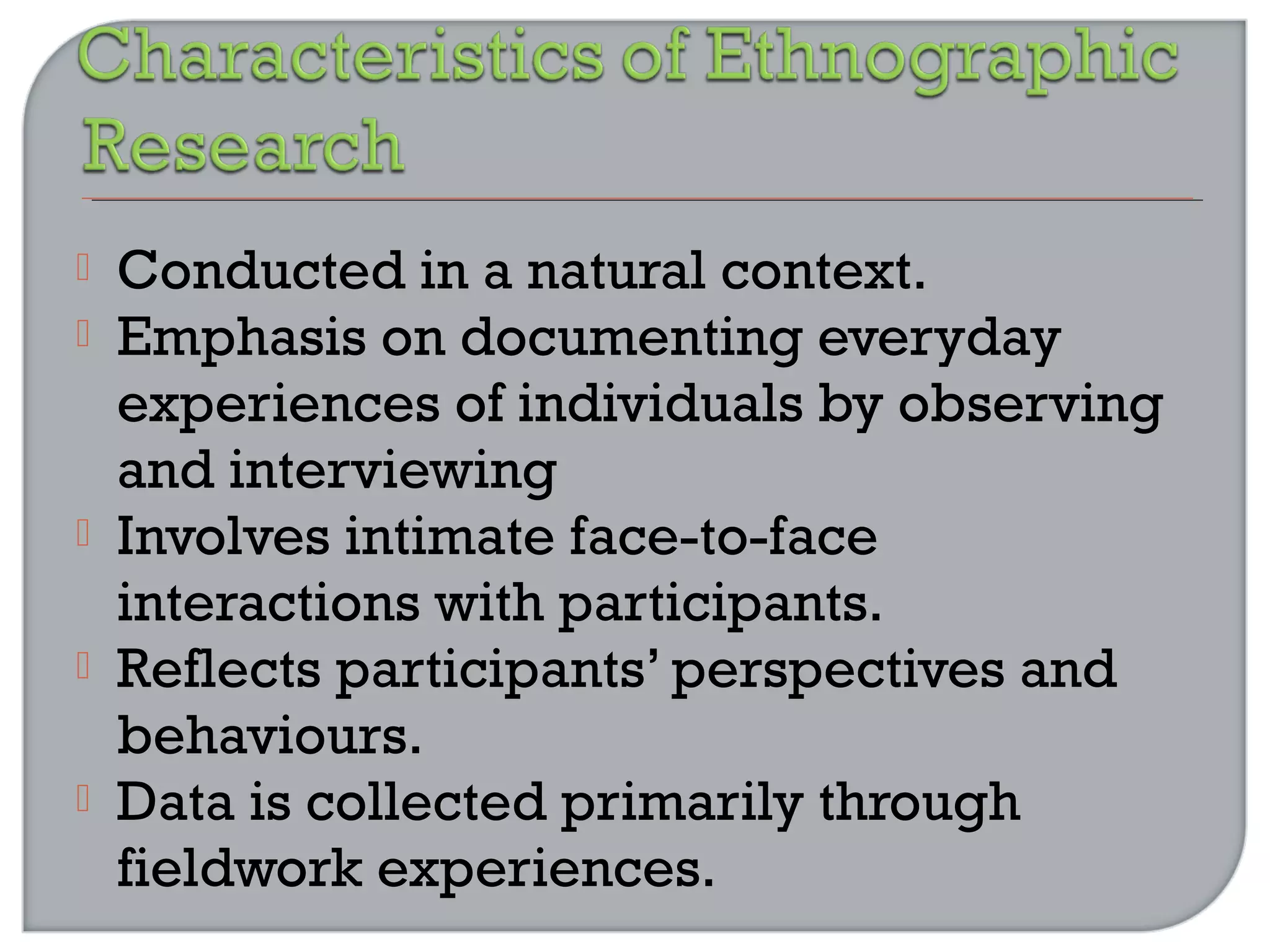
 Conducted in a natural context.
 Emphasis on documenting everyday
experiences of individuals by observing
and interviewing
 Involves intimate face-to-face
interactions with participants.
 Reflects participants’ perspectives and
behaviours.
 Data is collected primarily through
fieldwork experiences.
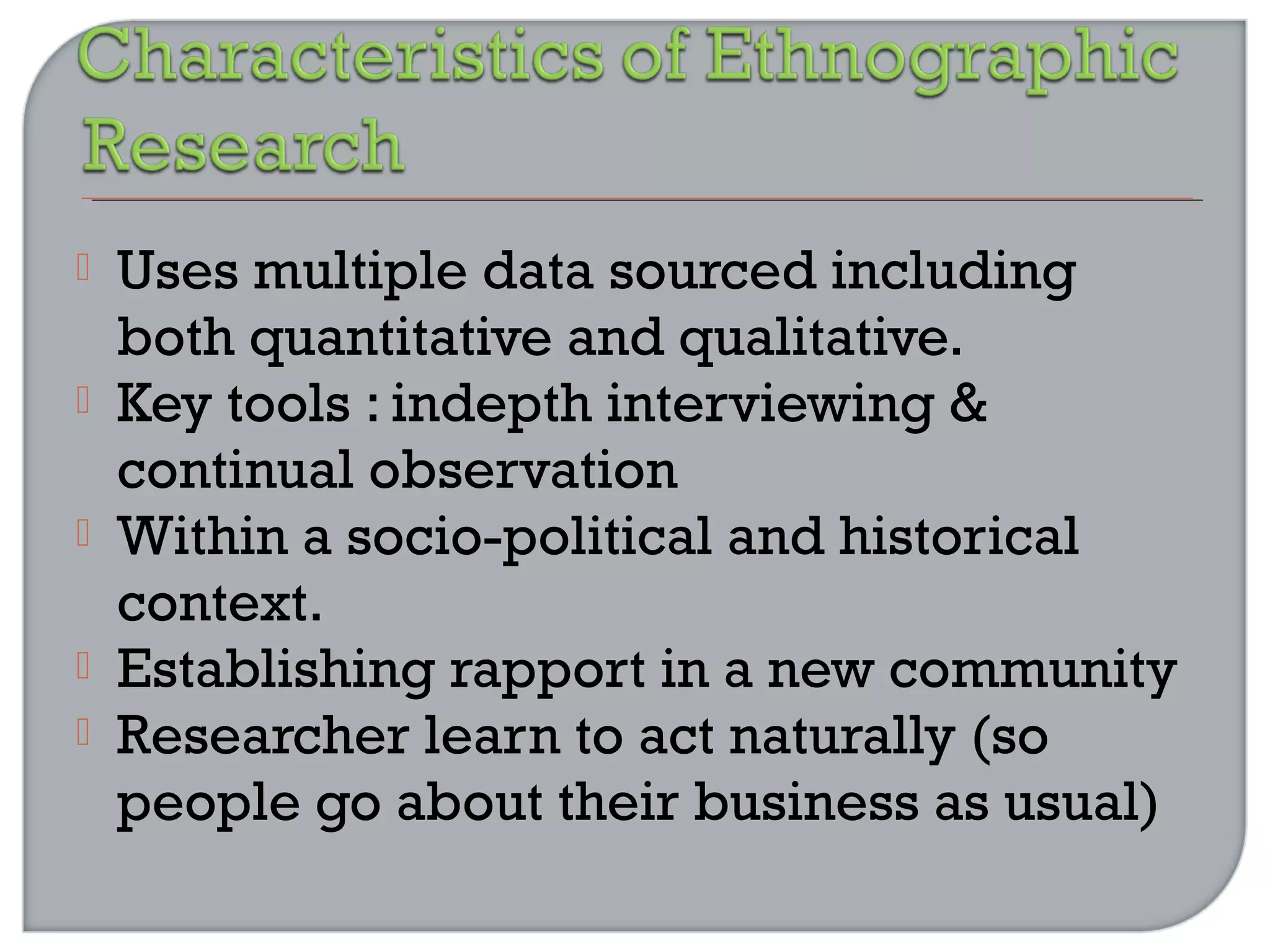
 Uses multiple data sourced including
both quantitative and qualitative.
 Key tools : indepth interviewing &
continual observation
 Within a socio-political and historical
context.
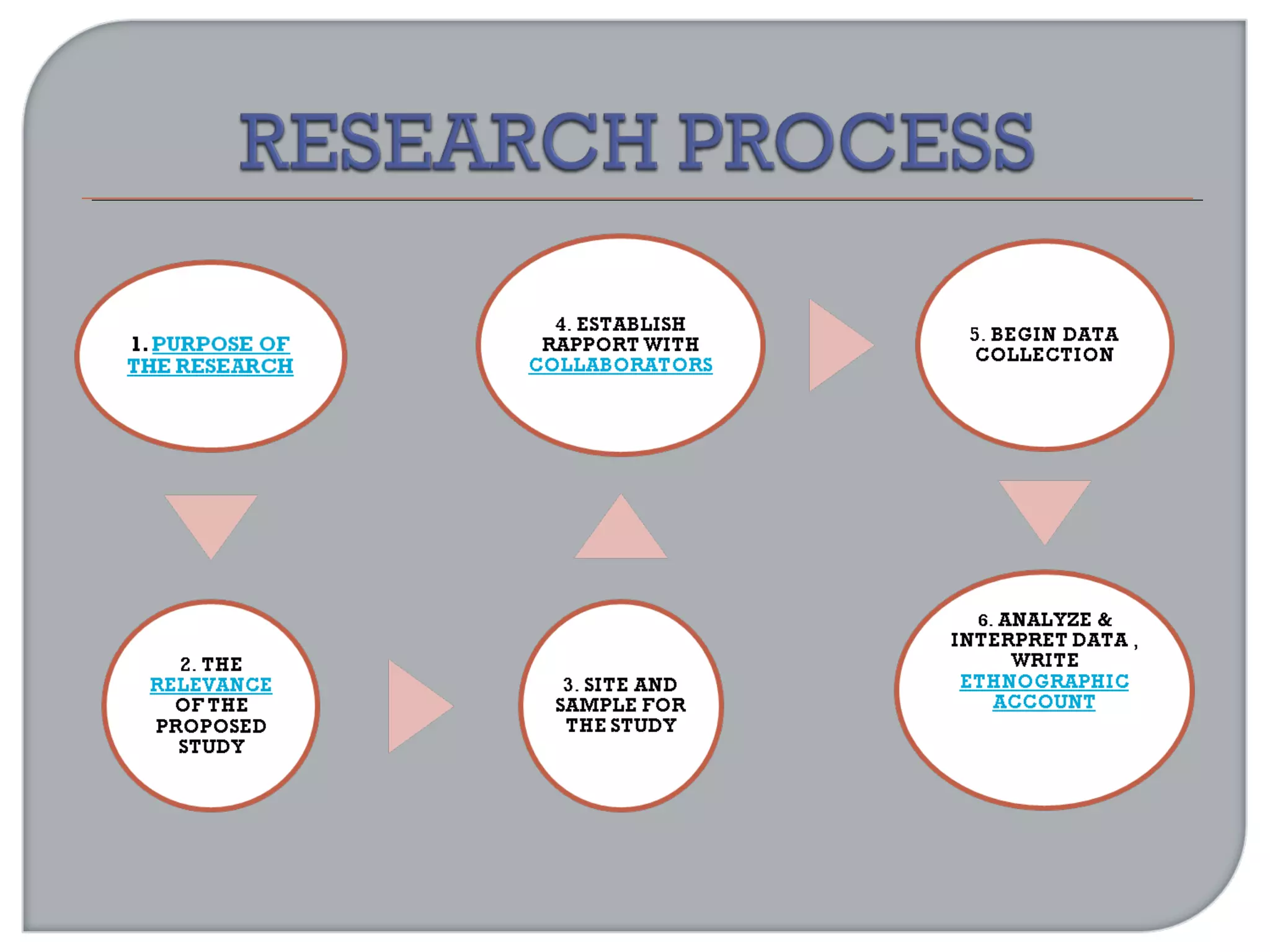
 Establishing rapport in a new community
 Researcher learn to act naturally (so
people go about their business as usual)
 Investigates a small number of cases in
detail.
 Uses data analysis that involve the
explicit interpretation of the meanings
and functions of human actions
 Interpretations of people’s actions and
behaviours that are uncovered through
the investigation of what they actually do
and the reason for doing it.
 Offers a representation or interpretation
of people’s lives and behaviours.
 Built on the points of understanding that
occur between the researcher and
participants.
 Thick description
 Non-judgmental orientation (researcher
refrain from making value judgement)
 Eg of Title: Inside High School:The student
perspective/Amalan Pengetua Cemerlang
Three major techniques:
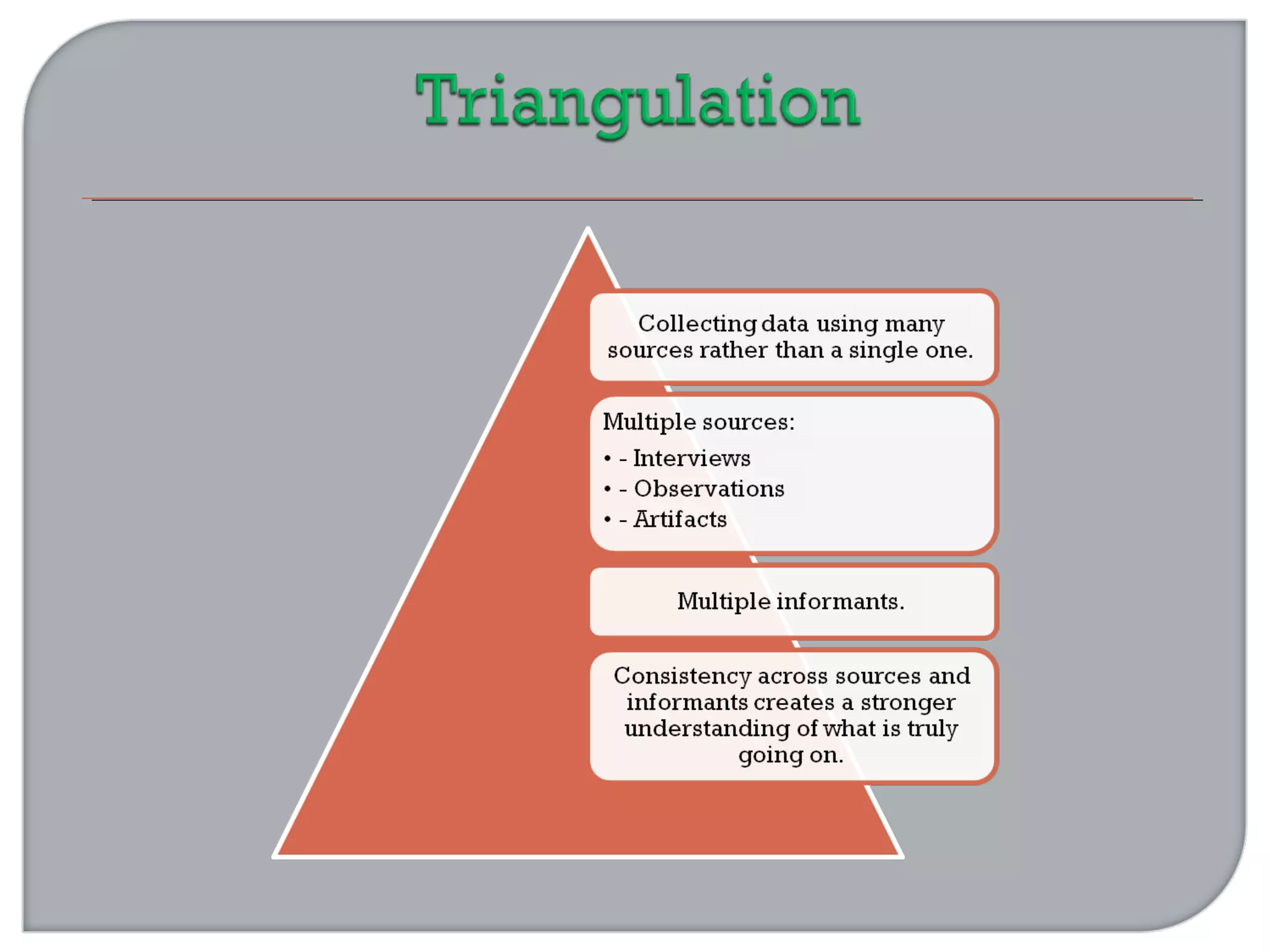
1)Triangulation
2)Participant Observation
3)Field notes
• Make mental notes and record them as soon as
possible after observing.
• Jot down key information.
• Capture key words and phrases without a lot of
explanation.
• Use a mnemonic device to help reconstruct the
observed events.
• Don’t worry about grammar or other rules.
• Trace what you did during the day.
• Avoid the temptation to recreate dialogue
• Describe as completely and accurately
as you can all relevant aspects of the
observation.
• Record your personal reactions (i.e.:
reflective field notes)
• Observe and record everything you
possibly can.
• Observe and look for nothing in
particular.
 Historical research is the act of researching the
events that have happened in history.There are
many classes available for this type of research.
 The definition of historical research is finding out
what happened in the past. Research is done by
using old newspapers, old census forms, or other
historical documents.This type of research is
done to understand past events.
 it is a process of critical inquiry into past events in
order to produce an accurate description of those
event. - Wiersma (1986)
 Historical research is conducted to
 Uncover the unknown
 Answer questions
 Identify the relationship that the past has
to the present
 Record and evaluate accomplishments of
individuals, agencies, or institutions
 Aid in understanding the culture in which
we live
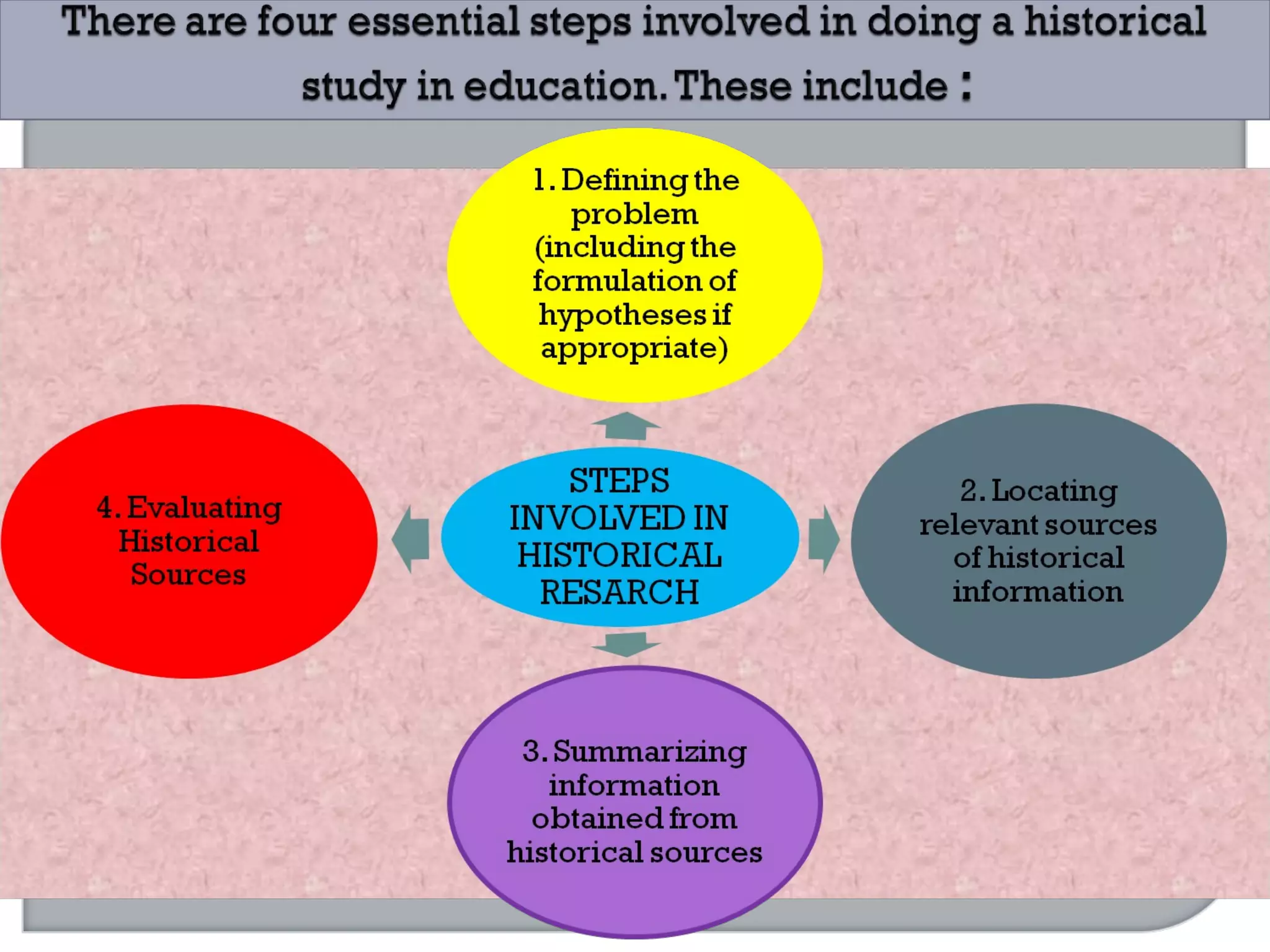
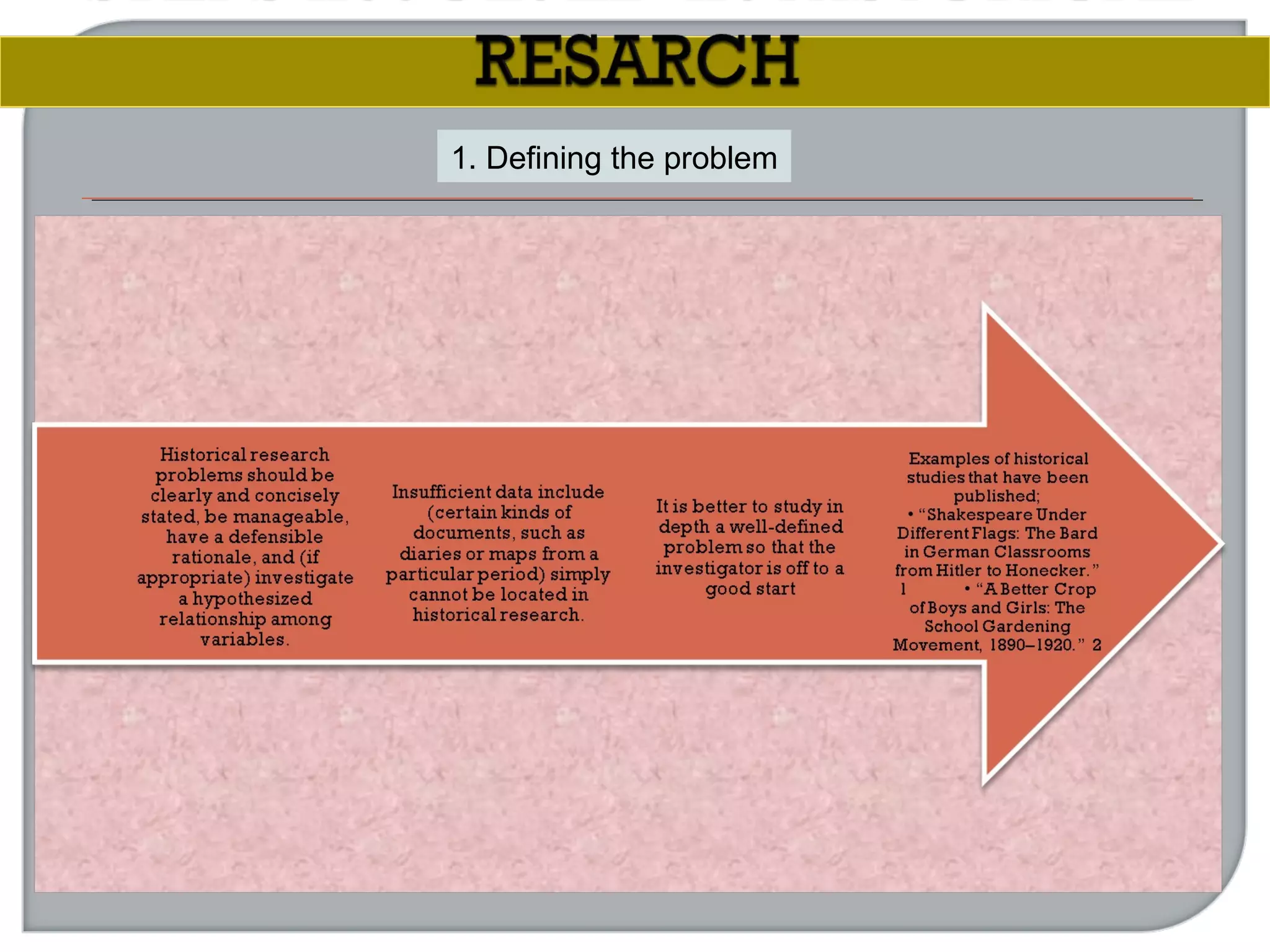
1. Defining the problem
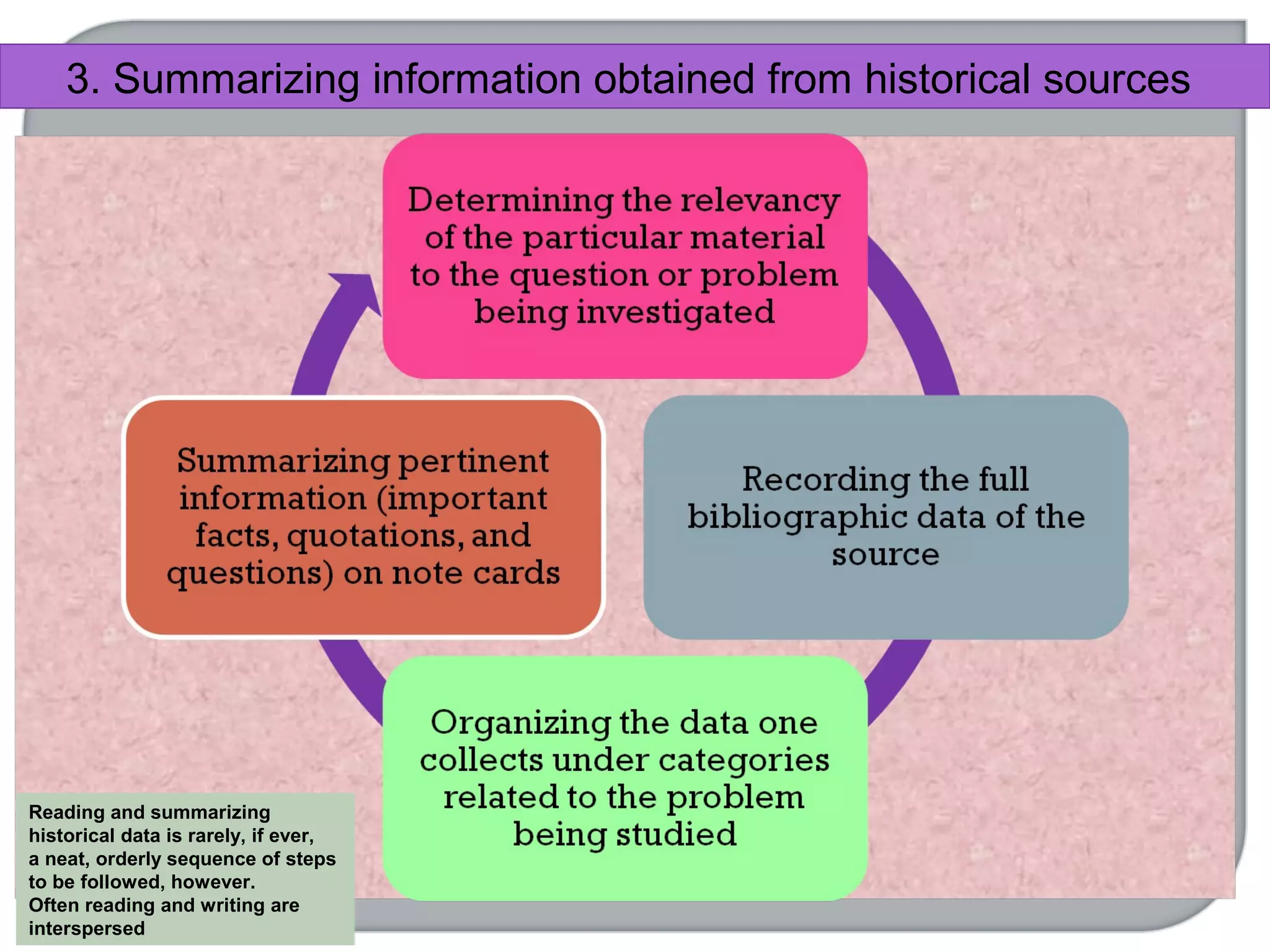
3. Summarizing information obtained from historical sources
Reading and summarizing
historical data is rarely, if ever,
a neat, orderly sequence of steps
to be followed, however.
Often reading and writing are
interspersed
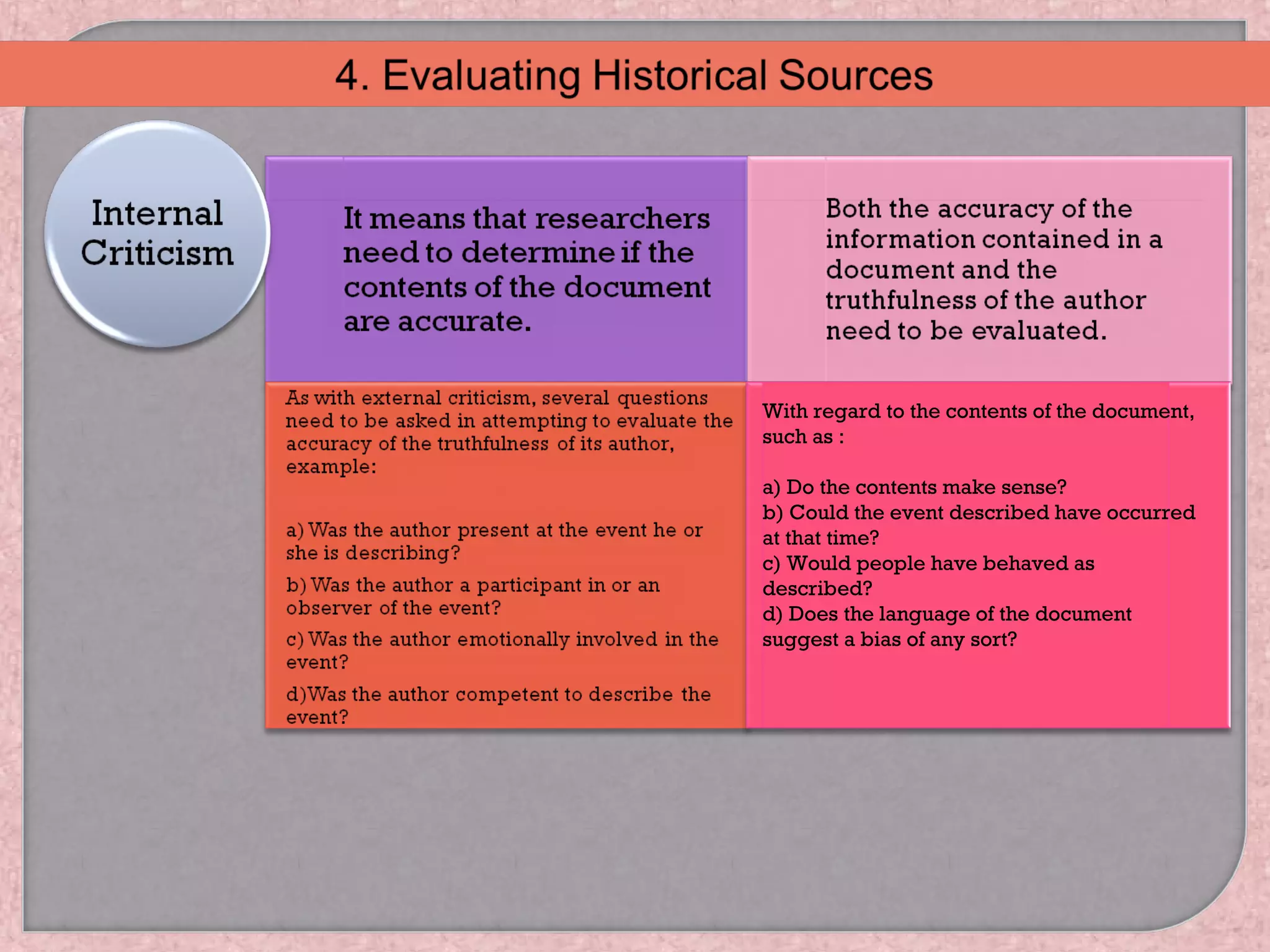
With regard to the contents of the document,
such as :
a) Do the contents make sense?
b) Could the event described have occurred
at that time?
c) Would people have behaved as
described?
d) Does the language of the document
suggest a bias of any sort?
GENERALIZATION INGENERALIZATION IN
HISTORICAL RESEARCHHISTORICAL RESEARCH
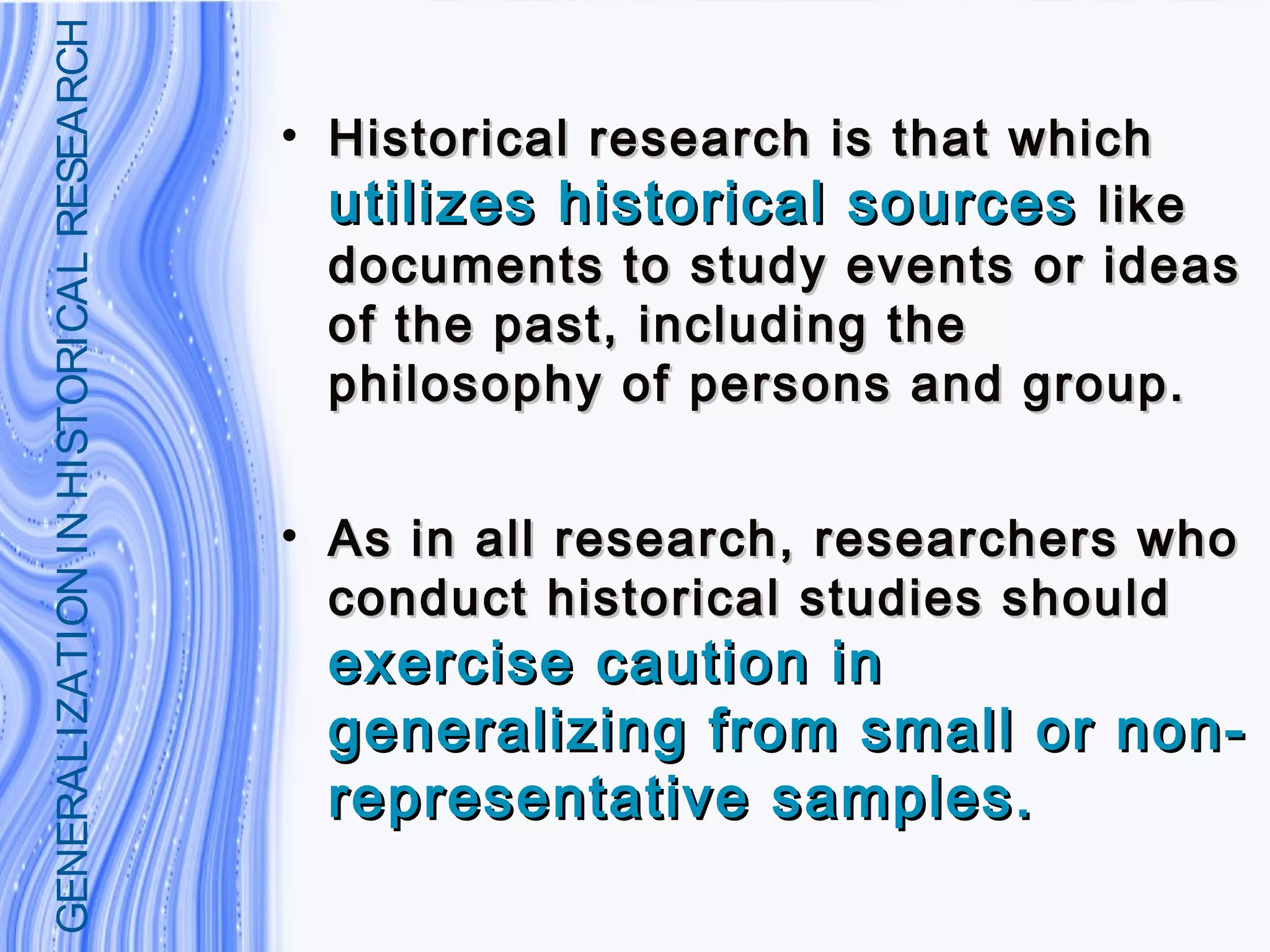
• Historical research is that whichHistorical research is that which
utilizes historical sourcesutilizes historical sources likelike
documents to study events or ideasdocuments to study events or ideas
of the past, including theof the past, including the
philosophy of persons and group.philosophy of persons and group.
• As in all research, researchers whoAs in all research, researchers who
conduct historical studies shouldconduct historical studies should
exercise caution inexercise caution in
generalizing from small or non-generalizing from small or non-
representative samples.representative samples.
GENERALIZATIONINHISTORICALRESEARCH
STRENGHTS OFSTRENGHTS OF
HISTORICAL RESEARCHHISTORICAL RESEARCH
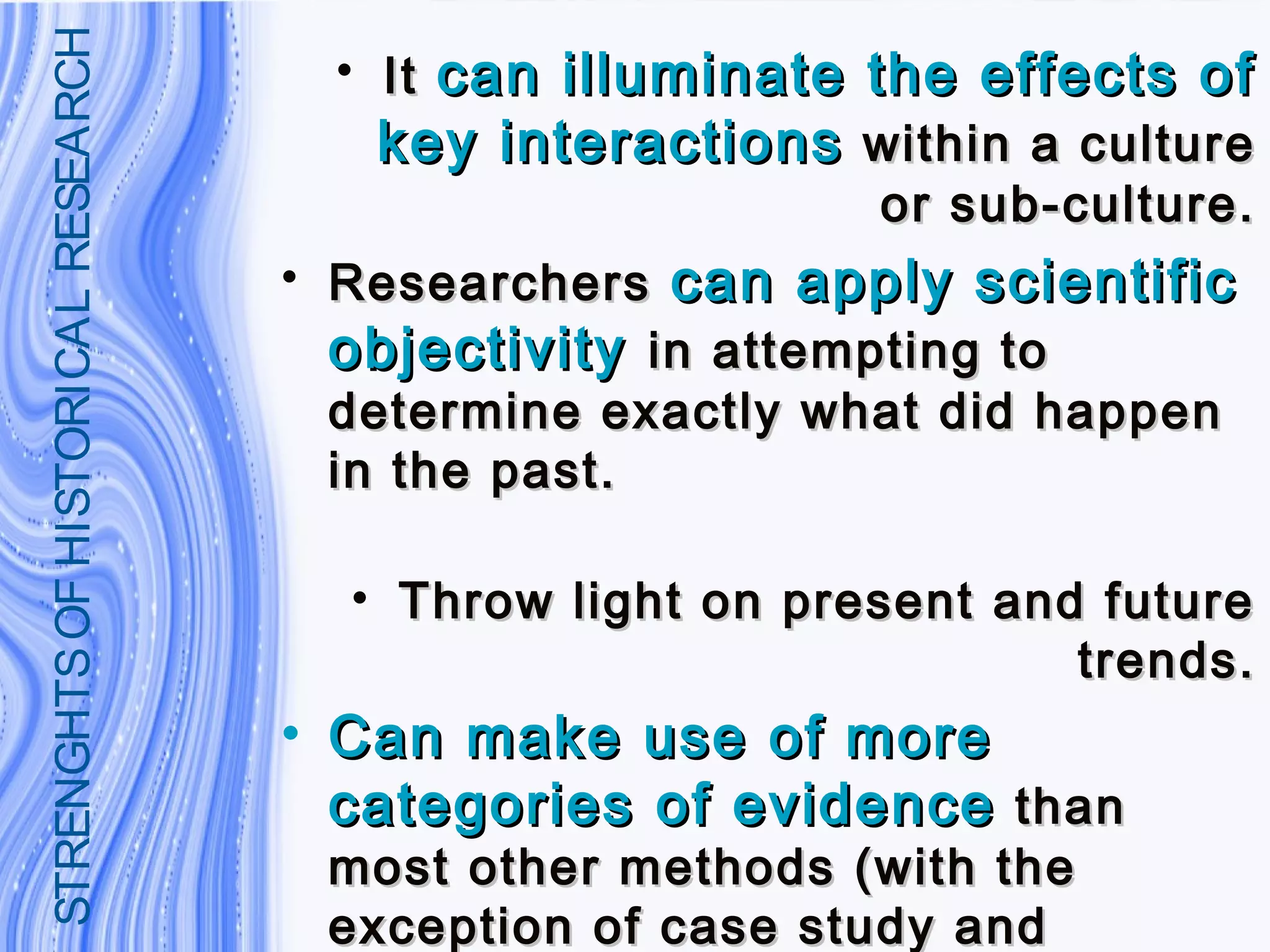
• ItIt can illuminate the effects ofcan illuminate the effects of
key interactionskey interactions within a culturewithin a culture
or sub-culture.or sub-culture.
• ResearchersResearchers can apply scientificcan apply scientific
objectivityobjectivity in attempting toin attempting to
determine exactly what did happendetermine exactly what did happen
in the past.in the past.
• Throw light on present and futureThrow light on present and future
trends.trends.
• Can make use of moreCan make use of more
categories of evidencecategories of evidence thanthan
most other methods (with themost other methods (with the
exception of case study andexception of case study and
STRENGHTSOFHISTORICALRESEARCH
LIMITATIONS OFLIMITATIONS OF
HISTORICAL RESEARCHHISTORICAL RESEARCH
LIMITATIONSOFHISTORICAL
RESEARCH
• History alsoHistory also depends on valuabledepends on valuable
materialsmaterials which arewhich are difficult todifficult to
preserve.preserve.
• CanCan only give a fractional viewonly give a fractional view
of the pastof the past; its knowledge is; its knowledge is
never complete and derived fromnever complete and derived from
the surviving records of athe surviving records of a limitedlimited
number of past events.number of past events.
• ResearchersResearchers cannot ensurecannot ensure
representation of the samplerepresentation of the sample ..
• LimitedLimited to whatever data areto whatever data are
available andavailable and excessively reliesexcessively relies
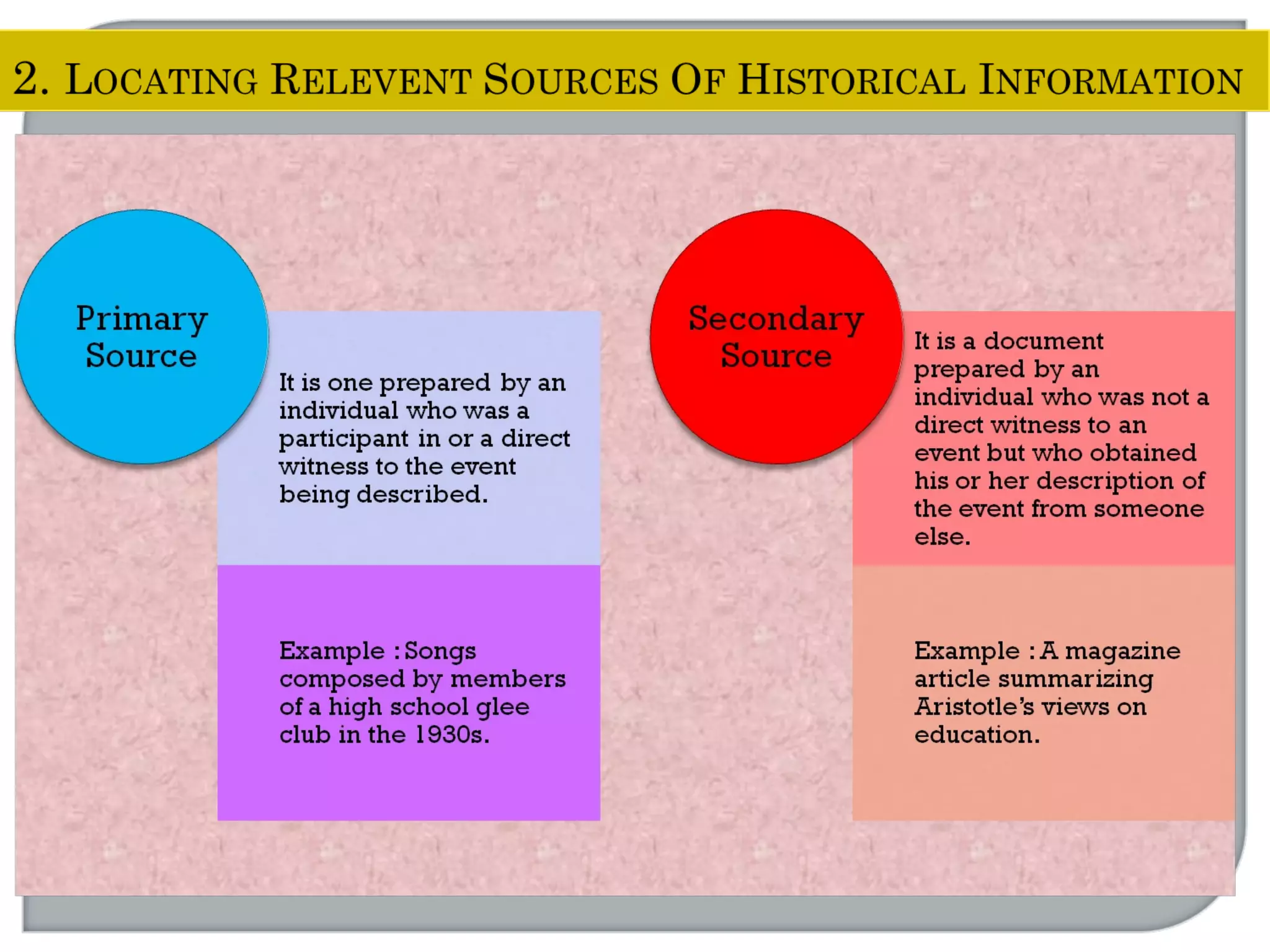
on secondary source of data.on secondary source of data.
Example of historical research
• Lydia Ann Stow: Self-Actualization in a Period
of Transition
– Vivian C. Fox , Worcester State College
• This paper is concerned with a crucial period
of self-actualization in the life of Lydia Ann
Stow (1823–1904)
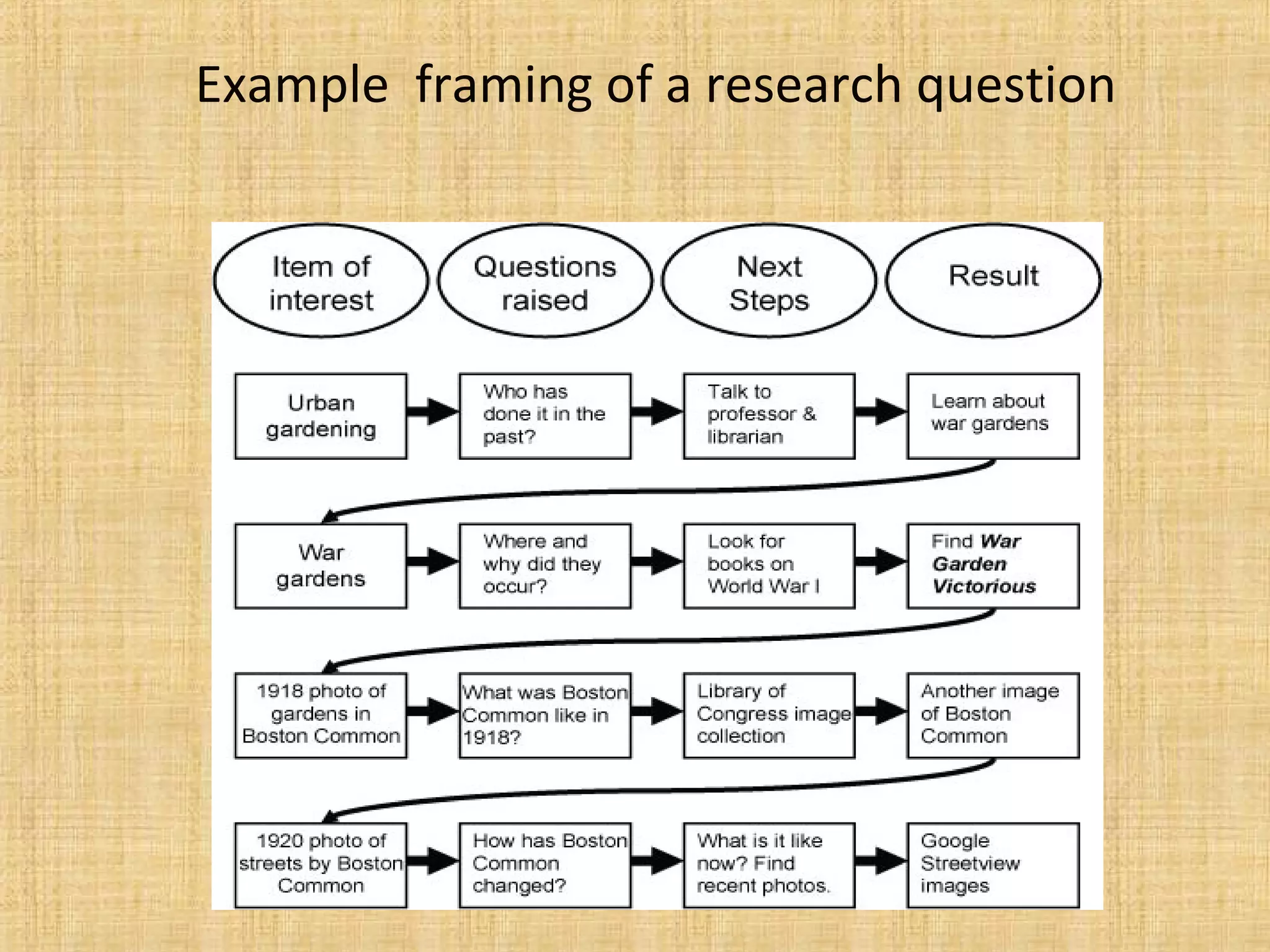
Example framing of a research question
QUESTIONS
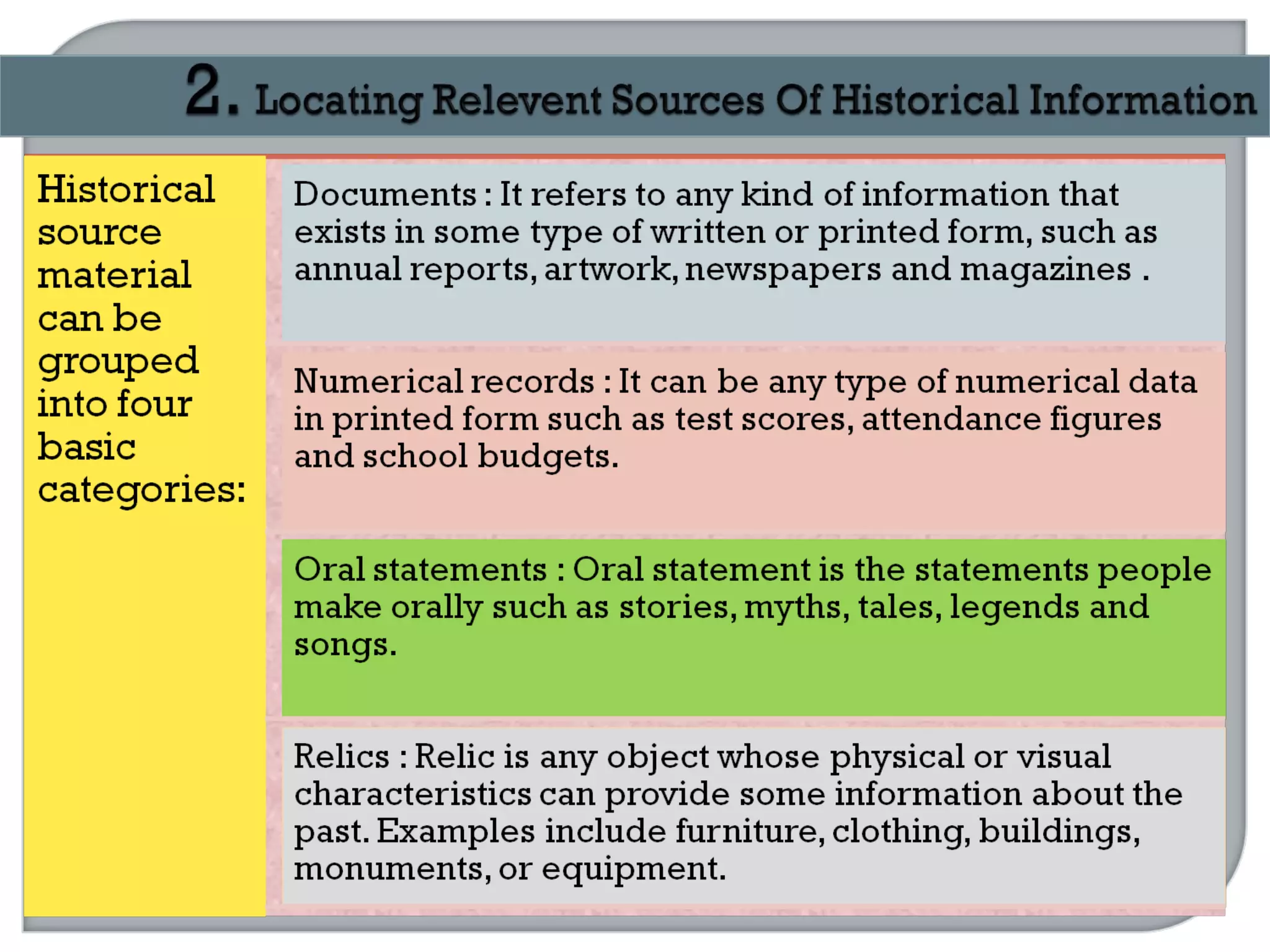
1. What is definition of Relic? Give FOUR example
of Relic.
2. Why is it important to establish rapport with
collaborators or group of society we want to do
our research on?
3. What is referred to as in the technique of
Triangulation?
4. What are the purposes of the researcher being
immersed in the research setting?
5. State ONE disadvantage of historical research.
For all

For all

  • 1.
    PREPARED BY: NURUL IFFAH AZLIN DABNEY NORDALILAH ELNIZIANA AINULZAKIRAH EDU 702 RESEARCH METHODOLOGY (DR JOHAN EDDY LUARAN)
  • 7.
     The mostcomplex of all research  To obtain as holistic a picture as possible  A holistic perspective of:  A particular group of society  Institution  Setting  Situation
  • 8.
     Conducted ina natural context.  Emphasis on documenting everyday experiences of individuals by observing and interviewing  Involves intimate face-to-face interactions with participants.  Reflects participants’ perspectives and behaviours.  Data is collected primarily through fieldwork experiences.
  • 9.
     Uses multipledata sourced including both quantitative and qualitative.  Key tools : indepth interviewing & continual observation  Within a socio-political and historical context.  Establishing rapport in a new community  Researcher learn to act naturally (so people go about their business as usual)
  • 10.
     Investigates asmall number of cases in detail.  Uses data analysis that involve the explicit interpretation of the meanings and functions of human actions  Interpretations of people’s actions and behaviours that are uncovered through the investigation of what they actually do and the reason for doing it.
  • 11.
     Offers arepresentation or interpretation of people’s lives and behaviours.  Built on the points of understanding that occur between the researcher and participants.  Thick description  Non-judgmental orientation (researcher refrain from making value judgement)  Eg of Title: Inside High School:The student perspective/Amalan Pengetua Cemerlang
  • 12.
  • 15.
    • Make mentalnotes and record them as soon as possible after observing. • Jot down key information. • Capture key words and phrases without a lot of explanation. • Use a mnemonic device to help reconstruct the observed events. • Don’t worry about grammar or other rules. • Trace what you did during the day. • Avoid the temptation to recreate dialogue
  • 16.
    • Describe ascompletely and accurately as you can all relevant aspects of the observation. • Record your personal reactions (i.e.: reflective field notes) • Observe and record everything you possibly can. • Observe and look for nothing in particular.
  • 18.
     Historical researchis the act of researching the events that have happened in history.There are many classes available for this type of research.  The definition of historical research is finding out what happened in the past. Research is done by using old newspapers, old census forms, or other historical documents.This type of research is done to understand past events.  it is a process of critical inquiry into past events in order to produce an accurate description of those event. - Wiersma (1986)
  • 19.
     Historical researchis conducted to  Uncover the unknown  Answer questions  Identify the relationship that the past has to the present  Record and evaluate accomplishments of individuals, agencies, or institutions  Aid in understanding the culture in which we live
  • 22.
  • 25.
    3. Summarizing informationobtained from historical sources Reading and summarizing historical data is rarely, if ever, a neat, orderly sequence of steps to be followed, however. Often reading and writing are interspersed
  • 27.
    With regard tothe contents of the document, such as : a) Do the contents make sense? b) Could the event described have occurred at that time? c) Would people have behaved as described? d) Does the language of the document suggest a bias of any sort?
  • 28.
  • 29.
    • Historical researchis that whichHistorical research is that which utilizes historical sourcesutilizes historical sources likelike documents to study events or ideasdocuments to study events or ideas of the past, including theof the past, including the philosophy of persons and group.philosophy of persons and group. • As in all research, researchers whoAs in all research, researchers who conduct historical studies shouldconduct historical studies should exercise caution inexercise caution in generalizing from small or non-generalizing from small or non- representative samples.representative samples. GENERALIZATIONINHISTORICALRESEARCH
  • 30.
    STRENGHTS OFSTRENGHTS OF HISTORICALRESEARCHHISTORICAL RESEARCH
  • 31.
    • ItIt canilluminate the effects ofcan illuminate the effects of key interactionskey interactions within a culturewithin a culture or sub-culture.or sub-culture. • ResearchersResearchers can apply scientificcan apply scientific objectivityobjectivity in attempting toin attempting to determine exactly what did happendetermine exactly what did happen in the past.in the past. • Throw light on present and futureThrow light on present and future trends.trends. • Can make use of moreCan make use of more categories of evidencecategories of evidence thanthan most other methods (with themost other methods (with the exception of case study andexception of case study and STRENGHTSOFHISTORICALRESEARCH
  • 32.
    LIMITATIONS OFLIMITATIONS OF HISTORICALRESEARCHHISTORICAL RESEARCH
  • 33.
    LIMITATIONSOFHISTORICAL RESEARCH • History alsoHistoryalso depends on valuabledepends on valuable materialsmaterials which arewhich are difficult todifficult to preserve.preserve. • CanCan only give a fractional viewonly give a fractional view of the pastof the past; its knowledge is; its knowledge is never complete and derived fromnever complete and derived from the surviving records of athe surviving records of a limitedlimited number of past events.number of past events. • ResearchersResearchers cannot ensurecannot ensure representation of the samplerepresentation of the sample .. • LimitedLimited to whatever data areto whatever data are available andavailable and excessively reliesexcessively relies on secondary source of data.on secondary source of data.
  • 34.
  • 35.
    • Lydia AnnStow: Self-Actualization in a Period of Transition – Vivian C. Fox , Worcester State College • This paper is concerned with a crucial period of self-actualization in the life of Lydia Ann Stow (1823–1904)
  • 36.
    Example framing ofa research question
  • 37.
    QUESTIONS 1. What isdefinition of Relic? Give FOUR example of Relic. 2. Why is it important to establish rapport with collaborators or group of society we want to do our research on? 3. What is referred to as in the technique of Triangulation? 4. What are the purposes of the researcher being immersed in the research setting? 5. State ONE disadvantage of historical research.