HOW TO PREPARE TITLE
AND ABSTRACT FOR
RESEARCH ARTICLES
M.K.H. GUNASEKARA
AS2010377

CSC 364 1.5 Seminar 2
Department of Computer Science and Statistics , USJP
Overview
2








Title
Characteristics of Good title
Abstract
Characteristics of Good abstract
Summary
Title
3

The title summarizes the main idea or ideas of
your study. A good title contains the fewest
possible words that adequately describe the
contents and purpose of your research paper.
Importance of Title
4

The title forms an important part of your
communication with your readers, both with the
editor and referees who will evaluate the
paper, and with the members of your discipline
community whom you want to read the paper
after its publication.
Strategies
5







Provide as much relevant information as
possible, but be concise
Use keywords prominently
Choose noun phrase, statement, or question?
Avoid ambiguity in noun phrases
6

Trick 01:Provide as much relevant
information as possible, but be
concise



To attract busy readers
Potential readers can judge your article easily

E.g.: Hybrid Approach to Optimize Cut Order
Plan Solutions in Apparel Manufacturing[1]
Trick 01 - Example
7
8

Trick 02:Use keywords
prominently


effective way to ensure your keyword(s) are at
the front of your title is to use a colon (:) or a
dash (–) to separate the first, keywordcontaining part of the title from a
second, explanatory section.

E.g.:
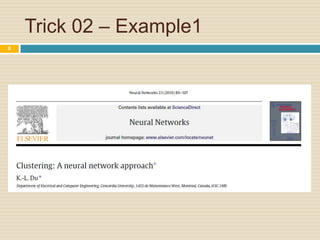
1. Clustering: A neural network approach[2]
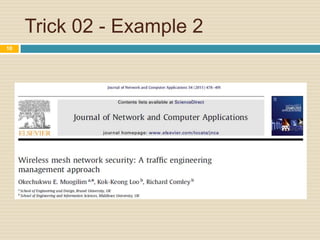
2. Wireless mesh network security: A traffic
engineering management approach[3]
Trick 02 – Example1
9
Trick 02 - Example 2
10
11

Trick 03:Choose strategically:
noun phrase, statement, or
question?




Statement titles are only suitable for papers
that address a specific question and present a
non-complex answer.
When there is no simple answer better to write
title as question.

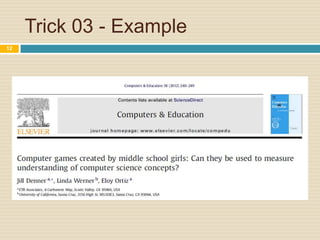
E.g. : Computer games created by middle school
girls: Can they be used to measure
understanding of computer science concepts?[4]
Trick 03 - Example
12
Trick 04:Avoid ambiguity in noun
phrases
13

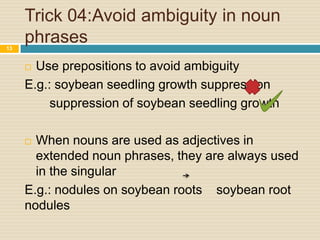
Use prepositions to avoid ambiguity
E.g.: soybean seedling growth suppression
suppression of soybean seedling growth


When nouns are used as adjectives in
extended noun phrases, they are always used
in the singular
E.g.: nodules on soybean roots soybean root
nodules

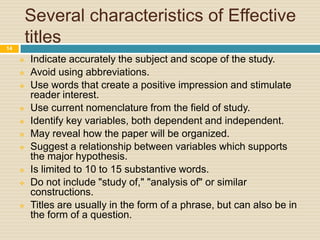
Several characteristics of Effective
titles
14
















Indicate accurately the subject and scope of the study.
Avoid using abbreviations.
Use words that create a positive impression and stimulate
reader interest.
Use current nomenclature from the field of study.
Identify key variables, both dependent and independent.
May reveal how the paper will be organized.
Suggest a relationship between variables which supports
the major hypothesis.
Is limited to 10 to 15 substantive words.
Do not include "study of," "analysis of" or similar
constructions.
Titles are usually in the form of a phrase, but can also be in
the form of a question.
Tip !
15



Write down a few possible titles, and then
select the best to refine further. Ask your
colleagues their opinion. Spending the time
needed to do this will result in a better title.
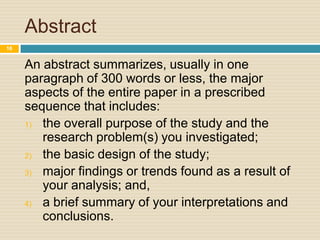
Abstract
16

An abstract summarizes, usually in one
paragraph of 300 words or less, the major
aspects of the entire paper in a prescribed
sequence that includes:
1) the overall purpose of the study and the
research problem(s) you investigated;
2) the basic design of the study;
3) major findings or trends found as a result of
your analysis; and,
4) a brief summary of your interpretations and
conclusions.
Importance of Abstract
17

For busy readers the Abstract, sometimes called
the Summary, may be the only part of the paper
they read, unless it succeeds in convincing them
to take the time to read the whole paper.
Abstract Types[5]
18






Critical Abstract
Descriptive Abstract
Informative Abstract
Highlight Abstract
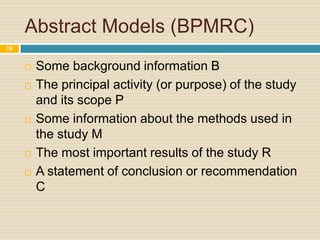
Abstract Models (BPMRC)
19









Some background information B
The principal activity (or purpose) of the study
and its scope P
Some information about the methods used in
the study M
The most important results of the study R
A statement of conclusion or recommendation
C
20

Characteristics of Effective
Abstract
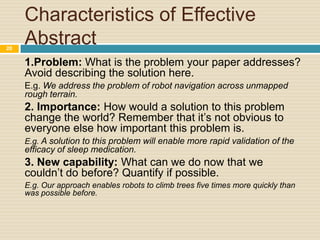
1.Problem: What is the problem your paper addresses?
Avoid describing the solution here.
E.g. We address the problem of robot navigation across unmapped
rough terrain.

2. Importance: How would a solution to this problem
change the world? Remember that it’s not obvious to
everyone else how important this problem is.
E.g. A solution to this problem will enable more rapid validation of the

efficacy of sleep medication.

3. New capability: What can we do now that we
couldn’t do before? Quantify if possible.
E.g. Our approach enables robots to climb trees five times more quickly than
was possible before.
21

Characteristics of Effective
Abstract
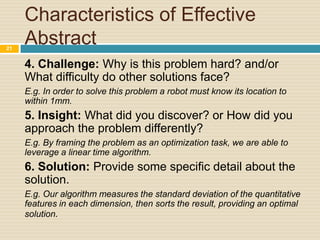
4. Challenge: Why is this problem hard? and/or
What difficulty do other solutions face?
E.g. In order to solve this problem a robot must know its location to
within 1mm.

5. Insight: What did you discover? or How did you
approach the problem differently?
E.g. By framing the problem as an optimization task, we are able to
leverage a linear time algorithm.

6. Solution: Provide some specific detail about the
solution.
E.g. Our algorithm measures the standard deviation of the quantitative
features in each dimension, then sorts the result, providing an optimal
solution.
22

Characteristics of Effective
Abstract
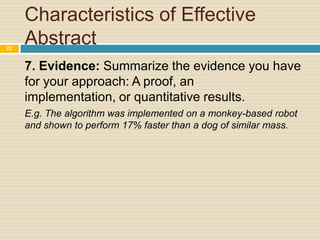
7. Evidence: Summarize the evidence you have
for your approach: A proof, an
implementation, or quantitative results.
E.g. The algorithm was implemented on a monkey-based robot
and shown to perform 17% faster than a dog of similar mass.
Example
23

[1]
Example
24

[7]
Summary
25







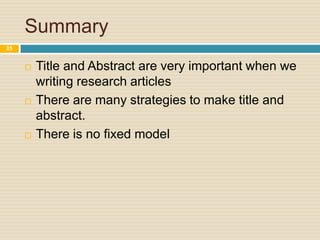
Title and Abstract are very important when we
writing research articles
There are many strategies to make title and
abstract.
There is no fixed model
References
26

[1] R P Abeysooriya, T G I Fernando,”Hybrid Approach to Optimize Cut Order Plan
Solutions in
Apparel Manufacturing”, International Journal of Information and Communication
Technology Research, volume 2,2012, pp.: 348-353
[2] K.-L. Du ,” Clustering: A neural network approach”, Neural Networks, Volume
23, Issue 1, January 2010, Pages 89–107
[3] Okechukwu E. Muogilima, Kok-Keong Loob, Richard Comleyb, “Wireless mesh
network security: A traffic engineering management approach”, Journal of Network
and Computer Applications , Volume 34, Issue 2, March 2011, Pages 478–491
[4] Jill Denner , Linda Werner, Eloy Ortiz,” Computer games created by middle
school girls: Can they be used to measure understanding of computer science
concepts?” , Computers & Education , Volume 58, Issue 1, January 2012, Pages
240–249
[5] Dr. Robert V. Labaree, “Organizing Your Social Sciences Research Paper”, Oct
18, 2013, http://libguides.usc.edu/writingguide ,( Oct 28,2013)
[6] Birger Andersson, Maria Bergholtz, Ananda Edirisuriya, Tharaka
Ilayperuma, Prasad Jayaweera, Paul Johannesson, Jelena
Zdravkovic, “, Enterprise Sustainability through the Alignment of Goal Models and
Business Models ”, Proceedings of BUSITAL 2008
Question & Answers
27
28

How to prepare Title and Abstract for Research Articles

  • 1.
    HOW TO PREPARETITLE AND ABSTRACT FOR RESEARCH ARTICLES M.K.H. GUNASEKARA AS2010377 CSC 364 1.5 Seminar 2 Department of Computer Science and Statistics , USJP
  • 2.
    Overview 2      Title Characteristics of Goodtitle Abstract Characteristics of Good abstract Summary
  • 3.
    Title 3 The title summarizesthe main idea or ideas of your study. A good title contains the fewest possible words that adequately describe the contents and purpose of your research paper.
  • 4.
    Importance of Title 4 Thetitle forms an important part of your communication with your readers, both with the editor and referees who will evaluate the paper, and with the members of your discipline community whom you want to read the paper after its publication.
  • 5.
    Strategies 5     Provide as muchrelevant information as possible, but be concise Use keywords prominently Choose noun phrase, statement, or question? Avoid ambiguity in noun phrases
  • 6.
    6 Trick 01:Provide asmuch relevant information as possible, but be concise   To attract busy readers Potential readers can judge your article easily E.g.: Hybrid Approach to Optimize Cut Order Plan Solutions in Apparel Manufacturing[1]
  • 7.
    Trick 01 -Example 7
  • 8.
    8 Trick 02:Use keywords prominently  effectiveway to ensure your keyword(s) are at the front of your title is to use a colon (:) or a dash (–) to separate the first, keywordcontaining part of the title from a second, explanatory section. E.g.: 1. Clustering: A neural network approach[2] 2. Wireless mesh network security: A traffic engineering management approach[3]
  • 9.
    Trick 02 –Example1 9
  • 10.
    Trick 02 -Example 2 10
  • 11.
    11 Trick 03:Choose strategically: nounphrase, statement, or question?   Statement titles are only suitable for papers that address a specific question and present a non-complex answer. When there is no simple answer better to write title as question. E.g. : Computer games created by middle school girls: Can they be used to measure understanding of computer science concepts?[4]
  • 12.
    Trick 03 -Example 12
  • 13.
    Trick 04:Avoid ambiguityin noun phrases 13 Use prepositions to avoid ambiguity E.g.: soybean seedling growth suppression suppression of soybean seedling growth  When nouns are used as adjectives in extended noun phrases, they are always used in the singular E.g.: nodules on soybean roots soybean root nodules 
  • 14.
    Several characteristics ofEffective titles 14           Indicate accurately the subject and scope of the study. Avoid using abbreviations. Use words that create a positive impression and stimulate reader interest. Use current nomenclature from the field of study. Identify key variables, both dependent and independent. May reveal how the paper will be organized. Suggest a relationship between variables which supports the major hypothesis. Is limited to 10 to 15 substantive words. Do not include "study of," "analysis of" or similar constructions. Titles are usually in the form of a phrase, but can also be in the form of a question.
  • 15.
    Tip ! 15  Write downa few possible titles, and then select the best to refine further. Ask your colleagues their opinion. Spending the time needed to do this will result in a better title.
  • 16.
    Abstract 16 An abstract summarizes,usually in one paragraph of 300 words or less, the major aspects of the entire paper in a prescribed sequence that includes: 1) the overall purpose of the study and the research problem(s) you investigated; 2) the basic design of the study; 3) major findings or trends found as a result of your analysis; and, 4) a brief summary of your interpretations and conclusions.
  • 17.
    Importance of Abstract 17 Forbusy readers the Abstract, sometimes called the Summary, may be the only part of the paper they read, unless it succeeds in convincing them to take the time to read the whole paper.
  • 18.
    Abstract Types[5] 18     Critical Abstract DescriptiveAbstract Informative Abstract Highlight Abstract
  • 19.
    Abstract Models (BPMRC) 19      Somebackground information B The principal activity (or purpose) of the study and its scope P Some information about the methods used in the study M The most important results of the study R A statement of conclusion or recommendation C
  • 20.
    20 Characteristics of Effective Abstract 1.Problem:What is the problem your paper addresses? Avoid describing the solution here. E.g. We address the problem of robot navigation across unmapped rough terrain. 2. Importance: How would a solution to this problem change the world? Remember that it’s not obvious to everyone else how important this problem is. E.g. A solution to this problem will enable more rapid validation of the efficacy of sleep medication. 3. New capability: What can we do now that we couldn’t do before? Quantify if possible. E.g. Our approach enables robots to climb trees five times more quickly than was possible before.
  • 21.
    21 Characteristics of Effective Abstract 4.Challenge: Why is this problem hard? and/or What difficulty do other solutions face? E.g. In order to solve this problem a robot must know its location to within 1mm. 5. Insight: What did you discover? or How did you approach the problem differently? E.g. By framing the problem as an optimization task, we are able to leverage a linear time algorithm. 6. Solution: Provide some specific detail about the solution. E.g. Our algorithm measures the standard deviation of the quantitative features in each dimension, then sorts the result, providing an optimal solution.
  • 22.
    22 Characteristics of Effective Abstract 7.Evidence: Summarize the evidence you have for your approach: A proof, an implementation, or quantitative results. E.g. The algorithm was implemented on a monkey-based robot and shown to perform 17% faster than a dog of similar mass.
  • 23.
  • 24.
  • 25.
    Summary 25    Title and Abstractare very important when we writing research articles There are many strategies to make title and abstract. There is no fixed model
  • 26.
    References 26 [1] R PAbeysooriya, T G I Fernando,”Hybrid Approach to Optimize Cut Order Plan Solutions in Apparel Manufacturing”, International Journal of Information and Communication Technology Research, volume 2,2012, pp.: 348-353 [2] K.-L. Du ,” Clustering: A neural network approach”, Neural Networks, Volume 23, Issue 1, January 2010, Pages 89–107 [3] Okechukwu E. Muogilima, Kok-Keong Loob, Richard Comleyb, “Wireless mesh network security: A traffic engineering management approach”, Journal of Network and Computer Applications , Volume 34, Issue 2, March 2011, Pages 478–491 [4] Jill Denner , Linda Werner, Eloy Ortiz,” Computer games created by middle school girls: Can they be used to measure understanding of computer science concepts?” , Computers & Education , Volume 58, Issue 1, January 2012, Pages 240–249 [5] Dr. Robert V. Labaree, “Organizing Your Social Sciences Research Paper”, Oct 18, 2013, http://libguides.usc.edu/writingguide ,( Oct 28,2013) [6] Birger Andersson, Maria Bergholtz, Ananda Edirisuriya, Tharaka Ilayperuma, Prasad Jayaweera, Paul Johannesson, Jelena Zdravkovic, “, Enterprise Sustainability through the Alignment of Goal Models and Business Models ”, Proceedings of BUSITAL 2008
  • 27.
  • 28.

Editor's Notes

  • #7 The purpose of a title is to attract busy readers in your particular target audience,so that they will want to access and read the whole document. The more revealingyour title is, the more easily your potential readers can judge how relevant yourpaper is to their interests. To exemplify the importance of this issue, we quotefrom relevant Author Guidelines: the Journal of Ecology asks for ‘‘a concise andinformative title (as short as possible)’’ (www.blackwellpublishing.com/submit.asp?ref¼0022-0477&site¼1); the New Phytologist stipulates a concise and informativetitle (for research papers, ideally stating the key finding or framing aquestion; www.blackwellpublishing.com/submit.asp?ref¼0028-646X&site¼1).Wewill return to this question of the most effective grammatical form for titles later.
  • #9 It is important to decide which words (keywords) will capture the attention ofreaders likely to be interested in your paper and to place them near the front ofyour title. This practice also helps ensure that your title is picked up efficiently bythe literature-scanning services, which use a keywords system to identify papers ofinterest to particular audiences. Wherever possible it is a good idea to place the most important word(s) in your title in the position of power: the beginning. Forexample:
  • #12 The traditional way to write titles and headings is as a noun phrase: a number ofwords clustered around one important ‘‘head’’ noun. Below are some examples ofthis kind of title, with the head nouns shown in bold.
  • #14 If writers place a string of nouns and adjectives together,
  • #18 Science Direct, JSTOR, Spriger, Research gate
  • #19 Critical AbstractA critical abstract provides, in addition to describing main findings and information, a judgement or comment about the study’s validity, reliability, or completeness. The researcher evaluates the paper and often compares it with other works on the same subject. Critical abstracts are generally 400-500 words in length due to the additional interpretive commentary. These types of abstracts are used infrequently.Descriptive AbstractA descriptive abstract indicates the type of information found in the work. It makes no judgments about the work, nor does it provide results or conclusions of the research. It does incorporate key words found in the text and may include the purpose, methods, and scope of the research. Essentially, the descriptive abstract only describes the work being abstracted. Some researchers consider it an outline of the work, rather than a summary. Descriptive abstracts are usually very short, 100 words or less.Informative AbstractThe majority of abstracts are informative. While they still do not critique or evaluate a work, they do more than describe it. A good informative abstract acts as a surrogate for the work itself. That is, the researcher presents and explains all the main arguments and the important results and evidence in the paper. An informative abstract includes the information that can be found in a descriptive abstract [purpose, methods, scope] it but also includes the results and conclusions of the research and the recommendations of the author. The length varies according to discipline, but an informative abstract is rarely more than 300 words in length.Highlight AbstractA highlight abstract is specifcally written to attract the reader’s attention to the study. No pretence is made of there being either a balanced or complete picture of the paper and, in fact, incomplete and leading remarks may be used to spark the reader’s interest. In that a highlight abstract cannot stand independent of its associated article, it is not a true abstract and, therefore, rarely used in academic writing.