Leadership Chapter 7 – Path-Goal Theory Northouse, 4 th  edition
Path-Goal Theory Perspective Conditions of Leadership Motivation  Leader Behaviors & Subordinate Characteristics Task Characteristics How Does the PGT Approach Work? Overview
Path-Goal Theory  (House, 1971)  Description Path-goal theory centers on how leaders motivate subordinates to accomplish designated goals Emphasizes the relationship between   the leaders style  the characteristics of the subordinates the work setting Definition
Path-Goal Theory  (House, 1971)  Description Goal -   To enhance employee performance and satisfaction by focusing on employee motivation Motivational Principles   (based on Expectancy Theory )  - Subordinates will be motivated if they believe:  they are capable of performing their work that their efforts will result in a certain outcome  that the payoffs for doing their work are worthwhile Perspective
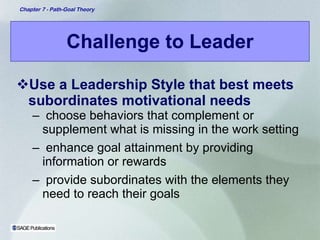
Challenge to Leader Use a Leadership Style that best meets subordinates motivational needs choose behaviors that complement or supplement what is missing in the work setting enhance goal attainment by providing information or rewards provide subordinates with the elements they need to reach their goals
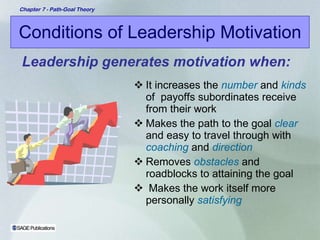
Conditions of Leadership Motivation It increases the   number   and   kinds   of  payoffs subordinates receive from their work Makes the path to the goal   clear   and easy to travel through with   coaching   and  direction Removes   obstacles   and roadblocks to attaining the goal Makes the work itself more personally  satisfying Leadership generates motivation when:
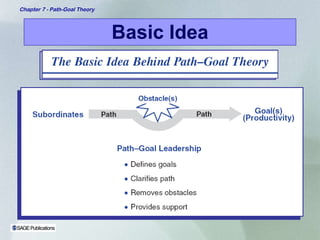
Basic Idea
Path-Goal Theory
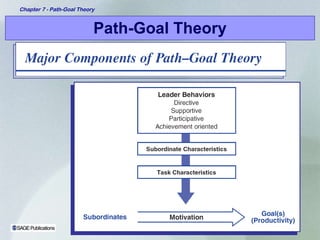
Major Components of Path-Goal Theory Path-Goal Theory Suggests: Each type of leader behavior has a different  kind of impact on subordinates motivation Whether or not a particular leader behavior is motivating is contingent on  subordinate characteristics  task characteristics
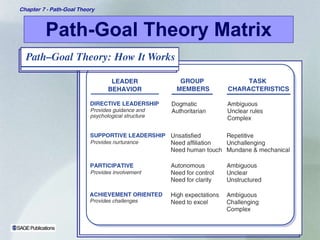
Leader Behaviors Directive Leadership Leader who gives subordinates task instruction including: What is expected of them How task is to be done Timeline for task completion Leader -  sets clear standards of performance makes rules & regulations clear to subordinates
Leader Behaviors Supportive Leadership Refers to being friendly and approachable as a leader and includes: Attending to well-being & human needs of subordinates’ Using supportive behavior to make work environment pleasant Treating subordinates as equals & give them respect for their status
Leader Behaviors Participative Leadership Leader who invites subordinates to share in the decision-making A participative leader: Consults with subordinates Seeks their ideas & opinions Integrates their input into group/organizational decisions
Leader Behaviors Achievement Oriented Leadership Leader who challenges subordinates to perform work at the highest level possible An achievement oriented leader: Establishes a high standard of excellence for subordinates Seeks continuous improvement Demonstrates a high degree of confidence in subordinates’ ability to establish & achieve challenging goals
Subordinate Characteristics Determine how a leader’s behavior will be interpreted by subordinates in a given work context Researchers focus on subordinates’ Need for affiliation Preferences for structure (less uncertainty) Desires for control (Locus of Control) Self-perceived level of task ability
Subordinate Characteristics Strong need for affiliation Friendly and concerned leadership is a source of satisfaction Supportive Leadership Preference for Structure   Dogmatic & authoritarian   Leadership provides psychological structure, task clarity & greater sense of certainty in work setting Directive Leadership
Subordinate Characteristics Desire for Control Internal locus of control Leadership that allows subordinates to feel in charge of their work & makes them an integral part of the decision-making process Participative Leadership External locus of control Leadership that parallels subordinates feelings that outside forces control their circumstances Directive Leadership
Subordinate Characteristics Perception of their own ability – specific task As perception of ability and competence goes up need for highly directive leadership goes down.  Directive leadership may become redundant – possibly excessively controlling
Task Characteristics Components Task Characteristics: Design of subordinates’ task Organization’s formal authority system Primary work group of subordinates
Task Characteristics Unclear and ambiguous -   Leader needs to provide structure Highly repetitive   -  Leader needs to provide support to maintain subordinate motivation Weak formal authority   -  If formal authority system is weak, the leader needs to assist subordinates by making rules and work requirements clear Nonsupportive/weak group norms  -  Leader needs to help build cohesiveness and role responsibility Task Situations Requiring Leader Involvement
Task Characteristics Anything in the work setting that gets in the way of subordinates They create excessive uncertainties, frustrations, or threats for subordinates Leaders responsibility is to help subordinates by – Removing the obstacles Helping subordinates around them  Assisting with obstacles will increase  Subordinates’ expectations to complete the task Their sense of job satisfaction Obstacles
How Does the Path-Goal Theory Approach Work? Focus of Path-Goal Theory  Strengths Criticisms Application
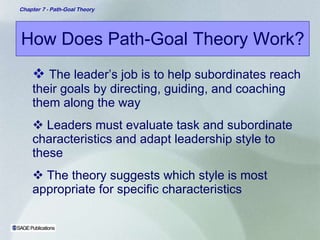
How Does Path-Goal Theory Work? The leader’s job is to help subordinates reach their goals by directing, guiding, and coaching them along the way Leaders must evaluate task and subordinate characteristics and adapt leadership style to these The theory suggests which style is most appropriate for specific characteristics
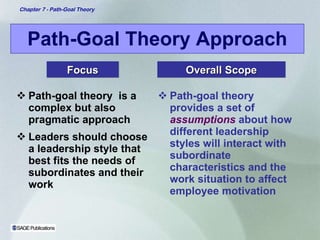
Path-Goal Theory Approach Path-goal theory  is a complex but also pragmatic approach Leaders should choose a leadership style that best fits the needs of subordinates and their work Path-goal theory provides a set of  assumptions   about how different leadership styles will interact with subordinate characteristics and the work situation to affect employee motivation Focus Overall Scope
Path-Goal Theory Matrix
Strengths Useful theoretical framework .  Path-goal theory is a useful theoretical framework for understanding how various leadership behaviors affect the satisfaction of subordinates and their work performance. Integrates motivation.   Path-goal theory attempts to integrate the motivation principles of expectancy theory into a theory of leadership. Practical model.   Path-goal theory provides a practical model that underscores and highlights the important ways leaders help subordinates .
Criticisms Interpreting the meaning of the theory can be   confusing   because it is so complex and incorporates so many different aspects of leadership; consequently, it is difficult to implement. Empirical research studies have demonstrated only   partial support   for path-goal theory. It fails to adequately explain the   relationship   between leadership behavior and worker motivation . The path-goal theory approach treats leadership as a   one-way   event in which the leader affects the subordinate.
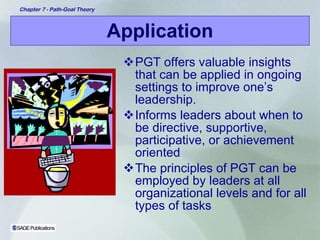
Application PGT offers valuable insights that can be applied in ongoing settings to improve one’s leadership. Informs leaders about when to be directive, supportive, participative, or achievement oriented The principles of PGT can be employed by leaders at all organizational levels and for all types of tasks

Leadership

  • 1.
    Leadership Chapter 7– Path-Goal Theory Northouse, 4 th edition
  • 2.
    Path-Goal Theory PerspectiveConditions of Leadership Motivation Leader Behaviors & Subordinate Characteristics Task Characteristics How Does the PGT Approach Work? Overview
  • 3.
    Path-Goal Theory (House, 1971) Description Path-goal theory centers on how leaders motivate subordinates to accomplish designated goals Emphasizes the relationship between the leaders style the characteristics of the subordinates the work setting Definition
  • 4.
    Path-Goal Theory (House, 1971) Description Goal - To enhance employee performance and satisfaction by focusing on employee motivation Motivational Principles (based on Expectancy Theory ) - Subordinates will be motivated if they believe: they are capable of performing their work that their efforts will result in a certain outcome that the payoffs for doing their work are worthwhile Perspective
  • 5.
    Challenge to LeaderUse a Leadership Style that best meets subordinates motivational needs choose behaviors that complement or supplement what is missing in the work setting enhance goal attainment by providing information or rewards provide subordinates with the elements they need to reach their goals
  • 6.
    Conditions of LeadershipMotivation It increases the number and kinds of payoffs subordinates receive from their work Makes the path to the goal clear and easy to travel through with coaching and direction Removes obstacles and roadblocks to attaining the goal Makes the work itself more personally satisfying Leadership generates motivation when:
  • 7.
  • 8.
  • 9.
    Major Components ofPath-Goal Theory Path-Goal Theory Suggests: Each type of leader behavior has a different kind of impact on subordinates motivation Whether or not a particular leader behavior is motivating is contingent on subordinate characteristics task characteristics
  • 10.
    Leader Behaviors DirectiveLeadership Leader who gives subordinates task instruction including: What is expected of them How task is to be done Timeline for task completion Leader - sets clear standards of performance makes rules & regulations clear to subordinates
  • 11.
    Leader Behaviors SupportiveLeadership Refers to being friendly and approachable as a leader and includes: Attending to well-being & human needs of subordinates’ Using supportive behavior to make work environment pleasant Treating subordinates as equals & give them respect for their status
  • 12.
    Leader Behaviors ParticipativeLeadership Leader who invites subordinates to share in the decision-making A participative leader: Consults with subordinates Seeks their ideas & opinions Integrates their input into group/organizational decisions
  • 13.
    Leader Behaviors AchievementOriented Leadership Leader who challenges subordinates to perform work at the highest level possible An achievement oriented leader: Establishes a high standard of excellence for subordinates Seeks continuous improvement Demonstrates a high degree of confidence in subordinates’ ability to establish & achieve challenging goals
  • 14.
    Subordinate Characteristics Determinehow a leader’s behavior will be interpreted by subordinates in a given work context Researchers focus on subordinates’ Need for affiliation Preferences for structure (less uncertainty) Desires for control (Locus of Control) Self-perceived level of task ability
  • 15.
    Subordinate Characteristics Strongneed for affiliation Friendly and concerned leadership is a source of satisfaction Supportive Leadership Preference for Structure Dogmatic & authoritarian Leadership provides psychological structure, task clarity & greater sense of certainty in work setting Directive Leadership
  • 16.
    Subordinate Characteristics Desirefor Control Internal locus of control Leadership that allows subordinates to feel in charge of their work & makes them an integral part of the decision-making process Participative Leadership External locus of control Leadership that parallels subordinates feelings that outside forces control their circumstances Directive Leadership
  • 17.
    Subordinate Characteristics Perceptionof their own ability – specific task As perception of ability and competence goes up need for highly directive leadership goes down. Directive leadership may become redundant – possibly excessively controlling
  • 18.
    Task Characteristics ComponentsTask Characteristics: Design of subordinates’ task Organization’s formal authority system Primary work group of subordinates
  • 19.
    Task Characteristics Unclearand ambiguous - Leader needs to provide structure Highly repetitive - Leader needs to provide support to maintain subordinate motivation Weak formal authority - If formal authority system is weak, the leader needs to assist subordinates by making rules and work requirements clear Nonsupportive/weak group norms - Leader needs to help build cohesiveness and role responsibility Task Situations Requiring Leader Involvement
  • 20.
    Task Characteristics Anythingin the work setting that gets in the way of subordinates They create excessive uncertainties, frustrations, or threats for subordinates Leaders responsibility is to help subordinates by – Removing the obstacles Helping subordinates around them Assisting with obstacles will increase Subordinates’ expectations to complete the task Their sense of job satisfaction Obstacles
  • 21.
    How Does thePath-Goal Theory Approach Work? Focus of Path-Goal Theory Strengths Criticisms Application
  • 22.
    How Does Path-GoalTheory Work? The leader’s job is to help subordinates reach their goals by directing, guiding, and coaching them along the way Leaders must evaluate task and subordinate characteristics and adapt leadership style to these The theory suggests which style is most appropriate for specific characteristics
  • 23.
    Path-Goal Theory ApproachPath-goal theory is a complex but also pragmatic approach Leaders should choose a leadership style that best fits the needs of subordinates and their work Path-goal theory provides a set of assumptions about how different leadership styles will interact with subordinate characteristics and the work situation to affect employee motivation Focus Overall Scope
  • 24.
  • 25.
    Strengths Useful theoreticalframework . Path-goal theory is a useful theoretical framework for understanding how various leadership behaviors affect the satisfaction of subordinates and their work performance. Integrates motivation. Path-goal theory attempts to integrate the motivation principles of expectancy theory into a theory of leadership. Practical model. Path-goal theory provides a practical model that underscores and highlights the important ways leaders help subordinates .
  • 26.
    Criticisms Interpreting themeaning of the theory can be confusing because it is so complex and incorporates so many different aspects of leadership; consequently, it is difficult to implement. Empirical research studies have demonstrated only partial support for path-goal theory. It fails to adequately explain the relationship between leadership behavior and worker motivation . The path-goal theory approach treats leadership as a one-way event in which the leader affects the subordinate.
  • 27.
    Application PGT offersvaluable insights that can be applied in ongoing settings to improve one’s leadership. Informs leaders about when to be directive, supportive, participative, or achievement oriented The principles of PGT can be employed by leaders at all organizational levels and for all types of tasks