










Presentation Skills
How to speak with power in any situation
By: Mahmoud Alaa
Ground Rules
Please make sure that your mobile is silent/off
Ask for clarification if you are confused
No sidebar conversations are allowed
All members are expected to participate in all phases of the session
Have Fun!
By the end of this session you will be able to:
•Recognize your audience well
•Know self-confidence strategies
•Start strong with any audience
•Plan and prepare your tailored talk
•List the eight parts of keynote talk
•Impress large audience
•Answer questions effectively
•End your talk with a bang
•Avoid deadly sins of presenters
Agenda
Audience
Planning & Preparation
Planning the visual part of your speech
Self-Confidence and Mental Mastery
Start Strong with Any Audience
Impressing large Audience
How to Answer Questions Effectively
Powerful Voice Techniques
End with a Bang
Common mistakes to Avoid
Audience
Audience
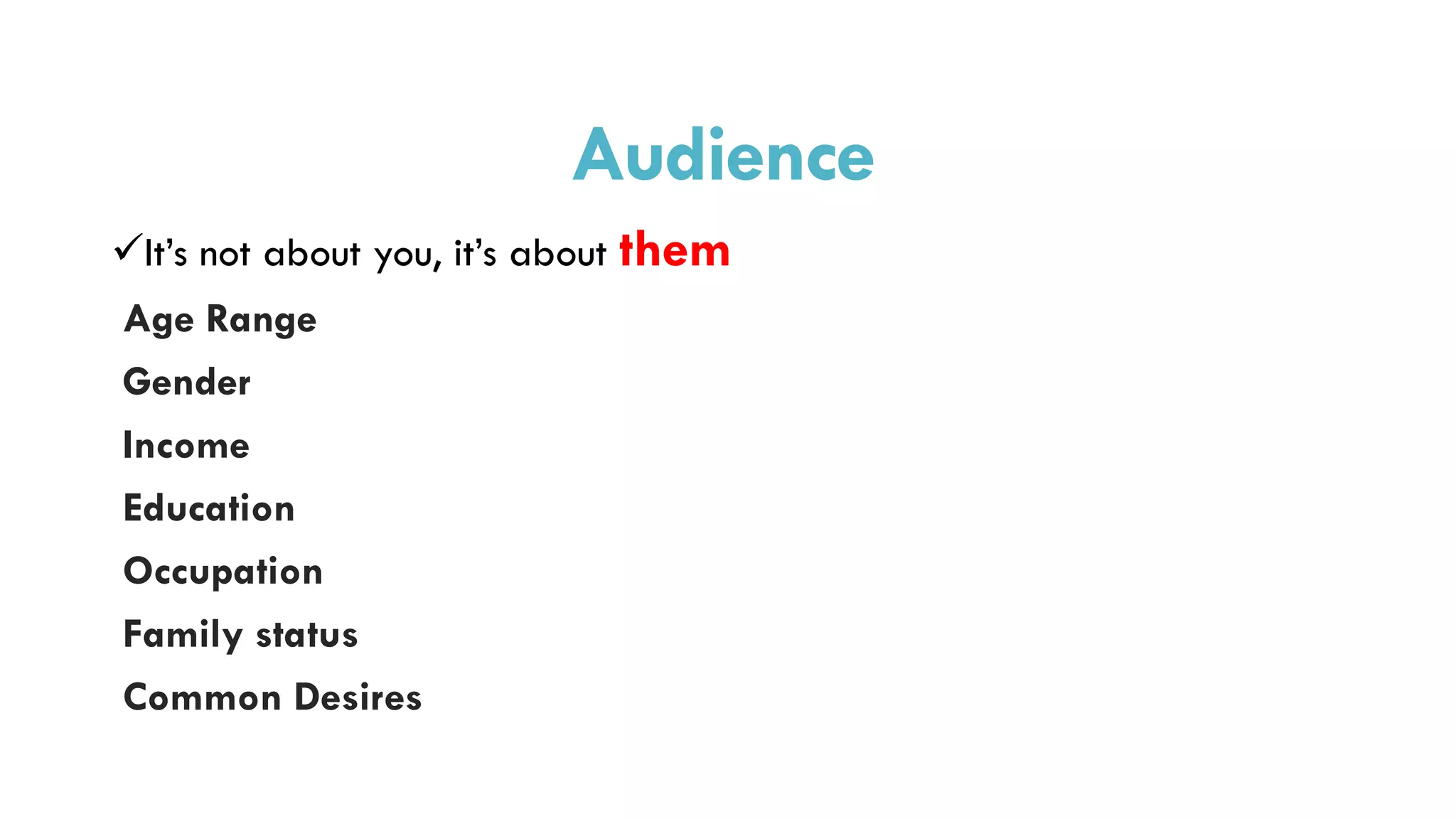
It’s not about you, it’s about them
Age Range
Gender
Income
Education
Occupation
Family status
Common Desires
Audience
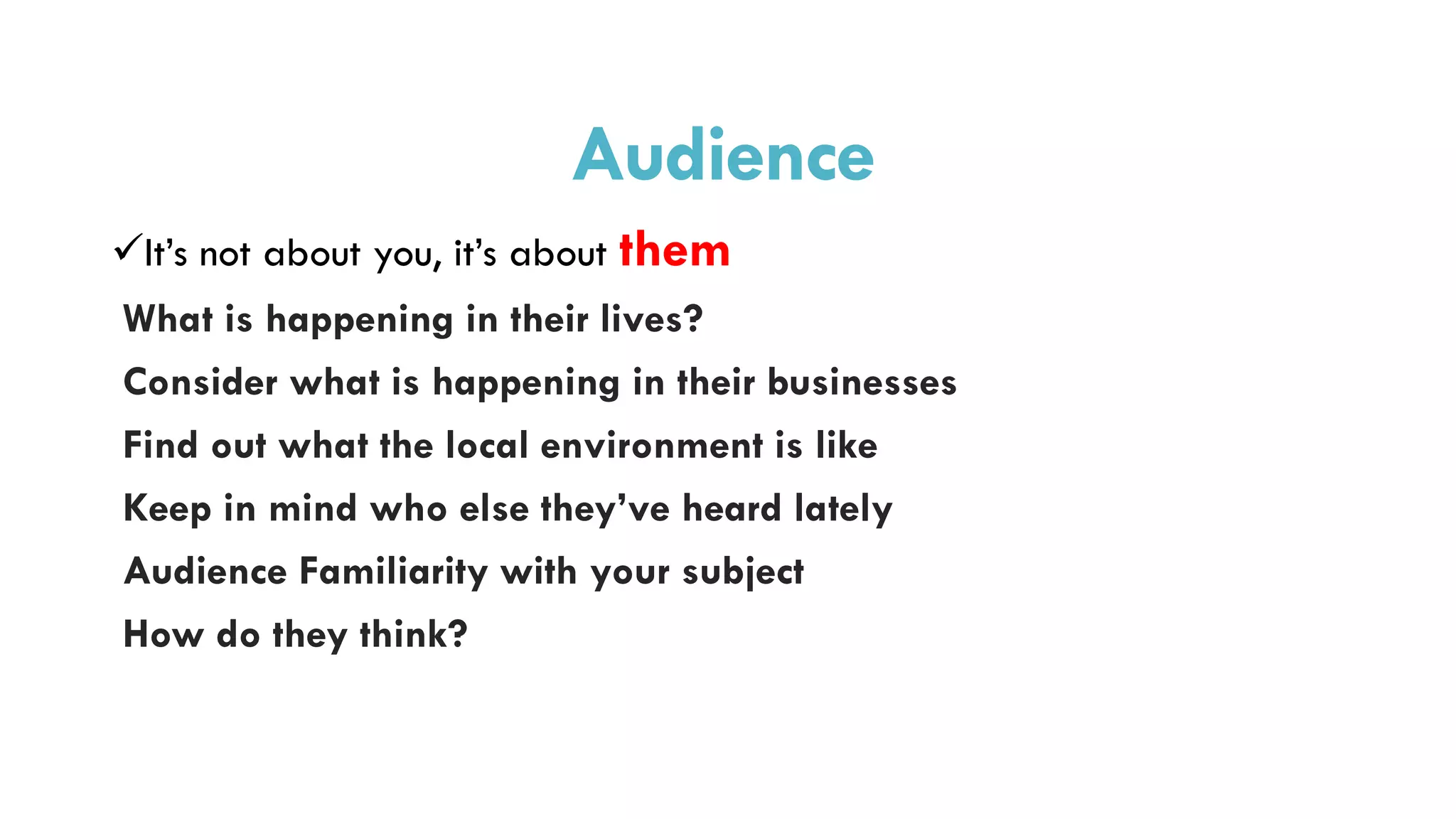
It’s not about you, it’s about them
What is happening in their lives?
Consider what is happening in their businesses
Find out what the local environment is like
Keep in mind who else they’ve heard lately
Audience Familiarity with your subject
How do they think?
Planning and Preparation
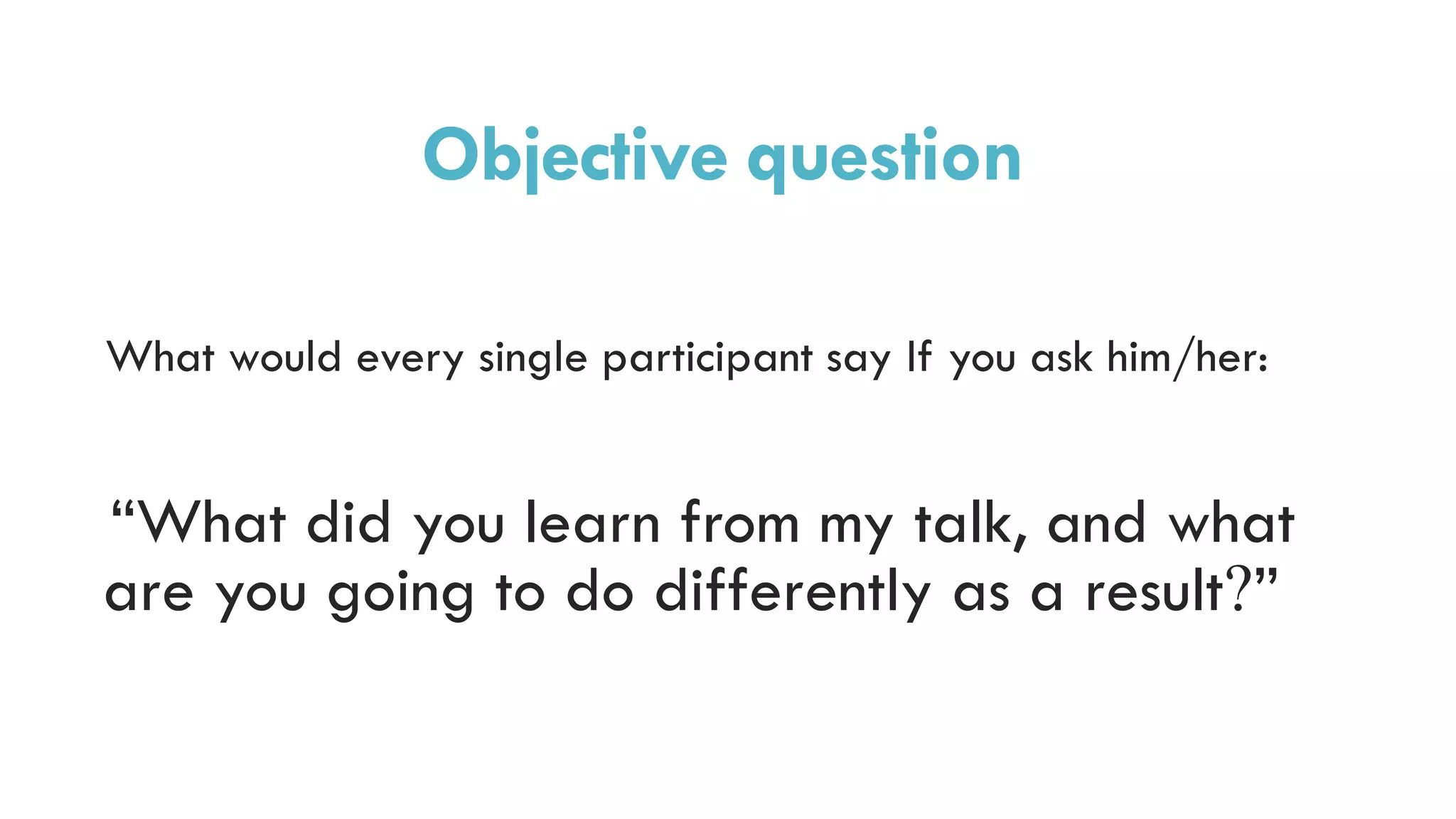
Objective question
What would every single participant say If you ask him/her:
“What did you learn from my talk, and what
are you going to do differently as a result?”
Planning and Preparation
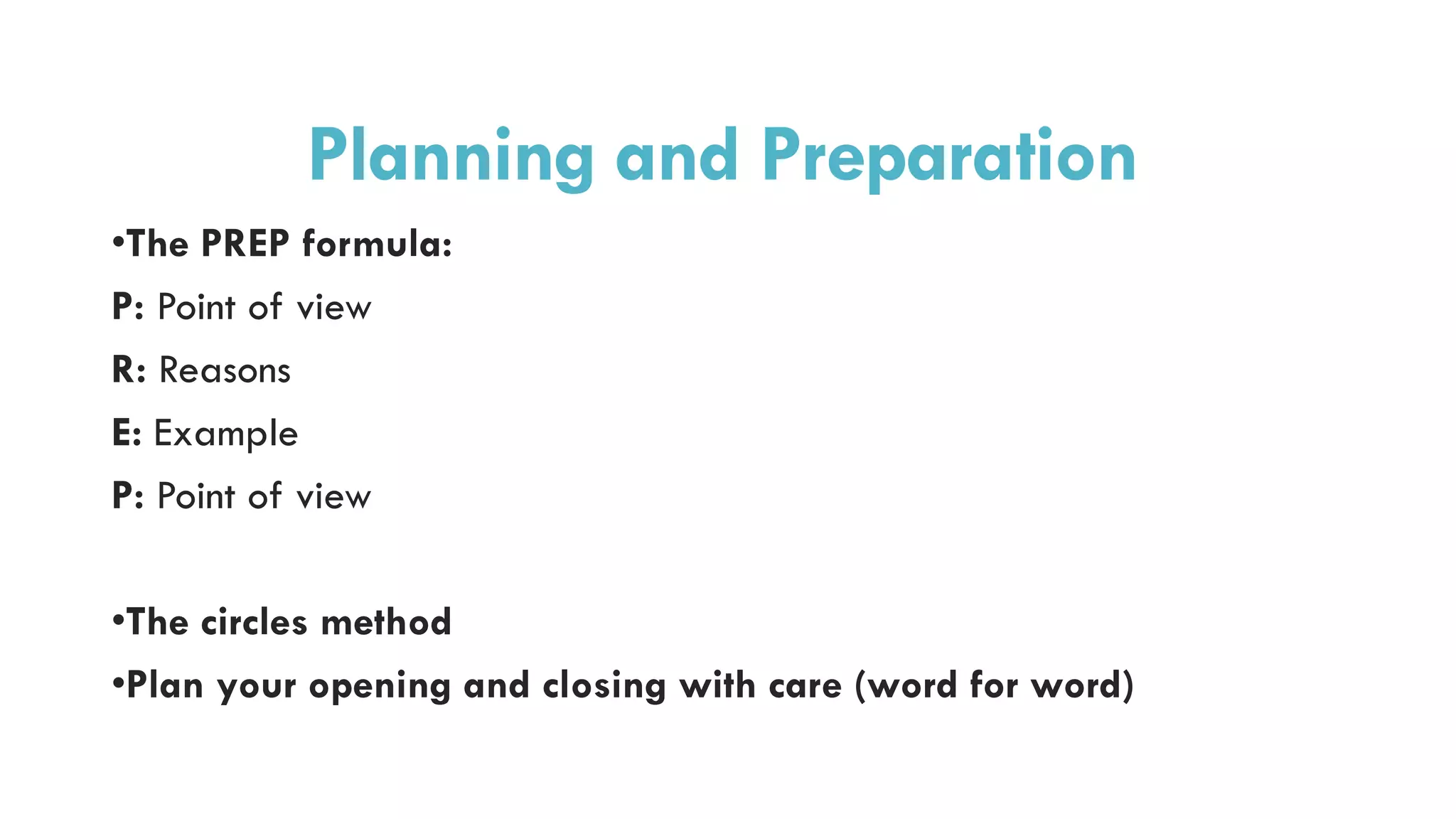
•The PREP formula:
P: Point of view
R: Reasons
E: Example
P: Point of view
•The circles method
•Plan your opening and closing with care (word for word)
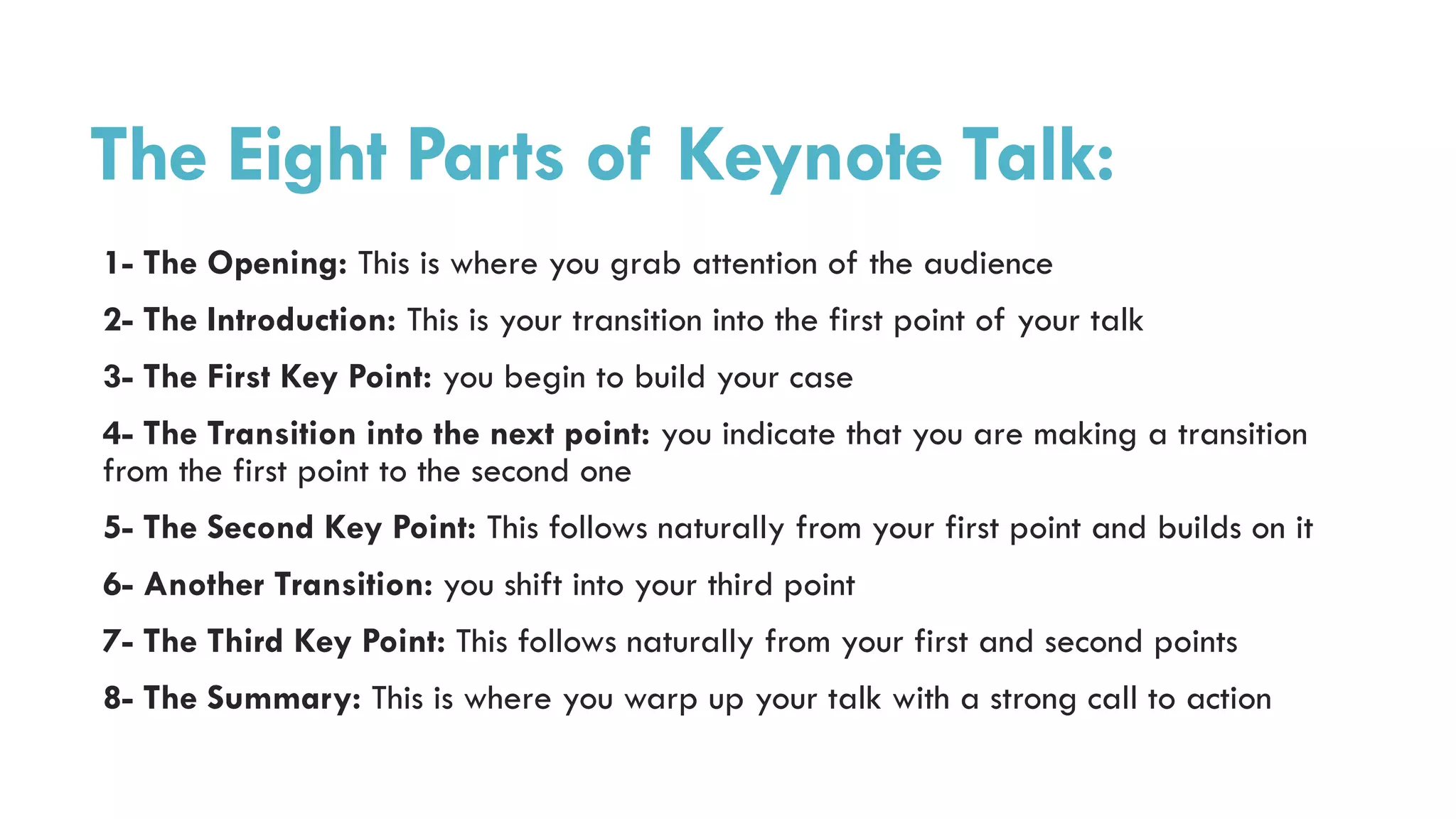
The Eight Parts of Keynote Talk:
1- The Opening: This is where you grab attention of the audience
2- The Introduction: This is your transition into the first point of your talk
3- The First Key Point: you begin to build your case
4- The Transition into the next point: you indicate that you are making a transition
from the first point to the second one
5- The Second Key Point: This follows naturally from your first point and builds on it
6- Another Transition: you shift into your third point
7- The Third Key Point: This follows naturally from your first and second points
8- The Summary: This is where you warp up your talk with a strong call to action
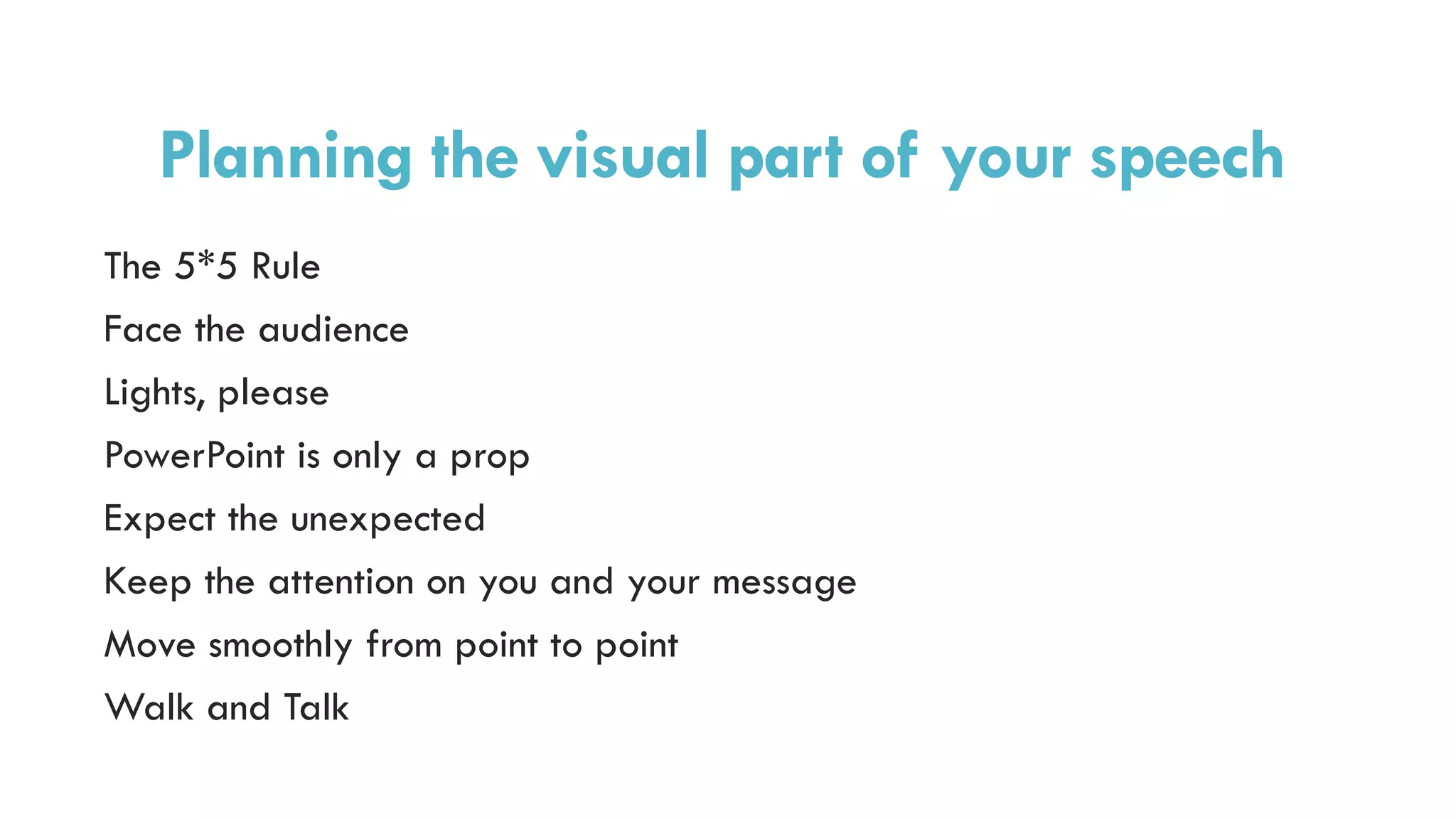
Planning the visual part of your speech
The 5*5 Rule
Face the audience
Lights, please
PowerPoint is only a prop
Expect the unexpected
Keep the attention on you and your message
Move smoothly from point to point
Walk and Talk
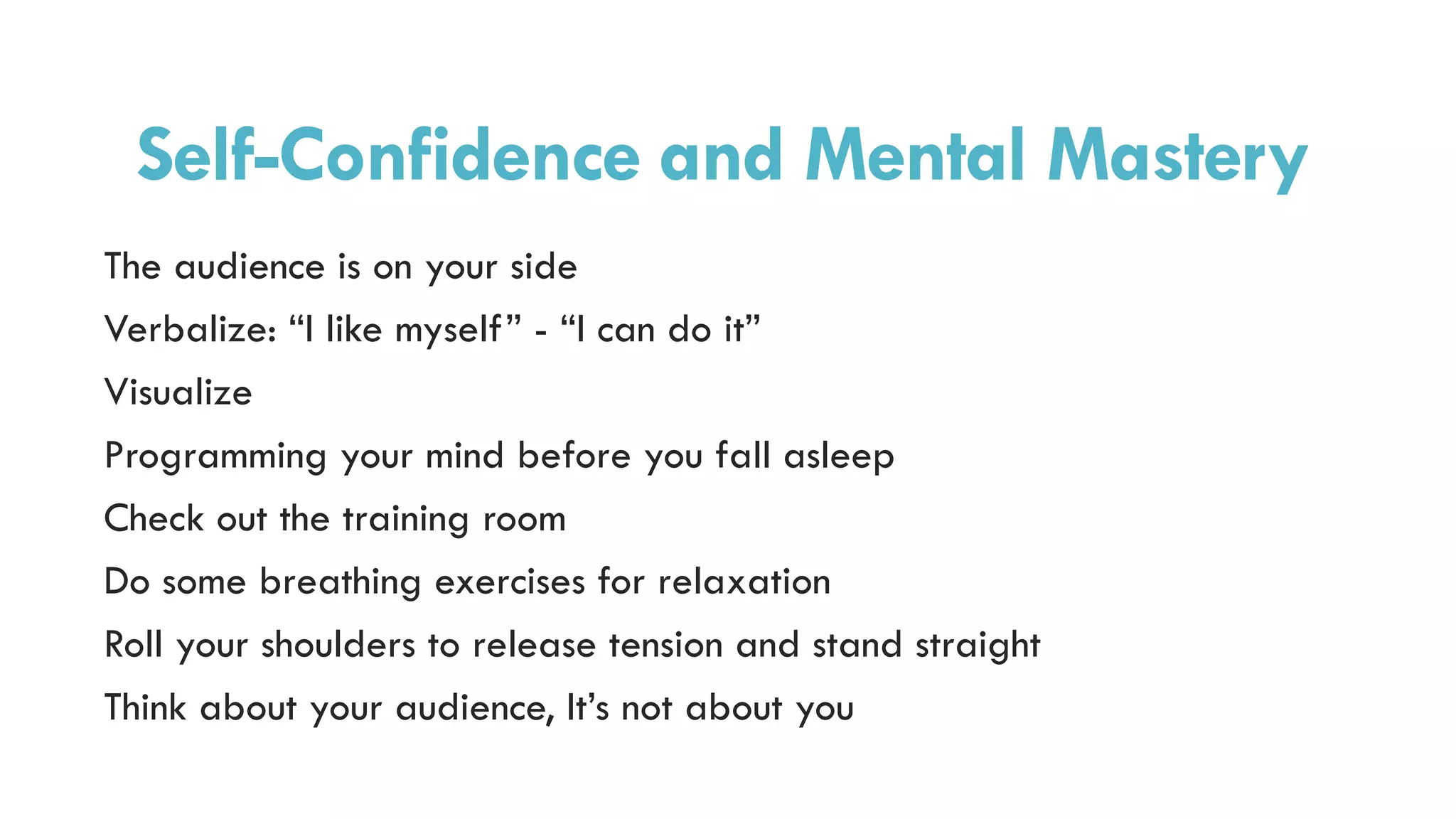
Self-Confidence and Mental Mastery
The audience is on your side
Verbalize: “I like myself” - “I can do it”
Visualize
Programming your mind before you fall asleep
Check out the training room
Do some breathing exercises for relaxation
Roll your shoulders to release tension and stand straight
Think about your audience, It’s not about you
Step up confidently
Look the part to make sure that nothing in your clothes
Build positive expectations
Take charge immediately, the people want you to become the leader
Thank the organizers
Tell them about yourself, build a bridge (something in common)
Compliment the audience
Refer to current or historical events
Start Strong with Any Audience
Refer to a well-known person’s quote
Repeat a recent conversation
Make a shocking statement
Start with a story
Give them hope
Start with Humor__Maybe
Ask a question, conduct a survey
Get them talk to one another
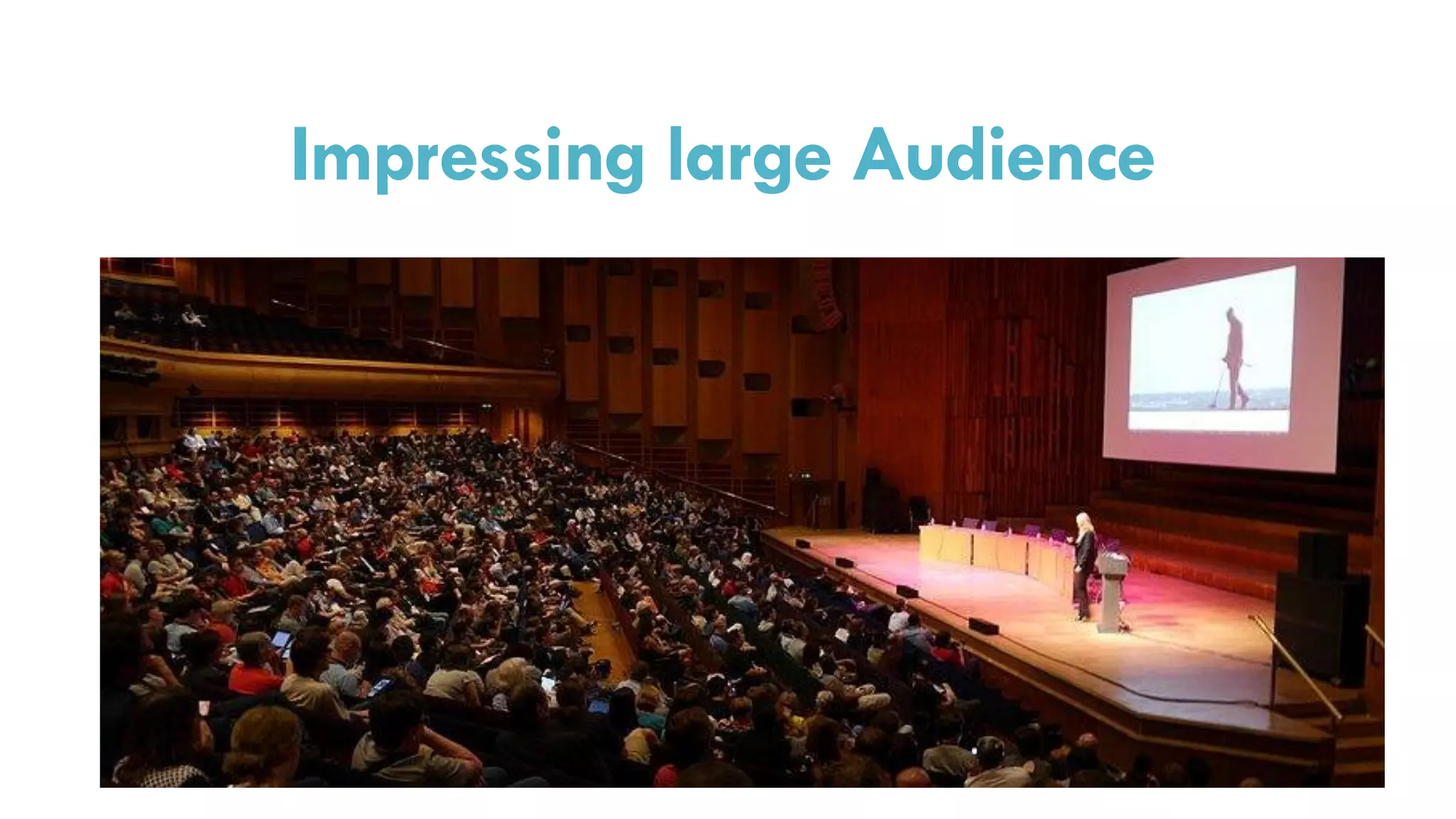
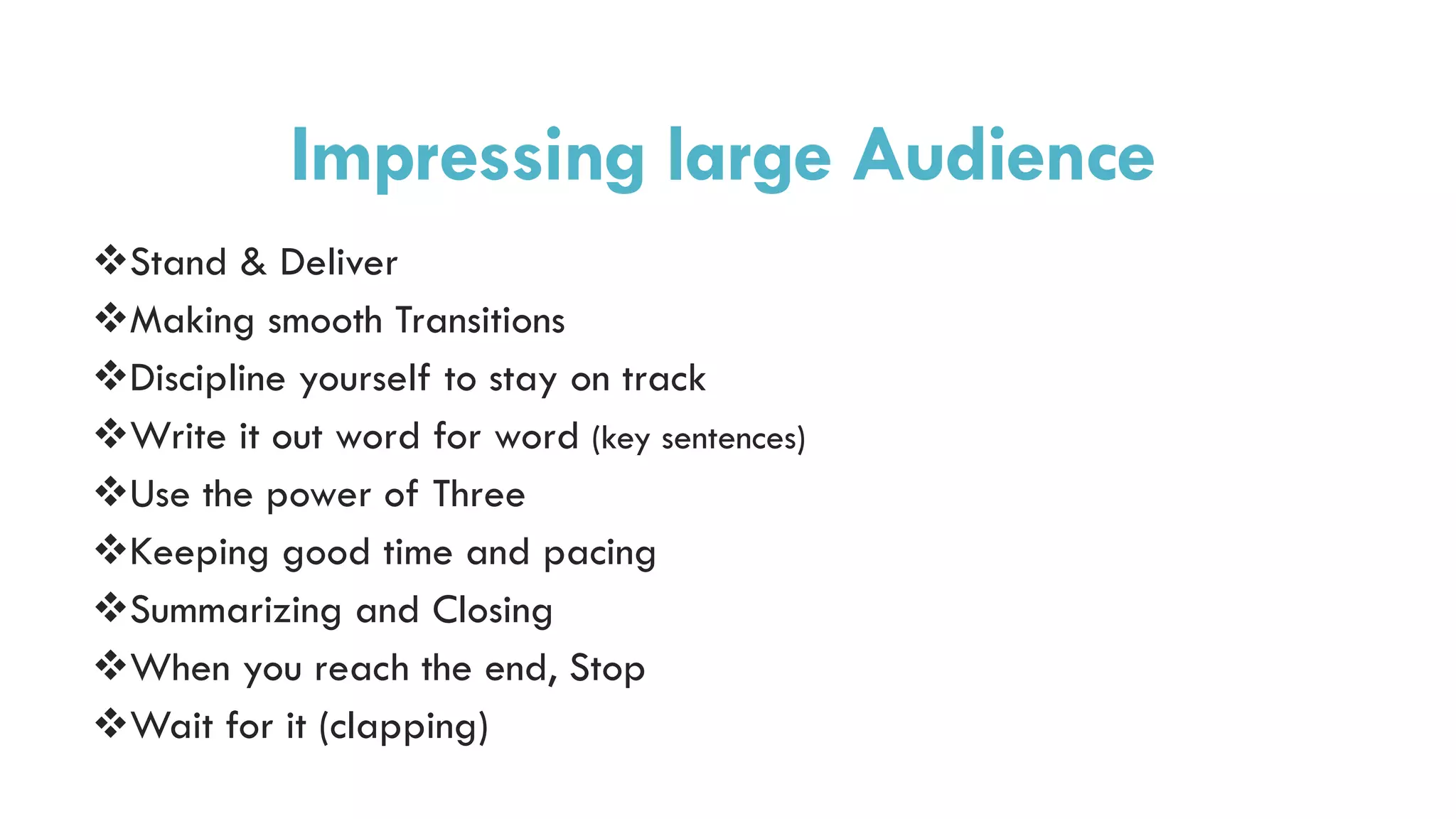
Impressing large Audience
Practice Makes perfect
Check out the room
Mix with your Audience
Listen to the other speakers and think on your feet
Meet your introducer
Showtime!
Link each point back into the story
Activate both brains
Look directly at people in the Audience
Impressing large Audience
Stand & Deliver
Making smooth Transitions
Discipline yourself to stay on track
Write it out word for word (key sentences)
Use the power of Three
Keeping good time and pacing
Summarizing and Closing
When you reach the end, Stop
Wait for it (clapping)
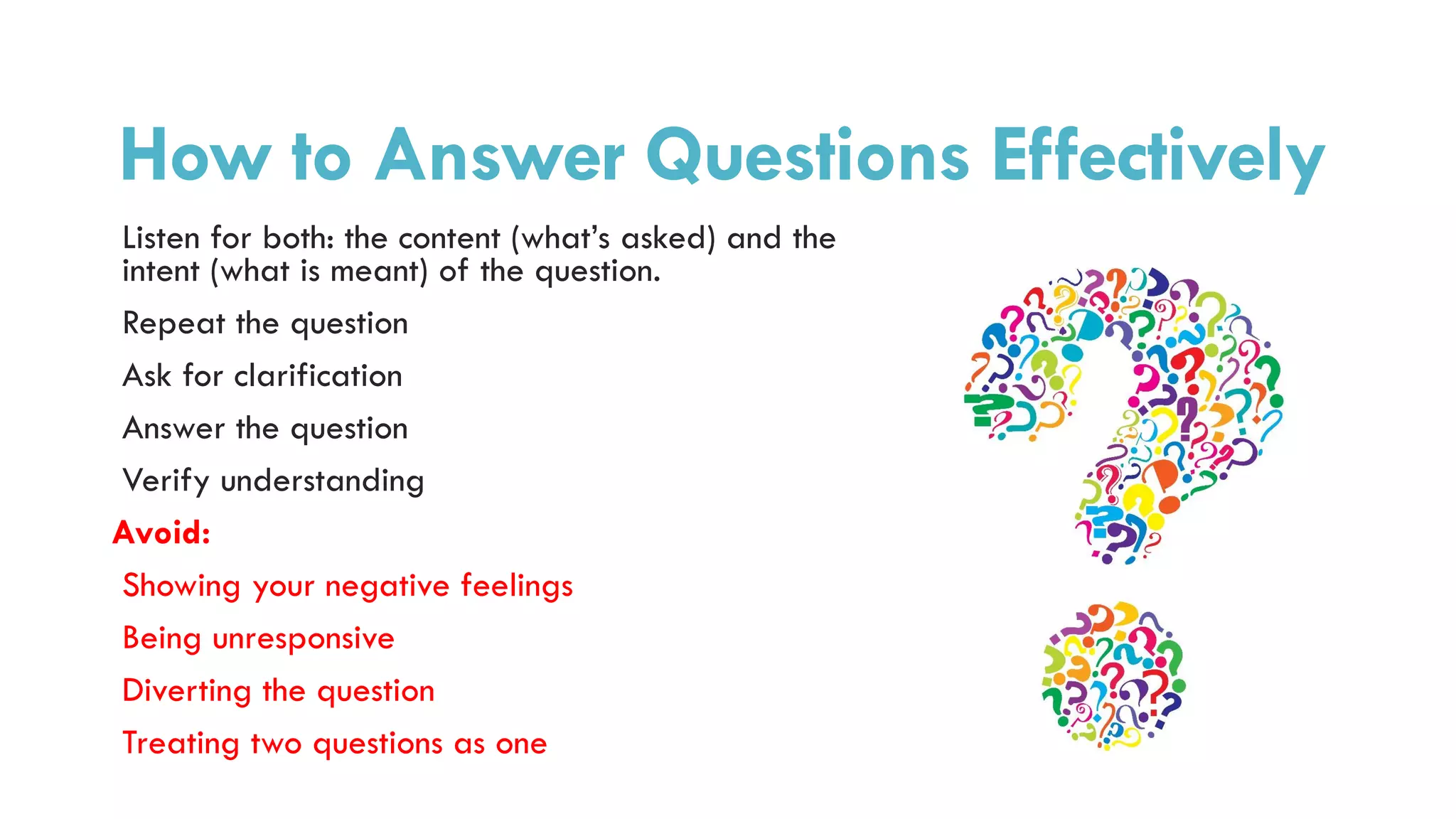
How to Answer Questions Effectively
Listen for both: the content (what’s asked) and the
intent (what is meant) of the question.
Repeat the question
Ask for clarification
Answer the question
Verify understanding
Avoid:
Showing your negative feelings
Being unresponsive
Diverting the question
Treating two questions as one
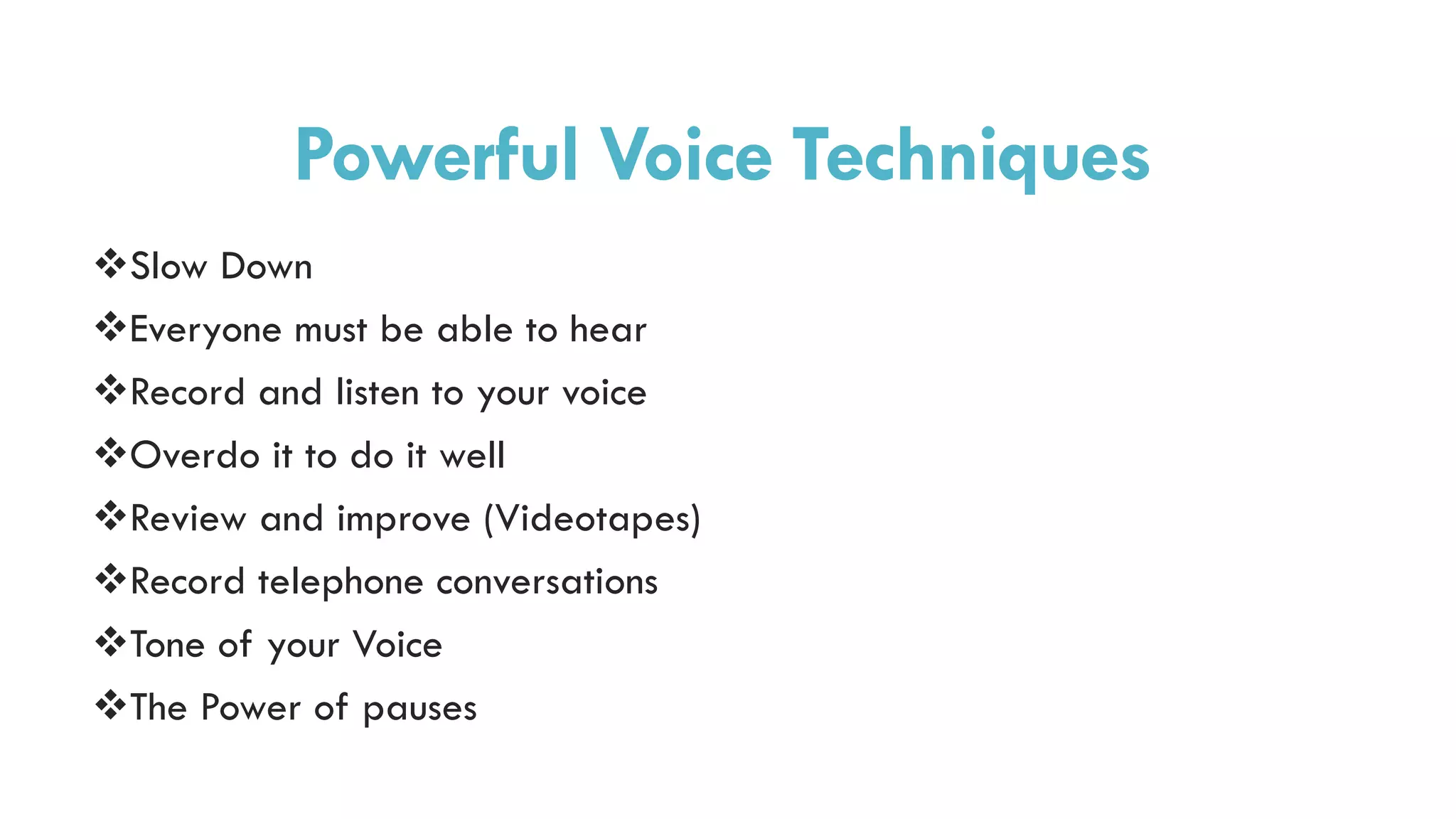
Powerful Voice Techniques
Slow Down
Everyone must be able to hear
Record and listen to your voice
Overdo it to do it well
Review and improve (Videotapes)
Record telephone conversations
Tone of your Voice
The Power of pauses
End with a Bang
End with a Bang
Plan your ending word for word
End with a Call to Action
Close with a Summary
Close with a Story
Make them laugh
Close with Inspiration
Make it clear that you are done
Let them applaud
Common mistakes to
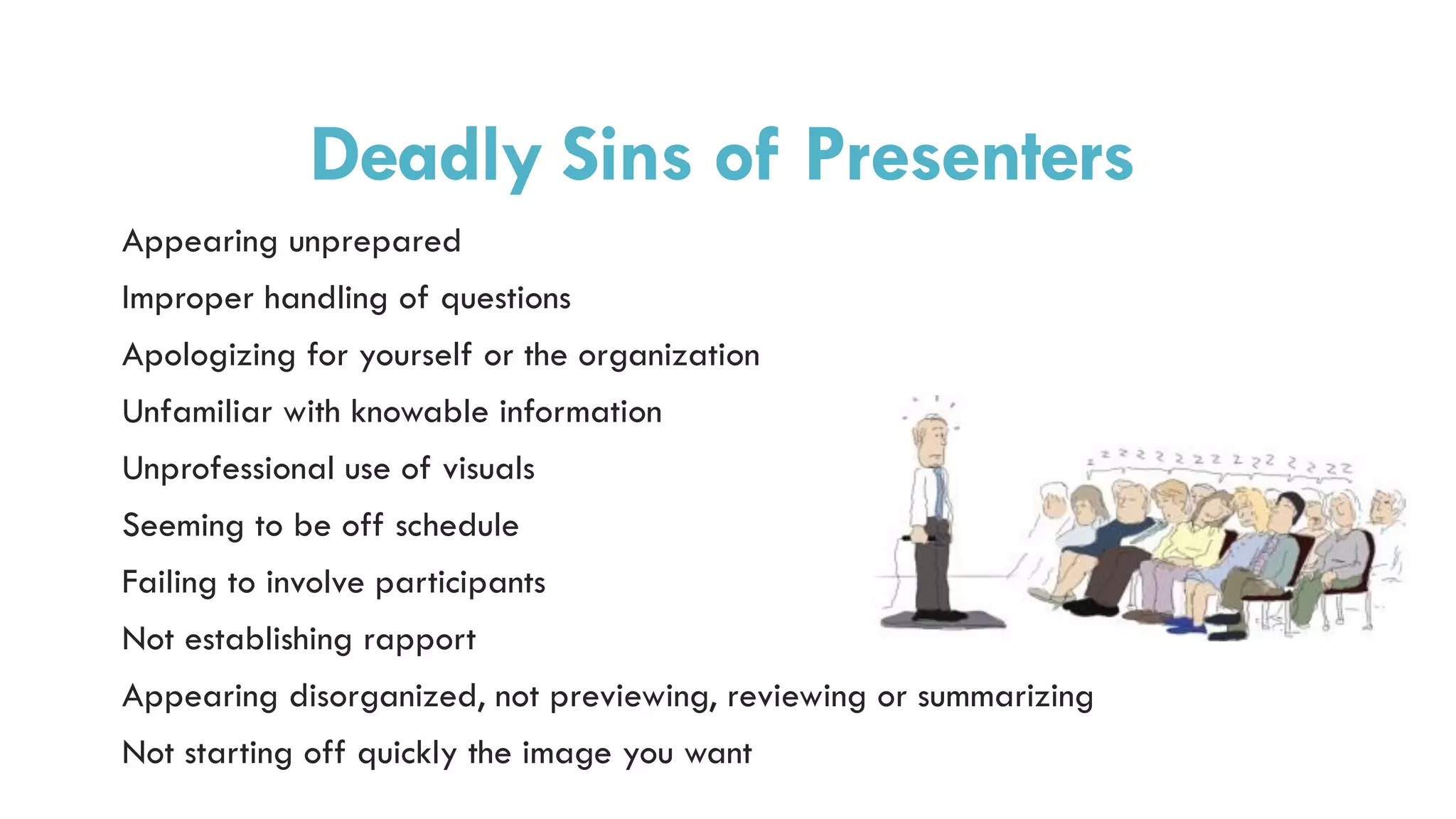
Deadly Sins of Presenters
Appearing unprepared
Improper handling of questions
Apologizing for yourself or the organization
Unfamiliar with knowable information
Unprofessional use of visuals
Seeming to be off schedule
Failing to involve participants
Not establishing rapport
Appearing disorganized, not previewing, reviewing or summarizing
Not starting off quickly the image you want
More Resources to Improve Your
Presentation Skills
Attend to professional speakers
Read
Online courses
YouTube
Animation movies
Keep practicing
TED Talks
Get Feedback each time you present
/mahm0udalaa

Presentation skills - How to present with power in any situation

  • 1.
    Presentation Skills How tospeak with power in any situation By: Mahmoud Alaa
  • 3.
    Ground Rules Please makesure that your mobile is silent/off Ask for clarification if you are confused No sidebar conversations are allowed All members are expected to participate in all phases of the session Have Fun!
  • 5.
    By the endof this session you will be able to: •Recognize your audience well •Know self-confidence strategies •Start strong with any audience •Plan and prepare your tailored talk •List the eight parts of keynote talk •Impress large audience •Answer questions effectively •End your talk with a bang •Avoid deadly sins of presenters
  • 6.
    Agenda Audience Planning & Preparation Planningthe visual part of your speech Self-Confidence and Mental Mastery Start Strong with Any Audience Impressing large Audience How to Answer Questions Effectively Powerful Voice Techniques End with a Bang Common mistakes to Avoid
  • 7.
  • 8.
    Audience It’s not aboutyou, it’s about them Age Range Gender Income Education Occupation Family status Common Desires
  • 9.
    Audience It’s not aboutyou, it’s about them What is happening in their lives? Consider what is happening in their businesses Find out what the local environment is like Keep in mind who else they’ve heard lately Audience Familiarity with your subject How do they think?
  • 10.
  • 11.
    Objective question What wouldevery single participant say If you ask him/her: “What did you learn from my talk, and what are you going to do differently as a result?”
  • 12.
    Planning and Preparation •ThePREP formula: P: Point of view R: Reasons E: Example P: Point of view •The circles method •Plan your opening and closing with care (word for word)
  • 13.
    The Eight Partsof Keynote Talk: 1- The Opening: This is where you grab attention of the audience 2- The Introduction: This is your transition into the first point of your talk 3- The First Key Point: you begin to build your case 4- The Transition into the next point: you indicate that you are making a transition from the first point to the second one 5- The Second Key Point: This follows naturally from your first point and builds on it 6- Another Transition: you shift into your third point 7- The Third Key Point: This follows naturally from your first and second points 8- The Summary: This is where you warp up your talk with a strong call to action
  • 14.
    Planning the visualpart of your speech
  • 15.
    Planning the visualpart of your speech The 5*5 Rule Face the audience Lights, please PowerPoint is only a prop Expect the unexpected Keep the attention on you and your message Move smoothly from point to point Walk and Talk
  • 16.
  • 17.
    Self-Confidence and MentalMastery The audience is on your side Verbalize: “I like myself” - “I can do it” Visualize Programming your mind before you fall asleep Check out the training room Do some breathing exercises for relaxation Roll your shoulders to release tension and stand straight Think about your audience, It’s not about you
  • 19.
    Step up confidently Lookthe part to make sure that nothing in your clothes Build positive expectations Take charge immediately, the people want you to become the leader Thank the organizers Tell them about yourself, build a bridge (something in common) Compliment the audience Refer to current or historical events Start Strong with Any Audience
  • 20.
    Start Strong withAny Audience Refer to a well-known person’s quote Repeat a recent conversation Make a shocking statement Start with a story Give them hope Start with Humor__Maybe Ask a question, conduct a survey Get them talk to one another
  • 21.
  • 22.
    Impressing large Audience PracticeMakes perfect Check out the room Mix with your Audience Listen to the other speakers and think on your feet Meet your introducer Showtime! Link each point back into the story Activate both brains Look directly at people in the Audience
  • 23.
    Impressing large Audience Stand& Deliver Making smooth Transitions Discipline yourself to stay on track Write it out word for word (key sentences) Use the power of Three Keeping good time and pacing Summarizing and Closing When you reach the end, Stop Wait for it (clapping)
  • 24.
    How to AnswerQuestions Effectively Listen for both: the content (what’s asked) and the intent (what is meant) of the question. Repeat the question Ask for clarification Answer the question Verify understanding Avoid: Showing your negative feelings Being unresponsive Diverting the question Treating two questions as one
  • 25.
  • 26.
    Powerful Voice Techniques SlowDown Everyone must be able to hear Record and listen to your voice Overdo it to do it well Review and improve (Videotapes) Record telephone conversations Tone of your Voice The Power of pauses
  • 27.
  • 28.
    End with aBang Plan your ending word for word End with a Call to Action Close with a Summary Close with a Story Make them laugh Close with Inspiration Make it clear that you are done Let them applaud
  • 29.
  • 30.
    Deadly Sins ofPresenters Appearing unprepared Improper handling of questions Apologizing for yourself or the organization Unfamiliar with knowable information Unprofessional use of visuals Seeming to be off schedule Failing to involve participants Not establishing rapport Appearing disorganized, not previewing, reviewing or summarizing Not starting off quickly the image you want
  • 31.
    More Resources toImprove Your Presentation Skills Attend to professional speakers Read Online courses YouTube Animation movies Keep practicing TED Talks Get Feedback each time you present
  • 34.