SIXTH FRAMEWORK PROGRAMME 
PRIORITY 7 
‘Citizens and Governance in a Knowledge Based 
Society’ 
Understanding and 
Responding to Societal 
Demands on Corporate 
Responsibility 
(RESPONSE) 
Contract no.: PL 506462 
Final Report 
DRAFT – Comments Welcome
RESPONSE: understanding and responding to societal demands on corporate responsibility 
RESPONSE RESEARCH TEAM: 
Maurizio Zollo, INSEAD, Academic Director, MC chair 
Valeria Berchicci, INSEAD 
Lourdes Casanova, INSEAD, MC member 
Donal Crilly, INSEAD 
Maria Gradillas, INSEAD 
Morten Hansen, INSEAD 
Joanne Lawrence, INSEAD 
Sophie Linguri, INSEAD 
Susan Schneider, HEC Geneva/INSEAD, MC 
member 
Pamela Sloan, HEC Montreal/INSEAD 
Michael Yaziji, IMD/INSEAD 
Peter Neergaard, coord. CBS, MC member 
Kai Hockerts, CBS, MC member 
Esben Pedersen, CBS 
Adri Tolstrup, CBSc 
Katrine Goul Dueholm , CBS 
Hanne Poulsen, CBS 
Antonio Tencati, MC member 
Francesco Perrini, coord. Bocconi group 
Mario Minoja, U. Bocconi 
Stefano Pogutz, U. Bocconi 
Alessandro Zollo, U. Bocconi 
Wojciech Gasparski, LKA 
Anna Lewicka­Strzalecka, LKA 
Wolfgang Hackl, Impact 
Shantanu Reinhold, Impact 
This report is dedicated to the fond memory of: 
Janet Bohdanowitz, LKA 
Academic Advisory Board  Business Advisory Board 
Henri­Claude de Bettignies, CEIBS  Peter Lacy, EABIS 
Tom Dunfee, U. Pennsylvania  Gilbert Lenssen, EABIS 
Ed Freeman, U. Virginia  Elena Bonfiglioli, Microsoft 
Bruce Kogut, INSEAD  Celia Moore, IBM 
Eric Orts, U. Pennsylvania  Brigitte Tantawi­Monsou, WBCSD 
(formerly, Unilever) 
Peter Pruzan, CBS  Frank Welvaert, Johnson & Johnson 
David Vogel, U. C. Berkeley  Mark Wade, (formerly) Shell 
Jim Walsh, U. Michigan
RESPONSE: understanding and responding to societal demands on corporate responsibility 
Contents 
Executive summary  6 
1  Introduction  12 
PART I: CSR AND COGNITIVE ALIGNMENT  15 
2  A model of cognitive alignment and social performance  16 
3  Methodology  25 
4  Findings: Managers’ understandings of CSR (Objective 1)  32 
5  Findings: External factors and cognitive alignment (Objective 2)  45 
6  Findings: Internal factors and cognitive alignment (Objective 3)  51 
PART II: SOCIALLY RESPONSIBLE BEHAVIOUR  58 
7  A Model of Social Consciousness and Socially Responsible Behavior  59 
8  Methodology  64 
9  Findings: Developing Social Consciousness and SRB in Managers (Objective 4)  69 
PART III: CONCLUSIONS AND RECOMMENDATIONS  76 
10  Conclusions from study findings  77 
11  Recommendations  82
RESPONSE: understanding and responding to societal demands on corporate responsibility 
Figures 
Figure 1:  Summary of research objectives..............................................................................14 
Figure 2:  The RESPONSE model...........................................................................................20 
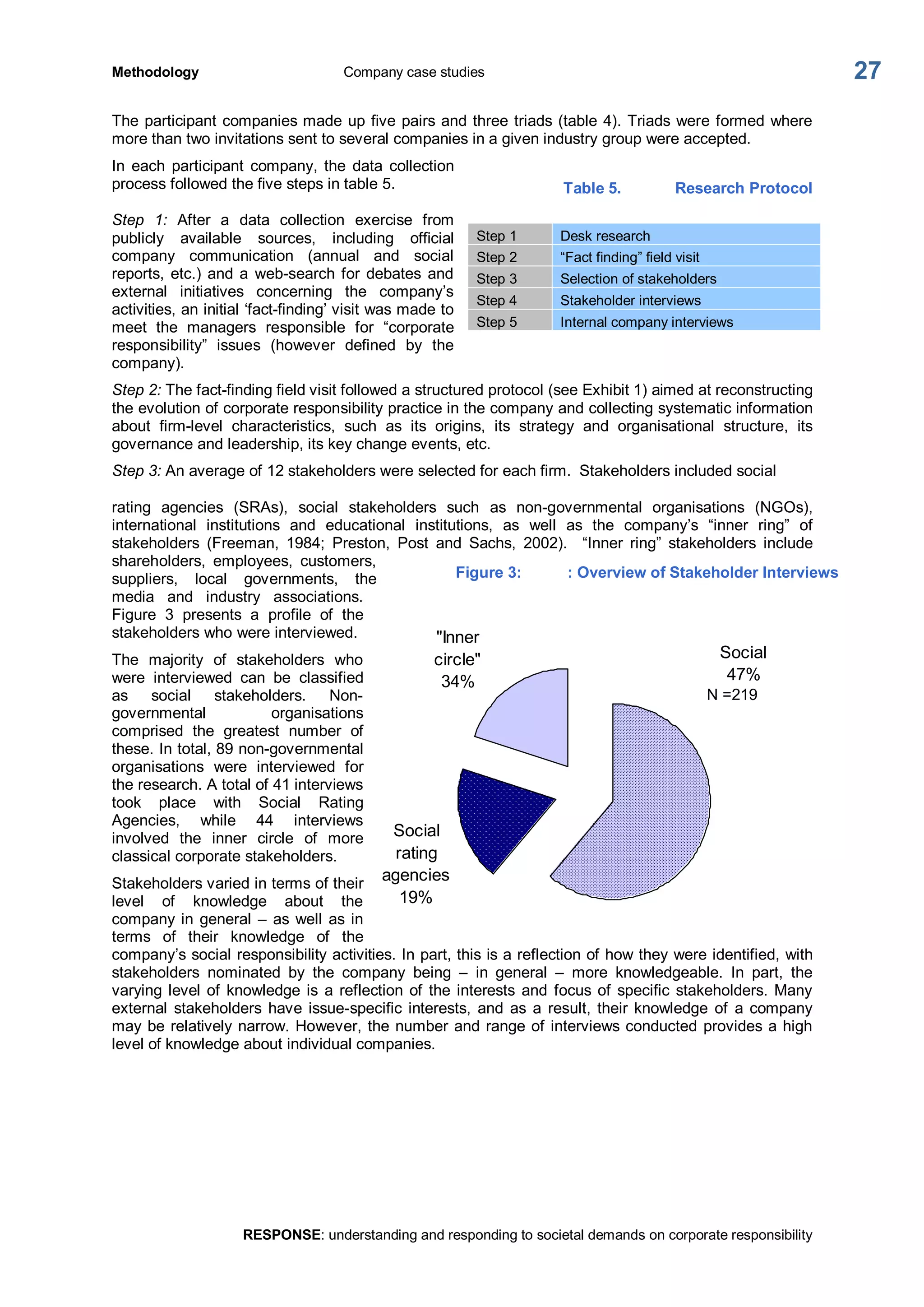
Figure 3:  : Overview of Stakeholder Interviews .......................................................................27 
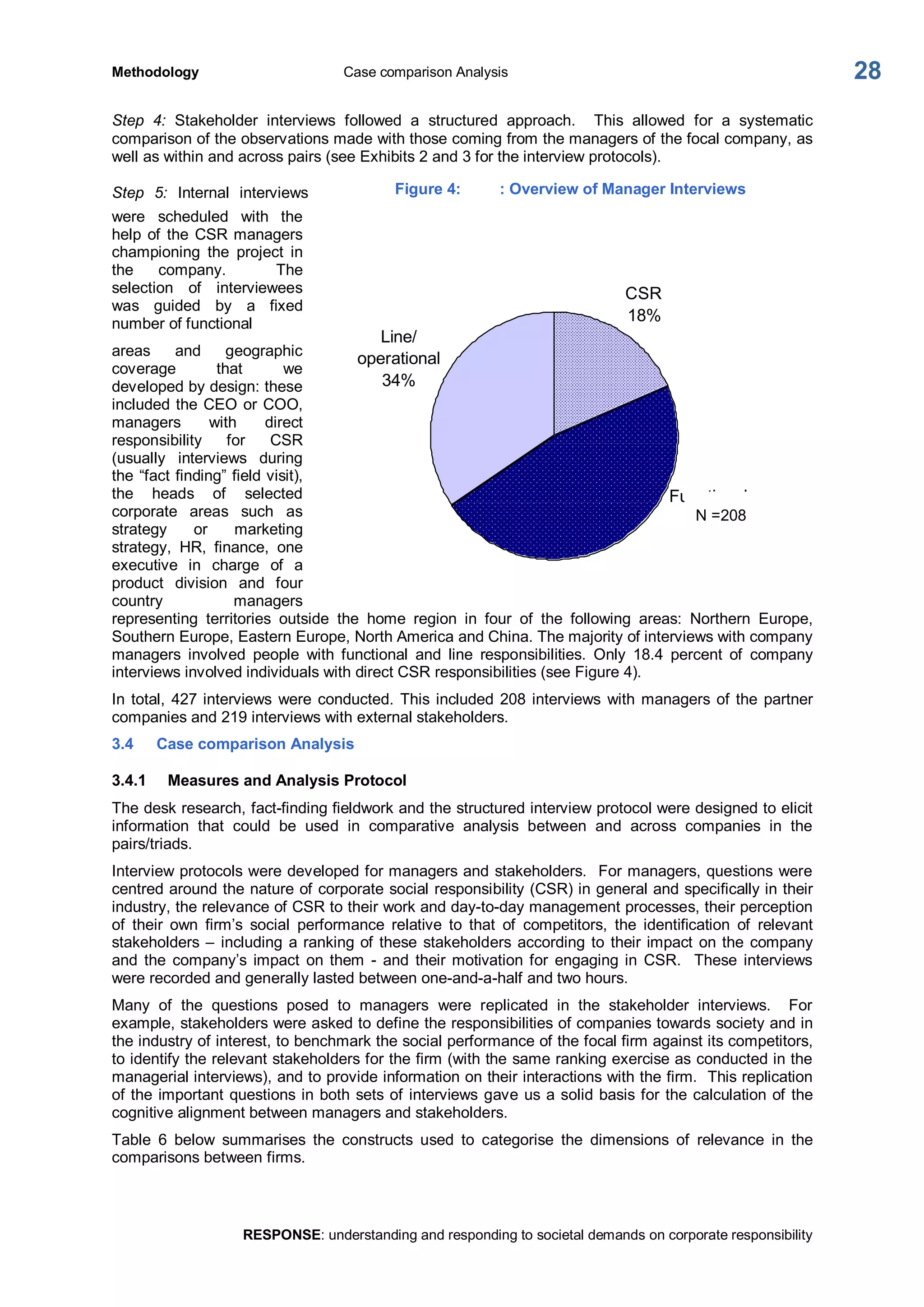
Figure 4:  : Overview of Manager Interviews............................................................................28 
Figure 5:  Frequency of CSR Issues in Managers and Stakeholders Interviews .......................35 
Figure 6:  Scope of Firms’ Social Consciousness in Managers’ and Stakeholders’ Interviews ..40 
Figure 7:  RESPONSE model..................................................................................................41 
Figure 8:  RESPONSE model..................................................................................................51 
Figure 9:  Impact of training on SRB........................................................................................60 
Figure 10:  Developing Social Consciousness and SRB ..........................................................60 
Figure 11:  Impact of learning interventions on cognitive alignment..........................................61 
Figure 12:  ‘One shot’ experimental design (pharma and IT#1 companies) ..............................65 
Figure 13:  “Cross­over” Experiment Design (IT#2 company)...................................................66 
Figure 14:  Three­Arm, Randomized, Double Control Experiment Design (Oil company)..........67
RESPONSE: understanding and responding to societal demands on corporate responsibility 
Tables 
Table 1.  Typology of factors impacting cognitive alignment.....................................................16 
Table 2.  Components of the RESPONSE model.....................................................................21 
Table 3.  Overview of CSP measures......................................................................................24 
Table 4.  Sample of 19 companies in matched pairs and triads................................................26 
Table 5.  Research Protocol....................................................................................................27 
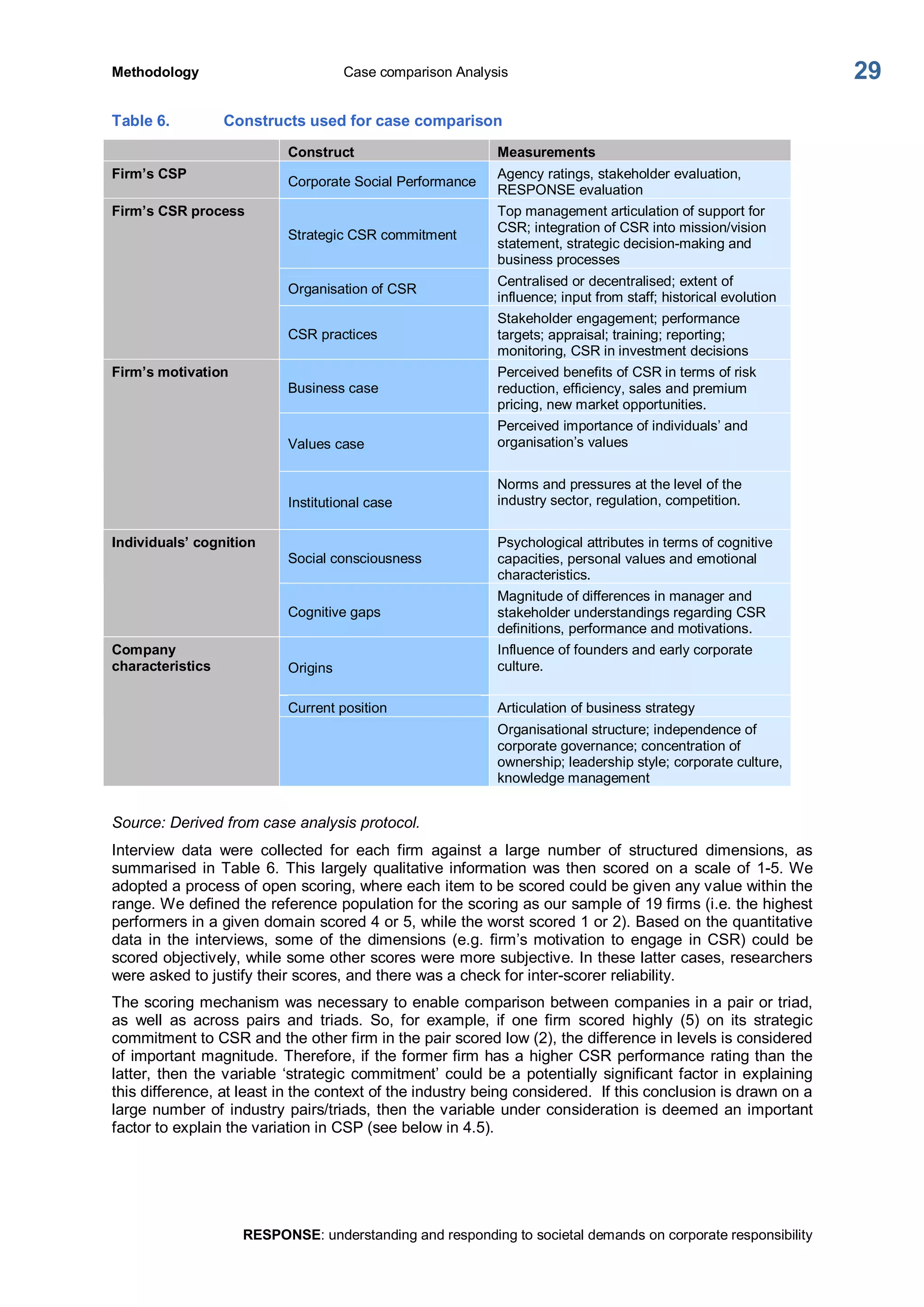
Table 6.  Constructs used for case comparison .......................................................................29 
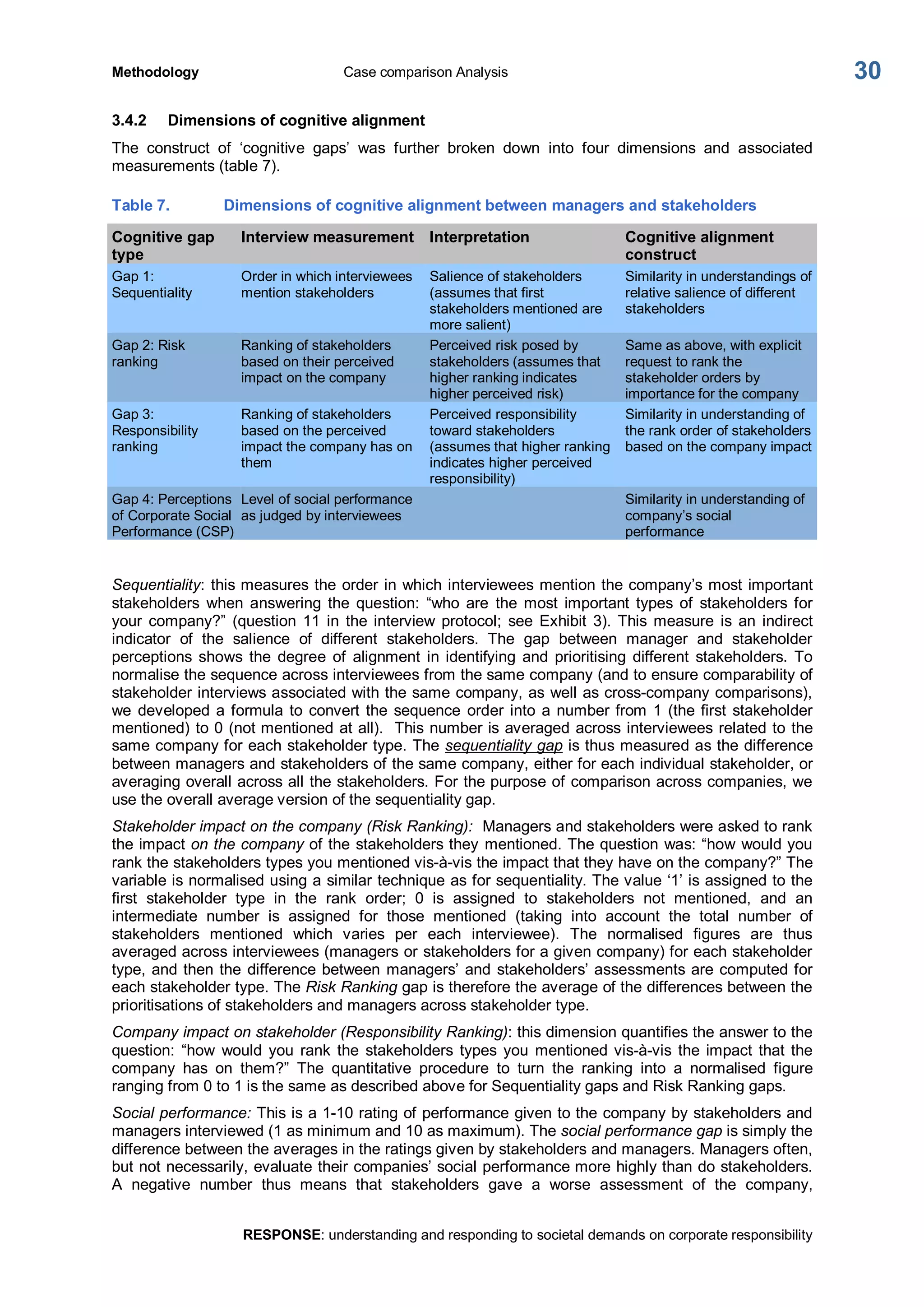
Table 7.  Dimensions of cognitive alignment between managers and stakeholders..................30 
Table 8.  : Dimensions of CSR issues......................................................................................33 
Table 9.  Gap in the Frequency of CSR Issues between Managers and Stakeholders .............35 
Table 10.  Scope of Firms’ Social Consciousness....................................................................37 
Table 11.  Variation between Managers and Stakeholders in Framing CSR.............................40 
Table 12.  Four dimensions of cognitive gaps by company ......................................................42 
Table 13.  Matched pair analysis by industry and CSP ............................................................44 
Table 14.  Average Cognitive Gaps in higher vs. lower CSP companies ..................................44 
Table 15.  Impact of External Stakeholder Pressure (ESP) on cognitive alignment...................46 
Table 16.  Impact of institutional motivation (IM) on cognitive alignment...................................47 
Table 17.  Cognitive gaps by industry......................................................................................48 
Table 18.  Cognitive gaps by geography (all companies) .........................................................49 
Table 19.  Cognitive gaps by geography (high CSP companies)..............................................50 
Table 20.  Cognitive gaps by geography (lower CSP companies) ............................................50 
Table 21.  Impact of firm origins on cognitive alignment...........................................................52 
Table 22.  Impact of corporate strategy on cognitive alignment................................................53 
Table 23.  Impact of knowledge management (KM) on cognitive alignment..............................54 
Table 24.  Impact of stakeholder engagement on cognitive alignment......................................54 
Table 25.  Impact of integration into business processes (IBP) ................................................56 
Table 26.  Relation of cognitive alignment with market opportunity motivation (NMO) ..............57 
Table 27.  Measurements of Social Consciousness and Socially Responsible Behaviour.........64 
Table 28.  Rationale and scope of the four experimental settings.............................................68 
Table 29.  Results of OLS regression of SRB types on social consciousness measures ..........70 
Table 30.  Step of the analysis calculations ...........................................................................104
Executive summary  The study 
RESPONSE: understanding and responding to societal demands on corporate responsibility 
6 
Executive summary 
The study 
In its communication of March 2006 1 
the European Commission established the objective of building 
a  stronger  partnership  between  business  and  society.  The  success  of  this  alliance,  just  like  any 
partnership, depends on the partners’ understandings of the common objectives to be achieved and 
of each partners’ specific interests and goals.  Alignment of thinking on the respective interests as well 
as  on  the  joint  ambitions  is expected  to  be  essential  to  progress  towards  effective mutual  support 
between business corporations and their societal counterparts, for the betterment of both. 
The RESPONSE project has been created and funded by the EU Commission’s D.G. Research to 
develop  knowledge  and  understanding  on  the  degree  of  alignment  between  companies  and  their 
stakeholders  about  what  corporate  social  responsibility  consists  of  within  their  specific  context 
(herethereafter  referred  to  as  “cognitive  alignment”).  In  addition,  the  study  seeks  to  assess  the 
implications of the degree of alignment for the perceptions of social performance created by corporate 
behaviour,  and  to  identify  the  internal  and  external factors  that might  influence  the variation  in the 
degree of cognitive alignment across business corporations.  Finally, the RESPONSE project aims to 
study CSR at the level of the individual manager’s behaviour, and to assess the relative effectiveness 
of  diverse  training  interventions  on  the  development  of  social  consciousness  in  managers.    The 
individuals’ understanding and sensitivity towards the social implications of their decisions and actions 
is deemed in fact to be crucial to enhancing the capacity of business organisations to respond to and 
bridge the “cognitive gaps” that separate them from their stakeholders and from society at large. 
This  3­year  research  project  was  conducted  by  a  multi­disciplinary  team  of  academic  researchers 
from a consortium of leading business schools in Europe (INSEAD, France; Copenhagen Business 
School, Denmark; Universita’ Commerciale Luigi Bocconi, Italy; Leon Kozminski Academy, Poland) 
and a training consultancy (Impact, Austria).  In addition, the RESPONSE team was fortunate to be 
able to draw on the wisdom and knowledge shared by the members of the Academic Advisory Board, 
which  includes  some  of  the  leading  thinkers  on  the  relationship  between  business  and  society. 
Finally, the project has benefited from the continuous support of, and engagement with, the European 
Academy of Business In Society (EABIS) and its corporate founding partners, in an innovative form of 
partnership between academic scholars and thoughtful practitioners. 
The evidence base accumulated during the study consists of 427 interviews related to 19 companies 
in  8  sectors,  selected  through  a  matched  pair/triad  design  aimed  at  maximizing  the  similarity  in 
product,  geography,  size  and  financial  performance,  while  maximizing  the  difference  in  social 
performance  across  companies  within  each  pair/triad.  For  each  company,  a  complex  research 
protocol was executed, including a one day in­depth “fact finding” mission, around 11 interviews with 
senior  executives  and  CSR  managers,  and  12  representatives  of  stakeholder  organizations 
2 
.  With 
respect  to  the  individual level  of  analysis, four  randomized  controlled  experiments  were  conducted 
with the collaboration of four multinational companies, involving 93 managers based in 15 locations 
worldwide,  with  the  pre­  and  post­training  assessment  conducted  via  a  web­based  questionnaire 3 
. 
Overall, the study has therefore leveraged the collaboration of over 300 managers in 20 multinational 
companies as well as representatives of 180 stakeholder organizations. 
Key Findings 
The key findings from the analysis of the collected data can be summarised as follows 4 
: 
1.  The analysis reported in Chapter 4 shows that there is a wide gap between managers’ and 
stakeholders’  understanding  of  what  constitutes  the  company’s  social  responsibilities.  In 
particular, managers seem to be tied to a fairly conservative view of corporate responsibility 
1 
Communication from the Commission to the European Parliament, the Council, and the European 
Economic and Social Committee, March 22, 2006. COM(2006) 136. 
2 
See Chapter 3 for a detailed description of the research design 
3 
See Chapter 8 for a detailed description of the design of the four experiments) 
4 
See Chapter 10 for a more detailed elaboration
Executive summary  Recommendations 
RESPONSE: understanding and responding to societal demands on corporate responsibility 
7 
characterised primarily by refraining from negative impacts (“do no harm”), rather than a pro­ 
active attempt to have a positive impact on society (“do good”).  Moreover, managers exhibit 
a relatively narrow consciousness of their company’s responsibility defined by the legal and 
moral  boundaries  while  stakeholders  have  a  broader  notion  of  an  expanded  enterprise 
including and integrating the interests of wider stakeholders and society as a whole. 
2.  Chapter  4  also  shows  evidence  in  support  to  our  hypothesis  related  to  the  link  between 
cognitive alignment and the perceptions of social performance.  The size of the gap (the lack 
of alignment) is indeed associated with lower social performance. 
3.  Chapter 5, then, reports evidence related to the influence of external factors on the degree of 
cognitive alignment, which includes the following results: 
­  Industry  dynamism:  more  dynamic  industries  (e.g.  high­tech)  are  associated  with 
better alignment 
­  Regional  dynamism:  more  dynamic  regions  (e.g.  Anglo­saxon  countries)  are 
associated with better alignment 
­  Pressure from external actors: the larger the pressure, the higher the alignment 
4.  In Chapter 6, the key internal factors influencing the degree of alignment are analysed and 
the  results  reported.    In  particular,  we  find  the  following  dimensions  to  distinguish  the 
companies with higher cognitive alignment from the others: 
­  Business strategy: firms adopting a differentiation strategy is associated with higher 
alignment, compared to firms choosing to compete with a cost­minimization strategy 
­  CSR  initiatives:  firms  prioritizing  internal  change  initiatives  (adapting  incentives, 
resource  allocation,  operating  processes,  etc.)  to  external  stakeholder  engagement 
processes show higher cognitive alignment 
­  Motivation:  firms  motivated  by  an  innovation­driven  business  case  show  higher 
alignment  compared  to  firms  motivate  by  organizational  values  or  other  types  of 
business case arguments (risk reduction, cost efficiency, sales or margin growth) 
5.  Part 2 of this report focuses on one important way to bridge the gap between managers’ and 
stakeholders’  understanding and behaviour: training/coaching programs. The results of the 
first field experiments on CSR training effectiveness ever attempted, reported in Ch. 9, show 
that: 
­  The standard executive education approach based on engaged discussions and case 
analyses  fails  to  facilitate  managers  to  shift  towards  higher  probabilities  to  make 
socially responsible decisions. 
­  On  the  other  hand,  coaching  programs  based  on  introspection  and  meditation 
techniques, without any discussion about CSR topics, exhibit a significant impact on 
both  the  probability  to  act  in  a  socially  responsible  way  and  on  the  factors  that 
influence the probability to behave that way 
­  Even  a  second  “non­orthodox”  training  intervention,  based  on  “hatha  yoga” 
techniques  (postures,  relaxation,  etc.),  produces  a  positive  impact  on  socially 
responsible  behaviour  and  on  some  of  its  psychological  antecedents,  however 
generally not as strong and diffused as the meditation­based coaching program. 
Recommendations 
The  recommendations  for  all  the  various  audiences  to  which  the  RESPONSE  project  speaks  are 
presented in Chapter 11.  The most important of them are briefly reported below. 
For business leaders 
Faced  with  significant  growing  expectations  from  society  on  their  role  in  the  development  and 
(possibly) the solution of social and environmental issues, companies have so far primarily responded 
by  developing  external  engagement  practices  to  better  understand  and  manage  the  risks  and  the 
opportunities associated with their social contract.  However, the findings of the RESPONSE project
Executive summary  Recommendations 
RESPONSE: understanding and responding to societal demands on corporate responsibility 
8 
indicate  that  significant  gaps  exist  between  managers  and  their  stakeholders  in  their  respective 
understanding of the role and responsibilities for environmental and social issues, primarily driven by 
internal  strategic  positioning  and  resource  allocation  choices.  The  data  also  shows  a  clear  link 
between  the magnitude  of  the  gaps  and  the  perception  of  social  performance that  the company is 
associated with. 
To address these gaps and enhance social performance, corporate executives and CSR managers 
need to redress the balance between external engagement and internal change initiatives in favour of 
the  latter.  This  includes  building  a  platform  of  both  sensing  and  change  capacities  at  the 
organisational and the individual levels through innovative and effective learning processes. 
Therefore, to drive social performance, executives and managers are advised to focus their attention 
on the following points: 
1.  Recognize the existence, the importance and the consequences of the gap in understanding 
the nature of their company’s social responsibility. 
2.  Shift  the  focus  of  CSR  activities  from  external  engagement  processes  towards  internal 
change  initiatives  aimed  at  adapting  strategic  and  operating  routines,  developing  change 
capabilities  and  enhancing  managerial  sensitivities  to  the  social  and  environmental 
implications of their decisions and actions. 
3.  HR managers might consider re­designing internal and external training programs to move 
beyond  awareness  building  and  towards  the  development  of  social  consciousness  in 
managers and employees. 
4.  CSR managers could strengthen their (hitherto peripheral) role within the company’s power 
structure  by  forging  an  innovative  type  of  partnership  with  external  stakeholders  aimed  at 
identifying and supporting the internal change processes that are required for a successful 
integration  of  corporate  responsibility  principles  in  the  operating  activities  and  strategic 
decision­making processes.  This is a significant departure from the current framing of the 
stakeholders’ engagement process as a dialogue exercise aimed, in the best case, at joint 
external initiatives. 
For stakeholder representatives 
The data analysed by the RESPONSE team also has specific implications for several categories of 
stakeholders, as they deal in their own domain with business managers. 
1.  Social Rating Agencies (SRAs) could reflect on the results of this project to re­design their 
methodologies  for  the  assessment  of  corporate  social  performance.    Much  more  attention 
should  be  devoted  to  the  evaluation  of  internal  change  processes,  and  the  reliance  on 
corporate communication and non­validated web­based information correspondingly reduced. 
2.  Social pressure groups (NGOs) might also reflect on the need to invest in their knowledge 
and understanding of the internal operations and change processes in the companies they 
are dealing with.  On the other hand, the data shows that their increasing scepticism towards 
corporations  offering  collaboration  in  external  engagement  initiatives,  rather  than  in  deep 
internal change processes, is justified. 
3.  Other  “inner  circle”  stakeholders  (employees,  customers,  suppliers,  financiers  and 
communities) are encouraged by the findings of the project to strengthen their voice and role 
as actors of the internal operating processes within the corporations that they deal with, and 
to avoid the “wait and see”, detached, attitude typical of transaction­ rather than relationship­ 
oriented processes. 
For management education institutions 
The  experimental  components  of  the  RESPONSE  project  point  to  the  need  to  reconsider  the 
approach taken in dealing with the core issue of developing managerial skills and sensitivities related 
to the impact of decisions and actions on the social context in which companies operate.  Whereas 
the  pedagogical  designs  currently  implemented  in  business  schools,  corporate  universities  and 
executive  training  centers  might  suffice  in  raising  managerial  awareness  of  the  multiplicity  and 
complexity  of  the  issues  at  stake,  they  might  fall  short  of  the  objective  to  develop  a  deep 
consciousness of the social role and responsibilities that managers carry in their daily activities.  The
Executive summary  Recommendations 
RESPONSE: understanding and responding to societal demands on corporate responsibility 
9 
likelihood  of  seeing  socially  responsible  behaviour  (particularly  of  a  pro­active,  “do  good”,  kind) 
emerge and becoming part of the fabric of the organisation depends on how effectively the evolution 
of personal values, emotional traits and decision­making processes is facilitated during internal and 
external managerial education efforts. 
The evidence emerging from the RESPONSE learning experiments shows that a coaching approach 
based on the practice of deep introspection and meditation techniques, without any mention of CSR 
concepts  or  cases,  can  succeed  in  shifting  psychological  traits  and  personal  values  towards 
increasing  levels  of  social  consciousness,  and  therefore  towards  increasing  likelihood  of  socially 
responsible behaviour to emerge spontaneously and diffuse throughout the organisation. 
For future academic research 
We believe that the findings of the RESPONSE project hold multiple implications of interest for future 
research on the relationship between business and society, from both a process and a content point 
of view.  For what concerns the content of future research the key indications can be summarised as 
follows: 
1.  CSR Cognition.  The results show for the first time how important cognition is in explaining the 
characteristics of the CSR process as well as the quality of its outcomes.  Future research could 
build  on  these  initial  findings  to  further  understand  (a)  how  managerial  and  stakeholders’ 
understanding about corporate responsibility can be measured and validated, (b) how it evolves 
over time, (c) how it shapes the way firms behave and (d) what outcomes it generates in terms of 
social and financial performance. 
2.  CSR Integration.  The integration of CSR principles and processes within operating routines and 
strategic decision­making is another area in which the RESPONSE data suggests future research 
should  study  more  in  depth.    How  is  that  integration  really  happening  within  business 
organisations?    What  are  the  barriers  and  the  enabling  factors  for  its  successful  realisation? 
What are the outcomes to expect in terms of social and financial performance and what factors 
might influence the quality of the outcomes? 
3.  The Individual Level.  RESPONSE has also highlighted in both theoretical and empirical terms 
the need to study CSR not only as an organisational process but as an individual behaviour.  We 
trust future scholars will build on these initial insights to further our understanding of the factors 
explaining  socially  responsible  behaviour  in  managers,  as  well  as  of  the  outcomes  for  the 
organisation and for society. 
4.  Learning  CSR.    The  last  area  where  we  feel  RESPONSE  has  broken  new  ground  for  future 
scholarship  to  advance  is  the  assessment  of  learning  processes  at  both  the  individual  and 
organisational levels of analysis.  Whereas the learning experiments have shown the feasibility 
and  the  importance  of  studying  different  approaches  to  the  problem  of  developing  social 
consciousness in managers, this study has not been able to evaluate with the desired precision 
the impact of knowledge development and diffusion processes at the organisational level.  We 
trust future scholars will be willing and able to make new inroads on this crucial quest to explain 
how firms develop competencies specific to the management of their social responsibilities. 
The implications of our experience for the design of future projects in this domain are, in our view, 
equally important: 
1.  Matched­Pair Sampling. We consider the matched­pair design implemented in RESPONSE to 
be one of the strengths of the study.  Empirical research in the Business & Society domain has 
been characterized so far by the study of a small number of companies, typically selected in an 
ad­hoc way on the basis of prior relationships.  We have tried to go beyond that limited design 
and have paid the price of a much more complex and uncertain recruitment process.  The fact 
that we have been able to complete the study, in all its limitations, with a solid sampling method 
should be an encouraging sign for future scholars in this field of work. 
2.  Experimental Design. The other innovative design successfully implemented in this study is the 
use  of  randomised  controlled  trials  to  measure  the  effect  of  training  interventions  on  the 
psychological  profile  and  behaviour  of managers.    Conducting  this  rather  intrusive  design  with 
practicing  managers  in  their  own  normal  working  environment  (i.e.  outside  of  the  standard
Executive summary  Recommendations 
RESPONSE: understanding and responding to societal demands on corporate responsibility 
10 
laboratory  conditions)  on  a  sensitive  subject  such  as  CSR  and  with  some  non­orthodox 
intervention techniques (such as meditation practices) gives comfort in the possibility of running 
cutting  edge  research  and  developing  the  highest  quality  of  knowledge  (comparable  to  that 
published in natural science journals) in this area of social science research. 
3.  Research Co­Development with Businesses and Stakeholders. One of the key factors for the 
successful implementation of both the matched pair sampling as well as the experimental designs 
lies  in  the  presence  of  multiple  established  relationships  and  cooperative  agreements  that  the 
research team has been able to leverage with corporations, especially the founding partners of 
the European Academy of Business In Society (EABIS), and with some of the key stakeholders 
(leading social rating agencies, NGOs, etc.).  This new model of social science research, based 
on  the  active  collaboration  with  the  “subjects”  of  the research  throughout  all the  phases  of  the 
process, from the initial formulation of the questions to pursue all the way to the dissemination of 
results,  offers  important  indications,  in  our  opinion,  for  future  scholars  in  this  area  on  how  to 
maximize their chances of success in complex, and politically charged, fields of study (see below 
for some related recommendations for policy­making and research funding institutions). 
For policy­makers 
A few key implications for policy­making institutions stemming from the results of the analysis ought to 
be carefully considered: 
1.  Internal  Change  Processes. The  definition  of  CSR  introduced  by  the  EU  Commission’s  white 
paper  in  2001  mentions  both  the  integration  of  CSR  in  the  operations  and  the  stakeholder 
engagement processes as constitutive elements of the concept itself.  The application in business 
firms  has  so  far  prioritised  the  stakeholder  engagement  component  to  the  detriment  of  the 
integration objective 5 
.  An important indication for future policy development could be, therefore, 
to  invite  enterprises  to  apply  the  definition  of  CSR  to  the  full  extent  of  its  meaning  and 
significance,  focusing  on  the  internal  change  processes  necessary  to  realise  the  integration 
objectives.  This will also help the alignment between the rhetoric (strongly developed in external 
stakeholder engagement initiatives) with the reality of concrete change in business conduct. 
2.  The Role of Business Strategy.  Given the importance of the company’s choices on how to 
compete  in  product  markets  for  the  likelihood  of  alignment  with  stakeholder  expectations,  we 
propose to extend the definition of the concept of CSR to include the integration of CSR in the 
decision­making  processes  and  outcomes  (major  resource  allocations,  pricing  strategies, 
corporate growth initiatives, market entries and exits, etc.) that characterise and shape the way 
the company competes on the markets of choice.  The definition of CSR could therefore be edited 
as follows: 
“CSR is a concept whereby companies integrate social and environmental concerns in their 
strategic  decision­making  processes,  in  their  business  operations  and  in  their  interaction 
with their stakeholders on a voluntary basis” 
3.  A New Role for the Partnership between Business and Society.  The recent initiative by 
the EU Commission towards the establishment of a partnership between business and society to 
enhance the quality of their mutual understanding, of their multiple interactions and ultimately of 
both  of  their  development  and  growth.  Our  suggestion  is  to  articulate  and focus  the  concrete 
outcomes of the partnership on the facilitation of a profound change process inside both business 
corporations and their societal counterparts.  We indicate the elements and the key steps of the 
mutually supported change and adaptation program in the final part of Chapter 11. 
4.  A New Way to Conduct Research on Business & Society.  Related to the previous point, 
RESPONSE has also demonstrated a new way in which academic research can be conducted in 
this field.  The cooperation between corporations, global stakeholders and scholars through all the 
phases of the research has yielded important results, despite the increased coordination costs, 
particularly  in  terms  of  achieving  a  fruitful  balance  between  academic  rigor  and  managerial 
5 
See to this end the results of the RARE project, funded by the EU Commission in the context of the 
6 th 
Framework Program
Executive summary  Recommendations 
RESPONSE: understanding and responding to societal demands on corporate responsibility 
11 
relevance.  We see this as the foundation of a new model for conducting academic research in 
this area, and suggest policy­makers and research funding agencies to take this experience into 
account  as  they  search  for  ways  to  enhance  the  quality  of  future  research  endeavours.    The 
existence and pursuit of a stable relationship and commitment to cooperation between research 
centres, business corporations and key stakeholders might be viewed as a necessary condition, 
and  recognised  as  such,  for  the  development  of  research  plans  that  can  aspire  to  real 
breakthrough results with both academic as well as managerial audiences.
Introduction  This report 
RESPONSE: understanding and responding to societal demands on corporate responsibility 
12 
1  Introduction 
1.1  This report 
The  RESPONSE  project  is  a  three­year  study  into  the  alignment  of  society’s  expectations  with 
managers’ understandings of their companies’ responsibilities towards society. It therefore examines 
the practices of Corporate Social Responsibility (CSR), as defined by the European Commission in its 
July 2001 Green Paper, July 2002 Communication (the so­called ‘White Paper’),  and its March 2006 
Communication to the European Parliament: 
“Corporate Social Responsibility (CSR) is a concept whereby companies 
integrate social and environmental concerns in their business operations 
and in their interaction with their stakeholders on a voluntary basis. It is 
about enterprises deciding to go beyond minimum legal requirements… in 
order to address societal needs.” 6 
Mutual trust is essential if business and stakeholders are to form a strong and lasting alliance that can 
produce the expected outcomes of combined social cohesion and economic development set by the 
Lisbon  Agenda.  Trust,  in  turn,  depends  on  the  cultivation  of  common  understandings  between  the 
parties and a commitment to work towards similar goals. The critical goal to mitigate climate change, 
for example, demands that all parties in an alliance of business and society are able to reach rapid 
agreement on priorities and consequent plan of action. 
Differing cognitive perspectives on the part of managers and stakeholders delay coherent action and 
therefore threaten the success of the alliance between business and society at its foundation. 
1.2  Understanding and developing ‘cognitive alignment’ 
Taking a multi­disciplinary, multi­level approach, RESPONSE has examined in detail both the internal 
and  external  factors  that  affect  the  perspectives  of  managers  and  stakeholders.  Internal  factors 
include: firms’  CSR­specific initiatives,  their motivations to  engage  in  those  initiatives,  and  a  firms’ 
characteristics (their  origin,  strategy,  structure, leadership,  etc.)  as  well  as the  values  and  traits  of 
individual  managers.  External  factors  include  the  influences  of  industry  and  regional  contexts,  the 
pressure of external constituencies, and the presence of generally accepted social norms. A range of 
stakeholders were interviewed, including international NGOs, local and industry­specific organisations 
such as the media and customer associations, and Social Ratings Agencies. 
Whereas  previous  empirical  research  has focused  on  the  role  of firm motivation  ­ for  example the 
implications  of  the  ‘business  case’  and  ‘values  case’  in  driving  CSR  strategy  ­  RESPONSE  sees 
cognitive alignment between managers and stakeholders as an important determinant of outcomes. 
Only when all parties frame their thinking about society’s problems in similar ways can a mechanism 
for  cooperation  develop.  A  model  that  encompasses  both  factors  –  cognition  and  motivation  ­  is 
therefore necessary. 
By  quantifying  the  extent  of  cognitive  alignment  in  different  contexts  this  study  is  able  to  expose 
patterns in their causes and impacts. The most persistent of these are then extrapolated to form the 
basis  of  recommendations  for  enhancement  of  the  relationship  between  business  and  society. 
Additionally, the results of an experimental study suggest how firms and educational institutions can 
enhance their approaches to CSR training programmes to cultivate in managers the values and the 
psychological traits that underpin socially responsible behaviour. 
Specific  recommendations  are  provided  for  business  managers,  stakeholder  representatives  and 
policy  makers  working  to  bring  business  and  society  closer  together  and  to  foster  a  climate  of 
collaboration. The outcomes thus inform the work  of the European Commission to make Europe  a 
“pole of excellence” on CSR. In addition, the multi­disciplinary approach of RESPONSE supports the 
principles of the European Research Area in challenging traditional silos of research. 
In summary, this research supports the view that the goals of growth, inclusion and sustainability are 
not mutually exclusive, but mutually reinforcing. It is therefore in line with the Lisbon Agenda to create 
6 
Communication from the Commission to the European Parliament, the Council, and the European 
Economic and Social Committee, March 22, 2006. COM(2006) 136.
Introduction  Aims of this study 
RESPONSE: understanding and responding to societal demands on corporate responsibility 
13 
“the most competitive and dynamic, knowledge­based economy in the world capable of sustainable 
economic growth with more and better jobs and greater social cohesion.” 
1.3  Aims of this study 
The  first  objective  addresses  the  well­known  problem  related  to  the  definition  of  Corporate  Social 
Responsibility (CSR). The theoretical argument is that there is a fundamental problem associated with 
the  cognitive  interpretation  of  societal  demands  on  the  part  of  business  organisations  and  their 
leaders. This belief enables us to go beyond the current state of affairs that tends to focus on  the 
variation related to the institutional environment, the industrial sector and the historical development of 
the corporation. Companies might have a hard time making a correct representation of what is being 
asked of them, partly because of the large number of different, and sometimes inconsistent, signals 
they receive from different stakeholders, but also partly because of the limited attention they pay in 
teasing out the issues. 
In order to study this problem, the first goal of the project was to assess at a fundamental level what 
large corporations understand as their duties towards society in the different cultural contexts in which 
they operate. To this end we surveyed how they actually define their social responsibilities, and (most 
importantly) to what degree their definition differs from that offered by their societal counterparts.  The 
measurement  of  societal  counterparts’  assessment  of  the  companies’  responsibilities  and  of  the 
degree to which they are aligned is a core component of this part of the study. 
SMART  Objective  1  (Chapter  5):  Understand  how  large  corporations  define  their  social 
responsibilities,  and  to  what  degree  their  definition  differs  from  that  offered  by  their  stakeholders. 
Study particularly the impact of regional and industry contexts on the type and magnitude of these 
discrepancies  (thereafter  referred  to  as  ‘cognitive  gaps’,  or  in  the  positive  sense  as  ‘cognitive 
alignment’). 
Since the initial proposal, RESPONSE has addressed an additional objective, related to the above, 
that  seeks  to  assess  the  impact  of  these  discrepancies  on  the  perceptions  of  the  firm’s  social 
performance: 
§  Objective 1b: (Section 5.4) Assess the impact of cognitive alignment on the perception 
of the firm’s social performance. 
Also, the impact of regional and industry contexts are considered part of the external factors that are 
addressed in SMART Objective 2. 
In the second step we study how external factors affect the cognitive alignment. 
SMART  Objective  2  (Chapter  6):  Understand  how  external  factors  such  as  the  firm’s  institutional 
environment, the strength and influence of advocacy groups and type of industry affect the perceived 
social risk to its normative legitimacy. 
Subsequent  to  the  initial  proposal,  we  have  developed  a  framework  that  calls  for  a  broader 
assessment of external factors and a definition of the objective of the analysis focused on cognitive 
alignment;  this  is  in  line  with  the  other  research  objectives  and  the  overarching  goal  of  the  work. 
Hence, we aim to understand how external factors such as the firm’s institutional environment (the 
strength  and  influence  of  advocacy  groups  and  the  overall industry  regional  context)  influence  the 
cognitive alignment between managers and stakeholders on the content of CSR. 
Our third objective assesses how factors internal to the firm influence the cognitive alignment of its 
executives and stakeholders. 
SMART Objective  3  (Chapter  7):  Understand  how  a firm’s management  of  knowledge  –  including 
stakeholder­engagement and learning processes, and the role of CSR departments ­ influences its 
ability to interpret and respond to society’s demands. 
Since the initial proposal, we have broadened the conceptual and empirical definition of the internal 
factors  beyond  the  knowledge  management  processes,  to  include  other  potentially  relevant 
characteristics of the firm, such as origins, strategy, structure and leadership. 
Empirically, the study draws on the qualitative analysis of cases to support SMART Objectives 1, 2 
and  3  (see  Chapter  4  for  the  methodology).    A  portion  of  the  structured  interviews  in  each  of  the 
selected  companies  is  dedicated  to  the  assessment  of  how  information  is  gathered  within  the 
participating  company,  how  it  is  transformed  in  applicable  knowledge  and  then  put  into  practice 
throughout the organisation.
Introduction  Structure of the report 
RESPONSE: understanding and responding to societal demands on corporate responsibility 
14 
SMART  Objective  4  (Chapter  8):  Test  the  degree  to  which  training  techniques  can  develop 
managers’  social  consciousness  in  order  to  produce  socially  responsible  behaviour  and  decision 
making. 
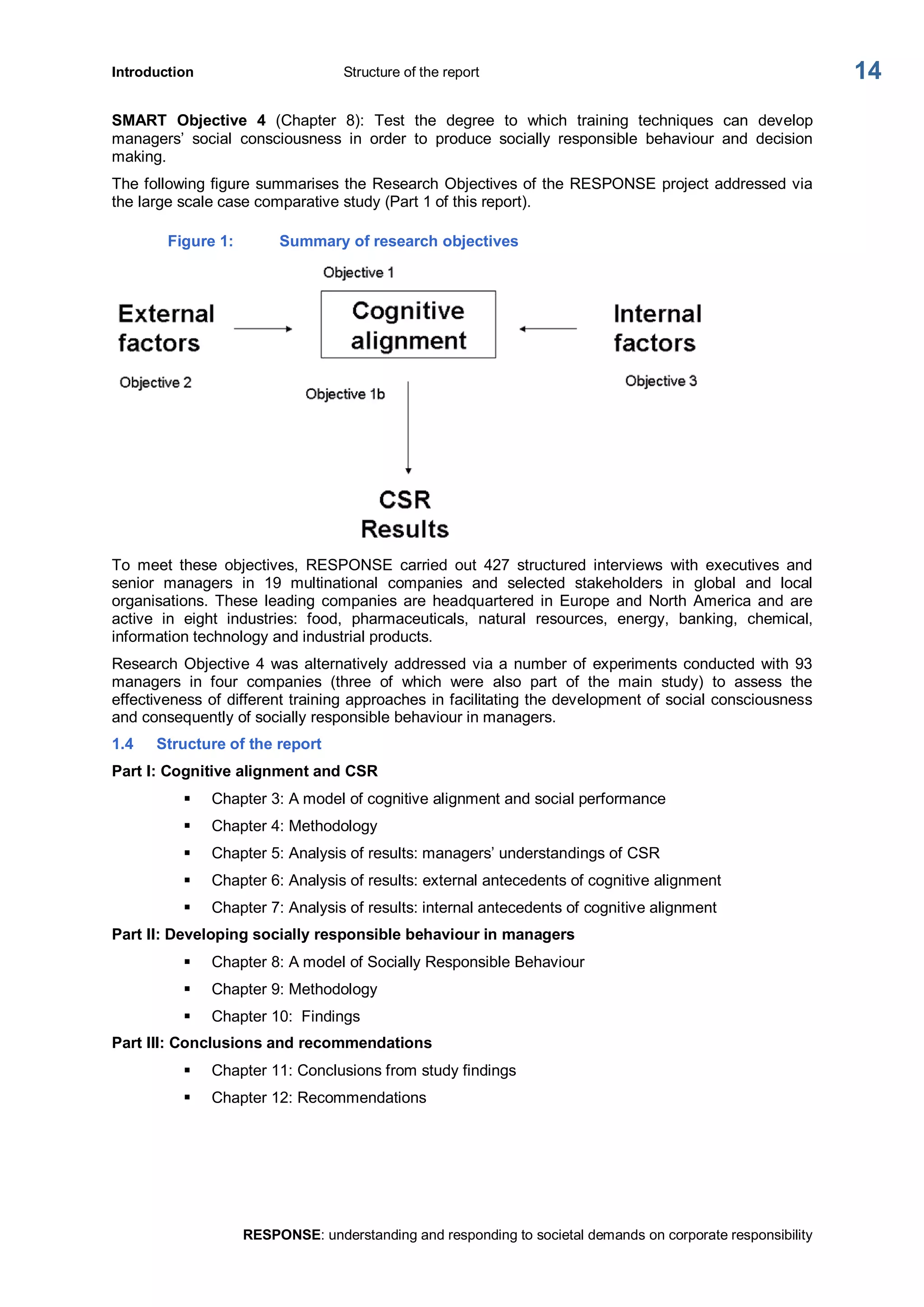
The following figure summarises the Research Objectives of the RESPONSE project addressed via 
the large scale case comparative study (Part 1 of this report). 
Figure 1:  Summary of research objectives 
To  meet  these  objectives,  RESPONSE  carried  out  427  structured  interviews  with  executives  and 
senior  managers  in  19  multinational  companies  and  selected  stakeholders  in  global  and  local 
organisations.  These  leading  companies  are  headquartered  in  Europe  and  North  America  and  are 
active  in  eight  industries:  food,  pharmaceuticals,  natural  resources,  energy,  banking,  chemical, 
information technology and industrial products. 
Research Objective 4 was alternatively addressed via a number of experiments conducted with 93 
managers  in  four  companies  (three  of  which  were  also  part  of  the  main  study)  to  assess  the 
effectiveness of different training approaches in facilitating the development of social consciousness 
and consequently of socially responsible behaviour in managers. 
1.4  Structure of the report 
Part I: Cognitive alignment and CSR 
§  Chapter 3: A model of cognitive alignment and social performance 
§  Chapter 4: Methodology 
§  Chapter 5: Analysis of results: managers’ understandings of CSR 
§  Chapter 6: Analysis of results: external antecedents of cognitive alignment 
§  Chapter 7: Analysis of results: internal antecedents of cognitive alignment 
Part II: Developing socially responsible behaviour in managers 
§  Chapter 8: A model of Socially Responsible Behaviour 
§  Chapter 9: Methodology 
§  Chapter 10:  Findings 
Part III: Conclusions and recommendations 
§  Chapter 11: Conclusions from study findings 
§  Chapter 12: Recommendations
PART I: CSR AND COGNITIVE ALIGNMENT  Structure of the report 
RESPONSE: understanding and responding to societal demands on corporate responsibility 
15 
PART I: CSR AND COGNITIVE 
ALIGNMENT
A model of cognitive alignment and social performance  Objectives and the state of the art 
RESPONSE: understanding and responding to societal demands on corporate responsibility 
16 
2  A model of cognitive alignment and social performance 
2.1  Objectives and the state of the art 
2.1.1  Objectives of the study 
The overarching aim of this study is to understand the factors that contribute to cognitive alignment in 
order that business and policy makers can optimise the performance of CSR strategies. To do so, an 
explanation is needed of the nature of differences that arise between the cognition of managers and 
stakeholders. This aim is encapsulated in the original RESPONSE proposal as Objective 1: 
“[to]  understand  how  large  corporations  all  over  the  world  define  their  social 
responsibilities, and to what degree their definition differs from that offered (implicitly 
or explicitly) by their stakeholders.” 
For example, which issues do managers identify as important in order to maintain or improve their 
company’s relationship with society? Do stakeholders identify the same or different issues? Do they 
order their priorities similarly or with reference to differing short­ and long­term objectives? 
This  study  also  investigates  the  key  causes  of  cognitive  misalignment  and  the  consequences  for 
corporate social performance. These various factors are classified according to whether they originate 
from sources external or internal to the firm. This simple typology corresponds to the Objectives 2 and 
3 respectively of the RESPONSE proposal (table 1). The two categories are further operationalised 
into component constructs that are explored during structured interviews conducted  with managers 
and stakeholders (see Chapter 4: Methodology). 
Table 1.  Typology of factors impacting cognitive alignment 
Constructs 
Level of 
impact 
Proposal 
objective 
Factors external to the firm  Perceived social risk 
§  Institutional conditions 
§  Advocacy groups 
§  Sector norms 
§  Firm behaviour 
Globalisation 
National cultural norms 
Legal and regulatory framework 
Firm’s 
environment 
Objective 2 
Firm origins 
Business strategy 
Organisational structure 
Organisational change 
Knowledge management 
Organisational values 
Firm Factors internal to the firm 
Individual values  Individual 
manager 
Objective 3
A model of cognitive alignment and social performance  Objectives and the state of the art 
RESPONSE: understanding and responding to societal demands on corporate responsibility 
17 
Judging  by  textbook  examples,  CSR  offers  a  win­win  situation  for  both  companies  and  society. 
Companies see an advantage in CSR because it prevents them from public regulation and pressure 
from various stakeholders, whereas society sees an advantage in self­regulation because it results in 
social  and  environmental  standards  that  exceed  the  requirements  of  government  regulation  (K. 
Kollman, A. Prakash 2001), (M. E. Porter, C. van der Linde 1995). 
Unfortunately,  the  perfect  harmony  between  profitability  and  social  and  environmental  awareness 
might not be as obvious as it appears in the literature of successful case stories (S. S. Hussain 1999). 
This goes well beyond the current state of the empirical literature on the correlation between social 
and  financial  performance,  which  still  shows inconsistent  results (D.  A. Whetten  et  al.  2003).   The 
problem is in the failure of the current literature to take into consideration the dynamics of the strategic 
interaction between the corporation and the constituencies it deals with. Social pressure groups, for 
example, might take a variety of positions vis­à­vis the business corporations, selecting from a (yet 
unknown) menu of strategic alternatives. The response of the corporation to simultaneously deal with 
several pressure groups in different cultural contexts and on different themes represents a complex 
strategic  problem  that  has  not  been  given  sufficient  attention  neither  in  the  CSR  literature,  nor 
(surprisingly) in the business strategy one. 
2.1.2  State of the art: interpreting CSR 
The majority of research within the field of CSR has focused on what societal demands on corporate 
behaviour  is  or  should  be.    The  question  of  what  companies  perceive  social  demands  upon 
themselves  to  be  and  what  explains  the  eventual  gap  between  these  two  sets  of  perceptions  has 
been left largely unresearched. The main task of Objective 1 is to begin filling this gap in our current 
understanding. 
In  the  last  50  years,  research  in  CSR  has  increased  exponentially  (A.  B.  Carroll,  A.  K.  Buchholtz 
1999;W. Frederick 1960). In the early 1950s, discussions focused primarily on the responsibilities of 
corporations versus governments. This was an important era in the development of the welfare state. 
Later, environmental responsibility became a major issue on the public agenda. From the early 1990s, 
however,  industrialised  countries  witnessed  a  revival  of  the  broader  CSR  concept,  which  includes 
elements of working conditions, child labour, union rights, training and technical assistance, gender 
issues, etc. One of the driving forces behind this development has been the globalisation of economic 
activities,  which  proved  to  be  the  trigger  of  both  positive  and  negative  social  and  environmental 
impacts (see e.g. (P. Christmann, G. Taylor 2001); (M. Halme et al. 2002); (R. Jenkins 2001); (M. W. 
Hansen 1995); (M. Hopkins 1997). 
Practitioners have also adopted the concept of CSR. Today companies embrace the language of CSR 
and  take  measures  to  reform  management  systems  to  make  them  more  responsive  to  the 
environmental and social concerns of different stakeholders (P. Utting 2000). Moreover, a number of 
business associations and international organisations (e.g. the World Bank, OECD, ILO, EU and UN) 
have launched CSR­related initiatives. 
The  emerging  consensus  seems  to  point  towards  a  notion  of  CSR  that  goes  significantly  beyond 
philanthropic  giving  in  the  community,  when  profits  are  good,  and focuses  on  responsible  decision 
making and practice in all business activities. This includes core processes such as strategic planning 
and risk review, marketing and advertising, public relations, HR policies, auditing and reporting, and 
ensuring social justice across the supply chain (Freeman, 1984; Greenley and Foxall, 1997; Mitchell, 
Agle et al., 1997; Gantreau and Kleiner, 2001; Starkey and Madan, 2001; (R. Welford et al. 1998)). 
Moreover, firms today are required to be responsive to broader concerns increasingly expressed by 
public  interest  groups.  This  approach  necessitates  looking  beyond  the  immediate  demands  of 
shareholders, to include a focus on stakeholder interests 7 
. This is why most of the literature on CSR 
seems  to  be  inspired  by  stakeholder  theory,  in  which  the  company  is  seen  as  a  coalition  of 
stakeholders,  which affect and in turn are affected by the actions of an organisation (A. Kolk et al. 
1999); (R. E. Freeman, D. Reed 1998); (D. J. Wood 1991)). Stakeholder theory offers  ­ at least in 
principle  ­  a  combination  between  an  inside­out  (firm­centric)  and  an  outside­in  (society­centric) 
7 
Authors  have  suggested  that  the  quality  and  acceptability  of  decision­making  in  such 
organisations is enhanced by incorporating stakeholder perspectives in the decision­making process 
(Thorpe and Hoffman, 2000; Pettijohn, Parker et al., 2001).
A model of cognitive alignment and social performance  Objectives and the state of the art 
RESPONSE: understanding and responding to societal demands on corporate responsibility 
18 
approach (D. A. Whetten et al. 2003). However, in practice most literature takes the point of departure 
in the external approach, in which CSR is constituted by a decision made by society, not by business 
(D. A. Whetten et al. 2003). In this view, CSR is the set of economic, legal, ethical and philanthropic 
expectations placed on organisations by society (A. B. Carroll 1979). When expectations are placed 
on organisations by society, the external perspective takes precedence. 
This  approach  seems  to  us  a  little  one­stringed  and  fails  to  recognise  in  its  full  extent  the 
interrelationship  between  business  and  society.  Companies  shape  and  are  shaped  by  the 
expectations of different stakeholders (Granowetter M. 1985); (Giddens A. 2001). They are able to 
affect stakeholders’ expectations through dialogue, communication, information, but also manipulation 
(see  e.g.  (D.  S.  Ackerstein,  Lemon  K.A.  1999).  Moreover,  external  stakeholder  pressure  might  be 
ambiguous,  incompatible  and  change  over  time 8 
.  Even  if  external  stakeholders  had  stable 
preferences, their expectations are not necessarily manifested in concrete actions and are therefore 
hard to interpret.  In addition, cognitive limitations, now recognised in both the organisational theory 
and business strategy literatures, impose severe restrictions to the attention span of managers and 
employees  (R.  M.  Cyert,  J.  G.  March  1992).    Consequently,  it  becomes  difficult  for  companies  to 
assess the likely consequences of non­compliance to society’s expectations. 
The  difficulties  in  interpreting  social  pressure  are  also  enhanced  by  the  confusion  concerning  the 
meaning and content of CSR. Even among scholars, there is no generally accepted definition of CSR 
and this lack of consistence is even more prevalent among businesspeople and other practitioners (A. 
Warhurst 2001); (D. J. Wood 1991) 9 
. 
As  Carroll  &  Buchholtz  (1999:27)  note:  “What  is  particularly  paradoxical  is  that  large  numbers  of 
business people have enthusiastically embraced the concept of corporate social responsibility during 
the  past  three  decades,  but  only  limited  consensus  has  emerged  about  what  corporate  social 
responsibility  really  means.”  Managers  might  perceive  ­  not  only  the  external  pressure  from 
stakeholders ­ but also the concept of CSR itself differently. 
In  conclusion,  a  company’s  ability  to  be  responsive  to  society’s  expectations  will  depend  on  an 
interpretation  it  makes  (or  rather  its  top  management  makes)  of  what  society  expects  from  them. 
Moreover, managers’ personal morality and understanding of the company’s role in society will affect 
CSR  policies  and  practices.  Last  but  not  least,  the  company  must  evaluate,  whether  the 
consequences of failing to meet society’s expectations is higher than the costs of being responsive to 
them. 
2.1.3  State of the art: explaining cognitive alignment 
Objective 2, to understand the impact of external factors on cognitive alignment (figure 1), highlights 
the  firm’s sector  and  institutional  environment,  the  strength  and  influence  of  stakeholder  advocacy 
groups,  and  the  effect  of  these  on  the  perceived  risk  to  the  firm’s  normative  legitimacy.  Extant 
research  considers  various  drivers  of  social  risk  perceptions  (Yaziji,  2003),  but  our  present 
contribution is to assess whether these also act as antecedents of cognitive alignment. 
a.  The legal and regulatory framework within which the firm operates sets the baseline for 
compliance.  The location  of  the firm’s  operating  subsidiaries  will thus  influence  CSR 
practices  and  performance.  In  locations  where  high  levels  of  public  and  political 
concern exist regarding the environment, for example, the firm may elect to go beyond 
the  baseline  by  awarding  bonuses  related  to  performance  targets.    Beyond  this,  the 
firm’s institutional environment matters, as legitimacy is not a result of merely obeying 
the law. A firm’s normative legitimacy (Scott, 2001; Orts, 1993a, 1993b) is diminished 
through challenges related to corporate social responsibility.  Legitimacy is the quality 
or state of being perceived or understood to be in accordance with a set of norms or 
8 
The  literature is  remarkably  silent  when  it  comes  to the  question,  how  managers  align interests 
when they are faced with incompatible expectations of various stakeholder groups. 
9 
This article uses the definition of the European Commission describing CSR as the voluntary 
activities  of  companies  that  contribute  positively  to  society  and  the  environment  (EC  2001).  CSR 
consists of an internal (e.g. improvements in working conditions, management of natural resources 
used  in  production)  and  an  external  (social,  responsible  practices  concerning the  local community) 
dimension.
A model of cognitive alignment and social performance  Objectives and the state of the art 
RESPONSE: understanding and responding to societal demands on corporate responsibility 
19 
values  concerning  what  is  desirable,  proper,  or  appropriate  (Suchman,  1995). 
Normative  legitimacy  lies  in  the  domain  of  social  values  (Selznick,  1957)  and  is 
indicative of society’s moral evaluation of the norms and values, means and ends of an 
organisation.    Multinational  organisations  are  subject  to  a  multiplicity  of  conflicting 
institutional demands. Efforts to mitigate the risk associated with one set of institutional 
demands  can  trigger  new  complaints  by  another  set  of  advocacy  groups  concerned 
with other institutional values. 
b.  The  second  external  factor  considered  is  the  social  movement  context.  This  largely 
determines  the  strength  of  the  advocacy  groups  expressing  particular  institutional 
demands. The various social movement histories, infrastructure and political systems of 
diverse countries give advocacy groups different levels of influence. For example, the 
US,  France,  Germany  and  UK  tend  to  have  more  powerful  groups  which  push  their 
institutional  demands  than,  say,  Ukraine  or  Singapore.  Within  a  single  country  the 
strength of various advocacy groups will  also differ by issue. In France, for example, 
social movements supporting the “French cultural exception” are quite powerful while 
anti­nuclear groups are relatively weak. 
c.  A third external driver that potentially affects a firm’s alignment is the industry in which it 
operates. Some industries, for example those with “high externalities” such as mining 
or dam construction, or high­profile industries such as big brand retailers attract more 
attention and social pressure. Therefore the firms within these industries may be more 
prone to react to events in their external environments. 
Objective 3, to understand the impact of internal factors, is drawn from a range of observations within 
the firm. 
a.  Most importantly, how effectively does a company gather knowledge through processes 
of stakeholder engagement and learning? Within the small literature on environmental 
scanning,  the  problem  of  gathering  information  on  the  social  (rather  than  economic) 
objectives and actions of peers has received attention only very recently (A. Palmer, B. 
Hartley 2002). Even in these recent treatments, however, there is only limited attention 
given  to  the  fundamental  problem:  firms  can  scan  only  a  very  small  portion  of  their 
environment. In order to be efficient in the use of their cognitive resources, therefore, 
they  need  to  understand  how  to  direct  their  attention  among  all  the  possible 
phenomena  that  they  could  potentially  scrutinise  under  a  given  issue  (in  our  case, 
CSR).    The  efficiency  and  effectiveness  of  these  processes  should  be  sensitive  to 
improvements in information management systems, but the degree to which this is the 
case  and  the  conditions  for  which  the  link  is  stronger  or  weaker  still  await  scholarly 
attention.  A  second  barrier  to  effective  response  strategies  concerns  the  cognitive 
limitations  of  the  individual.  Some  time  ago  (H.  A.  Simon  1959)  noted  that  "[t]he 
decision­maker's  model  of  the  world  encompasses  only  a  minute  fraction  of  all  the 
relevant  characteristics  of  the  real  environment,  and  his  inferences  extract  only  a 
minute  fraction  of  all  the  information  that  is  present  even  in  his  model".    The  large 
literature on managerial and organisational cognition (Walsh, 1995, for a review) takes 
these foundational observations on bounded rationality seriously in their studies of how 
managers form cognitive representations of the world and use them to make decisions. 
Similarly  to  the  organisational  level,  these  cognitive­behavioural  learning  processes 
could potentially be significantly enhanced through the enhanced efforts by managers 
to deliberately share their experiences and inferences from their interactions with the 
external  environment.    Besides  the  investments  in  articulation  of  their  implicit 
knowledge, codification processes might be particularly useful to force rigorous thinking 
about  ‘fuzzy’  problems  such  as  the  appreciation  and  response  to  societal  demands 
(Zollo and Winter, 2002). 
b.  However,  knowledge  management  is  only  one  internal factor  that  we  hypothesise  to 
drive cognitive alignment. Business  strategy and the founding beliefs about the firm’s 
role  in  society  also  impact  cognitive  alignment  (table  1).  A  company  focused  on 
differentiating itself against competitors might be expected to maintain closer links with 
customers and thus exhibit closer cognitive alignment with this bracket of stakeholder. 
Alternatively, a company focused on cost minimisation might be relatively unresponsive 
to the needs of its suppliers and so allows cognitive differences to widen.
A model of cognitive alignment and social performance  The RESPONSE model 
RESPONSE: understanding and responding to societal demands on corporate responsibility 
20 
Recent  research  distinguishes  integrated  and  decoupled  CSR  practices  within 
organisations (Weaver, Trevino and Cochran, 1999). To our knowledge, however, no 
linkage  has  been  shown  between  the  nature  of  a  firm’s  CSR  practices  and  its 
managers’ sensitivity to stakeholder demands. 
c.  Other factors that affect the potential for cognitive alignment include the structure of the 
business and location of accountability within that structure. A decentralised subsidiary 
that is accustomed to tailoring products and services to the needs of local customers 
might enjoy relative autonomy to similarly tailor its CSR initiatives. However, it may be 
relatively unreceptive to centralised CSR policies if responsibility for the consequences 
is deemed to lie with headquarters. 
Specific hypotheses are developed and tested in Chapters 4­6,  where, based on the literature, we 
predict that cognitive alignment is positively associated with social performance.  We also detail the 
external and internal factors that are expected to drive cognitive alignment, and compare our findings 
against these hypotheses. 
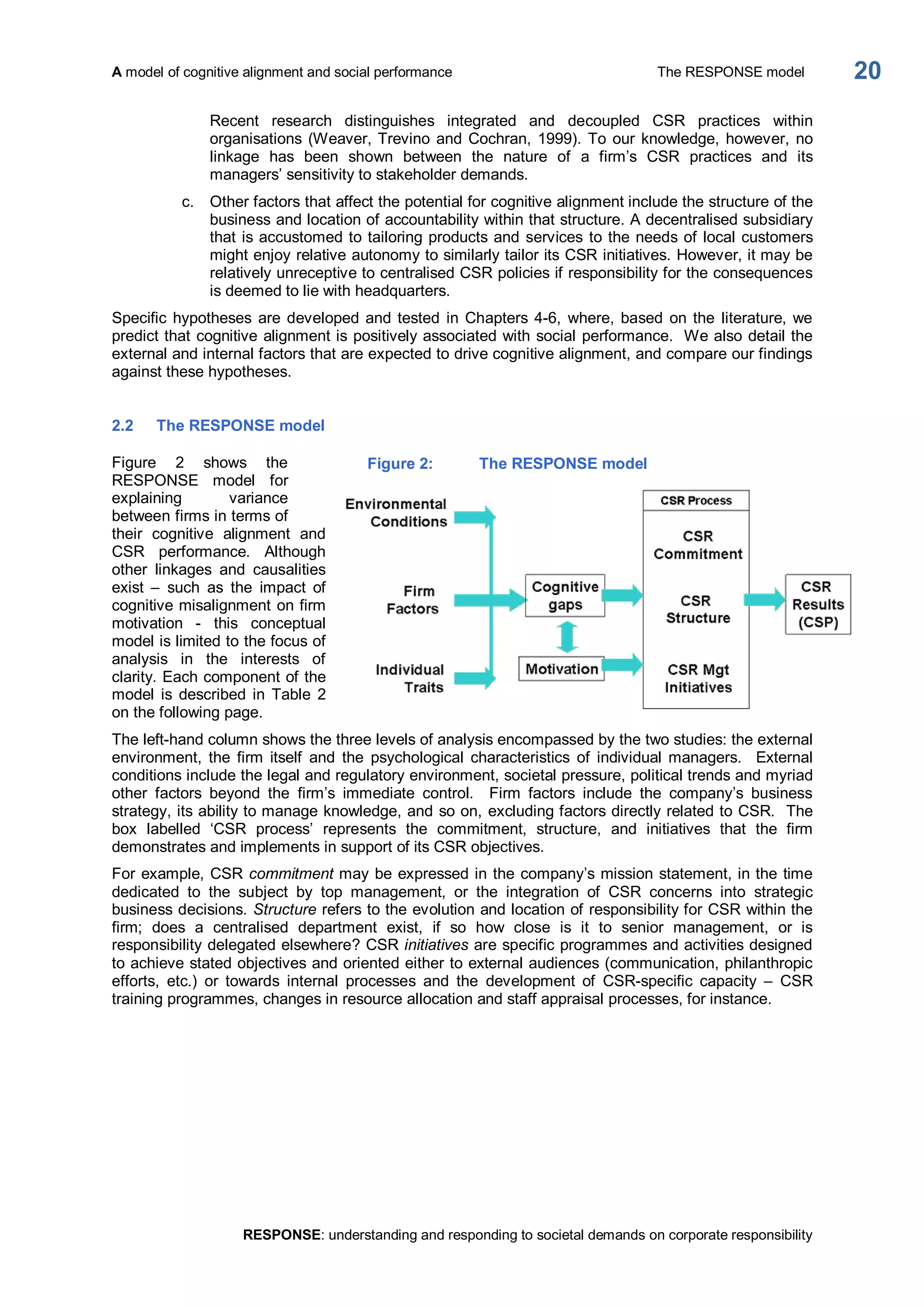
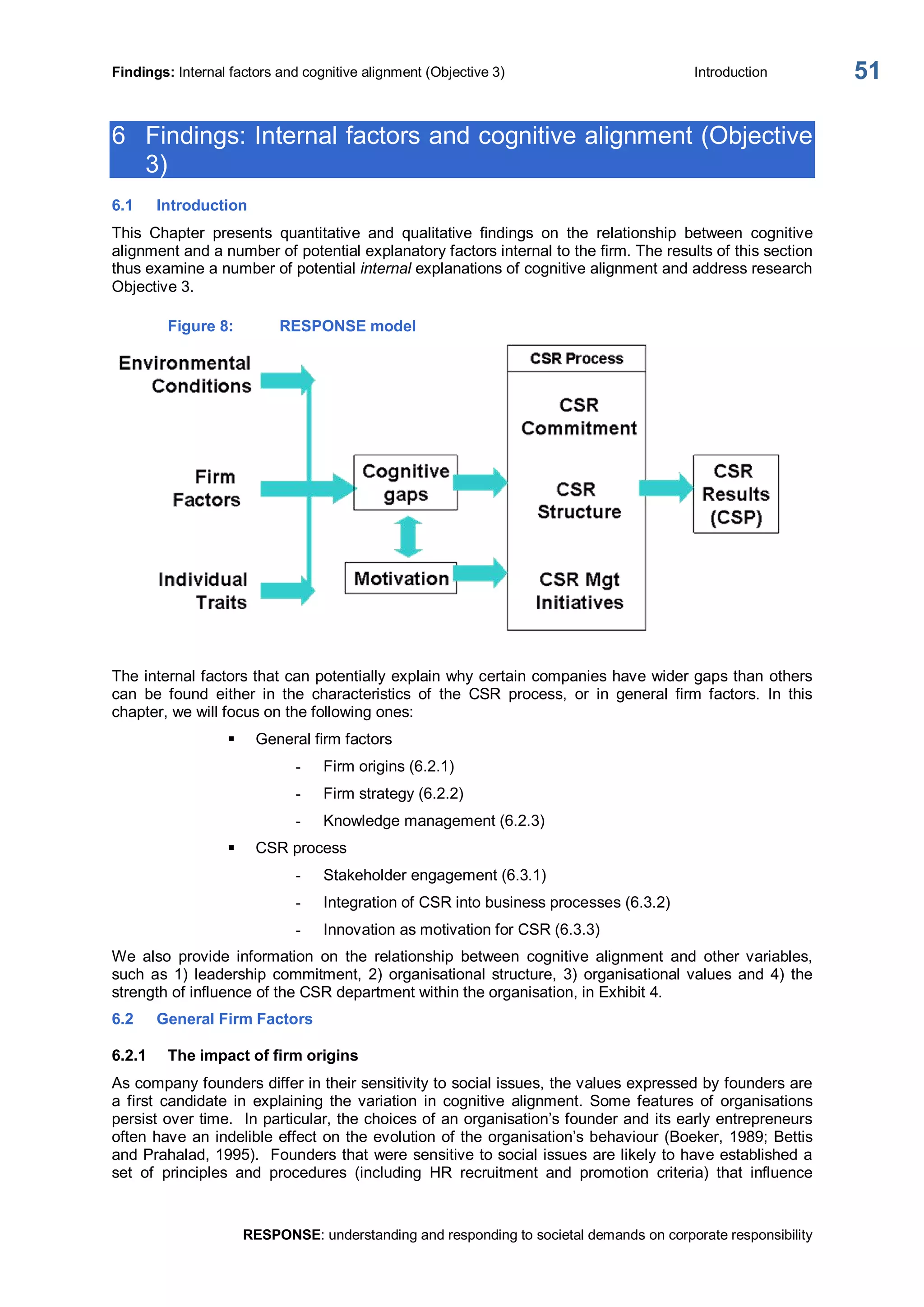
2.2  The RESPONSE model 
Figure  2  shows  the 
RESPONSE  model  for 
explaining  variance 
between firms in terms of 
their  cognitive  alignment  and 
CSR  performance.  Although 
other  linkages  and  causalities 
exist  –  such  as  the  impact  of 
cognitive misalignment on firm 
motivation  ­  this  conceptual 
model is limited to the focus of 
analysis  in  the  interests  of 
clarity. Each component of the 
model  is  described  in  Table  2 
on the following page. 
The left­hand column shows the three levels of analysis encompassed by the two studies: the external 
environment,  the  firm  itself  and  the  psychological  characteristics  of  individual  managers.    External 
conditions include the legal and regulatory environment, societal pressure, political trends and myriad 
other  factors  beyond  the  firm’s  immediate  control.    Firm  factors  include  the  company’s  business 
strategy, its ability to manage knowledge, and so on, excluding factors directly related to CSR.  The 
box  labelled  ‘CSR  process’  represents  the  commitment,  structure,  and  initiatives  that  the  firm 
demonstrates and implements in support of its CSR objectives. 
For example, CSR commitment may be expressed in the company’s mission statement, in the time 
dedicated  to  the  subject  by  top  management,  or  the  integration  of  CSR  concerns  into  strategic 
business decisions. Structure refers to the evolution and location of responsibility for CSR within the 
firm;  does  a  centralised  department  exist,  if  so  how  close  is  it  to  senior  management,  or  is 
responsibility delegated elsewhere? CSR initiatives are specific programmes and activities designed 
to achieve stated objectives and oriented either to external audiences (communication, philanthropic 
efforts,  etc.)  or  towards  internal  processes  and  the  development  of  CSR­specific  capacity  –  CSR 
training programmes, changes in resource allocation and staff appraisal processes, for instance. 
Figure 2:  The RESPONSE model
A model of cognitive alignment and social performance  The RESPONSE model 
RESPONSE: understanding and responding to societal demands on corporate responsibility 
21 
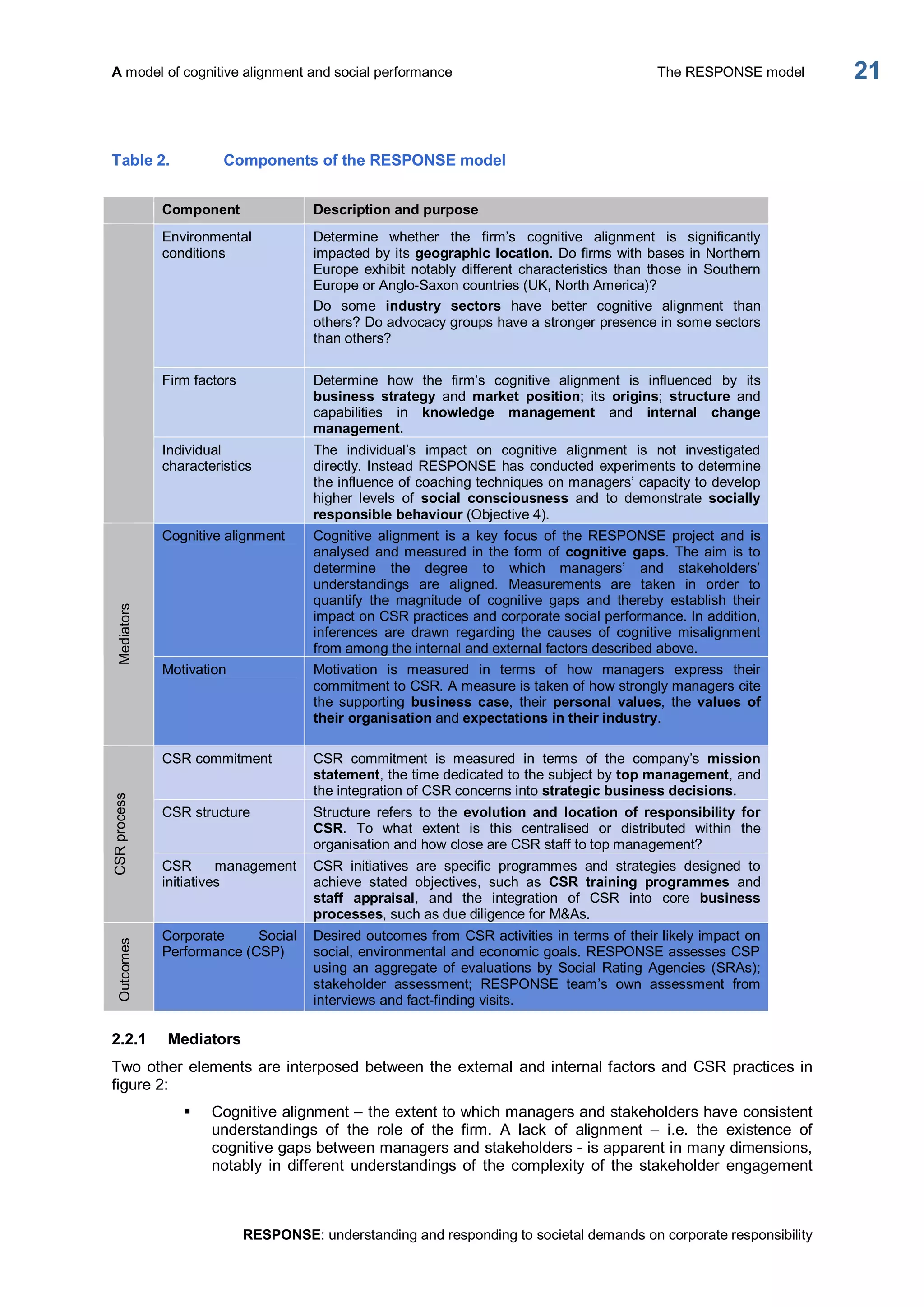
Table 2.  Components of the RESPONSE model 
Component  Description and purpose 
Environmental 
conditions 
Determine  whether  the  firm’s  cognitive  alignment  is  significantly 
impacted by its geographic location. Do firms with bases in Northern 
Europe exhibit notably different characteristics than those in Southern 
Europe or Anglo­Saxon countries (UK, North America)? 
Do  some  industry  sectors  have  better  cognitive  alignment  than 
others? Do advocacy groups have a stronger presence in some sectors 
than others? 
Firm factors  Determine  how  the  firm’s  cognitive  alignment  is  influenced  by  its 
business  strategy  and  market  position;  its  origins;  structure  and 
capabilities  in  knowledge  management  and  internal  change 
management. 
Individual 
characteristics 
The  individual’s  impact  on  cognitive  alignment  is  not  investigated 
directly. Instead RESPONSE has conducted experiments to determine 
the influence of coaching techniques on managers’ capacity to develop 
higher  levels  of  social  consciousness  and  to  demonstrate  socially 
responsible behaviour (Objective 4). 
Cognitive alignment  Cognitive  alignment  is  a  key  focus  of  the  RESPONSE  project  and  is 
analysed and measured in the form of cognitive gaps. The aim is to 
determine  the  degree  to  which  managers’  and  stakeholders’ 
understandings  are  aligned.  Measurements  are  taken  in  order  to 
quantify  the  magnitude  of  cognitive  gaps  and  thereby  establish  their 
impact on CSR practices and corporate social performance. In addition, 
inferences  are  drawn  regarding  the  causes  of  cognitive  misalignment 
from among the internal and external factors described above. 
Mediators 
Motivation  Motivation  is  measured  in  terms  of  how  managers  express  their 
commitment to CSR. A measure is taken of how strongly managers cite 
the supporting  business  case,  their  personal  values,  the values  of 
their organisation and expectations in their industry. 
CSR commitment  CSR  commitment  is  measured  in  terms  of  the  company’s  mission 
statement, the time dedicated to the subject by top management, and 
the integration of CSR concerns into strategic business decisions. 
CSR structure  Structure  refers  to  the  evolution  and  location  of  responsibility  for 
CSR.  To  what  extent  is  this  centralised  or  distributed  within  the 
organisation and how close are CSR staff to top management? 
CSR process 
CSR  management 
initiatives 
CSR  initiatives  are  specific  programmes  and  strategies  designed  to 
achieve  stated  objectives,  such  as  CSR  training  programmes  and 
staff  appraisal,  and  the  integration  of  CSR  into  core  business 
processes, such as due diligence for M&As. 
Outcomes 
Corporate  Social 
Performance (CSP) 
Desired outcomes from CSR activities in terms of their likely impact on 
social, environmental and economic goals. RESPONSE assesses CSP 
using an aggregate of evaluations by Social Rating Agencies (SRAs); 
stakeholder  assessment;  RESPONSE  team’s  own  assessment  from 
interviews and fact­finding visits. 
2.2.1  Mediators 
Two other elements are interposed between the external and internal factors and CSR practices in 
figure 2: 
§  Cognitive alignment – the extent to which managers and stakeholders have consistent 
understandings  of  the  role  of  the  firm.  A  lack  of  alignment  –  i.e.  the  existence  of 
cognitive gaps between managers and stakeholders ­ is apparent in many dimensions, 
notably  in  different  understandings  of  the  complexity  of the  stakeholder  engagement
A model of cognitive alignment and social performance  The RESPONSE model 
RESPONSE: understanding and responding to societal demands on corporate responsibility 
22 
process;  expectations  regarding  outcomes,  and  the  impact  of  stakeholders  on  the 
company and vice versa. 
§  Motivation ­ the overt and underlying objectives and incentives that drive the firm’s CSR 
activities. These may be articulated in terms of the business case for CSR (a direct or 
indirect  financial  return),  an  institutional  case  (sector  or  other  norms),  or  as  a  direct 
consequence of organisational or individual ‘values’. A firm’s motivation to pursue CSR 
strategies thus reflects its normative understanding of the role of business in society as 
well as instrumental concerns about competitive position. 
Motivation is impacted by all three boxes on the left of the model – external and internal factors, as 
well as individual values. The focus of the RESPONSE project, however, is on cognitive alignment, 
given that motivation has been explored in previous empirical work (especially regarding the business 
case for a link between CSR and financial performance 
10 
). Cognitive alignment is thus considered an 
important, and under­explored, determinant of corporate social performance. 
Motivation is positioned as having a direct impact on cognition (figure 2). For example, if a manager 
perceives ROI to be the key motivation for undertaking a CSR initiative, yet the relevant stakeholders 
expect the company to absorb ongoing costs, the apparent cognitive gap has obvious consequences 
for the success of the project. 
The potential for differences in cognition to develop is clear: managers have to engage with multiple 
stakeholders  that  have  disparate  interests  and  claims  on  the  firm’s  resources.  These  claims  are 
subject  to  change  and  can  at  times be  in  conflict.  In  addition,  the  constituencies  that  stakeholders 
represent  may  be  unclear  and  so  the  degree  to  which  the  company  should  respond  is  open  to 
interpretation. 
The following section examines cognitive alignment in more detail and presents an analytical model of 
their causes and impacts. 
Differences  in  cognition  may  reflect  different  scope  in  the  beliefs  of  managers  and  stakeholders 
regarding  the  extent  of  the  firm’s  influence.  For  example,  stakeholders  of  an  IT  company  may 
articulate their view of the firm’s priorities in terms of stakeholder rights. The firm itself may regard its 
primary role as having impact on the world beyond its immediate stakeholders, for example through 
providing low­price communications facilities to schools. 
It is important to note that the four types of cognitive gaps RESPONSE has analysed (see section 5.2) 
represent deeper levels of interaction than are generally considered under the more familiar rubric of 
‘stakeholder  engagement’.  The  assumption  of  this  study  is  that  commonly  used  metrics  such  as 
frequency  and  duration  of  stakeholder  consultation  and  number  of  mentions  in  CSR  reports,  are 
inadequate in capturing the underlying beliefs and expectations of the parties involved. By focusing on 
the  cognition  of  managers  and  stakeholders,  RESPONSE  is  able  to  identify  the  more  salient 
antecedent factors behind Corporate Social Performance (CSP). 
2.2.2  Corporate Social Performance (CSP) 
Corporate Social Performance (CSP) is the umbrella term used to encapsulate the notion of desired 
outcomes  from  CSR  activities.  The  ability  to  identify  causes  of  social  performance  has  clear 
instrumental value for business, stakeholders and policy­makers and so this objective (1b) has been 
added to those of the original RESPONSE proposal. 
However,  CSP  is  a  notoriously  problematic  concept  given  the  subjective  impacts  of  CSR  on  the 
economy,  the  environment  and  on  society.  Most  measures  of  CSP  are  perceptual;  even  where 
measures  depend  on  quantifiable  criteria,  the  decision  about  which  criteria  to  include  remains 
subjective. For the purposes of this study, we assessed CSP based on three sources: 
§  Evaluations of commercial Social Rating Agencies (SRAs) 
§  Stakeholder assessment obtained through the interview process 
10 
The  current  state  of  knowledge  is  equivocal.  Margolis,  J  and  Walsh,  J  (2001),  in  People  and 
Profits? The search for a link between a company’s  social and financial performance, conducted a 
meta­analysis of 90 empirical studies from 1978­2000 and found little consistent evidence for such a 
link. Other meta­studies, Orlitzky et al (2003) for example, found significant evidence to support a link.
A model of cognitive alignment and social performance  The RESPONSE model 
RESPONSE: understanding and responding to societal demands on corporate responsibility 
23 
§  RESPONSE team’s own assessment from interviews 
SRAs provide an important benchmark indicator of a company’s performance. However, RESPONSE 
has found these ratings to be an insufficient summary on their own, reflecting the concern recently 
voiced about their predictive validity (Chatterji, Aaron, Levin and Toffel, 2007). Differences between 
SRA assessments appear influenced by the founding conditions of the ratings agency itself. An SRA 
that traces its roots to environmental concerns, for example, will tend to reflect these origins in the 
prioritising of its evaluation criteria. Assessments of the same firm across SRAs are thus inconsistent. 
A second problem is that SRA methodologies depend for their data on the firm’s self­promotion in the 
form of published reports. We believe that one of strengths of this study lies in the fact that we have 
obtained direct assessments from a plurality of stakeholders, in addition to relying on SRAs and our 
own judgments. 
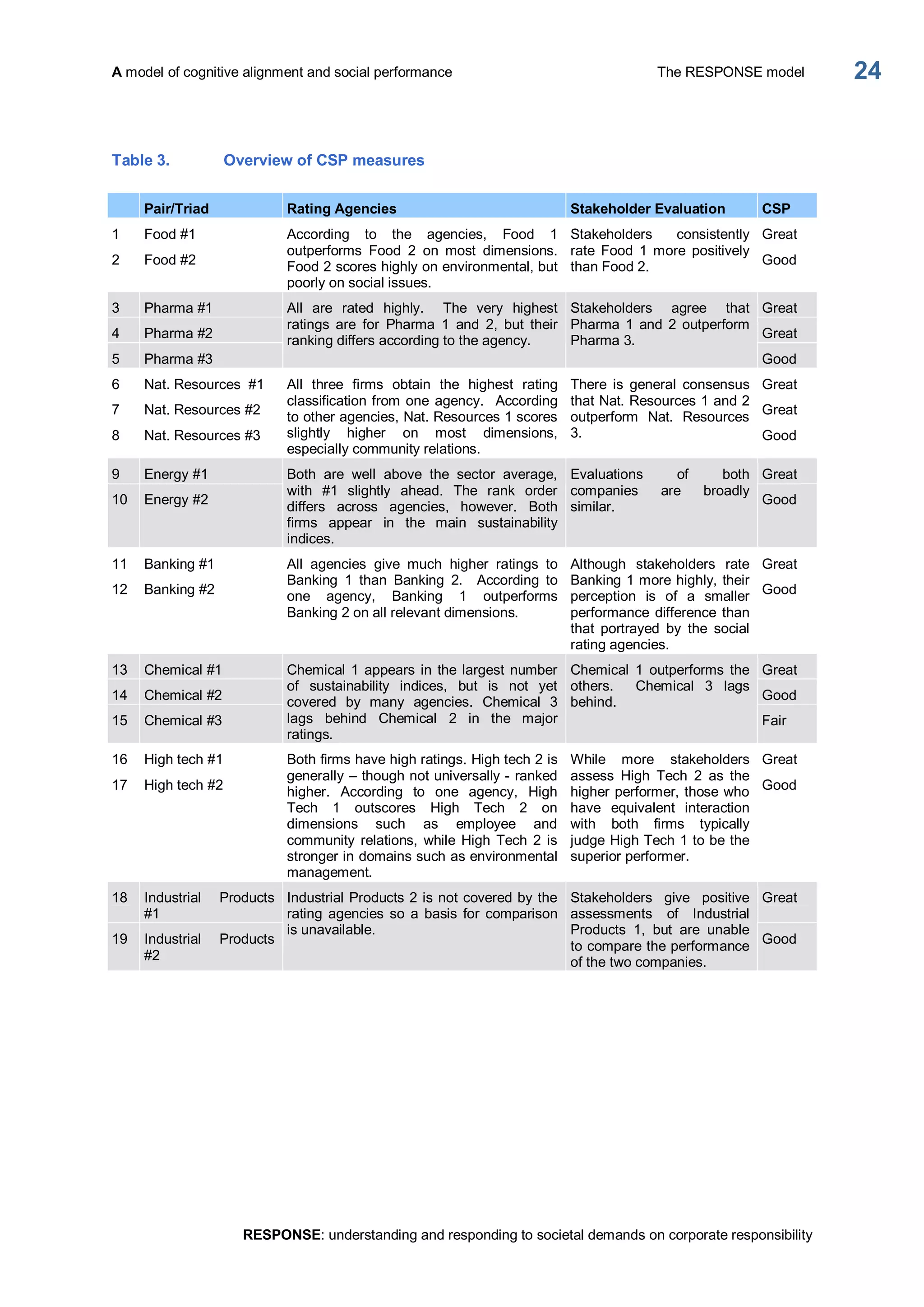
An overview of the CSP of the 19 companies is provided in Table 3, which contains information on 
agency  ratings,  stakeholder  evaluations  and  our  own  RESPONSE  evaluation.  Not  all  social  rating 
agencies cover all 19 companies. Although some agencies provide triple letter ratings, most agencies 
do not provide a single measure of a company’s social performance. Instead, they publish a score for 
individual areas of performance (environment, stakeholder relations, governance, etc.). In such cases, 
individual  scores  cannot  be  easily  aggregated  because  different  weightings  should  apply  across 
different  sectors.  For  example,  while  the  environment  is  a  potentially  important  domain  in  all 
industries, mining firms are likely to have a much larger impact on the environment than IT firms. For 
that reason, we have chosen to give a brief qualitative description of the published ratings. 
The degree of variation in CSP differs markedly across sectors. In most cases, the three sources of 
measures (rating agencies, stakeholders and our own CSP evaluation) are broadly consistent in their 
ranking of the companies’ social performance. In cases where the differences in social performance 
are more nuanced, rating agencies and  stakeholders may disagree about the best performers in a 
sector.  In  making  our  own  assessments  we  have  paid  particular  attention  to  the  comments  we 
received  from  well­informed  stakeholders  who  have  roughly  equal  amounts  of  interaction  with  all 
companies in the pair or triad.
A model of cognitive alignment and social performance  The RESPONSE model 
RESPONSE: understanding and responding to societal demands on corporate responsibility 
24 
Table 3.  Overview of CSP measures 
Pair/Triad  Rating Agencies  Stakeholder Evaluation  CSP 
1  Food #1  Great 
2  Food #2 
According  to  the  agencies,  Food  1 
outperforms  Food  2  on  most  dimensions. 
Food 2 scores highly on environmental, but 
poorly on social issues. 
Stakeholders  consistently 
rate  Food  1 more  positively 
than Food 2.  Good 
3  Pharma #1  Great 
4  Pharma #2  Great 
5  Pharma #3 
All  are  rated  highly.    The  very  highest 
ratings  are  for  Pharma  1  and  2,  but  their 
ranking differs according to the agency. 
Stakeholders  agree  that 
Pharma 1 and 2 outperform 
Pharma 3. 
Good 
6  Nat. Resources  #1  Great 
7  Nat. Resources #2  Great 
8  Nat. Resources #3 
All  three  firms  obtain  the  highest  rating 
classification from one agency.  According 
to other agencies, Nat. Resources 1 scores 
slightly  higher  on  most  dimensions, 
especially community relations. 
There  is  general  consensus 
that Nat. Resources 1 and 2 
outperform  Nat.  Resources 
3.  Good 
9  Energy #1  Great 
10  Energy #2 
Both  are  well  above  the  sector  average, 
with  #1  slightly  ahead.  The  rank  order 
differs  across  agencies,  however.  Both 
firms  appear  in  the  main  sustainability 
indices. 
Evaluations  of  both 
companies  are  broadly 
similar.  Good 
11  Banking #1  Great 
12  Banking #2 
All  agencies  give  much  higher  ratings  to 
Banking  1  than  Banking  2.    According  to 
one  agency,  Banking  1  outperforms 
Banking 2 on all relevant dimensions. 
Although  stakeholders  rate 
Banking 1 more highly, their 
perception  is  of  a  smaller 
performance difference than 
that  portrayed  by  the  social 
rating agencies. 
Good 
13  Chemical #1  Great 
14  Chemical #2  Good 
15  Chemical #3 
Chemical 1 appears in the largest number 
of  sustainability  indices,  but  is  not  yet 
covered  by  many  agencies.  Chemical  3 
lags  behind  Chemical  2  in  the  major 
ratings. 
Chemical  1  outperforms the 
others.    Chemical  3  lags 
behind. 
Fair 
16  High tech #1  Great 
17  High tech #2 
Both firms have high ratings. High tech 2 is 
generally – though not universally ­ ranked 
higher.  According  to  one  agency,  High 
Tech  1  outscores  High  Tech  2  on 
dimensions  such  as  employee  and 
community relations, while High Tech 2 is 
stronger in domains such as environmental 
management. 
While  more  stakeholders 
assess  High  Tech  2  as  the 
higher performer, those who 
have  equivalent  interaction 
with  both  firms  typically 
judge High Tech 1 to be the 
superior performer. 
Good 
18  Industrial  Products 
#1 
Great 
19  Industrial  Products 
#2 
Industrial Products 2 is not covered by the 
rating agencies so a basis for comparison 
is unavailable. 
Stakeholders  give  positive 
assessments  of  Industrial 
Products  1,  but  are  unable 
to compare the performance 
of the two companies. 
Good
Methodology  Scope 
RESPONSE: understanding and responding to societal demands on corporate responsibility 
25 
3  Methodology 
3.1  Scope 
The  research  design  calls  for  an  in­depth,  matched­pair  study  of  large  multinational  companies 
involved  in  selected  industries  and  headquartered  in  Europe  and  the  Anglo­Saxon  countries.  The 
selected  industries  are:  food,  pharmaceutical,  natural  resources,  energy,  banking,  chemical, 
information technology and industrial products. In three of these eight industries, a triad of companies 
has been studied, bringing the total number of case studies to 19. 
3.2  Sample selection 
Initial  desk  research,  supported  by  the  data  received  from  four  social  rating  agencies  (Innovest, 
Oekom, E­Capital and Vigeo), was conducted in order to select the matched pairs of companies in the 
identified industries. Multiple criteria were used to bracket companies by size, product/service portfolio 
and  industry  in  order  to  allocate  pairs  for  comparison.  The  matched­pair  design  requires  that  two 
companies  are  grouped  based  on  their  similarities  in  as  many  dimensions  as  feasible,  and  to 
maximise the differences in the relevant dependent variable (Eisenhardt, 1989) 
11 
.  In this study, the 
dependent variable is the perception of Corporate Social Performance (CSP). Therefore, the design 
requires that variation in CSP among the members of the pair/triad should be high. Pairs/triads should 
share broadly similar characteristics in terms of: 
§  Business sector 
§  Company size 
§  Financial performance 
§  Degree of multinationality 
Accordingly,  evaluations  from  commercial  ratings  companies  were  used  to  stratify  companies 
according to their social performance. After a long invitation and recruitment process, a total of 19 
companies  joined  the  study,  representing  eight  sectors:  food,  pharmaceutical,  natural  resources, 
energy,  banking,  chemical,  industrial  products  and  information  technology.  These  sectors  were 
selected  for  their  association  with  a  wide  range  of  corporate  responsibility  issues:  process­based 
industries with heavy environmental responsibilities (natural resources, energy, chemical); consumer 
goods  companies  with  significant  product  liability  issues  (food  and  pharmaceuticals);  financial 
services  with  community  development  and  customer  transparency  responsibilities;  high­tech 
companies (including, again, pharma) with significant product access issues. Moreover, some sectors 
have  longer  histories  in  CSR  (natural  resources,  chemical,  pharmaceutical)  than  others  (banking, 
industrial products). 
Within  each  sector,  most  firms  are  fairly  comparable  in  terms  of  degree  of  multinationality  and 
financial performance. With respect to the other dimensions of selection, the participant companies 
compare within each sector as follows: 
11 
Eisenhardt, K. M. (1989) Building Theories From Case Study Research. Academy of Management. 
The Academy of Management Review, 14, 532.
Methodology  Company case studies 
RESPONSE: understanding and responding to societal demands on corporate responsibility 
26 
Table 4.  Sample of 19 companies in matched pairs and triads 
Pair/Triad  HQ Region 
Similarity 
of Size 
Business 
Similarity  CSP 
1  Food #1  N.Europe  Great 
2  Food #2  N.Europe 
High  Low 
Good 
3  Pharma #1  Anglo 
Saxon 
Great 
4  Pharma #2  N.Europe  Great 
5  Pharma #3  S.Europe 
High  Very high 
Good 
6  Nat. Resources  #1  Anglo 
Saxon 
Great 
7  Nat. Resources #2  Anglo 
Saxon 
Great 
8  Nat. Resources #3  N.Europe 
High  High 
Good 
9  Energy #1  S.Europe  Great 
10  Energy #2  S.Europe 
High  High 
Good 
11  Banking #1  S.Europe  Great 
12  Banking #2  S.Europe 
Very high  Very high 
Good 
13  Chemical #1  N.Europe  Great 
14  Chemical #2  N.Europe  Good 
15  Chemical #3  N.Europe 
High  High 
Fair 
16  High tech #1  Anglo 
Saxon 
Great 
17  High tech #2  Anglo 
Saxon 
High  Medium 
Good 
18  Industrial products #1  N.Europe  Great 
19  Industrial products #2  N.Europe 
Low  Low 
Good 
Of the eight sectors, therefore, one (Industrials) is overall a poor match on the dimensions of size and 
business similarity. Consequently, we have ensured that, in the analysis section below (see Chapters 
5­7), the results described do not rely significantly on the presence of the Industrials pair. Additionally, 
the  food  sector  pair  has  one  weak  dimension,  namely  a  low  business  similarity.  Finally,  the 
pharmaceutical triad was created with one company representing each region to study eventual inter­ 
industry regional effects, excluded by design in the other sectors. 
For each company, stakeholders were  selected for relevance, firstly, based on  RESPONSE’s desk 
research of  NGOs and other organisations specialised in the industries under study, and secondly, 
from company recommendations and the opinions of Social Ratings Agencies (SRAs). In making their 
recommendations, companies were asked to name, in equal number, stakeholders with whom they 
had differences of opinion and those with whom they had good relations. 
3.3  Company case studies 
An initial sample of 70 companies was selected, arranged in matched groups based on similarity of 
industry,  headquarters  location,  size,  financial  performance  and  differences  in  CSP  ratings.  These 
were invited to join the study in sequential order, starting from the ‘best matches’ in terms of maximum 
variance.  Those  companies  that  declined  were  replaced  with  alternatives  identified  from  desk 
research.
Methodology  Company case studies 
RESPONSE: understanding and responding to societal demands on corporate responsibility 
27 
The participant companies made up five pairs and three triads (table 4). Triads were formed where 
more than two invitations sent to several companies in a given industry group were accepted. 
In  each  participant  company, the  data  collection 
process followed the five steps in table 5. 
Step  1:  After  a  data  collection  exercise  from 
publicly  available  sources,  including  official 
company  communication  (annual  and  social 
reports, etc.) and a  web­search for debates  and 
external  initiatives  concerning  the  company’s 
activities, an initial ‘fact­finding’ visit was made to 
meet  the  managers  responsible  for  “corporate 
responsibility”  issues  (however  defined  by  the 
company). 
Step 2: The fact­finding field visit followed a structured protocol (see Exhibit 1) aimed at reconstructing 
the evolution of corporate responsibility practice in the company and collecting systematic information 
about  firm­level  characteristics,  such  as  its  origins,  its  strategy  and  organisational  structure,  its 
governance and leadership, its key change events, etc. 
Step 3: An average of 12 stakeholders were selected for each firm.  Stakeholders included social 
rating  agencies  (SRAs),  social  stakeholders  such  as  non­governmental  organisations  (NGOs), 
international  institutions  and  educational  institutions,  as  well  as  the  company’s  “inner  ring”  of 
stakeholders  (Freeman,  1984;  Preston,  Post  and  Sachs,  2002).    “Inner  ring”  stakeholders  include 
shareholders,  employees,  customers, 
suppliers,  local  governments,  the 
media  and  industry  associations. 
Figure  3  presents  a  profile  of  the 
stakeholders who were interviewed. 
The  majority  of  stakeholders  who 
were  interviewed  can  be  classified 
as  social  stakeholders.  Non­ 
governmental  organisations 
comprised  the  greatest  number  of 
these. In total, 89 non­governmental 
organisations  were  interviewed  for 
the research. A total of 41 interviews 
took  place  with  Social  Rating 
Agencies,  while  44  interviews 
involved  the  inner  circle  of  more 
classical corporate stakeholders. 
Stakeholders varied in terms of their 
level  of  knowledge  about  the 
company in general  –  as well as in 
terms  of  their  knowledge  of  the 
company’s social responsibility activities. In part, this is a reflection of how they were identified, with 
stakeholders  nominated  by  the  company  being  –  in  general  –  more  knowledgeable.  In  part,  the 
varying level of knowledge is  a reflection of the interests and focus of specific stakeholders. Many 
external  stakeholders  have issue­specific  interests,  and  as  a  result, their  knowledge  of  a  company 
may be relatively narrow. However, the number and range of interviews conducted provides a high 
level of knowledge about individual companies. 
Table 5.  Research Protocol 
Step 1  Desk research 
Step 2  “Fact finding” field visit 
Step 3  Selection of stakeholders 
Step 4  Stakeholder interviews 
Step 5  Internal company interviews 
Figure 3:  : Overview of Stakeholder Interviews 
N =219 
Social 
47% 
"Inner 
circle" 
34% 
Social 
rating 
agencies 
19%
Methodology  Case comparison Analysis 
RESPONSE: understanding and responding to societal demands on corporate responsibility 
28 
Step  4:  Stakeholder  interviews  followed  a  structured  approach.    This  allowed  for  a  systematic 
comparison of the observations made with those coming from the managers of the focal company, as 
well as within and across pairs (see Exhibits 2 and 3 for the interview protocols). 
Step  5:  Internal  interviews 
were  scheduled  with  the 
help of the CSR managers 
championing  the  project  in 
the  company.    The 
selection  of  interviewees 
was  guided  by  a  fixed 
number of functional 
areas  and  geographic 
coverage  that  we 
developed by design: these 
included the CEO or COO, 
managers  with  direct 
responsibility  for  CSR 
(usually  interviews  during 
the “fact finding” field visit), 
the  heads  of  selected 
corporate  areas  such  as 
strategy  or  marketing 
strategy,  HR,  finance,  one 
executive  in  charge  of  a 
product  division  and  four 
country  managers 
representing  territories  outside  the  home  region  in  four  of  the  following  areas:  Northern  Europe, 
Southern Europe, Eastern Europe, North America and China. The majority of interviews with company 
managers  involved  people  with  functional  and  line  responsibilities.  Only  18.4  percent  of  company 
interviews involved individuals with direct CSR responsibilities (see Figure 4). 
In total, 427 interviews  were conducted. This included 208 interviews  with managers of the partner 
companies and 219 interviews with external stakeholders. 
3.4  Case comparison Analysis 
3.4.1  Measures and Analysis Protocol 
The desk research, fact­finding fieldwork and the structured interview protocol were designed to elicit 
information  that  could  be  used  in  comparative  analysis  between  and  across  companies  in  the 
pairs/triads. 
Interview protocols were developed for managers and stakeholders.  For managers, questions were 
centred around the nature of corporate social responsibility (CSR) in general and specifically in their 
industry, the relevance of CSR to their work and day­to­day management processes, their perception 
of  their  own  firm’s  social  performance  relative  to  that  of  competitors,  the  identification  of  relevant 
stakeholders –  including a ranking of these stakeholders according to their impact on the company 
and  the  company’s  impact  on them  ­  and  their motivation for  engaging in  CSR.  These  interviews 
were recorded and generally lasted between one­and­a­half and two hours. 
Many  of  the  questions  posed  to  managers  were  replicated  in  the  stakeholder  interviews.    For 
example, stakeholders were asked to define the responsibilities of companies towards society and in 
the industry of interest, to benchmark the social performance of the focal firm against its competitors, 
to identify the relevant stakeholders for the firm (with the same ranking exercise as conducted in the 
managerial interviews), and to provide information on their interactions with the firm.  This replication 
of the important questions in both sets of interviews gave us a solid basis for the calculation of the 
cognitive alignment between managers and stakeholders. 
Table  6  below  summarises  the  constructs  used  to  categorise  the  dimensions  of  relevance  in  the 
comparisons between firms. 
Figure 4:  : Overview of Manager Interviews 
CSR 
18% 
Line/ 
operational 
34% 
Functional 
48% N =208
Methodology  Case comparison Analysis 
RESPONSE: understanding and responding to societal demands on corporate responsibility 
29 
Table 6.  Constructs used for case comparison 
Construct  Measurements 
Firm’s CSP 
Corporate Social Performance 
Agency ratings, stakeholder evaluation, 
RESPONSE evaluation 
Strategic CSR commitment 
Top management articulation of support for 
CSR; integration of CSR into mission/vision 
statement, strategic decision­making and 
business processes 
Organisation of CSR 
Centralised or decentralised; extent of 
influence; input from staff; historical evolution 
Firm’s CSR process 
CSR practices 
Stakeholder engagement; performance 
targets; appraisal; training; reporting; 
monitoring, CSR in investment decisions 
Business case 
Perceived benefits of CSR in terms of risk 
reduction, efficiency, sales and premium 
pricing, new market opportunities. 
Values case 
Perceived importance of individuals’ and 
organisation’s values 
Firm’s motivation 
Institutional case 
Norms and pressures at the level of the 
industry sector, regulation, competition. 
Social consciousness 
Psychological attributes in terms of cognitive 
capacities, personal values and emotional 
characteristics. 
Individuals’ cognition 
Cognitive gaps 
Magnitude of differences in manager and 
stakeholder understandings regarding CSR 
definitions, performance and motivations. 
Origins 
Influence of founders and early corporate 
culture. 
Current position  Articulation of business strategy 
Company 
characteristics 
Organisational structure; independence of 
corporate governance; concentration of 
ownership; leadership style; corporate culture, 
knowledge management 
Source: Derived from case analysis protocol. 
Interview  data  were  collected  for  each  firm  against  a  large  number  of  structured  dimensions,  as 
summarised in Table 6. This largely qualitative information was then  scored  on a  scale of 1­5. We 
adopted a process of open scoring, where each item to be scored could be given any value within the 
range. We defined the reference population for the scoring as our sample of 19 firms (i.e. the highest 
performers in a given domain scored 4 or 5, while the worst scored 1 or 2). Based on the quantitative 
data  in the interviews,  some  of  the  dimensions (e.g. firm’s motivation  to  engage  in  CSR) could  be 
scored objectively, while some other scores were more subjective. In these latter cases, researchers 
were asked to justify their scores, and there was a check for inter­scorer reliability. 
The scoring mechanism was necessary to enable comparison between companies in a pair or triad, 
as  well  as  across  pairs  and  triads.  So,  for  example,  if  one  firm  scored  highly  (5)  on  its  strategic 
commitment to CSR and the other firm in the pair scored low (2), the difference in levels is considered 
of important magnitude. Therefore, if the former firm has a higher CSR performance rating than the 
latter, then the variable ‘strategic commitment’ could be a potentially significant factor in explaining 
this difference, at least in the context of the industry being considered.  If this conclusion is drawn on a 
large number of industry pairs/triads, then the variable under consideration is deemed an important 
factor to explain the variation in CSP (see below in 4.5).
Methodology  Case comparison Analysis 
RESPONSE: understanding and responding to societal demands on corporate responsibility 
30 
3.4.2  Dimensions of cognitive alignment 
The  construct  of  ‘cognitive  gaps’  was  further  broken  down  into  four  dimensions  and  associated 
measurements (table 7). 
Table 7.  Dimensions of cognitive alignment between managers and stakeholders 
Cognitive gap 
type 
Interview measurement  Interpretation  Cognitive alignment 
construct 
Gap 1: 
Sequentiality 
Order in which interviewees 
mention stakeholders 
Salience of stakeholders 
(assumes that first 
stakeholders mentioned are 
more salient) 
Similarity in understandings of 
relative salience of different 
stakeholders 
Gap 2: Risk 
ranking 
Ranking of stakeholders 
based on their perceived 
impact on the company 
Perceived risk posed by 
stakeholders (assumes that 
higher ranking indicates 
higher perceived risk) 
Same as above, with explicit 
request to rank the 
stakeholder orders by 
importance for the company 
Gap 3: 
Responsibility 
ranking 
Ranking of stakeholders 
based on the perceived 
impact the company has on 
them 
Perceived responsibility 
toward stakeholders 
(assumes that higher ranking 
indicates higher perceived 
responsibility) 
Similarity in understanding of 
the rank order of stakeholders 
based on the company impact 
Gap 4: Perceptions 
of Corporate Social 
Performance (CSP) 
Level of social performance 
as judged by interviewees 
Similarity in understanding of 
company’s social 
performance 
Sequentiality: this measures the order in which interviewees mention the company’s most important 
stakeholders  when  answering  the  question:  “who  are  the  most  important  types of  stakeholders  for 
your  company?”  (question  11  in  the interview  protocol;  see  Exhibit  3). This  measure  is  an  indirect 
indicator  of  the  salience  of  different  stakeholders.  The  gap  between  manager  and  stakeholder 
perceptions  shows  the  degree  of  alignment  in identifying  and  prioritising  different  stakeholders.  To 
normalise the sequence across interviewees from the same company (and to ensure comparability of 
stakeholder interviews associated with the same company, as well as cross­company comparisons), 
we  developed a formula to convert the sequence  order into a number from 1 (the first stakeholder 
mentioned) to 0 (not mentioned at all).  This number is averaged across interviewees related to the 
same company for each stakeholder type. The sequentiality gap is thus measured as the difference 
between managers and stakeholders of the same company, either for each individual stakeholder, or 
averaging overall across all the stakeholders. For the purpose of comparison across companies, we 
use the overall average version of the sequentiality gap. 
Stakeholder impact on the company (Risk Ranking):  Managers and stakeholders were asked to rank 
the impact on the company of the stakeholders they mentioned. The question was: “how would you 
rank the stakeholders types you mentioned vis­à­vis the impact that they have on the company?” The 
variable is normalised using a similar technique as for sequentiality. The value ‘1’ is assigned to the 
first  stakeholder  type  in  the  rank  order;  0  is  assigned  to  stakeholders  not  mentioned,  and  an 
intermediate  number  is  assigned  for  those  mentioned  (taking  into  account  the  total  number  of 
stakeholders  mentioned  which  varies  per  each  interviewee).  The  normalised  figures  are  thus 
averaged across interviewees (managers or stakeholders for a given company) for each stakeholder 
type, and then the difference between managers’ and stakeholders’ assessments are computed for 
each stakeholder type. The Risk Ranking gap is therefore the average of the differences between the 
prioritisations of stakeholders and managers across stakeholder type. 
Company impact on stakeholder (Responsibility Ranking): this dimension quantifies the answer to the 
question:  “how  would  you  rank  the  stakeholders  types  you  mentioned vis­à­vis  the impact  that  the 
company  has  on  them?”  The  quantitative  procedure  to  turn  the  ranking  into  a  normalised  figure 
ranging from 0 to 1 is the same as described above for Sequentiality gaps and Risk Ranking gaps. 
Social performance: This is a 1­10 rating of performance given to the company by stakeholders and 
managers interviewed (1 as minimum and 10 as maximum). The social performance gap is simply the 
difference between the averages in the ratings given by stakeholders and managers. Managers often, 
but not necessarily, evaluate their companies’ social performance more highly than do stakeholders. 
A  negative  number  thus  means  that  stakeholders  gave  a  worse  assessment  of  the  company,
Methodology  Cross­Pair Comparison Analysis 
RESPONSE: understanding and responding to societal demands on corporate responsibility 
31 
compared  to  the  managers.  A  negative  number  is  a  ‘negative’  indication  of  managers’  cognition, 
since  it  means  that  they  over­value  their  company’s  social  performance  in  comparison  to  their 
stakeholders’  perceptions.  A  positive  number  means  that  external  stakeholders  rank  the  social 
performance  of  the  company  higher  than  do  its  managers  –  in  other  words,  stakeholders  may 
overestimate the company’s performance – or managers may undervalue it. While the sign of this gap 
has meaning, we recognise that it is the absolute value of the gap – i.e. the extent to which managers 
‘overshoot’ or ‘undershoot’ ­ that may be more important as a measure of cognitive alignment. Hence, 
we use the absolute value of this gap in our subsequent analysis (with the exception of Section 4.3, in 
which  we  show  and  discuss  the  magnitude  of  the  different  cognitive  gaps  across  each  of  the  19 
companies). 
3.5  Cross­Pair Comparison Analysis 
Once the analysis of each company has been performed following the structured protocol developed 
(see Exhibits 2 and 3), the intra­pair/triad comparative analysis is conducted to identify the factors that 
appear to differ across companies within the same pair or triad. It then moves towards identifying the 
factors that appear to be consistently different across pairs/triads.  “Consistently” means the factor is 
deemed  a  potentially important  dimension  if  (a)  the  companies score  differently  on  that factor in  a 
large  number  of  pairs/triads,  and  (b)  the  differences  are  in  the  same  “direction”  vis­à­vis  social 
performance.  For example, if there are differences within several pairs with respect to the degree of 
integration of CSR in business strategy, we can identify that factor as a potential explanation for the 
variation in CSP only if the firm with higher CSP in each pair is associated with the higher extent of 
integration.  If, however, there is no consistency among the pairs on matching ‘high CSR integration in 
strategic  processes  and  high  CSP’,  then  the  factor  cannot  be  considered  a  meaningful  one  to 
understand the variation of CSP. 
This procedure allowed us to achieve two important objectives.  First, we could assess the magnitude 
and type of impact of cognitive alignment on CSP, thereby testing the relevance of the core concept in 
our  study  for  a  broader  model  of  social  performance (Research  Objective  1b).    Second,  we  could 
identify the factors that might be potential explanations for the degree of cognitive alignment among 
those that show the highest relevance for an overall model of CSP.  These are the factors that we 
have thus used as potential explanations for the degree of cognitive alignment (Research Objectives 
2 and 3). 
3.6  Explanatory Factors of Cognitive Alignment 
The last step of the analytical journey was to study the link between a selected number of potential 
explanations  and  the  magnitude  of  cognitive  alignment.    The  potential  explanations  (or  correlates, 
since causality could not be ascertained through the research design adopted in this study) have been 
identified through the cross­pair comparison analysis  described above in 4.5.  For each factor, the 
companies have been clustered in two groups, with a rough split at the median value. The averages 
of  the  four  measures  of  cognitive  alignment  (cognitive  gaps)  have  been  then  computed  and 
juxtaposed to assess (a) whether there is a difference between the average cognitive gaps in the two 
groups  of  companies,  and  (b)  whether  the  differences  are  consistent  across  the  four  measures  of 
cognitive alignment. 
If the differences were sufficiently large and stable across the four measures, the factor is considered 
potentially important to explain why certain companies exhibit higher levels of cognitive alignment with 
their stakeholders than others.
Findings: Managers’ understandings of CSR (Objective 1)  Introduction 
RESPONSE: understanding and responding to societal demands on corporate responsibility 
32 
4  Findings: Managers’ understandings of CSR (Objective 1) 
4.1  Introduction 
Following  Chapter  2  (theoretical  framework)  and  Chapter  3  (methodology),  the  following  three 
chapters present the results of the analysis of the data collected.  Each chapter deals in detail with the 
analysis of one objective.  Chapter 4 deals with the analysis of SMART Objective 1, Chapter 5 with 
the analysis of SMART Objective 2, and Chapter 6 with the analysis of SMART Objective 3. 
The  next  section  draws  on  the  427  interviews  with  managers  and  stakeholders  to  describe  how 
managers think about the responsibility of their firms, and the extent to which that differs from the way 
stakeholders  conceptualise  it.    As  a  guiding  tool  to  categorise  the  responses,  we  utilise  two 
frameworks developed from the analysis of a subset of the data. 
Section 5.3 presents results of analysis to establish the magnitude of each company’s cognitive gaps 
for  each  of  the  companies  analysed,  that  is,  the  level  of  cognitive  alignment  between  the 
understandings  of  managers  and  stakeholders.  It  thus  addresses  research  Objective  1.  The 
magnitude of the four types of cognitive gap introduced in Ch. 2 are thus presented, broken down by 
company and by stakeholder type. 
Section 5.4 explains each company’s Corporate Social Performance (CSP) in relation to the five types 
of cognitive gap (Objective 1b). Companies are grouped into matched industry pairs/triads in order to 
identify sector influences. 
4.2  Managers’ understandings of CSR 
The  objective  of  this  section  is  to  offer  a  summary  of  how  managers  conceive  of  their  company’s 
social responsibility, and of how this differs from the stakeholders’ conception.  An aggregate set of 
interviews, conducted across all companies and stakeholders, forms the basis of this investigation. In 
all these cases, the research protocol calls for answers to the question: “what is company X’s social 
responsibility?” This question generated open­ended responses that were then analysed to develop 
two organising frameworks: one was used to identify the typology of issues raised by managers and 
stakeholder representatives, and the other enabled us to study the differences in the cognitive framing 
of the concept of CSR. 
4.2.1  Dimensions of CSR issues 
The  first  framework  is  an  ‘issue’  matrix  that  categorises  the  issues  raised  on  two  dimensions  that 
appear relevant (see table 8): 
1.  Product/Process. The distinction between the responsibility related to the output of the 
company  activities  (its  products  or  services)  versus  the  process  through  which  the 
output is produced or delivered (process­based). 
2.  Do  no  harm/Do  good.  The  distinction  between  issues  related  to  the  avoidance  of 
harmful consequences versus those related to the proactive attempt to ‘do good’, that 
is to improve the wellbeing of the relevant constituencies.
Findings: Managers’ understandings of CSR (Objective 1)  Managers’ understandings of CSR 
RESPONSE: understanding and responding to societal demands on corporate responsibility 
33 
Table 8.  : Dimensions of CSR issues 
Product 
focus 
Process 
focus 
‘Do no harm’ 
Product impact 
§Ethical value of product 
§Impact on user’s well­being 
§Consequences of incorrect 
use 
Process impact 
§Environment 
§Supply chain 
§HR/human rights abuses 
§Lobbying, bribing 
§Anti­competitive behaviour. 
‘Do good’ 
Product access 
§For survival (food) 
§Health (medicine) 
§Poverty (finance) 
§Education (ICT) 
Process engagement 
§Defend human rights 
§Community support 
§Regional development 
§Human development 
The  following  quotes  provide  some  examples  of  CSR  issues  raised  by  both  Managers  and 
Stakeholders  and  might  help  clarify  how  they  have  been  classified  according  to  the  proposed 
conceptual framework. 
‘Do no harm’ / Product 
“We are in a business which acknowledges and has to acknowledge that if you misuse our 
product  and  if  you  don’t  consume  it  responsibly,  then  there  are  consequences  for  the 
individual  and  there  are  consequences  for  society,  and  therefore  part  of  our  responsibility, 
which is at the heart of your question, is to those societies based on how we market and sell 
our brands.” (Manager, food) 
“Compliance,  obeying  the  rules,  transparency,  traceability.  Companies  should  provide  the 
goods  that  they  themselves  want  to  consume.  Products  which  should  be  made  in  a 
sustainable  way.  Environmentally  friendly,  good  to  all,  including  the  producers  as  well. 
Companies must inform consumers how products are made. All companies have the same 
responsibilities.  They  have  to  label  from  the  very  beginning  of  the  product  to  the  end.” 
(Stakeholder, food) 
‘Do good’ / Product 
“…  access  to  drugs  in  the  developing  world.  We're  there  to  put  our  knowledge  and 
competency at their disposal, distribute drugs to them, within certain limits. We're not an NGO 
or a government.” (Manager, pharmaceuticals) 
“A  technology  company  can  use  its  intellectual  property  to  help  many  people  from  young 
school children to elderly people… We had one programme where we actually went in and 
taught the elderly, to use a computer because most of them had never had any experience of 
it… All of a sudden a whole new world opens up to them and things that they never dreamed 
about that they couldn’t do before, things they could find information on became so easy and 
particularly for a lot of them who aren’t as mobile, they can’t drive, they can’t go places and so 
this  opens  up  a  whole  new  world.    It  is  just  another  example  of  things  that  you  can  do.” 
(Manager, high tech)
Findings: Managers’ understandings of CSR (Objective 1)  Managers’ understandings of CSR 
RESPONSE: understanding and responding to societal demands on corporate responsibility 
34 
“If you buy something, you have no idea how much energy it uses. So if you could label these 
kinds of products, as a consumer then you could make a choice  like, “Hey, this product is 
much  [better]”  (…) So  I  think that  companies  should just  take more  of  a  leadership  role  in 
developing these kinds of products.”  (Stakeholder, industrials) 
‘Do no harm’ / Process 
“Being a responsible energy company implies being able to satisfy your customer demands 
in optimum conditions of price and quality of the service, and with the minimum impact to the 
environment.” (Manager, energy) 
“CSR  encompasses  all  the  "normal"  things  like  labour  conditions  and  safe  manufacturing 
practice,  I.e.  pharma  manufacturing  should  pose  no  harm  to  employees  and  environment. 
Need  to  be  open  &  honest  and  not  try  to  hide  unfavourable  data.  Companies  have  an 
obligation.” (Stakeholder, pharma) 
‘Do good’ / Process 
“It means things like, in Africa we provide for healthcare to our employees and their families 
so we extend it to their families, nobody obliges us to do that and it’s not because we are 
missionaries, but it’s also because if you want to keep a good workforce, you know they are 
also depending on their families and so you have to see that in the global context.” (Manager, 
food) 
“Companies  responsibility  is  being  competitive  and  dynamic;  in  other  words,  doing  their 
business  well.  At  the  same  time  they  have  to  comply  with  rules  and  ethical  standards 
accepted in the society (which can change in time). However, CSR goes beyond these first 
responsibilities, because being socially responsible means doing something more than that. 
So  our  vision  considers  the  competitive  aspect  as  well  the  social  one;  there  must  be  a 
synergy between them: the latter must not be to the detriment of the former.” (Stakeholder, 
industrials) 
The analysis and categorisation of the answers to the Question 2 from the interview protocol “what is 
the  social  responsibility  of multinational  corporations?”  revealed  the following frequency  distribution 
along the two dimensions:
Findings: Managers’ understandings of CSR (Objective 1)  Managers’ understandings of CSR 
RESPONSE: understanding and responding to societal demands on corporate responsibility 
35 
Figure 5:  Frequency of CSR Issues in Managers and Stakeholders Interviews 
11% 17% 
6% 
8% 
42% 
62% 
13% 
41% 
0% 
10% 
20% 
30% 
40% 
50% 
60% 
70% 
80% 
90% 
100% 
Managers  Stakeholders 
The comparison of the two datasets yields the following table showing the differences between the 
issues reported by managers and those reported by stakeholders: 
Table 9.  Gap in the Frequency of CSR Issues between Managers and Stakeholders 
Product 
focus 
Process focus  Total 
‘Do no harm’  6,3%  20,6%  26.9% 
‘Do good’  1.2%  (28.3%)  (26.9%) 
Total  7,6%  (7.6%)  0,0% 
From  the  analysis  of  the  differences  in  the  frequencies  of  CSR  issues  reported  by  managers  and 
stakeholders, three main findings emerge: 
a.  Both Managers and Stakeholders clearly prioritise process issues to product issues (75.7 
vs. 83.3%), even if Managers pay greater attention to product issues; 
b.  Managers tend to adopt a relatively passive view of their duties toward society, with an 
overwhelming share given to “do no harm” types of issues (4 to 1 ratio vs. the “do good” 
type of issues) 
c.  Stakeholders  see  CSR  issues  as  more  equally  split  between  refraining  from  harmful 
behaviours  and  improving  the  well­being  of  the  relevant  constituencies  (52.5%  vs. 
47.5%). 
4.2.2  Framing the Concept of CSR 
The second organising framework attempts to capture the way managers and stakeholders frame the 
concept of CSR along two dimensions: 
Process 
focus 
‘do good’ 
Process 
focus 
‘do no  harm’ 
Product 
focus ‘ 
do good’ 
Process 
focus 
‘do no harm’
Findings: Managers’ understandings of CSR (Objective 1)  Managers’ understandings of CSR 
RESPONSE: understanding and responding to societal demands on corporate responsibility 
36 
1.  The ‘scope of the firm”, that is the implicit understanding of what is a corporation (a multinational 
corporation, in particular).  This dimension is constituted by three ‘views’ with increasing levels of 
scope in the definition of corporate identity: 
o  The ‘firm view’, defines the identity of the corporation in its narrowest sense with its legal 
boundaries,  and  thus  focuses  exclusively  on  managers’  discretionary  choices  of  action 
driven by their perception of the constraints to their behaviour (legal, reputational, ethical). 
This is similar to the Carroll (1979) model of CSR. 
o  The  ‘stakeholder  view’,  which  expands  the  scope  of  the  identity  of  the  corporation  to  a 
network  of  different  types  of  actors  (employees,  customers,  suppliers,  etc.),  each  with 
different types of ties to the others, which are thus central to the conceptualisation of CSR. 
The firm as a network of stakeholders is closest to Freeman’s (1984) original formulation 
of the concept of CSR. 
o  The ‘world’ view broadens the identity concept still further beyond the boundaries of the 
firm  and  its  stakeholders  towards  a  notion  of  “global  corporate  citizen”,  a  (corporate) 
citizen  of  the  world,  which  is  thus  responsible  to  help  fix  the  maladies  of  the  globe: 
environmental emergencies, poverty, health, education, etc.  This view can be connected 
most directly to the more recent contributions to the theoretical debate made by Margolis 
and Walsh (2003) and to the formulation of the Millennium Development Goals. 
2.  The  ‘depth’  of  social  consciousness.    The  second  dimension  considers  the  (possibly  wide) 
diversity in the conceptualisation of CSR within each of the three broad categories defined by the 
three “Views” above. For each of them, respondents vary along a dimension that ranges from a 
more narrow or superficial understanding of the issues involved to broader and deeper ones. 
o  In  the  Firm  view,  perceptions  of  CSR  proceed  from  narrower  concerns  with  legal  and 
regulative  boundaries,  to  those  connected  to  social  norms  (violating  which  causes 
reputational  damage)  to  even  more  subtle  moral  obligations  that  contribute  to  societal 
development and respect its ethical norms. 
o  In  the  Stakeholder­based  view,  perceptions  vary  from  the  fundamental  types  of 
stakeholders  (shareholders,  employees  and  customers)  to  increasingly  broad  and 
sophisticated  notions  of  stakeholders  such  as  suppliers,  partners,  governments  and 
communities. 
o  In  the  ‘World  view’,  perceptions  can  be  simply  conveyed  as  a  concern  towards  the 
protection of the environment, or towards narrowly defined industry­specific issues (health 
for  food  and  pharma  companies;  education  for  ICT;  poverty  for  banks,  and  so  on).    A 
broader conceptualisation of the corporation as a “citizen of the world” includes all of the 
above,  irrespective  of  the  industry­specific  responsibilities,  as  well  as  the  reduction  of 
social maladies such as human rights violation, corruption, issues of social justice, and so 
on. 
Table 10 captures the proposed framework for the analysis of the cognitive framing of corporate social 
responsibility that is proposed.
Findings: Managers’ understandings of CSR (Objective 1)  Managers’ understandings of CSR 
RESPONSE: understanding and responding to societal demands on corporate responsibility 
37 
Table 10.  Scope of Firms’ Social Consciousness 
Depth  Firm View 
Stakeholder View 
(Extended 
Enterprise) 
World View 
Narrow 
Compliance and risk 
management 
Shareholders, employees, 
customers 
Industry­specific global 
issues (e.g. health for 
pharma) 
Broad  Moral duty (give back 
to society), ethical 
boundaries 
Suppliers, partners, 
communities, local 
government 
Proactive reduction of 
global maladies, MDGs 
The following quotes show how Managers and Stakeholders frame their concept of CSR along the 
two dimensions of the ‘scope of corporate identity” and the ‘depth’ of social consciousness. 
Firm view 
Narrow 
“Fair player in society, towards employees, towards environment. Meet the law.” (Manager, 
chemicals) 
“Rewards of being socially responsible, or having such a reputation, are that people will want 
to  work  for  you,  be  your  clients,  clients  will  be  more  faithful,  authorities  will  also  give  you 
permission easier and communities will accept you better.”(Manager, energy) 
“In Europe there is a stronger sense of accountability, for example to labour, whereas in the 
US  we  don't  have  that.  Companies  are  often  beneficiaries  of  tax  incentives  and  public 
funding, so they have to be accountable to society.” (Stakeholder, high tech) 
Broad 
“Companies  take  up  a  lot  of  space  and  use  a  lot  of  resources.  Need  to  operate  in  a 
responsible  way.  Relates  to  environmental  impact/footprint.  Also  relates  to  how  companies 
treat  people.  Corporations  need  to  consciously  look  at  ways  to  give  back  ­  not  to  take 
resources but to create resources ­ give back. Corporations have a lot of privileges ­ need to 
give back.” (Manager, natural resources) 
“Let’s say, if you want to be a decent company, I think that it is not right word but, if you would 
like to excel and go  beyond the competition, then you have to  have your act together and 
CSR is a part of it.” (Manager, chemicals) 
“To build sustainable business over time. Sustainability is the key objective of any business. 
Sustainability towards business, the communities and the environment. They are responsible 
for  getting  an  active  role  in  society  by  participating  in  the  national,  regional  and  global 
debates. To run business in a proper way. Not to be an Enron. To be ethical according to 
internal and external measures.” (Stakeholder, high tech) 
Stakeholder view 
Narrow 
“CSR is not corporate philanthropy. CSR is doing well one's own business, having in mind the 
stakeholders.  In  other words,  CSR  is  generating  sustainable  profit  in  the  long  term; so  the 
creation  of  value  for  shareholders  is  accompanied  by  customer  satisfaction,  employee
Findings: Managers’ understandings of CSR (Objective 1)  Managers’ understandings of CSR 
RESPONSE: understanding and responding to societal demands on corporate responsibility 
38 
motivation and satisfaction, positive relationship with communities. Therefore for a manager 
CSR  means  achieving  value  for  shareholders  in  a  sustainable  way  (meeting  stakeholders’ 
expectations).” (Manager, banking) 
“I  think  we  have  a  very  holistic  view  regarding  sustainability.    So,  I  guess  I  would  say  the 
responsibility  of  a  company  is  to  create  value  for  a  large  amount  of  stakeholders.    And  in 
creating the value, they should take into consideration the long­term views.  I guess that just 
about sums it up.” (Stakeholder, industrials) 
Broad 
While  the  narrow  stakeholder  view  is  limited  to  classical  stakeholders,  the  broader  perspective 
includes  stakeholders  outside  the  inner  circle  such  as  NGOs  that  essentially intermediate  between 
inner­circle stakeholders and the company or control additional sources of resources. 
“I think it is important for companies at least to – and that’s the minimum – to behave as good 
citizens and what that means is that you obey to the local rules, of the community you live in, 
that you obey to, let’s say, environmental requirements, so the first thing I’d say is to obey to. 
To basically pay the taxes which are due to the State, to make sure that people can work in 
the place which is at least not dangerous for their health. (...) and I think where CSR comes in 
is to make sure that the other stakeholders, like the other people or parts of the society we 
belong  to  that  implicitly  or  explicitly  help  you  to  satisfy  the  shareholders’  needs  are  being 
upheld  as  well.  So  what  I  mean  is,  well  maybe  it’s  not  an  example  of  [company],  but  it’s 
relatively  easy  to  fish  all  the  fish  and  take  all  the  fish  out  of  the  ocean  and  do  what  the 
crocodiles do... but in 20­30­40 years from now we will have a dramatically different nature so 
I see it as our social responsibility that we take measures that will balance this. Another part is 
... remaining close to our own internal vital personnel, that these people, obviously with their 
families, and the societies they participate in get an income out of the company.” (Manager, 
food) 
“The  most  essential  responsibility  of  any  business  is  to  do  business.  It’s  economic 
responsibility and this one cannot be discussed and it’s general for every business.  Definitely 
a company has responsibility to the community around it. When you speak of your community 
in the global society, you speak of your team.  So a company has a responsibility towards 
that. But we are not to be run by stakeholders. By being transparent in this and setting, you 
know, the limitations, so as. And the responsibilities of it we have at each access you can, 
you can work at it in quite effective way, but you have to say as a company I’m going that far 
and no further. That I’m the one in charge. I’m the captain on the boat for this one.” (Manager, 
pharma) 
“Corporations have responsibilities to communities where they operate, to their shareholders, 
to their employees and to the public in general in terms of product responsibility. They need to 
provide  their  employees  healthy  and  safe  workplaces,  products  should  be  safe  and  not 
provide dangers to consumers. Companies also have the responsibility to provide information 
to their stakeholders” (Stakeholder, natural resources) 
World view 
Narrow 
“Energy preservation ­ and natural resources.” (Manager, natural resources) 
“To  meet  the  demands  of  present  customers  in  a  way  to  meet  the  needs  of  future 
generations. Take all aspects of triple bottom line.” (Stakeholder, chemicals) 
Broad 
"This is a very personal answer. I think today’s debate is who is responsible and capable to 
address the main problems of society (Nowadays there are big challenges, access to health 
and education in poor countries. The gap is very big between rich and poor countries). The 
response is not clear yet. As companies, we pay a lot of taxes to government to actually give 
a solution to these issues, but...the reality is that it is not working, so what do we do? Keep 
watching TV?" (Manager, high tech) 
"We joined this company because we wanted to change the world, that is what we do and 
what we will keep on doing. That is our responsibility, to put all our knowledge and skills for
Findings: Managers’ understandings of CSR (Objective 1)  Managers’ understandings of CSR 
RESPONSE: understanding and responding to societal demands on corporate responsibility 
39 
the improvement of human life. We want to impact the world for the better." (Manager, high 
tech) 
“I  don’t  come  to  work  to  sell  [my  company’s]  products,  I  come  every  morning  to  make  an 
impact on the way in which the members of society relate and connect.” (Manager, high tech) 
“I believe that as a company, we can contribute to society, we create tremendous amount of 
jobs, we reduce poverty in the world by creating jobs by training people, we can, for instance, 
you can take a framework like the UN Millennium Development Goals coming from that NGO 
Worlds,  I  see  what  major  contributions  we  have  to  train  people,  to  create  new  jobs,  to 
complete  projects  that  serve  society.  Yes,  we  have  a  big  responsibility  to  protect  the 
environment, (…), to protect ecosystems. It’s true we manage our risks, but, we also have a 
big responsibility and a big challenge to contribute to society and that’s what we are doing.” 
(Manager, chemicals) 
“Creating  programs  to  help  communities  in  education,  health  care  and  environmental 
protection.” (Stakeholder, pharma) 
“It’s very broad and varies from country to country and according to local requirements. The 
corporate  sector  has  responsibilities  for  local  development.  Efficient  competition  works  for 
poverty reduction.” (Stakeholder, high tech) 
“Corporations  need  to  position  themselves  as  responsible  corporate  citizens  on  the  world 
stage  –  even  at  the  risk  of  taking  positions  that  are  not  widely  shared  in  the  business 
community.” (Stakeholder, natural resources) 
The framework was applied to categorise the responses to the question on the social performance of 
multinational firms in both managers and stakeholder interviews.  The results are conveyed in Figure 
6 and Table 11 below.
Findings: Managers’ understandings of CSR (Objective 1)  Managers’ understandings of CSR 
RESPONSE: understanding and responding to societal demands on corporate responsibility 
40 
Figure 6:  Scope of Firms’ Social Consciousness in Managers’ and Stakeholders’ 
Interviews 
20% 
41% 
15% 
23% 
4% 
12% 
8% 
28% 
26% 
11% 
8% 4% 
0% 
10% 
20% 
30% 
40% 
50% 
60% 
70% 
80% 
90% 
100% 
Managers  Stakeholders 
World view broad 
World view narrow 
Stakeholder view broad 
Stakeholder view narrow 
Firm view broad 
Firm view narrrow 
Table 11.  Variation between Managers and Stakeholders in Framing CSR 
The 
Firm 
View 
The Stakeholder 
View (Extended 
Enterprise) 
The World 
View 
(Global 
Citizen) 
Total 
Narrow  20.6%  8.2%  (14.1%)  14.7% 
Broad  8.7%  (19.3%)  (4%)  (14.6%) 
Total  29.3%  (11.1%)  (18.1%)  0% 
The analysis shows a significant difference between managers and stakeholder representatives in the 
way they frame the concept of CSR, along both the dimensions taken into consideration: 
a.  Along the first dimension, managers have a much more firm­focused conceptualisation 
of  CSR  (almost  twice  the  frequency,  64%  vs.  34%)  ,  and  consequently  a  more 
infrequent framing through a stakeholder (20% vs. 31%) and, even more, a “world” view 
(15.6% vs. 33.7%). 
b.  Along  the  second  dimension  (“depth”  of  the  concept,  within  a  given view),  managers 
show  a  significant  gap vs.  their  stakeholders  in  that  their  responses  tend  to  be  more 
narrowly focused compared to those provided by stakeholders (diff. about 15%). 
This result can be interpreted to mean that the misalignment between managers and stakeholders is 
fundamentally rooted in a different perspective as to the “raison d’etre” of the corporation and its role 
vis­à­vis society.  Stakeholders have a much broader frame of reference about the purpose of the 
corporation, which they tend to view as a global (corporate) citizen, with its rights and duties, whereas 
two thirds of the managers interviewed reveal a narrower conceptualisation the corporation, limited to 
its legal and operational boundaries.  Equally important, stakeholders seem to be more advanced in a
Findings: Managers’ understandings of CSR (Objective 1)  Magnitude of cognitive gaps (Objective 1) 
RESPONSE: understanding and responding to societal demands on corporate responsibility 
41 
hypothetical  “evolutionary”  process  of  their  conceptualisation  of  CSR,  showing  a  deeper 
understanding of the concept relative to managers, particularly in the “world view” framing. 
4.3  Magnitude of cognitive gaps (Objective 1) 
This  section  presents  quantitative  findings  on  the  cognitive  alignment  between  managers  and 
stakeholders at each company. It thus opens the ‘black box’ related to ‘cognition’ in the RESPONSE 
model as indicated in Figure 7  below. Alignment is measured in terms of four types of cognitive gap. 
The results of this section address research Objective 1. 
Figure 7:  RESPONSE model 
4.3.1  Cognitive gaps by company 
The following table provides an overview of the magnitude of the four cognitive gaps for each of the 
19  companies.    These  represent  the  four  dimensions  of  cognitive  alignment  that  we  described  in 
Section 4.2.2.
Findings: Managers’ understandings of CSR (Objective 1)  Magnitude of cognitive gaps (Objective 1) 
RESPONSE: understanding and responding to societal demands on corporate responsibility 
42 
Table 12.  Four dimensions of cognitive gaps by company 
Company  Sequentiality 
Stakeholder impact 
on company (risk 
ranking) 
Company impact 
on stakeholder 
(responsibility 
ranking) 
Firm social 
performance 
Gap 1  Gap 2  Gap 3  Gap 4 
High Tech 1  14%  16%  21%  10% 
High Tech 2  33%  29%  41%  ­6% 
Food 1  41%  59%  ­  ­ 
Food 2  13%  14%  ­  ­9% 
Chemicals 1  20%  32%  ­  ­3% 
Chemicals 2  26%  48%  ­  ­8% 
Chemicals 3  30%  38%  33%  ­22% 
Pharma 1  24%  22%  35%  ­2% 
Pharma 2  27%  27%  60%  ­3% 
Pharma 3  29%  36%  50%  15% 
Bank 1  28%  25%  23%  ­6% 
Bank 2  25%  19%  23%  ­7% 
Energy 1  29%  27%  ­  ­ 
Energy 2  30%  32%  32%  ­4% 
Industrials 1  17%  25%  ­  ­9% 
Industrials 2  43%  ­  ­  9% 
Nat. Resources 1  16%  11%  16%  2% 
Nat. Resources 2  22%  27%  22%  1% 
Nat. Resources 3  17%  30%  ­  ­38% 
AVERAGE  25%  29%  32%  ­6% 
MIN  13%  11%  16%  ­38% 
1st  Quartile  19%  23%  23%  ­8% 
MEDIAN  26%  27%  32%  ­4% 
3rd Quartile  29%  32%  38%  ­1% 
MAX  43%  59%  60%  15% 
Observations from the analysis of the data in Table 12. 
1.  The  magnitude  of  cognitive  gaps  varies  considerably  across  companies  even  in  the 
same industry and the same geographic region.  This is particularly salient in the case 
of gap 4.  This can be interpreted as a preliminary indication that cognition is a relevant 
dimension in the RESPONSE model. 
2.  The  Sequentiality  and  the  Risk  Ranking  gaps  seem  to  correlate  (in  high  tech, 
chemicals, pharma and banking), reflecting the fact that managers instinctively respond
Findings: Managers’ understandings of CSR (Objective 1)  Cognitive alignment and Corporate Social 
Performance (CSP, Objective 1b) 
RESPONSE: understanding and responding to societal demands on corporate responsibility 
43 
to the question “which ones are the key stakeholder to your company” with an implicit 
ranking of their importance for (i.e. impact on) the company.  Even if they talk about 
responsibility, which is inherently a notion of “impacting others”, what they have in mind 
is really “salience” (that is the stakeholder’s impact on the company). 
3.  Three  companies  –  Natural  Resources  1,  Natural  Resources  2,  and  High  Tech  1  – 
stand  out  as  having very low  cognitive  gaps.    Their managers  also  undervalue  their 
performance vis­à­vis their stakeholders.  This may imply that they have a very good 
appreciation of what good social performance means. 
4.4  Cognitive alignment and Corporate Social Performance (CSP, Objective 1b) 
An  important  part  of  the  study  of  cognitive  gaps  relates  to  their  impact  on  perceptions  of  social 
performance.  In a way, the question to address is: do cognitive gaps actually explain at least part of 
the difference between high and low social performers? 
This  section  presents  quantitative  findings  on  the  relationship  between  cognitive  alignment  and 
corporate social performance in each sector. Analysis is carried out by matched pair or triad for each 
of eight industries. The results of this section address research Objective 1b. 
4.4.1  Discussion of results for cognitive alignment and CSP 
A  fundamental  premise  of  this  study  is  that,  only  when  managers  and  stakeholders  frame  their 
thinking about firms’ social responsibilities, can a mechanism for cooperation develop.  The alignment 
of managers’ and stakeholders’ thinking implies the optimal identification of CSR strategies.  We are 
therefore  interested  to  assess  whether  cognitive  alignment  between  firms’  executives  and  their 
stakeholders actually matters for social performance.  Whilst awareness does not necessarily lead to 
action, behaviour is influenced by how individuals perceive and evaluate their environment (Axelrod, 
1976).    Early  research  on  the  cognition­behaviour  relationship  focused  on  attitudes,  finding  that 
attitude­behaviour consistency is higher where attitudes are formed from direct experience and where 
a person’s attitude reflects vested interest (Fiske and Taylor, 1991).  Some attitudes may drive ideal 
or socially desirable responses,  while competing attitudes may guide behaviour (Kahn and Corsby, 
1987).  However, the cognitive components of attitudes predict goal­driven behaviour better than the 
affective  components  of  attitudes  (Millar  and  Tesser,  1986).    To  the  extent  that  alignment  allows 
managers  to  choose  and  implement  suitable  practices  in  the  pursuit  of  organisational  goals,  we 
expect a positive relationship between alignment and social performance. To the extent that alignment 
allows  managers  to  choose  and  implement  suitable  practices,  we  expect  a  positive  relationship 
between alignment and social performance.  This leads to the following hypothesis. 
The  greater  the  cognitive  alignment  between  a  firm’s  executives  and  its 
stakeholders, the higher the firm’s CSP. 
This hypothesis is proposed in order to explain the relationship between corporate social performance 
and each of the four types of cognitive gap: 
1.  Sequentiality: The Sequentiality gap in higher CSP companies is expected to be smaller than 
in  lower  CSP companies.    The  reason  being  that managers  in  companies  that  have lower 
cognitive gaps are expected to give similar priorities to the interests of their stakeholders as 
stakeholders themselves do, increasing the chance of having a stronger CSP. 
2.  Risk and Responsibility Ranking: similarly, companies with lower Risk/Responsibility Ranking 
gaps are expected to be rewarded with larger CSP by their stakeholders because they show 
more cognitive alignment vis­à­vis the prioritisation of stakeholders with that of stakeholders 
themselves give. 
3.  Social Performance: companies with higher CSP are expected to have a smaller deviation in 
their managers’ perceptions of the company’s CSR performance (vis­à­vis the perceptions of 
stakeholders)  compared  to  lower  CSP  companies.  Having  different  conceptions  of  the 
company’s CSP, whether larger or smaller than those of stakeholders, means that managers 
are  not  really  aware  of  what  stakeholders  perceive  to  be  the  company’s  strengths  and 
weaknesses in meeting their interests.
Findings: Managers’ understandings of CSR (Objective 1)  Cognitive alignment and Corporate Social 
Performance (CSP, Objective 1b) 
RESPONSE: understanding and responding to societal demands on corporate responsibility 
44 
Table 13.  Matched pair analysis by industry and CSP 
Gap 1: 
sequentiality 
Gap 2: 
stakeholder 
impact on 
company 
Gap 3: 
company 
impact on 
stakeholders 
Gap 4: social 
performance 
The  higher  social 
performance  firm 
has a narrower gap 
than  lower  social 
performance firm 
High tech 
Food 
Pharma 
Chemicals 
High tech 
Pharma 
Energy 
Nat. Resources 
High tech 
Nat. Resources 
Pharma 
Banking 
Natural resources 
High tech 
Food 
Pharma 
Banking 
Chemicals 
The  lower  social 
performance  firm 
has a narrower gap 
than  higher  social 
performance firm 
Banking 
Energy 
Nat. Resources 
Food 
Banking 
The  above  table  shows  the  industry  matched  pairs  (or  triads)  that  support  each  of  the  four 
hypotheses, and those that refute it.  In all the 4 approaches taken to assess cognitive alignment, the 
number  of industries  in  which  the  higher  CSP firm  scores  smaller  cognitive  gaps (and  thus  higher 
cognitive  alignment)  than  lower  CSP  firms,  is  consistently  larger  than  the  number  of  industries  in 
which  this  does  not  happen.    In  Gaps  3  and  4,  in  particular,  all  the  industries  in  which  we  had 
systematic and reliable data support the hypothesised ordering of the firms vis­à­vis their CSP. 
Further evidence of the link between cognitive alignment and CSP can be gathered by comparing the 
average values of cognitive gaps among companies with high CSP vs. the same values in companies 
with lower CSP. 
Table 14.  Average Cognitive Gaps in higher vs. lower CSP companies 
0% 
10% 
20% 
30% 
40% 
Higher CSP Companies  24%  27%  30%  3% 
Lower CSP Companies  27%  31%  36%  9% 
Gap 1  Gap 2  Gap 3  Gap 4 
As  expected,  the  average  gaps  are  smaller in  higher  social  performance  companies  than  in  lower 
CSP  companies  across  all  the  four  dimensions  of  cognitive  alignment.  This  provides  support  for 
hypothesis developed above. 
Overall,  the  data  collected  provide  evidence  that  cognitive  alignment,  measured  in  several 
different ways, is correlated with CSP. 
Having found  evidence  of  the  “relevance”  of  cognitive  alignment for  the  explanation  of variance in 
CSP, it will be interesting to identify the factors that might explain why certain companies have wider 
gaps than others.  That is what we are aiming to do in Chapters 5 and 6.
Findings: External factors and cognitive alignment (Objective 2)  Introduction 
RESPONSE: understanding and responding to societal demands on corporate responsibility 
45 
5  Findings: External factors and cognitive alignment (Objective 
2) 
5.1  Introduction 
This  Chapter  presents  quantitative  and  qualitative  findings  on  the  impact  of  external  factors  on 
cognitive  alignment  in  each  company.  Four  types  of  external  factors  are  examined  –  industry 
characteristics,  overall  cultural  and  institutional  characteristics  (geographic  region  where  the 
companies are headquartered), the extent of pressure from external stakeholders and the degree to 
which institutional motivations play a role in justifying the company’s commitment to CSR activities. 
The results of this section thus examine the external causes of cognitive alignment and, in doing so, 
address research Objective 2. 
5.2  Discussion of results for impact of stakeholder pressure 
We  consider  social  risk  as  an  important  stimulus  to  learn  about  stakeholders’  demands. 
Organisations are influenced by those actors who have control over critical resources and gain the 
attention of managers (Pfeffer and Salancik, 1978).  The degree of pressure that companies feel from 
social actors is a key determinant of social risk.  Besides the legitimacy of their claims, the power and 
urgency with which  stakeholders make these claims also matters (Mitchell, Agle and Wood, 1997). 
As  Mitchell  et  al  (ibid.)  argue,  stakeholder  salience  will  be  high  when  at  least  two  of  the  three 
stakeholder  attributes  –  legitimacy,  power,  and  urgency  –  are  present.  In  particular,  powerful 
stakeholders who make urgent claims but lack legitimacy are ‘dangerous’ (p. 877) to the organisation 
as they may try to use coercion to block the focal firm’s activities.  This salience potentially affects 
how  managers  frame  their  understanding  of  their  company’s  response  to  societal  demands.  We 
therefore expect that higher levels of stakeholder pressure on the company result in lower cognitive 
gaps. 
Prima facie, the hypothesis is: 
Greater pressure from external stakeholders results in greater cognitive alignment. 
External pressure serves as a stimulus for managers to engage with stakeholders 
in order to gauge their expectations. 
However, external stakeholder pressure can also be the result of poor cognitive alignment between 
managers’ and stakeholders’ understanding of the problem.  Indeed, the failure to identify potentially 
dangerous  stakeholders  at  an  early  stage  can  result  in  fewer  opportunities  for  interaction  and 
accommodation, and thus heightened pressure, at a later stage (Mitchell et al., ibid.).  In this case, 
one would expect higher stakeholder pressure to be associated with larger cognitive gaps. 
An alternative hypothesis, therefore, is that: 
Greater  pressure  from  external  stakeholders  is  the  result  of  poor  cognitive 
alignment, and is therefore associated with larger cognitive gaps. 
Table 15 (below) shows the magnitude of average cognitive gaps for firms with high levels of external 
stakeholder pressure (ESP) compared to those with low levels of ESP (split around the approximate 
median).
Findings: External factors and cognitive alignment (Objective 2)  The impact of institutional norms as motivation 
for CSR 
RESPONSE: understanding and responding to societal demands on corporate responsibility 
46 
Table 15.  Impact of External Stakeholder Pressure (ESP) on cognitive alignment 
0% 
10% 
20% 
30% 
40% 
Higher ESP Companies  22%  24%  32%  9% 
Lower ESP Companies  28%  34%  33%  3% 
Gap 1  Gap 2  Gap 3  Gap 4 
The  results  in  the  table  above  support  the  first  hypothesis  in  the  case  of  cognitive  gaps  1  –  the 
sequential order of stakeholders ­ and 2 ­ the stakeholders’ impact on the company.  That is, firms 
that  experience  more  external  pressure  have  closer  understandings  between  stakeholders  and 
managers on the issue of how stakeholders impact on the company.  This may suggest that, under 
conditions  of  high  external  stakeholder  pressure,  the  stakeholders  who  exert  most  impact  are 
especially visible. 
However, other results are mixed. The measurement of gap 3 shows no sizeable difference and the 
Performance  Gap (4)  supports  in fact the  alternative hypothesis  as  the  result  (i.e.  a  larger  gap for 
firms that experience higher external stakeholder pressure) indicates that firms with less stakeholder 
pressure have a better understanding of the way their stakeholders judge their company’s behaviour. 
Overall,  the  data  analysed  point  towards  a  positive  role  of  external  stakeholder  pressure  in  that  it 
seems  to  be  associated  with  higher  levels  of  cognitive  alignment  between  managers  and 
stakeholders.    However,  since  one  of  the measures  of  alignment  adopted in this  study  indicates  a 
different  pattern,  the  link  between  external  stakeholder  pressure  and  cognitive  alignment  deserves 
further study. 
Some  of  the  qualitative  evidence  supports  the  notion  that  strong  stakeholder  pressure  is  a 
consequence of poor previous performance.  For example, the representative of one campaign group 
explained that the organisation was founded precisely because of the concern about the effects of 
extractive  companies  on  local  communities.    However,  rather  than  campaigning  against  whole 
companies, which are often diversified, his organisation focuses on specifically those local operations 
against  which  it  finds  fault.    In  this  case,  poor  perceived  performance  is  a  cause  of  stakeholder 
initiatives.    Moreover,  the  lack  of  dialogue  between  such  campaign  groups  and  commercial 
companies seems to intensify the cognitive gap.  One manager remarked that activist groups adopted 
a moral stand without having to face the consequences of their actions if, for example, they ended up 
delaying  operations  on  a  specific  site.    Of  course,  much  stakeholder  pressure  is  exerted  by 
transactional stakeholders and their representatives.  The pressure from workers’ representatives on 
another  participating  company  has  increased  in  recent  years  owing  to  job  losses  and  a  perceived 
deterioration in working conditions. 
5.3  The impact of institutional norms as motivation for CSR 
Institutional motivation  reflects  a  desire  to  conform  to  the  prevailing  ‘way  of  doing  things’,  whether 
based on industry or other norms. It therefore implies greater reliance on general norms than specific 
stakeholder feedback, thereby increasing the expected level of cognitive gaps. 
The institutional environment comprises the values of a society or a subset of society. Multinational 
organisations are often subject to a multiplicity of conflicting institutional demands. The companies are 
pulled in  different  directions,  and  efforts  to mitigate  the  risk  associated  with  one  set  of institutional 
demands  can  trigger  new  complaints  by  another  set  of  advocacy  groups  concerned  with  other 
institutional  values.    Importantly,  institutional  theory  predicts  that  firms  become  isomorphic. 
Isomorphism  can  occur  through  regulatory  or  normative  pressure,  but  in  the  face  of  uncertainty 
mimetic  processes  are  common  as  firms  copy  the  activities  of  competitors  (DiMaggio  and  Powell, 
1983).  The industry can serve as a source of recipes, i.e. shared patterns of belief that aid managers
Findings: External factors and cognitive alignment (Objective 2)  The impact of industry on cognitive gaps 
RESPONSE: understanding and responding to societal demands on corporate responsibility 
47 
in dealing with uncertainty (Spender, 1989).  Where there is such a prevailing way of doing things, 
managers may be less disposed to obtain specific feedback from stakeholders.  Consequently, where 
institutional norms are largely responsible for driving CSR compliance, firms may be moved to copy 
competitors’ actions rather than make sense of their own stakeholders’ demands. This leads to the 
following hypothesis: 
The greater the importance of institutional factors in motivating CSR, the wider the 
cognitive gaps (i.e. there will be lower levels of cognitive alignment observed). 
Table 16 below shows the magnitude of average cognitive gaps for firms whose CSR activities are 
motivated  to  a  significant  degree  by  institutional  norms  compared  with  those  with  a  low  level  of 
institutional motivation (split around the approximate median). 
Table 16.  Impact of institutional motivation (IM) on cognitive alignment 
0% 
10% 
20% 
30% 
40% 
HIGHER IM  22%  25%  36%  5% 
LOWER IM  27%  31%  29%  6% 
Gap 1  Gap 2  Gap 3  Gap 4 
As can be  seen, the evidence is inconclusive. Only gap 3 clearly supports the hypothesis. That is, 
cognitive  alignment  is  greater  for  firms  with  lower  levels  of  institutional  motivation  on  this  criterion 
alone.    Gaps  1  and  2,  however,  point  in  the  opposite  direction  and  gap  4  is  too  narrow  to  draw 
meaningful conclusions from. 
Overall,  the  evidence  is  mixed  along  the  different  types  of  cognitive  gaps  analysed.    No  clear 
association can thus be found in the data between the degree to which the company invests in CSR 
as a consequence of external norms and pressures, and the magnitude of cognitive alignment. 
The complicated nature of the institutional case is perhaps best highlighted in the natural resources 
sector.  The International Council on Mining and Minerals (ICMM), which is comprised of the world’s 
largest  mining  and  metals  companies,  has  its  own  Sustainable  Development  Framework.    All 
members are required to implement this.  As such, it represents a clear case of coercive isomorphism 
–  i.e.  large  firms  become  similar  in  their  behavior  without  necessarily  selecting  optimal  practices. 
However,  a  closer  look  at  the  ICMM  suggests  that  sustainability  guidelines  are  developed  in  co­ 
operation with members (and representatives from relevant interest groups).  It may even be argued 
that  membership  allows  firms  insight  into  best  practice.    Voluntary  industry  codes  were  also 
mentioned by managers in the food sector; managers believed that some difficult problems could only 
be tackled by several industry players in unison.  In short, where the institutional motive for CSR is 
taken to mean that firms implement practice uncritically or as window dressing, cognitive alignment 
between managers and stakeholders may be low.  On the other hand, where it means that firms have 
shared understandings about suitable ways to implement sustainable development, alignment may be 
high if firms are able to tap into expert knowledge and the experience of competitors. 
5.4  The impact of industry on cognitive gaps 
We are also interested in how cognitive alignment differs across industries.  A naïve hypothesis may 
be that rapid change in the environment impedes learning, and that more stable industries would be 
characterised  by  higher  alignment.    Recently,  however,  evolutionary  theory  has  recognised  that 
cognition  offers  adaptive  value  in  dynamic  and  complex  environments  (Godfrey­Smith,  1996).    In 
simple terms, “the function of cognition is to enable the agent to deal with environmental complexity” 
(p. 3), where complexity refers to the diversity of states that the environment can assume.  On the 
other  hand,  firms  in  stable  environments  potentially  stand  to  gain  less  from  scanning  their 
environments, and efficiency requirements may lead managers in such firms to pay less attention to
Findings: External factors and cognitive alignment (Objective 2)  The impact of industry on cognitive gaps 
RESPONSE: understanding and responding to societal demands on corporate responsibility 
48 
potential  environmental  threats  (Winter,  2004).  Some  industries  are  characterised  by  rapid  and 
frequent  discontinuous  change,  while  others  are  marked  by  stability.    In  addition,  some  industries 
require  companies  to  invest in  tailoring  their  products  or  services  to  the  needs  of  their  customers, 
another important source of complexity, whereas others are characterised by much higher levels of 
standardisation in the products and services offered. 
We  thus  submit  the  following  two  explanations  for  the  variance  in  cognitive  gaps  across  industry 
boundaries to empirical validation: 
§  Firms  in  industries  characterised  by  rapid  change  are  likely  to  show  greater  cognitive 
alignment between executives and  stakeholders than firms in industries characterised by 
slower rates of change. 
§  Firms in industries characterised by higher levels of customisation of products and services 
offered are likely to show greater cognitive alignment between executives and stakeholders 
than firms in industries characterised by higher levels of standardisation. 
We show below the magnitude of the four gaps across seven industries; the Industrial Products sector 
was omitted because of a poor match of the companies in that pair. 
Table 17.  Cognitive gaps by industry 
Industry 
Gap  1: 
sequential 
order  of 
stakeholders 
Gap  2: 
stakeholder 
impact  on 
company 
Gap  3: 
company 
impact  on 
stakeholders 
Gap  4:  firm 
social 
performance 
Food  27%  37%  ­  9% 
Pharma  26%  29%  48%  3% 
Nat. Res.  18%  23%  19%  11% 
Energy  29%  29%  32%  4% 
Banking  27%  22%  23%  6% 
Chemicals  25%  39%  33%  11% 
High tech  24%  22%  31%  2% 
The  data  show  a  significant  amount  of  variation  among  industry  contexts  along  the  various 
dimensions of cognitive alignment.  The following patterns can be detected: 
1.  Together with natural resources, an industry that has a long history of engagement in 
environmental and social responsibility, it came somewhat as a surprise to see that the 
high tech and banking industries show the lowest average gaps.  This might be due to 
the  rapid  change  and  the  degree  of  customisation  required  to  compete  in  these 
industries, thus supporting the hypotheses.  An additional explanation has to do with 
the innovation­ and differentiation­driven strategic logic that might push managers to be 
more  open  (and  invest  more)  towards  understanding  the  external  environments  that 
they are facing (see the related hypothesis on the link with strategic orientation).  This 
explanation  would  be  consistent  also  with  the  hypothesis  developed  for  the  link 
between business strategy and cognitive alignment (see 7.2.2). 
2.  Chemicals,  Energy  and  Food  have  the  highest  gaps  (lowest  alignment)  along  these 
dimensions. One trait that these industries have in common is a relatively low level of 
environmental  change  in  terms  of  new  product  introductions,  underlying  supply  and 
demand characteristics, etc. as well as the low customisation to client demand required 
for their products and services. 
A preliminary analysis, therefore, seems to indicate a role for the degree of environmental complexity 
(given  by  high  levels  of market  dynamism  as  well  as  customer  requirements for  differentiated  and 
tailored products/services) as potential factors to explain the cross­industry variation detected along 
the various measures of cognitive alignment.
Findings: External factors and cognitive alignment (Objective 2)  The impact of geography on the size of 
cognitive gaps 
RESPONSE: understanding and responding to societal demands on corporate responsibility 
49 
5.5  The impact of geography on the size of cognitive gaps 
The impact of the geographic location a company’s headquarters could influence the magnitude of 
cognitive gaps for different reasons.  On the one hand, the amount of pressure by stakeholders, and 
their  degree  of  sophistication,  can  vary  depending  on  the  cultural  traits,  social  norms  and  legal 
boundaries  present  in  a  given  region.    In more  advanced  regions,  such  as  Northern  Europe 12 
one 
would expect lower gaps because of the longer history of interaction between the companies and their 
stakeholders.  At the same time, though, stakeholder demand itself might evolve more rapidly in the 
most advanced regions making it harder for managers to maintain a high level of cognitive alignment. 
A  starting  hypothesis,  therefore,  would  be  that  Northern  Europe  would  exhibit  lower  gaps  than 
Southern Europe, and that European companies would have lower gaps than Anglo Saxon countries, 
based on the higher levels of sophistications of companies in that region.   However, if the stakeholder 
sophistication  effect  is  prevalent,  i.e.  stakeholders  demonstrate  more  sophisticated  demands  in 
advanced  regions,  then  the  sequence  of  the  three  regions  would  be  the  opposite:  Anglo  Saxon 
countries  would  have  smaller  gaps  than  Europe,  since  stakeholders  there  might  be  even  less 
sophisticated or complex to manage than in Europe. 
The average gaps across all the companies in each of the three regions is presented in Table 18. 
Table 18.  Cognitive gaps by geography (all companies) 
0% 
20% 
40% 
60% 
N.Europe  26%  35%  46%  10% 
S.Europe  28%  28%  37%  0% 
Anglo Saxons  22%  21%  27%  1% 
Gap 1  Gap 2  Gap 3  Gap 4 
The evidence suggests a series of somewhat unexpected findings: 
1.  Managers in Anglo­Saxon companies exhibit the lowest Sequential, Risk Ranking and 
Responsibility Ranking gaps, and therefore the larger degree of alignment, compared 
to  Southern  European  companies  and  even more  compared  to  Northern  European 
companies. 
2.  Northern  European  companies  also  seem  to  misjudge  (specifically,  overstate)  their 
own social performance more than Southern European and Anglo­Saxon companies, 
which are essentially on target vis­à­vis their stakeholders’ assessments. 
It  appears  that  the  effect  related  to  the  sophistication  of  stakeholders  is  stronger  than  that  of  the 
corporate  managers,  thereby  penalising  apparently  experienced  companies  based  in  Northern 
Europe.  However, the fact that Northern European companies also overstate their estimates of social 
performance  confirms  that  there  might  also  be  an  excessive  amount  of  praise  for  the  northern 
European  companies,  compared  to  those  headquartered  in  Anglo­Saxon  countries  and  Southern 
Europe. 
A  further  explanation  for  the  surprising  finding  may  be  related  to  our  hypothesis  that  dynamic 
industries  are  characterised  by  higher  alignment than  stable  industries.    In the  same  way, firms  in 
regions  marked  by  faster  economic  change  (e.g.  North  America  and  the  UK)  are  associated  with 
12 
Northern European countries typically score the highest in terms of CSP of their companies (CITE 
Responsible Competitiveness study by Accountability)
Findings: External factors and cognitive alignment (Objective 2)  The impact of geography on the size of 
cognitive gaps 
RESPONSE: understanding and responding to societal demands on corporate responsibility 
50 
greater  cognitive  alignment  between  executives  and  stakeholders  than  firms  in  regions  marked  by 
slower  economic  change  (e.g.  southern  Europe).  While  all  regions  demonstrate  economic  and 
structural  change,  liberal  economies  such  as  North  America  and  the  United  Kingdom  are 
characterised  by  more  radical  innovation  than  the  social  democratic  countries  of  Northern  Europe 
(Hall  and  Soskice,  2001).    The  central  and  northern  European  economies,  in  contrast,  are 
distinguished by more incremental innovation.  This may lead to more routinised behaviour (and an 
acceptance of the status quo) and less active scanning of the environment. 
However, when we distinguish high CSP (‘great’) companies from lower CSP (‘good’) companies, we 
notice a different pattern in the data.  Whereas, the high performing Anglo­Saxon companies confirm 
the greatest alignment across most gaps, the lower CSR Anglo­Saxon companies actually show the 
reverse, a lower alignment across some gaps than their peers in continental Europe.  This suggests a 
high  within­region  variation  across  the  social  performance  dimension,  especially  in  Anglo­Saxon 
regions,  and  varying  degrees  of  correlation  between  regional  features  and  cognitive  alignment  in 
different CSP segments of the population of companies. 
Table 19.  Cognitive gaps by geography (high CSP companies) 
Geography 
Gap  1: 
sequential  order 
of stakeholders 
Gap  2: 
stakeholder 
impact  on 
company 
Gap  3:  company 
impact  on 
stakeholders 
Gap  4:  firm 
social 
performance 
N.Europe  26%  36%  60%  5% 
S.Europe  28%  25%  23%  6% 
Anglo Saxons  19%  19%  24%  0% 
AVERAGE  24%  27%  36%  4% 
Table 20.  Cognitive gaps by geography (lower CSP companies) 
Geography 
Gap  1: 
sequential  order 
of stakeholders 
Gap  2: 
stakeholder 
impact  on 
company 
Gap  3:  company 
impact  on 
stakeholders 
Gap  4:  firm 
social 
performance 
N.Europe  26%  33%  33%  14% 
S.Europe  28%  29%  35%  2% 
Anglo Saxons  33%  29%  41%  6% 
AVERAGE  29%  30%  36%  6% 
Two additional points arose from the interviews.  First, whilst where the company is headquartered 
plays a role, managers stressed the need to adapt policies and behaviour to the local context.  As one 
American manager stated, “You have to live by the basics of what it is to do business in all those 
different countries.  You first of all have to honour their laws, their rules, their regulations, their policies 
and their procedures, even though it’ll be vastly different from country to country to country… I came 
here 18 months ago and I found the laws, the rules and the regulations quite different in the various 
countries of Europe than what we have in the United States.”  Finally, the generally poor reputation of 
southern European versus northern European firms is not borne out by our findings.  Though this may 
be partly explained by the small sample of southern European firms, an analyst at one of the social 
rating agencies mentioned a clear distinction in the quantity of publicly available information provided 
by northern and southern European firms.  Additionally, northern European firms are more likely to 
have  codes  and  formal  procedures  in  place.    The  question  remains:  does  the  availability  of  public 
information necessarily result in the implementation of higher standards?
Findings: Internal factors and cognitive alignment (Objective 3)  Introduction 
RESPONSE: understanding and responding to societal demands on corporate responsibility 
51 
6  Findings: Internal factors and cognitive alignment (Objective 
3) 
6.1  Introduction 
This  Chapter  presents  quantitative  and  qualitative  findings  on  the  relationship  between  cognitive 
alignment and a number of potential explanatory factors internal to the firm. The results of this section 
thus examine a number of potential internal explanations of cognitive alignment and address research 
Objective 3. 
Figure 8:  RESPONSE model 
The internal factors that can potentially explain why certain companies have wider gaps than others 
can  be  found  either  in  the  characteristics  of  the  CSR  process,  or  in  general  firm  factors.  In  this 
chapter, we will focus on the following ones: 
§  General firm factors 
­  Firm origins (6.2.1) 
­  Firm strategy (6.2.2) 
­  Knowledge management (6.2.3) 
§  CSR process 
­  Stakeholder engagement (6.3.1) 
­  Integration of CSR into business processes (6.3.2) 
­  Innovation as motivation for CSR (6.3.3) 
We  also  provide  information  on  the  relationship  between  cognitive  alignment  and  other  variables, 
such  as 1)  leadership  commitment,  2)  organisational structure,  3)  organisational values and  4)  the 
strength of influence of the CSR department within the organisation, in Exhibit 4. 
6.2  General Firm Factors 
6.2.1  The impact of firm origins 
As company founders differ in their sensitivity to social issues, the values expressed by founders are 
a  first  candidate  in  explaining  the  variation  in  cognitive  alignment.  Some  features  of  organisations 
persist over time.  In particular, the choices of an organisation’s founder and its early entrepreneurs 
often have an indelible effect on the evolution of the organisation’s behaviour (Boeker, 1989; Bettis 
and Prahalad, 1995).  Founders that were sensitive to social issues are likely to have established a 
set  of  principles  and  procedures  (including  HR  recruitment  and  promotion  criteria)  that  influence
Findings: Internal factors and cognitive alignment (Objective 3)  General Firm Factors 
RESPONSE: understanding and responding to societal demands on corporate responsibility 
52 
corporate  culture  many  years  later.  Where  early  values  are  reified  in  operating  principles  and 
procedures, they will continue to have an influence on corporate culture.  Our hypothesis is: 
Strong CSR values on the part of founders will produce closer cognitive alignment 
between managers and stakeholders. 
Table 21.  Impact of firm origins on cognitive alignment 
0% 
20% 
40% 
60% 
Resp Origin  26%  29%  41%  3% 
No Resp Origins  23%  28%  29%  9% 
Gap 1  Gap 2  Gap 3  Gap 4 
The results in table 21 above show support for the hypothesis only in gap 4, regarding appraisals of 
CSP. Gaps 1, 2 and 3 point in the opposite direction, and the responsibility gap (gap 3) is especially 
large. This implies that responsible origins may become a liability for some organisations if it means 
that those with an embedded CSR history have less ability or incentive to learn and to adapt. 
However, an embedded history of CSR and a strong founder profile do not have to inhibit learning. 
While long established values are an important motivation for one high tech company’s managers to 
operate  responsibly,  the  company  launched  a  project,  engaging  tens  of  thousands  of  employees 
worldwide,  to  redefine  its  values.    This  initiative  came  from  the  recognition  that  the  company’s 
structure  and  activities  had  changed  massively  from  its  foundation.    Moreover,  this  redefinition  of 
values  occurred  internally  without  the  intervention  of  external  consultants.    Yet,  while  those 
companies that have been around for some time are able to reformulate their values and keep them 
meaningful to new staff, under no circumstances is this an easy endeavour.  It is, as one manager 
remarked, “(a) cultural transformation, a process transformation, a structural transformation.” 
6.2.2  The impact of firm strategy 
The  strategic  positioning  of  the  focal  firm  is  a  further  internal  factor  likely  to  influence  alignment. 
Competitive  advantage  exists  when  a  firm  creates  higher  value  for  its  customers  than  the  cost  of 
creating it.  Porter (1980) posits that firms with advantages based on cost leadership or differentiation 
can outperform competitors.  The core component of cost leadership is efficiency, i.e. the favourable 
relationship  between  units  of  input  and  output  (Hambrick,  1983).    Components  of  a  differentiation 
strategy  include  premium  pricing,  advertising  intensity,  research  and  development,  novelty  and 
exclusive distribution networks (Hambrick, ibid.; Prescott, 1986).  The question we address empirically 
is whether either generic strategy consistently leads to greater cognitive alignment.  We expect that a 
strategic posture that prioritises differentiation (high margin, tailored product) over cost minimisation 
(high volumes, standardised product) should lead to greater sensitivity towards stakeholder interests 
and more openness in the search for solutions that prioritise their satisfaction. The hypothesis is: 
Differentiation strategies improve the cognitive alignment between managers and 
stakeholders (narrower cognitive gaps).
Findings: Internal factors and cognitive alignment (Objective 3)  General Firm Factors 
RESPONSE: understanding and responding to societal demands on corporate responsibility 
53 
Table 22.  Impact of corporate strategy on cognitive alignment 
0% 
10% 
20% 
30% 
40% 
Differentiation  25%  26%  27%  3% 
Cost efficiency  25%  33%  32%  9% 
Gap 1  Gap 2  Gap 3  Gap 4 
Table  22  above  shows  support  for  the  hypothesis  in  three  of  the  four  gaps,  with  only  gap  1, 
Sequentiality,  showing  no  difference  between  the  two  groups  of  companies.  The  data  therefore 
provide  evidence for  our  hypothesis  of  a  positive  correlation  between  differentiation  strategies  and 
cognitive alignment. 
Although the energy industry is commonly associated with the provision of commodity products and 
services,  one  of  the  participating  energy  companies  has  set  an  objective  to  be  a  global  leader  in 
sustainability and renewable energies. Interestingly, this renewable energy focus has had a concrete 
impact on the firm’s strategic content, especially its recent M&A activity.  Why, however, does this 
lead  to  greater  cognitive  alignment?  Its  strategy  has  encouraged  the  firm  to  detect  the  needs  of 
various stakeholders and set targets towards achieving progress. The very act of detecting needs and 
working towards fulfilling them results in a greater appreciation of stakeholder interests. 
6.2.3  The impact of knowledge management 
One part of the organisational response to this problem of correctly interpreting social demands might 
lie in the correct use of knowledge management systems directed towards capturing and analysing 
external  events.    The  quality  of  the  "sensors",  organisations  have,  to  understand  environmental 
changes has not been studied as an antecedent of strategic response behaviour, and, even less so, 
of responses to societal pressures.  We propose that the existence of advanced learning processes 13 
within  the  organisation  could  be  important  to  explain  the  magnitude  of  cognitive  gaps  because  it 
should  facilitate  the  development  of  capabilities  specific  to  the  management  of  stakeholder 
interactions, including an improved understanding of stakeholder interests and a better scanning of 
the environment for emerging issues. 
The hypothesis is therefore: 
More  developed  knowledge  management  practices  correlate  with  enhanced 
cognitive alignment (narrower cognitive gaps). 
Table 23 below shows the magnitude of average cognitive gaps for firms with high levels of ability in 
knowledge management compared with those with low levels (split around the approximate median). 
13 
established procedures to facilitate the generation of novel ideas, and the improvement of existing 
practices, e.g. suggestion boxes, brainstorming, debriefing practices, etc.
Findings: Internal factors and cognitive alignment (Objective 3)  Factors related to the CSR process 
RESPONSE: understanding and responding to societal demands on corporate responsibility 
54 
Table 23.  Impact of knowledge management (KM) on cognitive alignment 
0% 
10% 
20% 
30% 
40% 
HIGHER KM  28%  30%  36%  7% 
LOWER KM  22%  24%  33%  9% 
Gap 1  Gap 2  Gap 3  Gap 4 
Only one of the cognitive gap measures is in the hypothesised direction, so the data collected does 
not  show  support  for  a  role  of  knowledge  management  processes  in  the  development  of cognitive 
alignment.  This result might be in part explained by major difficulties encountered in measuring this 
particular  variable,  since  the  managers  in  several  companies  found  it  difficult  to  describe  the 
knowledge management practices in use in their organisation. 
Our  research  revealed  that many multinationals  have  structured  processes  to  identify  stakeholders 
and  monitor their  needs.    One  bank, for  example,  has  implemented  a  global customer  satisfaction 
index  and,  like  many  of  the  participating  firms,  conducts  regular  employee  surveys.    A  natural 
resources company has used its database of several thousand stakeholders to conduct stakeholder 
surveys.    The  low  stakeholder  response  rate  to  such  broadly  distributed  surveys  (in  the  natural 
resources case, the response rate has not exceeded 5%) suggests the limited effectiveness of some 
formal procedures to scan the environment. 
6.3  Factors related to the CSR process 
6.3.1  The impact of stakeholder engagement 
Stakeholder  engagement  processes  act  as  a  sensing  mechanism  to capture  information  about  the 
interests and expectations of societal counterparts.  As such, they can be considered a pre­requisite 
for cognitive alignment. At the same time, a higher level of cognitive alignment vis­à­vis stakeholders 
should facilitate the development of stakeholder engagement practices. 
The hypothesis is therefore: 
Higher  levels  of  stakeholder  engagement  are  associated  with  greater  cognitive 
alignment (narrower cognitive gaps). 
Table  24  below  shows  the  magnitude  of  average  cognitive  gaps  for  firms  with  high  levels  of 
stakeholder engagement compared with those with low levels (split around the approximate median). 
Table 24.  Impact of stakeholder engagement on cognitive alignment
Findings: Internal factors and cognitive alignment (Objective 3)  Factors related to the CSR process 
RESPONSE: understanding and responding to societal demands on corporate responsibility 
55 
0% 
10% 
20% 
30% 
40% 
HIGHER SE  25%  31%  29%  8% 
LOWER SE  25%  26%  36%  4% 
Gap 1  Gap 2  Gap 3  Gap 4 
The results of the analysis are not in favour of the hypothesised positive link between stakeholder 
engagement and cognitive alignment.  Of the four measures, only Gap 3 shows a narrower gap for 
companies with more developed stakeholder engagement practices.  Gaps 2 and 4 go in the opposite 
direction, and Gap 1 is non­conclusive.  Overall, the evidence does not support the hypothesis. 
Our surprising finding should not be taken to mean that all stakeholder engagement is negative for 
cognitive alignment between managers and  stakeholders, or for social performance.  For example, 
one of the high tech companies introduced a project for elderly users of technology in cooperation 
with a large number of NGOs and specialised developers.  This led to information exchange between 
managers and external stakeholders as well as benefits to the wider public.  Likewise, one of the food 
companies partners with external organisations in areas where their core competencies complement 
those of the organisation e.g. partnerships  with NGOs  on a range of issues from child health and 
nutrition  education  and  cooperation  national  governments  on  health  issues  such  as  obesity.    One 
bank  has  developed  consulting  committees  to  understand  the  evolution  of  local  communities’ 
economies,  their  specific  needs  and  to  share  guidelines  to  foster  their  development.    Interviewees 
emphasised that these committees do not engage in philanthropy.  Rather, they aim at fostering local 
investments  and  development  projects.  The  members  of  the  consulting  committees  are  local 
entrepreneurs, professionals, etc., and the committees are thus able to mediate different requests and 
expectations, because they are perceived as "third parties". 
On  the  other  hand,  one  stakeholder  in  the  high  tech  sector  observed  that  successful  engagement 
required  a  “partnership  orientation”  from  companies.    This  could  be  hampered  by  a  commercial 
orientation  (e.g.  subtle  pressure  on  the  stakeholder  to  support  the  company’s  products)  and  by 
frequent  personnel  changes,  which  inhibited  ongoing  dialogue  between  the  firm  and  stakeholder. 
Some  external  stakeholders  in  the  natural  resources  and  pharmaceutical  sectors  emphasised  a 
reluctance to engage with companies if this meant having to ‘rubber stamp’ their products. 
In sum, the nature of the engagement (with which stakeholder, for which purpose) and the quality of 
interaction may be decisive in determining the impact on alignment. 
6.3.1  The impact of integration of CSR in business processes 
Another consequence of cognitive alignment (and possibly an antecedent as  well) is the degree to 
which  CSR  practices  are  integrated  into  business  processes.    Companies  can  respond  to  societal 
demands  in  an  organisationally  integrated  or  decoupled  fashion  (Weaver,  Trevino  and  Cochran, 
1999).  While decoupled practices are disconnected from ongoing activities and operations, integrated 
practices imply that principles of CSR inform everyday decisions and their social impact is routinely 
taken into consideration.  The achievement of this latter type of change in business processes (e.g. 
investment  criteria,  incentive  systems,  sales  practices,  etc.)  requires  and  produces  an  enhanced 
understanding of stakeholders' interests and priorities.  Furthermore, as daily operations regulate the 
attention of managers (Ocasio and Joseph, 2005), the integration of CSR practices may also produce 
a deeper understanding of stakeholders’ interests. 
Therefore the hypothesis is: 
The greater the cognitive alignment between managers and stakeholders (narrower 
cognitive  gaps),  the  greater  the  integration  of  CSR  practices  into  business 
processes.
Findings: Internal factors and cognitive alignment (Objective 3)  Factors related to the CSR process 
RESPONSE: understanding and responding to societal demands on corporate responsibility 
56 
Table 25 below  shows the magnitude of average cognitive gaps for firms with CSR integrated into 
business processes to a significant degree, compared to those with less integration (split around the 
approximate median). 
Table 25.  Impact of integration into business processes (IBP) 
0% 
10% 
20% 
30% 
40% 
HIGHER IBP  25%  28%  25%  1% 
LOWER IBP  26%  20%  34%  6% 
Gap 1  Gap 2  Gap 3  Gap 4 
The results in the table above provide support for the proposition. Gaps 3 and 4 show higher levels of 
cognitive alignment (narrower gaps) in firms with higher levels of integration. Gap 1 goes in the same 
direction, although by a narrow margin.  Gap 2 is the only measure that goes against the hypothesis. 
Overall,  the  results,  therefore,  suggest  that  cognitive  alignment  is  positively  associated  with  the 
diffusion of CSR into business practices. 
As noted in the model (figure 7), the direction of causality of this association cannot be ascertained 
with  the  data.  Firms  that  integrate  CSR  into  business  processes  may  develop  better  cognitive 
alignment as a result, and firms with greater cognitive alignment may be more inclined to integrate 
CSR into business processes. A relevant question is therefore: does the achievement of this type of 
change  in  business  processes  (e.g.  investment  criteria,  incentive  systems,  sales  practices,  etc.) 
require or produce an enhanced understanding of stakeholders' interests and priorities? 
One  of  the  participating  natural  resource  companies  is  distinguished  by  its  success  in  integrating 
sustainable practices into its procurement approach.  This supports consideration of environmental, 
social and other business issues in the supply chain, at the time of purchase, in use and at end of life, 
which  is  a  natural  reinforcing  aspect  of  sustainability.    In  this  way,  managers  with  operational 
responsibilities are sensitised to the potential impacts of their operations.  Additionally, the inclusion of 
environment, health and safety in its management system has led to the establishment of indicators in 
all business units, sectors and groups.  Thus, performance can be tracked and benchmarked, and 
improvements  can  be  implemented  based  on  best  practice.  Within  the  natural  resources  sector 
generally,  stakeholders  observe  that  the  extent  of  integration  of  CSR  in  business  practices  differs 
across sites.  Legacy issues inhibit the introduction of best practice to older sites. 
Prominent  mechanisms  to  integrate  CSR  include  incentives  and  product  development/investment 
processes.  The inclusion of CSR in managers’ evaluation and compensation – as occurs in several of 
the participating companies with high cognitive alignment – seems to channel the attention of senior 
decision makers to their social responsibilities.  In the pharmaceutical industry, one company altered 
its whole drug discovery process because it wanted to launch a life­saving drug.  This subsequently 
became a new internal benchmark to which all other (non­CSR related) routines adhere. 
6.3.2  The impact of new market opportunity as motivation for CSR 
This section examines the responses of firms in which managers explain the rationale of engaging in 
CSR  practices  with  a  specific  emphasis  on  the  opportunity  to  direct  innovation  and  new  product 
development.  Managers must perceive and make sense of issues that emerge in the environment. 
Categorisation describes the process by which objects are recognised, differentiated and understood. 
While external environments can be perceived along various dimensions, the most widely investigated 
environmental  categorisation  is  that  of  threats  versus  opportunities  (Dutton  and  Jackson,  1987; 
Gilbert, 2005).  This is of consequence for our understanding of how motivation influences cognitive
Findings: Internal factors and cognitive alignment (Objective 3)  Other internal factors 
RESPONSE: understanding and responding to societal demands on corporate responsibility 
57 
alignment.   Many  companies  are motivated in their  commitment to  CSR  by the  business  case.    In 
some firms, managers explain the rationale of engaging in CSR practices with a specific emphasis on 
the  opportunity  to  direct  innovation  and  new  product  development.    In  others,  the  rationale  is  the 
avoidance  of  risk.    Dutton  and  Jackson  (1987)  argue  that  the  categorisation  of  an  issue  as  an 
opportunity leads to organisational responses that are constructed around the external environment. 
This  implies  extensive  interaction  with  external  stakeholders.    Consequently,  an  approach  to  CSR 
centred  on  innovation  may  involve  higher  degrees  of  openness  to,  and  understanding  of,  external 
interests and priorities.  Thus, it should be associated with higher levels of cognitive alignment.  On 
the  other  hand,  where  issues  are  labelled  as  threats,  organisational  attention  is  focused  on  the 
adaptation  of  internal  processes  (Dutton  and  Jackson  ibid.)  and  leads  to  a  rigid  definition  of  the 
problem (Gilbert, 2005).  We expect that a lower emphasis on new market opportunity (for example, a 
risk motivation) is associated with less cognitive alignment. 
The hypothesis is: 
Firms  that  emphasise  new  market  opportunities  will  exhibit  positive  cognitive 
alignment with their stakeholders. 
Table 26 below shows the magnitude of average cognitive gaps for firms whose CSR activities are 
motivated  to  a  significant  degree  by  the  opportunity  to  identify  new  markets  (split  around  the 
approximate median). 
Table 26.  Relation of cognitive alignment with market opportunity motivation (NMO) 
0% 
10% 
20% 
30% 
40% 
HIGHER NMO  25%  28%  25%  1% 
LOWER NMO  26%  30%  34%  6% 
Gap 1  Gap 2  Gap 3  Gap 4 
The data shows  strong evidence in support of the theoretical proposition. Companies motivated by 
new market opportunities seem to have a greater average cognitive alignment across gaps 3 and 4. 
Again,  this  causality  could  be  reversed  in  that  positive  cognitive  alignment  encourages  the  firm  to 
explore new market opportunities. 
One of the high tech companies has recently stressed the linkage between innovation and its social 
responsibility.  From  a  narrow  perspective,  innovation  affords  opportunities  for  the  company  (e.g. 
creating value for clients), but the company’s managers understand that their innovation can also help 
to solve societal problems. This awareness that innovation creates value for the world has led the 
company to share its intellectual capital, serving as an example of how the framing of an opportunity 
seems  to  encourage  responses  that  are  centred  around  the  external  environment  rather  than  on 
narrow  internal  processes.    That  opportunity  is  closely  allied  with  the  identification  of  needs  is 
illustrated by the case of a firm in the industrials sector.  It has combined its drive to meet the urgent 
needs  of  people  in  developing  countries  with  the  development  and  launch  of  water  purification 
solutions, a woodstove that uses much less wood than conventional stoves, and digital connectivity 
and sustainable lighting for areas with unreliable power supply.  This same company has managed to 
achieve almost 10% of its worldwide turnover through the sales of advanced ecological products. 
6.4  Other internal factors 
In the appendix, we also show the results of analysis of organisational structure, corporate leadership, 
the  internal influence  of  the  CSR  department  and  the  impact  of  organisational values  on  cognitive 
alignment (Exhibit 5).
PART II: SOCIALLY RESPONSIBLE BEHAVIOUR  Other internal factors 
RESPONSE: understanding and responding to societal demands on corporate responsibility 
58 
PART II: SOCIALLY RESPONSIBLE 
BEHAVIOUR
A Model of Social Consciousness and Socially Responsible Behavior  Modelling Socially Responsible Behaviour 
RESPONSE: understanding and responding to societal demands on corporate responsibility 
59 
7  A Model of Social Consciousness and Socially Responsible 
Behavior 
7.1  Modelling Socially Responsible Behaviour 
7.1.1  Objectives of experimental study 
Having established the causes and impacts of cognitive alignment (Objectives 1­3), attention turns to 
the identification of strategies for the enhancement of cognitive alignment (closing of cognitive gaps). 
In  particular,  what  we  intended  to  study  in  this  part  of  the  project  is  the  relative  effectiveness  of 
different  types  of  training  interventions  aimed  at  improving  managers’  capacity  to  understand  and 
synthesise  the  expectations  of  stakeholders  in  their  working  routines.  This  section  of  the  study 
addresses this objective, as stated in Objective 4 of the proposal: 
“Test  the  degree  to  which  training  techniques  of  different  types  can  develop 
managers’  social  consciousness  in  order  to  produce socially  responsible  behaviour 
and decision making.” 
The underlying assumption of this study is that common organisational practices aimed at ‘injecting 
CSR’ within the corporation, such as the development of codes of ethics, of socially driven mission 
statements and measurement systems are, at best, capable of raising awareness and, at worst, met 
with scepticism and indifference. In either case, the expectation is that these initiatives, although well 
targeted and implemented, might result in little measurable change in managerial behaviour unless 
supported by specific interventions at the individual level. 
How can more socially conscious behaviour be developed through training to encourage changes in 
individuals’ values and psychological traits? To answer this question it is necessary to understand the 
factors that explain people’s sensitivity to the social impacts of their decisions and actions. 
RESPONSE conducted an experimental study to test the outcomes of alternative training approaches 
designed to cultivate Socially Responsible Behaviour (SRB). These interventions were instrumentally 
focused  to  elicit  significant  change  in  psychological  attitudes  and  moral  values  in  managers.  The 
experiments follow established research design procedures in medical science and leverage a range 
of approaches from purely cognitive to deeply introspective practices, including novel techniques such 
as self­reflection and meditation (see Methodology, Chapter 8). 
This part of the RESPONSE study thus extends the investigation of cognitive alignment to the level of 
individual  values  and  psychological  traits  (see  the  RESPONSE  Model  in  figure  2  in  Ch.  2).  As 
described  above  in  part  1,  the  alignment  of  both motivation  and  cognition is  necessary  in  order  to 
build trust in the relationship between business and society. The success of cooperative processes 
between  business  corporations  and  their  societal  counterparts  requires  behavioural  and  internal 
change at the level of both the organisation and the individual. 
7.1.2  Definition of Socially Responsible Behaviour 
Schneider et al (2005) 14 
define socially responsible behaviour (SRB) as: 
“…discretionary  decisions  and  actions  taken  by  individuals  in  organisations  to  enhance 
societal well­being” (pp.10) 
From  this  definition,  a  simple  model  is  proposed  to  link  behavioural  output  (‘doing’)  with  the 
psychological  attributes  required  (‘being’)  in  order  to  sustain  that  behaviour,  namely  social 
consciousness.  The  model  therefore  allows  us  to  test  the  impact  of  training  techniques  on  the 
development of social consciousness and its consequent influence on SRB. 
14 
Schneider,  Oppengaard,  Zollo,  Huy  (2005)  “Socially  responsible  behavior:  developing  virtue  in 
organisations” (INSEAD working paper).
A Model of Social Consciousness and Socially Responsible Behavior  Modelling Socially Responsible Behaviour 
RESPONSE: understanding and responding to societal demands on corporate responsibility 
60 
Figure 9:  Impact of training on SRB 
From  Schneider  et  al  (2005)  the  achievement  of  high  levels  of  social  consciousness  requires  that 
individuals  do  more  than  demonstrate  good  intentions  but  are  able  take  decisions,  assume 
responsibility and direct their actions appropriately. Attributes thus include, first of all, the cognitive 
ability  to  take  into  account  situational  constraints,  ambiguities,  interdependencies,  and  multiple 
demands of stakeholders. Secondly, social consciousness is founded on intrinsic values rather than 
external rewards or threats. Thirdly, it demands a sense of personal responsibility and understanding 
of the consequences that stem from decisions and actions. 
This study defines social consciousness as a stable, albeit not fixed, set of psychological attributes: 
§  Cognitive  capacities  are  manifest  in  patterns  of  moral  reasoning  and  identity, 
decision­making and actions. 
§  Personal values are the states that motivate choices, attitudes and behaviours. 
The  most  prominent  dimension,  for  the  purpose  of  this  study  is  self­ 
transcendence.  According to Schwartz (1992, 1996, 2006), self­transcendence 
implies  the  recognition  of  the  self’s  interdependence,  striving  for  self 
improvement, and the degree of openness to change. 
§  Emotional  dispositions  are  apparent  in  expressions  of  care,  sympathy  and 
positive effect (a disposition to pleasant feelings), as well as in ‘moral emotions’ 
such as guilt and shame. 
The  above  definition  of  social  consciousness  is  combined  with  training  interventions  and  SRB 
outcomes in the dynamic model below (figure 10). 
Figure 10:  Developing Social Consciousness and SRB 
7.1.3  Training interventions and social consciousness 
To  understand  how  attributes  of  social  consciousness  can  be  deliberately modified  and  enhanced, 
different training approaches  were proposed, ranging from standard knowledge transfer (classroom 
experience) to deeply introspective practices (see Methodology, Chapter 8). These approaches were 
designed to test different types of interventions on changes in levels of social consciousness. 
Figure 11 below shows how these learning interventions might impact the cognition of managers and 
ultimately the magnitude of cognitive gaps between managers and stakeholders, as described above.
A Model of Social Consciousness and Socially Responsible Behavior  Modelling Socially Responsible Behaviour 
RESPONSE: understanding and responding to societal demands on corporate responsibility 
61 
Figure 11:  Impact of learning interventions on cognitive alignment 
Training  can  thus  impact  the  degree  of  cognitive  alignment  between  the  managers’  and  the 
stakeholders’  perceptions  on  the  interdependencies  between  the  company  and  its  environment  in 
three ways. 
a.  Cognitive  training  (typical  classroom  experience)  affects  the  manager’s 
processing  of  ‘signals’  from  the  company  and  from  the  external  environment. 
Such training is usually delivered through standard pedagogical approaches in 
the context of management development programs, and relies on a wide variety 
of  techniques  ranging  from  reading  and  lecturing  (at  one  extreme  of  lower 
engagement levels) to case analyses, group discussions, games and computer 
simulations (at the other extreme). 
b.  Behavioural  training  is  based  on  the  manager’s  direct  experience  of  the 
consequences of a given situation, in this case it could be the impact of company 
behaviour  on  society,  through  (for  example)  community  involvement 
programmes. 
c.  Thirdly,  training  based  on  introspective  and  meditative  practice  can  affect  the 
way  the  manager  perceives  herself  (her  own  personal values,  her virtues  and 
limitations) and her interdependencies  with the environment, including the way 
she perceives the impact of her decisions and actions on the  social context in 
which her company operates. 
7.1.4  Hypotheses for the experiment 
The following hypotheses were advanced for empirical validation: 
1.  The  three  dimensions  of  social  consciousness  ­  cognitive  capacities,  personal 
values, and emotional dispositions ­ influence the likelihood of observing Socially 
Responsible Behaviour in managers. 
2.  Among  the  different  training  approaches  that  can  positively  influence  the 
development  of  social  consciousness  in  managers,  we  expect  the 
introspective/meditative  one  to  be  the most  effective in  producing  the  required 
changes in the psychological factors influencing socially responsible behaviour. 
Whereas the theoretical development in support of #1 is already fairly advanced (see Schneider et al. 
2005),  it  might  be  worth  elaborating  on  the  second  hypothesis,  since  it  is  rather  novel  in  the 
management literature.  The argument is based on a series of observations: 
1.  Consciousness is fundamentally different from awareness, even though the two terms 
are often used inter­changeably in normal parlance.  Awareness arises from deliberate
A Model of Social Consciousness and Socially Responsible Behavior  Modelling Socially Responsible Behaviour 
RESPONSE: understanding and responding to societal demands on corporate responsibility 
62 
knowledge  transfer  and  translates  into  behaviour  through  deliberate  action. 
Consciousness,  on  the  other  hand,  is  triggered  primarily  by  external  stimuli  and 
produces  behavioural  outcomes  without  necessarily  the  intercession  of  will  and 
deliberation.  Therefore, one can expect awareness  of  the answers to questions like 
“what is CSR?” and “why is it important?” to raise via a classic classroom experience, 
but  the  development  of  social  consciousness  requires  a  lot  more  than  the 
understanding of the answers to what, why and how questions.  It requires changes in 
deeply  rooted  psychological  mechanisms:  emotional  attitudes  (care,  trust,  altruism, 
courage,  etc.),  tacit  decision­making  heuristics  (what  criteria  do  I  instinctively  apply 
when I have to make a difficult trade­off), personal values (e.g. what matters most to 
me as a guiding principle in my life), etc. 
2.  These  type  of  deep  personal  changes  are,  in  principle,  achievable  through  the 
development  of  self­knowledge  (understanding  of  one’s  own  traits,  strengths  and 
limitations)  and  of  a  profound  commitment  to  think  and  feel  differently  in  given 
situations or subject to specific stimuli.  This is at the basis of clinical psychology and 
psychotherapy.  But introspection also has its limits, since it is essentially a cognitive 
effort  that  is  supposed  to  counter  deeply  rooted  cognitive  routines.    It  is  cognition 
against cognition. 
3.  These limitations might not apply, in theory, to meditative practices.  In its traditional 
form, meditation is designed to reach a state of mental silence where cognitive activity 
is actually significantly reduced, with supposedly positive benefits for psycho­physical 
health  and  personal  growth  (Neki,  1975).    In  that  particular  consciousness  state,  a 
meta­cognitive shift is typically described by practitioners where thoughts, feelings and 
actions,  rather  than  occupying  the  person’s  full  attention,  can  be  observed  from  a 
detached witnessing awareness from which they can be dealt with in a more efficient 
manner.  When this state is routinized and integrated with normal mental and physical 
activity, not only a deep understanding of one’s own emotional traits, cognitive biases 
and  subjective  beliefs is apparently reachable,  but significant  and lasting  changes  to 
those traits might be possible (Rael Cahn and Polich, 2006) 
4.  Evidence  in  high  quality  academic  medical  and  neuro­science  journals  has  been 
produced  to  show  that  (selected)  meditation  techniques  influence  specific 
psychological, physiological and pathological states (for a very recent review, see Rael 
Cahn  and  Polich,  2006).  Perhaps  the  most  interesting  evidence  relates  to  recent 
advances in our understanding of neuro­plasticity, the capacity of the brain to redesign 
its  own  neural  circuitry  consequent  to  wilful  attention  and  practice  (Schwartz  and 
Bailey, 2003).  Lazar et al. (2005), for example, show  neuroplasticity effects in long­ 
term  Buddhist meditators.  The mechanisms through which these changes occur are 
seem to relate to the activation of the limbic system, the same responsible for activities 
connected  to  the  notion  of  “emotional  intelligence”,  as  well  as  specific  systems 
connected to higher consciousness functions (anterior cingulate cortex and dorsolateral 
prefrontal areas). 
5.  In addition to the neuro­plasticity effect, certain types of meditative practice appear to 
produce  long­term  effects  on  the  practitioner’s  psycho­emotional  stability  (lower 
positive  and  negative  mood  swings),  together  with  higher  dispositions  for  positive 
emotions such as compassion and care.  Aftanas and Golosheikin (2003), for example, 
show  that  experienced  meditators  (compared  to  novices)  exhibit  stronger  “long­ 
distance” links between different areas of the brain connected  with the production of 
positive  emotions,  even  before  they  started  meditating.  This  might  be  due  to  the 
development of specific capacities to produce positive emotional states and coherently 
positive behaviour. 15 
6.  Finally,  there  are  reasons  to  believe  that  meditation  practice  might  influence  the 
likelihood of socially responsible behaviour through its positive effects on occupational 
15 
see  Aftanas  and  Golocheikine  (2000,  2001,  2003,  2005)  for  a  series  of  studies  on  the  neural 
correlates of a specific type of yoga meditation, similar to the one utilized in our experiments
A Model of Social Consciousness and Socially Responsible Behavior  Modelling Socially Responsible Behaviour 
RESPONSE: understanding and responding to societal demands on corporate responsibility 
63 
stress (Van der Klint, 2001).  Why is occupational stress important to the development 
of social consciousness in business managers?  A number of reasons: 
a.  A  high  level  of  occupational  stress  strengthens  the  prevalence  of  short­term 
orientation as a criterion for decision­making, since subjects perceive the long­ 
term implications of their behaviour less relevant than the satisfaction of their 
immediate needs. 
b.  High  levels  of  occupational  stress  also  reduce  the  breadth  of  search  for 
solutions to problems and orients the search towards known territory, therefore 
reducing the likelihood to identify truly innovative solutions.  This is particularly 
serious in the context of ethical dilemmas or decisional trade­offs, where the 
willingness  to  explore  paths  different  from  normal  habits  is  crucial  to  the 
successful handling of these situations. 
c.  Occupational  stress  reduces  the  relevance  of  other’s  interests  in  one’s  own 
decision­making  priorities,  since  the  focus  is  increasingly  placed  on  the 
immediate satisfaction of one’s own needs.  This is, in a way, the essence of 
the psychological disposition to behave in a socially responsible manner.  If a 
manager does not give relevance to societal counterparts with which there is 
no direct interaction and/or interest, no amount of codes of conduct, corporate 
value  statements  or  training  programs  will  suffice  in  affecting  the  type  of 
debisions  and  behaviours  enacted.    This  is  especially  true  for  the  pro­active 
type  of  socially  responsible  behaviour,  aimed  at  “doing  good”  for  societal 
counterparts, rather than simply “avoiding harm”. 
The combination of short­term orientation, localized search for solutions and self­interest seeking can 
produce  a  “tunnel”  vision  in  the  decision­maker,  with  negative  implications  for  the  likelihood  of 
engaging in socially responsible behaviour. 
All together, the considerations made above appear to offer sufficient support for the hypothesis that 
we  are  interested  in  testing  through  appropriate  experimental  designs.  In  the  next  chapter,  we 
describe  the  research  experiements  we  conducted  to  test  the  hypothesized  effect  and  assess  its 
robustness vis­à­vis other training interventions.
Methodology  Introduction 
RESPONSE: understanding and responding to societal demands on corporate responsibility 
64 
8  Methodology 
8.1  Introduction 
Four  in­company  field  experiments  were  designed  and  executed  to  assess  the  effectiveness  of 
different training approaches on the development of social consciousness and Socially Responsible 
Behaviour (SRB) in individual managers.  In this chapter, we present the measurements conducted 
before and after each training intervention, the characteristics of the settings and of the interventions 
identified, and the design executed in each setting. 
8.2  Measurements 
The  assessment  of  the  effectiveness  of  the  training interventions  was  carried  out via  a  web­based 
questionnaire, which assembled several existing scales (in part or in total) dedicated to the empirical 
evaluation of each of the theoretical variables in the model described above in Chapter 7. 
Table 27 summarizes the scales utilized and the theoretical constructs operationalized.  The 63 item 
survey took about 30 minutes to complete 16 
. 
Table 27.  Measurements of Social Consciousness and Socially Responsible Behaviour 
Construct  Components  Test  Psychological scales 
Socially 
Responsible 
Behavior 
­ Decision dilemma scenarios 
­ ‘split the pie’ dilemma, with 3rd player 
w/o veto right 
­ Change in behavior for critical incidence 
­ Multidimentional Ethics Scale 
(Reidenbach & Robin, 1991) 
­ Ultimatum game, 3 player 
version 
­ Critical Incidence 
Experienced 
Cognitive 
rationales 
­ Rationales for choice on decision 
dilemmas 
­ Moral identity and reasoning 
­ Perceptions of quality of decision­ 
making in organisational culture 
­ Inglehard et al. (1990) 
­ M.E.S. (above) 
­ Moral identify scalee, Aguino 
­ Org. culture scale 
Personal 
values 
­ Self­transcendence 
­ Benevolence and universalism; 
­ Openness to change vs conservatism 
­ Schwartz (1992)’s scale on 
personal values 17 
Social 
consciousness 
Emotional 
dispositions 
­ Affect 
­ Empathy/sympathy 
­ Positive Affect / Negative 
Affect Scale (PANAS) by 
Watson & Clark, 1994) 
­ Davies 
Control  ­ Anxiety and stress levels 
­ age, gender, religion, culture, job, 
previous training, company culture, 
geography 
­ State Trait Anxiety Inventory 
(STAI) 18 
16 
The  questionnaire  itself  is  available  for  consultation.    Please  send  a  request  to 
Maurizio.zollo@insead.edu 
17 
Schwartz,  S.H.  1992,  The  universal  content  and  structure  of values:  Theoretical  advances    and 
empirical tests in 20 countries. Advances in experimental social psychology, 25, 1­65. 
18 
Spielberger,  C.D  et  al.,  1970,  STAI  manual  for  the  State–Trait  Anxiety  Inventory,  Consulting 
Psychologists Press, Palo Alto, CA (1970).
Methodology  Experiment Settings 
RESPONSE: understanding and responding to societal demands on corporate responsibility 
65 
8.3  Experiment Settings 
Four companies from three sectors ­ natural resources, information technology and pharmaceuticals ­ 
participated  in  different,  independent,  experimental  designs.  Three  of  the  companies  were  also 
participants in the study on cognitive alignment (Part 1), whereas a fourth joined the study specifically 
to participate in the experiments. 
Employees  in  each  setting  were  first  introduced  to  the  project  and  the  terms  of  involvement. 
Participation  in  the  experiment  was  voluntary  and  those  who  opted  to  participate  were  asked  to 
commit to a six­week training programme.  The group assignment (intervention or control groups) was 
randomised to control for individual differences and attenuate self­selection biases.  Each company 
was supplied with aggregate results of the tests; individual results were strictly confidential and not 
disclosed to the company. 
8.4  Experiment Protocols 
Each experiment was conducted under a controlled but different design in order to test for various 
conditions,  such  as  cultural  differences  and  the  professional  background  of  participants,  and  to 
accommodate the particular circumstances of each company. 
8.4.1  Pharma and IT#1 
A ‘one­shot’ design was used at both the pharma and IT #1 companies. Participants were randomly 
allocated  into  one  of  two  groups,  of  which  the  main  group  completed  a  programme  of  meditation 
coaching  over  a  period  of  six  weeks.  The  six­week  coaching  programme  was  based  on  a  “mental 
silence”­based mediation technique called Sahaja Yoga, adapted for corporate environment 19 
.  The 
program called for 2 weekly sessions of 45 minutes at the office, for a total of 9 contact hours, plus 
recommended daily home practice. 
The  sessions  aimed  at  the  development  of  psychological  characteristics  and  personal  values 
conducive to socially responsible behaviour, but without explicit, cognitive awareness of doing so. In 
fact, no discussion of CSR was allowed in the intervention group. The second group was put on a 
“waiting list”, asked nonetheless to complete the pre­ and the post­intervention measurements, and 
thus acted as a “passive” control group. 
Participants  from  the  pharma  company  were  based  in  one  country  but  came  from  different 
professional  backgrounds  and  underwent  the  intervention  as  a  group.  Participants  from  the  IT#1 
company  were  based  in  six  countries  worldwide  (Brasil,  Costa  Rica,  Malaysia,  Romania,  Belgium, 
France) and attended the yoga coaching programme either as individuals or in small groups of 2 or 3 
individuals. The IT#1 participants were all CSR professionals. 
Figure 12:  ‘One shot’ experimental design (pharma and IT#1 companies) 
19 
These specialised trainings were developed and delivered by Impact (www.impact­training.at) , one 
of the consortium member of the RESPONSE research project.
Methodology  Experiment Protocols 
RESPONSE: understanding and responding to societal demands on corporate responsibility 
66 
8.4.2  IT#2 
Participants from the IT #2 company were based in 10 countries in Europe and represented a uniform 
occupational profile in that all were internal coaches to managers in this large multinational company. 
Each  location  was  randomly  allocated  into  one  of  two  groups.    The  first  group  went  through  the 
coaching intervention first while the second acted as the passive control.  When the intervention in 
Group 1 ended, and a second round of measurement took place for both groups, the design called for 
the second group to undergo the intervention. (see figure 13).  At the end of the intervention in the 
second  group,  a  final  round  of  measurement  took  place  for  both  groups.  Each  participant,  thus, 
completed three measurement surveys. 
Figure 13:  “Cross­over” Experiment Design (IT#2 company) 
Main 
Group 
E 
E 
Control/ 
placebo 
6 weeks 
Measurement 
point 
Executive Education day E 
Pre  Post 
Intervention 
6 weeks 
Post 
Intervention 
2 nd Pre 
Waiting list 
To act as the control for the regular type of executive development training, both groups attended a 
one­day CSR training session presented in the form of a discussion and lecture provided by one of 
the most reputed executive education instructors in the CSR field in Europe. Participants to the first 
group  then  completed  the  same  type  of  meditation  coaching  programme  described  for  the  first 
experiment design (see above). 
The second group initially acted as the control. These participants completed the pre­intervention web 
survey before the training day and then six weeks later completed the post­intervention web survey
Methodology  Experiment Protocols 
RESPONSE: understanding and responding to societal demands on corporate responsibility 
67 
even  though  no  training  intervention  occurred.  The  experimental  design  thus  controls  for  the 
differential impact of the meditation coaching vis­à­vis a regular executive education training day. 
8.4.3  Natural resources 
Participants from the company in the natural resources sector were drawn from a uniform professional 
profile  of  young  managers  who  had  attended  the  company’s  internal  management  development 
programme within the previous two years, which included a whole day session on CSR/Sustainable 
Development. These 31 managers were all based in the same country.  Participants were randomly 
allocated to one of three groups: The first group attended the same mental silence­based meditation 
coaching programme, like in the other experiments. The second group attended a parallel coaching 
programme  of  Hatha  yoga,  which focused  on  relaxation  and  stress­release  techniques.  This  group 
functioned  as the  “active  control”,  an  optimal  way  to control for  “placebo”  (or  “Hawthorne”)  effects, 
since  the  two  “yoga”  programs  were  non­distinguishable  from  the  participant’s  point  of  view  and 
produced  the  same  perception  of  being  part  of  a  scientific  study  aimed  at  developing  social 
consciousness, and observed in their behaviour.  A third group acted as the standard (weighting list, 
passive)  control  and  provided  a  baseline  measure  of  pre­  and  post­experiment  tests  without 
experiencing any intervention 20 
. 
This three arm, randomised, controlled design with both a passive and a (credible) active control is 
considered to be capable of generating the highest quality of scientific evidence of change in human 
subjects, since it acts as a control for any type of intervention effects. 
In addition to the web­survey, the measurement in this experiment also included a bio­feedback test 
that involved measurements of Heart Rate Variability and skin temperature.  This was introduced to 
gain  objective  measures  of  physiological  arousal  in  sympathetic  activation,  which  is  expected  to 
decline more in deeper meditative states, compared to relaxation states. 
Figure 14:  Three­Arm, Randomized, Double Control Experiment Design (Oil 
company) 
The  second  intervention  followed  an  identical  format  as  for  the  main  group  but  with  Hatha  yoga 
replacing mediation as the intervention technique. This group thus maintained comparable conditions 
with the main group while controlling for general feelings of well­being due to relaxation, as well as for 
“placebo”  effects  given  by  the  knowledge  of  being  part  of  an  experiment  aimed  at  studying  social 
responsibility.  The Hatha yoga training was delivered by the president of the national association of 
specialised instructors. 
The following table summarizes the characteristics of the four settings, the logic of each design and 
the number of participants that completed both the pre­ and post­intervention measurements. 
20 
This group was given the opportunity to attend the mediation training after their post­intervention 
test in order to fulfil the obligation to the volunteers to provide a six­week training programme.
Methodology  Experiment Protocols 
RESPONSE: understanding and responding to societal demands on corporate responsibility 
68 
Table 28.  Rationale and scope of the four experimental settings 
Industry  Type of Intervention  Scope of Intervention  Objective 
No  of 
participants 
Pharma  1 shot controlled 
1  country:  managers  across 
all functions 
Pilot:  control  for  cultural 
characteristics  and  test  for 
different functional background  10 
IT #1  1 shot controlled 
6  countries:  all  CSR 
professionals,  one­to­one 
coaching 
Pilot:  control  for  professional 
background  and test for  cultural 
differences.  8 
IT #2 
2  samples,  2  step 
(Crossover) bet. them 
10  European  countries: 
Learning professionals 
Control  for  professional  profile; 
test  for  cultural  differences  and 
different coaching group size  44 
Natural 
Resources 
3 samples, 1 shot. 
Passive  &  active 
control 
1  country:  young,  ‘high­ 
potential”, managers 
Control for country; all alumni of 
company  training  on  CSR; 
Control  for  active  relaxation 
coaching (hatha yoga)  31 
Total  93
Findings: Developing Social Consciousness and SRB in Managers (Objective 4)  Introduction 
RESPONSE: understanding and responding to societal demands on corporate responsibility 
69 
9  Findings:  Developing  Social  Consciousness  and  SRB  in 
Managers (Objective 4) 
9.1  Introduction 
The  previous  two  chapters  set  out  the  theoretical  basis  and  methodology  for  the  experimental 
designs.  This  chapter  presents  results  of  experimental  interventions  designed  to  help  managers 
develop  their  sensitivity  towards  the  social  impact  of  their  decisions  and  actions  (Social 
Consciousness)  and  thus  enact  more  frequently  Socially  Responsible  Behaviour  (SRB).    At  the 
aggregate level, and in connection to the analysis in Part 1, the development of Social Consciousness 
is expected to enhance the Cognitive Alignment between the organization and its stakeholders, and 
the  enactment  of  Socially  Responsible  Behaviour  by  managers  is  expected  to  improve  the 
organizational response to stakeholders’ demands and thus enhance Corporate Social Performance. 
The next section presents the analysis of how higher levels of Social Consciousness affect Socially 
Responsible  Behaviour.  Then,  the  results  of  the  experiments  will  discuss  the  extent  to  which 
managerial training techniques can influence Social Consciousness levels, thus completing the study 
of  the  causal  chain  that  goes  from  Managerial  Training  to  Social  Consciousness  development  and 
from Social Consciousness development to Socially Responsible Behaviour (see Figure 10 in Chapter 
7). 
9.2  Impact of Social Consciousness on Socially Responsible Behaviour 
In the web­survey developed for the experimental portion of the study SRB is measured according to 
participants’ responses to four ethical dilemmas as described below. 
1.  Product safety – whether to withdraw a product from the market to conduct sufficient 
safety testing 
2.  Labour  conditions  ­  trade­off  between  low  cost  production  and  quality  of  working 
conditions in a decision about a plant closure 
3.  Product  access  ­  trade­off  between  economic  profit  and  access  to  medicine  for  the 
world’s poor 
4.  Community development – trade off between labour productivity and allowing staff to 
volunteer for community development projects 
A  factor  analysis  was  applied  to  the  responses 
21 
to  the  four  dilemmas  described  above,  which 
resulted  in  an  interesting  distinction  between  two  dimensions  of  Socially  Responsible  Behaviour 
(SRB): 
1.  the first two scenarios described above, related to product safety and labour condition 
issues, loaded on one factor, which we labelled ‘do no harm’ SRB. 
2.  The third and fourth scenarios load on a different factor, related to product access and 
community  development,  loaded  on  a  separate  factor,  which  we  labelled  “do  good” 
SRB. 
In and of itself, this is an important finding that corroborates the theoretical framework developed for 
the analysis of the responses to the interview protocol (see the first framework described in section 
5.2). 
21 
Since  this  exercise  is  aimed  at  providing  a  baseline  evaluation  of  the  link  between  social 
consciousness and SRB,  we  broadened the analysis  to a random sample of 266 managers in two 
large  companies  (also  participating  companies  in  the  case  analysis  study),  selected  among  all 
managers in level 2 to 4 across all countries.  These managers participated (with a 35% response 
rate) in a large scale web­survey which included the same items used in the measurement survey for 
the experiment.  This allows us to validate Hypothesis 1 with a larger population of managers and with 
broader  representation  of  the  global  management  population,  given  the  randomization  process  to 
select the sample of invitees.
Findings: Developing Social Consciousness and SRB in Managers (Objective 4)  Impact of mental silence 
meditation training on decision­making 
RESPONSE: understanding and responding to societal demands on corporate responsibility 
70 
An  additional  dimension  aimed  at  the  level  of  integration  of  CSR  in  the  day­to­day  work  of  the 
respondent was also selected (the level of participants’ agreement with the statement ‘I integrate CSR 
into my work’) for this analysis, in order to obtain a more direct assessment of the degree to which the 
manager’s psychological profile might influence the way he/she makes decisions and acts in the day­ 
to­day activity. 
The  next  step  was  to  distil  from the  psychological  scales  adopted,  the  factors  related  to  the  three 
variables that form the social consciousness construct: cognitive capacities, emotional capacities and 
personal  values.  That  was  accomplished  through  an  exploratory  factor  analysis  of  the  web­survey 
response  for  each  explanatory  variable.    The  factors  identified  were  then  included  in  an  OLS 
regression  model  aiming  at  explaining  the  variation  among  managers  in  their  answer  to  the  three 
types of socially responsible behaviour analysed: “do good”, “do no harm” and “I integrate CSR into 
my work”.  Table 29 summarises the results of this analysis. 
Table 29.  Results of OLS regression of SRB types on social consciousness measures 
Type of SRB  Dimension  of  Social 
Consciousness 
Positive influence  Negative influence 
Cognition  Moral decision criteria  Economic/legal  decision 
criteria 
Personal values  Social justice  Hedonism 
‘Do good’ 
Emotions  Guilt & shame 
Cognition  Moral decision criteria 
Personal values  Achievement,  Hedonism 
(not expected) 
‘Do no harm’ 
Emotions  ­  ­ 
Cognition  Moral decision criteria 
Personal values  Universal values 
‘I integrate CSR into my 
work’ 
Emotions  Neurotic emotions 
The models tested yielded a stronger explanatory power for pro­active, ‘do good’ SRB (adjusted R 2 
= 
35%) than for ‘do no harm’ SRB (adjusted R 2 
= 15%), which is itself an interesting finding.  It shows 
that  (a)  predicting  pro­active  SRB  is  very  different  from  predicting  passive,  risk­avoidance,  type  of 
SRB., and (b) that social consciousness in managers exerts a particularly strong influence on pro­ 
active “do good” SRB, compared to its influence on “do no harm” type of SRB. 
Importantly, these results confirm that all three dimensions of social consciousness which are part of 
the model of Socially Responsible Behaviour (cognition, emotions and personal values) are significant 
factors in explaining the variance in socially responsible behaviour, particularly when this is focused 
towards pro­active enhancement of societal well­being (as per the definition of SRB adopted). 
The next sections discuss findings regarding the impact of training on each of the constituents of SRB 
­ cognitive reasoning, personal values and emotional traits. 
9.3  Impact of mental silence meditation training on decision­making 
The  second  hypothesis  that  we  were  interested  to  test  calls for the  study  of  the impact  of training 
interventions on the development of social consciousness in managers.  To do so, we will proceed in 
three steps: 
1.  Effectiveness of the meditation coaching program.  Since this is the novel training approach 
that this study has for the first time evaluated, the first order of priority is to assess whether its 
adoption produces statistically significant pre­post intervention differences in SRB and social 
consciousness.    To  this  end,  the  analysis  leverages  the  observations  made  in  all  the  four 
experiments pulled together, a total of 51 participating managers 
2.  Comparison  between  the  standard  executive  education  and  the  novel  meditation  training 
intervention.  To this end, the focus is on the experiment conducted in “High­Tech2”, where 
both  training  approaches  were  utilized  in  a  “cross­over”  design.    A  mean  comparison  test
Findings: Developing Social Consciousness and SRB in Managers (Objective 4)  Impact of mental silence 
meditation training on decision­making 
RESPONSE: understanding and responding to societal demands on corporate responsibility 
71 
between the pre­post differences among the two interventions has been run.  23 managers 
participated in the meditation coaching and 21 attended only the executive education training. 
3.  Robustness  checks  to  “placebo”  effects.  One  of  the  most  difficult  issues  to  deal  with  in 
experimental designs is to rule out the possibility that pre­post changes in the responses are 
due to the fact that participants know that they have been measured, and that the training is 
“supposed” to have certain effects.  The way we do so is to compare pre­post variations in the 
meditation  training  with  those  of  a  “hatha  yoga”  training  program,  which  is  perceived  in  a 
similar  way,  despite  the  fact  that  it  is  supposed  to  yield  little  or  no  impact  on  participants’ 
psychological traits and behaviour.  It is similar to the “sugar  pill” in pharmaceutical testing 
processes.  The “oil” company setting allows us to compare managers that went through the 
meditation  training  program  with  those  who  attended  the  hatha  yoga  program,  using  the 
appropriate non­parametric tests given the small sample size (11 vs. 10). 
9.3.1  Impact on SRB and cognition (motives) 
The first step, therefore, is to assess the magnitude of changes before and after the introduction of 
meditation­ and introspection­based coaching programs across the four settings.  To this end, we ran 
statistical (t) tests to understand whether the pre­post difference of each survey item is significantly 
different from zero 22 
.  In reviewing these results, it might be worth to remind that no discussion about 
CSR was allowed to take place during the entire coaching program. 
The following are the key results of the analysis regarding the measures of behaviour (the decision 
scenarios) and the rationale for those decisions, one aspect of cognitive factors that might potentially 
explain managers’ socially responsible behaviour:
· Decision  Dilemmas.  All  the  pre­post  variations  for  the  four  dilemmas  tested  go  in  the 
expected direction, with reductions in the likelihood of making the decision in “do no harm” 
scenario, and increased likelihood to make the decision in “do good” scenarios.  In particular, 
the increase in the “do good (process)” scenario related to the choice of a social volunteering 
program  for  employees  vs.  productivity  increases  reaches  statistical  significance  (96% 
confidence level that the variation is larger than zero)
· Motives for decision dilemmas.  For each decision dilemma, the survey asked respondents to 
answer also the question “why” they would do as they said they would, and offers scores for 
different possible motivations.  The following pre­post changes were observed in the sample 
of 51 managers who attended the introspection/meditation coaching: 
o  “because it is morally right” remained at the same level 
o  “because it is culturally acceptable” had a minor increase 
o  “because it serves my interests” had a minor decrease 
o  “because it meets legal requirements” had a minor decrease 
o  “because  it  enhances  and  protects  the  company  economic  results”  decreased  in  a 
statistically significant way (95% confidence level) 
o  “because it violates an unwritten contract” increased, although it did not reach statistical 
significance 
o  “because  it  enhances  and  protects  corporate  reputation”,  decreased,  without  reaching 
statistical significance 
o  “because  it  shows  compassion  and  caring”  increased  in  a  statistically  significant  way 
(97% confidence level) 
22 
When  statistical  significance is  reached,  the  “level  of  confidence”  in  the fact that the variation is 
either  higher  or  lower  than  zero  (rather  than  being  randomly  generated)  is  indicated.    Normally, 
confidence levels larger than 95% are considered “strong results”, larger than 90% are considered 
significant  but  weaker  results”,  larger  than  80%  are  considered  trends  (to  be  validated  by  further 
studies)
Findings: Developing Social Consciousness and SRB in Managers (Objective 4) 
RESPONSE: understanding and responding to societal demands on corporate responsibility 
72 
Another  way  to  test  for  changes  in  the  way  managers  make  decisions  during  their  normal  work 
routines  used  a  series  of  bipolar  contrasts,  forcing  respondents  to  prioritize  along  a  trade­off 
dimension.  Here are the results of the statistical analysis of the pre­post training variation for each 
item:
· “Social welfare vs. economic profit”, a statistically significant shift towards social welfare as a 
decision­making criterion (93% confidence level)
· “Internal vs. external audiences”, a significant shift towards external audiences (90%)
· “Productivity vs. protection of natural environment”, a trend towards protection of the natural 
environment (83%)
· Other  trade­offs,  such  as  “Stakeholders  vs.  Shareholders”,  “Long­term  vs.  short­term”  and 
“economic profits vs. ethics” did not show any significant shift 
9.3.2  Impact on Emotions 
According  to the model  of  social  consciousness  proposed  in  Chapter  7  (Schneider  et  al.  2005), in 
addition to decision­making (cognitive) capacities, a specific set of emotions ­ such as expressions of 
care, sympathy, positive effect and ‘moral emotions’ such as guilt and shame – should be enhanced, 
in frequency  and  strength,  through mental  silence­based  meditation  coaching  programmes. To this 
end, participants score a list of 28 emotions (listed in the PANAS standardised scale) on the basis of 
the extent to which each emotion has been experienced during the previous 3 weeks. 
The key results of T tests for statistical significance of the difference from zero of the pre­post average 
variation for the group of managers who went through the meditation­based coaching intervention are 
the following: 
–  Sadness: decreased in a strongly significant, way (99.9%) 
–  Fatigue (feeling tired): decreased in a strongly significant, way (99.9%) 
–  Feeling upset: decreased in a strongly significant, way (99.7%) 
–  Inspiration (feeling inspired): increased significantly (90%) 
–  Feeling nervous: decreased in a strongly significant, way (99.1%) 
–  Happiness: increased in a strongly significant way (99.2%) 
–  Anger: decreased in a strongly significant, way (99.7%) 
–  Fearlessness (courage): increased in a strongly significant way (98.4%) 
–  Lack of Authenticity (feeling disguised): decreased significantly (91%) 
–  Dissatisfaction with self: decreased significantly (90%) 
Finally,  the  overall  index  for  Stress  and  Anxiety  levels  (STAI)  registered  a  strongly  significant 
reduction  (97%  confidence  level),  which  supports  the  hypothesized  effect  of  the  introspection  and 
meditation program. 
9.3.3  Impact on Personal Values 
Finally, we wanted to test for potential shifts caused by the training intervention in the personal values 
of managers, despite the fact that both the time horizon (six weeks) and the impact of the intervention 
(total 9 contact hours) were very limited for these types of deep personal change processes to occur. 
The  managers  were  asked  to  assess  the  degree  to  which  a  series  of  32  statements,  such  as 
gratification of desires, personal wealth, social justice, meaning in life and so on, were considered as 
‘guiding principles in my life’. 
The key results from this analysis are the following:
Findings: Developing Social Consciousness and SRB in Managers (Objective 4)  Comparing Meditation 
Coaching vs. Executive Education Training 
RESPONSE: understanding and responding to societal demands on corporate responsibility 
73 
–  Inner harmony: increased significantly (90%) 
–  Unity with nature: increased in a strongly significant way (97%) 
–  Wisdom: increased significantly (92%) 
–  A world of beauty: increased in a strongly significant way (99.1%) 
–  Preserve my public image (lack of detachment, superficiality): decreased significantly (95%) 
–  Forgiving: increased in a strongly significant way (99.9%) 
–  Responsible: increased, close to statistical significance (89%) 
All these variations were in a direction that was supportive of the hypothesized type of growth towards 
self­transcendence  (Schwartz,  1992),  that  is  towards  the  identification  with  a  broader  and  more 
evolved sense of self. 
We  also  found,  however,  a  few  changes  that  were  harder  to  explain  with  the  Schwartz  model  of 
personal values, and thus surprised us: 
–  Influential: increased in a strongly significant way (99.9%) 
–  Social power: increased significantly (90%) 
–  Self­indulgence: Increased significantly (90%) 
Further studies will be necessary to probe these findings and eventually to adjust our understanding 
of the process of personal growth. 
9.4  Comparing Meditation Coaching vs. Executive Education Training 
The  next  step in the  analysis  consists  of the  comparison  of  the  two  training  approaches  that  have 
been adopted in the “cross­over” design implemented in “High­Tech 2” company.  The impact of the 
1­day,  full  immersion,  executive  education  program  on  CSR  was  assessed  with  the  same 
methodology  that  has  been  used  in  section  9.3  above  to  assess  the  impact  of  the  coaching 
intervention.  Then a series of T­tests were run comparing the means of the two groups, trying to see 
whether the pre­post variations of one were, on average, significantly different (superior or inferior) 
from those of the other group. 
One  important  word  of  caution  is  that  the  samples  in  this  one  experiment  were  restricted  to  23 
managers  attending  the  meditation  coaching  (either  on  the  first  or  on  the  second  round)  and  21 
managers attending the executive education training only (in the first round), for a total N of 44 23 
.  This 
means that the experiment, the first of its kind, has the value of an exploratory foray and will require 
future probing to draw any definitive conclusions on the relative effectiveness of the two approaches 
to CSR education. 
9.4.1  Impact on SRB 
The  first  order  of  priority  was  to  look  at  the  pre­post variations  of  SRB  in the  executive  education 
training sample.  Here we found the first surprises, since the data shows an opposite trend vis­à­vis 
the  “virtuous”  one  observed  in  section  9.3.    There  was  actually  an  increase  in  the  likelihood  of 
enacting  decisions  violating  “Do  no  harm”  principles.    In  both  the  product  liability  (selling  not 
completely  tested  products)  and  the  process  liability  (outsourcing  decision)  scenarios,  the  pre­post 
variation  was  a  statistical  trend,  with  an  81%  confidence  level.  For  the  “do  good”  scenarios,  the 
situation  is  slightly  better,  but  the  product  scenario  (selling  unprofitable  drugs  to  Africa)  shows  a 
negative trend and the process scenario (volunteering vs. productivity) is only marginally positive 24 
. 
23 
We  also  replicated  the  analysis  with  non­parametric  tests  (Mann­Whitney)  that  would  be  more 
appropriate in case of non­normal distribution of the variables or of small sample size.  The results are 
very similar, with minor variations in significance levels, to those reported. 
24 
Recall that the meditation­based coaching program had a positive and strongly significant impact on 
the “Do good (process)” scenario (volunteering), at a 96% confidence level
Findings: Developing Social Consciousness and SRB in Managers (Objective 4)  Controlling for “Placebo” 
effects: comparing meditation vs. hatha yoga training 
RESPONSE: understanding and responding to societal demands on corporate responsibility 
74 
Given this surprising result, the comparison of the two types of training intervention on the basis of 
their  impact  on  antecedents  to  SRB  (motives,  emotions,  values,  etc.)  looses  most  of  its  meaning. 
This  would  only  matter  in  the  case  that  we  expected  would  be  easily  verified,  that  the  two 
interventions had a similarly positive impact on socially responsible behaviour, at least as measured 
by the variations in the responses to the four adopted scenarios.  Since that is not the case, a formal 
comparison on the basis of the impacts that the two training approaches produce on the managers’ 
psychological traits seems a bit void of practical relevance. 
The  indication  coming  from  the  data  analyzed  is  that  (a)  further  probing  of  the  actual  impact  of 
executive education on the development of socially responsible behaviour is necessary and urgent, 
and  (b)  different  approaches  to  the  problem  of  developing  social  consciousness  in  practicing 
managers  need  to  be  explored  and  comparatively  assessed  in  their  behavioural  and  psychological 
implications.  Please, see sections 10.3 and 11.3 for further elaborations and recommendations drawn 
from this set of results. 
9.5  Controlling for “Placebo” effects: comparing meditation vs. hatha yoga training 
The  last  step  in  the  analysis  protocol  of  the  data  aims  to  control  the  robustness  of  the  results 
described in section 9.3 to the so­called “placebo” effect.  This is an important issue in the conduct of 
experimental designs in social science, since the participants to the interventions are conscious of the 
fact that they are being observed and that there are expectations about certain type of effects to occur 
as a consequence of the intervention (a training program, in our case).  The way this is normally done 
in natural science is to provide the “sugar pill” together with the “real” pill and test whether the latter 
has an effect over and above that produced by the “sugar pill”. 
In the “oil company” experiment, we attempted for the first time to execute an experimental design of 
this kind.  Our initial assumption is that a “Hatha Yoga” training program could represent an adequate 
“placebo” to the meditation­based coaching, since it has a similar name to the mediation technique 
used (Sahaja Yoga) and is likely to be perceived similarly to the “real” intervention.  At the same time, 
though,  the  expectation  was  that  the  Hatha  Yoga  training,  since  it  is  based  only  on  postures  and 
relaxation  exercises  rather  than  deeper  introspection  and  meditation  practices,  would  not  produce 
deeper changes in emotional traits, personal values and decision­making patterns that we intend to 
study. 
The evidence emerging from the data is a little different 25 
.  Most of the effects described in Section 9.3 
are  still valid  and  maintain  statistical  significance  even  with  a  much  smaller  sample  (11 managers 
participating in the meditation program vs. 10 managers in the hatha yoga program) 26 
and in terms of 
difference vis­à­vis the pre­post variation of the hatha­yoga training.  This is the case, for example, for 
the results related to the impact on emotional traits, such as lower sadness (92% confidence level), 
higher happiness (99.4%), stronger inspiration (98%) and courage (93%).  Interestingly, an empathy 
test also results in a stronger impact of the meditation training compared on the hatha yoga training. 
In terms of (cognitive) decision­making processes, the data shows that managers who went through 
the meditation program report a significantly larger improvement (99.5%) in the extent to which they 
“make decisions easily”, compared to the same pre­post variation in the hatha yoga group.  Also, the 
reliance  on  “ethics  vs.  economic  profit”  (91%),  as  well  as  on  “protecting  the  environment  vs. 
productivity” (85%) increases to a larger extent in the yoga meditation group. 
In terms of shifts in personal values, the importance of “mature love” as a guiding principle increases 
in a significant way (90%) in the meditation group, compared to the same variation in the hatha yoga 
group. 
25 
It is worth noting that the Hatha Yoga training intervention does pass the test of having a positive 
impact on SRB.  The pre­post variation for the Hatha Yoga group is negative with respect to “Do no 
harm”  behaviour  (especially  strong  in  the  process  one,  related  to  the  outsourcing  decision),  and 
positive on the “do good” decision scenarios (although not as strong as the meditation training group). 
26 
We again replicated the analysis with non­parametric tests (Mann­Whitney) that is here required 
due to small sample size.  The confidence levels reported are those related to non­parametric tests.
Findings: Developing Social Consciousness and SRB in Managers (Objective 4)  Controlling for “Placebo” 
effects: comparing meditation vs. hatha yoga training 
RESPONSE: understanding and responding to societal demands on corporate responsibility 
75 
Finally,  the  data  shows  that  the  socially  responsible  behaviour  measured  by  the  “lottery  game” 
changes  in  the  expected  direction  (e.g.  splitting  a  10,000  euros  gain  more  in  favour  of  the  other 
players, particularly the one without any veto right on the proposed distribution) significantly more in 
the meditation group than in the hatha yoga group (97%). 
However, to our surprise, there are also pre­post shifts in the behaviour and some its antecedents 
(primarily personal values) recorded by the hatha yoga group which are significantly larger than those 
reported by the meditation group.  Here are the most important ones: 
–  SRB: the likelihood of a “do no harm (process)” decision (outsourcing) reduces more strongly 
in the hatha yoga group (95% confidence level) 
–  Motives for SRB decisions: the motive “it is morally right” increases more in the hatha yoga 
group (92%) 
–  Personal values: “social justice” (95%) and “protection of the environment” (89%) increase in 
salience  as  guiding  principles  for  managers  in  the  hatha  yoga  group  more  so  than  in  the 
meditation group. 
The  first  conclusion  that  one  might  draw  from  this  evidence  is  that  both  forms  of  “non­orthodox” 
training  interventions  exhibit  a  significant  influence  on  both  SRB  and  on  psychological  traits  that 
impact on SRB.  This might be due to the fact that both rely on a common stress­management pattern 
which  reduces  the  “tunnel  vision”  problem  discussed  in  Chapter  7.  An  important  implication  is, 
therefore,  to  consider  both  interventions  as  effective  CSR  training  strategies,  although  with  some 
important differences in the types of impacts they have on behaviour and psychological traits.  This 
conclusion  is  particularly  striking  in  the  comparison  of  both  yoga  training  approaches  with  the 
standard executive education one. 
Overall, however, the meditation­based coaching intervention shows evidence of more significant and 
diverse  impacts  on  different  dimensions  of  SRB  and  of  its  psychological  antecedents,  even  in 
comparison  with  the  hatha  yoga  training  group 27 
.    This  supports  our  initial  hypothesis  about  the 
influence  of  deep  consciousness  development  processes,  such  as  introspective  and  meditative 
techniques.  The important qualification to our initial assumptions is that the other yoga training, which 
we thought was simply a “placebo” effect, actually shows its own potency.  The data clearly suggests 
that the “sugar pill” does have its healing power.  The implications from this body of first­time evidence 
are drawn in Section 10.3 and 11.3. 
27 
Note that many more dimensions of SRB and of psychological factors show a significant difference 
in  favour  of  the  yoga  meditation  intervention,  compared  to  the  dimensions  on  which  hatha  yoga 
seems to prevail
PART III: CONCLUSIONS AND RECOMMENDATIONS  Controlling for “Placebo” effects: comparing meditation 
vs. hatha yoga training 
RESPONSE: understanding and responding to societal demands on corporate responsibility 
76 
PART III: CONCLUSIONS AND 
RECOMMENDATIONS
Conclusions from study findings  Assessing the Cognitive Alignment among Managers and Stakeholders 
RESPONSE: understanding and responding to societal demands on corporate responsibility 
77 
10 Conclusions from study findings 
After a fairly detailed explanation of the theoretical, methodological and analytical characteristics of 
the work, this chapter intends to summarise what we believe are the most important contributions of 
the project. 
10.1  Assessing the Cognitive Alignment among Managers and Stakeholders 
The  concept  of  Cognitive Alignment,  the  extent  to  which managers  and  stakeholders  converge  (or 
diverge) in framing the concept and the issues related to the company’s responsibility towards society, 
has  been  central  to  the  work  in  the  RESPONSE  project.    The  first  preoccupation,  and  the  first 
contribution, of this project was in developing a methodology to both qualitatively and quantitatively 
assess the concept in its multiple dimensions. 
So, how does managers’ and stakeholders’ framing of the concept and of the issues related to CSR 
differ from each other?  According to the analysis of the 427 interviews made, the two differ in three 
main ways: 
1.  Passive/Active Role. Managers frame the issues in the majority (4 out of 5) as a “Do 
No  Harm”,  rather  than  a  “Do  Good”  problem,  whereas  stakeholders  show  an  even 
distribution  (roughly  50/50)  between  the  two  ways  to  frame  the  problem.    This  is 
important because it implies that companies and societal counterparts will not be able 
to cooperate and coordinate their actions, even if they use the same “language” (CSR, 
sustainable  development,  stakeholder  engagement,  etc.).    The  data  that  we  have 
analysed, in fact, shows that the meaning attributed to those words typically differs to a 
large extent. 
2.  The different “Views” of CSR. The majority of managers, 2 out of 3, view the role of 
the firm in society as fundamentally disconnected from the well­being of both the global 
community  as  well  as  of  its  stakeholders.    Only  20%  of  them  appear  to  maintain  a 
stakeholder  view  of  their  company,  considering  it  as  a  network  of  interdependent 
stakeholders, and even less (15%) see their firm as a global corporate citizen, carrying 
its responsibilities to help solving the maladies of society.  Again, this compares with an 
even distribution of the three “views” on the role of the multination corporation among 
stakeholders,  roughly  one  third  each  for  the  “firm­centric”,  “stakeholder­centric”  and 
“world­centric” view. 
3.  The Scope of the Problem. Even when they hold the same “view” about the role of the 
firm  in  society,  managers  and  stakeholders  appear  to  articulate  it  with  significantly 
different  levels  of  sophistication,  or  scope  of  the  issue.    So,  for  example,  when 
managers articulate a “stakeholder view” of the firm, they most often (8 out of 10) refer 
only to the fundamental three stakeholders (shareholders, employees and customers), 
whereas  stakeholders  (9  out  of  10  of  them)  have  a  much  more  diverse  list  of 
stakeholders in mind, including communities, suppliers, NGOs, etc. 
4.  Salience  is  not  Responsibility.  Finally,  the  analysis  of  the  interviews  indicate  that 
when managers are asked to list their stakeholders, they automatically sequence them 
vis­à­vis their “salience”, the importance of their impact on the company.  That is they 
implicitly view  stakeholders  for  what  “they  can  do to us”,  rather  than  “what  we  do  to 
them”.    This  points  to  a  fundamental,  but  subtle,  mis­alignment  related  to  the  very 
notion of responsibility.  Obviously, one is responsible for the impact of his/her actions 
on  others’  well­being.   In  the  same  way,  CSR is  about  the  impact  of  the  company’s 
decisions  and  actions  on  its  stakeholders’  well­being,  rather  than  the  opposite. 
Stakeholders, of course, tend to reason in terms of responsibility, rather than salience, 
which creates a subtle, implicit, gap of which managers are rarely aware. 
10.2  Explaining  the  Cognitive  (Mis­)Alignment  among  Managers  and  Stakeholders  on  the 
Concept of CSR 
Having  characterised  the  “gaps”  in  the  way  managers  and  stakeholders  view  the  role  of 
business  in  society,  the  challenge  is  twofold:  first,  to  assess  whether  the  magnitude  of 
these  gaps  actually  matter,  that  is  if  they  really  influence  the  perception  of  social 
performance  that  companies  generate  among  their  stakeholders,  and,  second,  (if  so)  to 
identify the factors that are associated with the size of these gaps.
Conclusions from study findings  Explaining the Cognitive (Mis­)Alignment among Managers and 
Stakeholders on the Concept of CSR 
RESPONSE: understanding and responding to societal demands on corporate responsibility 
78 
On the first question, the data analysed is very clear: cognitive alignment matters a lot in 
explaining  the  variation  in  perceptions  of  social  performance,  particularly  the  difference 
between good and great social performance.  This is true across all the different measures 
adopted  to  assess  the  magnitude  of  cognitive  gaps:  the  average  magnitude  for  “great” 
social  performers  is  always  smaller  than  the  average  magnitude  for  “good”  social 
performers. 
So, the question becomes: why is it that certain firms seem to have a much higher level of 
cognitive alignment (smaller gaps) with their stakeholders, than others? What explains the 
size of these cognitive gaps? 
The answer to this question is, obviously, quite complex, and we believe this study has only 
began to “break the ice” in what feels like a fairly large iceberg, most of which, of course, is 
still under the water.  Nonetheless, we believe we have made considerable progress from 
where  we started  several years ago and  we certainly have a much clearer view of what 
needs to be done to crack the remaining part of the code. 
In Part 2 of this report, we broke down the explanations in two categories: external factors, 
having to do with the environment in which companies act, and internal factors, related to 
characteristics of their own organisations. 
The external factors that we found are most clearly associated with the degree of cognitive 
alignment between managers and stakeholders (Research Objective 2) are: 
1.  The  industry  in  which  they  operate.  In  particular,  the  data  indicates  that  the 
degree of dynamism (the speed of change) in the industry, not only the magnitude 
of its social impact, might have a positive effect on the level of cognitive alignment. 
Beyond  the  natural  resources  sector,  where  environmental  impacts  and 
sustainability  issues  have  always  been  paramount,  the  industries  with  highest 
alignment  (narrowest  gaps)  are  the  high­tech  and  the  banking  industries,  two 
sectors  which  are  relatively  new  to  the  CSR  debate,  but  where  the  degree  of 
dynamic  change  in  the  competitive  and  social  environment is  among  the  fastest 
across all sectors.  Also, ICT and banking are the sectors among those studied that 
have the strongest emphasis on product innovation and customisation. The sectors 
with  the  lowest  alignment  (largest  gaps)  are  energy  and  chemicals,  which  are 
characterised by low environmental dynamism and low level of product innovation 
and  customisation.  Alignment  between  managers’  and  stakeholders’  ways  of 
characterising the problem might therefore be influenced by the formers’ ability to 
understand and adapt to a rapid pace of change in their environment, as well as to 
innovate and tailor their products to the variations in demand and expectations. 
2.  The  regional  context  in  which  firms  are  headquartered.  Contrary  to 
expectations,  we  find  that  Anglo­Saxon  companies  exhibit  lower  cognitive  gaps 
(higher  levels  of  alignment)  than  both  Southern  and  Northern  European 
companies.  This might be in part due to lower levels of expectations on the part of 
Anglo­Saxon  stakeholders,  but  might  also  (at  least  in  part)  be  explained  by  the 
same factor identified above: the ability to understand and adapt to a rapid pace of 
change  in  the  external  environment may be much more  diffused  in Anglo­Saxon 
companies than in their European counterparts. 
3.  The  amount of  stakeholder  pressure/activism.  The  data  also  shows  that  the 
amount of pressure exercised on a given company by its external stakeholders is 
positively correlated with the degree of cognitive alignment between managers and 
stakeholders.    This  points  to  a  positive  role  played  by  external  pressures  in  the 
development of managerial awareness of the social implications of their decisions 
and  actions.    Put  another  way,  the magnitude  of  external  pressure  can  act  as  a 
powerful stimulus to managers' efforts to understand stakeholders' expectations. 
The internal factors that we found are most clearly associated with the degree of cognitive 
alignment between managers and stakeholders are: 
1.  Business strategy.  The data shows that companies competing on the basis of 
differentiation  strategies  exhibit  systematically  lower  gaps  (higher  cognitive 
alignment) compared to those competing on cost efficiency.
Conclusions from study findings  Developing Socially Responsible Behaviour in Managers 
RESPONSE: understanding and responding to societal demands on corporate responsibility 
79 
2.  Integration of CSR principles in business operations.  A clear association was 
found between the degree to which companies have integrated CSR principles in 
business operations and the degree of cognitive alignment between managers and 
stakeholders.  The higher the integration, the higher the alignment (the smaller the 
gaps).    The  causality  between  these  two  factors  awaits  further  investigation, 
though, since it could potentially go both ways: cognitive alignment causing higher 
levels of CSR integration, and vice versa. 
3.  Motivation  for  CSR:  innovation­based  business  case.  We  also  find  that  the 
way  managers  motivate  the  engagement  of  their  company  in  CSR  explains  the 
degree  of  cognitive  alignment.    In  particular,  companies  in  which  managers 
articulate the business case in terms of the expected enhancement of new product 
development  processes  have  higher  levels  of  cognitive  alignment,  compared  to 
companies  that  rely  on  risk  minimisation,  cost  efficiency  or  even  sales..    This  is 
consistent with the result on the impact of industry dynamics, as well as with that 
on the impact of business strategy reported above. 
4.  Non­Findings. Finally, in addition to the results identified above, two “non­findings” 
are particularly important to highlight. 
a.  Founding  conditions.    We  find  that  companies  that  were  created  by 
entrepreneurs  with  strong  social  sensitivities  and  commitments  to  social 
development do not exhibit higher levels of cognitive alignment, and in fact, 
the  level  of  cognitive  alignment  according  to  some  of  the  measures 
adopted might actually be lower (on average) than the (average) level in 
the  group  of  companies  that  did  not  have  these  type  of  conditions  at 
founding.  This is a puzzling result, which will need to be probed in future 
research, since it seems to point to a “liability”, rather than an advantage, 
of founding conditions.  Possible explanations include (a) the fact that this 
study is focusing on “good” and ‘great” social performers, it might very well 
be  that  founding  conditions  might  help  in  transitioning  towards  “good” 
social performance level but do not suffice to achieve top level status, and 
(b) the level of  internalisation of social responsibility at founding might in 
fact  deter  managers  from  investing  in  continuous  learning  and  the 
adaptation of their understanding and behavior to the dynamics of societal 
expectations, because the issue might become “taken for granted” as part 
of the identity and shared values of the organisation. 
b.  Stakeholder engagement.  There is no association in the data between 
the  degree  to  which  companies  have  developed  solid  stakeholder 
engagement practices and the magnitude of cognitive alignment.  This is 
surprising because one would expect that stakeholder engagement could 
be  one  of  the  principal  ways  in  which  cognitive  alignment  is  actually 
achieved.    A  potentially  important  explanation  points  to  the  fact  that 
cognitive alignment is to be viewed as the result of actual changes in day­ 
to­day  behavior  (see  the  result  on  the  integration  of  CSR  in  business 
processes),  rather  than  simply  in  communication  efforts  with  external 
stakeholders.    In  fact,  it  might  very  well  be  that  companies  that  have 
invested  heavily  in  external  communication  processes  might  have 
(inadvertedly)  done  so  at  the  expense  of  focusing  on  internal  change 
processes, which are more powerful means to achieve the desired degree 
of cognitive alignment, and, consequently, of social performance. 
10.3  Developing Socially Responsible Behaviour in Managers 
Research  Objective  4  required  the  development  and  testing  of  a  model  of  changes  in  Socially 
Responsible  Behaviour  by  managers  consequent  to  their  achievement  of  higher  levels  of  social 
consciousness  through  specific  training  interventions.    The  focus  of  this  part  of  the  study  was 
specifically on the hypothesis that the development of social consciousness in managers might not 
happen  effectively  via  standard  executive  training  interaction  approaches.  However,  it  might 
necessitate a (non­cognitive) pedagogical approach based on introspective and meditative practice, 
paradoxically,  without  the  need  to  communicate  or  discuss  specific  knowledge  about  the  subject 
matter.
Conclusions from study findings  Developing Socially Responsible Behaviour in Managers 
RESPONSE: understanding and responding to societal demands on corporate responsibility 
80 
The experimental part of the RESPONSE project starts with the empirical validation of the impact of 
social  consciousness  (in  its  emotional,  cognitive  and  value­based  components)  on  socially 
responsible  behaviour.    The  data  we  studied  confirms  that  all  three  components  of  social 
consciousness  play  an  important  role  in  explaining  individual  variation  in  socially  responsible 
behaviour, empirically validating our theoretical development efforts (Schneider et al. 2005). 
Then the question becomes, how effective are the different training approaches to the development of 
social consciousness in managers.  The evidence emerging from the four experiments conducted with 
as many multinational companies reveal that: 
1.  Meditation­based  coaching.  The  interventions  based  on  meditation­based  coaching 
show  statistically  significant  pre­post  changes  in  dimensions  of  Socially  Responsible 
Behaviour  (SRB)  as  well  as  in  all  the  three factors  that,  according  to  our theoretical 
model  (Schneider  et  al.  2005),  should  influence  the  development  of  social 
consciousness in managers: 
a.  “Do  good”  type  of  behaviour,  particularly  of  “process”,  rather  than  product­ 
based nature, such as the choice of investing in a social volunteering program 
for employees, is especially stimulated 
b.  Decision­making  criteria  adopted  to  justify  socially­responsible  initiatives  shift 
from  broadly  self­interest  minded  (firm  profit,  reputation,  personal  interests) 
towards emotional (“shows caring and compassion”) and ethical (“breach of an 
implicit social contract”) stands 
c.  More general decision­making criteria related to trade­offs made in day­to­day 
work  shift  towards  higher  priority  given  to  higher  social  and  environmental 
impacts: 
i.  from economic profit to social welfare 
ii.  from internal audiences towards external audiences’ interests 
iii.  from productivity towards the impact on the natural environment 
d.  Emotions.  Managers in the intervention groups experienced changes in a long 
list of feelings during the coaching period, related to: 
i.  Positive emotional states (happiness increased, anger, dissatisfaction 
with self and sadness decreased) 
ii.  Physical and mental well­being (feeling tired and nervous decreased) 
iii.  Self­confidence increased 
iv.  Inspiration increased (somewhat unexpected) 
v.  Autenticity increased (feeling less “disguised” at work) 
vi.  Most importantly, the overall stress and anxiety level (as measured by 
the STAI index) decreased 
e.  Personal values. Managers in the intervention groups also reported significant 
changes in several factors as a “guiding principle in my life”, generally related 
to  the  enhancement  of  “self­transcendence”  (Schwartz,  1992),  that  is  the 
development of a broader sense of self (“wisdom”, “forgiving”, “inner harmony”, 
“unity  with  nature”,  “a  world  of  beauty”).    Also  important  was  a  significant 
reduction in the importance attributed to “preserve my public image”.  Finally, 
given  the  content  matter  of  this  study,  it  was  nice  to  find  that  being 
“responsible” as a guiding principle in managers’ life increased in salience. 
28 
2.  Executive Education. The executive education intervention was ineffective in producing 
shifts  towards  higher  likelihoods  of  socially  responsible  behaviour  across  the  tested 
28 
Unexpected  changes  in  personal  values  such  as  “being  successful”,  “social  power”  and  “self­ 
indulgence” which are not in the direction of enhanced self­transcendence require further probing in 
future research
Conclusions from study findings  Developing Socially Responsible Behaviour in Managers 
RESPONSE: understanding and responding to societal demands on corporate responsibility 
81 
scenarios.  In fact, the changes we observed went in the opposite direction, with trends 
towards the reduction of likelihood of “do no harm” behaviour.  The implication for our 
analysis  is  that  a  comparison  between  the  two  interventions  on  the  basis  of  the 
psychological antecedents to socially responsible behaviour makes little logical sense. 
Future probing of the actual pre­post impacts of executive education intervention on the 
development  of  social  consciousness  and  the  enactment  of  socially  responsible 
behaviour needs to be carefully assessed in future research. 
3.  “Placebo”  training  intervention?  The  conclusion  regarding  executive  education 
interventions is further strengthened by the findings that even the presumed “placebo” 
intervention,  based  on  “hatha  yoga”  training  (postures,  relaxation)  shows  important 
positive  impacts  on  the  likelihood  of  enacting  socially  responsible  behaviour, 
particularly of the “do no harm” kind.  The comparison of the pre­post changes in both 
behaviours  and  psychological  traits  is  quite  interesting  in  that  both  “non­orthodox” 
interventions seem to exhibit potency in different dimensions of decision­making criteria 
and in personal values.  Overall, however, the meditation­based coaching intervention 
maintains a more powerful influence across the board, and especially on changes in 
emotional traits.
Recommendations  Recommendations for business 
RESPONSE: understanding and responding to societal demands on corporate responsibility 
82 
11 Recommendations 
This final chapter of the report intends to build on the findings summarised above, as well as on the 
vast amount of direct observations accumulated during the course of three years of work with the 21 
participant  companies.    The  objective,  of  course,  is  to  point  to  some  implications  and  consequent 
recommendations  for  action  aimed  at  helping  the  key  stakeholders  for  which  RESPONSE  was 
designed  and  executed,  develop  their  own  position  and  plan  their  future  course  of  action  on  this 
complex set of issues. 
11.1  Recommendations for business 
For corporate leaders and business managers (with P&L responsibility): 
1.  Reframing  CSR.  This  study  has  surfaced  a  significant  amount  of  mis­alignment 
between managers and  stakeholders  about how the  concept of CSR, and its related 
issues, are framed in people’s mind.  To bridge this gap, and consequently improve the 
social performance of their company, corporate leaders and business managers need 
to reframe the problem in a significant way and along many dimensions: 
a.  From  “Do  No  Harm”  to  “Do  Good”.  Stop  considering  (implicitly  or  explicitly) 
CSR simply as an issue of refraining from causing harm to society, and start 
framing  it  more  clearly  and  forcefully  as  a  challenge  to  find  the  most 
appropriate  ways  and  means  to  help  society  develop  to  the  fullest  possible 
extent, and in the best possible way 
b.  From  a  Firm­centric  to  a World­centric view  of  the  role  of  their  organisation. 
Managers  who intend to enhance the degree of alignment with the way their 
stakeholders think about the problem need to perceive their organisation as a 
truly global citizen. This requires moving beyond the narrow focus on the legal, 
reputational or ethical logics that define its boundaries, and accept the rights 
and  duties  connected  to  the  impact  it  has  on  the  environments  in  which  it 
operates. 
c.  Broaden  up.    Even  within  their  current  “View”,  there  is  a  lot  they  can  do  to 
expand  the  implicit framing  of  the  problem.    For  example, if they maintain  a 
stakeholder­centric  view  of  CSR,  then  at  the  very  least  they  might  consider 
expanding the scope of “responsibility” to include all the audiences for which 
their  company  matters,  that  is,  on  which  their  company  has  a  significant 
impact. 
d.  Finally,  but fundamentally, they might  consider  reframing  their thinking  about 
CSR from “what they can do to us” to ”what we can do to them”.  For example, 
the prioritisation of the company’s stakeholders need not be made on the basis 
of how salient they are for the company’s well­being (Mitchell, Agle and Wood, 
1997), but on how salient your company is for their well­being.  It is subtle but 
fundamental. 
2.  Reframing  “Why  CSR”.    One  of  the  key  findings  of  this  study  is  that  the  way 
companies  justify  their  commitment  to  CSR  influences  the  degree  of  cognitive 
alignment  with  their  counterparts,  as  well  as  the  perception  of  social  performance 
formed by stakeholders and civil society in general. In particular, our findings suggest 
that expressing the commitment to CSR through a “business case” based on the value 
that  CSR  brings  to  your  company’s  innovation  and  change  processes  is  particularly 
conducive of higher cognitive alignment with stakeholders’ way to thing about the issue. 
Innovation could thus represent the compromise solution, or even the “win­win” upon 
which both business managers and stakeholders can find common ground and a solid 
basis for cooperation. 
3.  Bridging the “gap”.  What can be done, then, to bridge the “gap” and enhance the 
cognitive  alignment  between  the  company  and  its  societal  counterparts?    This  study 
points  to  the  role  of  two  factors  that  are  particularly  important  and  potentially 
“actionable” for any corporate leader who intends to invest in improving the alignment 
with its societal counterpart, and thus the company’s social performance:
Recommendations  Recommendations for business 
RESPONSE: understanding and responding to societal demands on corporate responsibility 
83 
a.  Business Strategy.  The link between the competitive strategy adopted by the 
corporation  and  the  degree  of  cognitive  alignment  was  one  of  the  most 
interesting,  and  somewhat  unexpected,  results  of  this  study.    Taken  its 
implications further,  this  result  suggests  that  corporate  leaders  of  companies 
competing on cost efficiency, and on large volumes with lower margins, might 
consider changing the way the it competes towards a competitive posture that 
prioritises differentiation, innovation and customisation of its products/services, 
and  consequently  aiming  towards  higher  margins.    Of  course,  this  is  easier 
said  than  done,  and  there  are  many  other  factors  that  would  need  to  be 
considered  before  a  strategic  shift  of  this  sort  could  be  designed  and 
implemented.  The results of our analyses, however, speak clearly about the 
advantage  that  this  strategic  choice  would  bring  in  terms  of  reducing  the 
discrepancies  and  thus  enhancing  the  social  cohesion  among  stakeholders, 
with positive expected implications for both economic and social performance. 
This  recommendation  is  further  informed  by  the  findings  that  the  superior 
alignment of companies in highly dynamic, innovation and customisation­driven 
sectors, vis­à­vis more stable and efficiency­driven ones. 
b.  Integration  of  CSR  principles  in  Business  Processes.    This  factor  has 
emerged  in  our  analysis  as  one  of  the  strongest  predictors  of  social 
performance.    The  implication for  corporate leaders  is  clearly  pointing  to  the 
need to invest in deep internal change processes aimed at the adaptation of 
operating  and  strategic  processes  towards  the  integration  of  social 
responsibility  principles.    This  means,  in  concrete  terms,  that  all  the 
fundamental  processes  that  make  the  organisation  “work”,  from  the  way 
resources are allocated to the way people are hired and motivated, from the 
procurement  of  resources  to  the  marketing  and  sales  of  products;  each 
functional  activity  should  be  adapted  to  fully  embed  the  consideration  of  its 
potential  social  impact.    This  is  a  hugely  tall  order,  of  course,  particularly 
considering the peripheral role played by “CSR experts” in most of the large 
business  corporations  today.    The  power  and  the  responsibility  to make  this 
happen  rests  primarily  on  the  corporate  leaders’  and  senior  executives’ 
shoulders, those with P&L responsibility, which typically comes with the control 
of adequate resources and the endowment of sufficient internal power to affect 
the evolution of business activities.  We recommend this be the real litmus test 
to  assess  progress  in  your  company’s  efforts  to  become  an  effective  and 
recognised corporate citizen. 
For managers responsible for CSR related activities: 
1.  Reframe the problem: from external engagement to internal change.  Our data 
and observations show that the key factor explaining the difference between “good” 
and  “great”  social  performance  is  not  the  quality  of  the  company’s  stakeholder 
engagement, but the degree to which CSR is integrated within business operations 
and,  even  more  importantly,  the  strategic  decision­making  process.    In  fact,  in 
some cases, we have observed subtle disadvantages in over­investing in external 
communication  processes,  due  to  the  consequent  draining  of  attention  and 
resources  from  the  necessity  to  drive  internal  change  processes.    We  thus 
recommend  CSR  managers  refocus  their  attention  and  their  time/resource 
commitment  away  from  handling  external  communication  processes  (beyond  a 
minimum  requirement,  of  course)  and  focus  on  the  complexities  of  championing 
internal change initiatives aimed at mainstreaming CSR in all relevant business and 
strategic processes. 
2.  Redefine  Your  Role.  In  some  of  the  companies  we  have  studied  the  “CSR 
function”  has  been  undergoing  rapid  change  in  both  its  position  within  the 
organisational structure and in the nature of its mandate. In general, the changes 
have been towards an increasingly central role in the strategic debate  within the 
firm, and a higher level of integration with business functions. The movement from 
the  organisational  “periphery”  towards  the  centre  is  welcome,  of  course,  but  the 
road  ahead  seems  to  be  still  long  and  uphill,  particularly in light  of the  changing 
nature of the “challenge” (see above #1).  If CSR specialists are to assume a role
Recommendations  Recommendations for stakeholders 
RESPONSE: understanding and responding to societal demands on corporate responsibility 
84 
of champions (or at least “co­champions”) of internal change, then they will need to 
obtain  a  much  stronger  “voice”  and  a  more  central  position  with  respect  to  the 
organisational power structure, to have a real chance to succeed. 
3.  Rethink  the  Role  of  External  Audiences:  from  Counterparts  to  Partners  in 
Driving Internal Change.  The combination of point #1 and #2 above magnify the 
challenge  in  your  hands  by  an  order  of  magnitude.    One  way  to  handle  the 
challenge is to rethink the role of the external audiences you deal with on a regular 
basis  as  potential  partners  in  the  “uphill  battle”  that  the  CSR  “champions”  are 
fighting  to  gain  internal  legitimacy  and  drive  the  internal  change  agenda.    By 
showing concrete and pro­active support from external stakeholders to the internal 
change agenda, the CSR structure will certainly improve their chances of success 
in initiating as well as executing change.  To do so, however, requires not only a 
shift in the way the problem is framed, but also the rethinking of the whole CSR 
strategy and consequent action plan.  A new type of engagement seems to be in 
fact  necessary  with  the  stakeholders,  moving  beyond  the  “listening”  and  “telling” 
(production  of  information)  and  towards  active  collaboration  in  changing  the  way 
things are done inside the organisation.  Much more concrete, much more effective 
in  bridging  the  cognitive  gap,  but  also  much more  demanding  of managers’  and 
stakeholders’, efforts and resources. 
11.2  Recommendations for stakeholders 
The findings of the study, as well as the interactions we have had with more than 100 stakeholders 
over the course of the project, have produced a number of important implications for the wide variety 
of  counterparts  to  business  corporations.    We  summarise  them  below  by  general  category  of 
stakeholder type: 
1.  Social Rating Agencies (SRAs). SRAs have offered an invaluable help and support 
throughout  the  project,  from  sample  selection  to  stakeholder  data  collection.    In  a 
spirit of constructive feedback we have also engaged with some of them in a series of 
discussions  aimed  at  identifying  some  of  the  key  lessons  from  the  RESPONSE 
project that might help them improve the quality of their services to the community of 
investors,  corporations  and  stakeholders  that  look  at  the  results  of  their  work  from 
their specific perspective.  Here are some of the recommendations that can be made 
as a result of the frequent exchanges we had: 
a.  Understanding  the  Internal  Operations  of  Corporations.  Interview  data 
and  the  frequent  interactions  show  that  SRAs  focus  most  of  their  energy 
analysing  the  external  communication  patterns  of  the  companies  they 
evaluate, either coming from Internet sources or from the company itself, but 
very  little  in  analysing  the  way  companies  try  to  integrate  CSR  into  their 
ordinary  business  activities.    Overall,  they  seem  to  have,  in  fact,  a  limited 
understanding  of  what  actually  happens  inside  the  company  (how  they 
compete, motivate, allocate resources, organise, strategise, manage learning 
and  change,  etc.).    Based  on  our  findings,  this  approach  seems  to  be 
increasingly out of sync with what is needed.  To maintain and expand their 
role  as  evaluators  of  corporate  activities  in  this  space  and  advisors  to 
investors, SRAs need to move considerably beyond the analysis of external 
communication  and  towards  a  thorough  assessment  of  internal  change 
processes.    This  recommendation,  taken  seriously,  calls  for  a  significant 
retooling  of  the  evaluation  methodology,  and  the  redesign  of  their 
organisational and operational arrangements. 
b.  Mind  the  Gap.  It  might  appear  obvious,  at  this  point,  that  a  direct 
assessment of the cognitive alignment between managers and stakeholders 
is an important factor to assess when evaluating a company’s position in this 
area over and above the statements made and initiatives undertaken. What 
makes it particularly challenging from an SRA perspective is that this means 
developing  processes  and  metrics  aimed  at  soliciting  standardised  inputs 
from  the  stakeholders  of  the  company  evaluated,  which  can  then  be 
juxtaposed  with  the  input  from  internal  corporate  sources.  This  is  another 
significant departure from the current standard practice.
Recommendations  Recommendations for management education 
RESPONSE: understanding and responding to societal demands on corporate responsibility 
85 
2.  NGOs. There are also a few important take­aways from the work we have done for 
the  representatives  of  the  wide  variety  of  NGOs  that  interact  with  business 
corporations  in  so  many  different  ways,  on  so  many  different  topics  and  with 
sometimes  divergent  approaches  to  engagement  (from  the  most  confrontational  to 
entirely cooperative ones). 
a.  Understand the Business. The interviews conducted for this project reveal 
that NGOs typically possess, compared to SRAs, an even more limited level 
of  understanding  about  what  actually  happens  inside  corporations.    This  is 
problematic because the potential to influence corporate behaviour is clearly 
dependent  on  the  credibility  as  a  valid  counterpart  in  relevant  initiatives 
aimed at the joint impact on economic and social performance.  If NGOs want 
to have a chance to play a role in the change process that companies need 
to go through to become a more responsible actor in society, they need to 
substantially  upgrade  their  understanding  of  corporate  processes  and  their 
skills in coordinating and cooperating on the internal change agenda.  Unless 
and  until  business  corporations  complete  this  internal  change  process,  it is 
hardly  reasonable  to  expect  that  they  will  play their full  role  in  tackling  the 
global issues. 
b.  Be  Sceptical  of  “Engaging”  Corporations.    The  fact  that  the  degree  of 
development of stakeholder engagement practices in business corporations 
does not necessarily lead to a better understanding of stakeholders’ interests 
and  mindsets,  as  one  would  expect,  rings  an  alarm  bell  for  NGOs  who 
receive offers to engage in stakeholder dialogues or other external initiatives. 
There is nothing bad about engaging with corporations, of course, but NGOs 
should learn to discriminate when these offers come with motivations tied to 
boosting external reputations from the, much more rare but at the same time 
appealing, case in which the genuine motivation is to enact profound internal 
changes in the way the company operates. 
3.  “Inner Circle” Stakeholders.  SRAs and NGOs (including consumer associations, 
industry  associations,  and  issue­specific  pressure  groups)  can  be  considered 
intermediaries or mediators of the interests of “inner circle” stakeholders: customers, 
suppliers/partners,  shareholders,  employees  and  communities  (including  local  and 
national  government  authorities)  (Freeman,  1984; Preston,  Post  and  Sachs,  2002). 
The  message  offered  to  managers  about  the  refocusing  of  their  attention  and 
resources from the external engagement activities to internal change processes is of 
particular relevance for the “inner circle” stakeholders.  The implication is, in fact, that 
they become (or return to be) the central focus of both the attention and the rhetoric 
of  the  corporations  they  are  dealing  with.    In  turn,  this  means  an  increasing 
responsibility to help those corporations enact the internal changes necessary to fully 
integrate  the  social  impact  of  their  decisions  and  activities  in  their  operating  and 
strategic  processes.    Given  the  magnitude  of  the  internal  change  challenge,  and 
given the peripheral position of the “CSR experts” in most business corporations, it 
seems an obvious conclusion that the key to the puzzle really lies in the hands of the 
“inner stakeholders”: the shift towards a truly responsible enterprise can only happen 
if  customers,  suppliers/partners,  employees,  shareholders  and  communities  move 
beyond  signaling  and  towards  active  collaboration  in  driving  the  internal  change 
agenda. 
11.3  Recommendations for management education 
The experimental part of RESPONSE was designed specifically to assess the relative effectiveness of 
the current approaches to executive education on Corporate Social Responsibility.  In particular, the 
experiments  focused  on  the  challenge  of  helping  managers  and  corporate  leaders  develop  the 
psychological  attributes and  personal values  that can  support  the  integration  of  principles  of  social 
responsibility in the day­to­day operations of business corporations. 
The results summarised above point to the need to rethink the approach to CSR education in several 
different ways:
Recommendations  Recommendations for future academic research 
RESPONSE: understanding and responding to societal demands on corporate responsibility 
86 
1.  Limit the existing classroom approaches based on cognitive engagement through case 
discussion  and  knowledge  sharing  to  when  the  priority  is  to  build  awareness among 
managers and employees of the many issues related to CSR. 
2.  If,  however,  the  objective  is  to  develop  social  consciousness  in  managers  and 
corporate leaders, one should recognise that this is a very different learning objective, 
which  needs  to  be  addressed  with  different  pedagogical  approaches  and  tools.  It  is 
about  working  on  the  fundamental  antecedents  to  individual  behaviour,  rather  than 
directly on the behaviour itself. Cognitive engagement through class discussions might 
have little or no impact on deeply rooted factors such as personal values, emotional 
dispositions and (cognitive) decision­making biases. 
3.  We  recommend  that  business  schools  and  corporate  universities  experiment  with 
different  pedagogical  approaches  based  on  experiential  learning  as  well  as 
personalised coaching designed to elicit a profound reflection on personal values and 
psychological  traits.    The  aim  is  to  develop  not  only  self­knowledge,  but  “meta­ 
knowledge”, the ability to constantly witness ones’ thoughts, emotions and actions and 
the strength to uphold ones’ values and principles.  To this end, the data we analyzed 
seems to suggest, words might actually get in the way and (mental) silence might be 
the most appropriate learning milieu. 
11.4  Recommendations for future academic research 
At the end of such a large and complex research project, one is tempted to dwell on all the various 
findings  and  insights  developed  from  the  analysis  of  the  massive  amount  of  data  collected  and 
analysed.  The truth of the matter, of course, is that the questions that have been left unanswered, are 
much more numerous than the questions to which we feel we have been able to give at least an initial 
answer. 
Below we develop a list of pointers to future scholars engaged in this fascinating and rapidly evolving 
field of work, broken down between content and process issues for future research projects: 
For what concerns the content of future research the key indications can be summarized as follows: 
1.  CSR  Cognition.    The  results  show  for  the  first  time  how  important  cognition  is  in 
explaining the characteristics of the CSR process as well as the quality of its outcomes. 
Future  research  could  build  on  these  initial  findings  to  further  understand  (a)  how 
managerial  and  stakeholders’  understanding  about  corporate  responsibility  can  be 
measured and validated, (b) how it evolves over time, (c) how it shapes the way firms 
behave  and  (d)  what  outcomes  it  generates  in  terms  of  social  and  financial 
performance. 
2.  CSR  Integration.   The integration  of  CSR  principles and  processes  within  operating 
routines and strategic decision­making is another area in which the RESPONSE data 
suggests  future  research  should  study  more  in  depth.    How  is  that  integration  really 
happening  within  business  organizations?    What  are  the  barriers  and  the  enabling 
factors  for  its  successful  realization?    What  are  the  outcomes  to  expect  in  terms  of 
social  and  financial  performance  and  what  factors  might  influence  the  quality  of  the 
outcomes? 
3.  The  Individual  Level.  RESPONSE  has  also  highlighted  in  both  theoretical  and 
empirical terms the need to study CSR not only as an organizational process but as an 
individual  behaviour.    We  trust  future  scholars  will  build  on  these  initial  insights  to 
further  our  understanding  of  the  factors  explaining  socially  responsible  behaviour  in 
managers,  as  well  as  of  the  outcomes  for  the  organization  and  for  its  social 
counterparts. 
4.  Learning CSR.  The last area where we feel RESPONSE has broken new ground for 
future  scholarship  to  advance  is  the  assessment  of  learning  processes  at  both  the 
individual  and  organizational  levels  of  analysis.    Whereas  the  learning  experiments 
have shown the feasibility and the importance of studying different approaches to the 
problem of developing social consciousness in managers, this study has not been able 
to  evaluate  with  the  desired  precision  the  impact  of  knowledge  development  and 
diffusion processes at the organizational level.  We trust future scholars will be willing
Recommendations  Recommendations for policy and standards 
RESPONSE: understanding and responding to societal demands on corporate responsibility 
87 
and  able  to  make  new  inroads  on  this  crucial  quest  to  explain  how  firms  develop 
competencies specific to the management of their social responsibilities. 
The implications of our experience for the design of future projects in this domain are, in our view, 
equally important: 
1.  Matched­Pair  Sampling.  We  consider  the  matched­pair  design  implemented  in 
RESPONSE one of the strengths of the study.  Empirical research in the Business & 
Society  domain  has  been  characterized  so  far  by  the  study  of  a  small  number  of 
companies, typically selected in an ad­hoc way on the basis of prior relationships.  We 
have tried to go beyond that limited design and have paid the price of a much more 
complex  and  uncertain  recruitment  process.    The  fact  that  we  have  been  able  to 
complete  the  study,  in  all  its  limitations,  with  a  solid  sampling  method  should  be  an 
encouraging sign for future scholars in this field of work. 
2.  Experimental  Design.  The  other  innovative  design  successfully implemented  in  this 
study  is  the  use  of  randomized  controlled  trials  to  measure  the  effect  of  training 
interventions on the psychological profile and behaviour of managers.  Conducting this 
rather  intrusive  design  with  practicing  managers  in  their  own  normal  working 
environment (i.e. outside of the standard laboratory conditions) on a sensitive subject 
such as CSR and with some non­orthodox intervention techniques (such as meditation 
practices)  gives  comfort  in  the  possibility  to  run  cutting  edge  research  designs  and 
develop the highest quality of knowledge (comparable to that published in top natural 
science journals) also in this area of social science research. 
3.  Research  Co­Development  with  Businesses  and  Stakeholders.  One  of  the  most 
important  explanations  for  the  successful  implementation  of  both  the  matched  pair 
sampling  as  well  as  the  experimental  designs  lies  in  the  presence  of  multiple 
established relationships and cooperative agreement that the research team has been 
able  to  leverage  with  corporations,  especially  the founding  partners  of  the  European 
Academy  of  Business  In  Society  (EABIS),  and  with  some  of  the  key  stakeholders 
(leading  social  rating  agencies,  NGOs,  etc.).    This  new  model  of  social  science 
research,  based  on  the  active  collaboration  with  the  “subjects”  of  the  research 
throughout all the phases of the process, from the initial formulation of the questions to 
pursue all the way to the dissemination of results, offers important indications, in our 
opinion, for future scholars in this area on how to maximize their chances of success in 
complex,  and  politically  charged,  field  of  study  (see  below  for  some  related 
recommendations for policy­making and research funding institutions). 
11.5  Recommendations for policy and standards 
The  final  set  of  recommendations  that  we  would  like  to  offer  are  aimed  at  the  readers  who  are 
responsible for the development of public policy or international standards related to the interaction 
between business organisations and their societal counterparts. 
1.  Selective  and  Purposeful  Stakeholder  Engagement.    The  combination  of  the 
findings related to the impact of business  strategy and internal change processes on 
the  degree  of  cognitive  alignment  between  business  managers  and  stakeholder, 
together with the “non­finding” about the impact of stakeholder engagement processes, 
need  to  be  carefully  evaluated.    We  believe  that  drawing  the  conclusion  that 
stakeholder  engagement  is not  influential  or  is ineffective  would  be  misleading for  a 
number of reasons: 
a.  Necessary but not sufficient condition. The set of companies studied is made 
up of either “good” or “great” social performers; thus, it might very well be that 
stakeholder engagement could represent an important necessary condition to 
reach  “good”  status  from  a lower  level  of  perceived performance,  although  it 
might not be sufficient to join the best in class. 
b.  “Catch up” strategy. One of the possible reasons why stakeholder engagement 
might  not  be  sufficient  to  enhance  cognitive  alignment  is  that  companies 
investing  in  these  activities  are  primarily  aiming  at  closing  in  on  the  more 
advanced companies through visible external initiatives.  Thus, these initiatives 
might not result in narrowing the cognitive gaps with stakeholders, since that is
Recommendations  Recommendations for policy and standards 
RESPONSE: understanding and responding to societal demands on corporate responsibility 
88 
not the purpose, but might be helpful as a preliminary step towards increasing 
levels of understanding of their counterparts’ expectations. 
c.  Broadening  the  “firm  view”.    More  generally,  engaging  with  stakeholders  in 
external initiatives might be an important step in the process of reframing the 
view of CSR from “firm­centric” to “stakeholder centric”.  So, even if it might not 
translate  immediately  into  higher  cognitive  alignment,  engaging  in  dialogues 
with stakeholders might still serve the purpose of helping managers open up to 
new possible ways to interact with the external environment. 
However, the indication that we draw from the results of this study for policy­makers 
who  intend  to  facilitate  the  dialogue  between  business  corporations  and  their 
stakeholders is one of  selective and purposeful engagement.  Business corporations 
should be invited to engage in stakeholder dialogue only to the extent it is aimed at a 
concrete and measurable set of outcomes.  The answer to the question: “engagement 
to do what, exactly?” should be provided in clear and concrete terms, and should be 
centred  on  the  enhancement  of  the  well­being  of  a  plurality  of  inner­circle 
stakeholders:  employees,  customers,  suppliers  and  business  partners,  shareholders 
and  communities.    Relying  on  intermediaries  or  mediators  of  the  interests  of  these 
stakeholders  (social  pressure  groups,  media,  industry  and  customer  associations, 
social rating agencies, etc.) might be an imperfect alternative to the direct dialogue with 
the components of the “extended enterprise”. 
2.  Focus on Internal Change Processes.  The results of our analysis indicate that the 
companies  with  a  more  advanced  degree  of  integration  of  social  responsibility 
principles in their operating and strategy­making processes are characterised by higher 
(average)  degrees  of  cognitive  alignment.    Their  managers  seem  to  prioritise 
stakeholders  and  assess  their  company’s  social  performance more  in  line  with  what 
their stakeholders do.  The implication we would draw from a policy standpoint is that 
the initiation and completion of this major internal change process needs to become a 
priority in  the indications  to  companies  on  how  to  meet  their responsibilities  towards 
their societal counterparts.  CSR is thus to be re­framed as a massive internal change 
challenge,  which  is  the  direct,  but  so  far  under­appreciated,  consequence  of  the 
definition itself of the phenomenon offered by the EU Commission: “CSR is a concept 
whereby  companies  integrate  social  and  environmental  concerns  in  their  business 
operations and in their interaction with their stakeholders on a voluntary basis”.  The 
litmus test to discriminate the reality from the rhetoric of CSR 
29 
, therefore, seems to lie 
in  the  “integration  in  business  operations”  part  of  the  definition  and  should  thus  be 
emphasised  as  such,  with  its  logical  consequences,  in  all  the  future  policy 
interventions.  In  other  words,  it  is  hardly  possible  to  expect  that  companies  can 
meaningfully and truthfully change the way they interact with their stakeholders unless 
and until they have at least initiated a serious and deep effort to change the way they 
design, organise and manage their own operating and strategic processes. 
3.  Strategy front and centre.  Another important, and somewhat unexpected, result from 
the  analysis  refers  to  the  influence  the  way  companies  decide  to  compete  on  the 
degree of cognitive alignment between their managers and their stakeholders.  Those 
companies  that  compete  on  differentiation  and  customisation  of  their  products  and 
services present higher levels of alignment (on average) than those competing on cost 
efficiency.  The implication from a policy perspective cannot be to request companies to 
change their competitive strategy approach, of course.  Too many other considerations 
need to be part of that crucial choice.  However, the results of the RESPONSE study 
indicate that one of those considerations ought to be the ability of the corporation to 
understand and meet the expectations of its stakeholders.  Even more importantly, it is 
the process through which the corporate leaders craft and adapt the strategy of their 
organisation,  the  strategic  planning  process,  and  more  generally  the  way  the  key 
decisions that  affect the  competitive  position  of the  company  (market  entry  and  exit, 
pricing  strategy,  growth  strategies  through  M&A  and  partnerships,  R&D  strategies, 
29 
See to this end the results of the RARE project funded by the EU Commission within the context of 
the 6 th 
Framework Program
Recommendations  Recommendations for policy and standards 
RESPONSE: understanding and responding to societal demands on corporate responsibility 
89 
resource  allocation  and  investments,  etc.)  are  made  that  ought  to  be  adapted  to 
integrate  in  an  explicit  and  concrete  way  the  assessment  of  the  impact  of  those 
decisions on the stakeholders of the company and the societal context in general.  The 
first  step  in  this  process  of  focusing  the  CSR  debate  on  the  challenges  of  internal 
corporate  change  could  be  to  simply  edit  the  definition  of  CSR  proposed  by  the  EU 
Commission as follows: 
“CSR  is  a  concept  whereby  companies  integrate  social  and  environmental  concerns  in 
their  strategic  decision­making  processes,  in  their  business  operations  and  in  their 
interaction with their stakeholders on a voluntary basis” 
4.  A  New  Way  to  Conduct  Research  on  Business  &  Society.  Moving  from  the 
implications  of  the  results  of  RESPONSE  to  those  derived  from  our  experience  in 
managing the research process, we believe that there are some important lessons to 
learn  about  the  model  of  research  that  might  be  conducive  to  best  results  in  this 
particular field of social science research.  RESPONSE has been characterized by a 
stable cooperation between corporations, global stakeholders and scholars through all 
the  phases  of  the  research,  from  the  formulation  of  the  questions  to  pursue  to  the 
development  of  the  design  and  of  the  research  tools,  to  the  recruitment  of  other 
participant companies all the way to the sense­making of the results of the analysis and 
the dissemination of the output.  The results, despite the increased coordination costs, 
seem to be valuable particularly in terms of achieving a real balance between academic 
rigor  and  managerial  relevance  in  the  output  of  the  research.  We  see  this  as  the 
possible foundations of a new model to conduct academic research in this area, and 
suggest  policy­makers  and  research  funding  agencies  to  take  this  experience  into 
account as they search for ways to enhance the quality of future research endeavours. 
The  existence  and  pursuit  of  a  stable  relationship  and  commitment  to  cooperation 
between  research  centre(s),  business  corporations  and  key  stakeholders  might  be 
viewed  as  a  necessary  condition,  and  recognized  as  such,  for  the  development  of 
research plans that can aspire to real breakthrough results with both academic as well 
as managerial audiences. 
5.  A New Role for the Partnership between Business and Society.  The observations 
offered above can be integrated into one final recommendation on how to give content 
and purpose to the recent initiative by the EU Commission towards the establishment 
of  a  partnership  between  business  and  society  (including  academia)  to  enhance  the 
quality  of  their  mutual  understanding,  of  their  multiple  interactions  and  of  their 
development  and  growth.  Our  suggestion  is  to  articulate  and  focus  the  concrete 
outcomes of the “partnership” on the facilitation of a profound change process inside 
both business corporations as well as their societal counterparts.  The change process 
can be characterised in the following way: 
a.  Establish the partnership.  Even though the results of this study point to the fact 
that  stakeholder  dialogue  might  not  be  enough  to  effectively  align managers 
and stakeholders’ understanding, for many corporations this might still be the 
first order of priority since the standard way to operate is to decide/act first, and 
communicate later.  This is the logical first step for the establishment of any 
partnership. 
b.  Partner for internal change, first. The enactment of any partnership, however, 
cannot rely solely on open and trust­based dialogue.  It has to be supported by 
joint  activities  producing  concrete  output  which  improves  the  position  of  the 
“extended enterprise” (including all the “inner ring” stakeholders), thus creating 
a self­reinforcing cycle of results, commitment and adaptation (Doz and Hamel, 
1998).  The  content  of  these  activities  could  be  distinguished  between 
externally focused (aimed at improving global societal issues, in the spirit of a 
“world­view”)  vs.  internally  focused  (aimed  at  changing  the  way  business 
corporations and their social partners operate and function to integrate broader 
social  responsibility  principles).  The  core  results  of  the  RESPONSE  project 
suggest that the priority among these two types of change initiatives ought to 
be  given  to  internal  change  processes.    In  addition  to  the  production  of 
concrete output, such as for example innovative products with lower or better 
environmental  or  social  impact,  the  advantage  of  this  type  of  prioritisation
Recommendations  Recommendations for policy and standards 
RESPONSE: understanding and responding to societal demands on corporate responsibility 
90 
seems to be that it produces the type of cognitive alignment among managers 
and stakeholders that dialogue by itself fails to produce. In other words, the first 
concrete thing that business corporations and their counterparts (SRAs, NGOs, 
etc.) can do to have a positive impact on global problems is to collaborate to 
help each other change themselves towards (a) integrating social responsibility 
principles  in  their  day  to  day  work  (business  organisations)  and  (b)  upgrade 
their  competencies  to  evaluate  corporate  behaviour  and  offer  constructive 
support  in  their  internal  change  efforts  (stakeholders,  particularly  the 
intermediaries, such as NGOs and SRAs). 
c.  Then,  partner  for  external  change.  Only  once  the  collaboration  for  internal 
change is at least launched and the first fruits are generated, can the “partners” 
start investing in joint external change projects.  At that point, the two partners 
of the “alliance” will have established the credibility, the mutual respect and the 
inter­organisational  routines  (Zollo  et  al.  2002)  necessary  to  scale  up  the 
perspective and ambitions of their collaboration.  For example, addressing the 
global  issue  of  climate  change  should  pass  first  through  active  business  & 
society collaboration in changing the ways in which corporations are organised 
and work to produce their products and services to minimise the environmental 
impact  of  processes  and  outputs.    Only  once  that  is,  at  least  in  good  part, 
accomplished,  corporations  and  their  “alliance  partners”  will  have  developed 
the  joint  understanding  (cognitive  alignment),  the  external  credibility,  the 
internal commitment and the collaborative routines that will allow them to tackle 
the  broader  and  more  challenging  issues  of  solving  the  global  problems 
beyond the boundaries of their extended enterprises.
Recommendations  Recommendations for policy and standards 
RESPONSE: understanding and responding to societal demands on corporate responsibility 
91 
REFERENCES 
Ackerstein, D. S. and Lemon K.A. 1999. Greening the brand ­ Environmental marketing strategies and 
the American consumer. Charter M., Polonsky J., and (eds.). Greener Marketing ­ a global 
perspective on greening marketing practice. Sheffield, Greenleaf Publishing. 
Aftanas L. I., & Golocheikine S. A. 2002 Non­linear dynamic complexity of the 
human EEG during meditation. Neuroscience Letters, 330(2), 143–146. 
Aftanas L. I., & Golocheikine S. A. 2001. Human anterior and frontal midline theta 
and lower alpha reflect emotionally positive state and internalized attention: high resolution EEG 
investigation of meditation. Neuroscience Letters, 310(1), 57–60. 
Axelrod, R. 1976. Structure of decision: The causal maps of political elites. Princeton Univ Press. 
Batson, C. 1991. The altruism question: Toward a social­psychological answer. Hillsdale NJ, Erlbaum. 
Boeker, W. 1989. Strategic change: The effects of founding and history, Academy of Management 
Journal, 32(3), 489­505. 
Cahn, B.R. and Polich,J. 2006 Meditation states and  traits: EEG, ERP, and neuroimaging studies.. 
Psychological Bulletin, 132(2), 180. 
Cannon, T. 1994. Corporate responsibility. Edinburgh Gate, Harlow, England: Pearson Education 
Limited. 
Carroll, A. B. 1979. A three­dimensional model of corporate performance. Academy of Management 
Review, 4(4), 497­505. 
Carroll, A. B. and Buchholtz, A. K. 1999. Business & society ­ Ethics and stakeholder management. 
South­Western College Publishing. 
Chatterji, A.K., Levine, D.I. and Toffel, M.W. 2007. How well do social ratings actually measure 
corporate social responsibility? Harvard Business School Working Paper, No. 07­051. 
Christmann, P. and Taylor, G. 2001. Globalization and the environment: Determinants of firm self­ 
regulation in China. Journal of International Business Studies, 32(Third Quarter 2001), 439­458. 
Cyert, R. M. and March, J. G. 1992. A behavioral theory of the firm. Blackwell Business. 
DiMaggio, P. and Powell, W. 1983. The iron cage revisited: Institutional isomorphism and collective 
rationality in organizational fields. American Sociological Review, 48:147­160. 
Donaldson, T. and Preston, L. E. 1995. The stakeholder theory of the corporation: Concepts, 
evidence and implications. Academy of Management Review, 20(1), 65­91. 
Dutton J.E, and Jackson S.E. 1987. Categorizing strategic issues: Links to organizational action. 
Academy of Management Review, 12, 76. 
EC. 2001. Green Paper ­ Promoting a European framework for corporate social responsibility. 
Bruxelles,The European Commission. 
Eisenberg, N and Strayer, P. 2003. Critical issues in the study of empathy. In, Eisenberg, N and 
Strayer, P. Eds. Empathy and its development. New York: Cambridge University Press 
Eisenhardt,  K.  M.  1989.  Building  theories  from  case  study  research.  Academy  of  Management 
Review, 14, 532. 
Elenkov, D. S. 1997. Strategic uncertainty and environmental scanning: The case for institutional 
influences on scanning behavior. Strategic Management Journal, 18(4), 287­302. 
Fiske, S. T. and Taylor, S. E. 1991. Social cognition. New York: McGraw Hill. 
Frederick, W. 1960. The growing concern over business responsibility. California Management 
Review, 2(4), 54­61. 
Freeman, R. E. 1984. Strategic management: A stakeholder approach. Boston, Pitman Publishing. 
Freeman, R. E. and Reed, D. 1998. Stockholders and Stakeholders: A new Perspective on Corporate 
Governance. De Wit, B. and Meyer, R. Strategy, process, content, context. 829­837. 
Gautreau, A. and Kleiner, B. H. 2001. Recent trends in performance measurement systems ­ the 
balance scorecard approach. Management Research News, 24, 153­156. 
Gilbert, C. 2005. Unbundling the structure of inertia: Resource versus routine 
rigidity. Academy of Management Journal, 48: 741­763. 
Ghoshal, S. and Bartlett, C. A. 1995. Changing the role of top management: Beyond structure to 
process. Harvard Business Review, 73(1), 86­94. 
Giddens A. 2001. Sociology. Polity Press. 
Godfrey­Smith, P., 1996. Complexity and the function of mind in nature. Cambridge University Press. 
Goleman, D. 1995. Emotional intelligence. New York, Bantam. 
Granovetter M. 1985. Economic action and social structure: The problem of embeddedness. 
American Journal of Sociology, 91, 481­510.
Recommendations  Recommendations for policy and standards 
RESPONSE: understanding and responding to societal demands on corporate responsibility 
92 
Greenley, G. E. and Foxall, G. R. 1997. Multiple stakeholder orientation in UK companies and the 
implication for the company performance. Journal of Management Studies, 34(2), 259­285. 
Hall,  A.  and  Soskice,  D.  2001  Varieties  of  capitalism:  The  institutional  foundations  of  comparative 
advantage. Oxford University Press. 
Halme, M., Park, J., and Chiu, A. 2002. Managing globalization for sustainability in the 21st century. 
Business Strategy and the Environment, 11, 81­89. 
Hambrick, D.C. 1983. Some tests of the effectiveness and functional attributes of Miles and Snow’s 
strategic types. Academy of Management Journal. 26(1): 5­26. 
Hansen, M. W. 1995. Theories of transnational corporations, environment and development: A review 
of four dominant perspectives. Institute for Intercultural Communication and Management, 
Copenhagen Business School. 
Hopkins, M. 1997. Defining indicators to assess socially responsible enterprises. Futures, 29(7), 581­ 
603. 
Hussain, S. S. 1999. The ethics of 'going green': The corporate social responsibility debate. Business 
Strategy and the Environment, 8, 203­210. 
Jenkins, R. 2001. Corporate codes of conduct: Self­regulation in a global economy. United Nations 
Research Institute for Social Development (UNRISD). 
Kahn, W.A., and Crosby, F.J. 1985. Discriminating between attitudes and discriminatory behaviors: 
Change and stasis. In l. Larwood, A. Stromber, & B.A. Gutek (Eds.), Women and work: An annual 
review (Vol. 1). Beverly Hills, CA: Sage 
Kolk A. 2000. Economics of environmental management. England, Pearson Education Limited. 
Kolk, A., van Tulder, R., and Welters, C. 1999. International codes of conduct and corporate social 
responsibility: Can transnational corporations regulate themselves? Transnational Corporations 
8(1),143­180. 
Kollman, K. and Prakash, A. 2001. Green by choice? – Cross­national variations in firms' responses 
to EMS­based environmental regimes. World Politics, 53, 399­430. 
Lazarus, R. S. 1991. Emotion & adaption. New York, Oxford University Press. 
March, J. G. and Feldman, M. S. 1981. Information in organizations as signal and symbol. 
Administrative Science Quarterly, 26, 171­186. 
Margolis, J.D. and Walsh, J.P. 2001. People and profits. The search between a company’s social and 
financial performance. Lawrence Erlbaum, Mahwah (NJ). 
Margolis,  J.  D.  and  Walsh,  J.P.  2003.  Misery  loves  companies:  Rethinking  social.  initiatives  by 
business. Administrative Science Quarterly, 48: 268­305. 
Millar, M.G., Tesser, A. 1986. Effects of affective and cognitive focus on the attitude­behavior relation. 
Journal of Personality and Social Psychology, 51, 270­276. 
Mitchell, R. K., Agle, B. R., and Wood, D. J. 1997. Toward a theory of stakeholder identification and 
salience: Defining the principle of who and what really counts. Academy of Management Review, 
22(4), 853­886. 
Muirhead, S. A. et al. 2002. Corporate Citizenship in the New Century: Accountability, Transparency, 
and  Global  Stakeholder  Engagement.  (Washington,  D.C.:  The  Conference  Board  Research 
Report 1314. 
Ocasio, W., & Joseph, J. 2005. An attention­based theory of strategy formulation: Linking micro­ and 
macroperspectives in strategy process. 
Oliver,  Christine.  1991.  Strategic  responses  to  institutional  processes.  Academy  of  Management 
Review, 16:145­179. 
Orts, E. 1992. Beyond shareholders: Interpreting corporate constituency statutes, George Washington 
Law Review, 61, 14−135. 
Orts, E. 1993. Positive law and systemic legitimacy: A comment on Hart and Habermas, Ratio Juris, 
6., 245−78. 
Palmer, A. and Hartley, B. 2002. The business environment. McGraw­Hill Education. 
Pettijohn, L. S., Parker, S., Pettijohn, C. E., and Kent, J. L. 2001. Performance appraisals: usage, 
criteria, and observations. Journal of Management Development, 20(9), 754­771. 
Pfeffer, J., & Salancik, G. R. 1978. The external control of organizations: A resource 
dependence perspective. New York: Harper & Row. 
Porter,  M.  1980.  Competitive  strategy:  Techniques  for  analyzing  industries  and  competitors.  Free 
Press, New York. 
Porter, M. E. and van der Linde, C. 1995. Green and competitive: Ending the stalemate. Harvard 
Business Review, 73(5), 120­134. 
Post, J., Preston, L. and Sachs S. 2002. Redefining the corporation, stakeholder management and 
organisational wealth: Strategy, structure, culture, Stanford University Press, Stanford CA.
Recommendations  Recommendations for policy and standards 
RESPONSE: understanding and responding to societal demands on corporate responsibility 
93 
Prescott,  John  E.  1986.  Environments  as  moderators  of  the  relationship  between  strategy  and 
performance. Academy of Management Journal. 29(2): 329­346. 
Sarik, M. and Rands, G. P. 1995. Weaving an integrated web: multilevel and multisystem 
perspectives of ecologically sustainable organizations. Academy of Management Review, 20(4), 
908­935. 
Schneider, S., Oppengaard, K., Zollo, M, and Huy, Q. 2005. Socially responsible behavior: developing 
virtue in organisations. INSEAD working paper. 
Schwartz, S. H. 1992. Universals in the content and structure of values: Theory and 
empirical tests in 20 countries. In M. Zanna (Ed.), Advances in experimental social 
psychology, 25,1­65. New York: Academic Press. 
Schwartz, S. H. (1994). Are there universal asects in the content and structure of values? Journal of 
Social Issues, 50, 19­45. 
Scott, W. Richard. 2001. Institutions and Organizations, 2nd Edition. Thousand Oaks, CA: Sage. 
Schwartz, J. and Begley, S. 2003. The mind and the brain: Neuroplasticity and the power of mental 
force. Regan Books. 
Selznick, P. 1957. Leadership in administration. New York, Harper & Row. 
Simon, H. A. 1959. Theories of decision­making in economics and behavioral science. American 
Economic Review, 49, 253­283. 
Smircich, L. and Stubbart, C. 1985. Strategic management in an enacted world. Academy of 
Management Review, 10(4), 724­736. 
Spender, J. C. 1989, Industry recipes: inquiry into the nature and sources of managerial judgment. 
Cambridge, MA: Blackwell. 
Spielberger,  C.D  et  al.,  1970,  STAI  manual  for  the  State–Trait  Anxiety  Inventory.  Consulting 
Psychologists Press, Palo Alto, CA (1970). 
Starkey, K. and Madan, P. 2001. Bridging the relevance gap: Aligning stakeholders in the future of 
management research. British Journal of Management, 12, 3­26. 
Suchman, Mark C. 1995. Managing legitimacy: Strategic and institutional approaches. Academy of 
Management Review, 20, 571­610. 
Thorpe, R and Hoffman, G. 2000. Strategic reward systems. Harlow, Essex, Pearson Education. 
Utting, P. 2000. Business responsibility for sustainable development. Geneva, United Nations 
Research Institute for Sustainable Development (UNRISD). 
Walsh, James P. 1995 Managerial and organizational cognition: Notes from a trip down memory lane. 
Organization Science, 6(3), 280­334. 
Warhurst, A. 2001. Corporate citizenship and corporate social investment: Drivers of tri­sector 
partnerships. Greenleaf Publishing Ltd. 
Weaver,  G.R.,  Treviño,  L.K.,  &  Cochran,  P.  1999.  Corporate  ethics  programs  as  control  systems: 
Influences  of  executive  commitment  and  environmental  factors,  Academy  of  Management 
Journal, 42(1): 41­57. 
Wehrmeyer, W. 1995. Environmental management styles, corporate cultures and change. Greener 
Management International, 12. 
Welford, R., Young, W., and Ytterhus, B. 1998. Towards sustainable production and consumption: A 
conceptual framework. N.J.Roome (ed.). Washington, D.C., Island Press. 
Whetten, D. A., Rands, G., and Godfrey, P. 2003. What are the responsibilities of business society? 
Winter, S. G. 2004. Specialised perception, selection, and strategic surprise: Learning from the moths 
and bees. Long Range Planning, 37(2):163­170. 
Wood, D. J. 1991. Social Issues in Management: Theory and Research in Corporate Social 
Performance. Journal of Management, 17(2), 383­406. 
Yaziji, M. 2003. Toward a theory of social risk. Strategy Department, INSEAD. 
Zenisek, T. J. 1979. Corporate social responsibility: A conceptualization based on organizational 
literature. Academy of Management Review, 4(3), 359­368. 
Zollo,  M,  Reuer,  JJ,  Singh,  H.  2002.  Interorganizational  routines  and  performance  in  strategic. 
alliances. Organization Science, 13(6): 701­713. 
Zollo,  M.  and  Winter,  S.  2002,  Deliberate  learning  and  the  evolution  of  dynamic  capabilities. 
Organization Science, 13(3): 339–353.
Recommendations  Recommendations for policy and standards 
RESPONSE: understanding and responding to societal demands on corporate responsibility 
94 
Annexes 
Exhibit  1 . Desk Research and Field Visit Protocol 
Exhibit 2. Interview protocol (managers) 
Exhibit 3. Methodology for the calculation of cognitive gaps 
Exhibit 4. Other results from the analysis of the factors explaining 
cognitive alignment
Recommendations  Recommendations for policy and standards 
RESPONSE: understanding and responding to societal demands on corporate responsibility 
95 
Exhibit 1. Desk Research and Field Visit Protocol 
The information gathered during the desk research covers two areas two parts: 
1.  A description of the company, which is based on publicly available information (i.e. desk 
research).  In the “Research model”, this part is related to the Environmental and many of the 
Corporate level factors eventually explaining the magnitude of cognitive gaps and of motivation to 
act responsibly. 
2.  A description of the company’s CSR work, which is based on data collection at the company (i.e. 
the fact finding day).  In the “Research model”, this corresponds to the description of the CSR 
process, and of the cognitive gaps and of motivations they have.  The fact finding day, though, 
can provide precious information of explanatory factors as well, such as the founding conditions 
and the evolution of the company, its history of environmental and social accidents and the way 
they were managed, etc. 
1)  The company 
a.  Key Activities: 
­  Products produced and/or services delivered 
­  geographic markets covered 
­  customer segments covered 
b.  Origins: 
­  Original products/services 
­  Founders’ profile: the entrepreneurial idea, their level of sensitivity for social issues, 
their legacy within the company today 
­  Vision and Mission: why was the company created?  How was it supposed to be “useful 
for the world”? 
­  Brief historical overview of how the company “philosophy” (vision, purpose, mission) 
evolved over time 
c.  Values/principles: (probe with HR and CSR manager) 
­  Current articulation of what they believe are the core principles guiding their activity 
­  Evolution of the espoused values 
d.  Strategy: (probe with strategy/marketing manager) 
­  What is the current articulation of their competitive strategy? How do they think they 
can outcompete rivals? 
­  Do they aim to be the most cost efficient competitors (low price)?  Or are they aiming to 
distinguish themselves for the quality and uniqueness of their products (high price)? 
­  What do they see as their competitive strengths and weaknesses?  What can they do 
better than their competitors?  What do they do worse than average? 
­  What is their strategy­making process?  Is it just a strategic planning exercise for 
budget allocation purpose or there are also full discussions of problems, alternative 
solutions, implementation priorities? 
­  To what extent and is CSR brought within the picture?  Probe for examples to see if 
there is a real integration of CSR in the strategy debate. 
­  How did their strategy change over time?  Through what process?  Is the change 
through continuous marginal adjustments or with rare but radical shifts? 
­  Why did the changes occur?  What stimulated them?  Anything to do with stakeholder 
responsibility? 
e.  Corporate Governance: (CSR Manager, or other senior manager) 
­  Current rules of corporate governance:
Recommendations  Recommendations for policy and standards 
RESPONSE: understanding and responding to societal demands on corporate responsibility 
96 
­  Ownership: diffusion/concentration of shareholders, floating capital (%), rules of 
voting in assembly (if different from the norm) 
­  Board members: number of insiders, responsibilities, types of committees 
formed, compensation, frequency of meetings, rules of conduct 
(formal/informal) 
­  Top management: compensation levels and structure, reporting lines, 
management style, level of autonomy left to individuals 
­  Evolution of corporate governance 
­  Why and How did it change over time? 
f.  Structure (HR manager and CSR manager) 
­  Current organizational structure: 
­ By function? Business unit? Geography? Matrix (combination of them)? 
­  Degree of autonomy of BUs or countries: High/Low 
­  what can single units or subsidiaries decide without central OK? 
­  How much can they spend (roughly) without going to HQ? 
­  What does the corporate center do? How does it “add value”? What is it responsible 
for? Usual staff functions (strategy, control, legal, PR…) or also support for business 
functions: 
a.  HR processes 
b.  financial management, 
c.  IT systems 
d.  R&D 
e.  operational advisory 
f.  corp. development (specialized M&A/JVs units) 
g.  knowledge management 
g.  Organizational Change and Knowledge management (CSR Manager, or other long tenured 
manager) 
­  What have been the major changes the organization has gone through over the last 10­ 
15 years?  How did they handle them? 
­  How are they organized to manage change processes in the company?  Are there any 
established support structures (perhaps at Corp level)?  Are there generally accepted 
(more or less formalized) “ways of managing change” in this company? 
­  How do they try to facilitate the constant improvement of their practices?  Is it primarily 
top­down, or do they try to stimulated it bottom­up? Is there any process to stimulate 
improvement idea generation (suggestion boxes, rewards, etc.)?  How do they select 
the best suggestions to pursue?  How do they facilitate the diffusion of the selected new 
ideas to pursue?  Is there a history in the company of big change management projects 
that aborted or failed because people just did not change their behaviour? 
h.  Performance: 
­  Key financial indicators over at least 10 years (as far back as you can go) 
i.  Industry factors (for the industry – and not the specific company).  Normally, this part should 
be already prepared before we sign up the company. 
­  Competition 
­  Regulations 
­  Key stakeholders
Recommendations  Recommendations for policy and standards 
RESPONSE: understanding and responding to societal demands on corporate responsibility 
97 
­  Relations to NGOs 
­  Industry­related CSR issues 
­  Typical CSR activities and initiatives in this industry 
What to do – desk research 
a.  Assemble electronic copies of the last 5­10 years of annual reports, together with stock analysts 
reports. 
How  has  the  strategy,  structure  and  performance  of  the  company  evolved  over  this  period? 
Verify with the ethical indices/agencies whether the company is present in any of them, or if the 
company has ever been listed.  Has it received any of their awards? 
Check: FTSE4Good; Ethibel; Sustainability DowJones; Vigeo … others? 
b.  Assemble books, articles or historical treatments on the company. 
Study  the  origins  of  the  company:  why  was  it  founded?  What  was  the  vision/  mission  of  its 
founders? Corporate values? Big picture strategies?  What has the company been particularly 
good/bad at? How did all this change over time? 
c.  Assemble electronic copies of all the Environmental/Social Reports produced. 
How has the environmental/social responsibility practice evolved over time? What were the 
issues faced/reported?  How were they faced? How are they organized to do so? What kind of 
results they have achieved? 
d.  Request CSR champion to send copies of questionnaire responses to social rating agencies, or 
any other internal document related to environmental/social issues. 
This  is  highly  confidential.  Sign/fax  confidentiality  agreement  beforehand.    Study  this 
documentation  carefully.    How  does  it  differ  from  the  public  reports?    What  issues  were  not 
reported?  What was under/mis­represented? What changes of emphasis, tone and “color” did 
you note? 
e.  Analyze the company report prepared by the rating agency. 
Identify “hot issues” reported and how they differ from the company reports.  What was 
missed/discounted by the company? What was missed/discounted by the SRA? For issues 
reported by both, any difference in emphasis, tone, “color”? 
f.  Analyze information from NGO website (CorpWatch, etc.). 
Replicate, to the extent possible the analysis done with SRA reports. 
g.  Run a quick online / newspaper search to get up­to­date on major headlines. 
This is not to replicate the rating but rather bring you up to speed on news before you go and 
talk to them. 
2)  The CSR WORK: Cognition, Motivation and the Process 
There are four key areas for which you need to be able to construct the evolution of practice in the 
company: 
1.  Strategic commitment.  Their claims, ambitions, strategic statements about CSR. 
2.  Structural arrangements. How they organize themselves to handle CSR issues. 
3.  Initiatives and change proposals.  It is important to distinguish between the two. 
Philanthropic support is an initiative but not a change proposal.  Make sure you 
understand the weight given by these two alternative “action modes”. 
4.  Results.  How the company has been perceived over time along all the dimensions of 
CSR performance. 
1. Strategic Commitment 
a.  History of CSR: timeline of key events 
b.  CSR strategies, policies and goals
Recommendations  Recommendations for policy and standards 
RESPONSE: understanding and responding to societal demands on corporate responsibility 
98 
a.  Evolution of CSR strategy 
c.  Links between business/CSR strategy 
d.  Internal processes for the development of CSR strategy (organisational structure, timeline 
for decisions, link to budgeting) 
e.  CSR issues at focus: the evolution of the issues faced and the way they have been dealt 
with, including examples 
2.  Structural  Arrangements.    Note: if  no  CSR  group  exist,  describe  how  they  are  organized  to 
handle CSR activities (if existent), wherever it is in the company 
a.  Who are the people responsible for the various areas of CR (including environment)? 
b.  How are they organized?  Who reports to whom within the CSR domain?  Who reports to 
whom outside the CSR area (other functions/levels)?  Who did the structure evolve over 
time? 
c.  The CSR budget they control: how large? How is it allocated (PR vs. Phylantrophy vs. 
change processes)?  How did it evolve over time?  Who else outside the CSR group 
controls budget/resources related to CSR activities/initiatives? 
d.  What backgrounds they have? How are they recruited in the group? 
3.  Initiatives 
a.  What do they actually do about each of the CSR issues?  Study their initiatives and the 
processes they might have put in place to handle each issue.  Distinguish clearly between 
ad­hoc/one­time initiatives and proposals to change/create stable processes.  It makes a 
huge difference in terms of embedding CSR in their operations. 
b.  Managements systems: 
­  do they have an investment approval system that includes social impact criteria?  Is 
that reflected also in the IT systems? 
­  reward systems: how are people motivated to integrate CSR in their activities? 
­  employee training: how do people learn about CSR at this company? 
c.  Reporting on CSR: official standards (e.g. Global Compact, GRI, etc.), evolution of internal 
and external communication in content and format of information 
d.  Processes for engaging with stakeholders: how do they do that?  How often? How do they 
motivate people to do that? 
e.  How are new issues formed and raised to the group’s attention?  Split 10 points among: 
­  unexpected fire­drills 
­  the CSR group proactive search, internal (but not in the group) 
­  signals captured by the group, 
­  through stakeholder engagement processes 
­  others? 
4.  Results 
a.  Rating agencies reports 
b.  Consultants’ reports 
c.  Stakeholder responses 
d.  The most positive/negative CSR experiences: why did those occur?  How were they 
handled? What would happen now? 
e.  Key CSR challenges over the next five years and the consequent expected evolution of the 
CSR strategy
Recommendations  Recommendations for policy and standards 
RESPONSE: understanding and responding to societal demands on corporate responsibility 
99 
In addition to the CSR process described above, we would like to collect data on the personal network 
of contacts maintained  by  the  CSR manager(s).    This  is  the  answer  to  two  simple  questions  (with 
potentially long answers, though): 
1.  Which other CSR managers in other companies do you regularly interact with? 
2.  Who, outside the CSR group, do you regularly interact with? 
This  is  potentially  useful  information  to  test  hypotheses  related  to  the  importance  of  the  personal 
social  networks  of  the  CSR  manager  in  determining  the  successful  integration  of  CSR  within 
operations (Andrew Shipilov). 
What to do – fact finding 
Should be arranged prior to a visit. Allow 1 full day (eventually 2) in the company. 
a.  Who to interview during the visit 
Different members  of the  CSR  unit might  provide  us with  information  on  your  CSR  strategy. 
Consider bringing in some of the following people: 
1.  Head of CSR 
2.  Manager for CSR reporting/communication, community relations, IR 
3.  CSR manager within one Business Unit 
4.  CSR special project manager (external & internal) 
5.  CSR “historian” (i.e. someone who knows the history of CSR in your firm) 
b.  Suggested plan for the day 
30 min agree on priorities and plan for the day 
90 min standard internal interview 
30 personal networks inquiry 
60 min documents collection (missing items can be “ordered” during the day) 
120 fact finding on the general evolution of the company (part 1) 
180 fact finding on the evolution of the CSR practice (Part 2) 
c.  Documentation 
Public and internal information may help us better understand your firm’s research needs and 
thus  better  focus  the  RESPONSE  research  design.  We  would  therefore  welcome  any 
information you could easily share with us on your organizational structure/strategies, the CSR 
policy and implementation: 
1.Strategic corporate documents 
ð  CSR Unit Strategy; Corporate CSR policies: code of ethics and gap analysis, etc.; 
Sustainable development strategy (if different) 
ð  Core business strategy (corporate vision/mission statement, mid­term business 
planning, marketing plan, HR strategy, investor strategy, etc) 
2.CSR related communication 
ð  Internal CSR documents (intranet, magazines, PPT presentations etc.) 
ð  External CSR documents (reports, PPT presentations, videos) 
ð  Dossier for the participation on international CSR related awards 
3.Survey 
ð  Internal surveys (employees’ satisfaction, image, etc.) 
ð  External surveys (reputation, social image, consumers’ reports) 
ð  Profiles by Social Rating Agencies
Recommendations  Recommendations for policy and standards 
RESPONSE: understanding and responding to societal demands on corporate responsibility 
100 
4.Performance Measures 
ð  CSR performance indicators or sustainability performance indicators 
ð  Reward systems (in general and related to CSR) 
ð  Management systems focused on CSR (e.g. environmental management systems and 
occupational health) and supporting internal documentation 
ð  Official international standards (ISO 14 000; GRI; AA1000; SA8000; etc.) 
ð  If available: Balanced Scorecard (BSC), Objectives from MBO 
5.Others 
ð  CSR Training Handbooks etc 
ð  Consulting reports on CSR 
ð  External CSR reports related to your firm (NGOs, labor unions) 
ð  Press releases on good and bad corporate citizenship behavior 
ð  Case studies on CSR and other publications documenting the CSR history
Recommendations  Recommendations for policy and standards 
RESPONSE: understanding and responding to societal demands on corporate responsibility 
101 
Exhibit 2. Interview Protocol 
The Problem with Corporate Responsibility 
1.  Corporate  responsibility  has  been  the  subject  of  debate  all  over  the  world.  Multinationals 
companies,  in  particular,  are  subject  to  a  growing  amount  of  pressure  from many  different 
constituencies to change their behavior.  How do you explain all this, why is this happening? 
The Definition of Corporate Responsibility 
2.  What do you think the responsibilities of multinationals towards society are?  I would like to 
understand your personal view, not the “institutional” position at Company X. 
Why do you think that is the case? 
When is good “good enough”? 
Are there universal limits? Who defines these limits? 
The Relevance of Corporate Responsibility 
3.  How is corporate responsibility relevant for your day­to­day work, how important an issue is it 
for you?  (if he/she assigns any importance) Please, provide examples of how you integrate 
corporate responsibility issues in your day­to­day work. 
4.  And for your organization, how relevant is it for the success of your company? 
Benchmarking 
5.  What is the corporate responsibility of firms within your sector? 
6.  Who  are  your  main  competitors?  On  a  scale  from  1  to  10,  how  would  you  position  your 
company social performance vis a vis your competitors? 
7.  Does corporate responsibility play any role in competing within this sector? Is it a “strategic 
factor” for success? 
The Business Case for Corporate Responsibility 
8.  Some see responsible behavior as a pure cost factor. What do you think? 
9.  In such a case should your firm still engage in Corporate Responsibility? 
10. (Name an example of responsible behavior that was to your competitive disadvantage). 
11. Some see Corporate Responsibility as a source of competitive advantage. Can you name an 
example? If yes, please allocate 10 points in total between the following statements: 
Corporate Responsibility … 
… reduces firm risks 
… reduces costs and increases operating efficiency 
… helps our firm to sell more and at higher margins 
… is a source for new market opportunities 
12. For which of the four categories can you give an example from your firm? 
The Firm’s Stakeholders 
13. Name the most relevant stakeholders to whom you think your company or business unit is 
responsible. 
14. Can you please draw a scheme of how you see the relationship between your company and 
these stakeholders? 
15. How would you rank them on their impact on your company? 
16. How would you rank them on your company’s impact on their well­being? 
17. Let’s take them one at a time now: (repeat for each stakeholder)
Recommendations  Recommendations for policy and standards 
RESPONSE: understanding and responding to societal demands on corporate responsibility 
102 
b.  What do you think your company’s responsibility vis a vis stakeholder X is? 
c.  How does your company try to meet its responsibilities with X: which kind of initiatives have 
been taken or routine activities developed to do so? 
d.  What score (1­10) would stakeholder X give you to rate your performance? 
The Evolution of Corporate Responsibility 
18. How do you see the relation between your firm and its stakeholders have evolved over time? 
Explain  the  nature  of  the  evolution  and  changes.  (At  what  level:  a.  public  relations,  b. 
operations, c. values and principles). 
19. How do you see this relationship evolving in the future? 
20. How often do new social issues emerge? How does your firm identify them? 
The Day­to­Day Management Processes 
21. Are  socially  motivated  decisions,  actions  or  initiatives  recognized  in  your  performance 
evaluation or in any other way by your superiors? 
22. If  one  of  your  managers  failed  to  meet  a  financial  performance  target  in  favor  of  meeting 
stakeholder responsibilities, how would you reward/recognize/penalize this? 
23. In your part of the organization, is there a requirement to include an evaluation of the social 
impact of investment plans in order to decide on project proposals and resource allocation? 
Learning 
24. How did you learn all that you know about corporate responsibility? 
25. In  your  part  of  the  organization,  is  there  any  system  in  place  to  help  people  learn  about 
corporate responsibility? 
26. What do you think your company needs to  work on to learn and improve its behavior with 
stakeholders?  (Let  interviewee  talk  first,  then  if  they  do  are  not  spontaneously  discussed, 
probe the following areas) 
i.  Developing corporate policies, codes, incentive systems, 
ii.  Create specialized structures and functions 
iii.  Raising awareness of the importance of CR 
iv.  Building management skills to manage trade­offs, dilemmas. 
v.  Developing  social  consciousness  (integrating  CR  into  personal  values  and 
beliefs).
Recommendations  Recommendations for policy and standards 
RESPONSE: understanding and responding to societal demands on corporate responsibility 
103 
Exhibit 3. Methodology for the calculation of the cognitive gaps 
This  Exhibit  aims  to  explain  the  methodology  utilized  to  compute  the  four  measures  of  “Cognitive  Gap” 
between managers’ and stakeholders’  understanding  of a given Company’s social responsibility. The four 
measures of cognitive distance are based on the answers to different questions in the interview protocol: 
1.  Sequentiality: what are the most important type of stakeholders of Company X?  The (implicit) 
ranking is given by the order in which the stakeholder types are listed 
2.  Risk ranking: how would you rank them vis­à­vis the impact that they have on the company’s 
interests? 
3.  Responsibility ranking: how would you rank them vis­à­vis the impact that the company has on their 
interests? 
4.  Social performance: on a 1­10 basis, how would you assess the degree of satisfaction that 
stakeholders have about Company X’s behaviour? 
The  first  three  measures  of  cognitive  distance  need  a  fairly  complex  normalization  process  before  the 
answers collected about the same company from all the managers and all the stakeholder representatives 
interviewed  could  be  compared  to  each  other  and  consolidated  to  yield  a  single  measure  identifying  the 
degree of alignment in the response to the given question. 
For the fourth Cognitive Gap (Social Performance) the calculations were simpler, since the only requirement 
was  to  average  the  1­10  evaluations  among  managers  and  among  stakeholders,  and  then  compute  the 
difference between the two averages. 
We will thus focus on the general procedure that we developed to measure and aggregate the evaluations in 
the case of Gap 1, 2 and 3. 
In  each  case,  the  rankings  obtained  from  the  responses  to  the  relevant  interview  question  have  been 
normalized to allow for comparison and integration following these steps: 
1.  if N is the total number of stakeholders mentioned by the interviewee, 
2.  and X is the place in the ranking (1, 2, 3, 4) 
3.  Xn is the normalized ranking (1, ¾ , ½ , ¼), which can be computed with the following formula: Xn = 
(N – X +1)/N.  Xn is a “pure” number, ranging between 0 and 1, and provides meaningful 
comparisons across individual respondents and, in its aggregate form, across companies 
4.  All  the stakeholders not mentioned by the interviewee get 0 if they are mentioned by at least one 
other interviewee related to the same company. Otherwise they are not counted in the calculations 
for that particular company. 
The  following  table  explains  the  process  to  integrate  the  individual  assessments  from  managers  and 
stakeholders to obtain a single number for every company’s perception gap.
Recommendations: Recommendations for policy and standards  104 
RESPONSE: understanding and responding to societal demands on corporate responsibility 
Table 30.  Step of the analysis calculations 
Examples Action steps 
Client  Empl.  Shareh.  Suppliers  Communities  Client  Empl  Shareh  Suppliers  Comm. 
S1:  1  2  3  4  0  M1  1  2  5  3  4 Assign  ranking  order 
positions  of 
stakeholder types from 
interview responsense 
S2:  1  2  4  3  5  M2  2  1  3  0  4 
S1:  1  0,80  0,60  0,40  0  M1  1  0,80  0,20  0,60  0,40 Standardization  of  the 
rankings  (see  formula 
above)  S2:  1  0,80  0,40  0,60  0,20  M2  0,80  1  0,60  0  0,40 
Average  of  the 
standardized  rankings 
across  interviewees 
(managers  or 
stakeholders) 
S  1  0,80  0,50  0,50  0,10  M  0,90  0,90  0,40  0,30  0,40 
Cognitive  Gap 
assessed  for  each 
stakeholder type as the 
difference  bet. 
Managers’  and 
stakeholders’  average 
ranking 
S­M  0,10  0,10  0,10  0,20  0,30 
Cognitive  Gap  for 
Company  X:  Average 
of  cognitive  gaps 
across  all  stakeholder 
types 
Av. 
St
1­5 
0,16
Recommendations: Recommendations for policy and standards  105 
RESPONSE: understanding and responding to societal demands on corporate responsibility 
In the example, we have 2 managers (M1 and M2) and 2 stakeholders (S1 and S2) interviewed for the 
same company (X).  They list either 4 or 5 stakeholder types (in the columns). The ranking order, 
either implicit in the sequence of response (gap 1) or explicit in response to the ranking questions 
(gap 2 and 3) is also different among managers, among stakeholder and, more importantly for our 
purposes, between managers and stakeholders. 
In  the  example,  clients  and  employees  are  the  top  ranked  stakeholder  types  mentioned  by  both 
managers  and  stakeholders.    If  we  look  at  the  gap  we  see  that  the  perception  of  the  first  three 
stakeholders  is  very  similar  between  managers  and  stakeholders  (0,10)  while  for  the  last  two 
(suppliers and communities) the gap is quite high (0,20, 0,30). The overall gap (0,16 or 16%) is not so 
high, compared to what it could be, because the perception of the majority of stakeholder types (3 on 
a range of 5) are not so different between managers and stakeholders.
Recommendations: Recommendations for policy and standards  106 
RESPONSE: understanding and responding to societal demands on corporate responsibility 
Exhibit 4. Other results from the analysis of the factors explaining 
cognitive alignment 
1. Firm leadership and cognitive alignment 
A  corporate  leader  with  a  credible  reputation  of  personal  commitment to  CSR  can  be  expected  to 
have  a  positive  influence  on  cognitive  alignment.  The  effect  will  be  apparent  throughout  the 
organization  as  managers  will  tend  to  adopt  similar  beliefs  and  behaviors  and  so  respond  to 
stakeholder interests and priorities. The hypothesis is: 
§  The greater the commitment of leadership to CSR, the greater will be the cognitive 
alignment between managers and stakeholders (narrower cognitive gaps). 
Table A: Impact of leadership on cognitive alignment 
Gap  1: 
sequential 
order  of 
stakeholders 
Gap  2: 
stakeholders 
impact  on 
company 
Gap  3: 
company 
impact  on 
stakeholder 
s 
Gap  4:  firm 
social 
performance 
Strong  CSR 
leadership  28%  32%  34%  2% 
Weak  CSR 
leadership  23%  37%  32%  9% 
Table A shows that results of the analysis.  Cognitive gaps 2 and 4 supports the proposition, since 
managers  in  firms  with  strong  CSR  leadership  tend  to  have  a  more  aligned  “risk”  ranking  of 
stakeholders  and  a  more  careful  assessment  of  their  company’s  social  performance.  However, 
difference  in  averages  for  gaps  1  and  3  go  in  the  opposite  direction. 
In  summary,  the  corporate  leader’s  personal  commitment  to  CSR  might  be  an  important  factor  to 
explain inter­firm differences in the magnitude of cognitive alignment, but the evidence in support of 
this  hypothesis  is  mixed.  More  work  is  needed  on  this  factor  to  ascertain  its  impact  on  cognitive 
alignment. 
2. Organisational structure and cognitive alignment 
A  centralised  organisational  structure  allows  for  easier  diffusion  of  homogeneous  principles  and 
beliefs supporting social responsible behaviour throughout the organization. However, a decentralised 
structure  affords  more flexibility  and  openness  in  engaging  with  the interests  and  priorities  of local 
constituencies. Decentralisation also suggests the ability to tailor corporate behaviour for these local 
interests.  A dual hypothesis can therefore be proposed for empirical inquiry: 
§  H1. A centralized organizational structure is associated with higher cognitive alignment 
(lower gaps). 
§  H2. A decentralized organizational structure is associated with higher cognitive 
alignment (lower gaps).
Recommendations: Recommendations for policy and standards  107 
RESPONSE: understanding and responding to societal demands on corporate responsibility 
Table B: Impact of organisational structure on cognitive alignment 
Gap  1: 
sequential 
order  of 
stakeholders 
Gap  2: 
stakeholders 
impact  on 
company 
Gap  3: 
company 
impact  on 
stakeholder 
s 
Gap  4:  firm 
social 
performance 
Centralised  Org 
Structure  29%  27%  36%  1% 
Decentralised 
org structure  23%  30%  25%  6% 
Gaps  1  and  3  exhibit  strong  support  for  H2:  companies  with  a  decentralized  structure  are 
characterized by smaller average cognitive gaps (higher levels of alignment). However, Gaps 2 and 4 
appear  to  go  in  the  opposite  direction,  with  a  (slight)  advantage  enjoyed  by  companies  with  a 
centralized structure.  Overall, therefore, the pattern is not clear and further empirical work is called 
upon to develop clearer empirical evidence. 
3. Influence of CSR department and cognitive alignment 
An  influential  CSR  department  in  the  power  structure  of  the  organization  should  help  diffuse  the 
sensitivity towards, and understanding of, stakeholder interests by managers. The hypothesis is: 
§  The greater influence of CSR departments and executives, the greater cognitive 
alignment will be observed (narrower cognitive gaps). 
Table  C  below  shows  the  magnitude  of  average  cognitive  gaps  for  firms  with  influential  CSR 
departments compared with those with low levels of influence (split around the approximate median). 
Table C: Impact of CSR department’s influence on cognitive alignment 
Gap  1: 
Sequential 
order  of 
stakeholders 
Gap  2: 
stakeholders 
impact  on 
company 
Gap  3: 
company 
impact  on 
stakeholder 
s 
Gap  4:  firm 
social 
performance 
HIGHER 
influence  25%  28%  25%  1% 
LOWER influence  24%  26%  31%  7% 
Gaps 3 and 4 show support for the hypothesis.  Gaps 1 and 2 are too close to show a clear pattern. 
Overall, then, the data shows a modest support for the proposition, which is nonetheless offered to 
future studies for further probing. 
4. Organisational values and cognitive alignment 
Finally, managers in some companies motivate their company’s investments in CSR practices  with 
the  adherence  with  well  established  organizational  values.  Those  companies  in  which  managers 
make  a  clear  link  between  CSR  and  organisational  values  might  be  expected  to  have  a  positive 
cognitive alignment with their stakeholders, as shared beliefs of this kind produce a greater openness 
and understanding towards stakeholders' interests and priorities. The hypothesis is: 
§  Companies with managers citing organisational values as key rationale will 
exhibit greater cognitive alignment
Recommendations: Recommendations for policy and standards  108 
RESPONSE: understanding and responding to societal demands on corporate responsibility 
Table D below  shows the magnitude of average cognitive gaps for firms whose  CSR activities are 
motivated to a significant degree by organisational values (split around the approximate median). 
Table D: Relation of organisational values (OV) with cognitive alignment 
Gap  1: 
Sequential 
order  of 
stakeholders 
Gap  2: 
stakeholders 
impact  on 
company 
Gap  3: 
company 
impact  on 
stakeholder 
s 
Gap  4:  firm 
social 
performance 
HIGHER OV  27%  28%  33%  4% 
LOWER OV  22%  30%  31%  9% 
The data shows no clear support for the proposition.  Gaps 2 and 4 are supportive but Gap 1 and 3 go 
in the opposite direction.  Future work is thus required to further probe this proposition.

CSR-EU

  • 1.
  • 2.
    RESPONSE: understanding and responding to societal demands on corporate responsibility  RESPONSE RESEARCH TEAM:  Maurizio Zollo, INSEAD, Academic Director, MC chair  Valeria Berchicci, INSEAD  Lourdes Casanova, INSEAD, MC member  Donal Crilly, INSEAD  Maria Gradillas, INSEAD  Morten Hansen, INSEAD  Joanne Lawrence, INSEAD  Sophie Linguri, INSEAD  Susan Schneider, HEC Geneva/INSEAD, MC  member  Pamela Sloan, HEC Montreal/INSEAD  Michael Yaziji, IMD/INSEAD  Peter Neergaard, coord. CBS, MC member  Kai Hockerts, CBS, MC member  Esben Pedersen, CBS  Adri Tolstrup, CBSc  Katrine Goul Dueholm , CBS  Hanne Poulsen, CBS  Antonio Tencati, MC member  Francesco Perrini, coord. Bocconi group  Mario Minoja, U. Bocconi  Stefano Pogutz, U. Bocconi  Alessandro Zollo, U. Bocconi  Wojciech Gasparski, LKA  Anna Lewicka­Strzalecka, LKA  Wolfgang Hackl, Impact  Shantanu Reinhold, Impact  This report is dedicated to the fond memory of:  Janet Bohdanowitz, LKA  Academic Advisory Board  Business Advisory Board  Henri­Claude de Bettignies, CEIBS  Peter Lacy, EABIS  Tom Dunfee, U. Pennsylvania Gilbert Lenssen, EABIS  Ed Freeman, U. Virginia  Elena Bonfiglioli, Microsoft  Bruce Kogut, INSEAD  Celia Moore, IBM  Eric Orts, U. Pennsylvania  Brigitte Tantawi­Monsou, WBCSD  (formerly, Unilever)  Peter Pruzan, CBS  Frank Welvaert, Johnson & Johnson  David Vogel, U. C. Berkeley  Mark Wade, (formerly) Shell  Jim Walsh, U. Michigan
  • 3.
    RESPONSE: understanding and responding to societal demands on corporate responsibility  Contents  Executive summary  6  1  Introduction 12  PART I: CSR AND COGNITIVE ALIGNMENT  15  2  A model of cognitive alignment and social performance  16  3  Methodology  25  4  Findings: Managers’ understandings of CSR (Objective 1)  32  5  Findings: External factors and cognitive alignment (Objective 2)  45  6  Findings: Internal factors and cognitive alignment (Objective 3)  51  PART II: SOCIALLY RESPONSIBLE BEHAVIOUR  58  7  A Model of Social Consciousness and Socially Responsible Behavior  59  8  Methodology  64  9  Findings: Developing Social Consciousness and SRB in Managers (Objective 4)  69  PART III: CONCLUSIONS AND RECOMMENDATIONS  76  10  Conclusions from study findings  77  11  Recommendations  82
  • 4.
    RESPONSE: understanding and responding to societal demands on corporate responsibility  Figures  Figure 1:  Summary of research objectives..............................................................................14  Figure 2:  The RESPONSE model...........................................................................................20  Figure 3: : Overview of Stakeholder Interviews .......................................................................27  Figure 4:  : Overview of Manager Interviews............................................................................28  Figure 5:  Frequency of CSR Issues in Managers and Stakeholders Interviews .......................35  Figure 6:  Scope of Firms’ Social Consciousness in Managers’ and Stakeholders’ Interviews ..40  Figure 7:  RESPONSE model..................................................................................................41  Figure 8:  RESPONSE model..................................................................................................51  Figure 9:  Impact of training on SRB........................................................................................60  Figure 10:  Developing Social Consciousness and SRB ..........................................................60  Figure 11:  Impact of learning interventions on cognitive alignment..........................................61  Figure 12:  ‘One shot’ experimental design (pharma and IT#1 companies) ..............................65  Figure 13:  “Cross­over” Experiment Design (IT#2 company)...................................................66  Figure 14:  Three­Arm, Randomized, Double Control Experiment Design (Oil company)..........67
  • 5.
    RESPONSE: understanding and responding to societal demands on corporate responsibility  Tables  Table 1.  Typology of factors impacting cognitive alignment.....................................................16  Table 2.  Components of the RESPONSE model.....................................................................21  Table 3. Overview of CSP measures......................................................................................24  Table 4.  Sample of 19 companies in matched pairs and triads................................................26  Table 5.  Research Protocol....................................................................................................27  Table 6.  Constructs used for case comparison .......................................................................29  Table 7.  Dimensions of cognitive alignment between managers and stakeholders..................30  Table 8.  : Dimensions of CSR issues......................................................................................33  Table 9.  Gap in the Frequency of CSR Issues between Managers and Stakeholders .............35  Table 10.  Scope of Firms’ Social Consciousness....................................................................37  Table 11.  Variation between Managers and Stakeholders in Framing CSR.............................40  Table 12.  Four dimensions of cognitive gaps by company ......................................................42  Table 13.  Matched pair analysis by industry and CSP ............................................................44  Table 14.  Average Cognitive Gaps in higher vs. lower CSP companies ..................................44  Table 15.  Impact of External Stakeholder Pressure (ESP) on cognitive alignment...................46  Table 16.  Impact of institutional motivation (IM) on cognitive alignment...................................47  Table 17.  Cognitive gaps by industry......................................................................................48  Table 18.  Cognitive gaps by geography (all companies) .........................................................49  Table 19.  Cognitive gaps by geography (high CSP companies)..............................................50  Table 20.  Cognitive gaps by geography (lower CSP companies) ............................................50  Table 21.  Impact of firm origins on cognitive alignment...........................................................52  Table 22.  Impact of corporate strategy on cognitive alignment................................................53  Table 23.  Impact of knowledge management (KM) on cognitive alignment..............................54  Table 24.  Impact of stakeholder engagement on cognitive alignment......................................54  Table 25.  Impact of integration into business processes (IBP) ................................................56  Table 26.  Relation of cognitive alignment with market opportunity motivation (NMO) ..............57  Table 27.  Measurements of Social Consciousness and Socially Responsible Behaviour.........64  Table 28.  Rationale and scope of the four experimental settings.............................................68  Table 29.  Results of OLS regression of SRB types on social consciousness measures ..........70  Table 30.  Step of the analysis calculations ...........................................................................104
  • 6.
    Executive summary  The study  RESPONSE: understanding and responding to societal demands on corporate responsibility  6  Executive summary  The study  In its communication of March 2006 1  the European Commission established the objective of building  a  stronger partnership  between  business  and  society.  The  success  of  this  alliance,  just  like  any  partnership, depends on the partners’ understandings of the common objectives to be achieved and  of each partners’ specific interests and goals.  Alignment of thinking on the respective interests as well  as  on  the  joint  ambitions  is expected  to  be  essential  to  progress  towards  effective mutual  support  between business corporations and their societal counterparts, for the betterment of both.  The RESPONSE project has been created and funded by the EU Commission’s D.G. Research to  develop  knowledge  and  understanding  on  the  degree  of  alignment  between  companies  and  their  stakeholders  about  what  corporate  social  responsibility  consists  of  within  their  specific  context  (herethereafter  referred  to  as  “cognitive  alignment”).  In  addition,  the  study  seeks  to  assess  the  implications of the degree of alignment for the perceptions of social performance created by corporate  behaviour,  and  to  identify  the  internal  and  external factors  that might  influence  the variation  in the  degree of cognitive alignment across business corporations.  Finally, the RESPONSE project aims to  study CSR at the level of the individual manager’s behaviour, and to assess the relative effectiveness  of  diverse  training  interventions  on  the  development  of  social  consciousness  in  managers.    The  individuals’ understanding and sensitivity towards the social implications of their decisions and actions  is deemed in fact to be crucial to enhancing the capacity of business organisations to respond to and  bridge the “cognitive gaps” that separate them from their stakeholders and from society at large.  This  3­year  research  project  was  conducted  by  a  multi­disciplinary  team  of  academic  researchers  from a consortium of leading business schools in Europe (INSEAD, France; Copenhagen Business  School, Denmark; Universita’ Commerciale Luigi Bocconi, Italy; Leon Kozminski Academy, Poland)  and a training consultancy (Impact, Austria).  In addition, the RESPONSE team was fortunate to be  able to draw on the wisdom and knowledge shared by the members of the Academic Advisory Board,  which  includes  some  of  the  leading  thinkers  on  the  relationship  between  business  and  society.  Finally, the project has benefited from the continuous support of, and engagement with, the European  Academy of Business In Society (EABIS) and its corporate founding partners, in an innovative form of  partnership between academic scholars and thoughtful practitioners.  The evidence base accumulated during the study consists of 427 interviews related to 19 companies  in  8  sectors,  selected  through  a  matched  pair/triad  design  aimed  at  maximizing  the  similarity  in  product,  geography,  size  and  financial  performance,  while  maximizing  the  difference  in  social  performance  across  companies  within  each  pair/triad.  For  each  company,  a  complex  research  protocol was executed, including a one day in­depth “fact finding” mission, around 11 interviews with  senior  executives  and  CSR  managers,  and  12  representatives  of  stakeholder  organizations  2  .  With  respect  to  the  individual level  of  analysis, four  randomized  controlled  experiments  were  conducted  with the collaboration of four multinational companies, involving 93 managers based in 15 locations  worldwide,  with  the  pre­  and  post­training  assessment  conducted  via  a  web­based  questionnaire 3  .  Overall, the study has therefore leveraged the collaboration of over 300 managers in 20 multinational  companies as well as representatives of 180 stakeholder organizations.  Key Findings  The key findings from the analysis of the collected data can be summarised as follows 4  :  1.  The analysis reported in Chapter 4 shows that there is a wide gap between managers’ and  stakeholders’  understanding  of  what  constitutes  the  company’s  social  responsibilities.  In  particular, managers seem to be tied to a fairly conservative view of corporate responsibility  1  Communication from the Commission to the European Parliament, the Council, and the European  Economic and Social Committee, March 22, 2006. COM(2006) 136.  2  See Chapter 3 for a detailed description of the research design  3  See Chapter 8 for a detailed description of the design of the four experiments)  4  See Chapter 10 for a more detailed elaboration
  • 7.
    Executive summary  Recommendations  RESPONSE: understanding and responding to societal demands on corporate responsibility  7  characterised primarily by refraining from negative impacts (“do no harm”), rather than a pro­  active attempt to have a positive impact on society (“do good”).  Moreover, managers exhibit  a relatively narrow consciousness of their company’s responsibility defined by the legal and  moral  boundaries while  stakeholders  have  a  broader  notion  of  an  expanded  enterprise  including and integrating the interests of wider stakeholders and society as a whole.  2.  Chapter  4  also  shows  evidence  in  support  to  our  hypothesis  related  to  the  link  between  cognitive alignment and the perceptions of social performance.  The size of the gap (the lack  of alignment) is indeed associated with lower social performance.  3.  Chapter 5, then, reports evidence related to the influence of external factors on the degree of  cognitive alignment, which includes the following results:  ­  Industry  dynamism:  more  dynamic  industries  (e.g.  high­tech)  are  associated  with  better alignment  ­  Regional  dynamism:  more  dynamic  regions  (e.g.  Anglo­saxon  countries)  are  associated with better alignment  ­  Pressure from external actors: the larger the pressure, the higher the alignment  4.  In Chapter 6, the key internal factors influencing the degree of alignment are analysed and  the  results  reported.    In  particular,  we  find  the  following  dimensions  to  distinguish  the  companies with higher cognitive alignment from the others:  ­  Business strategy: firms adopting a differentiation strategy is associated with higher  alignment, compared to firms choosing to compete with a cost­minimization strategy  ­  CSR  initiatives:  firms  prioritizing  internal  change  initiatives  (adapting  incentives,  resource  allocation,  operating  processes,  etc.)  to  external  stakeholder  engagement  processes show higher cognitive alignment  ­  Motivation:  firms  motivated  by  an  innovation­driven  business  case  show  higher  alignment  compared  to  firms  motivate  by  organizational  values  or  other  types  of  business case arguments (risk reduction, cost efficiency, sales or margin growth)  5.  Part 2 of this report focuses on one important way to bridge the gap between managers’ and  stakeholders’  understanding and behaviour: training/coaching programs. The results of the  first field experiments on CSR training effectiveness ever attempted, reported in Ch. 9, show  that:  ­  The standard executive education approach based on engaged discussions and case  analyses  fails  to  facilitate  managers  to  shift  towards  higher  probabilities  to  make  socially responsible decisions.  ­  On  the  other  hand,  coaching  programs  based  on  introspection  and  meditation  techniques, without any discussion about CSR topics, exhibit a significant impact on  both  the  probability  to  act  in  a  socially  responsible  way  and  on  the  factors  that  influence the probability to behave that way  ­  Even  a  second  “non­orthodox”  training  intervention,  based  on  “hatha  yoga”  techniques  (postures,  relaxation,  etc.),  produces  a  positive  impact  on  socially  responsible  behaviour  and  on  some  of  its  psychological  antecedents,  however  generally not as strong and diffused as the meditation­based coaching program.  Recommendations  The  recommendations  for  all  the  various  audiences  to  which  the  RESPONSE  project  speaks  are  presented in Chapter 11.  The most important of them are briefly reported below.  For business leaders  Faced  with  significant  growing  expectations  from  society  on  their  role  in  the  development  and  (possibly) the solution of social and environmental issues, companies have so far primarily responded  by  developing  external  engagement  practices  to  better  understand  and  manage  the  risks  and  the  opportunities associated with their social contract.  However, the findings of the RESPONSE project
  • 8.
    Executive summary  Recommendations  RESPONSE: understanding and responding to societal demands on corporate responsibility  8  indicate  that significant  gaps  exist  between  managers  and  their  stakeholders  in  their  respective  understanding of the role and responsibilities for environmental and social issues, primarily driven by  internal  strategic  positioning  and  resource  allocation  choices.  The  data  also  shows  a  clear  link  between  the magnitude  of  the  gaps  and  the  perception  of  social  performance that  the company is  associated with.  To address these gaps and enhance social performance, corporate executives and CSR managers  need to redress the balance between external engagement and internal change initiatives in favour of  the  latter.  This  includes  building  a  platform  of  both  sensing  and  change  capacities  at  the  organisational and the individual levels through innovative and effective learning processes.  Therefore, to drive social performance, executives and managers are advised to focus their attention  on the following points:  1.  Recognize the existence, the importance and the consequences of the gap in understanding  the nature of their company’s social responsibility.  2.  Shift  the  focus  of  CSR  activities  from  external  engagement  processes  towards  internal  change  initiatives  aimed  at  adapting  strategic  and  operating  routines,  developing  change  capabilities  and  enhancing  managerial  sensitivities  to  the  social  and  environmental  implications of their decisions and actions.  3.  HR managers might consider re­designing internal and external training programs to move  beyond  awareness  building  and  towards  the  development  of  social  consciousness  in  managers and employees.  4.  CSR managers could strengthen their (hitherto peripheral) role within the company’s power  structure  by  forging  an  innovative  type  of  partnership  with  external  stakeholders  aimed  at  identifying and supporting the internal change processes that are required for a successful  integration  of  corporate  responsibility  principles  in  the  operating  activities  and  strategic  decision­making processes.  This is a significant departure from the current framing of the  stakeholders’ engagement process as a dialogue exercise aimed, in the best case, at joint  external initiatives.  For stakeholder representatives  The data analysed by the RESPONSE team also has specific implications for several categories of  stakeholders, as they deal in their own domain with business managers.  1.  Social Rating Agencies (SRAs) could reflect on the results of this project to re­design their  methodologies  for  the  assessment  of  corporate  social  performance.    Much  more  attention  should  be  devoted  to  the  evaluation  of  internal  change  processes,  and  the  reliance  on  corporate communication and non­validated web­based information correspondingly reduced.  2.  Social pressure groups (NGOs) might also reflect on the need to invest in their knowledge  and understanding of the internal operations and change processes in the companies they  are dealing with.  On the other hand, the data shows that their increasing scepticism towards  corporations  offering  collaboration  in  external  engagement  initiatives,  rather  than  in  deep  internal change processes, is justified.  3.  Other  “inner  circle”  stakeholders  (employees,  customers,  suppliers,  financiers  and  communities) are encouraged by the findings of the project to strengthen their voice and role  as actors of the internal operating processes within the corporations that they deal with, and  to avoid the “wait and see”, detached, attitude typical of transaction­ rather than relationship­  oriented processes.  For management education institutions  The  experimental  components  of  the  RESPONSE  project  point  to  the  need  to  reconsider  the  approach taken in dealing with the core issue of developing managerial skills and sensitivities related  to the impact of decisions and actions on the social context in which companies operate.  Whereas  the  pedagogical  designs  currently  implemented  in  business  schools,  corporate  universities  and  executive  training  centers  might  suffice  in  raising  managerial  awareness  of  the  multiplicity  and  complexity  of  the  issues  at  stake,  they  might  fall  short  of  the  objective  to  develop  a  deep  consciousness of the social role and responsibilities that managers carry in their daily activities.  The
  • 9.
    Executive summary  Recommendations  RESPONSE: understanding and responding to societal demands on corporate responsibility  9  likelihood  of seeing  socially  responsible  behaviour  (particularly  of  a  pro­active,  “do  good”,  kind)  emerge and becoming part of the fabric of the organisation depends on how effectively the evolution  of personal values, emotional traits and decision­making processes is facilitated during internal and  external managerial education efforts.  The evidence emerging from the RESPONSE learning experiments shows that a coaching approach  based on the practice of deep introspection and meditation techniques, without any mention of CSR  concepts  or  cases,  can  succeed  in  shifting  psychological  traits  and  personal  values  towards  increasing  levels  of  social  consciousness,  and  therefore  towards  increasing  likelihood  of  socially  responsible behaviour to emerge spontaneously and diffuse throughout the organisation.  For future academic research  We believe that the findings of the RESPONSE project hold multiple implications of interest for future  research on the relationship between business and society, from both a process and a content point  of view.  For what concerns the content of future research the key indications can be summarised as  follows:  1.  CSR Cognition.  The results show for the first time how important cognition is in explaining the  characteristics of the CSR process as well as the quality of its outcomes.  Future research could  build  on  these  initial  findings  to  further  understand  (a)  how  managerial  and  stakeholders’  understanding about corporate responsibility can be measured and validated, (b) how it evolves  over time, (c) how it shapes the way firms behave and (d) what outcomes it generates in terms of  social and financial performance.  2.  CSR Integration.  The integration of CSR principles and processes within operating routines and  strategic decision­making is another area in which the RESPONSE data suggests future research  should  study  more  in  depth.    How  is  that  integration  really  happening  within  business  organisations?    What  are  the  barriers  and  the  enabling  factors  for  its  successful  realisation?  What are the outcomes to expect in terms of social and financial performance and what factors  might influence the quality of the outcomes?  3.  The Individual Level.  RESPONSE has also highlighted in both theoretical and empirical terms  the need to study CSR not only as an organisational process but as an individual behaviour.  We  trust future scholars will build on these initial insights to further our understanding of the factors  explaining  socially  responsible  behaviour  in  managers,  as  well  as  of  the  outcomes  for  the  organisation and for society.  4.  Learning  CSR.    The  last  area  where  we  feel  RESPONSE  has  broken  new  ground  for  future  scholarship  to  advance  is  the  assessment  of  learning  processes  at  both  the  individual  and  organisational levels of analysis.  Whereas the learning experiments have shown the feasibility  and  the  importance  of  studying  different  approaches  to  the  problem  of  developing  social  consciousness in managers, this study has not been able to evaluate with the desired precision  the impact of knowledge development and diffusion processes at the organisational level.  We  trust future scholars will be willing and able to make new inroads on this crucial quest to explain  how firms develop competencies specific to the management of their social responsibilities.  The implications of our experience for the design of future projects in this domain are, in our view,  equally important:  1.  Matched­Pair Sampling. We consider the matched­pair design implemented in RESPONSE to  be one of the strengths of the study.  Empirical research in the Business & Society domain has  been characterized so far by the study of a small number of companies, typically selected in an  ad­hoc way on the basis of prior relationships.  We have tried to go beyond that limited design  and have paid the price of a much more complex and uncertain recruitment process.  The fact  that we have been able to complete the study, in all its limitations, with a solid sampling method  should be an encouraging sign for future scholars in this field of work.  2.  Experimental Design. The other innovative design successfully implemented in this study is the  use  of  randomised  controlled  trials  to  measure  the  effect  of  training  interventions  on  the  psychological  profile  and  behaviour  of managers.    Conducting  this  rather  intrusive  design  with  practicing  managers  in  their  own  normal  working  environment  (i.e.  outside  of  the  standard
  • 10.
    Executive summary  Recommendations  RESPONSE: understanding and responding to societal demands on corporate responsibility  10  laboratory  conditions) on  a  sensitive  subject  such  as  CSR  and  with  some  non­orthodox  intervention techniques (such as meditation practices) gives comfort in the possibility of running  cutting  edge  research  and  developing  the  highest  quality  of  knowledge  (comparable  to  that  published in natural science journals) in this area of social science research.  3.  Research Co­Development with Businesses and Stakeholders. One of the key factors for the  successful implementation of both the matched pair sampling as well as the experimental designs  lies  in  the  presence  of  multiple  established  relationships  and  cooperative  agreements  that  the  research team has been able to leverage with corporations, especially the founding partners of  the European Academy of Business In Society (EABIS), and with some of the key stakeholders  (leading social rating agencies, NGOs, etc.).  This new model of social science research, based  on  the  active  collaboration  with  the  “subjects”  of  the research  throughout  all the  phases  of  the  process, from the initial formulation of the questions to pursue all the way to the dissemination of  results,  offers  important  indications,  in  our  opinion,  for  future  scholars  in  this  area  on  how  to  maximize their chances of success in complex, and politically charged, fields of study (see below  for some related recommendations for policy­making and research funding institutions).  For policy­makers  A few key implications for policy­making institutions stemming from the results of the analysis ought to  be carefully considered:  1.  Internal  Change  Processes. The  definition  of  CSR  introduced  by  the  EU  Commission’s  white  paper  in  2001  mentions  both  the  integration  of  CSR  in  the  operations  and  the  stakeholder  engagement processes as constitutive elements of the concept itself.  The application in business  firms  has  so  far  prioritised  the  stakeholder  engagement  component  to  the  detriment  of  the  integration objective 5  .  An important indication for future policy development could be, therefore,  to  invite  enterprises  to  apply  the  definition  of  CSR  to  the  full  extent  of  its  meaning  and  significance,  focusing  on  the  internal  change  processes  necessary  to  realise  the  integration  objectives.  This will also help the alignment between the rhetoric (strongly developed in external  stakeholder engagement initiatives) with the reality of concrete change in business conduct.  2.  The Role of Business Strategy.  Given the importance of the company’s choices on how to  compete  in  product  markets  for  the  likelihood  of  alignment  with  stakeholder  expectations,  we  propose to extend the definition of the concept of CSR to include the integration of CSR in the  decision­making  processes  and  outcomes  (major  resource  allocations,  pricing  strategies,  corporate growth initiatives, market entries and exits, etc.) that characterise and shape the way  the company competes on the markets of choice.  The definition of CSR could therefore be edited  as follows:  “CSR is a concept whereby companies integrate social and environmental concerns in their  strategic  decision­making  processes,  in  their  business  operations  and  in  their  interaction  with their stakeholders on a voluntary basis”  3.  A New Role for the Partnership between Business and Society.  The recent initiative by  the EU Commission towards the establishment of a partnership between business and society to  enhance the quality of their mutual understanding, of their multiple interactions and ultimately of  both  of  their  development  and  growth.  Our  suggestion  is  to  articulate  and focus  the  concrete  outcomes of the partnership on the facilitation of a profound change process inside both business  corporations and their societal counterparts.  We indicate the elements and the key steps of the  mutually supported change and adaptation program in the final part of Chapter 11.  4.  A New Way to Conduct Research on Business & Society.  Related to the previous point,  RESPONSE has also demonstrated a new way in which academic research can be conducted in  this field.  The cooperation between corporations, global stakeholders and scholars through all the  phases of the research has yielded important results, despite the increased coordination costs,  particularly  in  terms  of  achieving  a  fruitful  balance  between  academic  rigor  and  managerial  5  See to this end the results of the RARE project, funded by the EU Commission in the context of the  6 th  Framework Program
  • 11.
    Executive summary  Recommendations  RESPONSE: understanding and responding to societal demands on corporate responsibility  11  relevance.  We see this as the foundation of a new model for conducting academic research in  this area, and suggest policy­makers and research funding agencies to take this experience into  account as  they  search  for  ways  to  enhance  the  quality  of  future  research  endeavours.    The  existence and pursuit of a stable relationship and commitment to cooperation between research  centres, business corporations and key stakeholders might be viewed as a necessary condition,  and  recognised  as  such,  for  the  development  of  research  plans  that  can  aspire  to  real  breakthrough results with both academic as well as managerial audiences.
  • 12.
    Introduction  This report  RESPONSE: understanding and responding to societal demands on corporate responsibility  12  1  Introduction  1.1 This report  The  RESPONSE  project  is  a  three­year  study  into  the  alignment  of  society’s  expectations  with  managers’ understandings of their companies’ responsibilities towards society. It therefore examines  the practices of Corporate Social Responsibility (CSR), as defined by the European Commission in its  July 2001 Green Paper, July 2002 Communication (the so­called ‘White Paper’),  and its March 2006  Communication to the European Parliament:  “Corporate Social Responsibility (CSR) is a concept whereby companies  integrate social and environmental concerns in their business operations  and in their interaction with their stakeholders on a voluntary basis. It is  about enterprises deciding to go beyond minimum legal requirements… in  order to address societal needs.” 6  Mutual trust is essential if business and stakeholders are to form a strong and lasting alliance that can  produce the expected outcomes of combined social cohesion and economic development set by the  Lisbon  Agenda.  Trust,  in  turn,  depends  on  the  cultivation  of  common  understandings  between  the  parties and a commitment to work towards similar goals. The critical goal to mitigate climate change,  for example, demands that all parties in an alliance of business and society are able to reach rapid  agreement on priorities and consequent plan of action.  Differing cognitive perspectives on the part of managers and stakeholders delay coherent action and  therefore threaten the success of the alliance between business and society at its foundation.  1.2  Understanding and developing ‘cognitive alignment’  Taking a multi­disciplinary, multi­level approach, RESPONSE has examined in detail both the internal  and  external  factors  that  affect  the  perspectives  of  managers  and  stakeholders.  Internal  factors  include: firms’  CSR­specific initiatives,  their motivations to  engage  in  those  initiatives,  and  a  firms’  characteristics (their  origin,  strategy,  structure, leadership,  etc.)  as  well  as the  values  and  traits  of  individual  managers.  External  factors  include  the  influences  of  industry  and  regional  contexts,  the  pressure of external constituencies, and the presence of generally accepted social norms. A range of  stakeholders were interviewed, including international NGOs, local and industry­specific organisations  such as the media and customer associations, and Social Ratings Agencies.  Whereas  previous  empirical  research  has focused  on  the  role  of firm motivation  ­ for  example the  implications  of  the  ‘business  case’  and  ‘values  case’  in  driving  CSR  strategy  ­  RESPONSE  sees  cognitive alignment between managers and stakeholders as an important determinant of outcomes.  Only when all parties frame their thinking about society’s problems in similar ways can a mechanism  for  cooperation  develop.  A  model  that  encompasses  both  factors  –  cognition  and  motivation  ­  is  therefore necessary.  By  quantifying  the  extent  of  cognitive  alignment  in  different  contexts  this  study  is  able  to  expose  patterns in their causes and impacts. The most persistent of these are then extrapolated to form the  basis  of  recommendations  for  enhancement  of  the  relationship  between  business  and  society.  Additionally, the results of an experimental study suggest how firms and educational institutions can  enhance their approaches to CSR training programmes to cultivate in managers the values and the  psychological traits that underpin socially responsible behaviour.  Specific  recommendations  are  provided  for  business  managers,  stakeholder  representatives  and  policy  makers  working  to  bring  business  and  society  closer  together  and  to  foster  a  climate  of  collaboration. The outcomes thus inform the work  of the European Commission to make Europe  a  “pole of excellence” on CSR. In addition, the multi­disciplinary approach of RESPONSE supports the  principles of the European Research Area in challenging traditional silos of research.  In summary, this research supports the view that the goals of growth, inclusion and sustainability are  not mutually exclusive, but mutually reinforcing. It is therefore in line with the Lisbon Agenda to create  6  Communication from the Commission to the European Parliament, the Council, and the European  Economic and Social Committee, March 22, 2006. COM(2006) 136.
  • 13.
    Introduction  Aims of this study  RESPONSE: understanding and responding to societal demands on corporate responsibility  13  “the most competitive and dynamic, knowledge­based economy in the world capable of sustainable  economic growth with more and better jobs and greater social cohesion.”  1.3  Aims of this study  The first  objective  addresses  the  well­known  problem  related  to  the  definition  of  Corporate  Social  Responsibility (CSR). The theoretical argument is that there is a fundamental problem associated with  the  cognitive  interpretation  of  societal  demands  on  the  part  of  business  organisations  and  their  leaders. This belief enables us to go beyond the current state of affairs that tends to focus on  the  variation related to the institutional environment, the industrial sector and the historical development of  the corporation. Companies might have a hard time making a correct representation of what is being  asked of them, partly because of the large number of different, and sometimes inconsistent, signals  they receive from different stakeholders, but also partly because of the limited attention they pay in  teasing out the issues.  In order to study this problem, the first goal of the project was to assess at a fundamental level what  large corporations understand as their duties towards society in the different cultural contexts in which  they operate. To this end we surveyed how they actually define their social responsibilities, and (most  importantly) to what degree their definition differs from that offered by their societal counterparts.  The  measurement  of  societal  counterparts’  assessment  of  the  companies’  responsibilities  and  of  the  degree to which they are aligned is a core component of this part of the study.  SMART  Objective  1  (Chapter  5):  Understand  how  large  corporations  define  their  social  responsibilities,  and  to  what  degree  their  definition  differs  from  that  offered  by  their  stakeholders.  Study particularly the impact of regional and industry contexts on the type and magnitude of these  discrepancies  (thereafter  referred  to  as  ‘cognitive  gaps’,  or  in  the  positive  sense  as  ‘cognitive  alignment’).  Since the initial proposal, RESPONSE has addressed an additional objective, related to the above,  that  seeks  to  assess  the  impact  of  these  discrepancies  on  the  perceptions  of  the  firm’s  social  performance:  §  Objective 1b: (Section 5.4) Assess the impact of cognitive alignment on the perception  of the firm’s social performance.  Also, the impact of regional and industry contexts are considered part of the external factors that are  addressed in SMART Objective 2.  In the second step we study how external factors affect the cognitive alignment.  SMART  Objective  2  (Chapter  6):  Understand  how  external  factors  such  as  the  firm’s  institutional  environment, the strength and influence of advocacy groups and type of industry affect the perceived  social risk to its normative legitimacy.  Subsequent  to  the  initial  proposal,  we  have  developed  a  framework  that  calls  for  a  broader  assessment of external factors and a definition of the objective of the analysis focused on cognitive  alignment;  this  is  in  line  with  the  other  research  objectives  and  the  overarching  goal  of  the  work.  Hence, we aim to understand how external factors such as the firm’s institutional environment (the  strength  and  influence  of  advocacy  groups  and  the  overall industry  regional  context)  influence  the  cognitive alignment between managers and stakeholders on the content of CSR.  Our third objective assesses how factors internal to the firm influence the cognitive alignment of its  executives and stakeholders.  SMART Objective  3  (Chapter  7):  Understand  how  a firm’s management  of  knowledge  –  including  stakeholder­engagement and learning processes, and the role of CSR departments ­ influences its  ability to interpret and respond to society’s demands.  Since the initial proposal, we have broadened the conceptual and empirical definition of the internal  factors  beyond  the  knowledge  management  processes,  to  include  other  potentially  relevant  characteristics of the firm, such as origins, strategy, structure and leadership.  Empirically, the study draws on the qualitative analysis of cases to support SMART Objectives 1, 2  and  3  (see  Chapter  4  for  the  methodology).    A  portion  of  the  structured  interviews  in  each  of  the  selected  companies  is  dedicated  to  the  assessment  of  how  information  is  gathered  within  the  participating  company,  how  it  is  transformed  in  applicable  knowledge  and  then  put  into  practice  throughout the organisation.
  • 14.
    Introduction  Structure of the report  RESPONSE: understanding and responding to societal demands on corporate responsibility  14  SMART Objective  4  (Chapter  8):  Test  the  degree  to  which  training  techniques  can  develop  managers’  social  consciousness  in  order  to  produce  socially  responsible  behaviour  and  decision  making.  The following figure summarises the Research Objectives of the RESPONSE project addressed via  the large scale case comparative study (Part 1 of this report).  Figure 1:  Summary of research objectives  To  meet  these  objectives,  RESPONSE  carried  out  427  structured  interviews  with  executives  and  senior  managers  in  19  multinational  companies  and  selected  stakeholders  in  global  and  local  organisations.  These  leading  companies  are  headquartered  in  Europe  and  North  America  and  are  active  in  eight  industries:  food,  pharmaceuticals,  natural  resources,  energy,  banking,  chemical,  information technology and industrial products.  Research Objective 4 was alternatively addressed via a number of experiments conducted with 93  managers  in  four  companies  (three  of  which  were  also  part  of  the  main  study)  to  assess  the  effectiveness of different training approaches in facilitating the development of social consciousness  and consequently of socially responsible behaviour in managers.  1.4  Structure of the report  Part I: Cognitive alignment and CSR  §  Chapter 3: A model of cognitive alignment and social performance  §  Chapter 4: Methodology  §  Chapter 5: Analysis of results: managers’ understandings of CSR  §  Chapter 6: Analysis of results: external antecedents of cognitive alignment  §  Chapter 7: Analysis of results: internal antecedents of cognitive alignment  Part II: Developing socially responsible behaviour in managers  §  Chapter 8: A model of Socially Responsible Behaviour  §  Chapter 9: Methodology  §  Chapter 10:  Findings  Part III: Conclusions and recommendations  §  Chapter 11: Conclusions from study findings  §  Chapter 12: Recommendations
  • 15.
  • 16.
    A model of cognitive alignment and social performance  Objectives and the state of the art  RESPONSE: understanding and responding to societal demands on corporate responsibility  16  2  A model of cognitive alignment and social performance  2.1 Objectives and the state of the art  2.1.1  Objectives of the study  The overarching aim of this study is to understand the factors that contribute to cognitive alignment in  order that business and policy makers can optimise the performance of CSR strategies. To do so, an  explanation is needed of the nature of differences that arise between the cognition of managers and  stakeholders. This aim is encapsulated in the original RESPONSE proposal as Objective 1:  “[to]  understand  how  large  corporations  all  over  the  world  define  their  social  responsibilities, and to what degree their definition differs from that offered (implicitly  or explicitly) by their stakeholders.”  For example, which issues do managers identify as important in order to maintain or improve their  company’s relationship with society? Do stakeholders identify the same or different issues? Do they  order their priorities similarly or with reference to differing short­ and long­term objectives?  This  study  also  investigates  the  key  causes  of  cognitive  misalignment  and  the  consequences  for  corporate social performance. These various factors are classified according to whether they originate  from sources external or internal to the firm. This simple typology corresponds to the Objectives 2 and  3 respectively of the RESPONSE proposal (table 1). The two categories are further operationalised  into component constructs that are explored during structured interviews conducted  with managers  and stakeholders (see Chapter 4: Methodology).  Table 1.  Typology of factors impacting cognitive alignment  Constructs  Level of  impact  Proposal  objective  Factors external to the firm  Perceived social risk  §  Institutional conditions  §  Advocacy groups  §  Sector norms  §  Firm behaviour  Globalisation  National cultural norms  Legal and regulatory framework  Firm’s  environment  Objective 2  Firm origins  Business strategy  Organisational structure  Organisational change  Knowledge management  Organisational values  Firm Factors internal to the firm  Individual values  Individual  manager  Objective 3
  • 17.
    A model of cognitive alignment and social performance  Objectives and the state of the art  RESPONSE: understanding and responding to societal demands on corporate responsibility  17  Judging  by textbook  examples,  CSR  offers  a  win­win  situation  for  both  companies  and  society.  Companies see an advantage in CSR because it prevents them from public regulation and pressure  from various stakeholders, whereas society sees an advantage in self­regulation because it results in  social  and  environmental  standards  that  exceed  the  requirements  of  government  regulation  (K.  Kollman, A. Prakash 2001), (M. E. Porter, C. van der Linde 1995).  Unfortunately,  the  perfect  harmony  between  profitability  and  social  and  environmental  awareness  might not be as obvious as it appears in the literature of successful case stories (S. S. Hussain 1999).  This goes well beyond the current state of the empirical literature on the correlation between social  and  financial  performance,  which  still  shows inconsistent  results (D.  A. Whetten  et  al.  2003).   The  problem is in the failure of the current literature to take into consideration the dynamics of the strategic  interaction between the corporation and the constituencies it deals with. Social pressure groups, for  example, might take a variety of positions vis­à­vis the business corporations, selecting from a (yet  unknown) menu of strategic alternatives. The response of the corporation to simultaneously deal with  several pressure groups in different cultural contexts and on different themes represents a complex  strategic  problem  that  has  not  been  given  sufficient  attention  neither  in  the  CSR  literature,  nor  (surprisingly) in the business strategy one.  2.1.2  State of the art: interpreting CSR  The majority of research within the field of CSR has focused on what societal demands on corporate  behaviour  is  or  should  be.    The  question  of  what  companies  perceive  social  demands  upon  themselves  to  be  and  what  explains  the  eventual  gap  between  these  two  sets  of  perceptions  has  been left largely unresearched. The main task of Objective 1 is to begin filling this gap in our current  understanding.  In  the  last  50  years,  research  in  CSR  has  increased  exponentially  (A.  B.  Carroll,  A.  K.  Buchholtz  1999;W. Frederick 1960). In the early 1950s, discussions focused primarily on the responsibilities of  corporations versus governments. This was an important era in the development of the welfare state.  Later, environmental responsibility became a major issue on the public agenda. From the early 1990s,  however,  industrialised  countries  witnessed  a  revival  of  the  broader  CSR  concept,  which  includes  elements of working conditions, child labour, union rights, training and technical assistance, gender  issues, etc. One of the driving forces behind this development has been the globalisation of economic  activities,  which  proved  to  be  the  trigger  of  both  positive  and  negative  social  and  environmental  impacts (see e.g. (P. Christmann, G. Taylor 2001); (M. Halme et al. 2002); (R. Jenkins 2001); (M. W.  Hansen 1995); (M. Hopkins 1997).  Practitioners have also adopted the concept of CSR. Today companies embrace the language of CSR  and  take  measures  to  reform  management  systems  to  make  them  more  responsive  to  the  environmental and social concerns of different stakeholders (P. Utting 2000). Moreover, a number of  business associations and international organisations (e.g. the World Bank, OECD, ILO, EU and UN)  have launched CSR­related initiatives.  The  emerging  consensus  seems  to  point  towards  a  notion  of  CSR  that  goes  significantly  beyond  philanthropic  giving  in  the  community,  when  profits  are  good,  and focuses  on  responsible  decision  making and practice in all business activities. This includes core processes such as strategic planning  and risk review, marketing and advertising, public relations, HR policies, auditing and reporting, and  ensuring social justice across the supply chain (Freeman, 1984; Greenley and Foxall, 1997; Mitchell,  Agle et al., 1997; Gantreau and Kleiner, 2001; Starkey and Madan, 2001; (R. Welford et al. 1998)).  Moreover, firms today are required to be responsive to broader concerns increasingly expressed by  public  interest  groups.  This  approach  necessitates  looking  beyond  the  immediate  demands  of  shareholders, to include a focus on stakeholder interests 7  . This is why most of the literature on CSR  seems  to  be  inspired  by  stakeholder  theory,  in  which  the  company  is  seen  as  a  coalition  of  stakeholders,  which affect and in turn are affected by the actions of an organisation (A. Kolk et al.  1999); (R. E. Freeman, D. Reed 1998); (D. J. Wood 1991)). Stakeholder theory offers  ­ at least in  principle  ­  a  combination  between  an  inside­out  (firm­centric)  and  an  outside­in  (society­centric)  7  Authors  have  suggested  that  the  quality  and  acceptability  of  decision­making  in  such  organisations is enhanced by incorporating stakeholder perspectives in the decision­making process  (Thorpe and Hoffman, 2000; Pettijohn, Parker et al., 2001).
  • 18.
    A model of cognitive alignment and social performance  Objectives and the state of the art  RESPONSE: understanding and responding to societal demands on corporate responsibility  18  approach (D. A. Whetten et al. 2003). However, in practice most literature takes the point of departure  in the external approach, in which CSR is constituted by a decision made by society, not by business  (D. A. Whetten et al. 2003). In this view, CSR is the set of economic, legal, ethical and philanthropic  expectations placed on organisations by society (A. B. Carroll 1979). When expectations are placed  on organisations by society, the external perspective takes precedence.  This  approach seems  to  us  a  little  one­stringed  and  fails  to  recognise  in  its  full  extent  the  interrelationship  between  business  and  society.  Companies  shape  and  are  shaped  by  the  expectations of different stakeholders (Granowetter M. 1985); (Giddens A. 2001). They are able to  affect stakeholders’ expectations through dialogue, communication, information, but also manipulation  (see  e.g.  (D.  S.  Ackerstein,  Lemon  K.A.  1999).  Moreover,  external  stakeholder  pressure  might  be  ambiguous,  incompatible  and  change  over  time 8  .  Even  if  external  stakeholders  had  stable  preferences, their expectations are not necessarily manifested in concrete actions and are therefore  hard to interpret.  In addition, cognitive limitations, now recognised in both the organisational theory  and business strategy literatures, impose severe restrictions to the attention span of managers and  employees  (R.  M.  Cyert,  J.  G.  March  1992).    Consequently,  it  becomes  difficult  for  companies  to  assess the likely consequences of non­compliance to society’s expectations.  The  difficulties  in  interpreting  social  pressure  are  also  enhanced  by  the  confusion  concerning  the  meaning and content of CSR. Even among scholars, there is no generally accepted definition of CSR  and this lack of consistence is even more prevalent among businesspeople and other practitioners (A.  Warhurst 2001); (D. J. Wood 1991) 9  .  As  Carroll  &  Buchholtz  (1999:27)  note:  “What  is  particularly  paradoxical  is  that  large  numbers  of  business people have enthusiastically embraced the concept of corporate social responsibility during  the  past  three  decades,  but  only  limited  consensus  has  emerged  about  what  corporate  social  responsibility  really  means.”  Managers  might  perceive  ­  not  only  the  external  pressure  from  stakeholders ­ but also the concept of CSR itself differently.  In  conclusion,  a  company’s  ability  to  be  responsive  to  society’s  expectations  will  depend  on  an  interpretation  it  makes  (or  rather  its  top  management  makes)  of  what  society  expects  from  them.  Moreover, managers’ personal morality and understanding of the company’s role in society will affect  CSR  policies  and  practices.  Last  but  not  least,  the  company  must  evaluate,  whether  the  consequences of failing to meet society’s expectations is higher than the costs of being responsive to  them.  2.1.3  State of the art: explaining cognitive alignment  Objective 2, to understand the impact of external factors on cognitive alignment (figure 1), highlights  the  firm’s sector  and  institutional  environment,  the  strength  and  influence  of  stakeholder  advocacy  groups,  and  the  effect  of  these  on  the  perceived  risk  to  the  firm’s  normative  legitimacy.  Extant  research  considers  various  drivers  of  social  risk  perceptions  (Yaziji,  2003),  but  our  present  contribution is to assess whether these also act as antecedents of cognitive alignment.  a.  The legal and regulatory framework within which the firm operates sets the baseline for  compliance.  The location  of  the firm’s  operating  subsidiaries  will thus  influence  CSR  practices  and  performance.  In  locations  where  high  levels  of  public  and  political  concern exist regarding the environment, for example, the firm may elect to go beyond  the  baseline  by  awarding  bonuses  related  to  performance  targets.    Beyond  this,  the  firm’s institutional environment matters, as legitimacy is not a result of merely obeying  the law. A firm’s normative legitimacy (Scott, 2001; Orts, 1993a, 1993b) is diminished  through challenges related to corporate social responsibility.  Legitimacy is the quality  or state of being perceived or understood to be in accordance with a set of norms or  8  The  literature is  remarkably  silent  when  it  comes  to the  question,  how  managers  align interests  when they are faced with incompatible expectations of various stakeholder groups.  9  This article uses the definition of the European Commission describing CSR as the voluntary  activities  of  companies  that  contribute  positively  to  society  and  the  environment  (EC  2001).  CSR  consists of an internal (e.g. improvements in working conditions, management of natural resources  used  in  production)  and  an  external  (social,  responsible  practices  concerning the  local community)  dimension.
  • 19.
    A model of cognitive alignment and social performance  Objectives and the state of the art  RESPONSE: understanding and responding to societal demands on corporate responsibility  19  values  concerning what  is  desirable,  proper,  or  appropriate  (Suchman,  1995).  Normative  legitimacy  lies  in  the  domain  of  social  values  (Selznick,  1957)  and  is  indicative of society’s moral evaluation of the norms and values, means and ends of an  organisation.    Multinational  organisations  are  subject  to  a  multiplicity  of  conflicting  institutional demands. Efforts to mitigate the risk associated with one set of institutional  demands  can  trigger  new  complaints  by  another  set  of  advocacy  groups  concerned  with other institutional values.  b.  The  second  external  factor  considered  is  the  social  movement  context.  This  largely  determines  the  strength  of  the  advocacy  groups  expressing  particular  institutional  demands. The various social movement histories, infrastructure and political systems of  diverse countries give advocacy groups different levels of influence. For example, the  US,  France,  Germany  and  UK  tend  to  have  more  powerful  groups  which  push  their  institutional  demands  than,  say,  Ukraine  or  Singapore.  Within  a  single  country  the  strength of various advocacy groups will  also differ by issue. In France, for example,  social movements supporting the “French cultural exception” are quite powerful while  anti­nuclear groups are relatively weak.  c.  A third external driver that potentially affects a firm’s alignment is the industry in which it  operates. Some industries, for example those with “high externalities” such as mining  or dam construction, or high­profile industries such as big brand retailers attract more  attention and social pressure. Therefore the firms within these industries may be more  prone to react to events in their external environments.  Objective 3, to understand the impact of internal factors, is drawn from a range of observations within  the firm.  a.  Most importantly, how effectively does a company gather knowledge through processes  of stakeholder engagement and learning? Within the small literature on environmental  scanning,  the  problem  of  gathering  information  on  the  social  (rather  than  economic)  objectives and actions of peers has received attention only very recently (A. Palmer, B.  Hartley 2002). Even in these recent treatments, however, there is only limited attention  given  to  the  fundamental  problem:  firms  can  scan  only  a  very  small  portion  of  their  environment. In order to be efficient in the use of their cognitive resources, therefore,  they  need  to  understand  how  to  direct  their  attention  among  all  the  possible  phenomena  that  they  could  potentially  scrutinise  under  a  given  issue  (in  our  case,  CSR).    The  efficiency  and  effectiveness  of  these  processes  should  be  sensitive  to  improvements in information management systems, but the degree to which this is the  case  and  the  conditions  for  which  the  link  is  stronger  or  weaker  still  await  scholarly  attention.  A  second  barrier  to  effective  response  strategies  concerns  the  cognitive  limitations  of  the  individual.  Some  time  ago  (H.  A.  Simon  1959)  noted  that  "[t]he  decision­maker's  model  of  the  world  encompasses  only  a  minute  fraction  of  all  the  relevant  characteristics  of  the  real  environment,  and  his  inferences  extract  only  a  minute  fraction  of  all  the  information  that  is  present  even  in  his  model".    The  large  literature on managerial and organisational cognition (Walsh, 1995, for a review) takes  these foundational observations on bounded rationality seriously in their studies of how  managers form cognitive representations of the world and use them to make decisions.  Similarly  to  the  organisational  level,  these  cognitive­behavioural  learning  processes  could potentially be significantly enhanced through the enhanced efforts by managers  to deliberately share their experiences and inferences from their interactions with the  external  environment.    Besides  the  investments  in  articulation  of  their  implicit  knowledge, codification processes might be particularly useful to force rigorous thinking  about  ‘fuzzy’  problems  such  as  the  appreciation  and  response  to  societal  demands  (Zollo and Winter, 2002).  b.  However,  knowledge  management  is  only  one  internal factor  that  we  hypothesise  to  drive cognitive alignment. Business  strategy and the founding beliefs about the firm’s  role  in  society  also  impact  cognitive  alignment  (table  1).  A  company  focused  on  differentiating itself against competitors might be expected to maintain closer links with  customers and thus exhibit closer cognitive alignment with this bracket of stakeholder.  Alternatively, a company focused on cost minimisation might be relatively unresponsive  to the needs of its suppliers and so allows cognitive differences to widen.
  • 20.
    A model of cognitive alignment and social performance  The RESPONSE model  RESPONSE: understanding and responding to societal demands on corporate responsibility  20  Recent  research distinguishes  integrated  and  decoupled  CSR  practices  within  organisations (Weaver, Trevino and Cochran, 1999). To our knowledge, however, no  linkage  has  been  shown  between  the  nature  of  a  firm’s  CSR  practices  and  its  managers’ sensitivity to stakeholder demands.  c.  Other factors that affect the potential for cognitive alignment include the structure of the  business and location of accountability within that structure. A decentralised subsidiary  that is accustomed to tailoring products and services to the needs of local customers  might enjoy relative autonomy to similarly tailor its CSR initiatives. However, it may be  relatively unreceptive to centralised CSR policies if responsibility for the consequences  is deemed to lie with headquarters.  Specific hypotheses are developed and tested in Chapters 4­6,  where, based on the literature, we  predict that cognitive alignment is positively associated with social performance.  We also detail the  external and internal factors that are expected to drive cognitive alignment, and compare our findings  against these hypotheses.  2.2  The RESPONSE model  Figure  2  shows  the  RESPONSE  model  for  explaining  variance  between firms in terms of  their  cognitive  alignment  and  CSR  performance.  Although  other  linkages  and  causalities  exist  –  such  as  the  impact  of  cognitive misalignment on firm  motivation  ­  this  conceptual  model is limited to the focus of  analysis  in  the  interests  of  clarity. Each component of the  model  is  described  in  Table  2  on the following page.  The left­hand column shows the three levels of analysis encompassed by the two studies: the external  environment,  the  firm  itself  and  the  psychological  characteristics  of  individual  managers.    External  conditions include the legal and regulatory environment, societal pressure, political trends and myriad  other  factors  beyond  the  firm’s  immediate  control.    Firm  factors  include  the  company’s  business  strategy, its ability to manage knowledge, and so on, excluding factors directly related to CSR.  The  box  labelled  ‘CSR  process’  represents  the  commitment,  structure,  and  initiatives  that  the  firm  demonstrates and implements in support of its CSR objectives.  For example, CSR commitment may be expressed in the company’s mission statement, in the time  dedicated  to  the  subject  by  top  management,  or  the  integration  of  CSR  concerns  into  strategic  business decisions. Structure refers to the evolution and location of responsibility for CSR within the  firm;  does  a  centralised  department  exist,  if  so  how  close  is  it  to  senior  management,  or  is  responsibility delegated elsewhere? CSR initiatives are specific programmes and activities designed  to achieve stated objectives and oriented either to external audiences (communication, philanthropic  efforts,  etc.)  or  towards  internal  processes  and  the  development  of  CSR­specific  capacity  –  CSR  training programmes, changes in resource allocation and staff appraisal processes, for instance.  Figure 2:  The RESPONSE model
  • 21.
    A model of cognitive alignment and social performance  The RESPONSE model  RESPONSE: understanding and responding to societal demands on corporate responsibility  21  Table 2.  Components of the RESPONSE model  Component Description and purpose  Environmental  conditions  Determine  whether  the  firm’s  cognitive  alignment  is  significantly  impacted by its geographic location. Do firms with bases in Northern  Europe exhibit notably different characteristics than those in Southern  Europe or Anglo­Saxon countries (UK, North America)?  Do  some  industry  sectors  have  better  cognitive  alignment  than  others? Do advocacy groups have a stronger presence in some sectors  than others?  Firm factors  Determine  how  the  firm’s  cognitive  alignment  is  influenced  by  its  business  strategy  and  market  position;  its  origins;  structure  and  capabilities  in  knowledge  management  and  internal  change  management.  Individual  characteristics  The  individual’s  impact  on  cognitive  alignment  is  not  investigated  directly. Instead RESPONSE has conducted experiments to determine  the influence of coaching techniques on managers’ capacity to develop  higher  levels  of  social  consciousness  and  to  demonstrate  socially  responsible behaviour (Objective 4).  Cognitive alignment  Cognitive  alignment  is  a  key  focus  of  the  RESPONSE  project  and  is  analysed and measured in the form of cognitive gaps. The aim is to  determine  the  degree  to  which  managers’  and  stakeholders’  understandings  are  aligned.  Measurements  are  taken  in  order  to  quantify  the  magnitude  of  cognitive  gaps  and  thereby  establish  their  impact on CSR practices and corporate social performance. In addition,  inferences  are  drawn  regarding  the  causes  of  cognitive  misalignment  from among the internal and external factors described above.  Mediators  Motivation  Motivation  is  measured  in  terms  of  how  managers  express  their  commitment to CSR. A measure is taken of how strongly managers cite  the supporting  business  case,  their  personal  values,  the values  of  their organisation and expectations in their industry.  CSR commitment  CSR  commitment  is  measured  in  terms  of  the  company’s  mission  statement, the time dedicated to the subject by top management, and  the integration of CSR concerns into strategic business decisions.  CSR structure  Structure  refers  to  the  evolution  and  location  of  responsibility  for  CSR.  To  what  extent  is  this  centralised  or  distributed  within  the  organisation and how close are CSR staff to top management?  CSR process  CSR  management  initiatives  CSR  initiatives  are  specific  programmes  and  strategies  designed  to  achieve  stated  objectives,  such  as  CSR  training  programmes  and  staff  appraisal,  and  the  integration  of  CSR  into  core  business  processes, such as due diligence for M&As.  Outcomes  Corporate  Social  Performance (CSP)  Desired outcomes from CSR activities in terms of their likely impact on  social, environmental and economic goals. RESPONSE assesses CSP  using an aggregate of evaluations by Social Rating Agencies (SRAs);  stakeholder  assessment;  RESPONSE  team’s  own  assessment  from  interviews and fact­finding visits.  2.2.1  Mediators  Two other elements are interposed between the external and internal factors and CSR practices in  figure 2:  §  Cognitive alignment – the extent to which managers and stakeholders have consistent  understandings  of  the  role  of  the  firm.  A  lack  of  alignment  –  i.e.  the  existence  of  cognitive gaps between managers and stakeholders ­ is apparent in many dimensions,  notably  in  different  understandings  of  the  complexity  of the  stakeholder  engagement
  • 22.
    A model of cognitive alignment and social performance  The RESPONSE model  RESPONSE: understanding and responding to societal demands on corporate responsibility  22  process;  expectations regarding  outcomes,  and  the  impact  of  stakeholders  on  the  company and vice versa.  §  Motivation ­ the overt and underlying objectives and incentives that drive the firm’s CSR  activities. These may be articulated in terms of the business case for CSR (a direct or  indirect  financial  return),  an  institutional  case  (sector  or  other  norms),  or  as  a  direct  consequence of organisational or individual ‘values’. A firm’s motivation to pursue CSR  strategies thus reflects its normative understanding of the role of business in society as  well as instrumental concerns about competitive position.  Motivation is impacted by all three boxes on the left of the model – external and internal factors, as  well as individual values. The focus of the RESPONSE project, however, is on cognitive alignment,  given that motivation has been explored in previous empirical work (especially regarding the business  case for a link between CSR and financial performance  10  ). Cognitive alignment is thus considered an  important, and under­explored, determinant of corporate social performance.  Motivation is positioned as having a direct impact on cognition (figure 2). For example, if a manager  perceives ROI to be the key motivation for undertaking a CSR initiative, yet the relevant stakeholders  expect the company to absorb ongoing costs, the apparent cognitive gap has obvious consequences  for the success of the project.  The potential for differences in cognition to develop is clear: managers have to engage with multiple  stakeholders  that  have  disparate  interests  and  claims  on  the  firm’s  resources.  These  claims  are  subject  to  change  and  can  at  times be  in  conflict.  In  addition,  the  constituencies  that  stakeholders  represent  may  be  unclear  and  so  the  degree  to  which  the  company  should  respond  is  open  to  interpretation.  The following section examines cognitive alignment in more detail and presents an analytical model of  their causes and impacts.  Differences  in  cognition  may  reflect  different  scope  in  the  beliefs  of  managers  and  stakeholders  regarding  the  extent  of  the  firm’s  influence.  For  example,  stakeholders  of  an  IT  company  may  articulate their view of the firm’s priorities in terms of stakeholder rights. The firm itself may regard its  primary role as having impact on the world beyond its immediate stakeholders, for example through  providing low­price communications facilities to schools.  It is important to note that the four types of cognitive gaps RESPONSE has analysed (see section 5.2)  represent deeper levels of interaction than are generally considered under the more familiar rubric of  ‘stakeholder  engagement’.  The  assumption  of  this  study  is  that  commonly  used  metrics  such  as  frequency  and  duration  of  stakeholder  consultation  and  number  of  mentions  in  CSR  reports,  are  inadequate in capturing the underlying beliefs and expectations of the parties involved. By focusing on  the  cognition  of  managers  and  stakeholders,  RESPONSE  is  able  to  identify  the  more  salient  antecedent factors behind Corporate Social Performance (CSP).  2.2.2  Corporate Social Performance (CSP)  Corporate Social Performance (CSP) is the umbrella term used to encapsulate the notion of desired  outcomes  from  CSR  activities.  The  ability  to  identify  causes  of  social  performance  has  clear  instrumental value for business, stakeholders and policy­makers and so this objective (1b) has been  added to those of the original RESPONSE proposal.  However,  CSP  is  a  notoriously  problematic  concept  given  the  subjective  impacts  of  CSR  on  the  economy,  the  environment  and  on  society.  Most  measures  of  CSP  are  perceptual;  even  where  measures  depend  on  quantifiable  criteria,  the  decision  about  which  criteria  to  include  remains  subjective. For the purposes of this study, we assessed CSP based on three sources:  §  Evaluations of commercial Social Rating Agencies (SRAs)  §  Stakeholder assessment obtained through the interview process  10  The  current  state  of  knowledge  is  equivocal.  Margolis,  J  and  Walsh,  J  (2001),  in  People  and  Profits? The search for a link between a company’s  social and financial performance, conducted a  meta­analysis of 90 empirical studies from 1978­2000 and found little consistent evidence for such a  link. Other meta­studies, Orlitzky et al (2003) for example, found significant evidence to support a link.
  • 23.
    A model of cognitive alignment and social performance  The RESPONSE model  RESPONSE: understanding and responding to societal demands on corporate responsibility  23  §  RESPONSE team’s own assessment from interviews  SRAs provide an important benchmark indicator of a company’s performance. However, RESPONSE  has found these ratings to be an insufficient summary on their own, reflecting the concern recently  voiced about their predictive validity (Chatterji, Aaron, Levin and Toffel, 2007). Differences between  SRA assessments appear influenced by the founding conditions of the ratings agency itself. An SRA  that traces its roots to environmental concerns, for example, will tend to reflect these origins in the  prioritising of its evaluation criteria. Assessments of the same firm across SRAs are thus inconsistent.  A second problem is that SRA methodologies depend for their data on the firm’s self­promotion in the  form of published reports. We believe that one of strengths of this study lies in the fact that we have  obtained direct assessments from a plurality of stakeholders, in addition to relying on SRAs and our  own judgments.  An overview of the CSP of the 19 companies is provided in Table 3, which contains information on  agency ratings,  stakeholder  evaluations  and  our  own  RESPONSE  evaluation.  Not  all  social  rating  agencies cover all 19 companies. Although some agencies provide triple letter ratings, most agencies  do not provide a single measure of a company’s social performance. Instead, they publish a score for  individual areas of performance (environment, stakeholder relations, governance, etc.). In such cases,  individual  scores  cannot  be  easily  aggregated  because  different  weightings  should  apply  across  different  sectors.  For  example,  while  the  environment  is  a  potentially  important  domain  in  all  industries, mining firms are likely to have a much larger impact on the environment than IT firms. For  that reason, we have chosen to give a brief qualitative description of the published ratings.  The degree of variation in CSP differs markedly across sectors. In most cases, the three sources of  measures (rating agencies, stakeholders and our own CSP evaluation) are broadly consistent in their  ranking of the companies’ social performance. In cases where the differences in social performance  are more nuanced, rating agencies and  stakeholders may disagree about the best performers in a  sector.  In  making  our  own  assessments  we  have  paid  particular  attention  to  the  comments  we  received  from  well­informed  stakeholders  who  have  roughly  equal  amounts  of  interaction  with  all  companies in the pair or triad.
  • 24.
    A model of cognitive alignment and social performance  The RESPONSE model  RESPONSE: understanding and responding to societal demands on corporate responsibility  24  Table 3.  Overview of CSP measures  Pair/Triad Rating Agencies  Stakeholder Evaluation  CSP  1  Food #1  Great  2  Food #2  According  to  the  agencies,  Food  1  outperforms  Food  2  on  most  dimensions.  Food 2 scores highly on environmental, but  poorly on social issues.  Stakeholders  consistently  rate  Food  1 more  positively  than Food 2.  Good  3  Pharma #1  Great  4  Pharma #2  Great  5  Pharma #3  All  are  rated  highly.    The  very  highest  ratings  are  for  Pharma  1  and  2,  but  their  ranking differs according to the agency.  Stakeholders  agree  that  Pharma 1 and 2 outperform  Pharma 3.  Good  6  Nat. Resources  #1  Great  7  Nat. Resources #2  Great  8  Nat. Resources #3  All  three  firms  obtain  the  highest  rating  classification from one agency.  According  to other agencies, Nat. Resources 1 scores  slightly  higher  on  most  dimensions,  especially community relations.  There  is  general  consensus  that Nat. Resources 1 and 2  outperform  Nat.  Resources  3.  Good  9  Energy #1  Great  10  Energy #2  Both  are  well  above  the  sector  average,  with  #1  slightly  ahead.  The  rank  order  differs  across  agencies,  however.  Both  firms  appear  in  the  main  sustainability  indices.  Evaluations  of  both  companies  are  broadly  similar.  Good  11  Banking #1  Great  12  Banking #2  All  agencies  give  much  higher  ratings  to  Banking  1  than  Banking  2.    According  to  one  agency,  Banking  1  outperforms  Banking 2 on all relevant dimensions.  Although  stakeholders  rate  Banking 1 more highly, their  perception  is  of  a  smaller  performance difference than  that  portrayed  by  the  social  rating agencies.  Good  13  Chemical #1  Great  14  Chemical #2  Good  15  Chemical #3  Chemical 1 appears in the largest number  of  sustainability  indices,  but  is  not  yet  covered  by  many  agencies.  Chemical  3  lags  behind  Chemical  2  in  the  major  ratings.  Chemical  1  outperforms the  others.    Chemical  3  lags  behind.  Fair  16  High tech #1  Great  17  High tech #2  Both firms have high ratings. High tech 2 is  generally – though not universally ­ ranked  higher.  According  to  one  agency,  High  Tech  1  outscores  High  Tech  2  on  dimensions  such  as  employee  and  community relations, while High Tech 2 is  stronger in domains such as environmental  management.  While  more  stakeholders  assess  High  Tech  2  as  the  higher performer, those who  have  equivalent  interaction  with  both  firms  typically  judge High Tech 1 to be the  superior performer.  Good  18  Industrial  Products  #1  Great  19  Industrial  Products  #2  Industrial Products 2 is not covered by the  rating agencies so a basis for comparison  is unavailable.  Stakeholders  give  positive  assessments  of  Industrial  Products  1,  but  are  unable  to compare the performance  of the two companies.  Good
  • 25.
    Methodology  Scope  RESPONSE: understanding and responding to societal demands on corporate responsibility  25  3  Methodology  3.1 Scope  The  research  design  calls  for  an  in­depth,  matched­pair  study  of  large  multinational  companies  involved  in  selected  industries  and  headquartered  in  Europe  and  the  Anglo­Saxon  countries.  The  selected  industries  are:  food,  pharmaceutical,  natural  resources,  energy,  banking,  chemical,  information technology and industrial products. In three of these eight industries, a triad of companies  has been studied, bringing the total number of case studies to 19.  3.2  Sample selection  Initial  desk  research,  supported  by  the  data  received  from  four  social  rating  agencies  (Innovest,  Oekom, E­Capital and Vigeo), was conducted in order to select the matched pairs of companies in the  identified industries. Multiple criteria were used to bracket companies by size, product/service portfolio  and  industry  in  order  to  allocate  pairs  for  comparison.  The  matched­pair  design  requires  that  two  companies  are  grouped  based  on  their  similarities  in  as  many  dimensions  as  feasible,  and  to  maximise the differences in the relevant dependent variable (Eisenhardt, 1989)  11  .  In this study, the  dependent variable is the perception of Corporate Social Performance (CSP). Therefore, the design  requires that variation in CSP among the members of the pair/triad should be high. Pairs/triads should  share broadly similar characteristics in terms of:  §  Business sector  §  Company size  §  Financial performance  §  Degree of multinationality  Accordingly,  evaluations  from  commercial  ratings  companies  were  used  to  stratify  companies  according to their social performance. After a long invitation and recruitment process, a total of 19  companies  joined  the  study,  representing  eight  sectors:  food,  pharmaceutical,  natural  resources,  energy,  banking,  chemical,  industrial  products  and  information  technology.  These  sectors  were  selected  for  their  association  with  a  wide  range  of  corporate  responsibility  issues:  process­based  industries with heavy environmental responsibilities (natural resources, energy, chemical); consumer  goods  companies  with  significant  product  liability  issues  (food  and  pharmaceuticals);  financial  services  with  community  development  and  customer  transparency  responsibilities;  high­tech  companies (including, again, pharma) with significant product access issues. Moreover, some sectors  have  longer  histories  in  CSR  (natural  resources,  chemical,  pharmaceutical)  than  others  (banking,  industrial products).  Within  each  sector,  most  firms  are  fairly  comparable  in  terms  of  degree  of  multinationality  and  financial performance. With respect to the other dimensions of selection, the participant companies  compare within each sector as follows:  11  Eisenhardt, K. M. (1989) Building Theories From Case Study Research. Academy of Management.  The Academy of Management Review, 14, 532.
  • 26.
    Methodology  Company case studies  RESPONSE: understanding and responding to societal demands on corporate responsibility  26  Table 4.  Sample of 19 companies in matched pairs and triads  Pair/Triad HQ Region  Similarity  of Size  Business  Similarity  CSP  1  Food #1  N.Europe  Great  2  Food #2  N.Europe  High  Low  Good  3  Pharma #1  Anglo  Saxon  Great  4  Pharma #2  N.Europe  Great  5  Pharma #3  S.Europe  High  Very high  Good  6  Nat. Resources  #1  Anglo  Saxon  Great  7  Nat. Resources #2  Anglo  Saxon  Great  8  Nat. Resources #3  N.Europe  High  High  Good  9  Energy #1  S.Europe  Great  10  Energy #2  S.Europe  High  High  Good  11  Banking #1  S.Europe  Great  12  Banking #2  S.Europe  Very high  Very high  Good  13  Chemical #1  N.Europe  Great  14  Chemical #2  N.Europe  Good  15  Chemical #3  N.Europe  High  High  Fair  16  High tech #1  Anglo  Saxon  Great  17  High tech #2  Anglo  Saxon  High  Medium  Good  18  Industrial products #1  N.Europe  Great  19  Industrial products #2  N.Europe  Low  Low  Good  Of the eight sectors, therefore, one (Industrials) is overall a poor match on the dimensions of size and  business similarity. Consequently, we have ensured that, in the analysis section below (see Chapters  5­7), the results described do not rely significantly on the presence of the Industrials pair. Additionally,  the  food  sector  pair  has  one  weak  dimension,  namely  a  low  business  similarity.  Finally,  the  pharmaceutical triad was created with one company representing each region to study eventual inter­  industry regional effects, excluded by design in the other sectors.  For each company, stakeholders were  selected for relevance, firstly, based on  RESPONSE’s desk  research of  NGOs and other organisations specialised in the industries under study, and secondly,  from company recommendations and the opinions of Social Ratings Agencies (SRAs). In making their  recommendations, companies were asked to name, in equal number, stakeholders with whom they  had differences of opinion and those with whom they had good relations.  3.3  Company case studies  An initial sample of 70 companies was selected, arranged in matched groups based on similarity of  industry,  headquarters  location,  size,  financial  performance  and  differences  in  CSP  ratings.  These  were invited to join the study in sequential order, starting from the ‘best matches’ in terms of maximum  variance.  Those  companies  that  declined  were  replaced  with  alternatives  identified  from  desk  research.
  • 27.
    Methodology  Company case studies  RESPONSE: understanding and responding to societal demands on corporate responsibility  27  The participant companies made up five pairs and three triads (table 4). Triads were formed where  more than two invitations sent to several companies in a given industry group were accepted.  In  each participant  company, the  data  collection  process followed the five steps in table 5.  Step  1:  After  a  data  collection  exercise  from  publicly  available  sources,  including  official  company  communication  (annual  and  social  reports, etc.) and a  web­search for debates  and  external  initiatives  concerning  the  company’s  activities, an initial ‘fact­finding’ visit was made to  meet  the  managers  responsible  for  “corporate  responsibility”  issues  (however  defined  by  the  company).  Step 2: The fact­finding field visit followed a structured protocol (see Exhibit 1) aimed at reconstructing  the evolution of corporate responsibility practice in the company and collecting systematic information  about  firm­level  characteristics,  such  as  its  origins,  its  strategy  and  organisational  structure,  its  governance and leadership, its key change events, etc.  Step 3: An average of 12 stakeholders were selected for each firm.  Stakeholders included social  rating  agencies  (SRAs),  social  stakeholders  such  as  non­governmental  organisations  (NGOs),  international  institutions  and  educational  institutions,  as  well  as  the  company’s  “inner  ring”  of  stakeholders  (Freeman,  1984;  Preston,  Post  and  Sachs,  2002).    “Inner  ring”  stakeholders  include  shareholders,  employees,  customers,  suppliers,  local  governments,  the  media  and  industry  associations.  Figure  3  presents  a  profile  of  the  stakeholders who were interviewed.  The  majority  of  stakeholders  who  were  interviewed  can  be  classified  as  social  stakeholders.  Non­  governmental  organisations  comprised  the  greatest  number  of  these. In total, 89 non­governmental  organisations  were  interviewed  for  the research. A total of 41 interviews  took  place  with  Social  Rating  Agencies,  while  44  interviews  involved  the  inner  circle  of  more  classical corporate stakeholders.  Stakeholders varied in terms of their  level  of  knowledge  about  the  company in general  –  as well as in  terms  of  their  knowledge  of  the  company’s social responsibility activities. In part, this is a reflection of how they were identified, with  stakeholders  nominated  by  the  company  being  –  in  general  –  more  knowledgeable.  In  part,  the  varying level of knowledge is  a reflection of the interests and focus of specific stakeholders. Many  external  stakeholders  have issue­specific  interests,  and  as  a  result, their  knowledge  of  a  company  may be relatively narrow. However, the number and range of interviews conducted provides a high  level of knowledge about individual companies.  Table 5.  Research Protocol  Step 1  Desk research  Step 2  “Fact finding” field visit  Step 3  Selection of stakeholders  Step 4  Stakeholder interviews  Step 5  Internal company interviews  Figure 3:  : Overview of Stakeholder Interviews  N =219  Social  47%  "Inner  circle"  34%  Social  rating  agencies  19%
  • 28.
    Methodology  Case comparison Analysis  RESPONSE: understanding and responding to societal demands on corporate responsibility  28  Step  4: Stakeholder  interviews  followed  a  structured  approach.    This  allowed  for  a  systematic  comparison of the observations made with those coming from the managers of the focal company, as  well as within and across pairs (see Exhibits 2 and 3 for the interview protocols).  Step  5:  Internal  interviews  were  scheduled  with  the  help of the CSR managers  championing  the  project  in  the  company.    The  selection  of  interviewees  was  guided  by  a  fixed  number of functional  areas  and  geographic  coverage  that  we  developed by design: these  included the CEO or COO,  managers  with  direct  responsibility  for  CSR  (usually  interviews  during  the “fact finding” field visit),  the  heads  of  selected  corporate  areas  such  as  strategy  or  marketing  strategy,  HR,  finance,  one  executive  in  charge  of  a  product  division  and  four  country  managers  representing  territories  outside  the  home  region  in  four  of  the  following  areas:  Northern  Europe,  Southern Europe, Eastern Europe, North America and China. The majority of interviews with company  managers  involved  people  with  functional  and  line  responsibilities.  Only  18.4  percent  of  company  interviews involved individuals with direct CSR responsibilities (see Figure 4).  In total, 427 interviews  were conducted. This included 208 interviews  with managers of the partner  companies and 219 interviews with external stakeholders.  3.4  Case comparison Analysis  3.4.1  Measures and Analysis Protocol  The desk research, fact­finding fieldwork and the structured interview protocol were designed to elicit  information  that  could  be  used  in  comparative  analysis  between  and  across  companies  in  the  pairs/triads.  Interview protocols were developed for managers and stakeholders.  For managers, questions were  centred around the nature of corporate social responsibility (CSR) in general and specifically in their  industry, the relevance of CSR to their work and day­to­day management processes, their perception  of  their  own  firm’s  social  performance  relative  to  that  of  competitors,  the  identification  of  relevant  stakeholders –  including a ranking of these stakeholders according to their impact on the company  and  the  company’s  impact  on them  ­  and  their motivation for  engaging in  CSR.  These  interviews  were recorded and generally lasted between one­and­a­half and two hours.  Many  of  the  questions  posed  to  managers  were  replicated  in  the  stakeholder  interviews.    For  example, stakeholders were asked to define the responsibilities of companies towards society and in  the industry of interest, to benchmark the social performance of the focal firm against its competitors,  to identify the relevant stakeholders for the firm (with the same ranking exercise as conducted in the  managerial interviews), and to provide information on their interactions with the firm.  This replication  of the important questions in both sets of interviews gave us a solid basis for the calculation of the  cognitive alignment between managers and stakeholders.  Table  6  below  summarises  the  constructs  used  to  categorise  the  dimensions  of  relevance  in  the  comparisons between firms.  Figure 4:  : Overview of Manager Interviews  CSR  18%  Line/  operational  34%  Functional  48% N =208
  • 29.
    Methodology  Case comparison Analysis  RESPONSE: understanding and responding to societal demands on corporate responsibility  29  Table 6.  Constructs used for case comparison  Construct Measurements  Firm’s CSP  Corporate Social Performance  Agency ratings, stakeholder evaluation,  RESPONSE evaluation  Strategic CSR commitment  Top management articulation of support for  CSR; integration of CSR into mission/vision  statement, strategic decision­making and  business processes  Organisation of CSR  Centralised or decentralised; extent of  influence; input from staff; historical evolution  Firm’s CSR process  CSR practices  Stakeholder engagement; performance  targets; appraisal; training; reporting;  monitoring, CSR in investment decisions  Business case  Perceived benefits of CSR in terms of risk  reduction, efficiency, sales and premium  pricing, new market opportunities.  Values case  Perceived importance of individuals’ and  organisation’s values  Firm’s motivation  Institutional case  Norms and pressures at the level of the  industry sector, regulation, competition.  Social consciousness  Psychological attributes in terms of cognitive  capacities, personal values and emotional  characteristics.  Individuals’ cognition  Cognitive gaps  Magnitude of differences in manager and  stakeholder understandings regarding CSR  definitions, performance and motivations.  Origins  Influence of founders and early corporate  culture.  Current position  Articulation of business strategy  Company  characteristics  Organisational structure; independence of  corporate governance; concentration of  ownership; leadership style; corporate culture,  knowledge management  Source: Derived from case analysis protocol.  Interview  data  were  collected  for  each  firm  against  a  large  number  of  structured  dimensions,  as  summarised in Table 6. This largely qualitative information was then  scored  on a  scale of 1­5. We  adopted a process of open scoring, where each item to be scored could be given any value within the  range. We defined the reference population for the scoring as our sample of 19 firms (i.e. the highest  performers in a given domain scored 4 or 5, while the worst scored 1 or 2). Based on the quantitative  data  in the interviews,  some  of  the  dimensions (e.g. firm’s motivation  to  engage  in  CSR) could  be  scored objectively, while some other scores were more subjective. In these latter cases, researchers  were asked to justify their scores, and there was a check for inter­scorer reliability.  The scoring mechanism was necessary to enable comparison between companies in a pair or triad,  as  well  as  across  pairs  and  triads.  So,  for  example,  if  one  firm  scored  highly  (5)  on  its  strategic  commitment to CSR and the other firm in the pair scored low (2), the difference in levels is considered  of important magnitude. Therefore, if the former firm has a higher CSR performance rating than the  latter, then the variable ‘strategic commitment’ could be a potentially significant factor in explaining  this difference, at least in the context of the industry being considered.  If this conclusion is drawn on a  large number of industry pairs/triads, then the variable under consideration is deemed an important  factor to explain the variation in CSP (see below in 4.5).
  • 30.
    Methodology  Case comparison Analysis  RESPONSE: understanding and responding to societal demands on corporate responsibility  30  3.4.2  Dimensions of cognitive alignment  The construct  of  ‘cognitive  gaps’  was  further  broken  down  into  four  dimensions  and  associated  measurements (table 7).  Table 7.  Dimensions of cognitive alignment between managers and stakeholders  Cognitive gap  type  Interview measurement  Interpretation  Cognitive alignment  construct  Gap 1:  Sequentiality  Order in which interviewees  mention stakeholders  Salience of stakeholders  (assumes that first  stakeholders mentioned are  more salient)  Similarity in understandings of  relative salience of different  stakeholders  Gap 2: Risk  ranking  Ranking of stakeholders  based on their perceived  impact on the company  Perceived risk posed by  stakeholders (assumes that  higher ranking indicates  higher perceived risk)  Same as above, with explicit  request to rank the  stakeholder orders by  importance for the company  Gap 3:  Responsibility  ranking  Ranking of stakeholders  based on the perceived  impact the company has on  them  Perceived responsibility  toward stakeholders  (assumes that higher ranking  indicates higher perceived  responsibility)  Similarity in understanding of  the rank order of stakeholders  based on the company impact  Gap 4: Perceptions  of Corporate Social  Performance (CSP)  Level of social performance  as judged by interviewees  Similarity in understanding of  company’s social  performance  Sequentiality: this measures the order in which interviewees mention the company’s most important  stakeholders  when  answering  the  question:  “who  are  the  most  important  types of  stakeholders  for  your  company?”  (question  11  in  the interview  protocol;  see  Exhibit  3). This  measure  is  an  indirect  indicator  of  the  salience  of  different  stakeholders.  The  gap  between  manager  and  stakeholder  perceptions  shows  the  degree  of  alignment  in identifying  and  prioritising  different  stakeholders.  To  normalise the sequence across interviewees from the same company (and to ensure comparability of  stakeholder interviews associated with the same company, as well as cross­company comparisons),  we  developed a formula to convert the sequence  order into a number from 1 (the first stakeholder  mentioned) to 0 (not mentioned at all).  This number is averaged across interviewees related to the  same company for each stakeholder type. The sequentiality gap is thus measured as the difference  between managers and stakeholders of the same company, either for each individual stakeholder, or  averaging overall across all the stakeholders. For the purpose of comparison across companies, we  use the overall average version of the sequentiality gap.  Stakeholder impact on the company (Risk Ranking):  Managers and stakeholders were asked to rank  the impact on the company of the stakeholders they mentioned. The question was: “how would you  rank the stakeholders types you mentioned vis­à­vis the impact that they have on the company?” The  variable is normalised using a similar technique as for sequentiality. The value ‘1’ is assigned to the  first  stakeholder  type  in  the  rank  order;  0  is  assigned  to  stakeholders  not  mentioned,  and  an  intermediate  number  is  assigned  for  those  mentioned  (taking  into  account  the  total  number  of  stakeholders  mentioned  which  varies  per  each  interviewee).  The  normalised  figures  are  thus  averaged across interviewees (managers or stakeholders for a given company) for each stakeholder  type, and then the difference between managers’ and stakeholders’ assessments are computed for  each stakeholder type. The Risk Ranking gap is therefore the average of the differences between the  prioritisations of stakeholders and managers across stakeholder type.  Company impact on stakeholder (Responsibility Ranking): this dimension quantifies the answer to the  question:  “how  would  you  rank  the  stakeholders  types  you  mentioned vis­à­vis  the impact  that  the  company  has  on  them?”  The  quantitative  procedure  to  turn  the  ranking  into  a  normalised  figure  ranging from 0 to 1 is the same as described above for Sequentiality gaps and Risk Ranking gaps.  Social performance: This is a 1­10 rating of performance given to the company by stakeholders and  managers interviewed (1 as minimum and 10 as maximum). The social performance gap is simply the  difference between the averages in the ratings given by stakeholders and managers. Managers often,  but not necessarily, evaluate their companies’ social performance more highly than do stakeholders.  A  negative  number  thus  means  that  stakeholders  gave  a  worse  assessment  of  the  company,
  • 31.
    Methodology  Cross­Pair Comparison Analysis  RESPONSE: understanding and responding to societal demands on corporate responsibility  31  compared  to the  managers.  A  negative  number  is  a  ‘negative’  indication  of  managers’  cognition,  since  it  means  that  they  over­value  their  company’s  social  performance  in  comparison  to  their  stakeholders’  perceptions.  A  positive  number  means  that  external  stakeholders  rank  the  social  performance  of  the  company  higher  than  do  its  managers  –  in  other  words,  stakeholders  may  overestimate the company’s performance – or managers may undervalue it. While the sign of this gap  has meaning, we recognise that it is the absolute value of the gap – i.e. the extent to which managers  ‘overshoot’ or ‘undershoot’ ­ that may be more important as a measure of cognitive alignment. Hence,  we use the absolute value of this gap in our subsequent analysis (with the exception of Section 4.3, in  which  we  show  and  discuss  the  magnitude  of  the  different  cognitive  gaps  across  each  of  the  19  companies).  3.5  Cross­Pair Comparison Analysis  Once the analysis of each company has been performed following the structured protocol developed  (see Exhibits 2 and 3), the intra­pair/triad comparative analysis is conducted to identify the factors that  appear to differ across companies within the same pair or triad. It then moves towards identifying the  factors that appear to be consistently different across pairs/triads.  “Consistently” means the factor is  deemed  a  potentially important  dimension  if  (a)  the  companies score  differently  on  that factor in  a  large  number  of  pairs/triads,  and  (b)  the  differences  are  in  the  same  “direction”  vis­à­vis  social  performance.  For example, if there are differences within several pairs with respect to the degree of  integration of CSR in business strategy, we can identify that factor as a potential explanation for the  variation in CSP only if the firm with higher CSP in each pair is associated with the higher extent of  integration.  If, however, there is no consistency among the pairs on matching ‘high CSR integration in  strategic  processes  and  high  CSP’,  then  the  factor  cannot  be  considered  a  meaningful  one  to  understand the variation of CSP.  This procedure allowed us to achieve two important objectives.  First, we could assess the magnitude  and type of impact of cognitive alignment on CSP, thereby testing the relevance of the core concept in  our  study  for  a  broader  model  of  social  performance (Research  Objective  1b).    Second,  we  could  identify the factors that might be potential explanations for the degree of cognitive alignment among  those that show the highest relevance for an overall model of CSP.  These are the factors that we  have thus used as potential explanations for the degree of cognitive alignment (Research Objectives  2 and 3).  3.6  Explanatory Factors of Cognitive Alignment  The last step of the analytical journey was to study the link between a selected number of potential  explanations  and  the  magnitude  of  cognitive  alignment.    The  potential  explanations  (or  correlates,  since causality could not be ascertained through the research design adopted in this study) have been  identified through the cross­pair comparison analysis  described above in 4.5.  For each factor, the  companies have been clustered in two groups, with a rough split at the median value. The averages  of  the  four  measures  of  cognitive  alignment  (cognitive  gaps)  have  been  then  computed  and  juxtaposed to assess (a) whether there is a difference between the average cognitive gaps in the two  groups  of  companies,  and  (b)  whether  the  differences  are  consistent  across  the  four  measures  of  cognitive alignment.  If the differences were sufficiently large and stable across the four measures, the factor is considered  potentially important to explain why certain companies exhibit higher levels of cognitive alignment with  their stakeholders than others.
  • 32.
    Findings: Managers’ understandings of CSR (Objective 1)  Introduction  RESPONSE: understanding and responding to societal demands on corporate responsibility  32  4  Findings: Managers’ understandings of CSR (Objective 1)  4.1 Introduction  Following  Chapter  2  (theoretical  framework)  and  Chapter  3  (methodology),  the  following  three  chapters present the results of the analysis of the data collected.  Each chapter deals in detail with the  analysis of one objective.  Chapter 4 deals with the analysis of SMART Objective 1, Chapter 5 with  the analysis of SMART Objective 2, and Chapter 6 with the analysis of SMART Objective 3.  The  next  section  draws  on  the  427  interviews  with  managers  and  stakeholders  to  describe  how  managers think about the responsibility of their firms, and the extent to which that differs from the way  stakeholders  conceptualise  it.    As  a  guiding  tool  to  categorise  the  responses,  we  utilise  two  frameworks developed from the analysis of a subset of the data.  Section 5.3 presents results of analysis to establish the magnitude of each company’s cognitive gaps  for  each  of  the  companies  analysed,  that  is,  the  level  of  cognitive  alignment  between  the  understandings  of  managers  and  stakeholders.  It  thus  addresses  research  Objective  1.  The  magnitude of the four types of cognitive gap introduced in Ch. 2 are thus presented, broken down by  company and by stakeholder type.  Section 5.4 explains each company’s Corporate Social Performance (CSP) in relation to the five types  of cognitive gap (Objective 1b). Companies are grouped into matched industry pairs/triads in order to  identify sector influences.  4.2  Managers’ understandings of CSR  The  objective  of  this  section  is  to  offer  a  summary  of  how  managers  conceive  of  their  company’s  social responsibility, and of how this differs from the stakeholders’ conception.  An aggregate set of  interviews, conducted across all companies and stakeholders, forms the basis of this investigation. In  all these cases, the research protocol calls for answers to the question: “what is company X’s social  responsibility?” This question generated open­ended responses that were then analysed to develop  two organising frameworks: one was used to identify the typology of issues raised by managers and  stakeholder representatives, and the other enabled us to study the differences in the cognitive framing  of the concept of CSR.  4.2.1  Dimensions of CSR issues  The  first  framework  is  an  ‘issue’  matrix  that  categorises  the  issues  raised  on  two  dimensions  that  appear relevant (see table 8):  1.  Product/Process. The distinction between the responsibility related to the output of the  company  activities  (its  products  or  services)  versus  the  process  through  which  the  output is produced or delivered (process­based).  2.  Do  no  harm/Do  good.  The  distinction  between  issues  related  to  the  avoidance  of  harmful consequences versus those related to the proactive attempt to ‘do good’, that  is to improve the wellbeing of the relevant constituencies.
  • 33.
    Findings: Managers’ understandings of CSR (Objective 1)  Managers’ understandings of CSR  RESPONSE: understanding and responding to societal demands on corporate responsibility  33  Table 8.  : Dimensions of CSR issues  Product  focus  Process  focus  ‘Do no harm’  Product impact  §Ethical value of product  §Impact on user’s well­being  §Consequences of incorrect  use  Process impact  §Environment  §Supply chain  §HR/human rights abuses  §Lobbying, bribing  §Anti­competitive behaviour.  ‘Do good’  Product access  §For survival (food)  §Health (medicine)  §Poverty (finance)  §Education (ICT)  Process engagement  §Defend human rights  §Community support  §Regional development  §Human development  The following  quotes  provide  some  examples  of  CSR  issues  raised  by  both  Managers  and  Stakeholders  and  might  help  clarify  how  they  have  been  classified  according  to  the  proposed  conceptual framework.  ‘Do no harm’ / Product  “We are in a business which acknowledges and has to acknowledge that if you misuse our  product  and  if  you  don’t  consume  it  responsibly,  then  there  are  consequences  for  the  individual  and  there  are  consequences  for  society,  and  therefore  part  of  our  responsibility,  which is at the heart of your question, is to those societies based on how we market and sell  our brands.” (Manager, food)  “Compliance,  obeying  the  rules,  transparency,  traceability.  Companies  should  provide  the  goods  that  they  themselves  want  to  consume.  Products  which  should  be  made  in  a  sustainable  way.  Environmentally  friendly,  good  to  all,  including  the  producers  as  well.  Companies must inform consumers how products are made. All companies have the same  responsibilities.  They  have  to  label  from  the  very  beginning  of  the  product  to  the  end.”  (Stakeholder, food)  ‘Do good’ / Product  “…  access  to  drugs  in  the  developing  world.  We're  there  to  put  our  knowledge  and  competency at their disposal, distribute drugs to them, within certain limits. We're not an NGO  or a government.” (Manager, pharmaceuticals)  “A  technology  company  can  use  its  intellectual  property  to  help  many  people  from  young  school children to elderly people… We had one programme where we actually went in and  taught the elderly, to use a computer because most of them had never had any experience of  it… All of a sudden a whole new world opens up to them and things that they never dreamed  about that they couldn’t do before, things they could find information on became so easy and  particularly for a lot of them who aren’t as mobile, they can’t drive, they can’t go places and so  this  opens  up  a  whole  new  world.    It  is  just  another  example  of  things  that  you  can  do.”  (Manager, high tech)
  • 34.
    Findings: Managers’ understandings of CSR (Objective 1)  Managers’ understandings of CSR  RESPONSE: understanding and responding to societal demands on corporate responsibility  34  “If you buy something, you have no idea how much energy it uses. So if you could label these  kinds of products, as a consumer then you could make a choice  like, “Hey, this product is  much [better]”  (…) So  I  think that  companies  should just  take more  of  a  leadership  role  in  developing these kinds of products.”  (Stakeholder, industrials)  ‘Do no harm’ / Process  “Being a responsible energy company implies being able to satisfy your customer demands  in optimum conditions of price and quality of the service, and with the minimum impact to the  environment.” (Manager, energy)  “CSR  encompasses  all  the  "normal"  things  like  labour  conditions  and  safe  manufacturing  practice,  I.e.  pharma  manufacturing  should  pose  no  harm  to  employees  and  environment.  Need  to  be  open  &  honest  and  not  try  to  hide  unfavourable  data.  Companies  have  an  obligation.” (Stakeholder, pharma)  ‘Do good’ / Process  “It means things like, in Africa we provide for healthcare to our employees and their families  so we extend it to their families, nobody obliges us to do that and it’s not because we are  missionaries, but it’s also because if you want to keep a good workforce, you know they are  also depending on their families and so you have to see that in the global context.” (Manager,  food)  “Companies  responsibility  is  being  competitive  and  dynamic;  in  other  words,  doing  their  business  well.  At  the  same  time  they  have  to  comply  with  rules  and  ethical  standards  accepted in the society (which can change in time). However, CSR goes beyond these first  responsibilities, because being socially responsible means doing something more than that.  So  our  vision  considers  the  competitive  aspect  as  well  the  social  one;  there  must  be  a  synergy between them: the latter must not be to the detriment of the former.” (Stakeholder,  industrials)  The analysis and categorisation of the answers to the Question 2 from the interview protocol “what is  the  social  responsibility  of multinational  corporations?”  revealed  the following frequency  distribution  along the two dimensions:
  • 35.
    Findings: Managers’ understandings of CSR (Objective 1)  Managers’ understandings of CSR  RESPONSE: understanding and responding to societal demands on corporate responsibility  35  Figure 5:  Frequency of CSR Issues in Managers and Stakeholders Interviews  11% 17%  6%  8%  42%  62%  13%  41%  0%  10%  20%  30%  40%  50%  60%  70%  80%  90%  100%  Managers Stakeholders  The comparison of the two datasets yields the following table showing the differences between the  issues reported by managers and those reported by stakeholders:  Table 9.  Gap in the Frequency of CSR Issues between Managers and Stakeholders  Product  focus  Process focus  Total  ‘Do no harm’  6,3%  20,6%  26.9%  ‘Do good’  1.2%  (28.3%)  (26.9%)  Total  7,6%  (7.6%)  0,0%  From  the  analysis  of  the  differences  in  the  frequencies  of  CSR  issues  reported  by  managers  and  stakeholders, three main findings emerge:  a.  Both Managers and Stakeholders clearly prioritise process issues to product issues (75.7  vs. 83.3%), even if Managers pay greater attention to product issues;  b.  Managers tend to adopt a relatively passive view of their duties toward society, with an  overwhelming share given to “do no harm” types of issues (4 to 1 ratio vs. the “do good”  type of issues)  c.  Stakeholders  see  CSR  issues  as  more  equally  split  between  refraining  from  harmful  behaviours  and  improving  the  well­being  of  the  relevant  constituencies  (52.5%  vs.  47.5%).  4.2.2  Framing the Concept of CSR  The second organising framework attempts to capture the way managers and stakeholders frame the  concept of CSR along two dimensions:  Process  focus  ‘do good’  Process  focus  ‘do no  harm’  Product  focus ‘  do good’  Process  focus  ‘do no harm’
  • 36.
    Findings: Managers’ understandings of CSR (Objective 1)  Managers’ understandings of CSR  RESPONSE: understanding and responding to societal demands on corporate responsibility  36  1.  The ‘scope of the firm”, that is the implicit understanding of what is a corporation (a multinational  corporation, in particular).  This dimension is constituted by three ‘views’ with increasing levels of  scope in the definition of corporate identity:  o The ‘firm view’, defines the identity of the corporation in its narrowest sense with its legal  boundaries,  and  thus  focuses  exclusively  on  managers’  discretionary  choices  of  action  driven by their perception of the constraints to their behaviour (legal, reputational, ethical).  This is similar to the Carroll (1979) model of CSR.  o  The  ‘stakeholder  view’,  which  expands  the  scope  of  the  identity  of  the  corporation  to  a  network  of  different  types  of  actors  (employees,  customers,  suppliers,  etc.),  each  with  different types of ties to the others, which are thus central to the conceptualisation of CSR.  The firm as a network of stakeholders is closest to Freeman’s (1984) original formulation  of the concept of CSR.  o  The ‘world’ view broadens the identity concept still further beyond the boundaries of the  firm  and  its  stakeholders  towards  a  notion  of  “global  corporate  citizen”,  a  (corporate)  citizen  of  the  world,  which  is  thus  responsible  to  help  fix  the  maladies  of  the  globe:  environmental emergencies, poverty, health, education, etc.  This view can be connected  most directly to the more recent contributions to the theoretical debate made by Margolis  and Walsh (2003) and to the formulation of the Millennium Development Goals.  2.  The  ‘depth’  of  social  consciousness.    The  second  dimension  considers  the  (possibly  wide)  diversity in the conceptualisation of CSR within each of the three broad categories defined by the  three “Views” above. For each of them, respondents vary along a dimension that ranges from a  more narrow or superficial understanding of the issues involved to broader and deeper ones.  o  In  the  Firm  view,  perceptions  of  CSR  proceed  from  narrower  concerns  with  legal  and  regulative  boundaries,  to  those  connected  to  social  norms  (violating  which  causes  reputational  damage)  to  even  more  subtle  moral  obligations  that  contribute  to  societal  development and respect its ethical norms.  o  In  the  Stakeholder­based  view,  perceptions  vary  from  the  fundamental  types  of  stakeholders  (shareholders,  employees  and  customers)  to  increasingly  broad  and  sophisticated  notions  of  stakeholders  such  as  suppliers,  partners,  governments  and  communities.  o  In  the  ‘World  view’,  perceptions  can  be  simply  conveyed  as  a  concern  towards  the  protection of the environment, or towards narrowly defined industry­specific issues (health  for  food  and  pharma  companies;  education  for  ICT;  poverty  for  banks,  and  so  on).    A  broader conceptualisation of the corporation as a “citizen of the world” includes all of the  above,  irrespective  of  the  industry­specific  responsibilities,  as  well  as  the  reduction  of  social maladies such as human rights violation, corruption, issues of social justice, and so  on.  Table 10 captures the proposed framework for the analysis of the cognitive framing of corporate social  responsibility that is proposed.
  • 37.
    Findings: Managers’ understandings of CSR (Objective 1)  Managers’ understandings of CSR  RESPONSE: understanding and responding to societal demands on corporate responsibility  37  Table 10.  Scope of Firms’ Social Consciousness  Depth Firm View  Stakeholder View  (Extended  Enterprise)  World View  Narrow  Compliance and risk  management  Shareholders, employees,  customers  Industry­specific global  issues (e.g. health for  pharma)  Broad  Moral duty (give back  to society), ethical  boundaries  Suppliers, partners,  communities, local  government  Proactive reduction of  global maladies, MDGs  The following quotes show how Managers and Stakeholders frame their concept of CSR along the  two dimensions of the ‘scope of corporate identity” and the ‘depth’ of social consciousness.  Firm view  Narrow  “Fair player in society, towards employees, towards environment. Meet the law.” (Manager,  chemicals)  “Rewards of being socially responsible, or having such a reputation, are that people will want  to  work  for  you,  be  your  clients,  clients  will  be  more  faithful,  authorities  will  also  give  you  permission easier and communities will accept you better.”(Manager, energy)  “In Europe there is a stronger sense of accountability, for example to labour, whereas in the  US  we  don't  have  that.  Companies  are  often  beneficiaries  of  tax  incentives  and  public  funding, so they have to be accountable to society.” (Stakeholder, high tech)  Broad  “Companies  take  up  a  lot  of  space  and  use  a  lot  of  resources.  Need  to  operate  in  a  responsible  way.  Relates  to  environmental  impact/footprint.  Also  relates  to  how  companies  treat  people.  Corporations  need  to  consciously  look  at  ways  to  give  back  ­  not  to  take  resources but to create resources ­ give back. Corporations have a lot of privileges ­ need to  give back.” (Manager, natural resources)  “Let’s say, if you want to be a decent company, I think that it is not right word but, if you would  like to excel and go  beyond the competition, then you have to  have your act together and  CSR is a part of it.” (Manager, chemicals)  “To build sustainable business over time. Sustainability is the key objective of any business.  Sustainability towards business, the communities and the environment. They are responsible  for  getting  an  active  role  in  society  by  participating  in  the  national,  regional  and  global  debates. To run business in a proper way. Not to be an Enron. To be ethical according to  internal and external measures.” (Stakeholder, high tech)  Stakeholder view  Narrow  “CSR is not corporate philanthropy. CSR is doing well one's own business, having in mind the  stakeholders.  In  other words,  CSR  is  generating  sustainable  profit  in  the  long  term; so  the  creation  of  value  for  shareholders  is  accompanied  by  customer  satisfaction,  employee
  • 38.
    Findings: Managers’ understandings of CSR (Objective 1)  Managers’ understandings of CSR  RESPONSE: understanding and responding to societal demands on corporate responsibility  38  motivation and satisfaction, positive relationship with communities. Therefore for a manager  CSR  means achieving  value  for  shareholders  in  a  sustainable  way  (meeting  stakeholders’  expectations).” (Manager, banking)  “I  think  we  have  a  very  holistic  view  regarding  sustainability.    So,  I  guess  I  would  say  the  responsibility  of  a  company  is  to  create  value  for  a  large  amount  of  stakeholders.    And  in  creating the value, they should take into consideration the long­term views.  I guess that just  about sums it up.” (Stakeholder, industrials)  Broad  While  the  narrow  stakeholder  view  is  limited  to  classical  stakeholders,  the  broader  perspective  includes  stakeholders  outside  the  inner  circle  such  as  NGOs  that  essentially intermediate  between  inner­circle stakeholders and the company or control additional sources of resources.  “I think it is important for companies at least to – and that’s the minimum – to behave as good  citizens and what that means is that you obey to the local rules, of the community you live in,  that you obey to, let’s say, environmental requirements, so the first thing I’d say is to obey to.  To basically pay the taxes which are due to the State, to make sure that people can work in  the place which is at least not dangerous for their health. (...) and I think where CSR comes in  is to make sure that the other stakeholders, like the other people or parts of the society we  belong  to  that  implicitly  or  explicitly  help  you  to  satisfy  the  shareholders’  needs  are  being  upheld  as  well.  So  what  I  mean  is,  well  maybe  it’s  not  an  example  of  [company],  but  it’s  relatively  easy  to  fish  all  the  fish  and  take  all  the  fish  out  of  the  ocean  and  do  what  the  crocodiles do... but in 20­30­40 years from now we will have a dramatically different nature so  I see it as our social responsibility that we take measures that will balance this. Another part is  ... remaining close to our own internal vital personnel, that these people, obviously with their  families, and the societies they participate in get an income out of the company.” (Manager,  food)  “The  most  essential  responsibility  of  any  business  is  to  do  business.  It’s  economic  responsibility and this one cannot be discussed and it’s general for every business.  Definitely  a company has responsibility to the community around it. When you speak of your community  in the global society, you speak of your team.  So a company has a responsibility towards  that. But we are not to be run by stakeholders. By being transparent in this and setting, you  know, the limitations, so as. And the responsibilities of it we have at each access you can,  you can work at it in quite effective way, but you have to say as a company I’m going that far  and no further. That I’m the one in charge. I’m the captain on the boat for this one.” (Manager,  pharma)  “Corporations have responsibilities to communities where they operate, to their shareholders,  to their employees and to the public in general in terms of product responsibility. They need to  provide  their  employees  healthy  and  safe  workplaces,  products  should  be  safe  and  not  provide dangers to consumers. Companies also have the responsibility to provide information  to their stakeholders” (Stakeholder, natural resources)  World view  Narrow  “Energy preservation ­ and natural resources.” (Manager, natural resources)  “To  meet  the  demands  of  present  customers  in  a  way  to  meet  the  needs  of  future  generations. Take all aspects of triple bottom line.” (Stakeholder, chemicals)  Broad  "This is a very personal answer. I think today’s debate is who is responsible and capable to  address the main problems of society (Nowadays there are big challenges, access to health  and education in poor countries. The gap is very big between rich and poor countries). The  response is not clear yet. As companies, we pay a lot of taxes to government to actually give  a solution to these issues, but...the reality is that it is not working, so what do we do? Keep  watching TV?" (Manager, high tech)  "We joined this company because we wanted to change the world, that is what we do and  what we will keep on doing. That is our responsibility, to put all our knowledge and skills for
  • 39.
    Findings: Managers’ understandings of CSR (Objective 1)  Managers’ understandings of CSR  RESPONSE: understanding and responding to societal demands on corporate responsibility  39  the improvement of human life. We want to impact the world for the better." (Manager, high  tech)  “I  don’t come  to  work  to  sell  [my  company’s]  products,  I  come  every  morning  to  make  an  impact on the way in which the members of society relate and connect.” (Manager, high tech)  “I believe that as a company, we can contribute to society, we create tremendous amount of  jobs, we reduce poverty in the world by creating jobs by training people, we can, for instance,  you can take a framework like the UN Millennium Development Goals coming from that NGO  Worlds,  I  see  what  major  contributions  we  have  to  train  people,  to  create  new  jobs,  to  complete  projects  that  serve  society.  Yes,  we  have  a  big  responsibility  to  protect  the  environment, (…), to protect ecosystems. It’s true we manage our risks, but, we also have a  big responsibility and a big challenge to contribute to society and that’s what we are doing.”  (Manager, chemicals)  “Creating  programs  to  help  communities  in  education,  health  care  and  environmental  protection.” (Stakeholder, pharma)  “It’s very broad and varies from country to country and according to local requirements. The  corporate  sector  has  responsibilities  for  local  development.  Efficient  competition  works  for  poverty reduction.” (Stakeholder, high tech)  “Corporations  need  to  position  themselves  as  responsible  corporate  citizens  on  the  world  stage  –  even  at  the  risk  of  taking  positions  that  are  not  widely  shared  in  the  business  community.” (Stakeholder, natural resources)  The framework was applied to categorise the responses to the question on the social performance of  multinational firms in both managers and stakeholder interviews.  The results are conveyed in Figure  6 and Table 11 below.
  • 40.
    Findings: Managers’ understandings of CSR (Objective 1)  Managers’ understandings of CSR  RESPONSE: understanding and responding to societal demands on corporate responsibility  40  Figure 6:  Scope of Firms’ Social Consciousness in Managers’ and Stakeholders’  Interviews  20%  41%  15%  23%  4%  12%  8%  28%  26%  11%  8% 4%  0%  10%  20%  30%  40%  50%  60%  70%  80%  90%  100%  Managers Stakeholders  World view broad  World view narrow  Stakeholder view broad  Stakeholder view narrow  Firm view broad  Firm view narrrow  Table 11.  Variation between Managers and Stakeholders in Framing CSR  The  Firm  View  The Stakeholder  View (Extended  Enterprise)  The World  View  (Global  Citizen)  Total  Narrow  20.6%  8.2%  (14.1%)  14.7%  Broad  8.7%  (19.3%)  (4%)  (14.6%)  Total  29.3%  (11.1%)  (18.1%)  0%  The analysis shows a significant difference between managers and stakeholder representatives in the  way they frame the concept of CSR, along both the dimensions taken into consideration:  a.  Along the first dimension, managers have a much more firm­focused conceptualisation  of  CSR  (almost  twice  the  frequency,  64%  vs.  34%)  ,  and  consequently  a  more  infrequent framing through a stakeholder (20% vs. 31%) and, even more, a “world” view  (15.6% vs. 33.7%).  b.  Along  the  second  dimension  (“depth”  of  the  concept,  within  a  given view),  managers  show  a  significant  gap vs.  their  stakeholders  in  that  their  responses  tend  to  be  more  narrowly focused compared to those provided by stakeholders (diff. about 15%).  This result can be interpreted to mean that the misalignment between managers and stakeholders is  fundamentally rooted in a different perspective as to the “raison d’etre” of the corporation and its role  vis­à­vis society.  Stakeholders have a much broader frame of reference about the purpose of the  corporation, which they tend to view as a global (corporate) citizen, with its rights and duties, whereas  two thirds of the managers interviewed reveal a narrower conceptualisation the corporation, limited to  its legal and operational boundaries.  Equally important, stakeholders seem to be more advanced in a
  • 41.
    Findings: Managers’ understandings of CSR (Objective 1)  Magnitude of cognitive gaps (Objective 1)  RESPONSE: understanding and responding to societal demands on corporate responsibility  41  hypothetical  “evolutionary” process  of  their  conceptualisation  of  CSR,  showing  a  deeper  understanding of the concept relative to managers, particularly in the “world view” framing.  4.3  Magnitude of cognitive gaps (Objective 1)  This  section  presents  quantitative  findings  on  the  cognitive  alignment  between  managers  and  stakeholders at each company. It thus opens the ‘black box’ related to ‘cognition’ in the RESPONSE  model as indicated in Figure 7  below. Alignment is measured in terms of four types of cognitive gap.  The results of this section address research Objective 1.  Figure 7:  RESPONSE model  4.3.1  Cognitive gaps by company  The following table provides an overview of the magnitude of the four cognitive gaps for each of the  19  companies.    These  represent  the  four  dimensions  of  cognitive  alignment  that  we  described  in  Section 4.2.2.
  • 42.
    Findings: Managers’ understandings of CSR (Objective 1)  Magnitude of cognitive gaps (Objective 1)  RESPONSE: understanding and responding to societal demands on corporate responsibility  42  Table 12.  Four dimensions of cognitive gaps by company  Company Sequentiality  Stakeholder impact  on company (risk  ranking)  Company impact  on stakeholder  (responsibility  ranking)  Firm social  performance  Gap 1  Gap 2  Gap 3  Gap 4  High Tech 1  14%  16%  21%  10%  High Tech 2  33%  29%  41%  ­6%  Food 1  41%  59%  ­  ­  Food 2  13%  14%  ­  ­9%  Chemicals 1  20%  32%  ­  ­3%  Chemicals 2  26%  48%  ­  ­8%  Chemicals 3  30%  38%  33%  ­22%  Pharma 1  24%  22%  35%  ­2%  Pharma 2  27%  27%  60%  ­3%  Pharma 3  29%  36%  50%  15%  Bank 1  28%  25%  23%  ­6%  Bank 2  25%  19%  23%  ­7%  Energy 1  29%  27%  ­  ­  Energy 2  30%  32%  32%  ­4%  Industrials 1  17%  25%  ­  ­9%  Industrials 2  43%  ­  ­  9%  Nat. Resources 1  16%  11%  16%  2%  Nat. Resources 2  22%  27%  22%  1%  Nat. Resources 3  17%  30%  ­  ­38%  AVERAGE  25%  29%  32%  ­6%  MIN  13%  11%  16%  ­38%  1st  Quartile  19%  23%  23%  ­8%  MEDIAN  26%  27%  32%  ­4%  3rd Quartile  29%  32%  38%  ­1%  MAX  43%  59%  60%  15%  Observations from the analysis of the data in Table 12.  1.  The  magnitude  of  cognitive  gaps  varies  considerably  across  companies  even  in  the  same industry and the same geographic region.  This is particularly salient in the case  of gap 4.  This can be interpreted as a preliminary indication that cognition is a relevant  dimension in the RESPONSE model.  2.  The  Sequentiality  and  the  Risk  Ranking  gaps  seem  to  correlate  (in  high  tech,  chemicals, pharma and banking), reflecting the fact that managers instinctively respond
  • 43.
    Findings: Managers’ understandings of CSR (Objective 1)  Cognitive alignment and Corporate Social  Performance (CSP, Objective 1b)  RESPONSE: understanding and responding to societal demands on corporate responsibility  43  to the question “which ones are the key stakeholder to your company” with an implicit  ranking of their importance for (i.e. impact on) the company.  Even if they talk about  responsibility, which is inherently a notion of “impacting others”, what they have in mind  is really “salience” (that is the stakeholder’s impact on the company).  3.  Three companies  –  Natural  Resources  1,  Natural  Resources  2,  and  High  Tech  1  –  stand  out  as  having very low  cognitive  gaps.    Their managers  also  undervalue  their  performance vis­à­vis their stakeholders.  This may imply that they have a very good  appreciation of what good social performance means.  4.4  Cognitive alignment and Corporate Social Performance (CSP, Objective 1b)  An  important  part  of  the  study  of  cognitive  gaps  relates  to  their  impact  on  perceptions  of  social  performance.  In a way, the question to address is: do cognitive gaps actually explain at least part of  the difference between high and low social performers?  This  section  presents  quantitative  findings  on  the  relationship  between  cognitive  alignment  and  corporate social performance in each sector. Analysis is carried out by matched pair or triad for each  of eight industries. The results of this section address research Objective 1b.  4.4.1  Discussion of results for cognitive alignment and CSP  A  fundamental  premise  of  this  study  is  that,  only  when  managers  and  stakeholders  frame  their  thinking about firms’ social responsibilities, can a mechanism for cooperation develop.  The alignment  of managers’ and stakeholders’ thinking implies the optimal identification of CSR strategies.  We are  therefore  interested  to  assess  whether  cognitive  alignment  between  firms’  executives  and  their  stakeholders actually matters for social performance.  Whilst awareness does not necessarily lead to  action, behaviour is influenced by how individuals perceive and evaluate their environment (Axelrod,  1976).    Early  research  on  the  cognition­behaviour  relationship  focused  on  attitudes,  finding  that  attitude­behaviour consistency is higher where attitudes are formed from direct experience and where  a person’s attitude reflects vested interest (Fiske and Taylor, 1991).  Some attitudes may drive ideal  or socially desirable responses,  while competing attitudes may guide behaviour (Kahn and Corsby,  1987).  However, the cognitive components of attitudes predict goal­driven behaviour better than the  affective  components  of  attitudes  (Millar  and  Tesser,  1986).    To  the  extent  that  alignment  allows  managers  to  choose  and  implement  suitable  practices  in  the  pursuit  of  organisational  goals,  we  expect a positive relationship between alignment and social performance. To the extent that alignment  allows  managers  to  choose  and  implement  suitable  practices,  we  expect  a  positive  relationship  between alignment and social performance.  This leads to the following hypothesis.  The  greater  the  cognitive  alignment  between  a  firm’s  executives  and  its  stakeholders, the higher the firm’s CSP.  This hypothesis is proposed in order to explain the relationship between corporate social performance  and each of the four types of cognitive gap:  1.  Sequentiality: The Sequentiality gap in higher CSP companies is expected to be smaller than  in  lower  CSP companies.    The  reason  being  that managers  in  companies  that  have lower  cognitive gaps are expected to give similar priorities to the interests of their stakeholders as  stakeholders themselves do, increasing the chance of having a stronger CSP.  2.  Risk and Responsibility Ranking: similarly, companies with lower Risk/Responsibility Ranking  gaps are expected to be rewarded with larger CSP by their stakeholders because they show  more cognitive alignment vis­à­vis the prioritisation of stakeholders with that of stakeholders  themselves give.  3.  Social Performance: companies with higher CSP are expected to have a smaller deviation in  their managers’ perceptions of the company’s CSR performance (vis­à­vis the perceptions of  stakeholders)  compared  to  lower  CSP  companies.  Having  different  conceptions  of  the  company’s CSP, whether larger or smaller than those of stakeholders, means that managers  are  not  really  aware  of  what  stakeholders  perceive  to  be  the  company’s  strengths  and  weaknesses in meeting their interests.
  • 44.
    Findings: Managers’ understandings of CSR (Objective 1)  Cognitive alignment and Corporate Social  Performance (CSP, Objective 1b)  RESPONSE: understanding and responding to societal demands on corporate responsibility  44  Table 13.  Matched pair analysis by industry and CSP  Gap 1:  sequentiality  Gap 2:  stakeholder  impact on  company  Gap 3:  company  impact on  stakeholders  Gap 4: social  performance  The higher  social  performance  firm  has a narrower gap  than  lower  social  performance firm  High tech  Food  Pharma  Chemicals  High tech  Pharma  Energy  Nat. Resources  High tech  Nat. Resources  Pharma  Banking  Natural resources  High tech  Food  Pharma  Banking  Chemicals  The  lower  social  performance  firm  has a narrower gap  than  higher  social  performance firm  Banking  Energy  Nat. Resources  Food  Banking  The  above  table  shows  the  industry  matched  pairs  (or  triads)  that  support  each  of  the  four  hypotheses, and those that refute it.  In all the 4 approaches taken to assess cognitive alignment, the  number  of industries  in  which  the  higher  CSP firm  scores  smaller  cognitive  gaps (and  thus  higher  cognitive  alignment)  than  lower  CSP  firms,  is  consistently  larger  than  the  number  of  industries  in  which  this  does  not  happen.    In  Gaps  3  and  4,  in  particular,  all  the  industries  in  which  we  had  systematic and reliable data support the hypothesised ordering of the firms vis­à­vis their CSP.  Further evidence of the link between cognitive alignment and CSP can be gathered by comparing the  average values of cognitive gaps among companies with high CSP vs. the same values in companies  with lower CSP.  Table 14.  Average Cognitive Gaps in higher vs. lower CSP companies  0%  10%  20%  30%  40%  Higher CSP Companies  24%  27%  30%  3%  Lower CSP Companies  27%  31%  36%  9%  Gap 1  Gap 2  Gap 3  Gap 4  As  expected,  the  average  gaps  are  smaller in  higher  social  performance  companies  than  in  lower  CSP  companies  across  all  the  four  dimensions  of  cognitive  alignment.  This  provides  support  for  hypothesis developed above.  Overall,  the  data  collected  provide  evidence  that  cognitive  alignment,  measured  in  several  different ways, is correlated with CSP.  Having found  evidence  of  the  “relevance”  of  cognitive  alignment for  the  explanation  of variance in  CSP, it will be interesting to identify the factors that might explain why certain companies have wider  gaps than others.  That is what we are aiming to do in Chapters 5 and 6.
  • 45.
    Findings: External factors and cognitive alignment (Objective 2)  Introduction  RESPONSE: understanding and responding to societal demands on corporate responsibility  45  5  Findings: External factors and cognitive alignment (Objective  2)  5.1 Introduction  This  Chapter  presents  quantitative  and  qualitative  findings  on  the  impact  of  external  factors  on  cognitive  alignment  in  each  company.  Four  types  of  external  factors  are  examined  –  industry  characteristics,  overall  cultural  and  institutional  characteristics  (geographic  region  where  the  companies are headquartered), the extent of pressure from external stakeholders and the degree to  which institutional motivations play a role in justifying the company’s commitment to CSR activities.  The results of this section thus examine the external causes of cognitive alignment and, in doing so,  address research Objective 2.  5.2  Discussion of results for impact of stakeholder pressure  We  consider  social  risk  as  an  important  stimulus  to  learn  about  stakeholders’  demands.  Organisations are influenced by those actors who have control over critical resources and gain the  attention of managers (Pfeffer and Salancik, 1978).  The degree of pressure that companies feel from  social actors is a key determinant of social risk.  Besides the legitimacy of their claims, the power and  urgency with which  stakeholders make these claims also matters (Mitchell, Agle and Wood, 1997).  As  Mitchell  et  al  (ibid.)  argue,  stakeholder  salience  will  be  high  when  at  least  two  of  the  three  stakeholder  attributes  –  legitimacy,  power,  and  urgency  –  are  present.  In  particular,  powerful  stakeholders who make urgent claims but lack legitimacy are ‘dangerous’ (p. 877) to the organisation  as they may try to use coercion to block the focal firm’s activities.  This salience potentially affects  how  managers  frame  their  understanding  of  their  company’s  response  to  societal  demands.  We  therefore expect that higher levels of stakeholder pressure on the company result in lower cognitive  gaps.  Prima facie, the hypothesis is:  Greater pressure from external stakeholders results in greater cognitive alignment.  External pressure serves as a stimulus for managers to engage with stakeholders  in order to gauge their expectations.  However, external stakeholder pressure can also be the result of poor cognitive alignment between  managers’ and stakeholders’ understanding of the problem.  Indeed, the failure to identify potentially  dangerous  stakeholders  at  an  early  stage  can  result  in  fewer  opportunities  for  interaction  and  accommodation, and thus heightened pressure, at a later stage (Mitchell et al., ibid.).  In this case,  one would expect higher stakeholder pressure to be associated with larger cognitive gaps.  An alternative hypothesis, therefore, is that:  Greater  pressure  from  external  stakeholders  is  the  result  of  poor  cognitive  alignment, and is therefore associated with larger cognitive gaps.  Table 15 (below) shows the magnitude of average cognitive gaps for firms with high levels of external  stakeholder pressure (ESP) compared to those with low levels of ESP (split around the approximate  median).
  • 46.
    Findings: External factors and cognitive alignment (Objective 2)  The impact of institutional norms as motivation  for CSR  RESPONSE: understanding and responding to societal demands on corporate responsibility  46  Table 15. Impact of External Stakeholder Pressure (ESP) on cognitive alignment  0%  10%  20%  30%  40%  Higher ESP Companies  22%  24%  32%  9%  Lower ESP Companies  28%  34%  33%  3%  Gap 1  Gap 2  Gap 3  Gap 4  The  results  in  the  table  above  support  the  first  hypothesis  in  the  case  of  cognitive  gaps  1  –  the  sequential order of stakeholders ­ and 2 ­ the stakeholders’ impact on the company.  That is, firms  that  experience  more  external  pressure  have  closer  understandings  between  stakeholders  and  managers on the issue of how stakeholders impact on the company.  This may suggest that, under  conditions  of  high  external  stakeholder  pressure,  the  stakeholders  who  exert  most  impact  are  especially visible.  However, other results are mixed. The measurement of gap 3 shows no sizeable difference and the  Performance  Gap (4)  supports  in fact the  alternative hypothesis  as  the  result  (i.e.  a  larger  gap for  firms that experience higher external stakeholder pressure) indicates that firms with less stakeholder  pressure have a better understanding of the way their stakeholders judge their company’s behaviour.  Overall,  the  data  analysed  point  towards  a  positive  role  of  external  stakeholder  pressure  in  that  it  seems  to  be  associated  with  higher  levels  of  cognitive  alignment  between  managers  and  stakeholders.    However,  since  one  of  the measures  of  alignment  adopted in this  study  indicates  a  different  pattern,  the  link  between  external  stakeholder  pressure  and  cognitive  alignment  deserves  further study.  Some  of  the  qualitative  evidence  supports  the  notion  that  strong  stakeholder  pressure  is  a  consequence of poor previous performance.  For example, the representative of one campaign group  explained that the organisation was founded precisely because of the concern about the effects of  extractive  companies  on  local  communities.    However,  rather  than  campaigning  against  whole  companies, which are often diversified, his organisation focuses on specifically those local operations  against  which  it  finds  fault.    In  this  case,  poor  perceived  performance  is  a  cause  of  stakeholder  initiatives.    Moreover,  the  lack  of  dialogue  between  such  campaign  groups  and  commercial  companies seems to intensify the cognitive gap.  One manager remarked that activist groups adopted  a moral stand without having to face the consequences of their actions if, for example, they ended up  delaying  operations  on  a  specific  site.    Of  course,  much  stakeholder  pressure  is  exerted  by  transactional stakeholders and their representatives.  The pressure from workers’ representatives on  another  participating  company  has  increased  in  recent  years  owing  to  job  losses  and  a  perceived  deterioration in working conditions.  5.3  The impact of institutional norms as motivation for CSR  Institutional motivation  reflects  a  desire  to  conform  to  the  prevailing  ‘way  of  doing  things’,  whether  based on industry or other norms. It therefore implies greater reliance on general norms than specific  stakeholder feedback, thereby increasing the expected level of cognitive gaps.  The institutional environment comprises the values of a society or a subset of society. Multinational  organisations are often subject to a multiplicity of conflicting institutional demands. The companies are  pulled in  different  directions,  and  efforts  to mitigate  the  risk  associated  with  one  set  of institutional  demands  can  trigger  new  complaints  by  another  set  of  advocacy  groups  concerned  with  other  institutional  values.    Importantly,  institutional  theory  predicts  that  firms  become  isomorphic.  Isomorphism  can  occur  through  regulatory  or  normative  pressure,  but  in  the  face  of  uncertainty  mimetic  processes  are  common  as  firms  copy  the  activities  of  competitors  (DiMaggio  and  Powell,  1983).  The industry can serve as a source of recipes, i.e. shared patterns of belief that aid managers
  • 47.
    Findings: External factors and cognitive alignment (Objective 2)  The impact of industry on cognitive gaps  RESPONSE: understanding and responding to societal demands on corporate responsibility  47  in dealing with uncertainty (Spender, 1989).  Where there is such a prevailing way of doing things,  managers may be less disposed to obtain specific feedback from stakeholders.  Consequently, where  institutional norms are largely responsible for driving CSR compliance, firms may be moved to copy  competitors’ actions rather than make sense of their own stakeholders’ demands. This leads to the  following hypothesis:  The greater the importance of institutional factors in motivating CSR, the wider the  cognitive gaps (i.e. there will be lower levels of cognitive alignment observed).  Table 16 below shows the magnitude of average cognitive gaps for firms whose CSR activities are  motivated to  a  significant  degree  by  institutional  norms  compared  with  those  with  a  low  level  of  institutional motivation (split around the approximate median).  Table 16.  Impact of institutional motivation (IM) on cognitive alignment  0%  10%  20%  30%  40%  HIGHER IM  22%  25%  36%  5%  LOWER IM  27%  31%  29%  6%  Gap 1  Gap 2  Gap 3  Gap 4  As can be  seen, the evidence is inconclusive. Only gap 3 clearly supports the hypothesis. That is,  cognitive  alignment  is  greater  for  firms  with  lower  levels  of  institutional  motivation  on  this  criterion  alone.    Gaps  1  and  2,  however,  point  in  the  opposite  direction  and  gap  4  is  too  narrow  to  draw  meaningful conclusions from.  Overall,  the  evidence  is  mixed  along  the  different  types  of  cognitive  gaps  analysed.    No  clear  association can thus be found in the data between the degree to which the company invests in CSR  as a consequence of external norms and pressures, and the magnitude of cognitive alignment.  The complicated nature of the institutional case is perhaps best highlighted in the natural resources  sector.  The International Council on Mining and Minerals (ICMM), which is comprised of the world’s  largest  mining  and  metals  companies,  has  its  own  Sustainable  Development  Framework.    All  members are required to implement this.  As such, it represents a clear case of coercive isomorphism  –  i.e.  large  firms  become  similar  in  their  behavior  without  necessarily  selecting  optimal  practices.  However,  a  closer  look  at  the  ICMM  suggests  that  sustainability  guidelines  are  developed  in  co­  operation with members (and representatives from relevant interest groups).  It may even be argued  that  membership  allows  firms  insight  into  best  practice.    Voluntary  industry  codes  were  also  mentioned by managers in the food sector; managers believed that some difficult problems could only  be tackled by several industry players in unison.  In short, where the institutional motive for CSR is  taken to mean that firms implement practice uncritically or as window dressing, cognitive alignment  between managers and stakeholders may be low.  On the other hand, where it means that firms have  shared understandings about suitable ways to implement sustainable development, alignment may be  high if firms are able to tap into expert knowledge and the experience of competitors.  5.4  The impact of industry on cognitive gaps  We are also interested in how cognitive alignment differs across industries.  A naïve hypothesis may  be that rapid change in the environment impedes learning, and that more stable industries would be  characterised  by  higher  alignment.    Recently,  however,  evolutionary  theory  has  recognised  that  cognition  offers  adaptive  value  in  dynamic  and  complex  environments  (Godfrey­Smith,  1996).    In  simple terms, “the function of cognition is to enable the agent to deal with environmental complexity”  (p. 3), where complexity refers to the diversity of states that the environment can assume.  On the  other  hand,  firms  in  stable  environments  potentially  stand  to  gain  less  from  scanning  their  environments, and efficiency requirements may lead managers in such firms to pay less attention to
  • 48.
    Findings: External factors and cognitive alignment (Objective 2)  The impact of industry on cognitive gaps  RESPONSE: understanding and responding to societal demands on corporate responsibility  48  potential environmental  threats  (Winter,  2004).  Some  industries  are  characterised  by  rapid  and  frequent  discontinuous  change,  while  others  are  marked  by  stability.    In  addition,  some  industries  require  companies  to  invest in  tailoring  their  products  or  services  to  the  needs  of  their  customers,  another important source of complexity, whereas others are characterised by much higher levels of  standardisation in the products and services offered.  We  thus  submit  the  following  two  explanations  for  the  variance  in  cognitive  gaps  across  industry  boundaries to empirical validation:  §  Firms  in  industries  characterised  by  rapid  change  are  likely  to  show  greater  cognitive  alignment between executives and  stakeholders than firms in industries characterised by  slower rates of change.  §  Firms in industries characterised by higher levels of customisation of products and services  offered are likely to show greater cognitive alignment between executives and stakeholders  than firms in industries characterised by higher levels of standardisation.  We show below the magnitude of the four gaps across seven industries; the Industrial Products sector  was omitted because of a poor match of the companies in that pair.  Table 17.  Cognitive gaps by industry  Industry  Gap  1:  sequential  order  of  stakeholders  Gap  2:  stakeholder  impact  on  company  Gap  3:  company  impact  on  stakeholders  Gap  4:  firm  social  performance  Food  27%  37%  ­  9%  Pharma  26%  29%  48%  3%  Nat. Res.  18%  23%  19%  11%  Energy  29%  29%  32%  4%  Banking  27%  22%  23%  6%  Chemicals  25%  39%  33%  11%  High tech  24%  22%  31%  2%  The  data  show  a  significant  amount  of  variation  among  industry  contexts  along  the  various  dimensions of cognitive alignment.  The following patterns can be detected:  1.  Together with natural resources, an industry that has a long history of engagement in  environmental and social responsibility, it came somewhat as a surprise to see that the  high tech and banking industries show the lowest average gaps.  This might be due to  the  rapid  change  and  the  degree  of  customisation  required  to  compete  in  these  industries, thus supporting the hypotheses.  An additional explanation has to do with  the innovation­ and differentiation­driven strategic logic that might push managers to be  more  open  (and  invest  more)  towards  understanding  the  external  environments  that  they are facing (see the related hypothesis on the link with strategic orientation).  This  explanation  would  be  consistent  also  with  the  hypothesis  developed  for  the  link  between business strategy and cognitive alignment (see 7.2.2).  2.  Chemicals,  Energy  and  Food  have  the  highest  gaps  (lowest  alignment)  along  these  dimensions. One trait that these industries have in common is a relatively low level of  environmental  change  in  terms  of  new  product  introductions,  underlying  supply  and  demand characteristics, etc. as well as the low customisation to client demand required  for their products and services.  A preliminary analysis, therefore, seems to indicate a role for the degree of environmental complexity  (given  by  high  levels  of market  dynamism  as  well  as  customer  requirements for  differentiated  and  tailored products/services) as potential factors to explain the cross­industry variation detected along  the various measures of cognitive alignment.
  • 49.
    Findings: External factors and cognitive alignment (Objective 2)  The impact of geography on the size of  cognitive gaps  RESPONSE: understanding and responding to societal demands on corporate responsibility  49  5.5 The impact of geography on the size of cognitive gaps  The impact of the geographic location a company’s headquarters could influence the magnitude of  cognitive gaps for different reasons.  On the one hand, the amount of pressure by stakeholders, and  their  degree  of  sophistication,  can  vary  depending  on  the  cultural  traits,  social  norms  and  legal  boundaries  present  in  a  given  region.    In more  advanced  regions,  such  as  Northern  Europe 12  one  would expect lower gaps because of the longer history of interaction between the companies and their  stakeholders.  At the same time, though, stakeholder demand itself might evolve more rapidly in the  most advanced regions making it harder for managers to maintain a high level of cognitive alignment.  A  starting  hypothesis,  therefore,  would  be  that  Northern  Europe  would  exhibit  lower  gaps  than  Southern Europe, and that European companies would have lower gaps than Anglo Saxon countries,  based on the higher levels of sophistications of companies in that region.   However, if the stakeholder  sophistication  effect  is  prevalent,  i.e.  stakeholders  demonstrate  more  sophisticated  demands  in  advanced  regions,  then  the  sequence  of  the  three  regions  would  be  the  opposite:  Anglo  Saxon  countries  would  have  smaller  gaps  than  Europe,  since  stakeholders  there  might  be  even  less  sophisticated or complex to manage than in Europe.  The average gaps across all the companies in each of the three regions is presented in Table 18.  Table 18.  Cognitive gaps by geography (all companies)  0%  20%  40%  60%  N.Europe  26%  35%  46%  10%  S.Europe  28%  28%  37%  0%  Anglo Saxons  22%  21%  27%  1%  Gap 1  Gap 2  Gap 3  Gap 4  The evidence suggests a series of somewhat unexpected findings:  1.  Managers in Anglo­Saxon companies exhibit the lowest Sequential, Risk Ranking and  Responsibility Ranking gaps, and therefore the larger degree of alignment, compared  to  Southern  European  companies  and  even more  compared  to  Northern  European  companies.  2.  Northern  European  companies  also  seem  to  misjudge  (specifically,  overstate)  their  own social performance more than Southern European and Anglo­Saxon companies,  which are essentially on target vis­à­vis their stakeholders’ assessments.  It  appears  that  the  effect  related  to  the  sophistication  of  stakeholders  is  stronger  than  that  of  the  corporate  managers,  thereby  penalising  apparently  experienced  companies  based  in  Northern  Europe.  However, the fact that Northern European companies also overstate their estimates of social  performance  confirms  that  there  might  also  be  an  excessive  amount  of  praise  for  the  northern  European  companies,  compared  to  those  headquartered  in  Anglo­Saxon  countries  and  Southern  Europe.  A  further  explanation  for  the  surprising  finding  may  be  related  to  our  hypothesis  that  dynamic  industries  are  characterised  by  higher  alignment than  stable  industries.    In the  same  way, firms  in  regions  marked  by  faster  economic  change  (e.g.  North  America  and  the  UK)  are  associated  with  12  Northern European countries typically score the highest in terms of CSP of their companies (CITE  Responsible Competitiveness study by Accountability)
  • 50.
    Findings: External factors and cognitive alignment (Objective 2)  The impact of geography on the size of  cognitive gaps  RESPONSE: understanding and responding to societal demands on corporate responsibility  50  greater cognitive  alignment  between  executives  and  stakeholders  than  firms  in  regions  marked  by  slower  economic  change  (e.g.  southern  Europe).  While  all  regions  demonstrate  economic  and  structural  change,  liberal  economies  such  as  North  America  and  the  United  Kingdom  are  characterised  by  more  radical  innovation  than  the  social  democratic  countries  of  Northern  Europe  (Hall  and  Soskice,  2001).    The  central  and  northern  European  economies,  in  contrast,  are  distinguished by more incremental innovation.  This may lead to more routinised behaviour (and an  acceptance of the status quo) and less active scanning of the environment.  However, when we distinguish high CSP (‘great’) companies from lower CSP (‘good’) companies, we  notice a different pattern in the data.  Whereas, the high performing Anglo­Saxon companies confirm  the greatest alignment across most gaps, the lower CSR Anglo­Saxon companies actually show the  reverse, a lower alignment across some gaps than their peers in continental Europe.  This suggests a  high  within­region  variation  across  the  social  performance  dimension,  especially  in  Anglo­Saxon  regions,  and  varying  degrees  of  correlation  between  regional  features  and  cognitive  alignment  in  different CSP segments of the population of companies.  Table 19.  Cognitive gaps by geography (high CSP companies)  Geography  Gap  1:  sequential  order  of stakeholders  Gap  2:  stakeholder  impact  on  company  Gap  3:  company  impact  on  stakeholders  Gap  4:  firm  social  performance  N.Europe  26%  36%  60%  5%  S.Europe  28%  25%  23%  6%  Anglo Saxons  19%  19%  24%  0%  AVERAGE  24%  27%  36%  4%  Table 20.  Cognitive gaps by geography (lower CSP companies)  Geography  Gap  1:  sequential  order  of stakeholders  Gap  2:  stakeholder  impact  on  company  Gap  3:  company  impact  on  stakeholders  Gap  4:  firm  social  performance  N.Europe  26%  33%  33%  14%  S.Europe  28%  29%  35%  2%  Anglo Saxons  33%  29%  41%  6%  AVERAGE  29%  30%  36%  6%  Two additional points arose from the interviews.  First, whilst where the company is headquartered  plays a role, managers stressed the need to adapt policies and behaviour to the local context.  As one  American manager stated, “You have to live by the basics of what it is to do business in all those  different countries.  You first of all have to honour their laws, their rules, their regulations, their policies  and their procedures, even though it’ll be vastly different from country to country to country… I came  here 18 months ago and I found the laws, the rules and the regulations quite different in the various  countries of Europe than what we have in the United States.”  Finally, the generally poor reputation of  southern European versus northern European firms is not borne out by our findings.  Though this may  be partly explained by the small sample of southern European firms, an analyst at one of the social  rating agencies mentioned a clear distinction in the quantity of publicly available information provided  by northern and southern European firms.  Additionally, northern European firms are more likely to  have  codes  and  formal  procedures  in  place.    The  question  remains:  does  the  availability  of  public  information necessarily result in the implementation of higher standards?
  • 51.
    Findings: Internal factors and cognitive alignment (Objective 3)  Introduction  RESPONSE: understanding and responding to societal demands on corporate responsibility  51  6 Findings: Internal factors and cognitive alignment (Objective  3)  6.1  Introduction  This  Chapter  presents  quantitative  and  qualitative  findings  on  the  relationship  between  cognitive  alignment and a number of potential explanatory factors internal to the firm. The results of this section  thus examine a number of potential internal explanations of cognitive alignment and address research  Objective 3.  Figure 8:  RESPONSE model  The internal factors that can potentially explain why certain companies have wider gaps than others  can  be  found  either  in  the  characteristics  of  the  CSR  process,  or  in  general  firm  factors.  In  this  chapter, we will focus on the following ones:  §  General firm factors  ­  Firm origins (6.2.1)  ­  Firm strategy (6.2.2)  ­  Knowledge management (6.2.3)  §  CSR process  ­  Stakeholder engagement (6.3.1)  ­  Integration of CSR into business processes (6.3.2)  ­  Innovation as motivation for CSR (6.3.3)  We  also  provide  information  on  the  relationship  between  cognitive  alignment  and  other  variables,  such  as 1)  leadership  commitment,  2)  organisational structure,  3)  organisational values and  4)  the  strength of influence of the CSR department within the organisation, in Exhibit 4.  6.2  General Firm Factors  6.2.1  The impact of firm origins  As company founders differ in their sensitivity to social issues, the values expressed by founders are  a  first  candidate  in  explaining  the  variation  in  cognitive  alignment.  Some  features  of  organisations  persist over time.  In particular, the choices of an organisation’s founder and its early entrepreneurs  often have an indelible effect on the evolution of the organisation’s behaviour (Boeker, 1989; Bettis  and Prahalad, 1995).  Founders that were sensitive to social issues are likely to have established a  set  of  principles  and  procedures  (including  HR  recruitment  and  promotion  criteria)  that  influence
  • 52.
    Findings: Internal factors and cognitive alignment (Objective 3)  General Firm Factors  RESPONSE: understanding and responding to societal demands on corporate responsibility  52  corporate culture  many  years  later.  Where  early  values  are  reified  in  operating  principles  and  procedures, they will continue to have an influence on corporate culture.  Our hypothesis is:  Strong CSR values on the part of founders will produce closer cognitive alignment  between managers and stakeholders.  Table 21.  Impact of firm origins on cognitive alignment  0%  20%  40%  60%  Resp Origin  26%  29%  41%  3%  No Resp Origins  23%  28%  29%  9%  Gap 1  Gap 2  Gap 3  Gap 4  The results in table 21 above show support for the hypothesis only in gap 4, regarding appraisals of  CSP. Gaps 1, 2 and 3 point in the opposite direction, and the responsibility gap (gap 3) is especially  large. This implies that responsible origins may become a liability for some organisations if it means  that those with an embedded CSR history have less ability or incentive to learn and to adapt.  However, an embedded history of CSR and a strong founder profile do not have to inhibit learning.  While long established values are an important motivation for one high tech company’s managers to  operate  responsibly,  the  company  launched  a  project,  engaging  tens  of  thousands  of  employees  worldwide,  to  redefine  its  values.    This  initiative  came  from  the  recognition  that  the  company’s  structure  and  activities  had  changed  massively  from  its  foundation.    Moreover,  this  redefinition  of  values  occurred  internally  without  the  intervention  of  external  consultants.    Yet,  while  those  companies that have been around for some time are able to reformulate their values and keep them  meaningful to new staff, under no circumstances is this an easy endeavour.  It is, as one manager  remarked, “(a) cultural transformation, a process transformation, a structural transformation.”  6.2.2  The impact of firm strategy  The  strategic  positioning  of  the  focal  firm  is  a  further  internal  factor  likely  to  influence  alignment.  Competitive  advantage  exists  when  a  firm  creates  higher  value  for  its  customers  than  the  cost  of  creating it.  Porter (1980) posits that firms with advantages based on cost leadership or differentiation  can outperform competitors.  The core component of cost leadership is efficiency, i.e. the favourable  relationship  between  units  of  input  and  output  (Hambrick,  1983).    Components  of  a  differentiation  strategy  include  premium  pricing,  advertising  intensity,  research  and  development,  novelty  and  exclusive distribution networks (Hambrick, ibid.; Prescott, 1986).  The question we address empirically  is whether either generic strategy consistently leads to greater cognitive alignment.  We expect that a  strategic posture that prioritises differentiation (high margin, tailored product) over cost minimisation  (high volumes, standardised product) should lead to greater sensitivity towards stakeholder interests  and more openness in the search for solutions that prioritise their satisfaction. The hypothesis is:  Differentiation strategies improve the cognitive alignment between managers and  stakeholders (narrower cognitive gaps).
  • 53.
    Findings: Internal factors and cognitive alignment (Objective 3)  General Firm Factors  RESPONSE: understanding and responding to societal demands on corporate responsibility  53  Table 22. Impact of corporate strategy on cognitive alignment  0%  10%  20%  30%  40%  Differentiation  25%  26%  27%  3%  Cost efficiency  25%  33%  32%  9%  Gap 1  Gap 2  Gap 3  Gap 4  Table  22  above  shows  support  for  the  hypothesis  in  three  of  the  four  gaps,  with  only  gap  1,  Sequentiality,  showing  no  difference  between  the  two  groups  of  companies.  The  data  therefore  provide  evidence for  our  hypothesis  of  a  positive  correlation  between  differentiation  strategies  and  cognitive alignment.  Although the energy industry is commonly associated with the provision of commodity products and  services,  one  of  the  participating  energy  companies  has  set  an  objective  to  be  a  global  leader  in  sustainability and renewable energies. Interestingly, this renewable energy focus has had a concrete  impact on the firm’s strategic content, especially its recent M&A activity.  Why, however, does this  lead  to  greater  cognitive  alignment?  Its  strategy  has  encouraged  the  firm  to  detect  the  needs  of  various stakeholders and set targets towards achieving progress. The very act of detecting needs and  working towards fulfilling them results in a greater appreciation of stakeholder interests.  6.2.3  The impact of knowledge management  One part of the organisational response to this problem of correctly interpreting social demands might  lie in the correct use of knowledge management systems directed towards capturing and analysing  external  events.    The  quality  of  the  "sensors",  organisations  have,  to  understand  environmental  changes has not been studied as an antecedent of strategic response behaviour, and, even less so,  of responses to societal pressures.  We propose that the existence of advanced learning processes 13  within  the  organisation  could  be  important  to  explain  the  magnitude  of  cognitive  gaps  because  it  should  facilitate  the  development  of  capabilities  specific  to  the  management  of  stakeholder  interactions, including an improved understanding of stakeholder interests and a better scanning of  the environment for emerging issues.  The hypothesis is therefore:  More  developed  knowledge  management  practices  correlate  with  enhanced  cognitive alignment (narrower cognitive gaps).  Table 23 below shows the magnitude of average cognitive gaps for firms with high levels of ability in  knowledge management compared with those with low levels (split around the approximate median).  13  established procedures to facilitate the generation of novel ideas, and the improvement of existing  practices, e.g. suggestion boxes, brainstorming, debriefing practices, etc.
  • 54.
    Findings: Internal factors and cognitive alignment (Objective 3)  Factors related tothe CSR process  RESPONSE: understanding and responding to societal demands on corporate responsibility  54  Table 23.  Impact of knowledge management (KM) on cognitive alignment  0%  10%  20%  30%  40%  HIGHER KM  28%  30%  36%  7%  LOWER KM  22%  24%  33%  9%  Gap 1  Gap 2  Gap 3  Gap 4  Only one of the cognitive gap measures is in the hypothesised direction, so the data collected does  not  show  support  for  a  role  of  knowledge  management  processes  in  the  development  of cognitive  alignment.  This result might be in part explained by major difficulties encountered in measuring this  particular  variable,  since  the  managers  in  several  companies  found  it  difficult  to  describe  the  knowledge management practices in use in their organisation.  Our  research  revealed  that many multinationals  have  structured  processes  to  identify  stakeholders  and  monitor their  needs.    One  bank, for  example,  has  implemented  a  global customer  satisfaction  index  and,  like  many  of  the  participating  firms,  conducts  regular  employee  surveys.    A  natural  resources company has used its database of several thousand stakeholders to conduct stakeholder  surveys.    The  low  stakeholder  response  rate  to  such  broadly  distributed  surveys  (in  the  natural  resources case, the response rate has not exceeded 5%) suggests the limited effectiveness of some  formal procedures to scan the environment.  6.3  Factors related to the CSR process  6.3.1  The impact of stakeholder engagement  Stakeholder  engagement  processes  act  as  a  sensing  mechanism  to capture  information  about  the  interests and expectations of societal counterparts.  As such, they can be considered a pre­requisite  for cognitive alignment. At the same time, a higher level of cognitive alignment vis­à­vis stakeholders  should facilitate the development of stakeholder engagement practices.  The hypothesis is therefore:  Higher  levels  of  stakeholder  engagement  are  associated  with  greater  cognitive  alignment (narrower cognitive gaps).  Table  24  below  shows  the  magnitude  of  average  cognitive  gaps  for  firms  with  high  levels  of  stakeholder engagement compared with those with low levels (split around the approximate median).  Table 24.  Impact of stakeholder engagement on cognitive alignment
  • 55.
    Findings: Internal factors and cognitive alignment (Objective 3)  Factors related tothe CSR process  RESPONSE: understanding and responding to societal demands on corporate responsibility  55  0%  10%  20%  30%  40%  HIGHER SE  25%  31%  29%  8%  LOWER SE  25%  26%  36%  4%  Gap 1  Gap 2  Gap 3  Gap 4  The results of the analysis are not in favour of the hypothesised positive link between stakeholder  engagement and cognitive alignment.  Of the four measures, only Gap 3 shows a narrower gap for  companies with more developed stakeholder engagement practices.  Gaps 2 and 4 go in the opposite  direction, and Gap 1 is non­conclusive.  Overall, the evidence does not support the hypothesis.  Our surprising finding should not be taken to mean that all stakeholder engagement is negative for  cognitive alignment between managers and  stakeholders, or for social performance.  For example,  one of the high tech companies introduced a project for elderly users of technology in cooperation  with a large number of NGOs and specialised developers.  This led to information exchange between  managers and external stakeholders as well as benefits to the wider public.  Likewise, one of the food  companies partners with external organisations in areas where their core competencies complement  those of the organisation e.g. partnerships  with NGOs  on a range of issues from child health and  nutrition  education  and  cooperation  national  governments  on  health  issues  such  as  obesity.    One  bank  has  developed  consulting  committees  to  understand  the  evolution  of  local  communities’  economies,  their  specific  needs  and  to  share  guidelines  to  foster  their  development.    Interviewees  emphasised that these committees do not engage in philanthropy.  Rather, they aim at fostering local  investments  and  development  projects.  The  members  of  the  consulting  committees  are  local  entrepreneurs, professionals, etc., and the committees are thus able to mediate different requests and  expectations, because they are perceived as "third parties".  On  the  other  hand,  one  stakeholder  in  the  high  tech  sector  observed  that  successful  engagement  required  a  “partnership  orientation”  from  companies.    This  could  be  hampered  by  a  commercial  orientation  (e.g.  subtle  pressure  on  the  stakeholder  to  support  the  company’s  products)  and  by  frequent  personnel  changes,  which  inhibited  ongoing  dialogue  between  the  firm  and  stakeholder.  Some  external  stakeholders  in  the  natural  resources  and  pharmaceutical  sectors  emphasised  a  reluctance to engage with companies if this meant having to ‘rubber stamp’ their products.  In sum, the nature of the engagement (with which stakeholder, for which purpose) and the quality of  interaction may be decisive in determining the impact on alignment.  6.3.1  The impact of integration of CSR in business processes  Another consequence of cognitive alignment (and possibly an antecedent as  well) is the degree to  which  CSR  practices  are  integrated  into  business  processes.    Companies  can  respond  to  societal  demands  in  an  organisationally  integrated  or  decoupled  fashion  (Weaver,  Trevino  and  Cochran,  1999).  While decoupled practices are disconnected from ongoing activities and operations, integrated  practices imply that principles of CSR inform everyday decisions and their social impact is routinely  taken into consideration.  The achievement of this latter type of change in business processes (e.g.  investment  criteria,  incentive  systems,  sales  practices,  etc.)  requires  and  produces  an  enhanced  understanding of stakeholders' interests and priorities.  Furthermore, as daily operations regulate the  attention of managers (Ocasio and Joseph, 2005), the integration of CSR practices may also produce  a deeper understanding of stakeholders’ interests.  Therefore the hypothesis is:  The greater the cognitive alignment between managers and stakeholders (narrower  cognitive  gaps),  the  greater  the  integration  of  CSR  practices  into  business  processes.
  • 56.
    Findings: Internal factors and cognitive alignment (Objective 3)  Factors related tothe CSR process  RESPONSE: understanding and responding to societal demands on corporate responsibility  56  Table 25 below  shows the magnitude of average cognitive gaps for firms with CSR integrated into  business processes to a significant degree, compared to those with less integration (split around the  approximate median).  Table 25.  Impact of integration into business processes (IBP)  0%  10%  20%  30%  40%  HIGHER IBP  25%  28%  25%  1%  LOWER IBP  26%  20%  34%  6%  Gap 1  Gap 2  Gap 3  Gap 4  The results in the table above provide support for the proposition. Gaps 3 and 4 show higher levels of  cognitive alignment (narrower gaps) in firms with higher levels of integration. Gap 1 goes in the same  direction, although by a narrow margin.  Gap 2 is the only measure that goes against the hypothesis.  Overall,  the  results,  therefore,  suggest  that  cognitive  alignment  is  positively  associated  with  the  diffusion of CSR into business practices.  As noted in the model (figure 7), the direction of causality of this association cannot be ascertained  with  the  data.  Firms  that  integrate  CSR  into  business  processes  may  develop  better  cognitive  alignment as a result, and firms with greater cognitive alignment may be more inclined to integrate  CSR into business processes. A relevant question is therefore: does the achievement of this type of  change  in  business  processes  (e.g.  investment  criteria,  incentive  systems,  sales  practices,  etc.)  require or produce an enhanced understanding of stakeholders' interests and priorities?  One  of  the  participating  natural  resource  companies  is  distinguished  by  its  success  in  integrating  sustainable practices into its procurement approach.  This supports consideration of environmental,  social and other business issues in the supply chain, at the time of purchase, in use and at end of life,  which  is  a  natural  reinforcing  aspect  of  sustainability.    In  this  way,  managers  with  operational  responsibilities are sensitised to the potential impacts of their operations.  Additionally, the inclusion of  environment, health and safety in its management system has led to the establishment of indicators in  all business units, sectors and groups.  Thus, performance can be tracked and benchmarked, and  improvements  can  be  implemented  based  on  best  practice.  Within  the  natural  resources  sector  generally,  stakeholders  observe  that  the  extent  of  integration  of  CSR  in  business  practices  differs  across sites.  Legacy issues inhibit the introduction of best practice to older sites.  Prominent  mechanisms  to  integrate  CSR  include  incentives  and  product  development/investment  processes.  The inclusion of CSR in managers’ evaluation and compensation – as occurs in several of  the participating companies with high cognitive alignment – seems to channel the attention of senior  decision makers to their social responsibilities.  In the pharmaceutical industry, one company altered  its whole drug discovery process because it wanted to launch a life­saving drug.  This subsequently  became a new internal benchmark to which all other (non­CSR related) routines adhere.  6.3.2  The impact of new market opportunity as motivation for CSR  This section examines the responses of firms in which managers explain the rationale of engaging in  CSR  practices  with  a  specific  emphasis  on  the  opportunity  to  direct  innovation  and  new  product  development.  Managers must perceive and make sense of issues that emerge in the environment.  Categorisation describes the process by which objects are recognised, differentiated and understood.  While external environments can be perceived along various dimensions, the most widely investigated  environmental  categorisation  is  that  of  threats  versus  opportunities  (Dutton  and  Jackson,  1987;  Gilbert, 2005).  This is of consequence for our understanding of how motivation influences cognitive
  • 57.
    Findings: Internal factors and cognitive alignment (Objective 3)  Other internal factors  RESPONSE: understanding and responding to societal demands on corporate responsibility  57  alignment.  Many  companies  are motivated in their  commitment to  CSR  by the  business  case.    In  some firms, managers explain the rationale of engaging in CSR practices with a specific emphasis on  the  opportunity  to  direct  innovation  and  new  product  development.    In  others,  the  rationale  is  the  avoidance  of  risk.    Dutton  and  Jackson  (1987)  argue  that  the  categorisation  of  an  issue  as  an  opportunity leads to organisational responses that are constructed around the external environment.  This  implies  extensive  interaction  with  external  stakeholders.    Consequently,  an  approach  to  CSR  centred  on  innovation  may  involve  higher  degrees  of  openness  to,  and  understanding  of,  external  interests and priorities.  Thus, it should be associated with higher levels of cognitive alignment.  On  the  other  hand,  where  issues  are  labelled  as  threats,  organisational  attention  is  focused  on  the  adaptation  of  internal  processes  (Dutton  and  Jackson  ibid.)  and  leads  to  a  rigid  definition  of  the  problem (Gilbert, 2005).  We expect that a lower emphasis on new market opportunity (for example, a  risk motivation) is associated with less cognitive alignment.  The hypothesis is:  Firms  that  emphasise  new  market  opportunities  will  exhibit  positive  cognitive  alignment with their stakeholders.  Table 26 below shows the magnitude of average cognitive gaps for firms whose CSR activities are  motivated  to  a  significant  degree  by  the  opportunity  to  identify  new  markets  (split  around  the  approximate median).  Table 26.  Relation of cognitive alignment with market opportunity motivation (NMO)  0%  10%  20%  30%  40%  HIGHER NMO  25%  28%  25%  1%  LOWER NMO  26%  30%  34%  6%  Gap 1  Gap 2  Gap 3  Gap 4  The data shows  strong evidence in support of the theoretical proposition. Companies motivated by  new market opportunities seem to have a greater average cognitive alignment across gaps 3 and 4.  Again,  this  causality  could  be  reversed  in  that  positive  cognitive  alignment  encourages  the  firm  to  explore new market opportunities.  One of the high tech companies has recently stressed the linkage between innovation and its social  responsibility.  From  a  narrow  perspective,  innovation  affords  opportunities  for  the  company  (e.g.  creating value for clients), but the company’s managers understand that their innovation can also help  to solve societal problems. This awareness that innovation creates value for the world has led the  company to share its intellectual capital, serving as an example of how the framing of an opportunity  seems  to  encourage  responses  that  are  centred  around  the  external  environment  rather  than  on  narrow  internal  processes.    That  opportunity  is  closely  allied  with  the  identification  of  needs  is  illustrated by the case of a firm in the industrials sector.  It has combined its drive to meet the urgent  needs  of  people  in  developing  countries  with  the  development  and  launch  of  water  purification  solutions, a woodstove that uses much less wood than conventional stoves, and digital connectivity  and sustainable lighting for areas with unreliable power supply.  This same company has managed to  achieve almost 10% of its worldwide turnover through the sales of advanced ecological products.  6.4  Other internal factors  In the appendix, we also show the results of analysis of organisational structure, corporate leadership,  the  internal influence  of  the  CSR  department  and  the  impact  of  organisational values  on  cognitive  alignment (Exhibit 5).
  • 58.
  • 59.
    A Model of Social Consciousness and Socially Responsible Behavior  Modelling Socially Responsible Behaviour  RESPONSE: understanding and responding to societal demands on corporate responsibility  59  7  A Model of Social Consciousness and Socially Responsible  Behavior  7.1 Modelling Socially Responsible Behaviour  7.1.1  Objectives of experimental study  Having established the causes and impacts of cognitive alignment (Objectives 1­3), attention turns to  the identification of strategies for the enhancement of cognitive alignment (closing of cognitive gaps).  In  particular,  what  we  intended  to  study  in  this  part  of  the  project  is  the  relative  effectiveness  of  different  types  of  training  interventions  aimed  at  improving  managers’  capacity  to  understand  and  synthesise  the  expectations  of  stakeholders  in  their  working  routines.  This  section  of  the  study  addresses this objective, as stated in Objective 4 of the proposal:  “Test  the  degree  to  which  training  techniques  of  different  types  can  develop  managers’  social  consciousness  in  order  to  produce socially  responsible  behaviour  and decision making.”  The underlying assumption of this study is that common organisational practices aimed at ‘injecting  CSR’ within the corporation, such as the development of codes of ethics, of socially driven mission  statements and measurement systems are, at best, capable of raising awareness and, at worst, met  with scepticism and indifference. In either case, the expectation is that these initiatives, although well  targeted and implemented, might result in little measurable change in managerial behaviour unless  supported by specific interventions at the individual level.  How can more socially conscious behaviour be developed through training to encourage changes in  individuals’ values and psychological traits? To answer this question it is necessary to understand the  factors that explain people’s sensitivity to the social impacts of their decisions and actions.  RESPONSE conducted an experimental study to test the outcomes of alternative training approaches  designed to cultivate Socially Responsible Behaviour (SRB). These interventions were instrumentally  focused  to  elicit  significant  change  in  psychological  attitudes  and  moral  values  in  managers.  The  experiments follow established research design procedures in medical science and leverage a range  of approaches from purely cognitive to deeply introspective practices, including novel techniques such  as self­reflection and meditation (see Methodology, Chapter 8).  This part of the RESPONSE study thus extends the investigation of cognitive alignment to the level of  individual  values  and  psychological  traits  (see  the  RESPONSE  Model  in  figure  2  in  Ch.  2).  As  described  above  in  part  1,  the  alignment  of  both motivation  and  cognition is  necessary  in  order  to  build trust in the relationship between business and society. The success of cooperative processes  between  business  corporations  and  their  societal  counterparts  requires  behavioural  and  internal  change at the level of both the organisation and the individual.  7.1.2  Definition of Socially Responsible Behaviour  Schneider et al (2005) 14  define socially responsible behaviour (SRB) as:  “…discretionary  decisions  and  actions  taken  by  individuals  in  organisations  to  enhance  societal well­being” (pp.10)  From  this  definition,  a  simple  model  is  proposed  to  link  behavioural  output  (‘doing’)  with  the  psychological  attributes  required  (‘being’)  in  order  to  sustain  that  behaviour,  namely  social  consciousness.  The  model  therefore  allows  us  to  test  the  impact  of  training  techniques  on  the  development of social consciousness and its consequent influence on SRB.  14  Schneider,  Oppengaard,  Zollo,  Huy  (2005)  “Socially  responsible  behavior:  developing  virtue  in  organisations” (INSEAD working paper).
  • 60.
    A Model of Social Consciousness and Socially Responsible Behavior  Modelling Socially Responsible Behaviour  RESPONSE: understanding and responding to societal demands on corporate responsibility  60  Figure 9:  Impact of training on SRB  From Schneider  et  al  (2005)  the  achievement  of  high  levels  of  social  consciousness  requires  that  individuals  do  more  than  demonstrate  good  intentions  but  are  able  take  decisions,  assume  responsibility and direct their actions appropriately. Attributes thus include, first of all, the cognitive  ability  to  take  into  account  situational  constraints,  ambiguities,  interdependencies,  and  multiple  demands of stakeholders. Secondly, social consciousness is founded on intrinsic values rather than  external rewards or threats. Thirdly, it demands a sense of personal responsibility and understanding  of the consequences that stem from decisions and actions.  This study defines social consciousness as a stable, albeit not fixed, set of psychological attributes:  §  Cognitive  capacities  are  manifest  in  patterns  of  moral  reasoning  and  identity,  decision­making and actions.  §  Personal values are the states that motivate choices, attitudes and behaviours.  The  most  prominent  dimension,  for  the  purpose  of  this  study  is  self­  transcendence.  According to Schwartz (1992, 1996, 2006), self­transcendence  implies  the  recognition  of  the  self’s  interdependence,  striving  for  self  improvement, and the degree of openness to change.  §  Emotional  dispositions  are  apparent  in  expressions  of  care,  sympathy  and  positive effect (a disposition to pleasant feelings), as well as in ‘moral emotions’  such as guilt and shame.  The  above  definition  of  social  consciousness  is  combined  with  training  interventions  and  SRB  outcomes in the dynamic model below (figure 10).  Figure 10:  Developing Social Consciousness and SRB  7.1.3  Training interventions and social consciousness  To  understand  how  attributes  of  social  consciousness  can  be  deliberately modified  and  enhanced,  different training approaches  were proposed, ranging from standard knowledge transfer (classroom  experience) to deeply introspective practices (see Methodology, Chapter 8). These approaches were  designed to test different types of interventions on changes in levels of social consciousness.  Figure 11 below shows how these learning interventions might impact the cognition of managers and  ultimately the magnitude of cognitive gaps between managers and stakeholders, as described above.
  • 61.
    A Model of Social Consciousness and Socially Responsible Behavior  Modelling Socially Responsible Behaviour  RESPONSE: understanding and responding to societal demands on corporate responsibility  61  Figure 11:  Impact of learning interventions on cognitive alignment  Training can  thus  impact  the  degree  of  cognitive  alignment  between  the  managers’  and  the  stakeholders’  perceptions  on  the  interdependencies  between  the  company  and  its  environment  in  three ways.  a.  Cognitive  training  (typical  classroom  experience)  affects  the  manager’s  processing  of  ‘signals’  from  the  company  and  from  the  external  environment.  Such training is usually delivered through standard pedagogical approaches in  the context of management development programs, and relies on a wide variety  of  techniques  ranging  from  reading  and  lecturing  (at  one  extreme  of  lower  engagement levels) to case analyses, group discussions, games and computer  simulations (at the other extreme).  b.  Behavioural  training  is  based  on  the  manager’s  direct  experience  of  the  consequences of a given situation, in this case it could be the impact of company  behaviour  on  society,  through  (for  example)  community  involvement  programmes.  c.  Thirdly,  training  based  on  introspective  and  meditative  practice  can  affect  the  way  the  manager  perceives  herself  (her  own  personal values,  her virtues  and  limitations) and her interdependencies  with the environment, including the way  she perceives the impact of her decisions and actions on the  social context in  which her company operates.  7.1.4  Hypotheses for the experiment  The following hypotheses were advanced for empirical validation:  1.  The  three  dimensions  of  social  consciousness  ­  cognitive  capacities,  personal  values, and emotional dispositions ­ influence the likelihood of observing Socially  Responsible Behaviour in managers.  2.  Among  the  different  training  approaches  that  can  positively  influence  the  development  of  social  consciousness  in  managers,  we  expect  the  introspective/meditative  one  to  be  the most  effective in  producing  the  required  changes in the psychological factors influencing socially responsible behaviour.  Whereas the theoretical development in support of #1 is already fairly advanced (see Schneider et al.  2005),  it  might  be  worth  elaborating  on  the  second  hypothesis,  since  it  is  rather  novel  in  the  management literature.  The argument is based on a series of observations:  1.  Consciousness is fundamentally different from awareness, even though the two terms  are often used inter­changeably in normal parlance.  Awareness arises from deliberate
  • 62.
    A Model of Social Consciousness and Socially Responsible Behavior  Modelling Socially Responsible Behaviour  RESPONSE: understanding and responding to societal demands on corporate responsibility  62  knowledge  transfer and  translates  into  behaviour  through  deliberate  action.  Consciousness,  on  the  other  hand,  is  triggered  primarily  by  external  stimuli  and  produces  behavioural  outcomes  without  necessarily  the  intercession  of  will  and  deliberation.  Therefore, one can expect awareness  of  the answers to questions like  “what is CSR?” and “why is it important?” to raise via a classic classroom experience,  but  the  development  of  social  consciousness  requires  a  lot  more  than  the  understanding of the answers to what, why and how questions.  It requires changes in  deeply  rooted  psychological  mechanisms:  emotional  attitudes  (care,  trust,  altruism,  courage,  etc.),  tacit  decision­making  heuristics  (what  criteria  do  I  instinctively  apply  when I have to make a difficult trade­off), personal values (e.g. what matters most to  me as a guiding principle in my life), etc.  2.  These  type  of  deep  personal  changes  are,  in  principle,  achievable  through  the  development  of  self­knowledge  (understanding  of  one’s  own  traits,  strengths  and  limitations)  and  of  a  profound  commitment  to  think  and  feel  differently  in  given  situations or subject to specific stimuli.  This is at the basis of clinical psychology and  psychotherapy.  But introspection also has its limits, since it is essentially a cognitive  effort  that  is  supposed  to  counter  deeply  rooted  cognitive  routines.    It  is  cognition  against cognition.  3.  These limitations might not apply, in theory, to meditative practices.  In its traditional  form, meditation is designed to reach a state of mental silence where cognitive activity  is actually significantly reduced, with supposedly positive benefits for psycho­physical  health  and  personal  growth  (Neki,  1975).    In  that  particular  consciousness  state,  a  meta­cognitive shift is typically described by practitioners where thoughts, feelings and  actions,  rather  than  occupying  the  person’s  full  attention,  can  be  observed  from  a  detached witnessing awareness from which they can be dealt with in a more efficient  manner.  When this state is routinized and integrated with normal mental and physical  activity, not only a deep understanding of one’s own emotional traits, cognitive biases  and  subjective  beliefs is apparently reachable,  but significant  and lasting  changes  to  those traits might be possible (Rael Cahn and Polich, 2006)  4.  Evidence  in  high  quality  academic  medical  and  neuro­science  journals  has  been  produced  to  show  that  (selected)  meditation  techniques  influence  specific  psychological, physiological and pathological states (for a very recent review, see Rael  Cahn  and  Polich,  2006).  Perhaps  the  most  interesting  evidence  relates  to  recent  advances in our understanding of neuro­plasticity, the capacity of the brain to redesign  its  own  neural  circuitry  consequent  to  wilful  attention  and  practice  (Schwartz  and  Bailey, 2003).  Lazar et al. (2005), for example, show  neuroplasticity effects in long­  term  Buddhist meditators.  The mechanisms through which these changes occur are  seem to relate to the activation of the limbic system, the same responsible for activities  connected  to  the  notion  of  “emotional  intelligence”,  as  well  as  specific  systems  connected to higher consciousness functions (anterior cingulate cortex and dorsolateral  prefrontal areas).  5.  In addition to the neuro­plasticity effect, certain types of meditative practice appear to  produce  long­term  effects  on  the  practitioner’s  psycho­emotional  stability  (lower  positive  and  negative  mood  swings),  together  with  higher  dispositions  for  positive  emotions such as compassion and care.  Aftanas and Golosheikin (2003), for example,  show  that  experienced  meditators  (compared  to  novices)  exhibit  stronger  “long­  distance” links between different areas of the brain connected  with the production of  positive  emotions,  even  before  they  started  meditating.  This  might  be  due  to  the  development of specific capacities to produce positive emotional states and coherently  positive behaviour. 15  6.  Finally,  there  are  reasons  to  believe  that  meditation  practice  might  influence  the  likelihood of socially responsible behaviour through its positive effects on occupational  15  see  Aftanas  and  Golocheikine  (2000,  2001,  2003,  2005)  for  a  series  of  studies  on  the  neural  correlates of a specific type of yoga meditation, similar to the one utilized in our experiments
  • 63.
    A Model of Social Consciousness and Socially Responsible Behavior  Modelling Socially Responsible Behaviour  RESPONSE: understanding and responding to societal demands on corporate responsibility  63  stress (Van der Klint, 2001).  Why is occupational stress important to the development  of social consciousness in business managers?  A number of reasons:  a.  A high  level  of  occupational  stress  strengthens  the  prevalence  of  short­term  orientation as a criterion for decision­making, since subjects perceive the long­  term implications of their behaviour less relevant than the satisfaction of their  immediate needs.  b.  High  levels  of  occupational  stress  also  reduce  the  breadth  of  search  for  solutions to problems and orients the search towards known territory, therefore  reducing the likelihood to identify truly innovative solutions.  This is particularly  serious in the context of ethical dilemmas or decisional trade­offs, where the  willingness  to  explore  paths  different  from  normal  habits  is  crucial  to  the  successful handling of these situations.  c.  Occupational  stress  reduces  the  relevance  of  other’s  interests  in  one’s  own  decision­making  priorities,  since  the  focus  is  increasingly  placed  on  the  immediate satisfaction of one’s own needs.  This is, in a way, the essence of  the psychological disposition to behave in a socially responsible manner.  If a  manager does not give relevance to societal counterparts with which there is  no direct interaction and/or interest, no amount of codes of conduct, corporate  value  statements  or  training  programs  will  suffice  in  affecting  the  type  of  debisions  and  behaviours  enacted.    This  is  especially  true  for  the  pro­active  type  of  socially  responsible  behaviour,  aimed  at  “doing  good”  for  societal  counterparts, rather than simply “avoiding harm”.  The combination of short­term orientation, localized search for solutions and self­interest seeking can  produce  a  “tunnel”  vision  in  the  decision­maker,  with  negative  implications  for  the  likelihood  of  engaging in socially responsible behaviour.  All together, the considerations made above appear to offer sufficient support for the hypothesis that  we  are  interested  in  testing  through  appropriate  experimental  designs.  In  the  next  chapter,  we  describe  the  research  experiements  we  conducted  to  test  the  hypothesized  effect  and  assess  its  robustness vis­à­vis other training interventions.
  • 64.
    Methodology  Introduction  RESPONSE: understanding and responding to societal demands on corporate responsibility  64  8  Methodology  8.1 Introduction  Four  in­company  field  experiments  were  designed  and  executed  to  assess  the  effectiveness  of  different training approaches on the development of social consciousness and Socially Responsible  Behaviour (SRB) in individual managers.  In this chapter, we present the measurements conducted  before and after each training intervention, the characteristics of the settings and of the interventions  identified, and the design executed in each setting.  8.2  Measurements  The  assessment  of  the  effectiveness  of  the  training interventions  was  carried  out via  a  web­based  questionnaire, which assembled several existing scales (in part or in total) dedicated to the empirical  evaluation of each of the theoretical variables in the model described above in Chapter 7.  Table 27 summarizes the scales utilized and the theoretical constructs operationalized.  The 63 item  survey took about 30 minutes to complete 16  .  Table 27.  Measurements of Social Consciousness and Socially Responsible Behaviour  Construct  Components  Test  Psychological scales  Socially  Responsible  Behavior  ­ Decision dilemma scenarios  ­ ‘split the pie’ dilemma, with 3rd player  w/o veto right  ­ Change in behavior for critical incidence  ­ Multidimentional Ethics Scale  (Reidenbach & Robin, 1991)  ­ Ultimatum game, 3 player  version  ­ Critical Incidence  Experienced  Cognitive  rationales  ­ Rationales for choice on decision  dilemmas  ­ Moral identity and reasoning  ­ Perceptions of quality of decision­  making in organisational culture  ­ Inglehard et al. (1990)  ­ M.E.S. (above)  ­ Moral identify scalee, Aguino  ­ Org. culture scale  Personal  values  ­ Self­transcendence  ­ Benevolence and universalism;  ­ Openness to change vs conservatism  ­ Schwartz (1992)’s scale on  personal values 17  Social  consciousness  Emotional  dispositions  ­ Affect  ­ Empathy/sympathy  ­ Positive Affect / Negative  Affect Scale (PANAS) by  Watson & Clark, 1994)  ­ Davies  Control  ­ Anxiety and stress levels  ­ age, gender, religion, culture, job,  previous training, company culture,  geography  ­ State Trait Anxiety Inventory  (STAI) 18  16  The  questionnaire  itself  is  available  for  consultation.    Please  send  a  request  to  Maurizio.zollo@insead.edu  17  Schwartz,  S.H.  1992,  The  universal  content  and  structure  of values:  Theoretical  advances    and  empirical tests in 20 countries. Advances in experimental social psychology, 25, 1­65.  18  Spielberger,  C.D  et  al.,  1970,  STAI  manual  for  the  State–Trait  Anxiety  Inventory,  Consulting  Psychologists Press, Palo Alto, CA (1970).
  • 65.
    Methodology  Experiment Settings  RESPONSE: understanding and responding to societal demands on corporate responsibility  65  8.3  Experiment Settings  Four companies from three sectors ­ natural resources, information technology and pharmaceuticals ­  participated in  different,  independent,  experimental  designs.  Three  of  the  companies  were  also  participants in the study on cognitive alignment (Part 1), whereas a fourth joined the study specifically  to participate in the experiments.  Employees  in  each  setting  were  first  introduced  to  the  project  and  the  terms  of  involvement.  Participation  in  the  experiment  was  voluntary  and  those  who  opted  to  participate  were  asked  to  commit to a six­week training programme.  The group assignment (intervention or control groups) was  randomised to control for individual differences and attenuate self­selection biases.  Each company  was supplied with aggregate results of the tests; individual results were strictly confidential and not  disclosed to the company.  8.4  Experiment Protocols  Each experiment was conducted under a controlled but different design in order to test for various  conditions,  such  as  cultural  differences  and  the  professional  background  of  participants,  and  to  accommodate the particular circumstances of each company.  8.4.1  Pharma and IT#1  A ‘one­shot’ design was used at both the pharma and IT #1 companies. Participants were randomly  allocated  into  one  of  two  groups,  of  which  the  main  group  completed  a  programme  of  meditation  coaching  over  a  period  of  six  weeks.  The  six­week  coaching  programme  was  based  on  a  “mental  silence”­based mediation technique called Sahaja Yoga, adapted for corporate environment 19  .  The  program called for 2 weekly sessions of 45 minutes at the office, for a total of 9 contact hours, plus  recommended daily home practice.  The  sessions  aimed  at  the  development  of  psychological  characteristics  and  personal  values  conducive to socially responsible behaviour, but without explicit, cognitive awareness of doing so. In  fact, no discussion of CSR was allowed in the intervention group. The second group was put on a  “waiting list”, asked nonetheless to complete the pre­ and the post­intervention measurements, and  thus acted as a “passive” control group.  Participants  from  the  pharma  company  were  based  in  one  country  but  came  from  different  professional  backgrounds  and  underwent  the  intervention  as  a  group.  Participants  from  the  IT#1  company  were  based  in  six  countries  worldwide  (Brasil,  Costa  Rica,  Malaysia,  Romania,  Belgium,  France) and attended the yoga coaching programme either as individuals or in small groups of 2 or 3  individuals. The IT#1 participants were all CSR professionals.  Figure 12:  ‘One shot’ experimental design (pharma and IT#1 companies)  19  These specialised trainings were developed and delivered by Impact (www.impact­training.at) , one  of the consortium member of the RESPONSE research project.
  • 66.
    Methodology  Experiment Protocols  RESPONSE: understanding and responding to societal demands on corporate responsibility  66  8.4.2  IT#2  Participants from the IT #2 company were based in 10 countries in Europe and represented a uniform  occupational profile in that all were internal coaches to managers in this large multinational company.  Each location  was  randomly  allocated  into  one  of  two  groups.    The  first  group  went  through  the  coaching intervention first while the second acted as the passive control.  When the intervention in  Group 1 ended, and a second round of measurement took place for both groups, the design called for  the second group to undergo the intervention. (see figure 13).  At the end of the intervention in the  second  group,  a  final  round  of  measurement  took  place  for  both  groups.  Each  participant,  thus,  completed three measurement surveys.  Figure 13:  “Cross­over” Experiment Design (IT#2 company)  Main  Group  E  E  Control/  placebo  6 weeks  Measurement  point  Executive Education day E  Pre  Post  Intervention  6 weeks  Post  Intervention  2 nd Pre  Waiting list  To act as the control for the regular type of executive development training, both groups attended a  one­day CSR training session presented in the form of a discussion and lecture provided by one of  the most reputed executive education instructors in the CSR field in Europe. Participants to the first  group  then  completed  the  same  type  of  meditation  coaching  programme  described  for  the  first  experiment design (see above).  The second group initially acted as the control. These participants completed the pre­intervention web  survey before the training day and then six weeks later completed the post­intervention web survey
  • 67.
    Methodology  Experiment Protocols  RESPONSE: understanding and responding to societal demands on corporate responsibility  67  even  though no  training  intervention  occurred.  The  experimental  design  thus  controls  for  the  differential impact of the meditation coaching vis­à­vis a regular executive education training day.  8.4.3  Natural resources  Participants from the company in the natural resources sector were drawn from a uniform professional  profile  of  young  managers  who  had  attended  the  company’s  internal  management  development  programme within the previous two years, which included a whole day session on CSR/Sustainable  Development. These 31 managers were all based in the same country.  Participants were randomly  allocated to one of three groups: The first group attended the same mental silence­based meditation  coaching programme, like in the other experiments. The second group attended a parallel coaching  programme  of  Hatha  yoga,  which focused  on  relaxation  and  stress­release  techniques.  This  group  functioned  as the  “active  control”,  an  optimal  way  to control for  “placebo”  (or  “Hawthorne”)  effects,  since  the  two  “yoga”  programs  were  non­distinguishable  from  the  participant’s  point  of  view  and  produced  the  same  perception  of  being  part  of  a  scientific  study  aimed  at  developing  social  consciousness, and observed in their behaviour.  A third group acted as the standard (weighting list,  passive)  control  and  provided  a  baseline  measure  of  pre­  and  post­experiment  tests  without  experiencing any intervention 20  .  This three arm, randomised, controlled design with both a passive and a (credible) active control is  considered to be capable of generating the highest quality of scientific evidence of change in human  subjects, since it acts as a control for any type of intervention effects.  In addition to the web­survey, the measurement in this experiment also included a bio­feedback test  that involved measurements of Heart Rate Variability and skin temperature.  This was introduced to  gain  objective  measures  of  physiological  arousal  in  sympathetic  activation,  which  is  expected  to  decline more in deeper meditative states, compared to relaxation states.  Figure 14:  Three­Arm, Randomized, Double Control Experiment Design (Oil  company)  The  second  intervention  followed  an  identical  format  as  for  the  main  group  but  with  Hatha  yoga  replacing mediation as the intervention technique. This group thus maintained comparable conditions  with the main group while controlling for general feelings of well­being due to relaxation, as well as for  “placebo”  effects  given  by  the  knowledge  of  being  part  of  an  experiment  aimed  at  studying  social  responsibility.  The Hatha yoga training was delivered by the president of the national association of  specialised instructors.  The following table summarizes the characteristics of the four settings, the logic of each design and  the number of participants that completed both the pre­ and post­intervention measurements.  20  This group was given the opportunity to attend the mediation training after their post­intervention  test in order to fulfil the obligation to the volunteers to provide a six­week training programme.
  • 68.
    Methodology  Experiment Protocols  RESPONSE: understanding and responding to societal demands on corporate responsibility  68  Table 28.  Rationale and scope of the four experimental settings  Industry Type of Intervention  Scope of Intervention  Objective  No  of  participants  Pharma  1 shot controlled  1  country:  managers  across  all functions  Pilot:  control  for  cultural  characteristics  and  test  for  different functional background  10  IT #1  1 shot controlled  6  countries:  all  CSR  professionals,  one­to­one  coaching  Pilot:  control  for  professional  background  and test for  cultural  differences.  8  IT #2  2  samples,  2  step  (Crossover) bet. them  10  European  countries:  Learning professionals  Control  for  professional  profile;  test  for  cultural  differences  and  different coaching group size  44  Natural  Resources  3 samples, 1 shot.  Passive  &  active  control  1  country:  young,  ‘high­  potential”, managers  Control for country; all alumni of  company  training  on  CSR;  Control  for  active  relaxation  coaching (hatha yoga)  31  Total  93
  • 69.
    Findings: Developing Social Consciousness and SRB in Managers (Objective 4)  Introduction  RESPONSE: understanding and responding to societal demands on corporate responsibility  69  9  Findings: Developing  Social  Consciousness  and  SRB  in  Managers (Objective 4)  9.1  Introduction  The  previous  two  chapters  set  out  the  theoretical  basis  and  methodology  for  the  experimental  designs.  This  chapter  presents  results  of  experimental  interventions  designed  to  help  managers  develop  their  sensitivity  towards  the  social  impact  of  their  decisions  and  actions  (Social  Consciousness)  and  thus  enact  more  frequently  Socially  Responsible  Behaviour  (SRB).    At  the  aggregate level, and in connection to the analysis in Part 1, the development of Social Consciousness  is expected to enhance the Cognitive Alignment between the organization and its stakeholders, and  the  enactment  of  Socially  Responsible  Behaviour  by  managers  is  expected  to  improve  the  organizational response to stakeholders’ demands and thus enhance Corporate Social Performance.  The next section presents the analysis of how higher levels of Social Consciousness affect Socially  Responsible  Behaviour.  Then,  the  results  of  the  experiments  will  discuss  the  extent  to  which  managerial training techniques can influence Social Consciousness levels, thus completing the study  of  the  causal  chain  that  goes  from  Managerial  Training  to  Social  Consciousness  development  and  from Social Consciousness development to Socially Responsible Behaviour (see Figure 10 in Chapter  7).  9.2  Impact of Social Consciousness on Socially Responsible Behaviour  In the web­survey developed for the experimental portion of the study SRB is measured according to  participants’ responses to four ethical dilemmas as described below.  1.  Product safety – whether to withdraw a product from the market to conduct sufficient  safety testing  2.  Labour  conditions  ­  trade­off  between  low  cost  production  and  quality  of  working  conditions in a decision about a plant closure  3.  Product  access  ­  trade­off  between  economic  profit  and  access  to  medicine  for  the  world’s poor  4.  Community development – trade off between labour productivity and allowing staff to  volunteer for community development projects  A  factor  analysis  was  applied  to  the  responses  21  to  the  four  dilemmas  described  above,  which  resulted  in  an  interesting  distinction  between  two  dimensions  of  Socially  Responsible  Behaviour  (SRB):  1.  the first two scenarios described above, related to product safety and labour condition  issues, loaded on one factor, which we labelled ‘do no harm’ SRB.  2.  The third and fourth scenarios load on a different factor, related to product access and  community  development,  loaded  on  a  separate  factor,  which  we  labelled  “do  good”  SRB.  In and of itself, this is an important finding that corroborates the theoretical framework developed for  the analysis of the responses to the interview protocol (see the first framework described in section  5.2).  21  Since  this  exercise  is  aimed  at  providing  a  baseline  evaluation  of  the  link  between  social  consciousness and SRB,  we  broadened the analysis  to a random sample of 266 managers in two  large  companies  (also  participating  companies  in  the  case  analysis  study),  selected  among  all  managers in level 2 to 4 across all countries.  These managers participated (with a 35% response  rate) in a large scale web­survey which included the same items used in the measurement survey for  the experiment.  This allows us to validate Hypothesis 1 with a larger population of managers and with  broader  representation  of  the  global  management  population,  given  the  randomization  process  to  select the sample of invitees.
  • 70.
    Findings: Developing Social Consciousness and SRB in Managers (Objective 4)  Impact of mental silence  meditation training on decision­making  RESPONSE: understanding and responding to societal demands on corporate responsibility  70  An  additional dimension  aimed  at  the  level  of  integration  of  CSR  in  the  day­to­day  work  of  the  respondent was also selected (the level of participants’ agreement with the statement ‘I integrate CSR  into my work’) for this analysis, in order to obtain a more direct assessment of the degree to which the  manager’s psychological profile might influence the way he/she makes decisions and acts in the day­  to­day activity.  The  next  step  was  to  distil  from the  psychological  scales  adopted,  the  factors  related  to  the  three  variables that form the social consciousness construct: cognitive capacities, emotional capacities and  personal  values.  That  was  accomplished  through  an  exploratory  factor  analysis  of  the  web­survey  response  for  each  explanatory  variable.    The  factors  identified  were  then  included  in  an  OLS  regression  model  aiming  at  explaining  the  variation  among  managers  in  their  answer  to  the  three  types of socially responsible behaviour analysed: “do good”, “do no harm” and “I integrate CSR into  my work”.  Table 29 summarises the results of this analysis.  Table 29.  Results of OLS regression of SRB types on social consciousness measures  Type of SRB  Dimension  of  Social  Consciousness  Positive influence  Negative influence  Cognition  Moral decision criteria  Economic/legal  decision  criteria  Personal values  Social justice  Hedonism  ‘Do good’  Emotions  Guilt & shame  Cognition  Moral decision criteria  Personal values  Achievement,  Hedonism  (not expected)  ‘Do no harm’  Emotions  ­  ­  Cognition  Moral decision criteria  Personal values  Universal values  ‘I integrate CSR into my  work’  Emotions  Neurotic emotions  The models tested yielded a stronger explanatory power for pro­active, ‘do good’ SRB (adjusted R 2  =  35%) than for ‘do no harm’ SRB (adjusted R 2  = 15%), which is itself an interesting finding.  It shows  that  (a)  predicting  pro­active  SRB  is  very  different  from  predicting  passive,  risk­avoidance,  type  of  SRB., and (b) that social consciousness in managers exerts a particularly strong influence on pro­  active “do good” SRB, compared to its influence on “do no harm” type of SRB.  Importantly, these results confirm that all three dimensions of social consciousness which are part of  the model of Socially Responsible Behaviour (cognition, emotions and personal values) are significant  factors in explaining the variance in socially responsible behaviour, particularly when this is focused  towards pro­active enhancement of societal well­being (as per the definition of SRB adopted).  The next sections discuss findings regarding the impact of training on each of the constituents of SRB  ­ cognitive reasoning, personal values and emotional traits.  9.3  Impact of mental silence meditation training on decision­making  The  second  hypothesis  that  we  were  interested  to  test  calls for the  study  of  the impact  of training  interventions on the development of social consciousness in managers.  To do so, we will proceed in  three steps:  1.  Effectiveness of the meditation coaching program.  Since this is the novel training approach  that this study has for the first time evaluated, the first order of priority is to assess whether its  adoption produces statistically significant pre­post intervention differences in SRB and social  consciousness.    To  this  end,  the  analysis  leverages  the  observations  made  in  all  the  four  experiments pulled together, a total of 51 participating managers  2.  Comparison  between  the  standard  executive  education  and  the  novel  meditation  training  intervention.  To this end, the focus is on the experiment conducted in “High­Tech2”, where  both  training  approaches  were  utilized  in  a  “cross­over”  design.    A  mean  comparison  test
  • 71.
    Findings: Developing Social Consciousness and SRB in Managers (Objective 4)  Impact of mental silence  meditation training on decision­making  RESPONSE: understanding and responding to societal demands on corporate responsibility  71  between the pre­post differences among the two interventions has been run.  23 managers  participated in the meditation coaching and 21 attended only the executive education training.  3. Robustness  checks  to  “placebo”  effects.  One  of  the  most  difficult  issues  to  deal  with  in  experimental designs is to rule out the possibility that pre­post changes in the responses are  due to the fact that participants know that they have been measured, and that the training is  “supposed” to have certain effects.  The way we do so is to compare pre­post variations in the  meditation  training  with  those  of  a  “hatha  yoga”  training  program,  which  is  perceived  in  a  similar  way,  despite  the  fact  that  it  is  supposed  to  yield  little  or  no  impact  on  participants’  psychological traits and behaviour.  It is similar to the “sugar  pill” in pharmaceutical testing  processes.  The “oil” company setting allows us to compare managers that went through the  meditation  training  program  with  those  who  attended  the  hatha  yoga  program,  using  the  appropriate non­parametric tests given the small sample size (11 vs. 10).  9.3.1  Impact on SRB and cognition (motives)  The first step, therefore, is to assess the magnitude of changes before and after the introduction of  meditation­ and introspection­based coaching programs across the four settings.  To this end, we ran  statistical (t) tests to understand whether the pre­post difference of each survey item is significantly  different from zero 22  .  In reviewing these results, it might be worth to remind that no discussion about  CSR was allowed to take place during the entire coaching program.  The following are the key results of the analysis regarding the measures of behaviour (the decision  scenarios) and the rationale for those decisions, one aspect of cognitive factors that might potentially  explain managers’ socially responsible behaviour: · Decision  Dilemmas.  All  the  pre­post  variations  for  the  four  dilemmas  tested  go  in  the  expected direction, with reductions in the likelihood of making the decision in “do no harm”  scenario, and increased likelihood to make the decision in “do good” scenarios.  In particular,  the increase in the “do good (process)” scenario related to the choice of a social volunteering  program  for  employees  vs.  productivity  increases  reaches  statistical  significance  (96%  confidence level that the variation is larger than zero) · Motives for decision dilemmas.  For each decision dilemma, the survey asked respondents to  answer also the question “why” they would do as they said they would, and offers scores for  different possible motivations.  The following pre­post changes were observed in the sample  of 51 managers who attended the introspection/meditation coaching:  o  “because it is morally right” remained at the same level  o  “because it is culturally acceptable” had a minor increase  o  “because it serves my interests” had a minor decrease  o  “because it meets legal requirements” had a minor decrease  o  “because  it  enhances  and  protects  the  company  economic  results”  decreased  in  a  statistically significant way (95% confidence level)  o  “because it violates an unwritten contract” increased, although it did not reach statistical  significance  o  “because  it  enhances  and  protects  corporate  reputation”,  decreased,  without  reaching  statistical significance  o  “because  it  shows  compassion  and  caring”  increased  in  a  statistically  significant  way  (97% confidence level)  22  When  statistical  significance is  reached,  the  “level  of  confidence”  in  the fact that the variation is  either  higher  or  lower  than  zero  (rather  than  being  randomly  generated)  is  indicated.    Normally,  confidence levels larger than 95% are considered “strong results”, larger than 90% are considered  significant  but  weaker  results”,  larger  than  80%  are  considered  trends  (to  be  validated  by  further  studies)
  • 72.
    Findings: Developing Social Consciousness and SRB in Managers (Objective 4)  RESPONSE: understanding and responding to societal demands on corporate responsibility  72  Another  way  to test  for  changes  in  the  way  managers  make  decisions  during  their  normal  work  routines  used  a  series  of  bipolar  contrasts,  forcing  respondents  to  prioritize  along  a  trade­off  dimension.  Here are the results of the statistical analysis of the pre­post training variation for each  item: · “Social welfare vs. economic profit”, a statistically significant shift towards social welfare as a  decision­making criterion (93% confidence level) · “Internal vs. external audiences”, a significant shift towards external audiences (90%) · “Productivity vs. protection of natural environment”, a trend towards protection of the natural  environment (83%) · Other  trade­offs,  such  as  “Stakeholders  vs.  Shareholders”,  “Long­term  vs.  short­term”  and  “economic profits vs. ethics” did not show any significant shift  9.3.2  Impact on Emotions  According  to the model  of  social  consciousness  proposed  in  Chapter  7  (Schneider  et  al.  2005), in  addition to decision­making (cognitive) capacities, a specific set of emotions ­ such as expressions of  care, sympathy, positive effect and ‘moral emotions’ such as guilt and shame – should be enhanced,  in frequency  and  strength,  through mental  silence­based  meditation  coaching  programmes. To this  end, participants score a list of 28 emotions (listed in the PANAS standardised scale) on the basis of  the extent to which each emotion has been experienced during the previous 3 weeks.  The key results of T tests for statistical significance of the difference from zero of the pre­post average  variation for the group of managers who went through the meditation­based coaching intervention are  the following:  –  Sadness: decreased in a strongly significant, way (99.9%)  –  Fatigue (feeling tired): decreased in a strongly significant, way (99.9%)  –  Feeling upset: decreased in a strongly significant, way (99.7%)  –  Inspiration (feeling inspired): increased significantly (90%)  –  Feeling nervous: decreased in a strongly significant, way (99.1%)  –  Happiness: increased in a strongly significant way (99.2%)  –  Anger: decreased in a strongly significant, way (99.7%)  –  Fearlessness (courage): increased in a strongly significant way (98.4%)  –  Lack of Authenticity (feeling disguised): decreased significantly (91%)  –  Dissatisfaction with self: decreased significantly (90%)  Finally,  the  overall  index  for  Stress  and  Anxiety  levels  (STAI)  registered  a  strongly  significant  reduction  (97%  confidence  level),  which  supports  the  hypothesized  effect  of  the  introspection  and  meditation program.  9.3.3  Impact on Personal Values  Finally, we wanted to test for potential shifts caused by the training intervention in the personal values  of managers, despite the fact that both the time horizon (six weeks) and the impact of the intervention  (total 9 contact hours) were very limited for these types of deep personal change processes to occur.  The  managers  were  asked  to  assess  the  degree  to  which  a  series  of  32  statements,  such  as  gratification of desires, personal wealth, social justice, meaning in life and so on, were considered as  ‘guiding principles in my life’.  The key results from this analysis are the following:
  • 73.
    Findings: Developing Social Consciousness and SRB in Managers (Objective 4)  Comparing Meditation  Coaching vs. Executive Education Training  RESPONSE: understanding and responding to societal demands on corporate responsibility  73  –  Inner harmony: increased significantly (90%)  – Unity with nature: increased in a strongly significant way (97%)  –  Wisdom: increased significantly (92%)  –  A world of beauty: increased in a strongly significant way (99.1%)  –  Preserve my public image (lack of detachment, superficiality): decreased significantly (95%)  –  Forgiving: increased in a strongly significant way (99.9%)  –  Responsible: increased, close to statistical significance (89%)  All these variations were in a direction that was supportive of the hypothesized type of growth towards  self­transcendence  (Schwartz,  1992),  that  is  towards  the  identification  with  a  broader  and  more  evolved sense of self.  We  also  found,  however,  a  few  changes  that  were  harder  to  explain  with  the  Schwartz  model  of  personal values, and thus surprised us:  –  Influential: increased in a strongly significant way (99.9%)  –  Social power: increased significantly (90%)  –  Self­indulgence: Increased significantly (90%)  Further studies will be necessary to probe these findings and eventually to adjust our understanding  of the process of personal growth.  9.4  Comparing Meditation Coaching vs. Executive Education Training  The  next  step in the  analysis  consists  of the  comparison  of  the  two  training  approaches  that  have  been adopted in the “cross­over” design implemented in “High­Tech 2” company.  The impact of the  1­day,  full  immersion,  executive  education  program  on  CSR  was  assessed  with  the  same  methodology  that  has  been  used  in  section  9.3  above  to  assess  the  impact  of  the  coaching  intervention.  Then a series of T­tests were run comparing the means of the two groups, trying to see  whether the pre­post variations of one were, on average, significantly different (superior or inferior)  from those of the other group.  One  important  word  of  caution  is  that  the  samples  in  this  one  experiment  were  restricted  to  23  managers  attending  the  meditation  coaching  (either  on  the  first  or  on  the  second  round)  and  21  managers attending the executive education training only (in the first round), for a total N of 44 23  .  This  means that the experiment, the first of its kind, has the value of an exploratory foray and will require  future probing to draw any definitive conclusions on the relative effectiveness of the two approaches  to CSR education.  9.4.1  Impact on SRB  The  first  order  of  priority  was  to  look  at  the  pre­post variations  of  SRB  in the  executive  education  training sample.  Here we found the first surprises, since the data shows an opposite trend vis­à­vis  the  “virtuous”  one  observed  in  section  9.3.    There  was  actually  an  increase  in  the  likelihood  of  enacting  decisions  violating  “Do  no  harm”  principles.    In  both  the  product  liability  (selling  not  completely  tested  products)  and  the  process  liability  (outsourcing  decision)  scenarios,  the  pre­post  variation  was  a  statistical  trend,  with  an  81%  confidence  level.  For  the  “do  good”  scenarios,  the  situation  is  slightly  better,  but  the  product  scenario  (selling  unprofitable  drugs  to  Africa)  shows  a  negative trend and the process scenario (volunteering vs. productivity) is only marginally positive 24  .  23  We  also  replicated  the  analysis  with  non­parametric  tests  (Mann­Whitney)  that  would  be  more  appropriate in case of non­normal distribution of the variables or of small sample size.  The results are  very similar, with minor variations in significance levels, to those reported.  24  Recall that the meditation­based coaching program had a positive and strongly significant impact on  the “Do good (process)” scenario (volunteering), at a 96% confidence level
  • 74.
    Findings: Developing Social Consciousness and SRB in Managers (Objective 4)  Controlling for “Placebo”  effects: comparing meditation vs. hatha yoga training  RESPONSE: understanding and responding to societal demands on corporate responsibility  74  Given this surprising result, the comparison of the two types of training intervention on the basis of  their  impact on  antecedents  to  SRB  (motives,  emotions,  values,  etc.)  looses  most  of  its  meaning.  This  would  only  matter  in  the  case  that  we  expected  would  be  easily  verified,  that  the  two  interventions had a similarly positive impact on socially responsible behaviour, at least as measured  by the variations in the responses to the four adopted scenarios.  Since that is not the case, a formal  comparison on the basis of the impacts that the two training approaches produce on the managers’  psychological traits seems a bit void of practical relevance.  The  indication  coming  from  the  data  analyzed  is  that  (a)  further  probing  of  the  actual  impact  of  executive education on the development of socially responsible behaviour is necessary and urgent,  and  (b)  different  approaches  to  the  problem  of  developing  social  consciousness  in  practicing  managers  need  to  be  explored  and  comparatively  assessed  in  their  behavioural  and  psychological  implications.  Please, see sections 10.3 and 11.3 for further elaborations and recommendations drawn  from this set of results.  9.5  Controlling for “Placebo” effects: comparing meditation vs. hatha yoga training  The  last  step  in  the  analysis  protocol  of  the  data  aims  to  control  the  robustness  of  the  results  described in section 9.3 to the so­called “placebo” effect.  This is an important issue in the conduct of  experimental designs in social science, since the participants to the interventions are conscious of the  fact that they are being observed and that there are expectations about certain type of effects to occur  as a consequence of the intervention (a training program, in our case).  The way this is normally done  in natural science is to provide the “sugar pill” together with the “real” pill and test whether the latter  has an effect over and above that produced by the “sugar pill”.  In the “oil company” experiment, we attempted for the first time to execute an experimental design of  this kind.  Our initial assumption is that a “Hatha Yoga” training program could represent an adequate  “placebo” to the meditation­based coaching, since it has a similar name to the mediation technique  used (Sahaja Yoga) and is likely to be perceived similarly to the “real” intervention.  At the same time,  though,  the  expectation  was  that  the  Hatha  Yoga  training,  since  it  is  based  only  on  postures  and  relaxation  exercises  rather  than  deeper  introspection  and  meditation  practices,  would  not  produce  deeper changes in emotional traits, personal values and decision­making patterns that we intend to  study.  The evidence emerging from the data is a little different 25  .  Most of the effects described in Section 9.3  are  still valid  and  maintain  statistical  significance  even  with  a  much  smaller  sample  (11 managers  participating in the meditation program vs. 10 managers in the hatha yoga program) 26  and in terms of  difference vis­à­vis the pre­post variation of the hatha­yoga training.  This is the case, for example, for  the results related to the impact on emotional traits, such as lower sadness (92% confidence level),  higher happiness (99.4%), stronger inspiration (98%) and courage (93%).  Interestingly, an empathy  test also results in a stronger impact of the meditation training compared on the hatha yoga training.  In terms of (cognitive) decision­making processes, the data shows that managers who went through  the meditation program report a significantly larger improvement (99.5%) in the extent to which they  “make decisions easily”, compared to the same pre­post variation in the hatha yoga group.  Also, the  reliance  on  “ethics  vs.  economic  profit”  (91%),  as  well  as  on  “protecting  the  environment  vs.  productivity” (85%) increases to a larger extent in the yoga meditation group.  In terms of shifts in personal values, the importance of “mature love” as a guiding principle increases  in a significant way (90%) in the meditation group, compared to the same variation in the hatha yoga  group.  25  It is worth noting that the Hatha Yoga training intervention does pass the test of having a positive  impact on SRB.  The pre­post variation for the Hatha Yoga group is negative with respect to “Do no  harm”  behaviour  (especially  strong  in  the  process  one,  related  to  the  outsourcing  decision),  and  positive on the “do good” decision scenarios (although not as strong as the meditation training group).  26  We again replicated the analysis with non­parametric tests (Mann­Whitney) that is here required  due to small sample size.  The confidence levels reported are those related to non­parametric tests.
  • 75.
    Findings: Developing Social Consciousness and SRB in Managers (Objective 4)  Controlling for “Placebo”  effects: comparing meditation vs. hatha yoga training  RESPONSE: understanding and responding to societal demands on corporate responsibility  75  Finally,  the data  shows  that  the  socially  responsible  behaviour  measured  by  the  “lottery  game”  changes  in  the  expected  direction  (e.g.  splitting  a  10,000  euros  gain  more  in  favour  of  the  other  players, particularly the one without any veto right on the proposed distribution) significantly more in  the meditation group than in the hatha yoga group (97%).  However, to our surprise, there are also pre­post shifts in the behaviour and some its antecedents  (primarily personal values) recorded by the hatha yoga group which are significantly larger than those  reported by the meditation group.  Here are the most important ones:  –  SRB: the likelihood of a “do no harm (process)” decision (outsourcing) reduces more strongly  in the hatha yoga group (95% confidence level)  –  Motives for SRB decisions: the motive “it is morally right” increases more in the hatha yoga  group (92%)  –  Personal values: “social justice” (95%) and “protection of the environment” (89%) increase in  salience  as  guiding  principles  for  managers  in  the  hatha  yoga  group  more  so  than  in  the  meditation group.  The  first  conclusion  that  one  might  draw  from  this  evidence  is  that  both  forms  of  “non­orthodox”  training  interventions  exhibit  a  significant  influence  on  both  SRB  and  on  psychological  traits  that  impact on SRB.  This might be due to the fact that both rely on a common stress­management pattern  which  reduces  the  “tunnel  vision”  problem  discussed  in  Chapter  7.  An  important  implication  is,  therefore,  to  consider  both  interventions  as  effective  CSR  training  strategies,  although  with  some  important differences in the types of impacts they have on behaviour and psychological traits.  This  conclusion  is  particularly  striking  in  the  comparison  of  both  yoga  training  approaches  with  the  standard executive education one.  Overall, however, the meditation­based coaching intervention shows evidence of more significant and  diverse  impacts  on  different  dimensions  of  SRB  and  of  its  psychological  antecedents,  even  in  comparison  with  the  hatha  yoga  training  group 27  .    This  supports  our  initial  hypothesis  about  the  influence  of  deep  consciousness  development  processes,  such  as  introspective  and  meditative  techniques.  The important qualification to our initial assumptions is that the other yoga training, which  we thought was simply a “placebo” effect, actually shows its own potency.  The data clearly suggests  that the “sugar pill” does have its healing power.  The implications from this body of first­time evidence  are drawn in Section 10.3 and 11.3.  27  Note that many more dimensions of SRB and of psychological factors show a significant difference  in  favour  of  the  yoga  meditation  intervention,  compared  to  the  dimensions  on  which  hatha  yoga  seems to prevail
  • 76.
  • 77.
    Conclusions from study findings  Assessing the Cognitive Alignment among Managers and Stakeholders  RESPONSE: understanding and responding to societal demands on corporate responsibility  77  10 Conclusions from study findings  After a fairly detailed explanation of the theoretical, methodological and analytical characteristics of  the work, this chapter intends to summarise what we believe are the most important contributions of  the project.  10.1 Assessing the Cognitive Alignment among Managers and Stakeholders  The  concept  of  Cognitive Alignment,  the  extent  to  which managers  and  stakeholders  converge  (or  diverge) in framing the concept and the issues related to the company’s responsibility towards society,  has  been  central  to  the  work  in  the  RESPONSE  project.    The  first  preoccupation,  and  the  first  contribution, of this project was in developing a methodology to both qualitatively and quantitatively  assess the concept in its multiple dimensions.  So, how does managers’ and stakeholders’ framing of the concept and of the issues related to CSR  differ from each other?  According to the analysis of the 427 interviews made, the two differ in three  main ways:  1.  Passive/Active Role. Managers frame the issues in the majority (4 out of 5) as a “Do  No  Harm”,  rather  than  a  “Do  Good”  problem,  whereas  stakeholders  show  an  even  distribution  (roughly  50/50)  between  the  two  ways  to  frame  the  problem.    This  is  important because it implies that companies and societal counterparts will not be able  to cooperate and coordinate their actions, even if they use the same “language” (CSR,  sustainable  development,  stakeholder  engagement,  etc.).    The  data  that  we  have  analysed, in fact, shows that the meaning attributed to those words typically differs to a  large extent.  2.  The different “Views” of CSR. The majority of managers, 2 out of 3, view the role of  the firm in society as fundamentally disconnected from the well­being of both the global  community  as  well  as  of  its  stakeholders.    Only  20%  of  them  appear  to  maintain  a  stakeholder  view  of  their  company,  considering  it  as  a  network  of  interdependent  stakeholders, and even less (15%) see their firm as a global corporate citizen, carrying  its responsibilities to help solving the maladies of society.  Again, this compares with an  even distribution of the three “views” on the role of the multination corporation among  stakeholders,  roughly  one  third  each  for  the  “firm­centric”,  “stakeholder­centric”  and  “world­centric” view.  3.  The Scope of the Problem. Even when they hold the same “view” about the role of the  firm  in  society,  managers  and  stakeholders  appear  to  articulate  it  with  significantly  different  levels  of  sophistication,  or  scope  of  the  issue.    So,  for  example,  when  managers articulate a “stakeholder view” of the firm, they most often (8 out of 10) refer  only to the fundamental three stakeholders (shareholders, employees and customers),  whereas  stakeholders  (9  out  of  10  of  them)  have  a  much  more  diverse  list  of  stakeholders in mind, including communities, suppliers, NGOs, etc.  4.  Salience  is  not  Responsibility.  Finally,  the  analysis  of  the  interviews  indicate  that  when managers are asked to list their stakeholders, they automatically sequence them  vis­à­vis their “salience”, the importance of their impact on the company.  That is they  implicitly view  stakeholders  for  what  “they  can  do to us”,  rather  than  “what  we  do  to  them”.    This  points  to  a  fundamental,  but  subtle,  mis­alignment  related  to  the  very  notion of responsibility.  Obviously, one is responsible for the impact of his/her actions  on  others’  well­being.   In  the  same  way,  CSR is  about  the  impact  of  the  company’s  decisions  and  actions  on  its  stakeholders’  well­being,  rather  than  the  opposite.  Stakeholders, of course, tend to reason in terms of responsibility, rather than salience,  which creates a subtle, implicit, gap of which managers are rarely aware.  10.2  Explaining  the  Cognitive  (Mis­)Alignment  among  Managers  and  Stakeholders  on  the  Concept of CSR  Having  characterised  the  “gaps”  in  the  way  managers  and  stakeholders  view  the  role  of  business  in  society,  the  challenge  is  twofold:  first,  to  assess  whether  the  magnitude  of  these  gaps  actually  matter,  that  is  if  they  really  influence  the  perception  of  social  performance  that  companies  generate  among  their  stakeholders,  and,  second,  (if  so)  to  identify the factors that are associated with the size of these gaps.
  • 78.
    Conclusions from study findings  Explaining the Cognitive (Mis­)Alignment among Managers and  Stakeholders on the Concept of CSR  RESPONSE: understanding and responding to societal demands on corporate responsibility  78  On the first question, the data analysed is very clear: cognitive alignment matters a lot in  explaining  the variation  in  perceptions  of  social  performance,  particularly  the  difference  between good and great social performance.  This is true across all the different measures  adopted  to  assess  the  magnitude  of  cognitive  gaps:  the  average  magnitude  for  “great”  social  performers  is  always  smaller  than  the  average  magnitude  for  “good”  social  performers.  So, the question becomes: why is it that certain firms seem to have a much higher level of  cognitive alignment (smaller gaps) with their stakeholders, than others? What explains the  size of these cognitive gaps?  The answer to this question is, obviously, quite complex, and we believe this study has only  began to “break the ice” in what feels like a fairly large iceberg, most of which, of course, is  still under the water.  Nonetheless, we believe we have made considerable progress from  where  we started  several years ago and  we certainly have a much clearer view of what  needs to be done to crack the remaining part of the code.  In Part 2 of this report, we broke down the explanations in two categories: external factors,  having to do with the environment in which companies act, and internal factors, related to  characteristics of their own organisations.  The external factors that we found are most clearly associated with the degree of cognitive  alignment between managers and stakeholders (Research Objective 2) are:  1.  The  industry  in  which  they  operate.  In  particular,  the  data  indicates  that  the  degree of dynamism (the speed of change) in the industry, not only the magnitude  of its social impact, might have a positive effect on the level of cognitive alignment.  Beyond  the  natural  resources  sector,  where  environmental  impacts  and  sustainability  issues  have  always  been  paramount,  the  industries  with  highest  alignment  (narrowest  gaps)  are  the  high­tech  and  the  banking  industries,  two  sectors  which  are  relatively  new  to  the  CSR  debate,  but  where  the  degree  of  dynamic  change  in  the  competitive  and  social  environment is  among  the  fastest  across all sectors.  Also, ICT and banking are the sectors among those studied that  have the strongest emphasis on product innovation and customisation. The sectors  with  the  lowest  alignment  (largest  gaps)  are  energy  and  chemicals,  which  are  characterised by low environmental dynamism and low level of product innovation  and  customisation.  Alignment  between  managers’  and  stakeholders’  ways  of  characterising the problem might therefore be influenced by the formers’ ability to  understand and adapt to a rapid pace of change in their environment, as well as to  innovate and tailor their products to the variations in demand and expectations.  2.  The  regional  context  in  which  firms  are  headquartered.  Contrary  to  expectations,  we  find  that  Anglo­Saxon  companies  exhibit  lower  cognitive  gaps  (higher  levels  of  alignment)  than  both  Southern  and  Northern  European  companies.  This might be in part due to lower levels of expectations on the part of  Anglo­Saxon  stakeholders,  but  might  also  (at  least  in  part)  be  explained  by  the  same factor identified above: the ability to understand and adapt to a rapid pace of  change  in  the  external  environment may be much more  diffused  in Anglo­Saxon  companies than in their European counterparts.  3.  The  amount of  stakeholder  pressure/activism.  The  data  also  shows  that  the  amount of pressure exercised on a given company by its external stakeholders is  positively correlated with the degree of cognitive alignment between managers and  stakeholders.    This  points  to  a  positive  role  played  by  external  pressures  in  the  development of managerial awareness of the social implications of their decisions  and  actions.    Put  another  way,  the magnitude  of  external  pressure  can  act  as  a  powerful stimulus to managers' efforts to understand stakeholders' expectations.  The internal factors that we found are most clearly associated with the degree of cognitive  alignment between managers and stakeholders are:  1.  Business strategy.  The data shows that companies competing on the basis of  differentiation  strategies  exhibit  systematically  lower  gaps  (higher  cognitive  alignment) compared to those competing on cost efficiency.
  • 79.
    Conclusions from study findings  Developing Socially Responsible Behaviour in Managers  RESPONSE: understanding and responding to societal demands on corporate responsibility  79  2.  Integration of CSR principles in business operations. A clear association was  found between the degree to which companies have integrated CSR principles in  business operations and the degree of cognitive alignment between managers and  stakeholders.  The higher the integration, the higher the alignment (the smaller the  gaps).    The  causality  between  these  two  factors  awaits  further  investigation,  though, since it could potentially go both ways: cognitive alignment causing higher  levels of CSR integration, and vice versa.  3.  Motivation  for  CSR:  innovation­based  business  case.  We  also  find  that  the  way  managers  motivate  the  engagement  of  their  company  in  CSR  explains  the  degree  of  cognitive  alignment.    In  particular,  companies  in  which  managers  articulate the business case in terms of the expected enhancement of new product  development  processes  have  higher  levels  of  cognitive  alignment,  compared  to  companies  that  rely  on  risk  minimisation,  cost  efficiency  or  even  sales..    This  is  consistent with the result on the impact of industry dynamics, as well as with that  on the impact of business strategy reported above.  4.  Non­Findings. Finally, in addition to the results identified above, two “non­findings”  are particularly important to highlight.  a.  Founding  conditions.    We  find  that  companies  that  were  created  by  entrepreneurs  with  strong  social  sensitivities  and  commitments  to  social  development do not exhibit higher levels of cognitive alignment, and in fact,  the  level  of  cognitive  alignment  according  to  some  of  the  measures  adopted might actually be lower (on average) than the (average) level in  the  group  of  companies  that  did  not  have  these  type  of  conditions  at  founding.  This is a puzzling result, which will need to be probed in future  research, since it seems to point to a “liability”, rather than an advantage,  of founding conditions.  Possible explanations include (a) the fact that this  study is focusing on “good” and ‘great” social performers, it might very well  be  that  founding  conditions  might  help  in  transitioning  towards  “good”  social performance level but do not suffice to achieve top level status, and  (b) the level of  internalisation of social responsibility at founding might in  fact  deter  managers  from  investing  in  continuous  learning  and  the  adaptation of their understanding and behavior to the dynamics of societal  expectations, because the issue might become “taken for granted” as part  of the identity and shared values of the organisation.  b.  Stakeholder engagement.  There is no association in the data between  the  degree  to  which  companies  have  developed  solid  stakeholder  engagement practices and the magnitude of cognitive alignment.  This is  surprising because one would expect that stakeholder engagement could  be  one  of  the  principal  ways  in  which  cognitive  alignment  is  actually  achieved.    A  potentially  important  explanation  points  to  the  fact  that  cognitive alignment is to be viewed as the result of actual changes in day­  to­day  behavior  (see  the  result  on  the  integration  of  CSR  in  business  processes),  rather  than  simply  in  communication  efforts  with  external  stakeholders.    In  fact,  it  might  very  well  be  that  companies  that  have  invested  heavily  in  external  communication  processes  might  have  (inadvertedly)  done  so  at  the  expense  of  focusing  on  internal  change  processes, which are more powerful means to achieve the desired degree  of cognitive alignment, and, consequently, of social performance.  10.3  Developing Socially Responsible Behaviour in Managers  Research  Objective  4  required  the  development  and  testing  of  a  model  of  changes  in  Socially  Responsible  Behaviour  by  managers  consequent  to  their  achievement  of  higher  levels  of  social  consciousness  through  specific  training  interventions.    The  focus  of  this  part  of  the  study  was  specifically on the hypothesis that the development of social consciousness in managers might not  happen  effectively  via  standard  executive  training  interaction  approaches.  However,  it  might  necessitate a (non­cognitive) pedagogical approach based on introspective and meditative practice,  paradoxically,  without  the  need  to  communicate  or  discuss  specific  knowledge  about  the  subject  matter.
  • 80.
    Conclusions from study findings  Developing Socially Responsible Behaviour in Managers  RESPONSE: understanding and responding to societal demands on corporate responsibility  80  The experimental part of the RESPONSE project starts with the empirical validation of the impact of  social  consciousness (in  its  emotional,  cognitive  and  value­based  components)  on  socially  responsible  behaviour.    The  data  we  studied  confirms  that  all  three  components  of  social  consciousness  play  an  important  role  in  explaining  individual  variation  in  socially  responsible  behaviour, empirically validating our theoretical development efforts (Schneider et al. 2005).  Then the question becomes, how effective are the different training approaches to the development of  social consciousness in managers.  The evidence emerging from the four experiments conducted with  as many multinational companies reveal that:  1.  Meditation­based  coaching.  The  interventions  based  on  meditation­based  coaching  show  statistically  significant  pre­post  changes  in  dimensions  of  Socially  Responsible  Behaviour  (SRB)  as  well  as  in  all  the  three factors  that,  according  to  our theoretical  model  (Schneider  et  al.  2005),  should  influence  the  development  of  social  consciousness in managers:  a.  “Do  good”  type  of  behaviour,  particularly  of  “process”,  rather  than  product­  based nature, such as the choice of investing in a social volunteering program  for employees, is especially stimulated  b.  Decision­making  criteria  adopted  to  justify  socially­responsible  initiatives  shift  from  broadly  self­interest  minded  (firm  profit,  reputation,  personal  interests)  towards emotional (“shows caring and compassion”) and ethical (“breach of an  implicit social contract”) stands  c.  More general decision­making criteria related to trade­offs made in day­to­day  work  shift  towards  higher  priority  given  to  higher  social  and  environmental  impacts:  i.  from economic profit to social welfare  ii.  from internal audiences towards external audiences’ interests  iii.  from productivity towards the impact on the natural environment  d.  Emotions.  Managers in the intervention groups experienced changes in a long  list of feelings during the coaching period, related to:  i.  Positive emotional states (happiness increased, anger, dissatisfaction  with self and sadness decreased)  ii.  Physical and mental well­being (feeling tired and nervous decreased)  iii.  Self­confidence increased  iv.  Inspiration increased (somewhat unexpected)  v.  Autenticity increased (feeling less “disguised” at work)  vi.  Most importantly, the overall stress and anxiety level (as measured by  the STAI index) decreased  e.  Personal values. Managers in the intervention groups also reported significant  changes in several factors as a “guiding principle in my life”, generally related  to  the  enhancement  of  “self­transcendence”  (Schwartz,  1992),  that  is  the  development of a broader sense of self (“wisdom”, “forgiving”, “inner harmony”,  “unity  with  nature”,  “a  world  of  beauty”).    Also  important  was  a  significant  reduction in the importance attributed to “preserve my public image”.  Finally,  given  the  content  matter  of  this  study,  it  was  nice  to  find  that  being  “responsible” as a guiding principle in managers’ life increased in salience.  28  2.  Executive Education. The executive education intervention was ineffective in producing  shifts  towards  higher  likelihoods  of  socially  responsible  behaviour  across  the  tested  28  Unexpected  changes  in  personal  values  such  as  “being  successful”,  “social  power”  and  “self­  indulgence” which are not in the direction of enhanced self­transcendence require further probing in  future research
  • 81.
    Conclusions from study findings  Developing Socially Responsible Behaviour in Managers  RESPONSE: understanding and responding to societal demands on corporate responsibility  81  scenarios.  In fact, the changes we observed went in the opposite direction, with trends  towards the reduction of likelihood of “do no harm” behaviour.  The implication for our  analysis is  that  a  comparison  between  the  two  interventions  on  the  basis  of  the  psychological antecedents to socially responsible behaviour makes little logical sense.  Future probing of the actual pre­post impacts of executive education intervention on the  development  of  social  consciousness  and  the  enactment  of  socially  responsible  behaviour needs to be carefully assessed in future research.  3.  “Placebo”  training  intervention?  The  conclusion  regarding  executive  education  interventions is further strengthened by the findings that even the presumed “placebo”  intervention,  based  on  “hatha  yoga”  training  (postures,  relaxation)  shows  important  positive  impacts  on  the  likelihood  of  enacting  socially  responsible  behaviour,  particularly of the “do no harm” kind.  The comparison of the pre­post changes in both  behaviours  and  psychological  traits  is  quite  interesting  in  that  both  “non­orthodox”  interventions seem to exhibit potency in different dimensions of decision­making criteria  and in personal values.  Overall, however, the meditation­based coaching intervention  maintains a more powerful influence across the board, and especially on changes in  emotional traits.
  • 82.
    Recommendations  Recommendations for business  RESPONSE: understanding and responding to societal demands on corporate responsibility  82  11 Recommendations  This final chapter of the report intends to build on the findings summarised above, as well as on the  vast amount of direct observations accumulated during the course of three years of work with the 21  participant companies.    The  objective,  of  course,  is  to  point  to  some  implications  and  consequent  recommendations  for  action  aimed  at  helping  the  key  stakeholders  for  which  RESPONSE  was  designed  and  executed,  develop  their  own  position  and  plan  their  future  course  of  action  on  this  complex set of issues.  11.1  Recommendations for business  For corporate leaders and business managers (with P&L responsibility):  1.  Reframing  CSR.  This  study  has  surfaced  a  significant  amount  of  mis­alignment  between managers and  stakeholders  about how the  concept of CSR, and its related  issues, are framed in people’s mind.  To bridge this gap, and consequently improve the  social performance of their company, corporate leaders and business managers need  to reframe the problem in a significant way and along many dimensions:  a.  From  “Do  No  Harm”  to  “Do  Good”.  Stop  considering  (implicitly  or  explicitly)  CSR simply as an issue of refraining from causing harm to society, and start  framing  it  more  clearly  and  forcefully  as  a  challenge  to  find  the  most  appropriate  ways  and  means  to  help  society  develop  to  the  fullest  possible  extent, and in the best possible way  b.  From  a  Firm­centric  to  a World­centric view  of  the  role  of  their  organisation.  Managers  who intend to enhance the degree of alignment with the way their  stakeholders think about the problem need to perceive their organisation as a  truly global citizen. This requires moving beyond the narrow focus on the legal,  reputational or ethical logics that define its boundaries, and accept the rights  and  duties  connected  to  the  impact  it  has  on  the  environments  in  which  it  operates.  c.  Broaden  up.    Even  within  their  current  “View”,  there  is  a  lot  they  can  do  to  expand  the  implicit framing  of  the  problem.    For  example, if they maintain  a  stakeholder­centric  view  of  CSR,  then  at  the  very  least  they  might  consider  expanding the scope of “responsibility” to include all the audiences for which  their  company  matters,  that  is,  on  which  their  company  has  a  significant  impact.  d.  Finally,  but fundamentally, they might  consider  reframing  their thinking  about  CSR from “what they can do to us” to ”what we can do to them”.  For example,  the prioritisation of the company’s stakeholders need not be made on the basis  of how salient they are for the company’s well­being (Mitchell, Agle and Wood,  1997), but on how salient your company is for their well­being.  It is subtle but  fundamental.  2.  Reframing  “Why  CSR”.    One  of  the  key  findings  of  this  study  is  that  the  way  companies  justify  their  commitment  to  CSR  influences  the  degree  of  cognitive  alignment  with  their  counterparts,  as  well  as  the  perception  of  social  performance  formed by stakeholders and civil society in general. In particular, our findings suggest  that expressing the commitment to CSR through a “business case” based on the value  that  CSR  brings  to  your  company’s  innovation  and  change  processes  is  particularly  conducive of higher cognitive alignment with stakeholders’ way to thing about the issue.  Innovation could thus represent the compromise solution, or even the “win­win” upon  which both business managers and stakeholders can find common ground and a solid  basis for cooperation.  3.  Bridging the “gap”.  What can be done, then, to bridge the “gap” and enhance the  cognitive  alignment  between  the  company  and  its  societal  counterparts?    This  study  points  to  the  role  of  two  factors  that  are  particularly  important  and  potentially  “actionable” for any corporate leader who intends to invest in improving the alignment  with its societal counterpart, and thus the company’s social performance:
  • 83.
    Recommendations  Recommendations for business  RESPONSE: understanding and responding to societal demands on corporate responsibility  83  a.  Business Strategy.  The link between the competitive strategy adopted by the  corporation and  the  degree  of  cognitive  alignment  was  one  of  the  most  interesting,  and  somewhat  unexpected,  results  of  this  study.    Taken  its  implications further,  this  result  suggests  that  corporate  leaders  of  companies  competing on cost efficiency, and on large volumes with lower margins, might  consider changing the way the it competes towards a competitive posture that  prioritises differentiation, innovation and customisation of its products/services,  and  consequently  aiming  towards  higher  margins.    Of  course,  this  is  easier  said  than  done,  and  there  are  many  other  factors  that  would  need  to  be  considered  before  a  strategic  shift  of  this  sort  could  be  designed  and  implemented.  The results of our analyses, however, speak clearly about the  advantage  that  this  strategic  choice  would  bring  in  terms  of  reducing  the  discrepancies  and  thus  enhancing  the  social  cohesion  among  stakeholders,  with positive expected implications for both economic and social performance.  This  recommendation  is  further  informed  by  the  findings  that  the  superior  alignment of companies in highly dynamic, innovation and customisation­driven  sectors, vis­à­vis more stable and efficiency­driven ones.  b.  Integration  of  CSR  principles  in  Business  Processes.    This  factor  has  emerged  in  our  analysis  as  one  of  the  strongest  predictors  of  social  performance.    The  implication for  corporate leaders  is  clearly  pointing  to  the  need to invest in deep internal change processes aimed at the adaptation of  operating  and  strategic  processes  towards  the  integration  of  social  responsibility  principles.    This  means,  in  concrete  terms,  that  all  the  fundamental  processes  that  make  the  organisation  “work”,  from  the  way  resources are allocated to the way people are hired and motivated, from the  procurement  of  resources  to  the  marketing  and  sales  of  products;  each  functional  activity  should  be  adapted  to  fully  embed  the  consideration  of  its  potential  social  impact.    This  is  a  hugely  tall  order,  of  course,  particularly  considering the peripheral role played by “CSR experts” in most of the large  business  corporations  today.    The  power  and  the  responsibility  to make  this  happen  rests  primarily  on  the  corporate  leaders’  and  senior  executives’  shoulders, those with P&L responsibility, which typically comes with the control  of adequate resources and the endowment of sufficient internal power to affect  the evolution of business activities.  We recommend this be the real litmus test  to  assess  progress  in  your  company’s  efforts  to  become  an  effective  and  recognised corporate citizen.  For managers responsible for CSR related activities:  1.  Reframe the problem: from external engagement to internal change.  Our data  and observations show that the key factor explaining the difference between “good”  and  “great”  social  performance  is  not  the  quality  of  the  company’s  stakeholder  engagement, but the degree to which CSR is integrated within business operations  and,  even  more  importantly,  the  strategic  decision­making  process.    In  fact,  in  some cases, we have observed subtle disadvantages in over­investing in external  communication  processes,  due  to  the  consequent  draining  of  attention  and  resources  from  the  necessity  to  drive  internal  change  processes.    We  thus  recommend  CSR  managers  refocus  their  attention  and  their  time/resource  commitment  away  from  handling  external  communication  processes  (beyond  a  minimum  requirement,  of  course)  and  focus  on  the  complexities  of  championing  internal change initiatives aimed at mainstreaming CSR in all relevant business and  strategic processes.  2.  Redefine  Your  Role.  In  some  of  the  companies  we  have  studied  the  “CSR  function”  has  been  undergoing  rapid  change  in  both  its  position  within  the  organisational structure and in the nature of its mandate. In general, the changes  have been towards an increasingly central role in the strategic debate  within the  firm, and a higher level of integration with business functions. The movement from  the  organisational  “periphery”  towards  the  centre  is  welcome,  of  course,  but  the  road  ahead  seems  to  be  still  long  and  uphill,  particularly in light  of the  changing  nature of the “challenge” (see above #1).  If CSR specialists are to assume a role
  • 84.
    Recommendations  Recommendations for stakeholders  RESPONSE: understanding and responding to societal demands on corporate responsibility  84  of champions (or at least “co­champions”) of internal change, then they will need to  obtain  a much  stronger  “voice”  and  a  more  central  position  with  respect  to  the  organisational power structure, to have a real chance to succeed.  3.  Rethink  the  Role  of  External  Audiences:  from  Counterparts  to  Partners  in  Driving Internal Change.  The combination of point #1 and #2 above magnify the  challenge  in  your  hands  by  an  order  of  magnitude.    One  way  to  handle  the  challenge is to rethink the role of the external audiences you deal with on a regular  basis  as  potential  partners  in  the  “uphill  battle”  that  the  CSR  “champions”  are  fighting  to  gain  internal  legitimacy  and  drive  the  internal  change  agenda.    By  showing concrete and pro­active support from external stakeholders to the internal  change agenda, the CSR structure will certainly improve their chances of success  in initiating as well as executing change.  To do so, however, requires not only a  shift in the way the problem is framed, but also the rethinking of the whole CSR  strategy and consequent action plan.  A new type of engagement seems to be in  fact  necessary  with  the  stakeholders,  moving  beyond  the  “listening”  and  “telling”  (production  of  information)  and  towards  active  collaboration  in  changing  the  way  things are done inside the organisation.  Much more concrete, much more effective  in  bridging  the  cognitive  gap,  but  also  much more  demanding  of managers’  and  stakeholders’, efforts and resources.  11.2  Recommendations for stakeholders  The findings of the study, as well as the interactions we have had with more than 100 stakeholders  over the course of the project, have produced a number of important implications for the wide variety  of  counterparts  to  business  corporations.    We  summarise  them  below  by  general  category  of  stakeholder type:  1.  Social Rating Agencies (SRAs). SRAs have offered an invaluable help and support  throughout  the  project,  from  sample  selection  to  stakeholder  data  collection.    In  a  spirit of constructive feedback we have also engaged with some of them in a series of  discussions  aimed  at  identifying  some  of  the  key  lessons  from  the  RESPONSE  project that might help them improve the quality of their services to the community of  investors,  corporations  and  stakeholders  that  look  at  the  results  of  their  work  from  their specific perspective.  Here are some of the recommendations that can be made  as a result of the frequent exchanges we had:  a.  Understanding  the  Internal  Operations  of  Corporations.  Interview  data  and  the  frequent  interactions  show  that  SRAs  focus  most  of  their  energy  analysing  the  external  communication  patterns  of  the  companies  they  evaluate, either coming from Internet sources or from the company itself, but  very  little  in  analysing  the  way  companies  try  to  integrate  CSR  into  their  ordinary  business  activities.    Overall,  they  seem  to  have,  in  fact,  a  limited  understanding  of  what  actually  happens  inside  the  company  (how  they  compete, motivate, allocate resources, organise, strategise, manage learning  and  change,  etc.).    Based  on  our  findings,  this  approach  seems  to  be  increasingly out of sync with what is needed.  To maintain and expand their  role  as  evaluators  of  corporate  activities  in  this  space  and  advisors  to  investors, SRAs need to move considerably beyond the analysis of external  communication  and  towards  a  thorough  assessment  of  internal  change  processes.    This  recommendation,  taken  seriously,  calls  for  a  significant  retooling  of  the  evaluation  methodology,  and  the  redesign  of  their  organisational and operational arrangements.  b.  Mind  the  Gap.  It  might  appear  obvious,  at  this  point,  that  a  direct  assessment of the cognitive alignment between managers and stakeholders  is an important factor to assess when evaluating a company’s position in this  area over and above the statements made and initiatives undertaken. What  makes it particularly challenging from an SRA perspective is that this means  developing  processes  and  metrics  aimed  at  soliciting  standardised  inputs  from  the  stakeholders  of  the  company  evaluated,  which  can  then  be  juxtaposed  with  the  input  from  internal  corporate  sources.  This  is  another  significant departure from the current standard practice.
  • 85.
    Recommendations  Recommendations for management education  RESPONSE: understanding and responding to societal demands on corporate responsibility  85  2. NGOs. There are also a few important take­aways from the work we have done for  the  representatives  of  the  wide  variety  of  NGOs  that  interact  with  business  corporations  in  so  many  different  ways,  on  so  many  different  topics  and  with  sometimes  divergent  approaches  to  engagement  (from  the  most  confrontational  to  entirely cooperative ones).  a.  Understand the Business. The interviews conducted for this project reveal  that NGOs typically possess, compared to SRAs, an even more limited level  of  understanding  about  what  actually  happens  inside  corporations.    This  is  problematic because the potential to influence corporate behaviour is clearly  dependent  on  the  credibility  as  a  valid  counterpart  in  relevant  initiatives  aimed at the joint impact on economic and social performance.  If NGOs want  to have a chance to play a role in the change process that companies need  to go through to become a more responsible actor in society, they need to  substantially  upgrade  their  understanding  of  corporate  processes  and  their  skills in coordinating and cooperating on the internal change agenda.  Unless  and  until  business  corporations  complete  this  internal  change  process,  it is  hardly  reasonable  to  expect  that  they  will  play their full  role  in  tackling  the  global issues.  b.  Be  Sceptical  of  “Engaging”  Corporations.    The  fact  that  the  degree  of  development of stakeholder engagement practices in business corporations  does not necessarily lead to a better understanding of stakeholders’ interests  and  mindsets,  as  one  would  expect,  rings  an  alarm  bell  for  NGOs  who  receive offers to engage in stakeholder dialogues or other external initiatives.  There is nothing bad about engaging with corporations, of course, but NGOs  should learn to discriminate when these offers come with motivations tied to  boosting external reputations from the, much more rare but at the same time  appealing, case in which the genuine motivation is to enact profound internal  changes in the way the company operates.  3.  “Inner Circle” Stakeholders.  SRAs and NGOs (including consumer associations,  industry  associations,  and  issue­specific  pressure  groups)  can  be  considered  intermediaries or mediators of the interests of “inner circle” stakeholders: customers,  suppliers/partners,  shareholders,  employees  and  communities  (including  local  and  national  government  authorities)  (Freeman,  1984; Preston,  Post  and  Sachs,  2002).  The  message  offered  to  managers  about  the  refocusing  of  their  attention  and  resources from the external engagement activities to internal change processes is of  particular relevance for the “inner circle” stakeholders.  The implication is, in fact, that  they become (or return to be) the central focus of both the attention and the rhetoric  of  the  corporations  they  are  dealing  with.    In  turn,  this  means  an  increasing  responsibility to help those corporations enact the internal changes necessary to fully  integrate  the  social  impact  of  their  decisions  and  activities  in  their  operating  and  strategic  processes.    Given  the  magnitude  of  the  internal  change  challenge,  and  given the peripheral position of the “CSR experts” in most business corporations, it  seems an obvious conclusion that the key to the puzzle really lies in the hands of the  “inner stakeholders”: the shift towards a truly responsible enterprise can only happen  if  customers,  suppliers/partners,  employees,  shareholders  and  communities  move  beyond  signaling  and  towards  active  collaboration  in  driving  the  internal  change  agenda.  11.3  Recommendations for management education  The experimental part of RESPONSE was designed specifically to assess the relative effectiveness of  the current approaches to executive education on Corporate Social Responsibility.  In particular, the  experiments  focused  on  the  challenge  of  helping  managers  and  corporate  leaders  develop  the  psychological  attributes and  personal values  that can  support  the  integration  of  principles  of  social  responsibility in the day­to­day operations of business corporations.  The results summarised above point to the need to rethink the approach to CSR education in several  different ways:
  • 86.
    Recommendations  Recommendations for future academic research  RESPONSE: understanding and responding to societal demands on corporate responsibility  86  1. Limit the existing classroom approaches based on cognitive engagement through case  discussion  and  knowledge  sharing  to  when  the  priority  is  to  build  awareness among  managers and employees of the many issues related to CSR.  2.  If,  however,  the  objective  is  to  develop  social  consciousness  in  managers  and  corporate leaders, one should recognise that this is a very different learning objective,  which  needs  to  be  addressed  with  different  pedagogical  approaches  and  tools.  It  is  about  working  on  the  fundamental  antecedents  to  individual  behaviour,  rather  than  directly on the behaviour itself. Cognitive engagement through class discussions might  have little or no impact on deeply rooted factors such as personal values, emotional  dispositions and (cognitive) decision­making biases.  3.  We  recommend  that  business  schools  and  corporate  universities  experiment  with  different  pedagogical  approaches  based  on  experiential  learning  as  well  as  personalised coaching designed to elicit a profound reflection on personal values and  psychological  traits.    The  aim  is  to  develop  not  only  self­knowledge,  but  “meta­  knowledge”, the ability to constantly witness ones’ thoughts, emotions and actions and  the strength to uphold ones’ values and principles.  To this end, the data we analyzed  seems to suggest, words might actually get in the way and (mental) silence might be  the most appropriate learning milieu.  11.4  Recommendations for future academic research  At the end of such a large and complex research project, one is tempted to dwell on all the various  findings  and  insights  developed  from  the  analysis  of  the  massive  amount  of  data  collected  and  analysed.  The truth of the matter, of course, is that the questions that have been left unanswered, are  much more numerous than the questions to which we feel we have been able to give at least an initial  answer.  Below we develop a list of pointers to future scholars engaged in this fascinating and rapidly evolving  field of work, broken down between content and process issues for future research projects:  For what concerns the content of future research the key indications can be summarized as follows:  1.  CSR  Cognition.    The  results  show  for  the  first  time  how  important  cognition  is  in  explaining the characteristics of the CSR process as well as the quality of its outcomes.  Future  research  could  build  on  these  initial  findings  to  further  understand  (a)  how  managerial  and  stakeholders’  understanding  about  corporate  responsibility  can  be  measured and validated, (b) how it evolves over time, (c) how it shapes the way firms  behave  and  (d)  what  outcomes  it  generates  in  terms  of  social  and  financial  performance.  2.  CSR  Integration.   The integration  of  CSR  principles and  processes  within  operating  routines and strategic decision­making is another area in which the RESPONSE data  suggests  future  research  should  study  more  in  depth.    How  is  that  integration  really  happening  within  business  organizations?    What  are  the  barriers  and  the  enabling  factors  for  its  successful  realization?    What  are  the  outcomes  to  expect  in  terms  of  social  and  financial  performance  and  what  factors  might  influence  the  quality  of  the  outcomes?  3.  The  Individual  Level.  RESPONSE  has  also  highlighted  in  both  theoretical  and  empirical terms the need to study CSR not only as an organizational process but as an  individual  behaviour.    We  trust  future  scholars  will  build  on  these  initial  insights  to  further  our  understanding  of  the  factors  explaining  socially  responsible  behaviour  in  managers,  as  well  as  of  the  outcomes  for  the  organization  and  for  its  social  counterparts.  4.  Learning CSR.  The last area where we feel RESPONSE has broken new ground for  future  scholarship  to  advance  is  the  assessment  of  learning  processes  at  both  the  individual  and  organizational  levels  of  analysis.    Whereas  the  learning  experiments  have shown the feasibility and the importance of studying different approaches to the  problem of developing social consciousness in managers, this study has not been able  to  evaluate  with  the  desired  precision  the  impact  of  knowledge  development  and  diffusion processes at the organizational level.  We trust future scholars will be willing
  • 87.
    Recommendations  Recommendations for policy and standards  RESPONSE: understanding and responding to societal demands on corporate responsibility  87  and  able to  make  new  inroads  on  this  crucial  quest  to  explain  how  firms  develop  competencies specific to the management of their social responsibilities.  The implications of our experience for the design of future projects in this domain are, in our view,  equally important:  1.  Matched­Pair  Sampling.  We  consider  the  matched­pair  design  implemented  in  RESPONSE one of the strengths of the study.  Empirical research in the Business &  Society  domain  has  been  characterized  so  far  by  the  study  of  a  small  number  of  companies, typically selected in an ad­hoc way on the basis of prior relationships.  We  have tried to go beyond that limited design and have paid the price of a much more  complex  and  uncertain  recruitment  process.    The  fact  that  we  have  been  able  to  complete  the  study,  in  all  its  limitations,  with  a  solid  sampling  method  should  be  an  encouraging sign for future scholars in this field of work.  2.  Experimental  Design.  The  other  innovative  design  successfully implemented  in  this  study  is  the  use  of  randomized  controlled  trials  to  measure  the  effect  of  training  interventions on the psychological profile and behaviour of managers.  Conducting this  rather  intrusive  design  with  practicing  managers  in  their  own  normal  working  environment (i.e. outside of the standard laboratory conditions) on a sensitive subject  such as CSR and with some non­orthodox intervention techniques (such as meditation  practices)  gives  comfort  in  the  possibility  to  run  cutting  edge  research  designs  and  develop the highest quality of knowledge (comparable to that published in top natural  science journals) also in this area of social science research.  3.  Research  Co­Development  with  Businesses  and  Stakeholders.  One  of  the  most  important  explanations  for  the  successful  implementation  of  both  the  matched  pair  sampling  as  well  as  the  experimental  designs  lies  in  the  presence  of  multiple  established relationships and cooperative agreement that the research team has been  able  to  leverage  with  corporations,  especially  the founding  partners  of  the  European  Academy  of  Business  In  Society  (EABIS),  and  with  some  of  the  key  stakeholders  (leading  social  rating  agencies,  NGOs,  etc.).    This  new  model  of  social  science  research,  based  on  the  active  collaboration  with  the  “subjects”  of  the  research  throughout all the phases of the process, from the initial formulation of the questions to  pursue all the way to the dissemination of results, offers important indications, in our  opinion, for future scholars in this area on how to maximize their chances of success in  complex,  and  politically  charged,  field  of  study  (see  below  for  some  related  recommendations for policy­making and research funding institutions).  11.5  Recommendations for policy and standards  The  final  set  of  recommendations  that  we  would  like  to  offer  are  aimed  at  the  readers  who  are  responsible for the development of public policy or international standards related to the interaction  between business organisations and their societal counterparts.  1.  Selective  and  Purposeful  Stakeholder  Engagement.    The  combination  of  the  findings related to the impact of business  strategy and internal change processes on  the  degree  of  cognitive  alignment  between  business  managers  and  stakeholder,  together with the “non­finding” about the impact of stakeholder engagement processes,  need  to  be  carefully  evaluated.    We  believe  that  drawing  the  conclusion  that  stakeholder  engagement  is not  influential  or  is ineffective  would  be  misleading for  a  number of reasons:  a.  Necessary but not sufficient condition. The set of companies studied is made  up of either “good” or “great” social performers; thus, it might very well be that  stakeholder engagement could represent an important necessary condition to  reach  “good”  status  from  a lower  level  of  perceived performance,  although  it  might not be sufficient to join the best in class.  b.  “Catch up” strategy. One of the possible reasons why stakeholder engagement  might  not  be  sufficient  to  enhance  cognitive  alignment  is  that  companies  investing  in  these  activities  are  primarily  aiming  at  closing  in  on  the  more  advanced companies through visible external initiatives.  Thus, these initiatives  might not result in narrowing the cognitive gaps with stakeholders, since that is
  • 88.
    Recommendations  Recommendations for policy and standards  RESPONSE: understanding and responding to societal demands on corporate responsibility  88  not the purpose, but might be helpful as a preliminary step towards increasing  levels of understanding of their counterparts’ expectations.  c.  Broadening the  “firm  view”.    More  generally,  engaging  with  stakeholders  in  external initiatives might be an important step in the process of reframing the  view of CSR from “firm­centric” to “stakeholder centric”.  So, even if it might not  translate  immediately  into  higher  cognitive  alignment,  engaging  in  dialogues  with stakeholders might still serve the purpose of helping managers open up to  new possible ways to interact with the external environment.  However, the indication that we draw from the results of this study for policy­makers  who  intend  to  facilitate  the  dialogue  between  business  corporations  and  their  stakeholders is one of  selective and purposeful engagement.  Business corporations  should be invited to engage in stakeholder dialogue only to the extent it is aimed at a  concrete and measurable set of outcomes.  The answer to the question: “engagement  to do what, exactly?” should be provided in clear and concrete terms, and should be  centred  on  the  enhancement  of  the  well­being  of  a  plurality  of  inner­circle  stakeholders:  employees,  customers,  suppliers  and  business  partners,  shareholders  and  communities.    Relying  on  intermediaries  or  mediators  of  the  interests  of  these  stakeholders  (social  pressure  groups,  media,  industry  and  customer  associations,  social rating agencies, etc.) might be an imperfect alternative to the direct dialogue with  the components of the “extended enterprise”.  2.  Focus on Internal Change Processes.  The results of our analysis indicate that the  companies  with  a  more  advanced  degree  of  integration  of  social  responsibility  principles in their operating and strategy­making processes are characterised by higher  (average)  degrees  of  cognitive  alignment.    Their  managers  seem  to  prioritise  stakeholders  and  assess  their  company’s  social  performance more  in  line  with  what  their stakeholders do.  The implication we would draw from a policy standpoint is that  the initiation and completion of this major internal change process needs to become a  priority in  the indications  to  companies  on  how  to  meet  their responsibilities  towards  their societal counterparts.  CSR is thus to be re­framed as a massive internal change  challenge,  which  is  the  direct,  but  so  far  under­appreciated,  consequence  of  the  definition itself of the phenomenon offered by the EU Commission: “CSR is a concept  whereby  companies  integrate  social  and  environmental  concerns  in  their  business  operations and in their interaction with their stakeholders on a voluntary basis”.  The  litmus test to discriminate the reality from the rhetoric of CSR  29  , therefore, seems to lie  in  the  “integration  in  business  operations”  part  of  the  definition  and  should  thus  be  emphasised  as  such,  with  its  logical  consequences,  in  all  the  future  policy  interventions.  In  other  words,  it  is  hardly  possible  to  expect  that  companies  can  meaningfully and truthfully change the way they interact with their stakeholders unless  and until they have at least initiated a serious and deep effort to change the way they  design, organise and manage their own operating and strategic processes.  3.  Strategy front and centre.  Another important, and somewhat unexpected, result from  the  analysis  refers  to  the  influence  the  way  companies  decide  to  compete  on  the  degree of cognitive alignment between their managers and their stakeholders.  Those  companies  that  compete  on  differentiation  and  customisation  of  their  products  and  services present higher levels of alignment (on average) than those competing on cost  efficiency.  The implication from a policy perspective cannot be to request companies to  change their competitive strategy approach, of course.  Too many other considerations  need to be part of that crucial choice.  However, the results of the RESPONSE study  indicate that one of those considerations ought to be the ability of the corporation to  understand and meet the expectations of its stakeholders.  Even more importantly, it is  the process through which the corporate leaders craft and adapt the strategy of their  organisation,  the  strategic  planning  process,  and  more  generally  the  way  the  key  decisions that  affect the  competitive  position  of the  company  (market  entry  and  exit,  pricing  strategy,  growth  strategies  through  M&A  and  partnerships,  R&D  strategies,  29  See to this end the results of the RARE project funded by the EU Commission within the context of  the 6 th  Framework Program
  • 89.
    Recommendations  Recommendations for policy and standards  RESPONSE: understanding and responding to societal demands on corporate responsibility  89  resource  allocation and  investments,  etc.)  are  made  that  ought  to  be  adapted  to  integrate  in  an  explicit  and  concrete  way  the  assessment  of  the  impact  of  those  decisions on the stakeholders of the company and the societal context in general.  The  first  step  in  this  process  of  focusing  the  CSR  debate  on  the  challenges  of  internal  corporate  change  could  be  to  simply  edit  the  definition  of  CSR  proposed  by  the  EU  Commission as follows:  “CSR  is  a  concept  whereby  companies  integrate  social  and  environmental  concerns  in  their  strategic  decision­making  processes,  in  their  business  operations  and  in  their  interaction with their stakeholders on a voluntary basis”  4.  A  New  Way  to  Conduct  Research  on  Business  &  Society.  Moving  from  the  implications  of  the  results  of  RESPONSE  to  those  derived  from  our  experience  in  managing the research process, we believe that there are some important lessons to  learn  about  the  model  of  research  that  might  be  conducive  to  best  results  in  this  particular field of social science research.  RESPONSE has been characterized by a  stable cooperation between corporations, global stakeholders and scholars through all  the  phases  of  the  research,  from  the  formulation  of  the  questions  to  pursue  to  the  development  of  the  design  and  of  the  research  tools,  to  the  recruitment  of  other  participant companies all the way to the sense­making of the results of the analysis and  the dissemination of the output.  The results, despite the increased coordination costs,  seem to be valuable particularly in terms of achieving a real balance between academic  rigor  and  managerial  relevance  in  the  output  of  the  research.  We  see  this  as  the  possible foundations of a new model to conduct academic research in this area, and  suggest  policy­makers  and  research  funding  agencies  to  take  this  experience  into  account as they search for ways to enhance the quality of future research endeavours.  The  existence  and  pursuit  of  a  stable  relationship  and  commitment  to  cooperation  between  research  centre(s),  business  corporations  and  key  stakeholders  might  be  viewed  as  a  necessary  condition,  and  recognized  as  such,  for  the  development  of  research plans that can aspire to real breakthrough results with both academic as well  as managerial audiences.  5.  A New Role for the Partnership between Business and Society.  The observations  offered above can be integrated into one final recommendation on how to give content  and purpose to the recent initiative by the EU Commission towards the establishment  of  a  partnership  between  business  and  society  (including  academia)  to  enhance  the  quality  of  their  mutual  understanding,  of  their  multiple  interactions  and  of  their  development  and  growth.  Our  suggestion  is  to  articulate  and  focus  the  concrete  outcomes of the “partnership” on the facilitation of a profound change process inside  both business corporations as well as their societal counterparts.  The change process  can be characterised in the following way:  a.  Establish the partnership.  Even though the results of this study point to the fact  that  stakeholder  dialogue  might  not  be  enough  to  effectively  align managers  and stakeholders’ understanding, for many corporations this might still be the  first order of priority since the standard way to operate is to decide/act first, and  communicate later.  This is the logical first step for the establishment of any  partnership.  b.  Partner for internal change, first. The enactment of any partnership, however,  cannot rely solely on open and trust­based dialogue.  It has to be supported by  joint  activities  producing  concrete  output  which  improves  the  position  of  the  “extended enterprise” (including all the “inner ring” stakeholders), thus creating  a self­reinforcing cycle of results, commitment and adaptation (Doz and Hamel,  1998).  The  content  of  these  activities  could  be  distinguished  between  externally focused (aimed at improving global societal issues, in the spirit of a  “world­view”)  vs.  internally  focused  (aimed  at  changing  the  way  business  corporations and their social partners operate and function to integrate broader  social  responsibility  principles).  The  core  results  of  the  RESPONSE  project  suggest that the priority among these two types of change initiatives ought to  be  given  to  internal  change  processes.    In  addition  to  the  production  of  concrete output, such as for example innovative products with lower or better  environmental  or  social  impact,  the  advantage  of  this  type  of  prioritisation
  • 90.
    Recommendations  Recommendations for policy and standards  RESPONSE: understanding and responding to societal demands on corporate responsibility  90  seems to be that it produces the type of cognitive alignment among managers  and stakeholders that dialogue by itself fails to produce. In other words, the first  concrete thing that business corporations and their counterparts (SRAs, NGOs,  etc.) can do to have a positive impact on global problems is to collaborate to  help each other change themselves towards (a) integrating social responsibility  principles  in their  day  to  day  work  (business  organisations)  and  (b)  upgrade  their  competencies  to  evaluate  corporate  behaviour  and  offer  constructive  support  in  their  internal  change  efforts  (stakeholders,  particularly  the  intermediaries, such as NGOs and SRAs).  c.  Then,  partner  for  external  change.  Only  once  the  collaboration  for  internal  change is at least launched and the first fruits are generated, can the “partners”  start investing in joint external change projects.  At that point, the two partners  of the “alliance” will have established the credibility, the mutual respect and the  inter­organisational  routines  (Zollo  et  al.  2002)  necessary  to  scale  up  the  perspective and ambitions of their collaboration.  For example, addressing the  global  issue  of  climate  change  should  pass  first  through  active  business  &  society collaboration in changing the ways in which corporations are organised  and work to produce their products and services to minimise the environmental  impact  of  processes  and  outputs.    Only  once  that  is,  at  least  in  good  part,  accomplished,  corporations  and  their  “alliance  partners”  will  have  developed  the  joint  understanding  (cognitive  alignment),  the  external  credibility,  the  internal commitment and the collaborative routines that will allow them to tackle  the  broader  and  more  challenging  issues  of  solving  the  global  problems  beyond the boundaries of their extended enterprises.
  • 91.
    Recommendations  Recommendations for policy and standards  RESPONSE: understanding and responding to societal demands on corporate responsibility  91  REFERENCES  Ackerstein, D. S. and Lemon K.A. 1999. Greening the brand ­ Environmental marketing strategies and  the American consumer. Charter M., Polonsky J., and (eds.). Greener Marketing ­ a global  perspective on greening marketing practice. Sheffield, Greenleaf Publishing.  Aftanas L. I., & Golocheikine S. A. 2002 Non­linear dynamic complexity of the  human EEG during meditation. Neuroscience Letters, 330(2), 143–146.  Aftanas L. I., & Golocheikine S. A. 2001. Human anterior and frontal midline theta  and lower alpha reflect emotionally positive state and internalized attention: high resolution EEG  investigation of meditation. Neuroscience Letters, 310(1), 57–60.  Axelrod, R. 1976. Structure of decision: The causal maps of political elites. Princeton Univ Press.  Batson, C. 1991. The altruism question: Toward a social­psychological answer. Hillsdale NJ, Erlbaum.  Boeker, W. 1989. Strategic change: The effects of founding and history, Academy of Management  Journal, 32(3), 489­505.  Cahn, B.R. and Polich,J. 2006 Meditation states and  traits: EEG, ERP, and neuroimaging studies..  Psychological Bulletin, 132(2), 180.  Cannon, T. 1994. Corporate responsibility. Edinburgh Gate, Harlow, England: Pearson Education  Limited.  Carroll, A. B. 1979. A three­dimensional model of corporate performance. Academy of Management  Review, 4(4), 497­505.  Carroll, A. B. and Buchholtz, A. K. 1999. Business & society ­ Ethics and stakeholder management.  South­Western College Publishing.  Chatterji, A.K., Levine, D.I. and Toffel, M.W. 2007. How well do social ratings actually measure  corporate social responsibility? Harvard Business School Working Paper, No. 07­051.  Christmann, P. and Taylor, G. 2001. Globalization and the environment: Determinants of firm self­  regulation in China. Journal of International Business Studies, 32(Third Quarter 2001), 439­458.  Cyert, R. M. and March, J. G. 1992. A behavioral theory of the firm. Blackwell Business.  DiMaggio, P. and Powell, W. 1983. The iron cage revisited: Institutional isomorphism and collective  rationality in organizational fields. American Sociological Review, 48:147­160.  Donaldson, T. and Preston, L. E. 1995. The stakeholder theory of the corporation: Concepts,  evidence and implications. Academy of Management Review, 20(1), 65­91.  Dutton J.E, and Jackson S.E. 1987. Categorizing strategic issues: Links to organizational action.  Academy of Management Review, 12, 76.  EC. 2001. Green Paper ­ Promoting a European framework for corporate social responsibility.  Bruxelles,The European Commission.  Eisenberg, N and Strayer, P. 2003. Critical issues in the study of empathy. In, Eisenberg, N and  Strayer, P. Eds. Empathy and its development. New York: Cambridge University Press  Eisenhardt, K.  M.  1989.  Building  theories  from  case  study  research.  Academy  of  Management  Review, 14, 532.  Elenkov, D. S. 1997. Strategic uncertainty and environmental scanning: The case for institutional  influences on scanning behavior. Strategic Management Journal, 18(4), 287­302.  Fiske, S. T. and Taylor, S. E. 1991. Social cognition. New York: McGraw Hill.  Frederick, W. 1960. The growing concern over business responsibility. California Management  Review, 2(4), 54­61.  Freeman, R. E. 1984. Strategic management: A stakeholder approach. Boston, Pitman Publishing.  Freeman, R. E. and Reed, D. 1998. Stockholders and Stakeholders: A new Perspective on Corporate  Governance. De Wit, B. and Meyer, R. Strategy, process, content, context. 829­837.  Gautreau, A. and Kleiner, B. H. 2001. Recent trends in performance measurement systems ­ the  balance scorecard approach. Management Research News, 24, 153­156.  Gilbert, C. 2005. Unbundling the structure of inertia: Resource versus routine  rigidity. Academy of Management Journal, 48: 741­763.  Ghoshal, S. and Bartlett, C. A. 1995. Changing the role of top management: Beyond structure to  process. Harvard Business Review, 73(1), 86­94.  Giddens A. 2001. Sociology. Polity Press.  Godfrey­Smith, P., 1996. Complexity and the function of mind in nature. Cambridge University Press.  Goleman, D. 1995. Emotional intelligence. New York, Bantam.  Granovetter M. 1985. Economic action and social structure: The problem of embeddedness.  American Journal of Sociology, 91, 481­510.
  • 92.
    Recommendations  Recommendations for policy and standards  RESPONSE: understanding and responding to societal demands on corporate responsibility  92  Greenley, G. E. and Foxall, G. R. 1997. Multiple stakeholder orientation in UK companies and the  implication for the company performance. Journal of Management Studies, 34(2), 259­285.  Hall,  A. and  Soskice,  D.  2001  Varieties  of  capitalism:  The  institutional  foundations  of  comparative  advantage. Oxford University Press.  Halme, M., Park, J., and Chiu, A. 2002. Managing globalization for sustainability in the 21st century.  Business Strategy and the Environment, 11, 81­89.  Hambrick, D.C. 1983. Some tests of the effectiveness and functional attributes of Miles and Snow’s  strategic types. Academy of Management Journal. 26(1): 5­26.  Hansen, M. W. 1995. Theories of transnational corporations, environment and development: A review  of four dominant perspectives. Institute for Intercultural Communication and Management,  Copenhagen Business School.  Hopkins, M. 1997. Defining indicators to assess socially responsible enterprises. Futures, 29(7), 581­  603.  Hussain, S. S. 1999. The ethics of 'going green': The corporate social responsibility debate. Business  Strategy and the Environment, 8, 203­210.  Jenkins, R. 2001. Corporate codes of conduct: Self­regulation in a global economy. United Nations  Research Institute for Social Development (UNRISD).  Kahn, W.A., and Crosby, F.J. 1985. Discriminating between attitudes and discriminatory behaviors:  Change and stasis. In l. Larwood, A. Stromber, & B.A. Gutek (Eds.), Women and work: An annual  review (Vol. 1). Beverly Hills, CA: Sage  Kolk A. 2000. Economics of environmental management. England, Pearson Education Limited.  Kolk, A., van Tulder, R., and Welters, C. 1999. International codes of conduct and corporate social  responsibility: Can transnational corporations regulate themselves? Transnational Corporations  8(1),143­180.  Kollman, K. and Prakash, A. 2001. Green by choice? – Cross­national variations in firms' responses  to EMS­based environmental regimes. World Politics, 53, 399­430.  Lazarus, R. S. 1991. Emotion & adaption. New York, Oxford University Press.  March, J. G. and Feldman, M. S. 1981. Information in organizations as signal and symbol.  Administrative Science Quarterly, 26, 171­186.  Margolis, J.D. and Walsh, J.P. 2001. People and profits. The search between a company’s social and  financial performance. Lawrence Erlbaum, Mahwah (NJ).  Margolis,  J.  D.  and  Walsh,  J.P.  2003.  Misery  loves  companies:  Rethinking  social.  initiatives  by  business. Administrative Science Quarterly, 48: 268­305.  Millar, M.G., Tesser, A. 1986. Effects of affective and cognitive focus on the attitude­behavior relation.  Journal of Personality and Social Psychology, 51, 270­276.  Mitchell, R. K., Agle, B. R., and Wood, D. J. 1997. Toward a theory of stakeholder identification and  salience: Defining the principle of who and what really counts. Academy of Management Review,  22(4), 853­886.  Muirhead, S. A. et al. 2002. Corporate Citizenship in the New Century: Accountability, Transparency,  and  Global  Stakeholder  Engagement.  (Washington,  D.C.:  The  Conference  Board  Research  Report 1314.  Ocasio, W., & Joseph, J. 2005. An attention­based theory of strategy formulation: Linking micro­ and  macroperspectives in strategy process.  Oliver,  Christine.  1991.  Strategic  responses  to  institutional  processes.  Academy  of  Management  Review, 16:145­179.  Orts, E. 1992. Beyond shareholders: Interpreting corporate constituency statutes, George Washington  Law Review, 61, 14−135.  Orts, E. 1993. Positive law and systemic legitimacy: A comment on Hart and Habermas, Ratio Juris,  6., 245−78.  Palmer, A. and Hartley, B. 2002. The business environment. McGraw­Hill Education.  Pettijohn, L. S., Parker, S., Pettijohn, C. E., and Kent, J. L. 2001. Performance appraisals: usage,  criteria, and observations. Journal of Management Development, 20(9), 754­771.  Pfeffer, J., & Salancik, G. R. 1978. The external control of organizations: A resource  dependence perspective. New York: Harper & Row.  Porter,  M.  1980.  Competitive  strategy:  Techniques  for  analyzing  industries  and  competitors.  Free  Press, New York.  Porter, M. E. and van der Linde, C. 1995. Green and competitive: Ending the stalemate. Harvard  Business Review, 73(5), 120­134.  Post, J., Preston, L. and Sachs S. 2002. Redefining the corporation, stakeholder management and  organisational wealth: Strategy, structure, culture, Stanford University Press, Stanford CA.
  • 93.
    Recommendations  Recommendations for policy and standards  RESPONSE: understanding and responding to societal demands on corporate responsibility  93  Prescott,  John E.  1986.  Environments  as  moderators  of  the  relationship  between  strategy  and  performance. Academy of Management Journal. 29(2): 329­346.  Sarik, M. and Rands, G. P. 1995. Weaving an integrated web: multilevel and multisystem  perspectives of ecologically sustainable organizations. Academy of Management Review, 20(4),  908­935.  Schneider, S., Oppengaard, K., Zollo, M, and Huy, Q. 2005. Socially responsible behavior: developing  virtue in organisations. INSEAD working paper.  Schwartz, S. H. 1992. Universals in the content and structure of values: Theory and  empirical tests in 20 countries. In M. Zanna (Ed.), Advances in experimental social  psychology, 25,1­65. New York: Academic Press.  Schwartz, S. H. (1994). Are there universal asects in the content and structure of values? Journal of  Social Issues, 50, 19­45.  Scott, W. Richard. 2001. Institutions and Organizations, 2nd Edition. Thousand Oaks, CA: Sage.  Schwartz, J. and Begley, S. 2003. The mind and the brain: Neuroplasticity and the power of mental  force. Regan Books.  Selznick, P. 1957. Leadership in administration. New York, Harper & Row.  Simon, H. A. 1959. Theories of decision­making in economics and behavioral science. American  Economic Review, 49, 253­283.  Smircich, L. and Stubbart, C. 1985. Strategic management in an enacted world. Academy of  Management Review, 10(4), 724­736.  Spender, J. C. 1989, Industry recipes: inquiry into the nature and sources of managerial judgment.  Cambridge, MA: Blackwell.  Spielberger,  C.D  et  al.,  1970,  STAI  manual  for  the  State–Trait  Anxiety  Inventory.  Consulting  Psychologists Press, Palo Alto, CA (1970).  Starkey, K. and Madan, P. 2001. Bridging the relevance gap: Aligning stakeholders in the future of  management research. British Journal of Management, 12, 3­26.  Suchman, Mark C. 1995. Managing legitimacy: Strategic and institutional approaches. Academy of  Management Review, 20, 571­610.  Thorpe, R and Hoffman, G. 2000. Strategic reward systems. Harlow, Essex, Pearson Education.  Utting, P. 2000. Business responsibility for sustainable development. Geneva, United Nations  Research Institute for Sustainable Development (UNRISD).  Walsh, James P. 1995 Managerial and organizational cognition: Notes from a trip down memory lane.  Organization Science, 6(3), 280­334.  Warhurst, A. 2001. Corporate citizenship and corporate social investment: Drivers of tri­sector  partnerships. Greenleaf Publishing Ltd.  Weaver,  G.R.,  Treviño,  L.K.,  &  Cochran,  P.  1999.  Corporate  ethics  programs  as  control  systems:  Influences  of  executive  commitment  and  environmental  factors,  Academy  of  Management  Journal, 42(1): 41­57.  Wehrmeyer, W. 1995. Environmental management styles, corporate cultures and change. Greener  Management International, 12.  Welford, R., Young, W., and Ytterhus, B. 1998. Towards sustainable production and consumption: A  conceptual framework. N.J.Roome (ed.). Washington, D.C., Island Press.  Whetten, D. A., Rands, G., and Godfrey, P. 2003. What are the responsibilities of business society?  Winter, S. G. 2004. Specialised perception, selection, and strategic surprise: Learning from the moths  and bees. Long Range Planning, 37(2):163­170.  Wood, D. J. 1991. Social Issues in Management: Theory and Research in Corporate Social  Performance. Journal of Management, 17(2), 383­406.  Yaziji, M. 2003. Toward a theory of social risk. Strategy Department, INSEAD.  Zenisek, T. J. 1979. Corporate social responsibility: A conceptualization based on organizational  literature. Academy of Management Review, 4(3), 359­368.  Zollo,  M,  Reuer,  JJ,  Singh,  H.  2002.  Interorganizational  routines  and  performance  in  strategic.  alliances. Organization Science, 13(6): 701­713.  Zollo,  M.  and  Winter,  S.  2002,  Deliberate  learning  and  the  evolution  of  dynamic  capabilities.  Organization Science, 13(3): 339–353.
  • 94.
  • 95.
    Recommendations  Recommendations for policy and standards  RESPONSE: understanding and responding to societal demands on corporate responsibility  95  Exhibit 1. Desk Research and Field Visit Protocol  The information gathered during the desk research covers two areas two parts:  1.  A description of the company, which is based on publicly available information (i.e. desk  research).  In the “Research model”, this part is related to the Environmental and many of the  Corporate level factors eventually explaining the magnitude of cognitive gaps and of motivation to  act responsibly.  2. A description of the company’s CSR work, which is based on data collection at the company (i.e.  the fact finding day).  In the “Research model”, this corresponds to the description of the CSR  process, and of the cognitive gaps and of motivations they have.  The fact finding day, though,  can provide precious information of explanatory factors as well, such as the founding conditions  and the evolution of the company, its history of environmental and social accidents and the way  they were managed, etc.  1)  The company  a.  Key Activities:  ­  Products produced and/or services delivered  ­  geographic markets covered  ­  customer segments covered  b.  Origins:  ­  Original products/services  ­  Founders’ profile: the entrepreneurial idea, their level of sensitivity for social issues,  their legacy within the company today  ­  Vision and Mission: why was the company created?  How was it supposed to be “useful  for the world”?  ­  Brief historical overview of how the company “philosophy” (vision, purpose, mission)  evolved over time  c.  Values/principles: (probe with HR and CSR manager)  ­  Current articulation of what they believe are the core principles guiding their activity  ­  Evolution of the espoused values  d.  Strategy: (probe with strategy/marketing manager)  ­  What is the current articulation of their competitive strategy? How do they think they  can outcompete rivals?  ­  Do they aim to be the most cost efficient competitors (low price)?  Or are they aiming to  distinguish themselves for the quality and uniqueness of their products (high price)?  ­  What do they see as their competitive strengths and weaknesses?  What can they do  better than their competitors?  What do they do worse than average?  ­  What is their strategy­making process?  Is it just a strategic planning exercise for  budget allocation purpose or there are also full discussions of problems, alternative  solutions, implementation priorities?  ­  To what extent and is CSR brought within the picture?  Probe for examples to see if  there is a real integration of CSR in the strategy debate.  ­  How did their strategy change over time?  Through what process?  Is the change  through continuous marginal adjustments or with rare but radical shifts?  ­  Why did the changes occur?  What stimulated them?  Anything to do with stakeholder  responsibility?  e.  Corporate Governance: (CSR Manager, or other senior manager)  ­  Current rules of corporate governance:
  • 96.
    Recommendations  Recommendations for policy and standards  RESPONSE: understanding and responding to societal demands on corporate responsibility  96  ­  Ownership: diffusion/concentration of shareholders, floating capital (%), rules of  voting in assembly (if different from the norm)  ­ Board members: number of insiders, responsibilities, types of committees  formed, compensation, frequency of meetings, rules of conduct  (formal/informal)  ­  Top management: compensation levels and structure, reporting lines,  management style, level of autonomy left to individuals  ­  Evolution of corporate governance  ­  Why and How did it change over time?  f.  Structure (HR manager and CSR manager)  ­  Current organizational structure:  ­ By function? Business unit? Geography? Matrix (combination of them)?  ­  Degree of autonomy of BUs or countries: High/Low  ­  what can single units or subsidiaries decide without central OK?  ­  How much can they spend (roughly) without going to HQ?  ­  What does the corporate center do? How does it “add value”? What is it responsible  for? Usual staff functions (strategy, control, legal, PR…) or also support for business  functions:  a.  HR processes  b.  financial management,  c.  IT systems  d.  R&D  e.  operational advisory  f.  corp. development (specialized M&A/JVs units)  g.  knowledge management  g.  Organizational Change and Knowledge management (CSR Manager, or other long tenured  manager)  ­  What have been the major changes the organization has gone through over the last 10­  15 years?  How did they handle them?  ­  How are they organized to manage change processes in the company?  Are there any  established support structures (perhaps at Corp level)?  Are there generally accepted  (more or less formalized) “ways of managing change” in this company?  ­  How do they try to facilitate the constant improvement of their practices?  Is it primarily  top­down, or do they try to stimulated it bottom­up? Is there any process to stimulate  improvement idea generation (suggestion boxes, rewards, etc.)?  How do they select  the best suggestions to pursue?  How do they facilitate the diffusion of the selected new  ideas to pursue?  Is there a history in the company of big change management projects  that aborted or failed because people just did not change their behaviour?  h.  Performance:  ­  Key financial indicators over at least 10 years (as far back as you can go)  i.  Industry factors (for the industry – and not the specific company).  Normally, this part should  be already prepared before we sign up the company.  ­  Competition  ­  Regulations  ­  Key stakeholders
  • 97.
    Recommendations  Recommendations for policy and standards  RESPONSE: understanding and responding to societal demands on corporate responsibility  97  ­  Relations to NGOs  ­ Industry­related CSR issues  ­  Typical CSR activities and initiatives in this industry  What to do – desk research  a.  Assemble electronic copies of the last 5­10 years of annual reports, together with stock analysts  reports.  How  has  the  strategy,  structure  and  performance  of  the  company  evolved  over  this  period?  Verify with the ethical indices/agencies whether the company is present in any of them, or if the  company has ever been listed.  Has it received any of their awards?  Check: FTSE4Good; Ethibel; Sustainability DowJones; Vigeo … others?  b.  Assemble books, articles or historical treatments on the company.  Study  the  origins  of  the  company:  why  was  it  founded?  What  was  the  vision/  mission  of  its  founders? Corporate values? Big picture strategies?  What has the company been particularly  good/bad at? How did all this change over time?  c.  Assemble electronic copies of all the Environmental/Social Reports produced.  How has the environmental/social responsibility practice evolved over time? What were the  issues faced/reported?  How were they faced? How are they organized to do so? What kind of  results they have achieved?  d.  Request CSR champion to send copies of questionnaire responses to social rating agencies, or  any other internal document related to environmental/social issues.  This  is  highly  confidential.  Sign/fax  confidentiality  agreement  beforehand.    Study  this  documentation  carefully.    How  does  it  differ  from  the  public  reports?    What  issues  were  not  reported?  What was under/mis­represented? What changes of emphasis, tone and “color” did  you note?  e.  Analyze the company report prepared by the rating agency.  Identify “hot issues” reported and how they differ from the company reports.  What was  missed/discounted by the company? What was missed/discounted by the SRA? For issues  reported by both, any difference in emphasis, tone, “color”?  f.  Analyze information from NGO website (CorpWatch, etc.).  Replicate, to the extent possible the analysis done with SRA reports.  g.  Run a quick online / newspaper search to get up­to­date on major headlines.  This is not to replicate the rating but rather bring you up to speed on news before you go and  talk to them.  2)  The CSR WORK: Cognition, Motivation and the Process  There are four key areas for which you need to be able to construct the evolution of practice in the  company:  1.  Strategic commitment.  Their claims, ambitions, strategic statements about CSR.  2.  Structural arrangements. How they organize themselves to handle CSR issues.  3.  Initiatives and change proposals.  It is important to distinguish between the two.  Philanthropic support is an initiative but not a change proposal.  Make sure you  understand the weight given by these two alternative “action modes”.  4.  Results.  How the company has been perceived over time along all the dimensions of  CSR performance.  1. Strategic Commitment  a.  History of CSR: timeline of key events  b.  CSR strategies, policies and goals
  • 98.
    Recommendations  Recommendations for policy and standards  RESPONSE: understanding and responding to societal demands on corporate responsibility  98  a.  Evolution of CSR strategy  c. Links between business/CSR strategy  d.  Internal processes for the development of CSR strategy (organisational structure, timeline  for decisions, link to budgeting)  e.  CSR issues at focus: the evolution of the issues faced and the way they have been dealt  with, including examples  2.  Structural  Arrangements.    Note: if  no  CSR  group  exist,  describe  how  they  are  organized  to  handle CSR activities (if existent), wherever it is in the company  a.  Who are the people responsible for the various areas of CR (including environment)?  b.  How are they organized?  Who reports to whom within the CSR domain?  Who reports to  whom outside the CSR area (other functions/levels)?  Who did the structure evolve over  time?  c.  The CSR budget they control: how large? How is it allocated (PR vs. Phylantrophy vs.  change processes)?  How did it evolve over time?  Who else outside the CSR group  controls budget/resources related to CSR activities/initiatives?  d.  What backgrounds they have? How are they recruited in the group?  3.  Initiatives  a.  What do they actually do about each of the CSR issues?  Study their initiatives and the  processes they might have put in place to handle each issue.  Distinguish clearly between  ad­hoc/one­time initiatives and proposals to change/create stable processes.  It makes a  huge difference in terms of embedding CSR in their operations.  b.  Managements systems:  ­  do they have an investment approval system that includes social impact criteria?  Is  that reflected also in the IT systems?  ­  reward systems: how are people motivated to integrate CSR in their activities?  ­  employee training: how do people learn about CSR at this company?  c.  Reporting on CSR: official standards (e.g. Global Compact, GRI, etc.), evolution of internal  and external communication in content and format of information  d.  Processes for engaging with stakeholders: how do they do that?  How often? How do they  motivate people to do that?  e.  How are new issues formed and raised to the group’s attention?  Split 10 points among:  ­  unexpected fire­drills  ­  the CSR group proactive search, internal (but not in the group)  ­  signals captured by the group,  ­  through stakeholder engagement processes  ­  others?  4.  Results  a.  Rating agencies reports  b.  Consultants’ reports  c.  Stakeholder responses  d.  The most positive/negative CSR experiences: why did those occur?  How were they  handled? What would happen now?  e.  Key CSR challenges over the next five years and the consequent expected evolution of the  CSR strategy
  • 99.
    Recommendations  Recommendations for policy and standards  RESPONSE: understanding and responding to societal demands on corporate responsibility  99  In addition to the CSR process described above, we would like to collect data on the personal network  of contacts maintained  by the  CSR manager(s).    This  is  the  answer  to  two  simple  questions  (with  potentially long answers, though):  1.  Which other CSR managers in other companies do you regularly interact with?  2.  Who, outside the CSR group, do you regularly interact with?  This  is  potentially  useful  information  to  test  hypotheses  related  to  the  importance  of  the  personal  social  networks  of  the  CSR  manager  in  determining  the  successful  integration  of  CSR  within  operations (Andrew Shipilov).  What to do – fact finding  Should be arranged prior to a visit. Allow 1 full day (eventually 2) in the company.  a.  Who to interview during the visit  Different members  of the  CSR  unit might  provide  us with  information  on  your  CSR  strategy.  Consider bringing in some of the following people:  1.  Head of CSR  2.  Manager for CSR reporting/communication, community relations, IR  3.  CSR manager within one Business Unit  4.  CSR special project manager (external & internal)  5.  CSR “historian” (i.e. someone who knows the history of CSR in your firm)  b.  Suggested plan for the day  30 min agree on priorities and plan for the day  90 min standard internal interview  30 personal networks inquiry  60 min documents collection (missing items can be “ordered” during the day)  120 fact finding on the general evolution of the company (part 1)  180 fact finding on the evolution of the CSR practice (Part 2)  c.  Documentation  Public and internal information may help us better understand your firm’s research needs and  thus  better  focus  the  RESPONSE  research  design.  We  would  therefore  welcome  any  information you could easily share with us on your organizational structure/strategies, the CSR  policy and implementation:  1.Strategic corporate documents  ð  CSR Unit Strategy; Corporate CSR policies: code of ethics and gap analysis, etc.;  Sustainable development strategy (if different)  ð  Core business strategy (corporate vision/mission statement, mid­term business  planning, marketing plan, HR strategy, investor strategy, etc)  2.CSR related communication  ð  Internal CSR documents (intranet, magazines, PPT presentations etc.)  ð  External CSR documents (reports, PPT presentations, videos)  ð  Dossier for the participation on international CSR related awards  3.Survey  ð  Internal surveys (employees’ satisfaction, image, etc.)  ð  External surveys (reputation, social image, consumers’ reports)  ð  Profiles by Social Rating Agencies
  • 100.
    Recommendations  Recommendations for policy and standards  RESPONSE: understanding and responding to societal demands on corporate responsibility  100  4.Performance Measures  ð  CSR performance indicators or sustainability performance indicators  ð Reward systems (in general and related to CSR)  ð  Management systems focused on CSR (e.g. environmental management systems and  occupational health) and supporting internal documentation  ð  Official international standards (ISO 14 000; GRI; AA1000; SA8000; etc.)  ð  If available: Balanced Scorecard (BSC), Objectives from MBO  5.Others  ð  CSR Training Handbooks etc  ð  Consulting reports on CSR  ð  External CSR reports related to your firm (NGOs, labor unions)  ð  Press releases on good and bad corporate citizenship behavior  ð  Case studies on CSR and other publications documenting the CSR history
  • 101.
    Recommendations  Recommendations for policy and standards  RESPONSE: understanding and responding to societal demands on corporate responsibility  101  Exhibit 2. Interview Protocol  The Problem with Corporate Responsibility  1.  Corporate responsibility  has  been  the  subject  of  debate  all  over  the  world.  Multinationals  companies,  in  particular,  are  subject  to  a  growing  amount  of  pressure  from many  different  constituencies to change their behavior.  How do you explain all this, why is this happening?  The Definition of Corporate Responsibility  2.  What do you think the responsibilities of multinationals towards society are?  I would like to  understand your personal view, not the “institutional” position at Company X.  Why do you think that is the case?  When is good “good enough”?  Are there universal limits? Who defines these limits?  The Relevance of Corporate Responsibility  3.  How is corporate responsibility relevant for your day­to­day work, how important an issue is it  for you?  (if he/she assigns any importance) Please, provide examples of how you integrate  corporate responsibility issues in your day­to­day work.  4.  And for your organization, how relevant is it for the success of your company?  Benchmarking  5.  What is the corporate responsibility of firms within your sector?  6.  Who  are  your  main  competitors?  On  a  scale  from  1  to  10,  how  would  you  position  your  company social performance vis a vis your competitors?  7.  Does corporate responsibility play any role in competing within this sector? Is it a “strategic  factor” for success?  The Business Case for Corporate Responsibility  8.  Some see responsible behavior as a pure cost factor. What do you think?  9.  In such a case should your firm still engage in Corporate Responsibility?  10. (Name an example of responsible behavior that was to your competitive disadvantage).  11. Some see Corporate Responsibility as a source of competitive advantage. Can you name an  example? If yes, please allocate 10 points in total between the following statements:  Corporate Responsibility …  … reduces firm risks  … reduces costs and increases operating efficiency  … helps our firm to sell more and at higher margins  … is a source for new market opportunities  12. For which of the four categories can you give an example from your firm?  The Firm’s Stakeholders  13. Name the most relevant stakeholders to whom you think your company or business unit is  responsible.  14. Can you please draw a scheme of how you see the relationship between your company and  these stakeholders?  15. How would you rank them on their impact on your company?  16. How would you rank them on your company’s impact on their well­being?  17. Let’s take them one at a time now: (repeat for each stakeholder)
  • 102.
    Recommendations  Recommendations for policy and standards  RESPONSE: understanding and responding to societal demands on corporate responsibility  102  b.  What do you think your company’s responsibility vis a vis stakeholder X is?  c. How does your company try to meet its responsibilities with X: which kind of initiatives have  been taken or routine activities developed to do so?  d.  What score (1­10) would stakeholder X give you to rate your performance?  The Evolution of Corporate Responsibility  18. How do you see the relation between your firm and its stakeholders have evolved over time?  Explain  the  nature  of  the  evolution  and  changes.  (At  what  level:  a.  public  relations,  b.  operations, c. values and principles).  19. How do you see this relationship evolving in the future?  20. How often do new social issues emerge? How does your firm identify them?  The Day­to­Day Management Processes  21. Are  socially  motivated  decisions,  actions  or  initiatives  recognized  in  your  performance  evaluation or in any other way by your superiors?  22. If  one  of  your  managers  failed  to  meet  a  financial  performance  target  in  favor  of  meeting  stakeholder responsibilities, how would you reward/recognize/penalize this?  23. In your part of the organization, is there a requirement to include an evaluation of the social  impact of investment plans in order to decide on project proposals and resource allocation?  Learning  24. How did you learn all that you know about corporate responsibility?  25. In  your  part  of  the  organization,  is  there  any  system  in  place  to  help  people  learn  about  corporate responsibility?  26. What do you think your company needs to  work on to learn and improve its behavior with  stakeholders?  (Let  interviewee  talk  first,  then  if  they  do  are  not  spontaneously  discussed,  probe the following areas)  i.  Developing corporate policies, codes, incentive systems,  ii.  Create specialized structures and functions  iii.  Raising awareness of the importance of CR  iv.  Building management skills to manage trade­offs, dilemmas.  v.  Developing  social  consciousness  (integrating  CR  into  personal  values  and  beliefs).
  • 103.
    Recommendations  Recommendations for policy and standards  RESPONSE: understanding and responding to societal demands on corporate responsibility  103  Exhibit 3. Methodology for the calculation of the cognitive gaps  This  Exhibit aims  to  explain  the  methodology  utilized  to  compute  the  four  measures  of  “Cognitive  Gap”  between managers’ and stakeholders’  understanding  of a given Company’s social responsibility. The four  measures of cognitive distance are based on the answers to different questions in the interview protocol:  1.  Sequentiality: what are the most important type of stakeholders of Company X?  The (implicit)  ranking is given by the order in which the stakeholder types are listed  2.  Risk ranking: how would you rank them vis­à­vis the impact that they have on the company’s  interests?  3.  Responsibility ranking: how would you rank them vis­à­vis the impact that the company has on their  interests?  4.  Social performance: on a 1­10 basis, how would you assess the degree of satisfaction that  stakeholders have about Company X’s behaviour?  The  first  three  measures  of  cognitive  distance  need  a  fairly  complex  normalization  process  before  the  answers collected about the same company from all the managers and all the stakeholder representatives  interviewed  could  be  compared  to  each  other  and  consolidated  to  yield  a  single  measure  identifying  the  degree of alignment in the response to the given question.  For the fourth Cognitive Gap (Social Performance) the calculations were simpler, since the only requirement  was  to  average  the  1­10  evaluations  among  managers  and  among  stakeholders,  and  then  compute  the  difference between the two averages.  We will thus focus on the general procedure that we developed to measure and aggregate the evaluations in  the case of Gap 1, 2 and 3.  In  each  case,  the  rankings  obtained  from  the  responses  to  the  relevant  interview  question  have  been  normalized to allow for comparison and integration following these steps:  1.  if N is the total number of stakeholders mentioned by the interviewee,  2.  and X is the place in the ranking (1, 2, 3, 4)  3.  Xn is the normalized ranking (1, ¾ , ½ , ¼), which can be computed with the following formula: Xn =  (N – X +1)/N.  Xn is a “pure” number, ranging between 0 and 1, and provides meaningful  comparisons across individual respondents and, in its aggregate form, across companies  4.  All  the stakeholders not mentioned by the interviewee get 0 if they are mentioned by at least one  other interviewee related to the same company. Otherwise they are not counted in the calculations  for that particular company.  The  following  table  explains  the  process  to  integrate  the  individual  assessments  from  managers  and  stakeholders to obtain a single number for every company’s perception gap.
  • 104.
    Recommendations: Recommendations for policy and standards  104  RESPONSE: understanding and responding to societal demands on corporate responsibility  Table 30.  Step of the analysis calculations  Examples Action steps  Client Empl.  Shareh.  Suppliers  Communities  Client  Empl  Shareh  Suppliers  Comm.  S1:  1  2  3  4  0  M1  1  2  5  3  4 Assign  ranking  order  positions  of  stakeholder types from  interview responsense  S2:  1  2  4  3  5  M2  2  1  3  0  4  S1:  1  0,80  0,60  0,40  0  M1  1  0,80  0,20  0,60  0,40 Standardization  of  the  rankings  (see  formula  above)  S2:  1  0,80  0,40  0,60  0,20  M2  0,80  1  0,60  0  0,40  Average  of  the  standardized  rankings  across  interviewees  (managers  or  stakeholders)  S  1  0,80  0,50  0,50  0,10  M  0,90  0,90  0,40  0,30  0,40  Cognitive  Gap  assessed  for  each  stakeholder type as the  difference  bet.  Managers’  and  stakeholders’  average  ranking  S­M  0,10  0,10  0,10  0,20  0,30  Cognitive  Gap  for  Company  X:  Average  of  cognitive  gaps  across  all  stakeholder  types  Av.  St 1­5  0,16
  • 105.
    Recommendations: Recommendations for policy and standards  105  RESPONSE: understanding and responding to societal demands on corporate responsibility  In the example, we have 2 managers (M1 and M2) and 2 stakeholders (S1 and S2) interviewed for the  same company (X).  They list either 4 or 5 stakeholder types (in the columns). The ranking order,  either implicit in the sequence of response (gap 1) or explicit in response to the ranking questions  (gap 2 and 3) is also different among managers, among stakeholder and, more importantly for our  purposes, between managers and stakeholders.  In  the example,  clients  and  employees  are  the  top  ranked  stakeholder  types  mentioned  by  both  managers  and  stakeholders.    If  we  look  at  the  gap  we  see  that  the  perception  of  the  first  three  stakeholders  is  very  similar  between  managers  and  stakeholders  (0,10)  while  for  the  last  two  (suppliers and communities) the gap is quite high (0,20, 0,30). The overall gap (0,16 or 16%) is not so  high, compared to what it could be, because the perception of the majority of stakeholder types (3 on  a range of 5) are not so different between managers and stakeholders.
  • 106.
    Recommendations: Recommendations for policy and standards  106  RESPONSE: understanding and responding to societal demands on corporate responsibility  Exhibit 4. Other results from the analysis of the factors explaining  cognitive alignment  1. Firm leadership and cognitive alignment  A  corporate leader  with  a  credible  reputation  of  personal  commitment to  CSR  can  be  expected  to  have  a  positive  influence  on  cognitive  alignment.  The  effect  will  be  apparent  throughout  the  organization  as  managers  will  tend  to  adopt  similar  beliefs  and  behaviors  and  so  respond  to  stakeholder interests and priorities. The hypothesis is:  §  The greater the commitment of leadership to CSR, the greater will be the cognitive  alignment between managers and stakeholders (narrower cognitive gaps).  Table A: Impact of leadership on cognitive alignment  Gap  1:  sequential  order  of  stakeholders  Gap  2:  stakeholders  impact  on  company  Gap  3:  company  impact  on  stakeholder  s  Gap  4:  firm  social  performance  Strong  CSR  leadership  28%  32%  34%  2%  Weak  CSR  leadership  23%  37%  32%  9%  Table A shows that results of the analysis.  Cognitive gaps 2 and 4 supports the proposition, since  managers  in  firms  with  strong  CSR  leadership  tend  to  have  a  more  aligned  “risk”  ranking  of  stakeholders  and  a  more  careful  assessment  of  their  company’s  social  performance.  However,  difference  in  averages  for  gaps  1  and  3  go  in  the  opposite  direction.  In  summary,  the  corporate  leader’s  personal  commitment  to  CSR  might  be  an  important  factor  to  explain inter­firm differences in the magnitude of cognitive alignment, but the evidence in support of  this  hypothesis  is  mixed.  More  work  is  needed  on  this  factor  to  ascertain  its  impact  on  cognitive  alignment.  2. Organisational structure and cognitive alignment  A  centralised  organisational  structure  allows  for  easier  diffusion  of  homogeneous  principles  and  beliefs supporting social responsible behaviour throughout the organization. However, a decentralised  structure  affords  more flexibility  and  openness  in  engaging  with  the interests  and  priorities  of local  constituencies. Decentralisation also suggests the ability to tailor corporate behaviour for these local  interests.  A dual hypothesis can therefore be proposed for empirical inquiry:  §  H1. A centralized organizational structure is associated with higher cognitive alignment  (lower gaps).  §  H2. A decentralized organizational structure is associated with higher cognitive  alignment (lower gaps).
  • 107.
    Recommendations: Recommendations for policy and standards  107  RESPONSE: understanding and responding to societal demands on corporate responsibility  Table B: Impact of organisational structure on cognitive alignment  Gap  1:  sequential  order of  stakeholders  Gap  2:  stakeholders  impact  on  company  Gap  3:  company  impact  on  stakeholder  s  Gap  4:  firm  social  performance  Centralised  Org  Structure  29%  27%  36%  1%  Decentralised  org structure  23%  30%  25%  6%  Gaps  1  and  3  exhibit  strong  support  for  H2:  companies  with  a  decentralized  structure  are  characterized by smaller average cognitive gaps (higher levels of alignment). However, Gaps 2 and 4  appear  to  go  in  the  opposite  direction,  with  a  (slight)  advantage  enjoyed  by  companies  with  a  centralized structure.  Overall, therefore, the pattern is not clear and further empirical work is called  upon to develop clearer empirical evidence.  3. Influence of CSR department and cognitive alignment  An  influential  CSR  department  in  the  power  structure  of  the  organization  should  help  diffuse  the  sensitivity towards, and understanding of, stakeholder interests by managers. The hypothesis is:  §  The greater influence of CSR departments and executives, the greater cognitive  alignment will be observed (narrower cognitive gaps).  Table  C  below  shows  the  magnitude  of  average  cognitive  gaps  for  firms  with  influential  CSR  departments compared with those with low levels of influence (split around the approximate median).  Table C: Impact of CSR department’s influence on cognitive alignment  Gap  1:  Sequential  order  of  stakeholders  Gap  2:  stakeholders  impact  on  company  Gap  3:  company  impact  on  stakeholder  s  Gap  4:  firm  social  performance  HIGHER  influence  25%  28%  25%  1%  LOWER influence  24%  26%  31%  7%  Gaps 3 and 4 show support for the hypothesis.  Gaps 1 and 2 are too close to show a clear pattern.  Overall, then, the data shows a modest support for the proposition, which is nonetheless offered to  future studies for further probing.  4. Organisational values and cognitive alignment  Finally, managers in some companies motivate their company’s investments in CSR practices  with  the  adherence  with  well  established  organizational  values.  Those  companies  in  which  managers  make  a  clear  link  between  CSR  and  organisational  values  might  be  expected  to  have  a  positive  cognitive alignment with their stakeholders, as shared beliefs of this kind produce a greater openness  and understanding towards stakeholders' interests and priorities. The hypothesis is:  §  Companies with managers citing organisational values as key rationale will  exhibit greater cognitive alignment
  • 108.
    Recommendations: Recommendations for policy and standards  108  RESPONSE: understanding and responding to societal demands on corporate responsibility  Table D below  shows the magnitude of average cognitive gaps for firms whose CSR activities are  motivated to a significant degree by organisational values (split around the approximate median).  Table D: Relation of organisational values (OV) with cognitive alignment  Gap  1:  Sequential  order  of  stakeholders  Gap  2:  stakeholders  impact  on  company  Gap  3:  company  impact  on  stakeholder  s  Gap  4:  firm  social  performance  HIGHER OV  27%  28%  33%  4%  LOWER OV  22%  30%  31%  9%  The data shows no clear support for the proposition.  Gaps 2 and 4 are supportive but Gap 1 and 3 go  in the opposite direction.  Future work is thus required to further probe this proposition.