THE LED REVOLUTION
Solid State Lighting is
the most disruptive
technology to hit the
lighting industry in
60years.....
LED technology will create the same disruptive
revolution in the Lighting Industry as Digital Recording
MP3 did in the Music Industry .
3. The market will change from a lamp replacement business into a system replacement business ,
resulting in a declining ( conventional) lamp business and a booming LED- module and systems
business. Totally new players will enter the business challenging the existing players of which a
few have positioned themselves well to emerge as successful future players .
2. It will fundamentally change today’s Lighting Industry which consists of a few global
lamp manufacturers and thousands of local and regional fixture manufacturers .
1. LED technology will enable new possibilities for Lighting design in existing
applications and open up new applications where the sky will be the limit.
Customer says
“I want to use LEDs”
What is their goal?
Saving energy?
Saving Money?
Better Lighting?
Being “Green”?
The history of LED’S
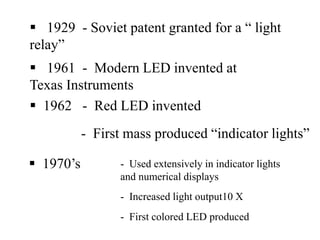
 1929 - Soviet patent granted for a “ light
relay”
 1961 - Modern LED invented at
Texas Instruments
 1962 - Red LED invented
- First mass produced “indicator lights”
 1970’s - Used extensively in indicator lights
and numerical displays
- Increased light output10 X
- First colored LED produced
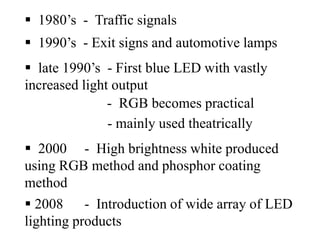
 1980’s - Traffic signals
 1990’s - Exit signs and automotive lamps
 late 1990’s - First blue LED with vastly
increased light output
- RGB becomes practical
- mainly used theatrically
 2000 - High brightness white produced
using RGB method and phosphor coating
method
 2008 - Introduction of wide array of LED
lighting products
What is an LED?
Light Emitting
Diode
Colour
White
Anatomy of an LED
How do LED’s Work?
Like a normal diode, the
LED consists of a chip
of semiconducting
material impregnated, or
doped with impurities to
create a p-n junction.
LED Basic Components
LED chips are made of silicone
(like computer chips) then
mounted in a “package” that has
some electrical leads and
sometimes a heat sink
LED’s Are Small
Which can make
for small fixtures
Currently Most LED’s Are Directional
The LED chip is located
in a little reflective cup
that sends the light in a
direction.
Which makes them good
for applications requiring a
spot light.
Currently Most LED’s Are Directional
But not so good for applications better
suited to omni directional lamps
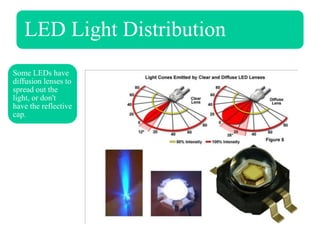
LED Light Distribution
Some LEDs have
diffusion lenses to
spread out the
light, or don't
have the reflective
cap.
Myth #1
LED’s Create No Heat
Light Output vs. Junction Temperature
Heat Management
Getting away
from the junction
is critical to LED
performance
*Life
*Lumen Output
The package is
then attached to a
heat sink that then
becomes a part of
either a lamp or a
luminaire.
LED fixtures need to dissipate heat differently than
incandescent fixtures.
Myth #2
LEDs last 100,000 hours
(or forever depending on who you ask!)
Myth #2
LEDs last 100,000 hours
(or forever depending on who you ask!)
Myth #3
LEDs are “White Light Sources”
Watts
_______
Efficiency: Lumens, Watts, & Efficacy
 Lumens: total “light”
 Watts: total power
 Efficacy: how much light for the power
(lumens per watt, LPW)
(similar to miles per gallon)
 Foot Candles: Light per square foot
on a surface
 Footcandles are what we measure
with a light meter
 Different tasks require different
levels of Footcandles
Color Rendering...
Color Rendering Index ( CRI )
How Natural And Normal
Do People And
Things Appear Under
Artificial Light?
CRI Scale goes from: 0 - 100,
with 100 being the best CRI
Color Rendering Index ( CRI )
STD. METAL HALIDE ( 65-70 )
DELUXE LUCALOX ( 65 )
100
90
80
70
60
50
40
30
20
10
0 LPS ( 0 )
CLEAR MERCURY ( 15 )
LUCALOX, HPS ( 22 )
COATED MERCURY ( 50 )
FLUORESCENT ( 60+ to 92 )
CMH (85+)
INCANDESCENT / HALOGEN (100)
DAYLIGHT MH ( 90 )
POORER
BETTER
The Perfect Light Source...
“The SUN”
Perfect
Color
Rendering
The Higher The Color temperature,
The “cooler” The Color
2700 o
4100 o Fluorescent
2200 o Incandescent
Lucalox
Common Colour Temperatures
Approx Temp. Light Source
8500K Blue Sky
6500K Daylight Fluorescent Lamp
6000K Clear Mercury Lamp
4500K Clear Metal Halide Lamp
4000K Cool White Fluorescent Lamp
3000K Halogen Lamp, WW Fluorescent
2500K 40 Watt Incandescent Lamp
2000K Candle, HP Sodium Lamp
Common Colour Temperatures
“White” LEDs
White light LEDs are
generally made by
taking a blue LED
and “doping” it with
yellow phosphors.
LEDs & Colour Temperature
Many so called
“White” LEDs
are a pale blue
colour, 5000-
6500K.
5000K
LEDs & Colour Temperature
Sometimes LED’s are marketed in a
warm colour temperature, very often
this is fairly cool. 3500-4000K
Its just warmer the “cool”
4000K 5000K
LEDs & Colour Temperature
If what you are
expecting is an
incandescent
replacement (2700-
3000K) then you may
be disappointed .
3000K 4000K 5000K
Currently few
LED’s are
consistently
available in that
warm a colour
temperature.
Junolightinggroup.com
• Online training e.luminance
The advantages of
LED’S
• Size
• Efficiency
• Life expectancy
• Dimmable
• Low temperatures
• Toxin free
The challenges of LED’S
• Cost
• Colour
• Directional distribution
• Performance
• Life expectancy of components
• Colour shift
• Interface with controls
• Replacement parts
The best applications of
LED’S

The-LED-Revolution.pptx

  • 1.
  • 2.
    Solid State Lightingis the most disruptive technology to hit the lighting industry in 60years.....
  • 3.
    LED technology willcreate the same disruptive revolution in the Lighting Industry as Digital Recording MP3 did in the Music Industry . 3. The market will change from a lamp replacement business into a system replacement business , resulting in a declining ( conventional) lamp business and a booming LED- module and systems business. Totally new players will enter the business challenging the existing players of which a few have positioned themselves well to emerge as successful future players . 2. It will fundamentally change today’s Lighting Industry which consists of a few global lamp manufacturers and thousands of local and regional fixture manufacturers . 1. LED technology will enable new possibilities for Lighting design in existing applications and open up new applications where the sky will be the limit.
  • 4.
    Customer says “I wantto use LEDs” What is their goal? Saving energy? Saving Money? Better Lighting? Being “Green”?
  • 5.
  • 6.
     1929 -Soviet patent granted for a “ light relay”  1961 - Modern LED invented at Texas Instruments  1962 - Red LED invented - First mass produced “indicator lights”  1970’s - Used extensively in indicator lights and numerical displays - Increased light output10 X - First colored LED produced
  • 7.
     1980’s -Traffic signals  1990’s - Exit signs and automotive lamps  late 1990’s - First blue LED with vastly increased light output - RGB becomes practical - mainly used theatrically  2000 - High brightness white produced using RGB method and phosphor coating method  2008 - Introduction of wide array of LED lighting products
  • 8.
    What is anLED? Light Emitting Diode Colour White
  • 9.
  • 10.
    How do LED’sWork? Like a normal diode, the LED consists of a chip of semiconducting material impregnated, or doped with impurities to create a p-n junction.
  • 11.
    LED Basic Components LEDchips are made of silicone (like computer chips) then mounted in a “package” that has some electrical leads and sometimes a heat sink
  • 12.
    LED’s Are Small Whichcan make for small fixtures
  • 13.
    Currently Most LED’sAre Directional The LED chip is located in a little reflective cup that sends the light in a direction. Which makes them good for applications requiring a spot light.
  • 14.
    Currently Most LED’sAre Directional But not so good for applications better suited to omni directional lamps
  • 15.
    LED Light Distribution SomeLEDs have diffusion lenses to spread out the light, or don't have the reflective cap.
  • 16.
  • 17.
    Light Output vs.Junction Temperature
  • 18.
    Heat Management Getting away fromthe junction is critical to LED performance *Life *Lumen Output The package is then attached to a heat sink that then becomes a part of either a lamp or a luminaire.
  • 19.
    LED fixtures needto dissipate heat differently than incandescent fixtures.
  • 20.
    Myth #2 LEDs last100,000 hours (or forever depending on who you ask!)
  • 21.
    Myth #2 LEDs last100,000 hours (or forever depending on who you ask!)
  • 22.
    Myth #3 LEDs are“White Light Sources”
  • 23.
    Watts _______ Efficiency: Lumens, Watts,& Efficacy  Lumens: total “light”  Watts: total power  Efficacy: how much light for the power (lumens per watt, LPW) (similar to miles per gallon)
  • 24.
     Foot Candles:Light per square foot on a surface  Footcandles are what we measure with a light meter  Different tasks require different levels of Footcandles
  • 25.
    Color Rendering... Color RenderingIndex ( CRI ) How Natural And Normal Do People And Things Appear Under Artificial Light? CRI Scale goes from: 0 - 100, with 100 being the best CRI
  • 26.
    Color Rendering Index( CRI ) STD. METAL HALIDE ( 65-70 ) DELUXE LUCALOX ( 65 ) 100 90 80 70 60 50 40 30 20 10 0 LPS ( 0 ) CLEAR MERCURY ( 15 ) LUCALOX, HPS ( 22 ) COATED MERCURY ( 50 ) FLUORESCENT ( 60+ to 92 ) CMH (85+) INCANDESCENT / HALOGEN (100) DAYLIGHT MH ( 90 ) POORER BETTER The Perfect Light Source... “The SUN” Perfect Color Rendering
  • 27.
    The Higher TheColor temperature, The “cooler” The Color 2700 o 4100 o Fluorescent 2200 o Incandescent Lucalox
  • 28.
    Common Colour Temperatures ApproxTemp. Light Source 8500K Blue Sky 6500K Daylight Fluorescent Lamp 6000K Clear Mercury Lamp 4500K Clear Metal Halide Lamp 4000K Cool White Fluorescent Lamp 3000K Halogen Lamp, WW Fluorescent 2500K 40 Watt Incandescent Lamp 2000K Candle, HP Sodium Lamp Common Colour Temperatures
  • 29.
    “White” LEDs White lightLEDs are generally made by taking a blue LED and “doping” it with yellow phosphors.
  • 30.
    LEDs & ColourTemperature Many so called “White” LEDs are a pale blue colour, 5000- 6500K. 5000K
  • 31.
    LEDs & ColourTemperature Sometimes LED’s are marketed in a warm colour temperature, very often this is fairly cool. 3500-4000K Its just warmer the “cool” 4000K 5000K
  • 32.
    LEDs & ColourTemperature If what you are expecting is an incandescent replacement (2700- 3000K) then you may be disappointed . 3000K 4000K 5000K Currently few LED’s are consistently available in that warm a colour temperature.
  • 36.
  • 37.
  • 38.
    • Size • Efficiency •Life expectancy • Dimmable • Low temperatures • Toxin free
  • 39.
  • 40.
    • Cost • Colour •Directional distribution • Performance • Life expectancy of components • Colour shift • Interface with controls • Replacement parts
  • 41.