ABHISHEK KUMAR 
2011EEC87
GREEN LED 
HOPE FOR A GREEN FUTURE 
THE FUTURE OF LIGHTING IS LED
HISTORY OF LIGHTING 
 SUN 
 PLANTS IN FORM OF PHOTOSYNTHESIS 
 BIRTH OF FUEL LAMPS 
 EDISON AND OTHERS INVENTED BULBS 
THAT WILL LAST FOR MAXIMUM 1500 
HOURS(1880 
 SHUJI NAKAMURA INVENTED FIRST 
BLUE AND WITH ADDITIONAL 
PHOSPHOR,WHITE LED AND STARS A 
LED BOOM
WHAT IS LED? 
LED are semiconductor p-n junctions that under forward bias conditions can emit 
radiation by electroluminescence in the UV, visible or infrared regions of the 
electromagnetic spectrum. The qaunta of light energy released is approximately 
proportional to the band gap of the semiconductor.
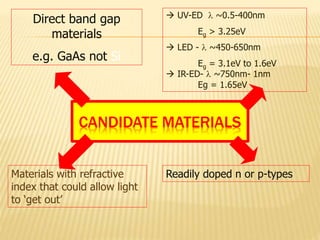
Direct band gap 
materials 
e.g. GaAs not Si 
 UV-ED  ~0.5-400nm 
Eg > 3.25eV 
 LED -  ~450-650nm 
Eg = 3.1eV to 1.6eV 
 IR-ED-  ~750nm- 1nm 
Eg = 1.65eV 
CANDIDATE MATERIALS 
Materials with refractive Readily doped n or p-types 
index that could allow light 
to ‘get out’
QUESTION 1 
Indicate the binary 
compounds that can be 
selected for red, yellow, 
green and blue LED.
CANDIDATE MATERIALS 
GROUP III-V & GROUP II-VI 
Group II Group III Group IV Group V 
iii iv v 
ii 
Al 
Ga 
In 
N 
P 
As 
Periodic Table to show group III-V and II-V binaries
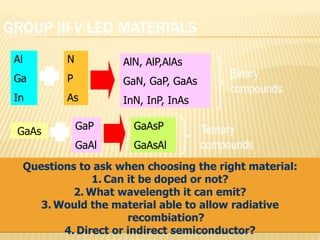
GROUP III-V LED MATERIALS 
Al 
Ga 
In 
N 
P 
As 
AlN, AlP,AlAs 
GaN, GaP, GaAs 
InN, InP, InAs 
GaAs 
GaP 
GaAl 
GaAsP 
GaAsAl 
Binary 
compounds 
Ternary 
compounds 
Questions to ask when choosing the right material: 
1. Can it be doped or not? 
2.What wavelength it can emit? 
3. Would the material able to allow radiative 
recombiation? 
4. Direct or indirect semiconductor?
STOKES SHIFT 
 Current bright blue LEDs are based on the 
wide band gap semiconductors GaN (gallium 
nitride) and InGaN (indium gallium nitride). 
 Among the challenges being faced to 
improve the efficiency of LED-based white 
light sources is the development of more 
efficient phosphors.
GREEN LED(NOBEL PRIZE WINNER-2014)
WHY LED IS GREEN? 
 A modern white LED lightblub converts more 
than 50 percent of the electricity it uses into 
light. 
 LEDs also last up to 100,000 hours, 
compared to 10,000 hours for fluorescent 
lights and 1,000 hours for incandescent 
bulbs. 
 REDUCE CARBON EMISSION
WHAT MADE IT POSSIBLE? 
 Gallium nitride, a chemical that appears in 
many of the layers in a blue LED. 
 The previous red and green LEDs used 
gallium phosphide, which was easier to 
produce. 
 Either by mixing the outputs of blue, red and 
green LEDs, or by exciting a phosphor 
material with a blue LED to generate green 
and red light
FUTURE SCOPE 
 REDUCING ENERGY CONSUMPTION 
 INCREASING AREAS OF APPLICATIONS 
 PROVIDING EACH AND EVERYONE IN 
THIS PLANET WITH THE GIFT OF 
ELECTRICITY.
TRUE WORDS INDEED 
“Engineers like to solve 
problems. If there are no 
problems handily avialable, 
they will create their own 
problems.”

Presentation1

  • 1.
  • 2.
    GREEN LED HOPEFOR A GREEN FUTURE THE FUTURE OF LIGHTING IS LED
  • 3.
    HISTORY OF LIGHTING  SUN  PLANTS IN FORM OF PHOTOSYNTHESIS  BIRTH OF FUEL LAMPS  EDISON AND OTHERS INVENTED BULBS THAT WILL LAST FOR MAXIMUM 1500 HOURS(1880  SHUJI NAKAMURA INVENTED FIRST BLUE AND WITH ADDITIONAL PHOSPHOR,WHITE LED AND STARS A LED BOOM
  • 4.
    WHAT IS LED? LED are semiconductor p-n junctions that under forward bias conditions can emit radiation by electroluminescence in the UV, visible or infrared regions of the electromagnetic spectrum. The qaunta of light energy released is approximately proportional to the band gap of the semiconductor.
  • 5.
    Direct band gap materials e.g. GaAs not Si  UV-ED  ~0.5-400nm Eg > 3.25eV  LED -  ~450-650nm Eg = 3.1eV to 1.6eV  IR-ED-  ~750nm- 1nm Eg = 1.65eV CANDIDATE MATERIALS Materials with refractive Readily doped n or p-types index that could allow light to ‘get out’
  • 6.
    QUESTION 1 Indicatethe binary compounds that can be selected for red, yellow, green and blue LED.
  • 7.
    CANDIDATE MATERIALS GROUPIII-V & GROUP II-VI Group II Group III Group IV Group V iii iv v ii Al Ga In N P As Periodic Table to show group III-V and II-V binaries
  • 8.
    GROUP III-V LEDMATERIALS Al Ga In N P As AlN, AlP,AlAs GaN, GaP, GaAs InN, InP, InAs GaAs GaP GaAl GaAsP GaAsAl Binary compounds Ternary compounds Questions to ask when choosing the right material: 1. Can it be doped or not? 2.What wavelength it can emit? 3. Would the material able to allow radiative recombiation? 4. Direct or indirect semiconductor?
  • 9.
    STOKES SHIFT Current bright blue LEDs are based on the wide band gap semiconductors GaN (gallium nitride) and InGaN (indium gallium nitride).  Among the challenges being faced to improve the efficiency of LED-based white light sources is the development of more efficient phosphors.
  • 10.
  • 11.
    WHY LED ISGREEN?  A modern white LED lightblub converts more than 50 percent of the electricity it uses into light.  LEDs also last up to 100,000 hours, compared to 10,000 hours for fluorescent lights and 1,000 hours for incandescent bulbs.  REDUCE CARBON EMISSION
  • 12.
    WHAT MADE ITPOSSIBLE?  Gallium nitride, a chemical that appears in many of the layers in a blue LED.  The previous red and green LEDs used gallium phosphide, which was easier to produce.  Either by mixing the outputs of blue, red and green LEDs, or by exciting a phosphor material with a blue LED to generate green and red light
  • 13.
    FUTURE SCOPE REDUCING ENERGY CONSUMPTION  INCREASING AREAS OF APPLICATIONS  PROVIDING EACH AND EVERYONE IN THIS PLANET WITH THE GIFT OF ELECTRICITY.
  • 14.
    TRUE WORDS INDEED “Engineers like to solve problems. If there are no problems handily avialable, they will create their own problems.”