 We are inhabited by as many as ten thousand bacterial
species , those cells outnumber those which we
consider our own by ten to one ,and weight all told
about three pounds(1360grams) __ the same as our
brain.
 Together, they are referred to as microbiome___ and
play such a crucial role in our lives that scientists have
begun to reconsider what it means to be human.
Michael Specter
MICROBIOME : Microbiome refers to the collection
of genomes from all the microorganisms in the
enviroment.
MICROBIOTA: Microbiota refer to all the
microorganisms found in an environment, including
bacteria, viruses,and fungi.
 In a healthy human the internal tissues (
brain, blood ,muscles) are normally free
from microorganisms.
 The surface tissues (skin and mucous
membranes ) are constantly in contact with
environmental microorganisms and
become readily colonized by certain
microbial species.
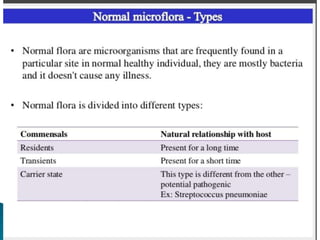
 The mixture of microorganisms
regularly found at any anatomical
site is referred to as to as the normal
microbiota , microflora or normal
flora.
 Bacteria make up most of the normal
microbiota , they are emphasised
over the fungi and protozoa.
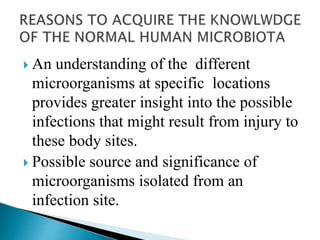
 An understanding of the different
microorganisms at specific locations
provides greater insight into the possible
infections that might result from injury to
these body sites.
 Possible source and significance of
microorganisms isolated from an
infection site.
 To understand the causes and
consequences of colonization and growth
by microorganisms normally absent at a
specific body site.
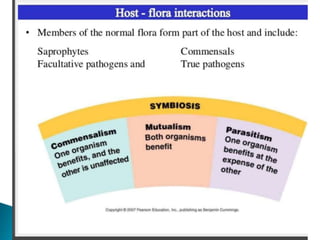
 Normal microflora apply an important
role in stimulating the host immune
response . This awareness is important
because the immune system provides
protection against potential pathogens.
Unfavourable habitat for microorganisms :
 Has many areas subject to periodic drying .
 Acidic ph
 High sodium chloride concentration
Most skin microbes are associated with glands
 Eccrine glands: dispersed sweat glands
 Apocrine glands : sweat glands activated during
puberty.
 Sebaceous glands : with each hair follicle.
Gland secretions contain water , amino acids,
urea, salts,and fatty acids that can serve as
nutrients.
Staphylococcus epidermidis –found in regions
of high moisture.
Major inhabitant making up more than 90% of
the flora.
 S. aureus – nose ,
Occurrence in nasal passages varies with age being
greatest in newborn and less in adults.
 Micrococci, Diptheroids ,Propionibacterium
Eg. P. acnes = children younger than 10 years are rarely
colonized with it.
It is a gram positive bacteria, round in shape and appear in the
form grapes cluster.
Disease caused:- it can cause a range of illness, from minor
skin infections to, such as pimples, impetigo, boils, cellulitis,
folliculitis, carbuncles, scalded skin syndrome etc……..
Prevention:- Prevention of diseases caused by S.aureus is by
using peptide RIP (RNAΙΙΙ inhibiting peptide)
Beneficial effects:- It is beneficial to human host as it kills the
pathogenic and by inhibiting and killing non indigenous
microorganisms .
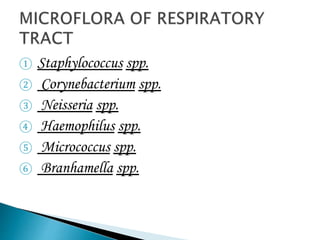
① Staphylococcus spp.
② Corynebacterium spp.
③ Neisseria spp.
④ Haemophilus spp.
⑤ Micrococcus spp.
⑥ Branhamella spp.
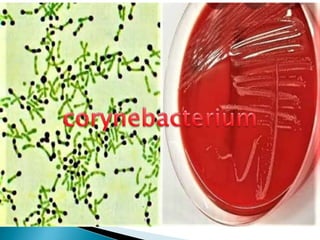
Corynebacterium spp.
Corynebacterium is a genus of bacteria that are Gram positive and
aerobic , club shaped, which inspired the genus name.
ROLE IN DISEASES
 The most noteable human infection is diphthera, caused by
C.diphtheriae.
 It is an acute and contagious infection characterized by
psedumembranes of dead epithelial cells, red blood cells that form
around the tonsils and back of the throat.
 In developed countries it is an uncommon illness that tend to
occur in unvaccinated indiviuals, especially school aged children
or immunocompromised patients and those with prosthetic
devices such as shunts.
 Treatments include antibiotics and an antitoxin that
neutralises the diphtheria toxin.
 Antibiotics such as penicillin or erythromycin.
 Vaccine is also avaliable. DTap ,Tdap DT, etc.
• Streptococcus spp.
• Staphylococcus spp.
• Lactobacillus spp.
• Peptostreptococcus spp.
 Some lactobacillus species have been associated
with cases of dental caries (cavities). Lactic acid
produced by these corrode teeth.
 Lactobacillus species produce hydrogen peroxide
which inhibit the growth and virulence of the
fungal pathogen Candida albacins in vitro and in
vivo.
Treatment:-
Following antibiotic therapy, certain Candida species
can suppress the regrowth of Lactobacillus species at
body sites where they cohabitate, such as in the
gastrointestinal tract.
• Lactobacillus spp.
• Clostridium spp.
• Mycobacterium spp.
• Enterococci
• Enterobacteriaceae
• Streptococcus spp.
• Pseudomonas spp.
It belongs to the family of gram negative
bacteria.
Disease:-
Enterobacterial infections are the infections caused by group of
rod shaped bacteria called Enterobacteriaceae.
Symptoms:-
Production of diarrhea, vomiting for more than3days, fever
greater than 102◦C . etc…..
Beneficial effects :-
Some enterobacteria produce endotoxins. Endotoxins reside in
the cell wall and are released when the cell dies and the cell wall
disintegrates.
A. Lactobacillus spp.
B. Peptostreptococcus spp.
C. Diphtheroids
D. Streptococcus spp.
E. Clostridium spp.
F. Bacteroids
G. Candida spp.
H. Gardnerella vaginalis
 Lactobacilli have been shown to inhibit in vitro growth of
pathogenic microorganisms, e.g. Bacteroides fragilis
 Moreover, lactobacilli normally help to prevent long-
term colonization of the vagina by adhering to vaginal
epithelial cells. This usually reduces pathogens from
infecting to the vaginal epithelium.
 A yeast infection can cause itching or soreness in the vagina
and sometimes causes pain or burning when you urinate.
Some women's also have a thick ,clumpy, white discharge
that has no odor.
Cause of vaginal yeast infections
 Most of these infections are caused by Candida albicans.
The most common bacteria ,Lactobacillus acidophilus , help in
keeping other yeast and bacteria under control.
When something happens to change in the balances of these
microorganism ,yeast can grow too much and cause infections.
PREVENTION
 Practice good hygiene.
 Avoid scented sprays .
 Keep vagina clean and dry.
 Probiotics are also helpful in fighting yeast
infections .
TREATMENT
 Antifungal creams can be applied . Some
common brands are Monisat, Vagistat.
 Use of tea tree oil is effective property.
MICROFLORA.pptx
MICROFLORA.pptx
MICROFLORA.pptx
MICROFLORA.pptx

MICROFLORA.pptx

  • 2.
     We areinhabited by as many as ten thousand bacterial species , those cells outnumber those which we consider our own by ten to one ,and weight all told about three pounds(1360grams) __ the same as our brain.  Together, they are referred to as microbiome___ and play such a crucial role in our lives that scientists have begun to reconsider what it means to be human. Michael Specter
  • 3.
    MICROBIOME : Microbiomerefers to the collection of genomes from all the microorganisms in the enviroment. MICROBIOTA: Microbiota refer to all the microorganisms found in an environment, including bacteria, viruses,and fungi.
  • 4.
     In ahealthy human the internal tissues ( brain, blood ,muscles) are normally free from microorganisms.  The surface tissues (skin and mucous membranes ) are constantly in contact with environmental microorganisms and become readily colonized by certain microbial species.
  • 5.
     The mixtureof microorganisms regularly found at any anatomical site is referred to as to as the normal microbiota , microflora or normal flora.  Bacteria make up most of the normal microbiota , they are emphasised over the fungi and protozoa.
  • 6.
     An understandingof the different microorganisms at specific locations provides greater insight into the possible infections that might result from injury to these body sites.  Possible source and significance of microorganisms isolated from an infection site.
  • 7.
     To understandthe causes and consequences of colonization and growth by microorganisms normally absent at a specific body site.  Normal microflora apply an important role in stimulating the host immune response . This awareness is important because the immune system provides protection against potential pathogens.
  • 16.
    Unfavourable habitat formicroorganisms :  Has many areas subject to periodic drying .  Acidic ph  High sodium chloride concentration Most skin microbes are associated with glands  Eccrine glands: dispersed sweat glands  Apocrine glands : sweat glands activated during puberty.  Sebaceous glands : with each hair follicle.
  • 17.
    Gland secretions containwater , amino acids, urea, salts,and fatty acids that can serve as nutrients. Staphylococcus epidermidis –found in regions of high moisture. Major inhabitant making up more than 90% of the flora.
  • 18.
     S. aureus– nose , Occurrence in nasal passages varies with age being greatest in newborn and less in adults.  Micrococci, Diptheroids ,Propionibacterium Eg. P. acnes = children younger than 10 years are rarely colonized with it.
  • 19.
    It is agram positive bacteria, round in shape and appear in the form grapes cluster. Disease caused:- it can cause a range of illness, from minor skin infections to, such as pimples, impetigo, boils, cellulitis, folliculitis, carbuncles, scalded skin syndrome etc…….. Prevention:- Prevention of diseases caused by S.aureus is by using peptide RIP (RNAΙΙΙ inhibiting peptide) Beneficial effects:- It is beneficial to human host as it kills the pathogenic and by inhibiting and killing non indigenous microorganisms .
  • 21.
    ① Staphylococcus spp. ②Corynebacterium spp. ③ Neisseria spp. ④ Haemophilus spp. ⑤ Micrococcus spp. ⑥ Branhamella spp.
  • 22.
    Corynebacterium spp. Corynebacterium isa genus of bacteria that are Gram positive and aerobic , club shaped, which inspired the genus name. ROLE IN DISEASES  The most noteable human infection is diphthera, caused by C.diphtheriae.  It is an acute and contagious infection characterized by psedumembranes of dead epithelial cells, red blood cells that form around the tonsils and back of the throat.  In developed countries it is an uncommon illness that tend to occur in unvaccinated indiviuals, especially school aged children or immunocompromised patients and those with prosthetic devices such as shunts.
  • 24.
     Treatments includeantibiotics and an antitoxin that neutralises the diphtheria toxin.  Antibiotics such as penicillin or erythromycin.  Vaccine is also avaliable. DTap ,Tdap DT, etc.
  • 25.
    • Streptococcus spp. •Staphylococcus spp. • Lactobacillus spp. • Peptostreptococcus spp.
  • 26.
     Some lactobacillusspecies have been associated with cases of dental caries (cavities). Lactic acid produced by these corrode teeth.  Lactobacillus species produce hydrogen peroxide which inhibit the growth and virulence of the fungal pathogen Candida albacins in vitro and in vivo. Treatment:- Following antibiotic therapy, certain Candida species can suppress the regrowth of Lactobacillus species at body sites where they cohabitate, such as in the gastrointestinal tract.
  • 27.
    • Lactobacillus spp. •Clostridium spp. • Mycobacterium spp. • Enterococci • Enterobacteriaceae • Streptococcus spp. • Pseudomonas spp.
  • 28.
    It belongs tothe family of gram negative bacteria. Disease:- Enterobacterial infections are the infections caused by group of rod shaped bacteria called Enterobacteriaceae. Symptoms:- Production of diarrhea, vomiting for more than3days, fever greater than 102◦C . etc….. Beneficial effects :- Some enterobacteria produce endotoxins. Endotoxins reside in the cell wall and are released when the cell dies and the cell wall disintegrates.
  • 29.
    A. Lactobacillus spp. B.Peptostreptococcus spp. C. Diphtheroids D. Streptococcus spp. E. Clostridium spp. F. Bacteroids G. Candida spp. H. Gardnerella vaginalis
  • 30.
     Lactobacilli havebeen shown to inhibit in vitro growth of pathogenic microorganisms, e.g. Bacteroides fragilis  Moreover, lactobacilli normally help to prevent long- term colonization of the vagina by adhering to vaginal epithelial cells. This usually reduces pathogens from infecting to the vaginal epithelium.
  • 31.
     A yeastinfection can cause itching or soreness in the vagina and sometimes causes pain or burning when you urinate. Some women's also have a thick ,clumpy, white discharge that has no odor. Cause of vaginal yeast infections  Most of these infections are caused by Candida albicans. The most common bacteria ,Lactobacillus acidophilus , help in keeping other yeast and bacteria under control. When something happens to change in the balances of these microorganism ,yeast can grow too much and cause infections.
  • 32.
    PREVENTION  Practice goodhygiene.  Avoid scented sprays .  Keep vagina clean and dry.  Probiotics are also helpful in fighting yeast infections . TREATMENT  Antifungal creams can be applied . Some common brands are Monisat, Vagistat.  Use of tea tree oil is effective property.