CENTRAL UNIVERSITY OF HIMACHAL PRADESH
Department of Chemistry and Chemical Sciences
PRESENTATION TOPIC:-LEVELS OF PROTEIN STRUCTURES.
PRESENTED TO:-Dr.NEERAJ GUPTA.
PRESENTED BY:-Kanupriya (M.Sc. Chemistry).
ROLLNO.:- CUHP19CCS11.
PROTEINS
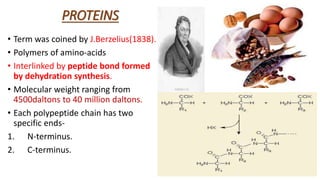
• Term was coined by J.Berzelius(1838).
• Polymers of amino-acids
• Interlinked by peptide bond formed
by dehydration synthesis.
• Molecular weight ranging from
4500daltons to 40 million daltons.
• Each polypeptide chain has two
specific ends-
1. N-terminus.
2. C-terminus.
STRUCTURAL ORGANIZATION OF PROTEINS.
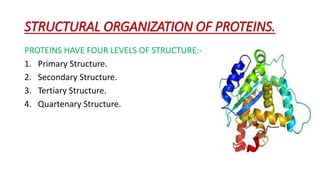
PROTEINS HAVE FOUR LEVELS OF STRUCTURE:-
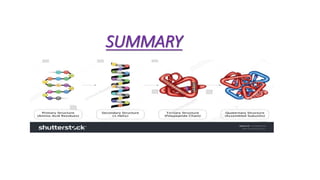
1. Primary Structure.
2. Secondary Structure.
3. Tertiary Structure.
4. Quartenary Structure.
PRIMARY STRUCTURE
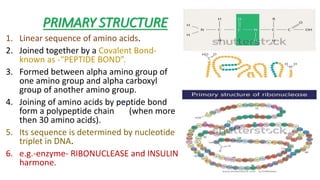
1. Linear sequence of amino acids.
2. Joined together by a Covalent Bond-
known as -“PEPTIDE BOND”.
3. Formed between alpha amino group of
one amino group and alpha carboxyl
group of another amino group.
4. Joining of amino acids by peptide bond
form a polypeptide chain (when more
then 30 amino acids).
5. Its sequence is determined by nucleotide
triplet in DNA.
6. e.g.-enzyme- RIBONUCLEASE and INSULIN
harmone.
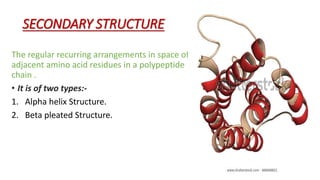
SECONDARY STRUCTURE
The regular recurring arrangements in space of
adjacent amino acid residues in a polypeptide
chain .
• It is of two types:-
1. Alpha helix Structure.
2. Beta pleated Structure.
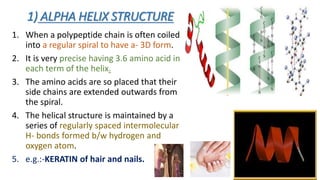
1) ALPHA HELIX STRUCTURE
1. When a polypeptide chain is often coiled
into a regular spiral to have a- 3D form.
2. It is very precise having 3.6 amino acid in
each term of the helix.
3. The amino acids are so placed that their
side chains are extended outwards from
the spiral.
4. The helical structure is maintained by a
series of regularly spaced intermolecular
H- bonds formed b/w hydrogen and
oxygen atom.
5. e.g.:-KERATIN of hair and nails.
2) BETA-PLEATED STRUCTURE.
1. Two or more polypeptide chains joined
together by intermolecular H-bonds and may
bend into parallel folds which by H-bonding
assume to form a pleated structure.
2. In a pleated structure the adjacent
polypeptide chains may run in the same
direction (Parallel pleated) or in opposite
direction (Antiparallel pleated sheet).
3. e.g.:-Antibodies .
Protein of silk fibre.
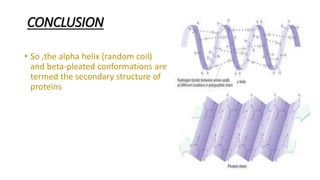
CONCLUSION
• So ,the alpha helix (random coil)
and beta-pleated conformations are
termed the secondary structure of
proteins
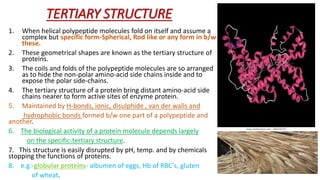
TERTIARY STRUCTURE
1. When helical polypeptide molecules fold on itself and assume a
complex but specific form-Spherical, Rod like or any form in b/w
these.
2. These geometrical shapes are known as the tertiary structure of
proteins.
3. The coils and folds of the polypeptide molecules are so arranged
as to hide the non-polar amino-acid side chains inside and to
expose the polar side-chains.
4. The tertiary structure of a protein bring distant amino-acid side
chains nearer to form active sites of enzyme protein.
5. Maintained by H-bonds, ionic, disulphide , van der walls and
hydrophobic bonds formed b/w one part of a polypeptide and
another.
6. The biological activity of a protein molecule depends largely
on the specific-tertiary structure.
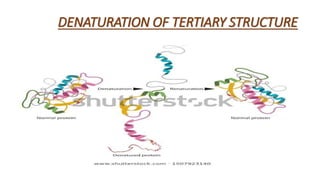
7. This structure is easily disrupted by pH, temp. and by chemicals
stopping the functions of proteins.
8. e.g:-globular proteins- albumen of eggs, Hb of RBC’s, gluten
of wheat.
DENATURATION OF TERTIARY STRUCTURE
QUARTERNARY STRUCTURE
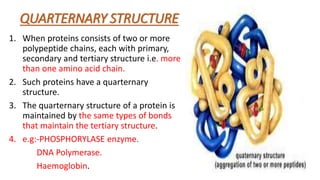
1. When proteins consists of two or more
polypeptide chains, each with primary,
secondary and tertiary structure i.e. more
than one amino acid chain.
2. Such proteins have a quarternary
structure.
3. The quarternary structure of a protein is
maintained by the same types of bonds
that maintain the tertiary structure.
4. e.g:-PHOSPHORYLASE enzyme.
DNA Polymerase.
Haemoglobin.
SUMMARY
THANKYOU

Presentation on proteins.pdf

  • 1.
    CENTRAL UNIVERSITY OFHIMACHAL PRADESH Department of Chemistry and Chemical Sciences PRESENTATION TOPIC:-LEVELS OF PROTEIN STRUCTURES. PRESENTED TO:-Dr.NEERAJ GUPTA. PRESENTED BY:-Kanupriya (M.Sc. Chemistry). ROLLNO.:- CUHP19CCS11.
  • 2.
    PROTEINS • Term wascoined by J.Berzelius(1838). • Polymers of amino-acids • Interlinked by peptide bond formed by dehydration synthesis. • Molecular weight ranging from 4500daltons to 40 million daltons. • Each polypeptide chain has two specific ends- 1. N-terminus. 2. C-terminus.
  • 3.
    STRUCTURAL ORGANIZATION OFPROTEINS. PROTEINS HAVE FOUR LEVELS OF STRUCTURE:- 1. Primary Structure. 2. Secondary Structure. 3. Tertiary Structure. 4. Quartenary Structure.
  • 4.
    PRIMARY STRUCTURE 1. Linearsequence of amino acids. 2. Joined together by a Covalent Bond- known as -“PEPTIDE BOND”. 3. Formed between alpha amino group of one amino group and alpha carboxyl group of another amino group. 4. Joining of amino acids by peptide bond form a polypeptide chain (when more then 30 amino acids). 5. Its sequence is determined by nucleotide triplet in DNA. 6. e.g.-enzyme- RIBONUCLEASE and INSULIN harmone.
  • 5.
    SECONDARY STRUCTURE The regularrecurring arrangements in space of adjacent amino acid residues in a polypeptide chain . • It is of two types:- 1. Alpha helix Structure. 2. Beta pleated Structure.
  • 6.
    1) ALPHA HELIXSTRUCTURE 1. When a polypeptide chain is often coiled into a regular spiral to have a- 3D form. 2. It is very precise having 3.6 amino acid in each term of the helix. 3. The amino acids are so placed that their side chains are extended outwards from the spiral. 4. The helical structure is maintained by a series of regularly spaced intermolecular H- bonds formed b/w hydrogen and oxygen atom. 5. e.g.:-KERATIN of hair and nails.
  • 7.
    2) BETA-PLEATED STRUCTURE. 1.Two or more polypeptide chains joined together by intermolecular H-bonds and may bend into parallel folds which by H-bonding assume to form a pleated structure. 2. In a pleated structure the adjacent polypeptide chains may run in the same direction (Parallel pleated) or in opposite direction (Antiparallel pleated sheet). 3. e.g.:-Antibodies . Protein of silk fibre.
  • 8.
    CONCLUSION • So ,thealpha helix (random coil) and beta-pleated conformations are termed the secondary structure of proteins
  • 9.
    TERTIARY STRUCTURE 1. Whenhelical polypeptide molecules fold on itself and assume a complex but specific form-Spherical, Rod like or any form in b/w these. 2. These geometrical shapes are known as the tertiary structure of proteins. 3. The coils and folds of the polypeptide molecules are so arranged as to hide the non-polar amino-acid side chains inside and to expose the polar side-chains. 4. The tertiary structure of a protein bring distant amino-acid side chains nearer to form active sites of enzyme protein. 5. Maintained by H-bonds, ionic, disulphide , van der walls and hydrophobic bonds formed b/w one part of a polypeptide and another. 6. The biological activity of a protein molecule depends largely on the specific-tertiary structure. 7. This structure is easily disrupted by pH, temp. and by chemicals stopping the functions of proteins. 8. e.g:-globular proteins- albumen of eggs, Hb of RBC’s, gluten of wheat.
  • 10.
  • 11.
    QUARTERNARY STRUCTURE 1. Whenproteins consists of two or more polypeptide chains, each with primary, secondary and tertiary structure i.e. more than one amino acid chain. 2. Such proteins have a quarternary structure. 3. The quarternary structure of a protein is maintained by the same types of bonds that maintain the tertiary structure. 4. e.g:-PHOSPHORYLASE enzyme. DNA Polymerase. Haemoglobin.
  • 12.
  • 13.