CATALYSIS BY SOLID BASES
(A green approach towards sustainable development of chemical industry)
Submitted to – Dr. Neeraj Gupta.
Course Code – CCS 564.
Course Name – Asymmetric Organic
Catalysis Synthesis.
Presented by - Kanupriya and
Shagun.
M.Sc. Chemistry(4thsem)
CUHP19CCS11
CUHP19CCS24
INTRODUCTION
In contrast with extensive studies on solid acids, fewer
efforts have been devoted to heterogeneous basic catalysts
(solid base catalysts). The first study on the heterogeneous
base catalyst was reported by Pines and Haag, who showed
that the sodium metal dispersed on alumina was an effective
catalyst for double-bond isomerization of alkenes. In 1970,
Tanabe published a book entitled Solid Acids and Bases. This
was an epoch-making book which made the term “SOLID
BASE” more popular in the catalysis community
SOLID BASES
The solids having the sites which serve as a Bronsted base and/or
Lewis base are called SOLID BASES. These are used in place of liquid
bases like NaOH, KOH etc.
AH B
- A
- BH
A B A B
A] Bronsted-Lowery concept of conjugate acid -base pair-
B] LEWIS -Base concept -
lewis base
BASE Conjugate-acid
The solids having the sites which serve as a Bronsted base and/or
Lewis base are called SOLID BASES.
With Proton Abstraction- On the surface of solid bases, there are
specific sites or centers, which function as a base. Basic
sites(centers) abstract protons from the reactant molecules(AH) to
form a carbanion(A-).Here the basic site act as a bronsted base.
AH B
-
A
- BH
BASE Conjugate-acid
Activation of reactants on SOLID BASES- It occurs by
two ways-
1]
2] Without Proton Abstraction- Reactants such as ketones and
aldehydes are often activated by bases without proton transfer, here
the basic sites B- act as lewis base. This kind of interaction is important
in many base-catalysed reactions such as Aldol-
Condensations,Knoevenagel condensation and hydrogen transfer
reactions.
C O B
- H3C
B
O-
• WHY SOLID BASES ARE SO
IMPORTANT FOR CHEMICAL
SYNTHESIS
 Carbanions are important intermediates in many organic
reactions, such as isomerization, additions, condensations
and alkylations. These organic reactions often require a
stoichiometric amount of liquid bases to generate
carbanions and produce a stoichiometric amount of metal
salts as by-product.
 In solid-base catalyzed reactions, solvents must dissolve
only reactants (and products). This considerably expands
the choice of solvents. It is known that the solvent effects in
solid-base catalyzed reactions are different from those in
the corresponding homogeneous reactions.
PhCH2CN CH3I NaOH NaI H2O
1] CONVENTIONAL METHOD - The Methylation of Phenylacetonitrile with
Methyl Iodide proceeds in the presence of Bases under a Phase-Transfer
Condition.
SN2
REACTION
PhCH(CH3)CN
2] GREEN APPROACH - The methylation of Phenylacetonitrile by using methanol
or Dimethyl carbonate as the methylating agent and alkali-exchanged zeolites as
catalysts. The reaction can be performed in vapour phase.
PhCH2CN CH3OH
ZEOLITES
Phenylacetonitrile Base(needed in
stochiometric amounts)
Toxic
reagent
Inorganic salt(disposing
problem)
PhCH(CH3)CN H2O
Phenylacetonitrile
SN2 REACTION
COMPARISON B/W CONVENTIONAL
AND GREEN METHODS -
Green by product
Examples of reactions
catalysed by SOLID BASES
 The ALDOL CONDENSATION is a key step in the production of several
commodity chemicals, including the solvent Methylisobutylketone (MIBK) and
2-Ethylhexanol. More than 1 million tons of these chemicals are produced
worldwide on an annual basis using homogeneous bases such as 30% aqueous
caustic (NaOH) .
PROBLEMS- Major problems are associated with the safe handling of
the 30% caustic and treatment of caustic contaminated waste streams. About 1
kg of spent catalyst is generated per 10 kg of product and it has been estimated
that 30% of the selling price is related to product recovery, purification and
waste treatment.
O O
NaOH
CH2
CH3
H
O O
O
O
-
OH-
-
O
H H
O
O H
α
β
H H
-OH-
NaOH
Δ
O
α
β
H
H
H
O
-H20
O
β
H
α
Acetone
Enolate
3] Protonation
4] Dehydration α,β-Unsaturated ketone
1] Abstraction of proton 2] Enolate attack
General Mechanism Of
ALDOL-CONDENSATION-
Green Approach -1) HYDROTALCITE
(Anionic Clays )
 Hydrotalcite is a natural mineral with the approximate formula
Mg6Al2(OH)16CO3.4H2O, having a structure similar to Brucite, Mg(OH)2.
 In hydrotalcite the Mg2+ cations are partially replaced with Al3+ and the resulting
positive charge is compensated by anions, typically carbonate(CO3
2-), in the
interlamellar space b/w the brucite like sheets.
 When Hydrotalcite is calcined at 5000C it is decarbonated and dehydrated to afford
a strongly basic mixed Mg/Al oxide.
 Rehydration restores the original hydrotalcite structure and creates Bronsted base
sites(OH-) in the interlamellar space.
 Activated hydrotalcites prepared in this way have been used as solid base catalysts in
e.g., the aldol and related reactions.
 Impregnation of the Hydrotalcite with Pd or Ni affords bifunctional catalyst which
are able to mediate the one pot reductive aldol condensation of acetone to 2-
ethylhexanol or MIBK, respectively.
Structure Comparison b/w
Brucite and Hydrotalcite
Brucite Hydrotalcite
Mg2+
Al3+
Anions
OH-
1
2
ALDOL CONDENSATION BY HYDROTALCITE AS A
BASE IN PLACE NaOH
CH2OH
2-Ethylhexanol
[Methylisobutylketone]
(MIBK) and 2-ethylhexanol, the precursor of the PVC
plasticizer, and are used in Paints.
2) IONONE SYNTHESIS BY
CONVENTIONAL METHOD
IONONES are commercially obtained through a
conventional homogenous catalytic process involving
many operations -
1. The first step consists is the obtention of Pseudoionones catalysed by
KOH solution. Citral conversion is close to 60% and Pseudoionone
selectivity comes close to 80%.
2. The second step is the obtention of alpha and beta-ionone through
the cyclisation of Pseudoionones in acid media. In this process
conversion is almost 60%.Alpha and beta-ionone selectivities depend
on the strength of the acid as a catalyst. Alpha ionone is obtained in
the presence of weak acids and strong acids are used for beta-
ionone.
3. Operations such as Neutralization, Washing, Phase separations and
Vaccum distillations are associated with both steps.
O
OH
-
Pseudoionone
Acetone
Citral
CH CHCOCH3
CH CHCOCH3
OR
CH CHCOCH3
β - ionone
H+
+
Conventional Method - IONONE
SYNTHESIS BY ALDOL-CONDENSATION
[Aldol Condensation]
60% conv.
80% selectivity
1
2
3
4
α - ionone
Me
O
Me
Me Me
Me
Me
CHCCH3
O
Me
Me
Me
CH
Me
Me Me
H
H
α
β
α
β
α
β
CH CHCOCH3
CYCLIZATION
GREEN SYNTHETIC ROUTE FOR IONONE
SYNTHESIS USING HTDROTALCITE
1) The substitution of this conventional process by heterogenous
catalysis can reduce the consumption of reactants and no.of steps
involved e.g., the neutralization and washing steps can be eliminated
and substituted by filtration stages.
2) In addition the possibility of selecting the most active and/or the
most selective catalyst can increase the total yield of the desired
products and can also reduce by- product formation and thereby
simplifying the distillation step.
O CH CHCOCH3
Pseudoionone
Acetone
Citral
CH CHCOCH3
OR
CH CHCOCH3
α - ionone β - ionone
[Aldol Condensation]
>95% conv.
70% selectivity
HYDROTALCITE
HYDROTALCITE method for the
synthesis of IONONES
1
2
Ionones are used in perfume
industry.
CHO
α
β
α
β
2) Zeolites as Solid Bases –
Zeolites are crystalline aluminosilicates with pores of molecular dimensions.
General formula = M[(AlO2) x(SiO2) y].MH2O
AlO2and SiO2 are fundamental units sharing oxygen ions to form tetrahedral Al04
and SiO4 building blocks for zeolite unit cell.
Basic zeolites are of following types
1. Alkali cation exchange zeolites -
Catalytic activity - The catalytic activities of alkali cation exchange zeolites increases with an
increase in Al/Si ratio zeolites framework.
Charges of negative oxygen for a series of alkali cation exchanged zeolites are of order :
Li < Na < K <Rb <Cs
The basicity therefore follows the order :
Li< Na < K < Rb<Cs
2. Alkali metal oxide loaded zeolites -
Alkali metal oxide loaded zeolites are strong bases and can be generated within the pores and
cavities of zeolites by over exchanging them with an appropriate metal salt to offer highly dispersed
basic oxide occluded in the pores and cavities.
3. Alkali metal loaded zeolites -
Alkali metal loaded zeolites show significant catalytic activity for several reactions for which alkali
cation exchange or alkali metal oxide zeolites show no activity.
Reactions catalysed by Basic Zeolites
Knoevenagel condensation :-
1. It is very important reaction in organic synthesis.
2. It is the key step in manufacture of flavors and fragrances,
pharmaceuticals, and other specialty chemicals.
3. The condensation is classically catalysed by bases in liquid
system.
Conventional route -
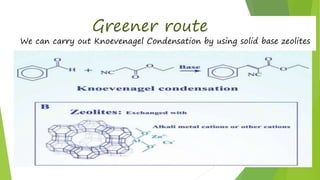
Greener route
We can carry out Knoevenagel Condensation by using solid base zeolites
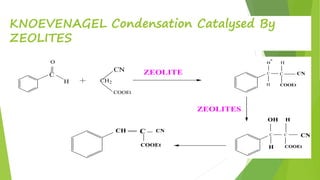
KNOEVENAGEL Condensation Catalysed By
ZEOLITES
C
O
H CH2
CN
COOEt
C
O
-
H
ZEOLITE C
H
COOEt
CN
C
OH
H
C CN
H
COOEt
CH C CN
COOEt
ZEOLITES
Amines and Ammonium ion tethered
to solid surfaces -
1. Amines and ammonium ions are common catalysts for base catalysed
reactions.
2. By immobilizing, these basic moieties and making them a heterogeneous
catalyst we can catalyze a no. of reactions.
 Loading of basic functional groups to high surface area SILICA materials.
A. Grafting method -
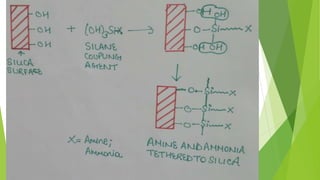
The most common method for tethering of amino and ammonium groups to
solid surfaces is the reaction of hydroxyl group of silica with silane coupling
agent having these functional groups. Silane coupling agents have the general
formula
(OR) 3-Si-R'-X where X will be amine or ammonia containing groups.
 Examples - MCM-41, TBD etc.
Knoevenagel condensation catalysed by
amine and ammonia group
immobilized on silica -
Advantages of Solid Base Catalysts -
1. No aqueous waste streams.
2. Recyclable.
3. Easy separation.
4. Safer to use.
5. Reduces production cost.
6. Reduces environmental burden associated with disposal.
7. No inorganic salts formation.
8. Choice of solvents .
9. Reduce energy requirements.
10.High activity and selectivity.
11.Catalytic amount is required.
12.Solid base catalyst system afford much more environmental benign reactions
system than the system using liquid bases. They offer high possibility of new
catalytic reactions which can not be achieved through homogenous catalysis.
Catalysis by solid bases [recovered] [autosaved]

Catalysis by solid bases [recovered] [autosaved]

  • 1.
    CATALYSIS BY SOLIDBASES (A green approach towards sustainable development of chemical industry) Submitted to – Dr. Neeraj Gupta. Course Code – CCS 564. Course Name – Asymmetric Organic Catalysis Synthesis. Presented by - Kanupriya and Shagun. M.Sc. Chemistry(4thsem) CUHP19CCS11 CUHP19CCS24
  • 2.
    INTRODUCTION In contrast withextensive studies on solid acids, fewer efforts have been devoted to heterogeneous basic catalysts (solid base catalysts). The first study on the heterogeneous base catalyst was reported by Pines and Haag, who showed that the sodium metal dispersed on alumina was an effective catalyst for double-bond isomerization of alkenes. In 1970, Tanabe published a book entitled Solid Acids and Bases. This was an epoch-making book which made the term “SOLID BASE” more popular in the catalysis community
  • 3.
    SOLID BASES The solidshaving the sites which serve as a Bronsted base and/or Lewis base are called SOLID BASES. These are used in place of liquid bases like NaOH, KOH etc. AH B - A - BH A B A B A] Bronsted-Lowery concept of conjugate acid -base pair- B] LEWIS -Base concept - lewis base BASE Conjugate-acid The solids having the sites which serve as a Bronsted base and/or Lewis base are called SOLID BASES.
  • 4.
    With Proton Abstraction-On the surface of solid bases, there are specific sites or centers, which function as a base. Basic sites(centers) abstract protons from the reactant molecules(AH) to form a carbanion(A-).Here the basic site act as a bronsted base. AH B - A - BH BASE Conjugate-acid Activation of reactants on SOLID BASES- It occurs by two ways- 1] 2] Without Proton Abstraction- Reactants such as ketones and aldehydes are often activated by bases without proton transfer, here the basic sites B- act as lewis base. This kind of interaction is important in many base-catalysed reactions such as Aldol- Condensations,Knoevenagel condensation and hydrogen transfer reactions. C O B - H3C B O-
  • 5.
    • WHY SOLIDBASES ARE SO IMPORTANT FOR CHEMICAL SYNTHESIS  Carbanions are important intermediates in many organic reactions, such as isomerization, additions, condensations and alkylations. These organic reactions often require a stoichiometric amount of liquid bases to generate carbanions and produce a stoichiometric amount of metal salts as by-product.  In solid-base catalyzed reactions, solvents must dissolve only reactants (and products). This considerably expands the choice of solvents. It is known that the solvent effects in solid-base catalyzed reactions are different from those in the corresponding homogeneous reactions.
  • 6.
    PhCH2CN CH3I NaOHNaI H2O 1] CONVENTIONAL METHOD - The Methylation of Phenylacetonitrile with Methyl Iodide proceeds in the presence of Bases under a Phase-Transfer Condition. SN2 REACTION PhCH(CH3)CN 2] GREEN APPROACH - The methylation of Phenylacetonitrile by using methanol or Dimethyl carbonate as the methylating agent and alkali-exchanged zeolites as catalysts. The reaction can be performed in vapour phase. PhCH2CN CH3OH ZEOLITES Phenylacetonitrile Base(needed in stochiometric amounts) Toxic reagent Inorganic salt(disposing problem) PhCH(CH3)CN H2O Phenylacetonitrile SN2 REACTION COMPARISON B/W CONVENTIONAL AND GREEN METHODS - Green by product
  • 7.
    Examples of reactions catalysedby SOLID BASES  The ALDOL CONDENSATION is a key step in the production of several commodity chemicals, including the solvent Methylisobutylketone (MIBK) and 2-Ethylhexanol. More than 1 million tons of these chemicals are produced worldwide on an annual basis using homogeneous bases such as 30% aqueous caustic (NaOH) . PROBLEMS- Major problems are associated with the safe handling of the 30% caustic and treatment of caustic contaminated waste streams. About 1 kg of spent catalyst is generated per 10 kg of product and it has been estimated that 30% of the selling price is related to product recovery, purification and waste treatment.
  • 8.
    O O NaOH CH2 CH3 H O O O O - OH- - O HH O O H α β H H -OH- NaOH Δ O α β H H H O -H20 O β H α Acetone Enolate 3] Protonation 4] Dehydration α,β-Unsaturated ketone 1] Abstraction of proton 2] Enolate attack General Mechanism Of ALDOL-CONDENSATION-
  • 9.
    Green Approach -1)HYDROTALCITE (Anionic Clays )  Hydrotalcite is a natural mineral with the approximate formula Mg6Al2(OH)16CO3.4H2O, having a structure similar to Brucite, Mg(OH)2.  In hydrotalcite the Mg2+ cations are partially replaced with Al3+ and the resulting positive charge is compensated by anions, typically carbonate(CO3 2-), in the interlamellar space b/w the brucite like sheets.  When Hydrotalcite is calcined at 5000C it is decarbonated and dehydrated to afford a strongly basic mixed Mg/Al oxide.  Rehydration restores the original hydrotalcite structure and creates Bronsted base sites(OH-) in the interlamellar space.  Activated hydrotalcites prepared in this way have been used as solid base catalysts in e.g., the aldol and related reactions.  Impregnation of the Hydrotalcite with Pd or Ni affords bifunctional catalyst which are able to mediate the one pot reductive aldol condensation of acetone to 2- ethylhexanol or MIBK, respectively.
  • 10.
    Structure Comparison b/w Bruciteand Hydrotalcite Brucite Hydrotalcite Mg2+ Al3+ Anions OH-
  • 11.
    1 2 ALDOL CONDENSATION BYHYDROTALCITE AS A BASE IN PLACE NaOH CH2OH 2-Ethylhexanol [Methylisobutylketone] (MIBK) and 2-ethylhexanol, the precursor of the PVC plasticizer, and are used in Paints.
  • 12.
    2) IONONE SYNTHESISBY CONVENTIONAL METHOD IONONES are commercially obtained through a conventional homogenous catalytic process involving many operations - 1. The first step consists is the obtention of Pseudoionones catalysed by KOH solution. Citral conversion is close to 60% and Pseudoionone selectivity comes close to 80%. 2. The second step is the obtention of alpha and beta-ionone through the cyclisation of Pseudoionones in acid media. In this process conversion is almost 60%.Alpha and beta-ionone selectivities depend on the strength of the acid as a catalyst. Alpha ionone is obtained in the presence of weak acids and strong acids are used for beta- ionone. 3. Operations such as Neutralization, Washing, Phase separations and Vaccum distillations are associated with both steps.
  • 13.
    O OH - Pseudoionone Acetone Citral CH CHCOCH3 CH CHCOCH3 OR CHCHCOCH3 β - ionone H+ + Conventional Method - IONONE SYNTHESIS BY ALDOL-CONDENSATION [Aldol Condensation] 60% conv. 80% selectivity 1 2 3 4 α - ionone Me O Me Me Me Me Me CHCCH3 O Me Me Me CH Me Me Me H H α β α β α β CH CHCOCH3 CYCLIZATION
  • 14.
    GREEN SYNTHETIC ROUTEFOR IONONE SYNTHESIS USING HTDROTALCITE 1) The substitution of this conventional process by heterogenous catalysis can reduce the consumption of reactants and no.of steps involved e.g., the neutralization and washing steps can be eliminated and substituted by filtration stages. 2) In addition the possibility of selecting the most active and/or the most selective catalyst can increase the total yield of the desired products and can also reduce by- product formation and thereby simplifying the distillation step.
  • 15.
    O CH CHCOCH3 Pseudoionone Acetone Citral CHCHCOCH3 OR CH CHCOCH3 α - ionone β - ionone [Aldol Condensation] >95% conv. 70% selectivity HYDROTALCITE HYDROTALCITE method for the synthesis of IONONES 1 2 Ionones are used in perfume industry. CHO α β α β
  • 16.
    2) Zeolites asSolid Bases – Zeolites are crystalline aluminosilicates with pores of molecular dimensions. General formula = M[(AlO2) x(SiO2) y].MH2O AlO2and SiO2 are fundamental units sharing oxygen ions to form tetrahedral Al04 and SiO4 building blocks for zeolite unit cell.
  • 17.
    Basic zeolites areof following types 1. Alkali cation exchange zeolites - Catalytic activity - The catalytic activities of alkali cation exchange zeolites increases with an increase in Al/Si ratio zeolites framework. Charges of negative oxygen for a series of alkali cation exchanged zeolites are of order : Li < Na < K <Rb <Cs The basicity therefore follows the order : Li< Na < K < Rb<Cs 2. Alkali metal oxide loaded zeolites - Alkali metal oxide loaded zeolites are strong bases and can be generated within the pores and cavities of zeolites by over exchanging them with an appropriate metal salt to offer highly dispersed basic oxide occluded in the pores and cavities. 3. Alkali metal loaded zeolites - Alkali metal loaded zeolites show significant catalytic activity for several reactions for which alkali cation exchange or alkali metal oxide zeolites show no activity.
  • 18.
    Reactions catalysed byBasic Zeolites Knoevenagel condensation :- 1. It is very important reaction in organic synthesis. 2. It is the key step in manufacture of flavors and fragrances, pharmaceuticals, and other specialty chemicals. 3. The condensation is classically catalysed by bases in liquid system.
  • 19.
  • 20.
    Greener route We cancarry out Knoevenagel Condensation by using solid base zeolites
  • 21.
    KNOEVENAGEL Condensation CatalysedBy ZEOLITES C O H CH2 CN COOEt C O - H ZEOLITE C H COOEt CN C OH H C CN H COOEt CH C CN COOEt ZEOLITES
  • 22.
    Amines and Ammoniumion tethered to solid surfaces - 1. Amines and ammonium ions are common catalysts for base catalysed reactions. 2. By immobilizing, these basic moieties and making them a heterogeneous catalyst we can catalyze a no. of reactions.  Loading of basic functional groups to high surface area SILICA materials. A. Grafting method - The most common method for tethering of amino and ammonium groups to solid surfaces is the reaction of hydroxyl group of silica with silane coupling agent having these functional groups. Silane coupling agents have the general formula (OR) 3-Si-R'-X where X will be amine or ammonia containing groups.  Examples - MCM-41, TBD etc.
  • 25.
    Knoevenagel condensation catalysedby amine and ammonia group immobilized on silica -
  • 26.
    Advantages of SolidBase Catalysts - 1. No aqueous waste streams. 2. Recyclable. 3. Easy separation. 4. Safer to use. 5. Reduces production cost. 6. Reduces environmental burden associated with disposal. 7. No inorganic salts formation. 8. Choice of solvents . 9. Reduce energy requirements. 10.High activity and selectivity. 11.Catalytic amount is required. 12.Solid base catalyst system afford much more environmental benign reactions system than the system using liquid bases. They offer high possibility of new catalytic reactions which can not be achieved through homogenous catalysis.