Comparing Single vs.
Double Acting Cylinders
Understanding the Key Differences, Advantages, and Use Cases
Introduction to Pneumatic Cylinders
Definition
Pneumatic cylinders are
mechanical devices that use
compressed air to produce linear
motion and force, commonly
used in industrial machinery
Role in Industry
Widely used for automation,
manufacturing, and assembly,
where precise, repetitive, and
controlled movement is necessary
What is a Single Acting Cylinder?
Single Acting Cylinder (SAC)
Operates using air pressure to
push the piston in one direction;
a built-in spring returns the
piston to its original position
when air is removed
Working Mechanism
Air enters from one side,
forcing the piston to extend
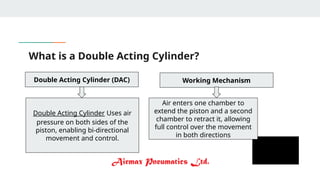
What is a Double Acting Cylinder?
Double Acting Cylinder (DAC)
Double Acting Cylinder Uses air
pressure on both sides of the
piston, enabling bi-directional
movement and control.
Working Mechanism
Air enters one chamber to
extend the piston and a second
chamber to retract it, allowing
full control over the movement
in both directions
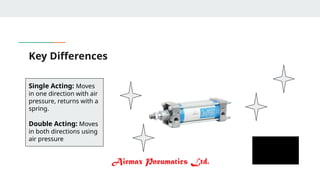
Key Differences
Single Acting: Moves
in one direction with air
pressure, returns with a
spring.
Double Acting: Moves
in both directions using
air pressure
Air Consumption
Single Acting: Less air usage,
lower operational costs.
Double Acting: Higher air
usage due to bi-directional
operation.
Applications
Single Acting: Simple tasks with
unidirectional force (e.g.,
clamping).
Double Acting: Complex tasks
needing continuous movement
(e.g., conveyor belt automation).
Industrial Applications for Each Type
Single Acting Cylinder Applications: Clamping Operations: Provides firm and
controlled pressure to hold items securely in place.
Lifting and Holding: Used in light lifting and positioning equipment where
force is required in only one direction.
Packaging and Sealing: Common in packaging industries for tasks
Double Acting Cylinder Applications
Automated Assembly Lines: Continuous back-and-forth movement for
parts handling and assembly tasks.
Heavy Lifting and Industrial Machinery: Used in equipment that requires
bi-directional force, such as hydraulic presses and conveyor systems.
Automotive manufacturing, food and beverage processing, and electronics
assembly
THANK YOU
Plot no. 133, "HYDINT HOUSE", B/h. Cozy Hotel,
Narol Road, Ahmedabad – 382 405. (Gujarat) –
INDIA
www.airmaxindia.com

Single vs. Double Acting Cylinders: Key Differences & Applications in Industry

  • 1.
    Comparing Single vs. DoubleActing Cylinders Understanding the Key Differences, Advantages, and Use Cases
  • 2.
    Introduction to PneumaticCylinders Definition Pneumatic cylinders are mechanical devices that use compressed air to produce linear motion and force, commonly used in industrial machinery Role in Industry Widely used for automation, manufacturing, and assembly, where precise, repetitive, and controlled movement is necessary
  • 3.
    What is aSingle Acting Cylinder? Single Acting Cylinder (SAC) Operates using air pressure to push the piston in one direction; a built-in spring returns the piston to its original position when air is removed Working Mechanism Air enters from one side, forcing the piston to extend
  • 4.
    What is aDouble Acting Cylinder? Double Acting Cylinder (DAC) Double Acting Cylinder Uses air pressure on both sides of the piston, enabling bi-directional movement and control. Working Mechanism Air enters one chamber to extend the piston and a second chamber to retract it, allowing full control over the movement in both directions
  • 5.
    Key Differences Single Acting:Moves in one direction with air pressure, returns with a spring. Double Acting: Moves in both directions using air pressure
  • 6.
    Air Consumption Single Acting:Less air usage, lower operational costs. Double Acting: Higher air usage due to bi-directional operation. Applications Single Acting: Simple tasks with unidirectional force (e.g., clamping). Double Acting: Complex tasks needing continuous movement (e.g., conveyor belt automation).
  • 7.
    Industrial Applications forEach Type Single Acting Cylinder Applications: Clamping Operations: Provides firm and controlled pressure to hold items securely in place. Lifting and Holding: Used in light lifting and positioning equipment where force is required in only one direction. Packaging and Sealing: Common in packaging industries for tasks
  • 8.
    Double Acting CylinderApplications Automated Assembly Lines: Continuous back-and-forth movement for parts handling and assembly tasks. Heavy Lifting and Industrial Machinery: Used in equipment that requires bi-directional force, such as hydraulic presses and conveyor systems. Automotive manufacturing, food and beverage processing, and electronics assembly
  • 9.
    THANK YOU Plot no.133, "HYDINT HOUSE", B/h. Cozy Hotel, Narol Road, Ahmedabad – 382 405. (Gujarat) – INDIA www.airmaxindia.com