Models for Health Economic Evaluation: A European Perspective 
Jorge Mestre-Ferrandiz 
Access to Innovation –A Conditioned Reality 
APIFARMA Conference Series 
Lisbon • 1 October 2014
Lisbon, 1 October 2014 2 
Agenda 
• 
Context 
• 
Selected European models of economic evaluation 
• 
Some final remarks
Lisbon, 1 October 2014 3 
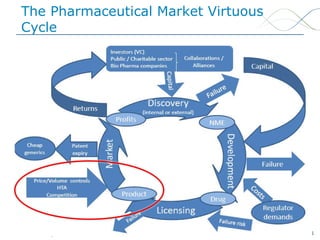
The Pharmaceutical Market Virtuous Cycle
Lisbon, 1 October 2014 4 
Overview –Five Global Challenges 
Challenge 1: Increasing importance of specialised and stratified medicines 
Challenge 2: Rising drug development costs 
Challenge 3: Closer benefit-risk monitoring by regulators over a medicines’ life cycle 
Challenge 4: Increase in demand for real world evidence of relative effectiveness by HTA, payers and regulators 
Challenge 5: Disconnect between regulators’ and payers’/HTA bodies’ evidence needs 
Key variables: Price * Volume * Time (and ‘VALUE'!)
Lisbon, 1 October 2014 5 
Europe –Some Basic Facts 
• 
European pharmaceutical market = US$243bn (25% of world) [Source: IMS World Review 2013] 
• 
Large number of individual national markets which display differing characteristics 
• 
Pricing and reimbursement (P&R) policies and economic evaluation models are likely to remain matters of national competence within EU for foreseeable future 
• 
Range of possible policies is large and varied. The vigour with which they may be applied in different EU markets also varies 
• 
Need a logical structure in order to analyse developments over time
Lisbon, 1 October 2014 6 
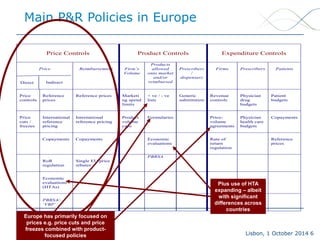
Main P&R Policies in Europe 
Price Controls Product Controls Expenditure Controls Price Reimbursement Firm’s Volume Products allowed onto market and/or reimbursed Prescribers / dispensers Firms Prescribers Patients Price controls Reference prices Reference prices Marketing spend limits + ve / - ve lists Generic substitution Revenue controls Physician drug budgets Patient budgets Price cuts / freezes International reference pricing International reference pricing Product volume caps Formularies Price- volume agreements Physician health care budgets Copayments Copayments Copayments Economic evaluations Rate of return regulation Reference prices RoR regulation Single EU price + rebates PBRSA Economic evaluations (HTAs) PBRSA/ ‘VBP’ Direct Indirect 
Europe has primarily focused on prices e.g. price cuts and price freezes combined with product- focused policies 
Plus use of HTA expanding –albeit with significant differences across countries
Lisbon, 1 October 2014 7 
Agenda 
• 
Context 
• 
Selected European models of economic evaluation 
• 
Some final remarks
Lisbon, 1 October 2014 8 
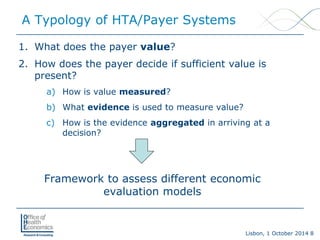
1. 
What does the payer value? 
2. 
How does the payer decide if sufficient value is present? 
a) 
How is value measured? 
b) 
What evidenceis used to measure value? 
c) 
How is the evidence aggregated in arriving at a decision? 
Framework to assess different economic evaluation models 
A Typology of HTA/Payer Systems
Lisbon, 1 October 2014 9 
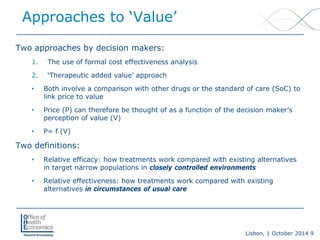
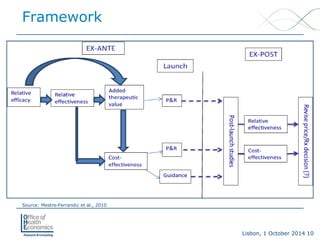
Two approaches by decision makers: 
1. 
The use of formal cost effectiveness analysis 
2. 
‘Therapeutic added value’ approach 
• 
Both involve a comparison with other drugs or the standard of care (SoC) to link price to value 
• 
Price (P) can therefore be thought of as a function of the decision maker’s perception of value (V) 
• 
P= f (V) 
Two definitions: 
• 
Relative efficacy:how treatments work compared with existing alternatives in target narrow populations in closely controlled environments 
• 
Relative effectiveness: how treatments work compared with existing alternatives in circumstances of usual care 
Approaches to ‘Value’
Lisbon, 1 October 2014 10 
Framework 
Source: Mestre-Ferrandiz et al., 2010
Lisbon, 1 October 2014 11 
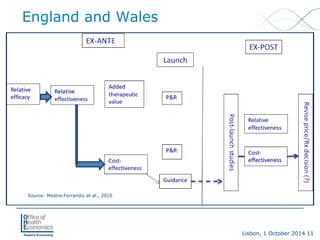
England and Wales 
Source: Mestre-Ferrandiz et al., 2010
Lisbon, 1 October 2014 12 
Sources of value 
Health gains measured as QALYs, cost against comparator, some aspects of severity, and other factors including equity 
Measures of value 
Incremental cost effectiveness ratio as compared to threshold value 
End of life, paediatric or orphan patient population 
The English System (Current)
Lisbon, 1 October 2014 13 
Evidence of value 
Incremental cost effectiveness ratio (ICER) established based on RCT data against comparator via an explicit economic model 
Cost = NHS and personal social services costs (tax funded) 
Effectiveness = quality adjusted life years (QALYs) –usually measured with EQ-5D instrument 
End of life and orphan patients identified explicitly, implicit consideration of other evidence of patient disadvantage 
Aggregation of value 
Decisions heavily influenced, but not dictated, by comparing ICERs against £/QALY threshold range 
Manufacturer sets price, then NICE accepts or rejects for reimbursement 
Possibility of patient access schemes giving companies a 'second chance' to find an acceptable price 
End of life modelled as a range of QALY multipliers 
Other considerations weighed deliberatively by committees 
The English System (Current)
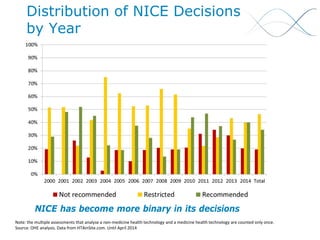
Distribution of NICE Decisions by Year 
NICE has become more binary in its decisions 
Note: the multiple assessments that analyse a non-medicine health technology and a medicine health technology are counted only once. 
Source: OHE analysis. Data from HTAinSite.com. Until April 2014
Lisbon, 1 October 2014 15 
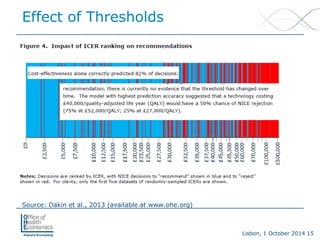
Effect of Thresholds 
Source: Dakin et al., 2013 (available at www.ohe.org)
Lisbon, 1 October 2014 16 
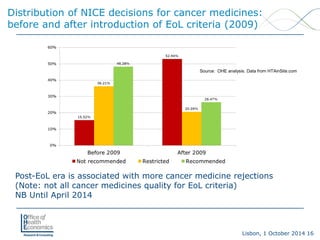
Distribution of NICE decisions for cancer medicines: before and after introduction of EoL criteria (2009) 
Post-EoL era is associated with more cancer medicine rejections (Note: not all cancer medicines quality for EoL criteria) 
NB Until April 2014 
Source: OHE analysis. Data from HTAinSite.com
Lisbon, 1 October 2014 17 
Cancer Drugs Fund 
• 
For oncology medicines specifically, a ‘Cancer Drugs Fund’ (CDF) was introduced in England in 2010 
• 
Originally announced to run until 2014, it has now been given extra money and extended until 2016 
• 
The CDF provides a means of improving patient access to cancer drugs, and is used to fund drug treatments, including radiopharmaceuticals, for patients who have been unable to access a drug recommended by their oncologist 
• 
This includes drugs that are either not routinely available on the NHS or have not been approved or appraised by NICE. It also provides fast track access to cancer drugs that are awaiting NICE guidance as well as access to drugs for less common cancers 
• 
There have been notifications for 41 medicines under the CDF (August 2014) 
• 
Four drugs –bevacizumab, abiraterone, bendamustine and cetuximab –account for nearly 53 per cent of all patient notifications (requests) to the CDF (http://www.kingsfund.org.uk/blog/2014/09/cancer-drugs-fund-inequitable-and-inefficient)
Lisbon, 1 October 2014 18 
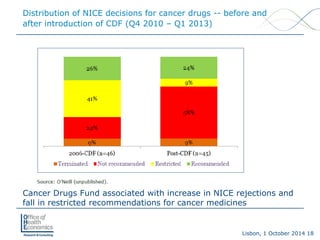
Distribution of NICE decisions for cancer drugs --before and after introduction of CDF (Q4 2010 –Q1 2013) 
Cancer Drugs Fund associated with increase in NICE rejections and fall in restricted recommendations for cancer medicines
Lisbon, 1 October 2014 19 
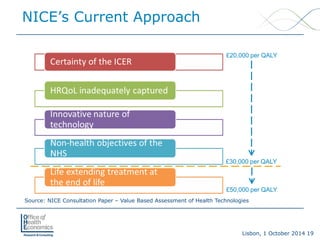
NICE’s Current Approach 
£20,000 per QALY 
£30,000 per QALY 
£50,000 per QALY 
Source: NICE Consultation Paper –Value Based Assessment of Health Technologies
Lisbon, 1 October 2014 20 
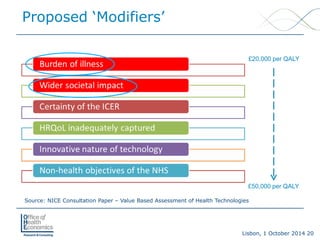
Proposed ‘Modifiers’ 
£20,000 per QALY 
£50,000 per QALY 
Source: NICE Consultation Paper –Value Based Assessment of Health Technologies
Lisbon, 1 October 2014 21 
NICE’s Response 
‘Following a consultation, the Institute has decided to undertake further work before making changes to the way it appraises new medicines and other technologies for use by the NHS. It argues that any changes to NICE’s methods need to be made as part of a wider review of the innovation, evaluation and adoption of new treatments (including those for cancers) involving patients, people working in or with the NHS, the life sciences industries and health researchers.’ (18 September 2014) 
https://www.nice.org.uk/news/press-and-media/nice-calls-for-a-new- approach-to-managing-the-entry-of-drugs-into-the-nhs
Lisbon, 1 October 2014 22 
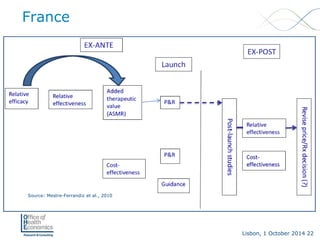
France 
Source: Mestre-Ferrandiz et al., 2010
Lisbon, 1 October 2014 23 
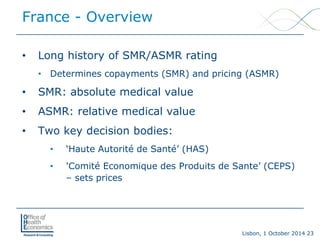
• 
Long history of SMR/ASMR rating 
• 
Determines copayments (SMR) and pricing (ASMR) 
• 
SMR: absolute medical value 
• 
ASMR: relative medical value 
• 
Two key decision bodies: 
• 
‘Haute Autorité de Santé’ (HAS) 
• 
'Comité Economique des Produits de Sante’ (CEPS) –sets prices 
France -Overview
Lisbon, 1 October 2014 24 
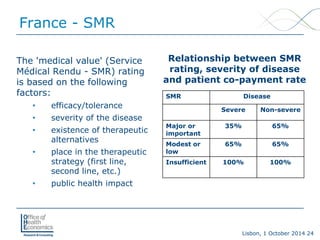
France -SMR 
The 'medical value' (Service Médical Rendu -SMR) rating is based on the following factors: 
• 
efficacy/tolerance 
• 
severity of the disease 
• 
existence of therapeutic alternatives 
• 
place in the therapeutic strategy (first line, second line, etc.) 
• 
public health impact 
SMR 
Disease 
Severe 
Non-severe 
Major or important 
35% 
65% 
Modest or low 
65% 
65% 
Insufficient 
100% 
100% 
Relationship between SMR rating, severity of disease and patient co-payment rate
Lisbon, 1 October 2014 25 
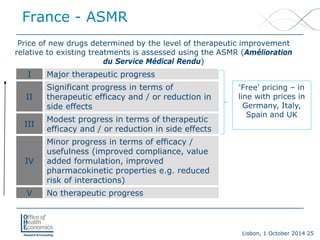
France -ASMR 
Price of new drugs determined by the level of therapeutic improvement relative to existing treatments is assessed using the ASMR (Amélioration du Service Médical Rendu) 
I 
Major therapeutic progress 
II 
Significant progress in terms of therapeutic efficacy and / or reduction in side effects 
III 
Modest progress in terms of therapeutic efficacy and / or reduction in side effects 
IV 
Minor progress in terms of efficacy / usefulness (improved compliance, value added formulation, improved pharmacokinetic properties e.g. reduced risk of interactions) 
V 
No therapeutic progress 
'Free' pricing –in line with prices in Germany, Italy, Spain and UK
Lisbon, 1 October 2014 26 
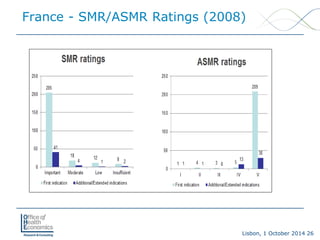
France -SMR/ASMR Ratings (2008)
Lisbon, 1 October 2014 27 
• 
Current reforms being implemented in France are part of an on-going discussion around pharmaceutical regulation, prompted by what has been termed the 'Mediator scandal' 
• 
Focuses on improving pharmacovigilance and pharmaceutical regulation 
• 
But also new requirements around comparators 
France -On-going Reforms
Lisbon, 1 October 2014 28 
• 
But also includes a decree changing the comparator requirement for new medicines introduced to the French market –this can be viewed as part of an on- going trend in France 
• 
Manufacturers are required to provide evidence demonstrating that the new drug has an additional benefit against an active comparator as well as a placebo 
• 
The Transparency Committee (TC) is becoming more strict in its application of the SMR and ASMR criteria 
• 
Some uncertainties still exist around how comparator requirements will be implemented in practice 
France -On-going Reforms
Lisbon, 1 October 2014 29 
France -On-going Reforms 
• 
Integration of SMR/ASMR rating into one index (relative therapeutic index, Index Thérapeutique Relatif [ITR]) 
• 
The generation of the ITR will be a sequential, semi-quantitative process 
• 
The TC first will validate primary and secondary efficacy endpoints and the comparator used by the sponsor; then assess relative efficacy, primarily based on a product’s primary clinical endpoint and, if needed, also based on secondary criteria. The product’s tolerance and its administration then will be considered in setting the ITR in one of the five classes: Inferior, Identical, Slightly Superior, Moderately Superior, Very Superior 
• 
HAS will then recommend to the Ministry of Health the reimbursement and pricing be applied as follows: 
• 
Inferior: No reimbursement 
• 
Identical: No reimbursement or at a reduced price (vs. comparator) 
• 
Slightly superior: Reimbursement at same price of comparator 
• 
Moderately superior: Reimbursement at a negotiated price 
• 
Very superior: European price
Lisbon, 1 October 2014 30 
France: On-going Reforms 
• 
By law, an economic assessment will be required for products that either are viewed as having a significant impact on health economics or that will change the management of a disease 
• 
At least two assessments: 
1. 
'Flash study' performed by reviewing the sponsor’s submission to verify validity and compliance with HAS’s guidelines and to estimate the preliminary drug’s cost/efficacy ratio –based on clinical data 
2. 
A study will then be designed and agreed with the firm to collect 'real world' data and determine incremental cost-effectiveness versus the comparator that is representative of standard practice. Timeline between the two assessments is presently unclear but is expected to be two to three years. Such cost/effectiveness assessment will lead to review and, if need be, to revise reimbursement, conditions of use and pricing of that drug
Lisbon, 1 October 2014 31 
France -On-going Reforms 
• 
Future role of economic evaluations –Methods guideline published in October 2012 
– 
QALYs are to be measured in cost utility analyses, where it is possible to get QALY data at reasonable cost 
– 
This has signalled a move to a more formalised economic evaluation process based on cost effectiveness 
– 
However, the methodology and processes recommended are much less formal than in the UK, for instance
Lisbon, 1 October 2014 32 
AMNOG represents a paradigm shift in the way new drugs launched in Germany are assessed and priced 
• 
It came into effect on 1 January 2011 
The main difference pre-and post-AMNOG is the lack of free pricing 
After more than 3 years of AMNOG, some tweaks to the system –see later 
Germany
Lisbon, 1 October 2014 33 
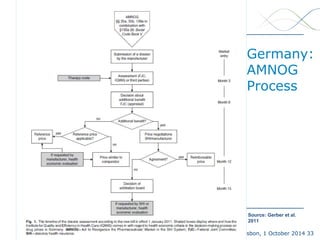
Source: Gerber et al. 2011 
Germany: AMNOG Process
Lisbon, 1 October 2014 34 
1. 
The manufacturer submits a comprehensive value dossier to the decision- making body, the Federal Joint Committee (GBA) –focusing on clinical / health gain and added value 
2. 
The GBA, the IQWiG (or another commissioned third party), has three months to determine the additional clinical benefit of the new drug relative to appropriate therapeutic alternatives (Early Benefit Assessment) 
3. 
The manufacturer can then comment on the review in a hearing process. GBA analyses the hearing comments received, and, after another three months, passes a resolution as to whether the new has an additional benefit 
4. 
If a drug is categorised as having ‘no additional benefit’, it is priced according to similar drugs in the same therapeutic reference group 
5. 
If the drug provides an additional benefit, the GBA (or the IQWiG) assess the extent of additional benefit proven, by patient group. The size of the additional benefit is categorised on a six point scale (a 'major' improvement corresponds to a score of 1 while a 'smaller benefit' corresponds to a score of 6) 
6. 
The manufacturer and the National Association of the Statutory Health Insurance Funds (GKV-SV) then negotiate a reimbursement price 
7. 
If no agreement is reached, an arbitration board has 3 months to determine a price 
AMNOG -Timelines
Lisbon, 1 October 2014 35 
Sources of value 
The German system is a search for efficacy. A valuable medicine is one with a proven and high efficacy, based on available RCT results 
Societal perspective is mentioned in the IQWiG methodology guide, but it is completely ignored in practice. 
Measures of value 
Mortality, morbidity, improvement in disease and quality of life 
A medicine that only had effects on quality of life, without a clinical measure, would be rejected –need to show, for example, pain free days, returns to work 
Reduced side effects would be a useful addition measure, but would not gain approval without proven efficacy 
The German System
Lisbon, 1 October 2014 36 
Evidence of value 
Evidence presented in Germany must almost always be RCT-based 
More interest in direct measures of mortality. Reduction in blood pressure would not be a good measure, relative to showing actual reduced cardiac events. No comparison across disease areas 
Officially quality of life improvement is important, but tends to be of poor quality, and tends not to attract much weight 
Strength of evidence is very important: for two drugs, one showing uncertain evidence of a large effect, the other showing certain evidence of a small effect, the second would be approved while the first would not 
Aggregation of value 
There is no aggregation in the IQWiG process. The most important outcome will drive the decision 
The main concern is avoiding uncertainty 
The German System
Lisbon, 1 October 2014 37 
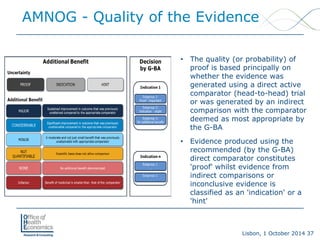
AMNOG -Quality of the Evidence 
• 
The quality (or probability) of proof is based principally on whether the evidence was generated using a direct active comparator (head-to-head) trial or was generated by an indirect comparison with the comparator deemed as most appropriate by the G-BA 
• 
Evidence produced using the recommended (by the G-BA) direct comparator constitutes 'proof' whilst evidence from indirect comparisons or inconclusive evidence is classified as an 'indication' or a 'hint'
Lisbon, 1 October 2014 38 
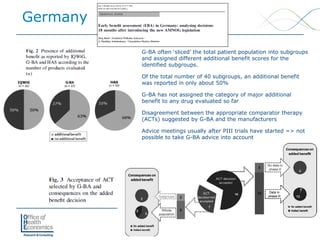
Germany 
G-BA often ‘sliced’ the total patient population into subgroups and assigned different additional benefit scores for the identified subgroups. 
Of the total number of 40 subgroups, an additional benefit was reported in only about 50% 
G-BA has not assigned the category of major additional benefit to any drug evaluated so far 
Disagreement between the appropriate comparator therapy (ACTs) suggested by G-BA and the manufacturers 
Advice meetings usually after PIII trials have started => not possible to take G-BA advice into account
Lisbon, 1 October 2014 39 
Agenda 
• 
Context 
• 
Selected European models of economic evaluation 
• 
Some final remarks
Lisbon, 1 October 2014 40 
Country-specific Challenges 
• 
United Kingdom: Value based assessment 
• 
Germany: Focus on certainty 
• 
France: Increasing cost consciousness
Lisbon, 1 October 2014 41 
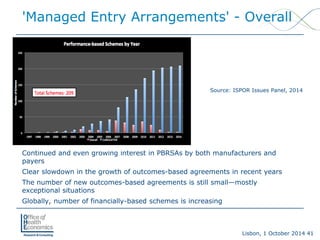
'Managed Entry Arrangements' -Overall 
Continued and even growing interest in PBRSAs by both manufacturers and payers 
Clear slowdown in the growth of outcomes-based agreements in recent years 
The number of new outcomes-based agreements is still small—mostly exceptional situations 
Globally, number of financially-based schemes is increasing 
Source: ISPOR Issues Panel, 2014
Lisbon, 1 October 2014 42 
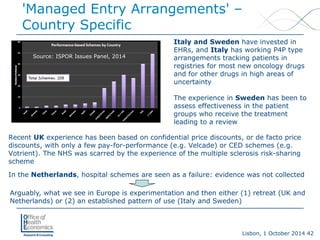
'Managed Entry Arrangements' – Country Specific 
Recent UKexperience has been based on confidential price discounts, or de facto price discounts, with only a few pay-for-performance (e.g. Velcade) or CED schemes (e.g. Votrient). The NHS was scarred by the experience of the multiple sclerosis risk-sharing scheme 
In the Netherlands, hospital schemes are seen as a failure: evidence was not collected 
Italy and Sweden have invested in EHRs, and Italyhas working P4P type arrangements tracking patients in registries for most new oncology drugs and for other drugs in high areas of uncertainty 
The experience in Swedenhas been to assess effectiveness in the patient groups who receive the treatment leading to a review 
Arguably, what we see in Europe is experimentation and then either (1) retreat (UK and Netherlands) or (2) an established pattern of use (Italy and Sweden) 
Source: ISPOR Issues Panel, 2014
Lisbon, 1 October 2014 43 
To enquire about additional information and analyses, please contact Dr. Jorge Mestre-Ferrandiz at jmestre-ferrandiz@ohe.org 
The Office of Health Economics is a research and consulting organisation that has been providing specialised research, analysis and expertise on a range of health care and life sciences issues and topics for more than 50 years. 
OHE’s publications may be downloaded free of charge for registered users of its website. 
To keep up with the latest news and research, subscribe to our blog, OHE News 
Follow us on Twitter @OHENews, LinkedInand SlideShare 
Office of Health EconomicsSouthside, 7th Floor105 Victoria StreetLondon SW1E 6QT United Kingdom 
+44 20 7747 8850www.ohe.org 
©Office of Health Economics 
About OHE

Approaches to Evaluating New Medicines in France, Germany and England

  • 1.
    Models for HealthEconomic Evaluation: A European Perspective Jorge Mestre-Ferrandiz Access to Innovation –A Conditioned Reality APIFARMA Conference Series Lisbon • 1 October 2014
  • 2.
    Lisbon, 1 October2014 2 Agenda • Context • Selected European models of economic evaluation • Some final remarks
  • 3.
    Lisbon, 1 October2014 3 The Pharmaceutical Market Virtuous Cycle
  • 4.
    Lisbon, 1 October2014 4 Overview –Five Global Challenges Challenge 1: Increasing importance of specialised and stratified medicines Challenge 2: Rising drug development costs Challenge 3: Closer benefit-risk monitoring by regulators over a medicines’ life cycle Challenge 4: Increase in demand for real world evidence of relative effectiveness by HTA, payers and regulators Challenge 5: Disconnect between regulators’ and payers’/HTA bodies’ evidence needs Key variables: Price * Volume * Time (and ‘VALUE'!)
  • 5.
    Lisbon, 1 October2014 5 Europe –Some Basic Facts • European pharmaceutical market = US$243bn (25% of world) [Source: IMS World Review 2013] • Large number of individual national markets which display differing characteristics • Pricing and reimbursement (P&R) policies and economic evaluation models are likely to remain matters of national competence within EU for foreseeable future • Range of possible policies is large and varied. The vigour with which they may be applied in different EU markets also varies • Need a logical structure in order to analyse developments over time
  • 6.
    Lisbon, 1 October2014 6 Main P&R Policies in Europe Price Controls Product Controls Expenditure Controls Price Reimbursement Firm’s Volume Products allowed onto market and/or reimbursed Prescribers / dispensers Firms Prescribers Patients Price controls Reference prices Reference prices Marketing spend limits + ve / - ve lists Generic substitution Revenue controls Physician drug budgets Patient budgets Price cuts / freezes International reference pricing International reference pricing Product volume caps Formularies Price- volume agreements Physician health care budgets Copayments Copayments Copayments Economic evaluations Rate of return regulation Reference prices RoR regulation Single EU price + rebates PBRSA Economic evaluations (HTAs) PBRSA/ ‘VBP’ Direct Indirect Europe has primarily focused on prices e.g. price cuts and price freezes combined with product- focused policies Plus use of HTA expanding –albeit with significant differences across countries
  • 7.
    Lisbon, 1 October2014 7 Agenda • Context • Selected European models of economic evaluation • Some final remarks
  • 8.
    Lisbon, 1 October2014 8 1. What does the payer value? 2. How does the payer decide if sufficient value is present? a) How is value measured? b) What evidenceis used to measure value? c) How is the evidence aggregated in arriving at a decision? Framework to assess different economic evaluation models A Typology of HTA/Payer Systems
  • 9.
    Lisbon, 1 October2014 9 Two approaches by decision makers: 1. The use of formal cost effectiveness analysis 2. ‘Therapeutic added value’ approach • Both involve a comparison with other drugs or the standard of care (SoC) to link price to value • Price (P) can therefore be thought of as a function of the decision maker’s perception of value (V) • P= f (V) Two definitions: • Relative efficacy:how treatments work compared with existing alternatives in target narrow populations in closely controlled environments • Relative effectiveness: how treatments work compared with existing alternatives in circumstances of usual care Approaches to ‘Value’
  • 10.
    Lisbon, 1 October2014 10 Framework Source: Mestre-Ferrandiz et al., 2010
  • 11.
    Lisbon, 1 October2014 11 England and Wales Source: Mestre-Ferrandiz et al., 2010
  • 12.
    Lisbon, 1 October2014 12 Sources of value Health gains measured as QALYs, cost against comparator, some aspects of severity, and other factors including equity Measures of value Incremental cost effectiveness ratio as compared to threshold value End of life, paediatric or orphan patient population The English System (Current)
  • 13.
    Lisbon, 1 October2014 13 Evidence of value Incremental cost effectiveness ratio (ICER) established based on RCT data against comparator via an explicit economic model Cost = NHS and personal social services costs (tax funded) Effectiveness = quality adjusted life years (QALYs) –usually measured with EQ-5D instrument End of life and orphan patients identified explicitly, implicit consideration of other evidence of patient disadvantage Aggregation of value Decisions heavily influenced, but not dictated, by comparing ICERs against £/QALY threshold range Manufacturer sets price, then NICE accepts or rejects for reimbursement Possibility of patient access schemes giving companies a 'second chance' to find an acceptable price End of life modelled as a range of QALY multipliers Other considerations weighed deliberatively by committees The English System (Current)
  • 14.
    Distribution of NICEDecisions by Year NICE has become more binary in its decisions Note: the multiple assessments that analyse a non-medicine health technology and a medicine health technology are counted only once. Source: OHE analysis. Data from HTAinSite.com. Until April 2014
  • 15.
    Lisbon, 1 October2014 15 Effect of Thresholds Source: Dakin et al., 2013 (available at www.ohe.org)
  • 16.
    Lisbon, 1 October2014 16 Distribution of NICE decisions for cancer medicines: before and after introduction of EoL criteria (2009) Post-EoL era is associated with more cancer medicine rejections (Note: not all cancer medicines quality for EoL criteria) NB Until April 2014 Source: OHE analysis. Data from HTAinSite.com
  • 17.
    Lisbon, 1 October2014 17 Cancer Drugs Fund • For oncology medicines specifically, a ‘Cancer Drugs Fund’ (CDF) was introduced in England in 2010 • Originally announced to run until 2014, it has now been given extra money and extended until 2016 • The CDF provides a means of improving patient access to cancer drugs, and is used to fund drug treatments, including radiopharmaceuticals, for patients who have been unable to access a drug recommended by their oncologist • This includes drugs that are either not routinely available on the NHS or have not been approved or appraised by NICE. It also provides fast track access to cancer drugs that are awaiting NICE guidance as well as access to drugs for less common cancers • There have been notifications for 41 medicines under the CDF (August 2014) • Four drugs –bevacizumab, abiraterone, bendamustine and cetuximab –account for nearly 53 per cent of all patient notifications (requests) to the CDF (http://www.kingsfund.org.uk/blog/2014/09/cancer-drugs-fund-inequitable-and-inefficient)
  • 18.
    Lisbon, 1 October2014 18 Distribution of NICE decisions for cancer drugs --before and after introduction of CDF (Q4 2010 –Q1 2013) Cancer Drugs Fund associated with increase in NICE rejections and fall in restricted recommendations for cancer medicines
  • 19.
    Lisbon, 1 October2014 19 NICE’s Current Approach £20,000 per QALY £30,000 per QALY £50,000 per QALY Source: NICE Consultation Paper –Value Based Assessment of Health Technologies
  • 20.
    Lisbon, 1 October2014 20 Proposed ‘Modifiers’ £20,000 per QALY £50,000 per QALY Source: NICE Consultation Paper –Value Based Assessment of Health Technologies
  • 21.
    Lisbon, 1 October2014 21 NICE’s Response ‘Following a consultation, the Institute has decided to undertake further work before making changes to the way it appraises new medicines and other technologies for use by the NHS. It argues that any changes to NICE’s methods need to be made as part of a wider review of the innovation, evaluation and adoption of new treatments (including those for cancers) involving patients, people working in or with the NHS, the life sciences industries and health researchers.’ (18 September 2014) https://www.nice.org.uk/news/press-and-media/nice-calls-for-a-new- approach-to-managing-the-entry-of-drugs-into-the-nhs
  • 22.
    Lisbon, 1 October2014 22 France Source: Mestre-Ferrandiz et al., 2010
  • 23.
    Lisbon, 1 October2014 23 • Long history of SMR/ASMR rating • Determines copayments (SMR) and pricing (ASMR) • SMR: absolute medical value • ASMR: relative medical value • Two key decision bodies: • ‘Haute Autorité de Santé’ (HAS) • 'Comité Economique des Produits de Sante’ (CEPS) –sets prices France -Overview
  • 24.
    Lisbon, 1 October2014 24 France -SMR The 'medical value' (Service Médical Rendu -SMR) rating is based on the following factors: • efficacy/tolerance • severity of the disease • existence of therapeutic alternatives • place in the therapeutic strategy (first line, second line, etc.) • public health impact SMR Disease Severe Non-severe Major or important 35% 65% Modest or low 65% 65% Insufficient 100% 100% Relationship between SMR rating, severity of disease and patient co-payment rate
  • 25.
    Lisbon, 1 October2014 25 France -ASMR Price of new drugs determined by the level of therapeutic improvement relative to existing treatments is assessed using the ASMR (Amélioration du Service Médical Rendu) I Major therapeutic progress II Significant progress in terms of therapeutic efficacy and / or reduction in side effects III Modest progress in terms of therapeutic efficacy and / or reduction in side effects IV Minor progress in terms of efficacy / usefulness (improved compliance, value added formulation, improved pharmacokinetic properties e.g. reduced risk of interactions) V No therapeutic progress 'Free' pricing –in line with prices in Germany, Italy, Spain and UK
  • 26.
    Lisbon, 1 October2014 26 France -SMR/ASMR Ratings (2008)
  • 27.
    Lisbon, 1 October2014 27 • Current reforms being implemented in France are part of an on-going discussion around pharmaceutical regulation, prompted by what has been termed the 'Mediator scandal' • Focuses on improving pharmacovigilance and pharmaceutical regulation • But also new requirements around comparators France -On-going Reforms
  • 28.
    Lisbon, 1 October2014 28 • But also includes a decree changing the comparator requirement for new medicines introduced to the French market –this can be viewed as part of an on- going trend in France • Manufacturers are required to provide evidence demonstrating that the new drug has an additional benefit against an active comparator as well as a placebo • The Transparency Committee (TC) is becoming more strict in its application of the SMR and ASMR criteria • Some uncertainties still exist around how comparator requirements will be implemented in practice France -On-going Reforms
  • 29.
    Lisbon, 1 October2014 29 France -On-going Reforms • Integration of SMR/ASMR rating into one index (relative therapeutic index, Index Thérapeutique Relatif [ITR]) • The generation of the ITR will be a sequential, semi-quantitative process • The TC first will validate primary and secondary efficacy endpoints and the comparator used by the sponsor; then assess relative efficacy, primarily based on a product’s primary clinical endpoint and, if needed, also based on secondary criteria. The product’s tolerance and its administration then will be considered in setting the ITR in one of the five classes: Inferior, Identical, Slightly Superior, Moderately Superior, Very Superior • HAS will then recommend to the Ministry of Health the reimbursement and pricing be applied as follows: • Inferior: No reimbursement • Identical: No reimbursement or at a reduced price (vs. comparator) • Slightly superior: Reimbursement at same price of comparator • Moderately superior: Reimbursement at a negotiated price • Very superior: European price
  • 30.
    Lisbon, 1 October2014 30 France: On-going Reforms • By law, an economic assessment will be required for products that either are viewed as having a significant impact on health economics or that will change the management of a disease • At least two assessments: 1. 'Flash study' performed by reviewing the sponsor’s submission to verify validity and compliance with HAS’s guidelines and to estimate the preliminary drug’s cost/efficacy ratio –based on clinical data 2. A study will then be designed and agreed with the firm to collect 'real world' data and determine incremental cost-effectiveness versus the comparator that is representative of standard practice. Timeline between the two assessments is presently unclear but is expected to be two to three years. Such cost/effectiveness assessment will lead to review and, if need be, to revise reimbursement, conditions of use and pricing of that drug
  • 31.
    Lisbon, 1 October2014 31 France -On-going Reforms • Future role of economic evaluations –Methods guideline published in October 2012 – QALYs are to be measured in cost utility analyses, where it is possible to get QALY data at reasonable cost – This has signalled a move to a more formalised economic evaluation process based on cost effectiveness – However, the methodology and processes recommended are much less formal than in the UK, for instance
  • 32.
    Lisbon, 1 October2014 32 AMNOG represents a paradigm shift in the way new drugs launched in Germany are assessed and priced • It came into effect on 1 January 2011 The main difference pre-and post-AMNOG is the lack of free pricing After more than 3 years of AMNOG, some tweaks to the system –see later Germany
  • 33.
    Lisbon, 1 October2014 33 Source: Gerber et al. 2011 Germany: AMNOG Process
  • 34.
    Lisbon, 1 October2014 34 1. The manufacturer submits a comprehensive value dossier to the decision- making body, the Federal Joint Committee (GBA) –focusing on clinical / health gain and added value 2. The GBA, the IQWiG (or another commissioned third party), has three months to determine the additional clinical benefit of the new drug relative to appropriate therapeutic alternatives (Early Benefit Assessment) 3. The manufacturer can then comment on the review in a hearing process. GBA analyses the hearing comments received, and, after another three months, passes a resolution as to whether the new has an additional benefit 4. If a drug is categorised as having ‘no additional benefit’, it is priced according to similar drugs in the same therapeutic reference group 5. If the drug provides an additional benefit, the GBA (or the IQWiG) assess the extent of additional benefit proven, by patient group. The size of the additional benefit is categorised on a six point scale (a 'major' improvement corresponds to a score of 1 while a 'smaller benefit' corresponds to a score of 6) 6. The manufacturer and the National Association of the Statutory Health Insurance Funds (GKV-SV) then negotiate a reimbursement price 7. If no agreement is reached, an arbitration board has 3 months to determine a price AMNOG -Timelines
  • 35.
    Lisbon, 1 October2014 35 Sources of value The German system is a search for efficacy. A valuable medicine is one with a proven and high efficacy, based on available RCT results Societal perspective is mentioned in the IQWiG methodology guide, but it is completely ignored in practice. Measures of value Mortality, morbidity, improvement in disease and quality of life A medicine that only had effects on quality of life, without a clinical measure, would be rejected –need to show, for example, pain free days, returns to work Reduced side effects would be a useful addition measure, but would not gain approval without proven efficacy The German System
  • 36.
    Lisbon, 1 October2014 36 Evidence of value Evidence presented in Germany must almost always be RCT-based More interest in direct measures of mortality. Reduction in blood pressure would not be a good measure, relative to showing actual reduced cardiac events. No comparison across disease areas Officially quality of life improvement is important, but tends to be of poor quality, and tends not to attract much weight Strength of evidence is very important: for two drugs, one showing uncertain evidence of a large effect, the other showing certain evidence of a small effect, the second would be approved while the first would not Aggregation of value There is no aggregation in the IQWiG process. The most important outcome will drive the decision The main concern is avoiding uncertainty The German System
  • 37.
    Lisbon, 1 October2014 37 AMNOG -Quality of the Evidence • The quality (or probability) of proof is based principally on whether the evidence was generated using a direct active comparator (head-to-head) trial or was generated by an indirect comparison with the comparator deemed as most appropriate by the G-BA • Evidence produced using the recommended (by the G-BA) direct comparator constitutes 'proof' whilst evidence from indirect comparisons or inconclusive evidence is classified as an 'indication' or a 'hint'
  • 38.
    Lisbon, 1 October2014 38 Germany G-BA often ‘sliced’ the total patient population into subgroups and assigned different additional benefit scores for the identified subgroups. Of the total number of 40 subgroups, an additional benefit was reported in only about 50% G-BA has not assigned the category of major additional benefit to any drug evaluated so far Disagreement between the appropriate comparator therapy (ACTs) suggested by G-BA and the manufacturers Advice meetings usually after PIII trials have started => not possible to take G-BA advice into account
  • 39.
    Lisbon, 1 October2014 39 Agenda • Context • Selected European models of economic evaluation • Some final remarks
  • 40.
    Lisbon, 1 October2014 40 Country-specific Challenges • United Kingdom: Value based assessment • Germany: Focus on certainty • France: Increasing cost consciousness
  • 41.
    Lisbon, 1 October2014 41 'Managed Entry Arrangements' -Overall Continued and even growing interest in PBRSAs by both manufacturers and payers Clear slowdown in the growth of outcomes-based agreements in recent years The number of new outcomes-based agreements is still small—mostly exceptional situations Globally, number of financially-based schemes is increasing Source: ISPOR Issues Panel, 2014
  • 42.
    Lisbon, 1 October2014 42 'Managed Entry Arrangements' – Country Specific Recent UKexperience has been based on confidential price discounts, or de facto price discounts, with only a few pay-for-performance (e.g. Velcade) or CED schemes (e.g. Votrient). The NHS was scarred by the experience of the multiple sclerosis risk-sharing scheme In the Netherlands, hospital schemes are seen as a failure: evidence was not collected Italy and Sweden have invested in EHRs, and Italyhas working P4P type arrangements tracking patients in registries for most new oncology drugs and for other drugs in high areas of uncertainty The experience in Swedenhas been to assess effectiveness in the patient groups who receive the treatment leading to a review Arguably, what we see in Europe is experimentation and then either (1) retreat (UK and Netherlands) or (2) an established pattern of use (Italy and Sweden) Source: ISPOR Issues Panel, 2014
  • 43.
    Lisbon, 1 October2014 43 To enquire about additional information and analyses, please contact Dr. Jorge Mestre-Ferrandiz at jmestre-ferrandiz@ohe.org The Office of Health Economics is a research and consulting organisation that has been providing specialised research, analysis and expertise on a range of health care and life sciences issues and topics for more than 50 years. OHE’s publications may be downloaded free of charge for registered users of its website. To keep up with the latest news and research, subscribe to our blog, OHE News Follow us on Twitter @OHENews, LinkedInand SlideShare Office of Health EconomicsSouthside, 7th Floor105 Victoria StreetLondon SW1E 6QT United Kingdom +44 20 7747 8850www.ohe.org ©Office of Health Economics About OHE