
Introduction
What is AI ? 
• Artificial Intelligence is concerned with the 
design of intelligence in an artificial device 
• The term was coined by McCarthy in 1956.
What is intelligence? 
• Is it that which characterize humans? 
• Behave as intelligently as a human 
• Behave in the best possible manner 
• Behavior strategies 
• Thinking? 
• Action?
Scope and view of Artificial 
Intelligence 
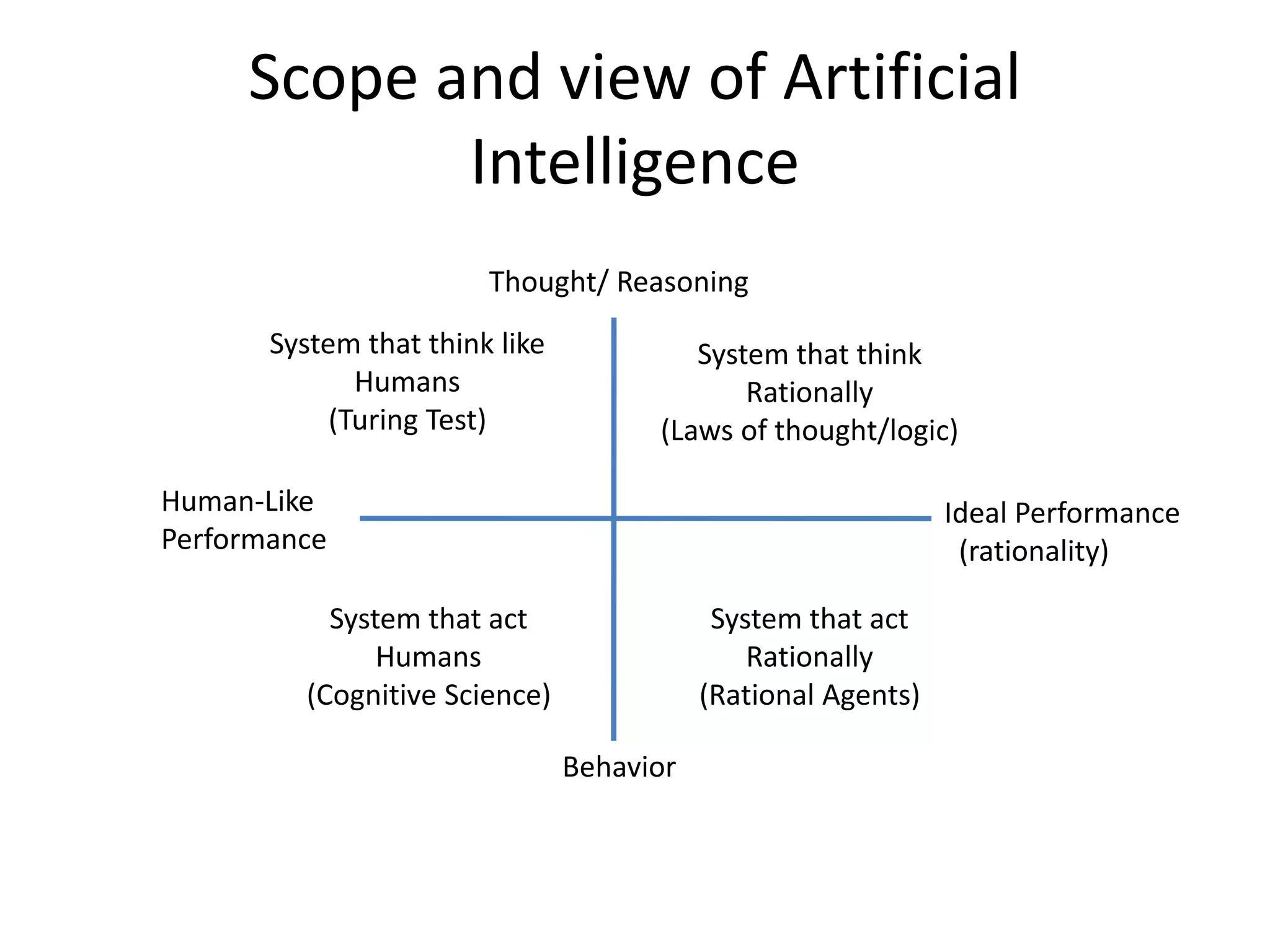
Ideal Performance 
(rationality) 
Human-Like 
Performance 
Thought/ Reasoning 
Behavior 
System that think like 
Humans 
(Turing Test) 
System that think 
Rationally 
(Laws of thought/logic) 
System that act 
Humans 
(Cognitive Science) 
System that act 
Rationally 
(Rational Agents)
Scope and view of Artificial 
Intelligence. 
• One view is that artificial intelligence is about 
designing systems that are as intelligent as 
humans. 
• Trying to understand human thought 
• Effort to build machines that emulate the 
human thought process. 
• Cognitive science approach to AI.
Scope and view of Artificial 
Intelligence 
• Turing test for intelligence. 
– ‘Imitation game‘ 
– Turing argued that if the interrogator could not 
distinguish them by questioning, then it would be 
unreasonable not to call the computer intelligent.
Turing test
Turing test 
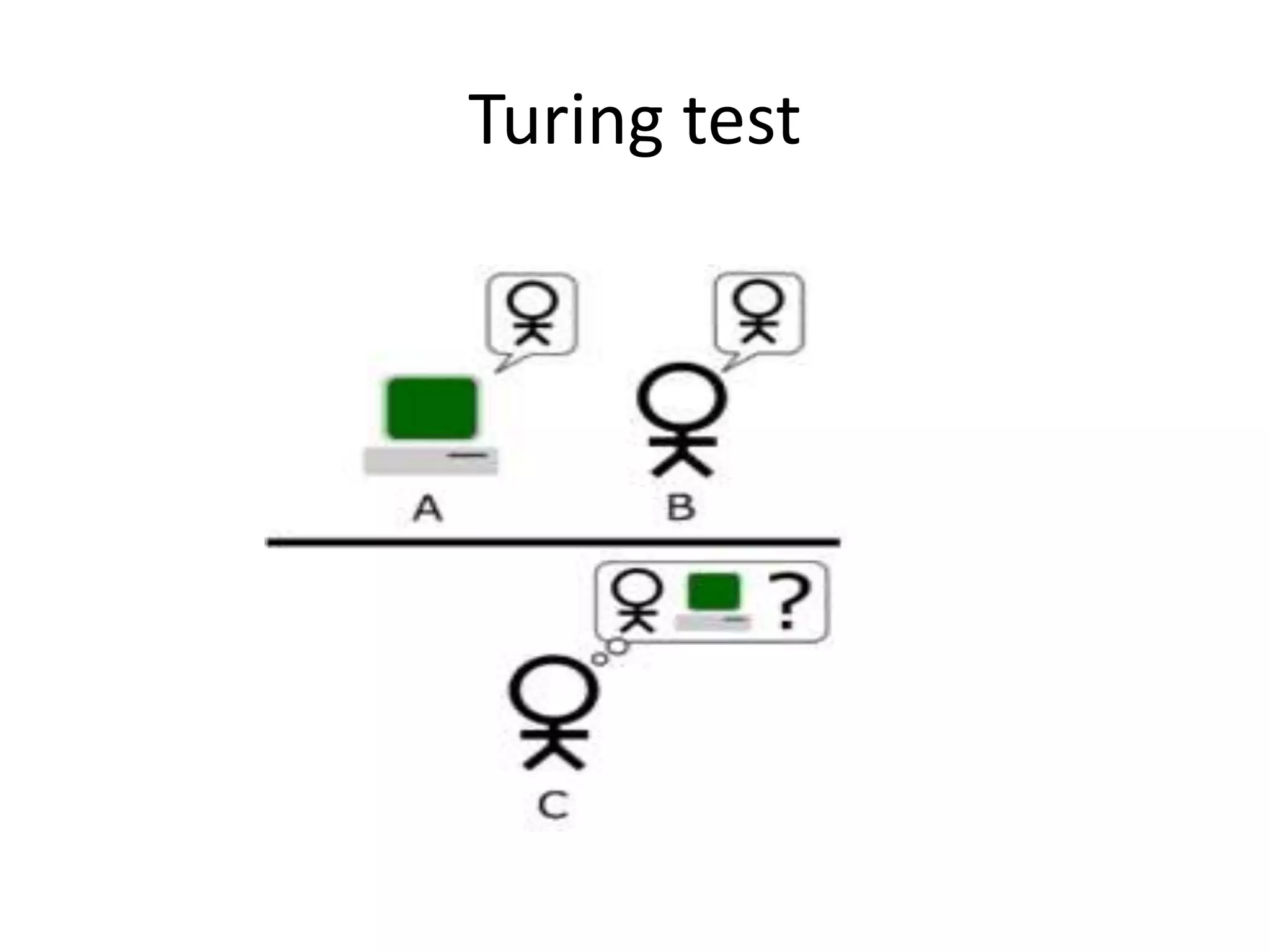
• There are two rooms, A and B. 
• One of the rooms contains a computer. The other 
contains a human. 
• The interrogator is outside and does not know which 
one is a computer. 
• He can ask questions through a teletype and receives 
answers from both A and B. 
• The interrogator needs to identify whether A or B are 
humans. 
• To pass the Turing test, the machine has to fool the 
interrogator into believing that it is human
Scope and view of Artificial 
Intelligence. 
• Logic and laws of thought 
– Deals with studies of ideal or rational thought 
process and inference. 
– The emphasis in this case is on the inference 
mechanism, and its properties. 
– That is how the system arrives at a conclusion, or 
the reasoning behind its selection of actions is 
very important in this point of view.
Scope and view of Artificial 
Intelligence. 
• Rational agents. 
– Deals with building machines that act rationally. 
– The focus is on how the system acts and performs, 
and not so much on the reasoning process. 
– A rational agent is one that acts rationally, that is, 
is in the best possible manner.
Typical AI problems 
• “Intelligent entity” need to perform both 
“common-place” tasks as well as expert tasks 
• Common task are done routinely by people 
and some other animals. 
• Common task examples 
– Recognizing people 
– objects. 
– Communicating (through natural language) 
Navigating around obstacles on the streets
Typical AI problems 
• Expert tasks cannot be done by all people, and 
can only be performed by skilled specialists. 
• Expert tasks include 
– Medical diagnosis 
– Mathematical problem solving 
– Playing games like chess
Intelligent behavior 
• Perception involving image recognition and 
computer vision ƒ 
• Reasoning (With information we have) ƒ 
• Learning 
• ƒUnderstanding language involving natural 
language processing, speech processing ƒ 
• Solving problems
What’s easy and what’s hard? 
• It’s been easier to mechanize many of the high level cognitive tasks 
we usually associate with “intelligence” in people 
– e. g., symbolic integration, proving theorems, playing chess, 
some aspect of medical diagnosis, etc. 
• It’s been very hard to mechanize tasks that animals can do easily 
– walking around without running into things 
– catching prey and avoiding predators 
– interpreting complex sensory information (visual, aural, …) 
– modeling the internal states of other animals from their 
behavior 
– working as a team (ants, bees)
Practical Impact of AI 
• AI components are embedded in numerous 
devices 
• AI systems are in everyday use 
– Copy machines 
– Identifying credit card fraud, 
– Advising doctors 
– Recognizing speech 
– Helping complex planning tasks 
– Systems that provide students with personalized 
attention
Approaches to AI 
• Strong AI 
– Aims to build machines that can truly reason and 
solve problems 
– Self aware 
– Intellectual ability need to be indistinguishable 
from that of a human being.
Approaches to AI 
• Weak AI 
– Intelligence that cannot truly reason and solve 
problems 
– Acts as if it were intelligent 
• Applied AI 
– Aims to produce commercially viable "smart" 
systems such as, for example, a security system 
that is able to recognize the faces of people who 
are permitted to enter a particular building.
Approaches to AI 
• Cognitive AI: Computers are used to test 
theories about how the human mind works 
• For example, 
– Theories about how we recognize faces and other 
objects 
– About how we solve abstract problems.
Limits of AI Today 
• What can AI systems do ? 
– In Computer vision, the systems are capable of face recognition 
– In Robotics, we have been able to make vehicles that are mostly 
autonomous. 
– In Natural language processing, we have systems that are capable of 
simple machine translation. 
– Today’s Expert systems can carry out medical diagnosis in a narrow 
domain 
– Speech understanding systems are capable of recognizing several 
thousand words continuous speech 
– Planning and scheduling systems had been employed in scheduling 
experiments with the Hubble Telescope. 
– The Learning systems are capable of doing text categorization into 
about a 1000 topics 
– In Games, AI systems can play at the Grand Master level in chess 
(world champion), checkers, etc.
What can AI systems NOT do yet? 
• Understand natural language robustly (e.g., 
read and understand articles in a newspaper) 
• Surf the web 
• Interpret an arbitrary visual scene 
• Learn a natural language 
• Construct plans in dynamic real-time domains 
• Exhibit true autonomy and intelligence
Assignment # 1 
• History of AI?

Lecture 1

  • 1.
  • 2.
    What is AI? • Artificial Intelligence is concerned with the design of intelligence in an artificial device • The term was coined by McCarthy in 1956.
  • 3.
    What is intelligence? • Is it that which characterize humans? • Behave as intelligently as a human • Behave in the best possible manner • Behavior strategies • Thinking? • Action?
  • 4.
    Scope and viewof Artificial Intelligence Ideal Performance (rationality) Human-Like Performance Thought/ Reasoning Behavior System that think like Humans (Turing Test) System that think Rationally (Laws of thought/logic) System that act Humans (Cognitive Science) System that act Rationally (Rational Agents)
  • 5.
    Scope and viewof Artificial Intelligence. • One view is that artificial intelligence is about designing systems that are as intelligent as humans. • Trying to understand human thought • Effort to build machines that emulate the human thought process. • Cognitive science approach to AI.
  • 6.
    Scope and viewof Artificial Intelligence • Turing test for intelligence. – ‘Imitation game‘ – Turing argued that if the interrogator could not distinguish them by questioning, then it would be unreasonable not to call the computer intelligent.
  • 7.
  • 8.
    Turing test •There are two rooms, A and B. • One of the rooms contains a computer. The other contains a human. • The interrogator is outside and does not know which one is a computer. • He can ask questions through a teletype and receives answers from both A and B. • The interrogator needs to identify whether A or B are humans. • To pass the Turing test, the machine has to fool the interrogator into believing that it is human
  • 9.
    Scope and viewof Artificial Intelligence. • Logic and laws of thought – Deals with studies of ideal or rational thought process and inference. – The emphasis in this case is on the inference mechanism, and its properties. – That is how the system arrives at a conclusion, or the reasoning behind its selection of actions is very important in this point of view.
  • 10.
    Scope and viewof Artificial Intelligence. • Rational agents. – Deals with building machines that act rationally. – The focus is on how the system acts and performs, and not so much on the reasoning process. – A rational agent is one that acts rationally, that is, is in the best possible manner.
  • 11.
    Typical AI problems • “Intelligent entity” need to perform both “common-place” tasks as well as expert tasks • Common task are done routinely by people and some other animals. • Common task examples – Recognizing people – objects. – Communicating (through natural language) Navigating around obstacles on the streets
  • 12.
    Typical AI problems • Expert tasks cannot be done by all people, and can only be performed by skilled specialists. • Expert tasks include – Medical diagnosis – Mathematical problem solving – Playing games like chess
  • 13.
    Intelligent behavior •Perception involving image recognition and computer vision ƒ • Reasoning (With information we have) ƒ • Learning • ƒUnderstanding language involving natural language processing, speech processing ƒ • Solving problems
  • 14.
    What’s easy andwhat’s hard? • It’s been easier to mechanize many of the high level cognitive tasks we usually associate with “intelligence” in people – e. g., symbolic integration, proving theorems, playing chess, some aspect of medical diagnosis, etc. • It’s been very hard to mechanize tasks that animals can do easily – walking around without running into things – catching prey and avoiding predators – interpreting complex sensory information (visual, aural, …) – modeling the internal states of other animals from their behavior – working as a team (ants, bees)
  • 15.
    Practical Impact ofAI • AI components are embedded in numerous devices • AI systems are in everyday use – Copy machines – Identifying credit card fraud, – Advising doctors – Recognizing speech – Helping complex planning tasks – Systems that provide students with personalized attention
  • 16.
    Approaches to AI • Strong AI – Aims to build machines that can truly reason and solve problems – Self aware – Intellectual ability need to be indistinguishable from that of a human being.
  • 17.
    Approaches to AI • Weak AI – Intelligence that cannot truly reason and solve problems – Acts as if it were intelligent • Applied AI – Aims to produce commercially viable "smart" systems such as, for example, a security system that is able to recognize the faces of people who are permitted to enter a particular building.
  • 18.
    Approaches to AI • Cognitive AI: Computers are used to test theories about how the human mind works • For example, – Theories about how we recognize faces and other objects – About how we solve abstract problems.
  • 19.
    Limits of AIToday • What can AI systems do ? – In Computer vision, the systems are capable of face recognition – In Robotics, we have been able to make vehicles that are mostly autonomous. – In Natural language processing, we have systems that are capable of simple machine translation. – Today’s Expert systems can carry out medical diagnosis in a narrow domain – Speech understanding systems are capable of recognizing several thousand words continuous speech – Planning and scheduling systems had been employed in scheduling experiments with the Hubble Telescope. – The Learning systems are capable of doing text categorization into about a 1000 topics – In Games, AI systems can play at the Grand Master level in chess (world champion), checkers, etc.
  • 20.
    What can AIsystems NOT do yet? • Understand natural language robustly (e.g., read and understand articles in a newspaper) • Surf the web • Interpret an arbitrary visual scene • Learn a natural language • Construct plans in dynamic real-time domains • Exhibit true autonomy and intelligence
  • 21.
    Assignment # 1 • History of AI?