Presented By:
Kathryn Fitzpatrick, Matt Nieusma,
and Fabrizio Lepiz
What is Artificial Intelligence
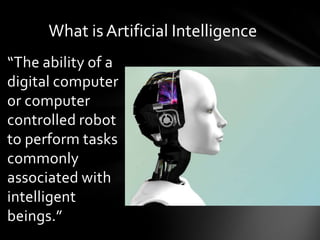
“The ability of a
digital computer
or computer
controlled robot
to perform tasks
commonly
associated with
intelligent
beings.”
History of Artificial Intelligence
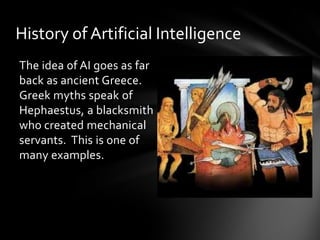
The idea of AI goes as far
back as ancient Greece.
Greek myths speak of
Hephaestus, a blacksmith
who created mechanical
servants. This is one of
many examples.
History of Artificial Intelligence
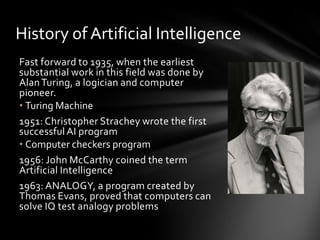
Fast forward to 1935, when the earliest
substantial work in this field was done by
Alan Turing, a logician and computer
pioneer.
• Turing Machine
1951: Christopher Strachey wrote the first
successful AI program
• Computer checkers program
1956: John McCarthy coined the term
Artificial Intelligence
1963: ANALOGY, a program created by
Thomas Evans, proved that computers can
solve IQ test analogy problems
History of Artificial Intelligence
             1967: First successful knowledge-based
             program in science and mathematics
             1972: SHRDLU created by Terry Winograd
             • Robot arm responded to commands
             1987: Marvin Minsky publishes The Society of
             Mind, which portrays the brain as a series of
             cooperating agents
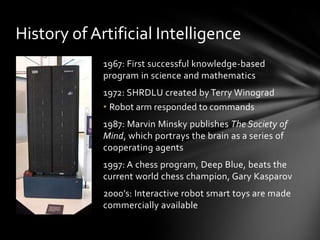
             1997: A chess program, Deep Blue, beats the
             current world chess champion, Gary Kasparov
             2000’s: Interactive robot smart toys are made
             commercially available
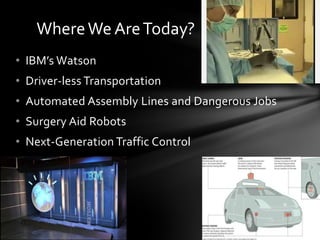
Where We Are Today?
• IBM’s Watson
• Driver-less Transportation
• Automated Assembly Lines and Dangerous Jobs
• Surgery Aid Robots
• Next-Generation Traffic Control
IBM’s Watson
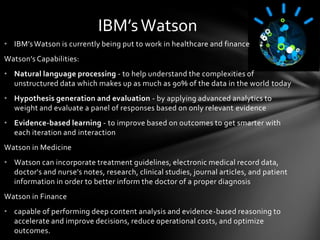
• IBM’s Watson is currently being put to work in healthcare and finance
Watson’s Capabilities:
• Natural language processing - to help understand the complexities of
  unstructured data which makes up as much as 90% of the data in the world today
• Hypothesis generation and evaluation - by applying advanced analytics to
  weight and evaluate a panel of responses based on only relevant evidence
• Evidence-based learning - to improve based on outcomes to get smarter with
  each iteration and interaction
Watson in Medicine
• Watson can incorporate treatment guidelines, electronic medical record data,
  doctor's and nurse's notes, research, clinical studies, journal articles, and patient
  information in order to better inform the doctor of a proper diagnosis
Watson in Finance
• capable of performing deep content analysis and evidence-based reasoning to
  accelerate and improve decisions, reduce operational costs, and optimize
  outcomes.
IBM Watson Video
Driverless Transport
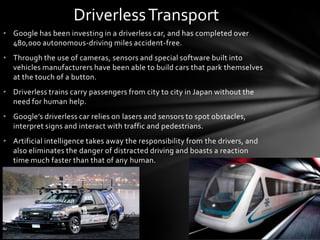
• Google has been investing in a driverless car, and has completed over
  480,000 autonomous-driving miles accident-free.
• Through the use of cameras, sensors and special software built into
  vehicles manufacturers have been able to build cars that park themselves
  at the touch of a button.
• Driverless trains carry passengers from city to city in Japan without the
  need for human help.
• Google’s driverless car relies on lasers and sensors to spot obstacles,
  interpret signs and interact with traffic and pedestrians.
• Artificial intelligence takes away the responsibility from the drivers, and
  also eliminates the danger of distracted driving and boasts a reaction
  time much faster than that of any human.
Surgical Aid Robots


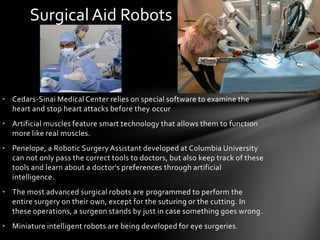
• Cedars-Sinai Medical Center relies on special software to examine the
  heart and stop heart attacks before they occur
• Artificial muscles feature smart technology that allows them to function
  more like real muscles.
• Penelope, a Robotic Surgery Assistant developed at Columbia University
  can not only pass the correct tools to doctors, but also keep track of these
  tools and learn about a doctor's preferences through artificial
  intelligence.
• The most advanced surgical robots are programmed to perform the
  entire surgery on their own, except for the suturing or the cutting. In
  these operations, a surgeon stands by just in case something goes wrong.
• Miniature intelligent robots are being developed for eye surgeries.
Automated Assembly Lines and
              Dangerous Jobs
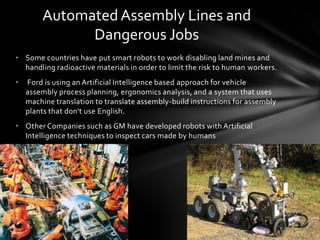
• Some countries have put smart robots to work disabling land mines and
  handling radioactive materials in order to limit the risk to human workers.
•   Ford is using an Artificial Intelligence based approach for vehicle
    assembly process planning, ergonomics analysis, and a system that uses
    machine translation to translate assembly-build instructions for assembly
    plants that don't use English.
• Other Companies such as GM have developed robots with Artificial
  Intelligence techniques to inspect cars made by humans
Next Generation Traffic Control
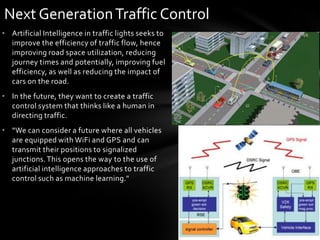
• Artificial Intelligence in traffic lights seeks to
  improve the efficiency of traffic flow, hence
  improving road space utilization, reducing
  journey times and potentially, improving fuel
  efficiency, as well as reducing the impact of
  cars on the road.
• In the future, they want to create a traffic
  control system that thinks like a human in
  directing traffic.
• “We can consider a future where all vehicles
  are equipped with WiFi and GPS and can
  transmit their positions to signalized
  junctions. This opens the way to the use of
  artificial intelligence approaches to traffic
  control such as machine learning."
Future of A.I.
Right now, A.I. is at level comparable to
less intelligent animals or insects.
Is it possible to go farther, to reach
human intelligence?
“Cognitivists”, who believe the human
conscious can be simulated, and “anti-
cognitivists” who believe it to be
impossible.
Future of A.I.
2050: Estimated date of the emergence of
the Singularity, or greater-than-human
super-intelligence.
At this point, it’s thought that certain
machines will exceed the human brain in
terms of intelligence
It’s believed that this breakthrough will lead
to a rapid advancement in technology, as
super intelligent A.I. designs new computers
and machines at a rate no human could
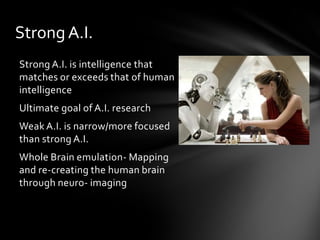
Strong A.I.
Strong A.I. is intelligence that
matches or exceeds that of human
intelligence
Ultimate goal of A.I. research
Weak A.I. is narrow/more focused
than strong A.I.
Whole Brain emulation- Mapping
and re-creating the human brain
through neuro- imaging
What Could This Mean for I.S?
If the singularity is reached, and
an age of rapid technological
advancement occurs, IS and
many technologies will be in a
dynamic era
Companies will have to
constantly change to keep up
with the rapid pace of
technology
It’s probable that every
successful company involved in
technology will need their own
A.I.
Problems with A.I.
 One basic problem lies in the
 question of what intelligence is
 exactly.
 How can we recreate a learning,
 thinking mind with technology?
 Is it even possible? Some do not
 think so.
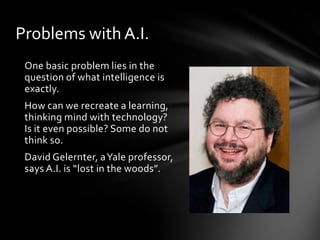
 David Gelernter, a Yale professor,
 says A.I. is “lost in the woods”.
Problems with A.I.
What is the human conscious? Gelernter argues that
we can’t construct a conscious A.I. without even
knowing what exactly the conscious is.
“Without this cognitive continuum, AI has no
comprehensive view of thought: it tends to ignore
some thought modes (such as free association and
dreaming), is uncertain how to integrate emotion and
thought, and has made strikingly little progress in
understanding analogies--which seem to underlie
creativity.”
Problems with A.I.
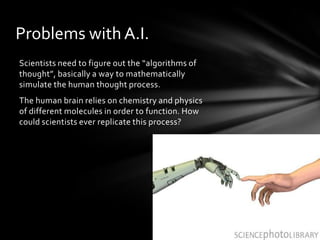
Scientists need to figure out the “algorithms of
thought”, basically a way to mathematically
simulate the human thought process.
The human brain relies on chemistry and physics
of different molecules in order to function. How
could scientists ever replicate this process?
Questions
• Do you believe that A.I. should be taken any
  further?
• Is A.I interfering with religion? Are we playing
  God?
• If machines can be made to think like us, then
  what do you think sets us apart as humans? At
  what point is a machine considered life?
• If we were to create intelligent beings, what
  kind of rights would they be given? Should they
  even be given rights?
Bibliography
http://www-03.ibm.com/innovation/us/watson/index.shtml
http://googleblog.blogspot.hu/2012/08/the-self-driving-car-logs-more-miles-on.html
http://en.wikipedia.org/wiki/Google_driverless_car
http://dsc.discovery.com/tv-shows/curiosity/topics/ways-artificial-intelligence-will-affect-our-lives.htm
http://curiosity.discovery.com/question/robots-perform-surgery
http://www.columbiasurgery.org/news/si/2005_penelope.html
http://www.computer.org/portal/web/csdl/doi/10.1109/MIS.2007.13
http://www.sciencedaily.com/releases/2012/08/120824082434.htm
http://www.technologyreview.com/article/408171/artificial-intelligence-is-lost-in-the-woods/7/
http://www-formal.stanford.edu/jmc/whatisai/whatisai.html
http://www.scientificamerican.com/article.cfm?id=rise-of-the-robots
http://www.futureforall.org/ai/artificial_intelligence.htm
http://aitopics.net/BriefHistory
http://library.thinkquest.org/2705/history.html
http://www.cs.washington.edu/education/courses/csep590/06au/projects/history-ai.pdf
http://www.britannica.com/EBchecked/topic/37146/artificial-intelligence-AI

Artificial Intelligence

  • 1.
    Presented By: Kathryn Fitzpatrick,Matt Nieusma, and Fabrizio Lepiz
  • 2.
    What is ArtificialIntelligence “The ability of a digital computer or computer controlled robot to perform tasks commonly associated with intelligent beings.”
  • 3.
    History of ArtificialIntelligence The idea of AI goes as far back as ancient Greece. Greek myths speak of Hephaestus, a blacksmith who created mechanical servants. This is one of many examples.
  • 4.
    History of ArtificialIntelligence Fast forward to 1935, when the earliest substantial work in this field was done by Alan Turing, a logician and computer pioneer. • Turing Machine 1951: Christopher Strachey wrote the first successful AI program • Computer checkers program 1956: John McCarthy coined the term Artificial Intelligence 1963: ANALOGY, a program created by Thomas Evans, proved that computers can solve IQ test analogy problems
  • 5.
    History of ArtificialIntelligence 1967: First successful knowledge-based program in science and mathematics 1972: SHRDLU created by Terry Winograd • Robot arm responded to commands 1987: Marvin Minsky publishes The Society of Mind, which portrays the brain as a series of cooperating agents 1997: A chess program, Deep Blue, beats the current world chess champion, Gary Kasparov 2000’s: Interactive robot smart toys are made commercially available
  • 6.
    Where We AreToday? • IBM’s Watson • Driver-less Transportation • Automated Assembly Lines and Dangerous Jobs • Surgery Aid Robots • Next-Generation Traffic Control
  • 7.
    IBM’s Watson • IBM’sWatson is currently being put to work in healthcare and finance Watson’s Capabilities: • Natural language processing - to help understand the complexities of unstructured data which makes up as much as 90% of the data in the world today • Hypothesis generation and evaluation - by applying advanced analytics to weight and evaluate a panel of responses based on only relevant evidence • Evidence-based learning - to improve based on outcomes to get smarter with each iteration and interaction Watson in Medicine • Watson can incorporate treatment guidelines, electronic medical record data, doctor's and nurse's notes, research, clinical studies, journal articles, and patient information in order to better inform the doctor of a proper diagnosis Watson in Finance • capable of performing deep content analysis and evidence-based reasoning to accelerate and improve decisions, reduce operational costs, and optimize outcomes.
  • 8.
  • 9.
    Driverless Transport • Googlehas been investing in a driverless car, and has completed over 480,000 autonomous-driving miles accident-free. • Through the use of cameras, sensors and special software built into vehicles manufacturers have been able to build cars that park themselves at the touch of a button. • Driverless trains carry passengers from city to city in Japan without the need for human help. • Google’s driverless car relies on lasers and sensors to spot obstacles, interpret signs and interact with traffic and pedestrians. • Artificial intelligence takes away the responsibility from the drivers, and also eliminates the danger of distracted driving and boasts a reaction time much faster than that of any human.
  • 10.
    Surgical Aid Robots •Cedars-Sinai Medical Center relies on special software to examine the heart and stop heart attacks before they occur • Artificial muscles feature smart technology that allows them to function more like real muscles. • Penelope, a Robotic Surgery Assistant developed at Columbia University can not only pass the correct tools to doctors, but also keep track of these tools and learn about a doctor's preferences through artificial intelligence. • The most advanced surgical robots are programmed to perform the entire surgery on their own, except for the suturing or the cutting. In these operations, a surgeon stands by just in case something goes wrong. • Miniature intelligent robots are being developed for eye surgeries.
  • 11.
    Automated Assembly Linesand Dangerous Jobs • Some countries have put smart robots to work disabling land mines and handling radioactive materials in order to limit the risk to human workers. • Ford is using an Artificial Intelligence based approach for vehicle assembly process planning, ergonomics analysis, and a system that uses machine translation to translate assembly-build instructions for assembly plants that don't use English. • Other Companies such as GM have developed robots with Artificial Intelligence techniques to inspect cars made by humans
  • 12.
    Next Generation TrafficControl • Artificial Intelligence in traffic lights seeks to improve the efficiency of traffic flow, hence improving road space utilization, reducing journey times and potentially, improving fuel efficiency, as well as reducing the impact of cars on the road. • In the future, they want to create a traffic control system that thinks like a human in directing traffic. • “We can consider a future where all vehicles are equipped with WiFi and GPS and can transmit their positions to signalized junctions. This opens the way to the use of artificial intelligence approaches to traffic control such as machine learning."
  • 14.
    Future of A.I. Rightnow, A.I. is at level comparable to less intelligent animals or insects. Is it possible to go farther, to reach human intelligence? “Cognitivists”, who believe the human conscious can be simulated, and “anti- cognitivists” who believe it to be impossible.
  • 15.
    Future of A.I. 2050:Estimated date of the emergence of the Singularity, or greater-than-human super-intelligence. At this point, it’s thought that certain machines will exceed the human brain in terms of intelligence It’s believed that this breakthrough will lead to a rapid advancement in technology, as super intelligent A.I. designs new computers and machines at a rate no human could
  • 16.
    Strong A.I. Strong A.I.is intelligence that matches or exceeds that of human intelligence Ultimate goal of A.I. research Weak A.I. is narrow/more focused than strong A.I. Whole Brain emulation- Mapping and re-creating the human brain through neuro- imaging
  • 17.
    What Could ThisMean for I.S? If the singularity is reached, and an age of rapid technological advancement occurs, IS and many technologies will be in a dynamic era Companies will have to constantly change to keep up with the rapid pace of technology It’s probable that every successful company involved in technology will need their own A.I.
  • 18.
    Problems with A.I. One basic problem lies in the question of what intelligence is exactly. How can we recreate a learning, thinking mind with technology? Is it even possible? Some do not think so. David Gelernter, a Yale professor, says A.I. is “lost in the woods”.
  • 19.
    Problems with A.I. Whatis the human conscious? Gelernter argues that we can’t construct a conscious A.I. without even knowing what exactly the conscious is. “Without this cognitive continuum, AI has no comprehensive view of thought: it tends to ignore some thought modes (such as free association and dreaming), is uncertain how to integrate emotion and thought, and has made strikingly little progress in understanding analogies--which seem to underlie creativity.”
  • 20.
    Problems with A.I. Scientistsneed to figure out the “algorithms of thought”, basically a way to mathematically simulate the human thought process. The human brain relies on chemistry and physics of different molecules in order to function. How could scientists ever replicate this process?
  • 21.
    Questions • Do youbelieve that A.I. should be taken any further? • Is A.I interfering with religion? Are we playing God? • If machines can be made to think like us, then what do you think sets us apart as humans? At what point is a machine considered life? • If we were to create intelligent beings, what kind of rights would they be given? Should they even be given rights?
  • 22.
    Bibliography http://www-03.ibm.com/innovation/us/watson/index.shtml http://googleblog.blogspot.hu/2012/08/the-self-driving-car-logs-more-miles-on.html http://en.wikipedia.org/wiki/Google_driverless_car http://dsc.discovery.com/tv-shows/curiosity/topics/ways-artificial-intelligence-will-affect-our-lives.htm http://curiosity.discovery.com/question/robots-perform-surgery http://www.columbiasurgery.org/news/si/2005_penelope.html http://www.computer.org/portal/web/csdl/doi/10.1109/MIS.2007.13 http://www.sciencedaily.com/releases/2012/08/120824082434.htm http://www.technologyreview.com/article/408171/artificial-intelligence-is-lost-in-the-woods/7/ http://www-formal.stanford.edu/jmc/whatisai/whatisai.html http://www.scientificamerican.com/article.cfm?id=rise-of-the-robots http://www.futureforall.org/ai/artificial_intelligence.htm http://aitopics.net/BriefHistory http://library.thinkquest.org/2705/history.html http://www.cs.washington.edu/education/courses/csep590/06au/projects/history-ai.pdf http://www.britannica.com/EBchecked/topic/37146/artificial-intelligence-AI