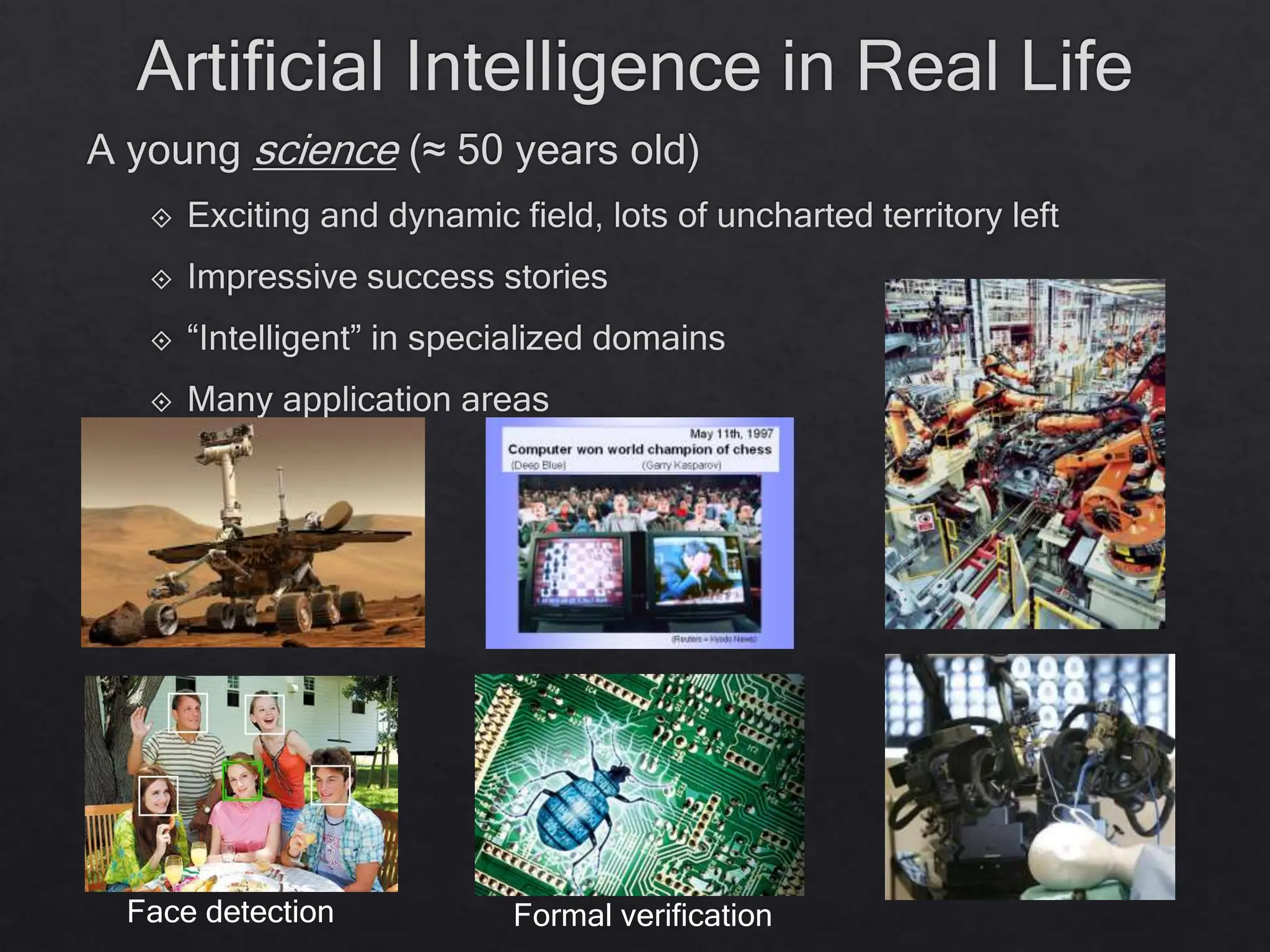
Face detection Formal verification
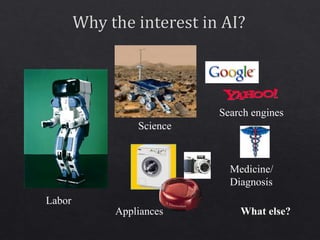
Search engines
Labor
Science
Medicine/
Diagnosis
Appliances What else?
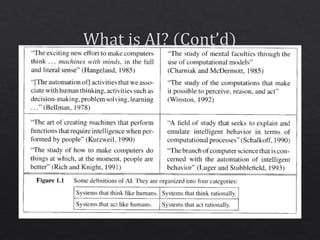
What is artificial intelligence?
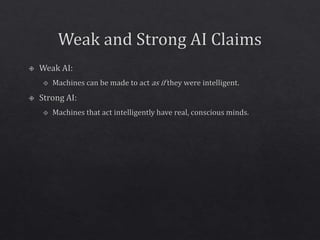
• There is no clear consensus on the definition of AI
• John McCarthy coined the phrase AI in 1956
Q. What is artificial intelligence?
A. It is the science and engineering of making intelligent
machines, especially intelligent computer programs. It is

related to the similar task of using computers to understand
human or other intelligence, but AI does not have to confine
itself to methods that are biologically observable.
Q. Yes, but what is intelligence?
A. Intelligence is the computational part of the ability to
achieve goals in the world. Varying kinds and degrees of
intelligence occur in people, many animals and some
machines.
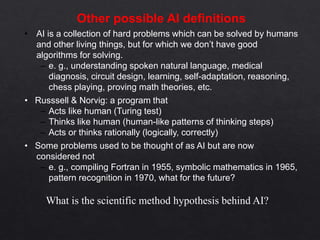
Other possible AI definitions
• AI is a collection of hard problems which can be solved by humans
and other living things, but for which we don’t have good
algorithms for solving.
– e. g., understanding spoken natural language, medical
diagnosis, circuit design, learning, self-adaptation, reasoning,
chess playing, proving math theories, etc.
• Russsell & Norvig: a program that
– Acts like human (Turing test)
– Thinks like human (human-like patterns of thinking steps)
– Acts or thinks rationally (logically, correctly)
• Some problems used to be thought of as AI but are now
considered not
– e. g., compiling Fortran in 1955, symbolic mathematics in 1965,
pattern recognition in 1970, what for the future?
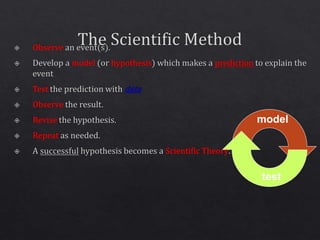
What is the scientific method hypothesis behind AI?
model
test
Artificial intelligence is the study of how to make
computers do things that people are better at or would be
better at if:
• they could extend what they do to a World Wide
Web-sized amount of data and
• not make mistakes.
"AI can have two purposes. One is to use the power of
computers to augment human thinking, just as we use
motors to augment human or horse power. Robotics
and expert systems are major branches of that. The
other is to use a computer's artificial intelligence to
understand how humans think. In a humanoid way. If
you test your programs not merely by what they can
accomplish, but how they accomplish it, they you're
really doing cognitive science; you're using AI to
understand the human mind."
- Herb Simon
What’s easy and what’s hard?
• It’s been easier to mechanize many of the high level cognitive
tasks we usually associate with “intelligence” in people
– e. g., symbolic integration, proving theorems, playing chess,
some aspect of medical diagnosis, etc.
• It’s been very hard to mechanize tasks that animals can do easily
– walking around without running into things
– catching prey and avoiding predators
– interpreting complex sensory information (visual, aural, …)
– modeling the internal states of other animals from their
behavior
– working as a team (ants, bees)
• Is there a fundamental difference between the two categories?
• Why are some complex problems (e.g., solving differential
equations, database operations) are not subjects of AI?
History of AI
• AI has roots in a number of scientific disciplines
– computer science and engineering (hardware and software)
– philosophy (rules of reasoning)
– mathematics (logic, algorithms, optimization)
– cognitive science and psychology (modeling high level
human/animal thinking)
– neural science (model low level human/animal brain activity)
– linguistics
• The birth of AI (1943 – 1956)
– McCulloch and Pitts (1943): simplified mathematical model of
neurons (resting/firing states) can realize all propositional logic
primitives (can compute all Turing computable functions)
– Alan Turing: Turing machine and Turing test (1950)
– Claude Shannon: information theory; possibility of chess playing
computers
– Boole, Aristotle, Euclid (logics, syllogisms)
• Early enthusiasm (1952 – 1969)
– 1956 Dartmouth conference
John McCarthy (Lisp);
Marvin Minsky (first neural network machine);
Alan Newell and Herbert Simon (GPS);
– Emphasis on intelligent general problem solving
GSP (means-ends analysis);
Lisp (AI programming language);
Resolution by John Robinson (basis for automatic
theorem proving);
heuristic search (A*, AO*, game tree search)
• Emphasis on knowledge (1966 – 1974)
– domain specific knowledge is the key to overcome existing
difficulties
– knowledge representation (KR) paradigms
– declarative vs. procedural representation
• Knowledge-based systems (1969 – 1999)
– DENDRAL: the first knowledge intensive system (determining 3D
structures of complex chemical compounds)
– MYCIN: first rule-based expert system (containing 450 rules for
diagnosing blood infectious diseases)
EMYCIN: an ES shell
– PROSPECTOR: first knowledge-based system that made
significant profit (geological ES for mineral deposits)
• AI became an industry (1980 – 1989)
– wide applications in various domains
– commercially available tools
– AI winter
• Current trends (1990 – present)
– more realistic goals
– more practical (application oriented)
– distributed AI and intelligent software agents
– resurgence of natural computation - neural networks and
emergence of genetic algorithms – many applications
– dominance of machine learning (big apps)
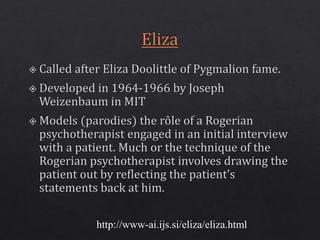
http://www-ai.ijs.si/eliza/eliza.html
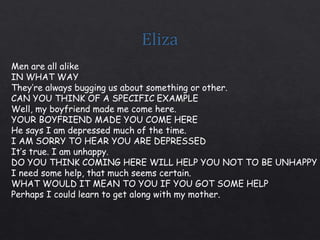
Men are all alike
IN WHAT WAY
They’re always bugging us about something or other.
CAN YOU THINK OF A SPECIFIC EXAMPLE
Well, my boyfriend made me come here.
YOUR BOYFRIEND MADE YOU COME HERE
He says I am depressed much of the time.
I AM SORRY TO HEAR YOU ARE DEPRESSED
It’s true. I am unhappy.
DO YOU THINK COMING HERE WILL HELP YOU NOT TO BE UNHAPPY
I need some help, that much seems certain.
WHAT WOULD IT MEAN TO YOU IF YOU GOT SOME HELP
Perhaps I could learn to get along with my mother.
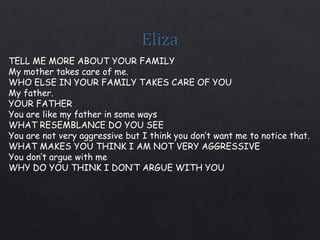
TELL ME MORE ABOUT YOUR FAMILY
My mother takes care of me.
WHO ELSE IN YOUR FAMILY TAKES CARE OF YOU
My father.
YOUR FATHER
You are like my father in some ways
WHAT RESEMBLANCE DO YOU SEE
You are not very aggressive but I think you don’t want me to notice that.
WHAT MAKES YOU THINK I AM NOT VERY AGGRESSIVE
You don’t argue with me
WHY DO YOU THINK I DON’T ARGUE WITH YOU
http://www.simonlaven.com/
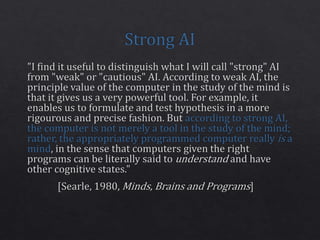
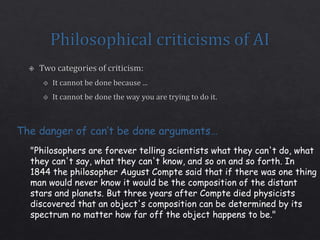
"Philosophers are forever telling scientists what they can't do, what
they can't say, what they can't know, and so on and so forth. In
1844 the philosopher August Compte said that if there was one thing
man would never know it would be the composition of the distant
stars and planets. But three years after Compte died physicists
discovered that an object's composition can be determined by its
spectrum no matter how far off the object happens to be."
The danger of can’t be done arguments…
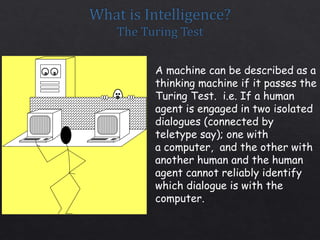
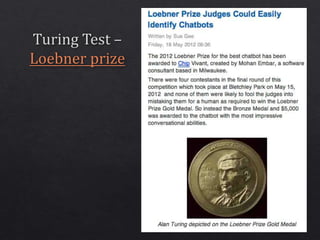
A machine can be described as a
thinking machine if it passes the
Turing Test. i.e. If a human
agent is engaged in two isolated
dialogues (connected by
teletype say); one with
a computer, and the other with
another human and the human
agent cannot reliably identify
which dialogue is with the
computer.
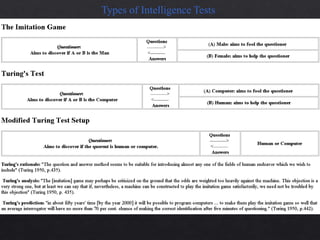
Types of Intelligence Tests
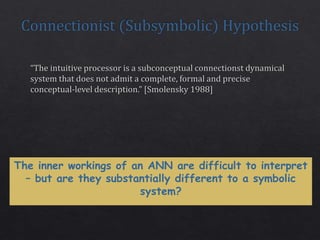
The inner workings of an ANN are difficult to interpret
– but are they substantially different to a symbolic
system?
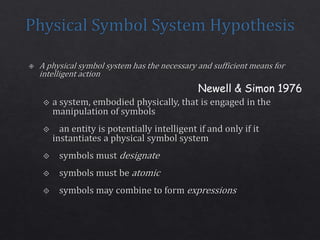
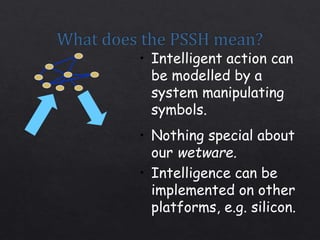
Newell & Simon 1976
• Intelligent action can
be modelled by a
system manipulating
symbols.
• Nothing special about
our wetware.
• Intelligence can be
implemented on other
platforms, e.g. silicon.
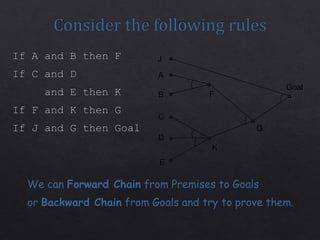
A
B
C
D
E
F
G
K
Goal
J
We can Forward Chain from Premises to Goals
or Backward Chain from Goals and try to prove them.
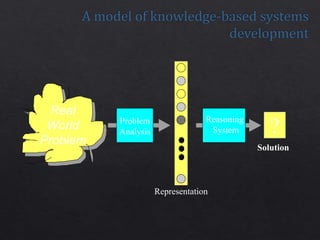
Representation
Problem
Analysis ?
Solution
Real
World
Problem
Reasoning
System
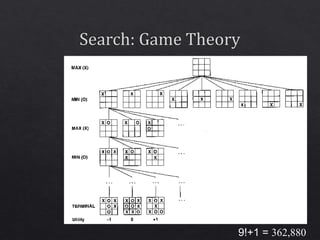
9!+1 = 362,880

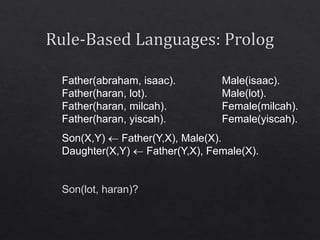
Father(abraham, isaac). Male(isaac).
Father(haran, lot). Male(lot).
Father(haran, milcah). Female(milcah).
Father(haran, yiscah). Female(yiscah).
Son(X,Y)  Father(Y,X), Male(X).
Daughter(X,Y)  Father(Y,X), Female(X).
Son(lot, haran)?
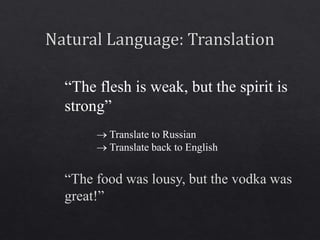
“The flesh is weak, but the spirit is
strong”
 Translate to Russian
 Translate back to English
“The food was lousy, but the vodka was
great!”
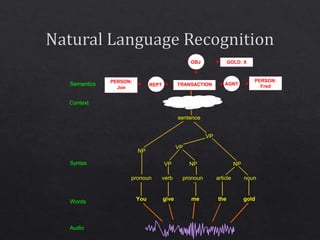
You give me the gold
pronoun
n
verb pronoun
d
article noun
VP NP
VP
NP
VP
NP
sentence
w
PERSON:
Joe
PERSON:
Fred
TRANSACTION
GOLD: X
REPT
OBJ
AGNT
Audio
Words
Syntax
Context
Semantics
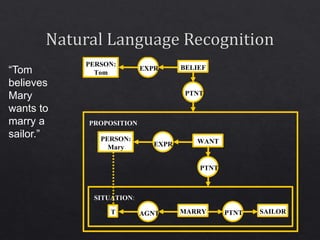
PERSON:
Tom
BELIEF
PERSON:
Mary
WANT
T MARRY SAILOR
SITUATION:
PROPOSITION
:
EXPR
EXPR
AGNT
PTNT
PTNT
PTNT
“Tom
believes
Mary
wants to
marry a
sailor.”
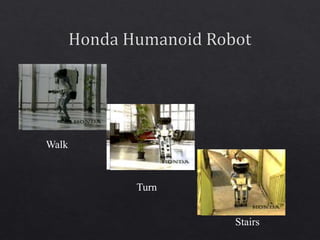
Walk
Turn
Stairs
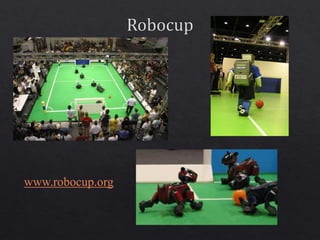
www.robocup.org
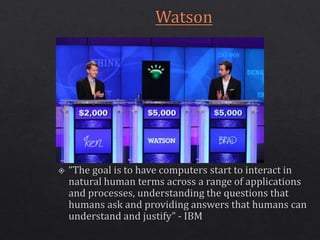
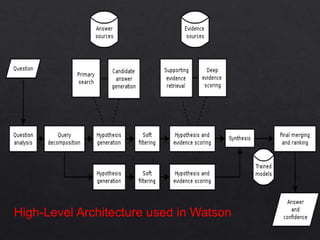
High-Level Architecture used in Watson
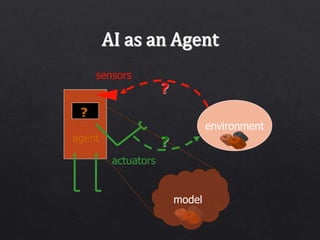
environment
agent
?
sensors
actuators
?
?
?
model
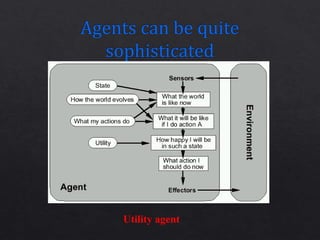
Utility agent
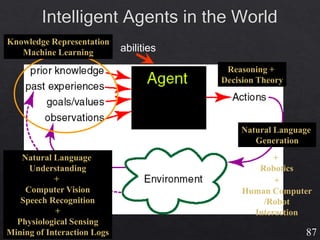
87
Natural Language
Understanding
+
Computer Vision
Speech Recognition
+
Physiological Sensing
Mining of Interaction Logs
Knowledge Representation
Machine Learning
Reasoning +
Decision Theory
+
Robotics
+
Human Computer
/Robot
Interaction
Natural Language
Generation
abilities
Introduction to Artificial intelligence and ML

Introduction to Artificial intelligence and ML

  • 1.
  • 2.
  • 4.
    What is artificialintelligence? • There is no clear consensus on the definition of AI • John McCarthy coined the phrase AI in 1956 Q. What is artificial intelligence? A. It is the science and engineering of making intelligent machines, especially intelligent computer programs. It is related to the similar task of using computers to understand human or other intelligence, but AI does not have to confine itself to methods that are biologically observable. Q. Yes, but what is intelligence? A. Intelligence is the computational part of the ability to achieve goals in the world. Varying kinds and degrees of intelligence occur in people, many animals and some machines.
  • 6.
    Other possible AIdefinitions • AI is a collection of hard problems which can be solved by humans and other living things, but for which we don’t have good algorithms for solving. – e. g., understanding spoken natural language, medical diagnosis, circuit design, learning, self-adaptation, reasoning, chess playing, proving math theories, etc. • Russsell & Norvig: a program that – Acts like human (Turing test) – Thinks like human (human-like patterns of thinking steps) – Acts or thinks rationally (logically, correctly) • Some problems used to be thought of as AI but are now considered not – e. g., compiling Fortran in 1955, symbolic mathematics in 1965, pattern recognition in 1970, what for the future? What is the scientific method hypothesis behind AI?
  • 7.
  • 8.
    Artificial intelligence isthe study of how to make computers do things that people are better at or would be better at if: • they could extend what they do to a World Wide Web-sized amount of data and • not make mistakes.
  • 9.
    "AI can havetwo purposes. One is to use the power of computers to augment human thinking, just as we use motors to augment human or horse power. Robotics and expert systems are major branches of that. The other is to use a computer's artificial intelligence to understand how humans think. In a humanoid way. If you test your programs not merely by what they can accomplish, but how they accomplish it, they you're really doing cognitive science; you're using AI to understand the human mind." - Herb Simon
  • 10.
    What’s easy andwhat’s hard? • It’s been easier to mechanize many of the high level cognitive tasks we usually associate with “intelligence” in people – e. g., symbolic integration, proving theorems, playing chess, some aspect of medical diagnosis, etc. • It’s been very hard to mechanize tasks that animals can do easily – walking around without running into things – catching prey and avoiding predators – interpreting complex sensory information (visual, aural, …) – modeling the internal states of other animals from their behavior – working as a team (ants, bees) • Is there a fundamental difference between the two categories? • Why are some complex problems (e.g., solving differential equations, database operations) are not subjects of AI?
  • 11.
    History of AI •AI has roots in a number of scientific disciplines – computer science and engineering (hardware and software) – philosophy (rules of reasoning) – mathematics (logic, algorithms, optimization) – cognitive science and psychology (modeling high level human/animal thinking) – neural science (model low level human/animal brain activity) – linguistics • The birth of AI (1943 – 1956) – McCulloch and Pitts (1943): simplified mathematical model of neurons (resting/firing states) can realize all propositional logic primitives (can compute all Turing computable functions) – Alan Turing: Turing machine and Turing test (1950) – Claude Shannon: information theory; possibility of chess playing computers – Boole, Aristotle, Euclid (logics, syllogisms)
  • 12.
    • Early enthusiasm(1952 – 1969) – 1956 Dartmouth conference John McCarthy (Lisp); Marvin Minsky (first neural network machine); Alan Newell and Herbert Simon (GPS); – Emphasis on intelligent general problem solving GSP (means-ends analysis); Lisp (AI programming language); Resolution by John Robinson (basis for automatic theorem proving); heuristic search (A*, AO*, game tree search) • Emphasis on knowledge (1966 – 1974) – domain specific knowledge is the key to overcome existing difficulties – knowledge representation (KR) paradigms – declarative vs. procedural representation
  • 13.
    • Knowledge-based systems(1969 – 1999) – DENDRAL: the first knowledge intensive system (determining 3D structures of complex chemical compounds) – MYCIN: first rule-based expert system (containing 450 rules for diagnosing blood infectious diseases) EMYCIN: an ES shell – PROSPECTOR: first knowledge-based system that made significant profit (geological ES for mineral deposits) • AI became an industry (1980 – 1989) – wide applications in various domains – commercially available tools – AI winter • Current trends (1990 – present) – more realistic goals – more practical (application oriented) – distributed AI and intelligent software agents – resurgence of natural computation - neural networks and emergence of genetic algorithms – many applications – dominance of machine learning (big apps)
  • 19.
  • 20.
    Men are allalike IN WHAT WAY They’re always bugging us about something or other. CAN YOU THINK OF A SPECIFIC EXAMPLE Well, my boyfriend made me come here. YOUR BOYFRIEND MADE YOU COME HERE He says I am depressed much of the time. I AM SORRY TO HEAR YOU ARE DEPRESSED It’s true. I am unhappy. DO YOU THINK COMING HERE WILL HELP YOU NOT TO BE UNHAPPY I need some help, that much seems certain. WHAT WOULD IT MEAN TO YOU IF YOU GOT SOME HELP Perhaps I could learn to get along with my mother.
  • 21.
    TELL ME MOREABOUT YOUR FAMILY My mother takes care of me. WHO ELSE IN YOUR FAMILY TAKES CARE OF YOU My father. YOUR FATHER You are like my father in some ways WHAT RESEMBLANCE DO YOU SEE You are not very aggressive but I think you don’t want me to notice that. WHAT MAKES YOU THINK I AM NOT VERY AGGRESSIVE You don’t argue with me WHY DO YOU THINK I DON’T ARGUE WITH YOU
  • 23.
  • 24.
  • 26.
    "Philosophers are forevertelling scientists what they can't do, what they can't say, what they can't know, and so on and so forth. In 1844 the philosopher August Compte said that if there was one thing man would never know it would be the composition of the distant stars and planets. But three years after Compte died physicists discovered that an object's composition can be determined by its spectrum no matter how far off the object happens to be." The danger of can’t be done arguments…
  • 27.
    A machine canbe described as a thinking machine if it passes the Turing Test. i.e. If a human agent is engaged in two isolated dialogues (connected by teletype say); one with a computer, and the other with another human and the human agent cannot reliably identify which dialogue is with the computer.
  • 32.
  • 33.
    The inner workingsof an ANN are difficult to interpret – but are they substantially different to a symbolic system?
  • 34.
  • 35.
    • Intelligent actioncan be modelled by a system manipulating symbols. • Nothing special about our wetware. • Intelligence can be implemented on other platforms, e.g. silicon.
  • 38.
    A B C D E F G K Goal J We can ForwardChain from Premises to Goals or Backward Chain from Goals and try to prove them.
  • 39.
  • 44.
  • 50.
  • 54.
    Father(abraham, isaac). Male(isaac). Father(haran,lot). Male(lot). Father(haran, milcah). Female(milcah). Father(haran, yiscah). Female(yiscah). Son(X,Y)  Father(Y,X), Male(X). Daughter(X,Y)  Father(Y,X), Female(X). Son(lot, haran)?
  • 60.
    “The flesh isweak, but the spirit is strong”  Translate to Russian  Translate back to English “The food was lousy, but the vodka was great!”
  • 61.
    You give methe gold pronoun n verb pronoun d article noun VP NP VP NP VP NP sentence w PERSON: Joe PERSON: Fred TRANSACTION GOLD: X REPT OBJ AGNT Audio Words Syntax Context Semantics
  • 62.
  • 64.
  • 68.
  • 74.
  • 80.
  • 82.
  • 83.
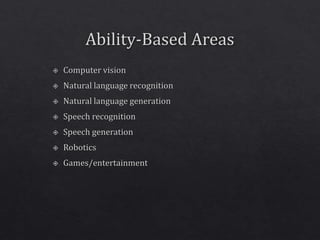
    87 Natural Language Understanding + Computer Vision SpeechRecognition + Physiological Sensing Mining of Interaction Logs Knowledge Representation Machine Learning Reasoning + Decision Theory + Robotics + Human Computer /Robot Interaction Natural Language Generation abilities