What is Artificial
Intelligence?
Artificial intelligence (AI) is a set of technologies that
enable computers to perform a variety of advanced
functions, including the ability to see, understand and
translate spoken and written language, analyze data,
make recommendations, and more.
AI is the backbone of innovation in modern computing.
3.
How does AIwork ?
five steps that illustrate how AI works: inputs, processing, outcomes,
adjustments, and assessments.
Input
Data is first collected from various sources in the form of text, audio, videos, and more. It is
sorted into categories
Output
Once data is gathered and inputted, the next step is to allow AI to decide what to do with
the data
Processing
In this step, the AI is programmed to decide whether specific data is a “pass” or “fail”—in
other words, does it match previous patterns? That determines outcomes that can be used
to make decisions.
4.
Adjustments
When datasets are considered a “fail”, AI learns from that mistake,
and the process is repeated again under different conditions.
Assessments
The final step for AI completing an assigned task is assessment.
5.
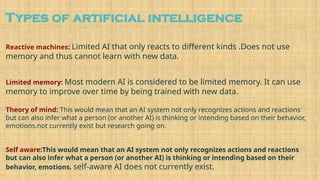
Types of artificialintelligence
Reactive machines: Limited AI that only reacts to different kinds .Does not use
memory and thus cannot learn with new data.
Limited memory: Most modern AI is considered to be limited memory. It can use
memory to improve over time by being trained with new data.
Theory of mind: This would mean that an AI system not only recognizes actions and reactions
but can also infer what a person (or another AI) is thinking or intending based on their behavior,
emotions.not currently exist but research going on.
Self aware:This would mean that an AI system not only recognizes actions and reactions
but can also infer what a person (or another AI) is thinking or intending based on their
behavior, emotions. self-aware AI does not currently exist.
6.
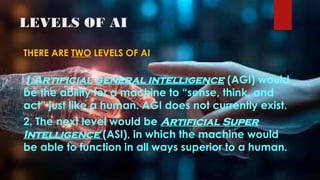
LEVELS OF AI
THEREARE TWO LEVELS OF AI
1.Artificial general intelligence (AGI) would
be the ability for a machine to “sense, think, and
act” just like a human. AGI does not currently exist.
2. The next level would be Artificial Super
Intelligence (ASI), in which the machine would
be able to function in all ways superior to a human.
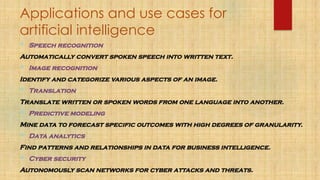
Applications and usecases for
artificial intelligence
Speech recognition
Automatically convert spoken speech into written text.
Image recognition
Identify and categorize various aspects of an image.
Translation
Translate written or spoken words from one language into another.
Predictive modeling
Mine data to forecast specific outcomes with high degrees of granularity.
Data analytics
Find patterns and relationships in data for business intelligence.
Cyber security
Autonomously scan networks for cyber attacks and threats.
9.
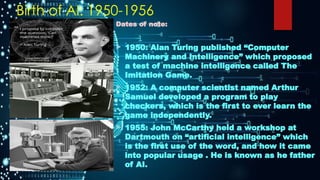
Birth of AI:1950-1956
Dates of note:
1950: Alan Turing published “Computer
Machinery and Intelligence” which proposed
a test of machine intelligence called The
Imitation Game.
1952: A computer scientist named Arthur
Samuel developed a program to play
checkers, which is the first to ever learn the
game independently.
1955: John McCarthy held a workshop at
Dartmouth on “artificial intelligence” which
is the first use of the word, and how it came
into popular usage . He is known as he father
of AI.
10.
POTENTIAL OF ARTIFICIALINTELLIGENCE
As we progress further into the 21st
century, artificial intelligence (AI) is
becoming increasingly important in our
lives.
AI is about creating smart machines
that can think and act like humans.
AI is rapidly being deployed in the retail
sector to create more efficient and
personalized shopping experiences.
(suggestions).
AI has also been used in the
transportation industry to improve safety
and reduce traffic congestion.(timings)
Artificial intelligence
Strong AI
This is the next stage of AI and
is yet to be achieved. Such AI
is able to grasp things that it
has learned in one area and
apply those findings in
another unfamiliar situation.
This is similar to what human
beings and other intelligent
organisms can do.
Weak AI or Narrow AI
This type is able to perform specific
tasks with intelligence. It can only do
things for which it is trained and not
more. Some examples of narrow AI
are:
All these systems are intelligent, but
they have limitations as they can only
perform in certain predefined
conditions.
13.
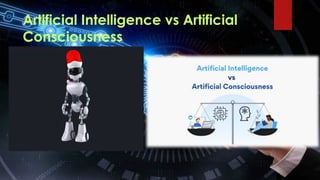
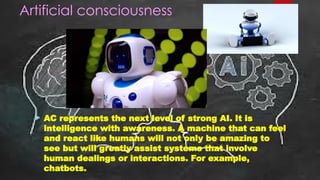
Artificial consciousness
ACrepresents the next level of strong AI. It is
intelligence with awareness. A machine that can feel
and react like humans will not only be amazing to
see but will greatly assist systems that involve
human dealings or interactions. For example,
chatbots.
14.
What Industries WillAI Impact the Most?
There’s virtually no major industry that modern AI hasn’t already
affected. Here are a few of the industries undergoing the greatest
changes as a result of AI.
AI in Manufacturing
AI in Healthcare
AI in Finance
AI in Education
AI in Media
AI in Customer Service
AI in Transportation
15.
Dangers of AI
Job Losses
Human Biases
Data Privacy
Automated Weapons
Artificial intelligence bias
Job displacement
Security
AI malware
AI race
Dependence on AI
16.
discover more…………
What doesthe future of AI look
like?
AI is expected to improve
industries like healthcare,
manufacturing and customer
service, leading to higher-quality
experiences for both workers
and customers. However, it does
face challenges like increased
regulation, data privacy
concerns and worries over job
losses.
17.
RESEARCH MORE……….
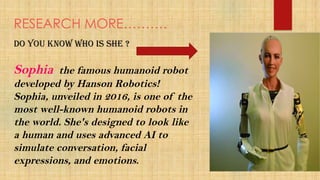
Do youknow who is she ?
Sophia the famous humanoid robot
developed by Hanson Robotics!
Sophia, unveiled in 2016, is one of the
most well-known humanoid robots in
the world. She's designed to look like
a human and uses advanced AI to
simulate conversation, facial
expressions, and emotions.
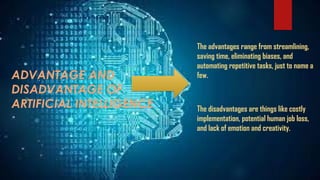
The advantages rangefrom streamlining,
saving time, eliminating biases, and
automating repetitive tasks, just to name a
few.
The disadvantages are things like costly
implementation, potential human job loss,
and lack of emotion and creativity.
ADVANTAGE AND
DISADVANTAGE OF
ARTIFICIAL INTELLIGENCE



![Intro to ET [Chapter 03 chgjkljg uyt ftyf f yyf 7].pptx](https://cdn.slidesharecdn.com/ss_thumbnails/introtoetchapter03-250427123226-489b5f38-thumbnail.jpg?width=640&height=640&fit=bounds)


![waterpollutionanditsmanagementppt-151116172005-lva1-app6891 (3)[1].pptx](https://cdn.slidesharecdn.com/ss_thumbnails/waterpollutionanditsmanagementppt-151116172005-lva1-app689131-250420123634-04f7bcb8-thumbnail.jpg?width=640&height=640&fit=bounds)


