Artificial Intelligence
Course Introduction
Artificial Intelligence (AI)
3170716
 Looping
Outline
 Introduction to Artificial Intelligence (AI)
 Applications of AI
What is Artificial Intelligence (AI)?
 AI is a branch of computer science dealing with the simulation of intelligent
behavior in computers.
 AI is the study of how to make computers do things which, at the moment,
people do better.
 AI is, the study and design of intelligent agents where an intelligent agent is a
system that perceives its environment and takes actions.
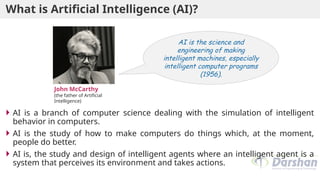
AI is the science and
engineering of making
intelligent machines, especially
intelligent computer programs
(1956).
John McCarthy
(the father of Artificial
Intelligence)
What is Artificial Intelligence (AI)?
 Before leading to the meaning of artificial intelligence let understand what is
the meaning of Intelligence-
 Intelligence: The ability to learn and solve problems. This definition is taken
from webster’s Dictionary.
 The most common answer that one expects is “to make computers intelligent
so that they can act intelligently!”, but the question is how much intelligent?
How can one judge intelligence?
 …as intelligent as humans. If the computers can, somehow, solve real-world
problems, by improving on their own from past experiences, they would be
called “intelligent”.
Thus, the AI systems are more generic(rather than specific), can “think” and are
more flexible.
How can one judge intelligence?
 Intelligence is composed of:
 Reasoning
 Learning
 Problem Solving
 Perception
 Linguistic Intelligence
 Many tools are used in AI, including versions of search and mathematical
optimization, logic, and methods based on probability and economics. The AI
field draws upon computer science, mathematics, psychology, linguistics,
philosophy, neuroscience, artificial psychology, and many others.
 Need for Artificial Intelligence
 To create expert systems that exhibit intelligent behaviour with the capability to
learn, demonstrate, explain, and advise its users.
 Helping machines find solutions to complex problems like humans do and
applying them as algorithms in a computer-friendly manner.
 Approaches of AI
 There are a total of four approaches of AI and that are as follows:
 Acting humanly (The Turing Test approach): This approach was designed by
Alan Turing. The ideology behind this approach is that a computer passes the
test if a human interrogator, after asking some written questions, cannot
identify whether the written responses come from a human or from a computer.
 Thinking humanly (The cognitive modeling approach): The idea behind this
approach is to determine whether the computer thinks like a human.
 Thinking rationally (The “laws of thought” approach): The idea behind this
approach is to determine whether the computer thinks rationally i.e. with
logical reasoning.
 Acting rationally (The rational agent approach): The idea behind this
approach is to determine whether the computer acts rationally i.e. with logical
reasoning.
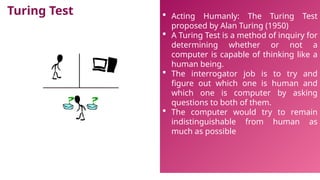
 Acting Humanly: The Turing Test
proposed by Alan Turing (1950)
 A Turing Test is a method of inquiry for
determining whether or not a
computer is capable of thinking like a
human being.
 The interrogator job is to try and
figure out which one is human and
which one is computer by asking
questions to both of them.
 The computer would try to remain
indistinguishable from human as
much as possible
Turing Test
AI Techniques
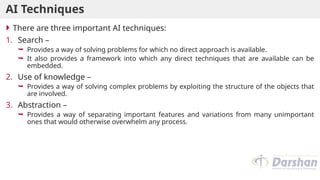
 There are three important AI techniques:
1. Search –
 Provides a way of solving problems for which no direct approach is available.
 It also provides a framework into which any direct techniques that are available can be
embedded.
2. Use of knowledge –
 Provides a way of solving complex problems by exploiting the structure of the objects that
are involved.
3. Abstraction –
 Provides a way of separating important features and variations from many unimportant
ones that would otherwise overwhelm any process.
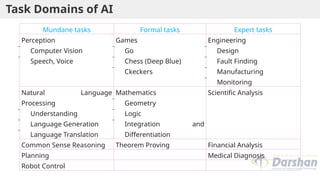
Task Domains of AI
Mundane tasks Formal tasks Expert tasks
Perception
 Computer Vision
 Speech, Voice
Games
 Go
 Chess (Deep Blue)
 Ckeckers
Engineering
 Design
 Fault Finding
 Manufacturing
 Monitoring
Natural Language
Processing
 Understanding
 Language Generation
 Language Translation
Mathematics
 Geometry
 Logic
 Integration and
Differentiation
Scientific Analysis
Common Sense Reasoning Theorem Proving Financial Analysis
Planning Medical Diagnosis
Robot Control
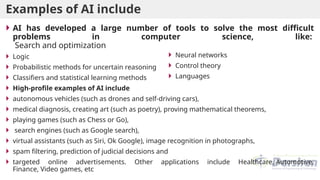
Examples of AI include
 AI has developed a large number of tools to solve the most difficult
problems in computer science, like:
Search and optimization
 Logic
 Probabilistic methods for uncertain reasoning
 Classifiers and statistical learning methods
 High-profile examples of AI include
 autonomous vehicles (such as drones and self-driving cars),
 medical diagnosis, creating art (such as poetry), proving mathematical theorems,
 playing games (such as Chess or Go),
 search engines (such as Google search),
 virtual assistants (such as Siri, Ok Google), image recognition in photographs,
 spam filtering, prediction of judicial decisions and
 targeted online advertisements. Other applications include Healthcare, Automotive,
Finance, Video games, etc
 Neural networks
 Control theory
 Languages
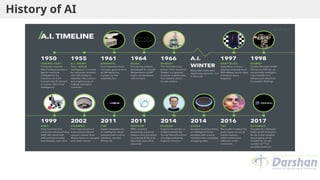
History of AI
Application Domains of AI
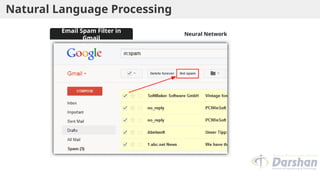
Natural Language Processing
Neural Network
Email Spam Filter in
Gmail
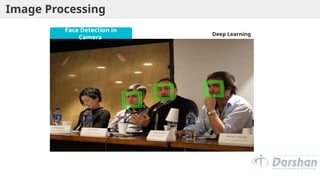
Image Processing
Deep Learning
Face Detection in
Camera
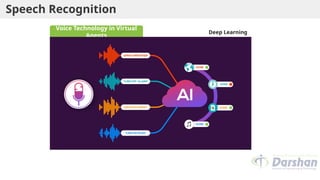
Speech Recognition
Deep Learning
Voice Technology in Virtual
Agents
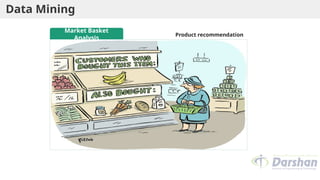
Data Mining
Product recommendation
Market Basket
Analysis
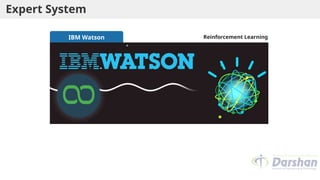
Expert System
Reinforcement Learning
IBM Watson
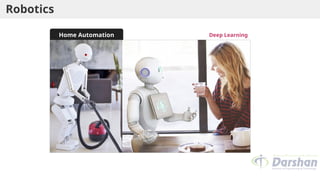
Robotics
Deep Learning
Home Automation
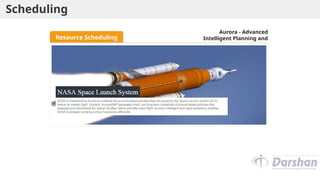
Scheduling
Aurora - Advanced
Intelligent Planning and
Scheduling Solution
Resource Scheduling
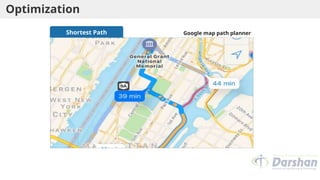
Optimization
Google map path planner
Shortest Path
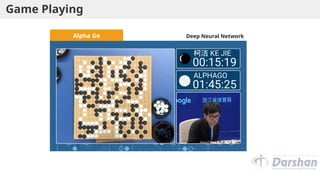
Game Playing
Deep Neural Network
Alpha Go
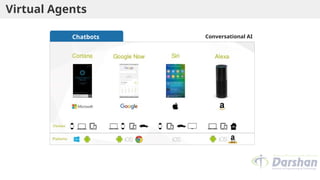
Virtual Agents
Conversational AI
Chatbots
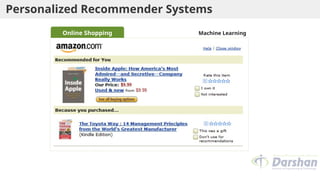
Personalized Recommender Systems
Machine Learning
Online Shopping
Automated Control Systems
Fuzzy Logic
Washing Machine
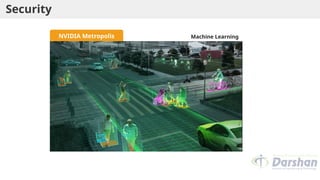
Security
Machine Learning
NVIDIA Metropolis
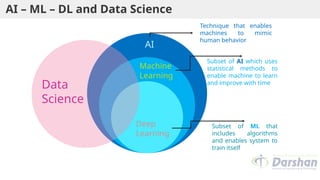
AI – ML – DL and Data Science
AI
Technique that enables
machines to mimic
human behavior
Subset of AI which uses
statistical methods to
enable machine to learn
and improve with time
Machine
Learning
Deep
Learning
Data
Science
Subset of ML that
includes algorithms
and enables system to
train itself
Thank You!

Artificial intelligence introduction and basis

  • 1.
  • 2.
     Looping Outline  Introductionto Artificial Intelligence (AI)  Applications of AI
  • 3.
    What is ArtificialIntelligence (AI)?  AI is a branch of computer science dealing with the simulation of intelligent behavior in computers.  AI is the study of how to make computers do things which, at the moment, people do better.  AI is, the study and design of intelligent agents where an intelligent agent is a system that perceives its environment and takes actions. AI is the science and engineering of making intelligent machines, especially intelligent computer programs (1956). John McCarthy (the father of Artificial Intelligence)
  • 4.
    What is ArtificialIntelligence (AI)?  Before leading to the meaning of artificial intelligence let understand what is the meaning of Intelligence-  Intelligence: The ability to learn and solve problems. This definition is taken from webster’s Dictionary.  The most common answer that one expects is “to make computers intelligent so that they can act intelligently!”, but the question is how much intelligent? How can one judge intelligence?  …as intelligent as humans. If the computers can, somehow, solve real-world problems, by improving on their own from past experiences, they would be called “intelligent”. Thus, the AI systems are more generic(rather than specific), can “think” and are more flexible.
  • 5.
    How can onejudge intelligence?  Intelligence is composed of:  Reasoning  Learning  Problem Solving  Perception  Linguistic Intelligence  Many tools are used in AI, including versions of search and mathematical optimization, logic, and methods based on probability and economics. The AI field draws upon computer science, mathematics, psychology, linguistics, philosophy, neuroscience, artificial psychology, and many others.
  • 6.
     Need forArtificial Intelligence  To create expert systems that exhibit intelligent behaviour with the capability to learn, demonstrate, explain, and advise its users.  Helping machines find solutions to complex problems like humans do and applying them as algorithms in a computer-friendly manner.
  • 7.
     Approaches ofAI  There are a total of four approaches of AI and that are as follows:  Acting humanly (The Turing Test approach): This approach was designed by Alan Turing. The ideology behind this approach is that a computer passes the test if a human interrogator, after asking some written questions, cannot identify whether the written responses come from a human or from a computer.  Thinking humanly (The cognitive modeling approach): The idea behind this approach is to determine whether the computer thinks like a human.  Thinking rationally (The “laws of thought” approach): The idea behind this approach is to determine whether the computer thinks rationally i.e. with logical reasoning.  Acting rationally (The rational agent approach): The idea behind this approach is to determine whether the computer acts rationally i.e. with logical reasoning.
  • 8.
     Acting Humanly:The Turing Test proposed by Alan Turing (1950)  A Turing Test is a method of inquiry for determining whether or not a computer is capable of thinking like a human being.  The interrogator job is to try and figure out which one is human and which one is computer by asking questions to both of them.  The computer would try to remain indistinguishable from human as much as possible Turing Test
  • 9.
    AI Techniques  Thereare three important AI techniques: 1. Search –  Provides a way of solving problems for which no direct approach is available.  It also provides a framework into which any direct techniques that are available can be embedded. 2. Use of knowledge –  Provides a way of solving complex problems by exploiting the structure of the objects that are involved. 3. Abstraction –  Provides a way of separating important features and variations from many unimportant ones that would otherwise overwhelm any process.
  • 10.
    Task Domains ofAI Mundane tasks Formal tasks Expert tasks Perception  Computer Vision  Speech, Voice Games  Go  Chess (Deep Blue)  Ckeckers Engineering  Design  Fault Finding  Manufacturing  Monitoring Natural Language Processing  Understanding  Language Generation  Language Translation Mathematics  Geometry  Logic  Integration and Differentiation Scientific Analysis Common Sense Reasoning Theorem Proving Financial Analysis Planning Medical Diagnosis Robot Control
  • 11.
    Examples of AIinclude  AI has developed a large number of tools to solve the most difficult problems in computer science, like: Search and optimization  Logic  Probabilistic methods for uncertain reasoning  Classifiers and statistical learning methods  High-profile examples of AI include  autonomous vehicles (such as drones and self-driving cars),  medical diagnosis, creating art (such as poetry), proving mathematical theorems,  playing games (such as Chess or Go),  search engines (such as Google search),  virtual assistants (such as Siri, Ok Google), image recognition in photographs,  spam filtering, prediction of judicial decisions and  targeted online advertisements. Other applications include Healthcare, Automotive, Finance, Video games, etc  Neural networks  Control theory  Languages
  • 12.
  • 13.
  • 14.
    Natural Language Processing NeuralNetwork Email Spam Filter in Gmail
  • 15.
  • 16.
    Speech Recognition Deep Learning VoiceTechnology in Virtual Agents
  • 17.
  • 18.
  • 19.
  • 20.
    Scheduling Aurora - Advanced IntelligentPlanning and Scheduling Solution Resource Scheduling
  • 21.
    Optimization Google map pathplanner Shortest Path
  • 22.
    Game Playing Deep NeuralNetwork Alpha Go
  • 23.
  • 24.
  • 25.
    Automated Control Systems FuzzyLogic Washing Machine
  • 26.
  • 27.
    AI – ML– DL and Data Science AI Technique that enables machines to mimic human behavior Subset of AI which uses statistical methods to enable machine to learn and improve with time Machine Learning Deep Learning Data Science Subset of ML that includes algorithms and enables system to train itself
  • 28.