ARTIFICIAL INTELLIGENCE
PRESENTED BY:-
ASHUTOSH HOTA
BRANCH:-MECHANICAL
REGD. NO:- F21126004007
SEMESTER:- 4th
• INTRODUCTION
• PROBLEMS DEDUCTED THROUGH A.I.
• APPROACHES
• TOOLS
• ADVANTAGES
• DISADVANTAGE
• APPLICATION
• CONCLUSION
• REFERENCES
CONTENTS
 From SIRI to self-driving cars, artificial
intelligence (AI) is progressing rapidly.
 While science fiction often portrays AI as robots
with human-like characteristics, AI can
encompass anything from Google’s search
algorithms to IBM’s Watson to autonomous
weapons.
 Artificial intelligence today is properly known as
narrow AI (or weak AI), in that it is designed to
perform a narrow task (e.g. only facial recognition
or only internet searches or only driving a car).
However, the long-term goal of many researchers
is to create general AI (AGI or strong AI).
INTRODUCTION
 Artificial intelligence (AI) is the
intelligence of machines and the
branch of computer science that
aims to create it.
 AI textbooks define the field as
"the study and design of
intelligent agents" where an
intelligent agent is a system
that perceives its environment
and takes actions that maximize
its chances of success.
What is Artificial Intelligence?
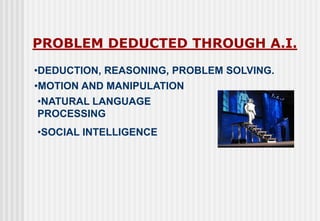
•DEDUCTION, REASONING, PROBLEM SOLVING.
PROBLEM DEDUCTED THROUGH A.I.
•NATURAL LANGUAGE
PROCESSING
•SOCIAL INTELLIGENCE
•MOTION AND MANIPULATION
•CYBERNETICS AND BRAIN SIMULATION
•SYMBOLIC
When access to digital computers became
possible in the middle 1950s, AI research began
to explore the possibility that human intelligence
could be reduced to symbol manipulation.
APPROACHES
TOOLS
•SEARCH AND OPTIMIZATION
Many problems in AI can be solved in theory by
intelligently searching through many possible
solutions. Planning algorithms search through trees
of goals and subgoals, attempting to find a path to a
target goal, a process called means-ends analysis.
LOGIC
Logic is used for knowledge representation and
problem solving, but it can be applied to other
problems as well. AI researchers have devised a
number of powerful tools to solve these problems
using methods from probability theory and
economics.
•CONTROL THEORY
Control theory, the grandchild of cybernetics, has
many important applications, especially in robotics.
•LANGUAGES
AI researchers have developed several specialized
languages for AI research, including Lisp and Prolog.
ADVANTAGES
• Artificial intelligence would not need any sleep.
• Unemotional consideration of problems.
• Easier copying.
DISADVANTAGE
• Limited Sensory input.
• An artificial mind is limited capable to talk.
APPLICATIONS
• Gesture recognition
• Individual voice recognition
• Global voice recognition
• Facial expression recognition for interpretation of
emotion and non verbal queues.
• Robot navigation.
Conclusion
 Artificial Intelligence and Machine
Learning are products of both science
and myth. The idea that machines could
think and perform tasks just as humans
do is thousands of years old.
 The cognitive truths expressed in AI and
Machine Learning systems are not new
either. It may be better to view these
technologies as the implementation of
powerful and long-established cognitive
principles through engineering.
REFERENCES
 www.google.com
 www.wikipedia.com
 www.studymafia.org
14
THANK YOU

Artificial-Intelligence-ppt.pptx

  • 1.
    ARTIFICIAL INTELLIGENCE PRESENTED BY:- ASHUTOSHHOTA BRANCH:-MECHANICAL REGD. NO:- F21126004007 SEMESTER:- 4th
  • 2.
    • INTRODUCTION • PROBLEMSDEDUCTED THROUGH A.I. • APPROACHES • TOOLS • ADVANTAGES • DISADVANTAGE • APPLICATION • CONCLUSION • REFERENCES CONTENTS
  • 3.
     From SIRIto self-driving cars, artificial intelligence (AI) is progressing rapidly.  While science fiction often portrays AI as robots with human-like characteristics, AI can encompass anything from Google’s search algorithms to IBM’s Watson to autonomous weapons.  Artificial intelligence today is properly known as narrow AI (or weak AI), in that it is designed to perform a narrow task (e.g. only facial recognition or only internet searches or only driving a car). However, the long-term goal of many researchers is to create general AI (AGI or strong AI). INTRODUCTION
  • 4.
     Artificial intelligence(AI) is the intelligence of machines and the branch of computer science that aims to create it.  AI textbooks define the field as "the study and design of intelligent agents" where an intelligent agent is a system that perceives its environment and takes actions that maximize its chances of success. What is Artificial Intelligence?
  • 5.
    •DEDUCTION, REASONING, PROBLEMSOLVING. PROBLEM DEDUCTED THROUGH A.I. •NATURAL LANGUAGE PROCESSING •SOCIAL INTELLIGENCE •MOTION AND MANIPULATION
  • 6.
    •CYBERNETICS AND BRAINSIMULATION •SYMBOLIC When access to digital computers became possible in the middle 1950s, AI research began to explore the possibility that human intelligence could be reduced to symbol manipulation. APPROACHES
  • 7.
    TOOLS •SEARCH AND OPTIMIZATION Manyproblems in AI can be solved in theory by intelligently searching through many possible solutions. Planning algorithms search through trees of goals and subgoals, attempting to find a path to a target goal, a process called means-ends analysis.
  • 8.
    LOGIC Logic is usedfor knowledge representation and problem solving, but it can be applied to other problems as well. AI researchers have devised a number of powerful tools to solve these problems using methods from probability theory and economics.
  • 9.
    •CONTROL THEORY Control theory,the grandchild of cybernetics, has many important applications, especially in robotics. •LANGUAGES AI researchers have developed several specialized languages for AI research, including Lisp and Prolog.
  • 10.
    ADVANTAGES • Artificial intelligencewould not need any sleep. • Unemotional consideration of problems. • Easier copying.
  • 11.
    DISADVANTAGE • Limited Sensoryinput. • An artificial mind is limited capable to talk.
  • 12.
    APPLICATIONS • Gesture recognition •Individual voice recognition • Global voice recognition • Facial expression recognition for interpretation of emotion and non verbal queues. • Robot navigation.
  • 13.
    Conclusion  Artificial Intelligenceand Machine Learning are products of both science and myth. The idea that machines could think and perform tasks just as humans do is thousands of years old.  The cognitive truths expressed in AI and Machine Learning systems are not new either. It may be better to view these technologies as the implementation of powerful and long-established cognitive principles through engineering.
  • 14.
  • 15.

Editor's Notes