Artificial
Intelligen
ceNarendra Panwar,Shubham
Kumar
1
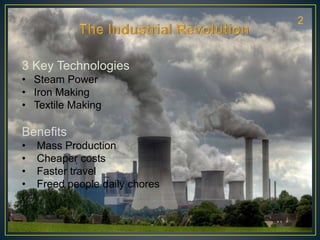
3 Key Technologies
• Steam Power
• Iron Making
• Textile Making
Benefits
• Mass Production
• Cheaper costs
• Faster travel
• Freed people daily chores
2
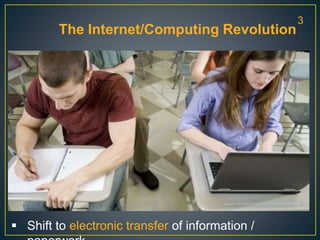
 Shift to electronic transfer of information /
The Internet/Computing Revolution
3
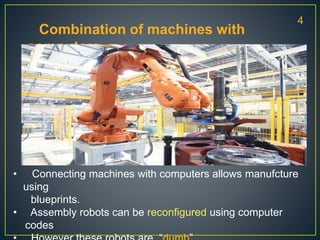
Combination of machines with
computers
• Connecting machines with computers allows manufcture
using
blueprints.
• Assembly robots can be reconfigured using computer
codes
4
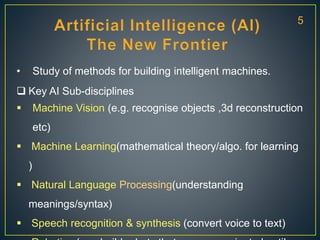
• Study of methods for building intelligent machines.
 Key AI Sub-disciplines
 Machine Vision (e.g. recognise objects ,3d reconstruction
etc)
 Machine Learning(mathematical theory/algo. for learning
)
 Natural Language Processing(understanding
meanings/syntax)
 Speech recognition & synthesis (convert voice to text)
5
What is
Artificial
Intelligence
The theory and development
of computer systems able to
perform tasks normally
requiring human intelligence,
such as visual perception,
speech recognition, decision-
making, and translation
between languages.
6
What is
Artificial
Intelligence
In Simple, it’s the science and
engineering of making
intelligent machines , especially
intelligent computer programs.
7
What is
Artificial
Intelligence
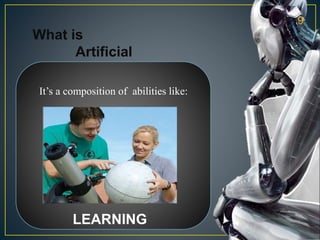
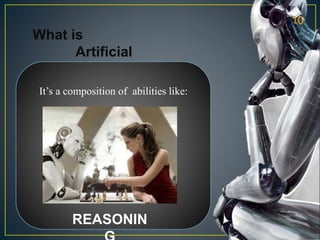
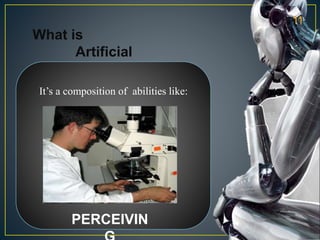
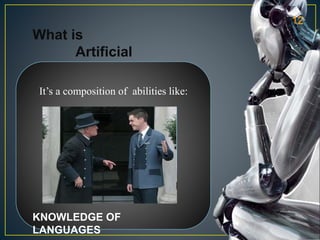
It’s a composition of abilities like:
8
What is
Artificial
Intelligence
It’s a composition of abilities like:
LEARNING
9
What is
Artificial
Intelligence
It’s a composition of abilities like:
REASONIN
10
What is
Artificial
Intelligence
It’s a composition of abilities like:
PERCEIVIN
11
What is
Artificial
Intelligence
It’s a composition of abilities like:
KNOWLEDGE OF
LANGUAGES
12
• Intelligence:
“ the capacity to learn and solve
problems”
• Artificial Intelligence (AI):
It is the intelligence of machines and
robots
and the branch of computer science that
aims to create it
 the ability to solve problems.
 the ability to act rationally.
13
“machines will be capable , within twenty
years,
of doing any work a man can do”. Two
years later MIT researcher Marvin Minsky
predicted,
“Within a generation … the problem of
creating
‘Artificial Intelligence’ will substantially be
solved”.
14
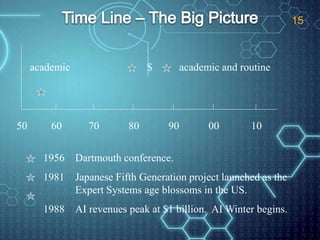
50 60 70 80 90 00 10
1956 Dartmouth conference.
1981 Japanese Fifth Generation project launched as the
Expert Systems age blossoms in the US.
1988 AI revenues peak at $1 billion. AI Winter begins.
academic $ academic and routine
15
J. McCarthy, M. L. Minsky, N. Rochester,
and C.E. Shannon. August 31, 1955. "We
propose that a 2 month, 10 man study of
artificial intelligence be carried out during the
summer of 1956 at Dartmouth College in
Hanover, New Hampshire. The study is to
proceed on the basis of the conjecture that
every aspect of learning or any other feature
of intelligence can in principle be so
precisely described that a machine can be
16
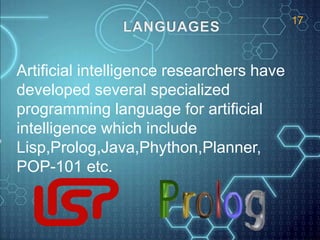
Artificial intelligence researchers have
developed several specialized
programming language for artificial
intelligence which include
Lisp,Prolog,Java,Phython,Planner,
POP-101 etc.
17
 Lisp is a family of computer programming
languages with a long history.
 The name LISP derives from “List
Processing”.
 Linked list are one of LISP languages’
major data structure and lisp source code
is itself made of lists so lisp can
manipulate code as a data structure.
 It is an important language for AI
programming.
Lisp programs define how to perform an
18
• Game Playing
• Speech recognition
• Understanding natural language
• Robotics
• Education
• Expert System
• General Problem Solving
• Unmanned drone aircraft
• Medical field like remote controlled
surgical procedures
• Many other Industrial uses(Robotic
19
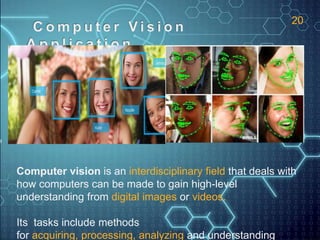
Computer vision is an interdisciplinary field that deals with
how computers can be made to gain high-level
understanding from digital images or videos.
Its tasks include methods
for acquiring, processing, analyzing and understanding
20
A common example - Google photos
21
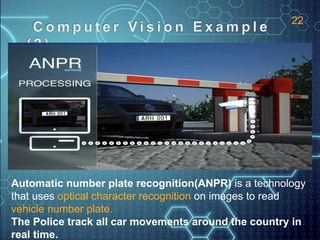
Automatic number plate recognition(ANPR) is a technology
that uses optical character recognition on images to read
vehicle number plate.
The Police track all car movements around the country in
real time.
22
23
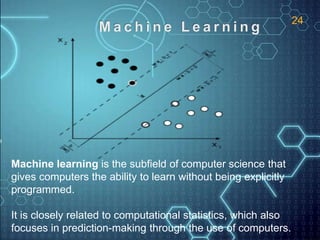
Machine learning is the subfield of computer science that
gives computers the ability to learn without being explicitly
programmed.
It is closely related to computational statistics, which also
focuses in prediction-making through the use of computers.
24
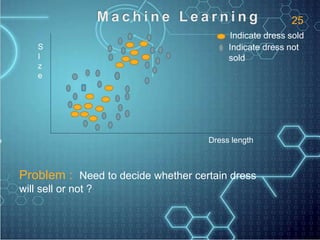
Dress length
S
I
z
e
Indicate dress sold
Indicate dress not
sold
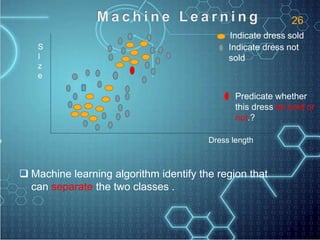
Problem : Need to decide whether certain dress
will sell or not ?
25
Dress length
S
I
z
e
Indicate dress sold
Indicate dress not
sold
 Machine learning algorithm identify the region that
can separate the two classes .
Predicate whether
this dress be sold or
not.?
26
 Ultimate goal : build machine that can ‘understand ‘
human
language
 Speech understanding
 Speech recognition – convert speech to text
 Speech synthesis – convert text to speech
 Language understanding
 Understand the meaning of sentence
 one of the hardest problem in AI
27
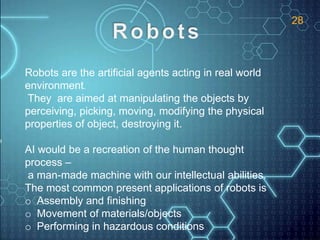
Robots are the artificial agents acting in real world
environment.
They are aimed at manipulating the objects by
perceiving, picking, moving, modifying the physical
properties of object, destroying it.
AI would be a recreation of the human thought
process –
a man-made machine with our intellectual abilities.
The most common present applications of robots is
o Assembly and finishing
o Movement of materials/objects
o Performing in hazardous conditions
28
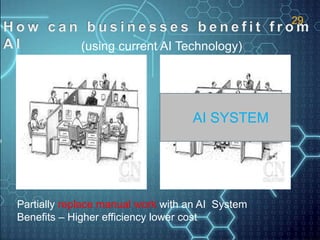
(using current AI Technology)
AI SYSTEM
Partially replace manual work with an AI System
Benefits – Higher efficiency lower cost
29
Till now , we have discussed in brief about
artificial intelligence . We have discuss some
of its principle, its application ,its achievement
etc.
The ultimate goal of institutions and scientists
working on AI is to solve majority of the
problem
or to achieve the tasks which we humans
directly
can’t accomplish . It is for sure that
development in this field of computer science
will change the complete scenario of the
30
31
32

Artifical intelligence-NIT Kurukshetra

  • 1.
  • 2.
    3 Key Technologies •Steam Power • Iron Making • Textile Making Benefits • Mass Production • Cheaper costs • Faster travel • Freed people daily chores 2
  • 3.
     Shift toelectronic transfer of information / The Internet/Computing Revolution 3
  • 4.
    Combination of machineswith computers • Connecting machines with computers allows manufcture using blueprints. • Assembly robots can be reconfigured using computer codes 4
  • 5.
    • Study ofmethods for building intelligent machines.  Key AI Sub-disciplines  Machine Vision (e.g. recognise objects ,3d reconstruction etc)  Machine Learning(mathematical theory/algo. for learning )  Natural Language Processing(understanding meanings/syntax)  Speech recognition & synthesis (convert voice to text) 5
  • 6.
    What is Artificial Intelligence The theoryand development of computer systems able to perform tasks normally requiring human intelligence, such as visual perception, speech recognition, decision- making, and translation between languages. 6
  • 7.
    What is Artificial Intelligence In Simple,it’s the science and engineering of making intelligent machines , especially intelligent computer programs. 7
  • 8.
    What is Artificial Intelligence It’s acomposition of abilities like: 8
  • 9.
    What is Artificial Intelligence It’s acomposition of abilities like: LEARNING 9
  • 10.
    What is Artificial Intelligence It’s acomposition of abilities like: REASONIN 10
  • 11.
    What is Artificial Intelligence It’s acomposition of abilities like: PERCEIVIN 11
  • 12.
    What is Artificial Intelligence It’s acomposition of abilities like: KNOWLEDGE OF LANGUAGES 12
  • 13.
    • Intelligence: “ thecapacity to learn and solve problems” • Artificial Intelligence (AI): It is the intelligence of machines and robots and the branch of computer science that aims to create it  the ability to solve problems.  the ability to act rationally. 13
  • 14.
    “machines will becapable , within twenty years, of doing any work a man can do”. Two years later MIT researcher Marvin Minsky predicted, “Within a generation … the problem of creating ‘Artificial Intelligence’ will substantially be solved”. 14
  • 15.
    50 60 7080 90 00 10 1956 Dartmouth conference. 1981 Japanese Fifth Generation project launched as the Expert Systems age blossoms in the US. 1988 AI revenues peak at $1 billion. AI Winter begins. academic $ academic and routine 15
  • 16.
    J. McCarthy, M.L. Minsky, N. Rochester, and C.E. Shannon. August 31, 1955. "We propose that a 2 month, 10 man study of artificial intelligence be carried out during the summer of 1956 at Dartmouth College in Hanover, New Hampshire. The study is to proceed on the basis of the conjecture that every aspect of learning or any other feature of intelligence can in principle be so precisely described that a machine can be 16
  • 17.
    Artificial intelligence researchershave developed several specialized programming language for artificial intelligence which include Lisp,Prolog,Java,Phython,Planner, POP-101 etc. 17
  • 18.
     Lisp isa family of computer programming languages with a long history.  The name LISP derives from “List Processing”.  Linked list are one of LISP languages’ major data structure and lisp source code is itself made of lists so lisp can manipulate code as a data structure.  It is an important language for AI programming. Lisp programs define how to perform an 18
  • 19.
    • Game Playing •Speech recognition • Understanding natural language • Robotics • Education • Expert System • General Problem Solving • Unmanned drone aircraft • Medical field like remote controlled surgical procedures • Many other Industrial uses(Robotic 19
  • 20.
    Computer vision isan interdisciplinary field that deals with how computers can be made to gain high-level understanding from digital images or videos. Its tasks include methods for acquiring, processing, analyzing and understanding 20
  • 21.
    A common example- Google photos 21
  • 22.
    Automatic number platerecognition(ANPR) is a technology that uses optical character recognition on images to read vehicle number plate. The Police track all car movements around the country in real time. 22
  • 23.
  • 24.
    Machine learning isthe subfield of computer science that gives computers the ability to learn without being explicitly programmed. It is closely related to computational statistics, which also focuses in prediction-making through the use of computers. 24
  • 25.
    Dress length S I z e Indicate dresssold Indicate dress not sold Problem : Need to decide whether certain dress will sell or not ? 25
  • 26.
    Dress length S I z e Indicate dresssold Indicate dress not sold  Machine learning algorithm identify the region that can separate the two classes . Predicate whether this dress be sold or not.? 26
  • 27.
     Ultimate goal: build machine that can ‘understand ‘ human language  Speech understanding  Speech recognition – convert speech to text  Speech synthesis – convert text to speech  Language understanding  Understand the meaning of sentence  one of the hardest problem in AI 27
  • 28.
    Robots are theartificial agents acting in real world environment. They are aimed at manipulating the objects by perceiving, picking, moving, modifying the physical properties of object, destroying it. AI would be a recreation of the human thought process – a man-made machine with our intellectual abilities. The most common present applications of robots is o Assembly and finishing o Movement of materials/objects o Performing in hazardous conditions 28
  • 29.
    (using current AITechnology) AI SYSTEM Partially replace manual work with an AI System Benefits – Higher efficiency lower cost 29
  • 30.
    Till now ,we have discussed in brief about artificial intelligence . We have discuss some of its principle, its application ,its achievement etc. The ultimate goal of institutions and scientists working on AI is to solve majority of the problem or to achieve the tasks which we humans directly can’t accomplish . It is for sure that development in this field of computer science will change the complete scenario of the 30
  • 31.
  • 32.