By Kaushalendra
Artificial Intelligence
Agenda
• What is intelligence?
• What is artificial intelligence?
• History of A.I.
• Type of A.I.
• Turing test & Chinese room test
• Intelligent agents
• Agents & Environment
• Human intelligence Vs A.I.
• A.I. Vs Conventional computing
• A.I and our society
• Our personal opinion
• Conclusion
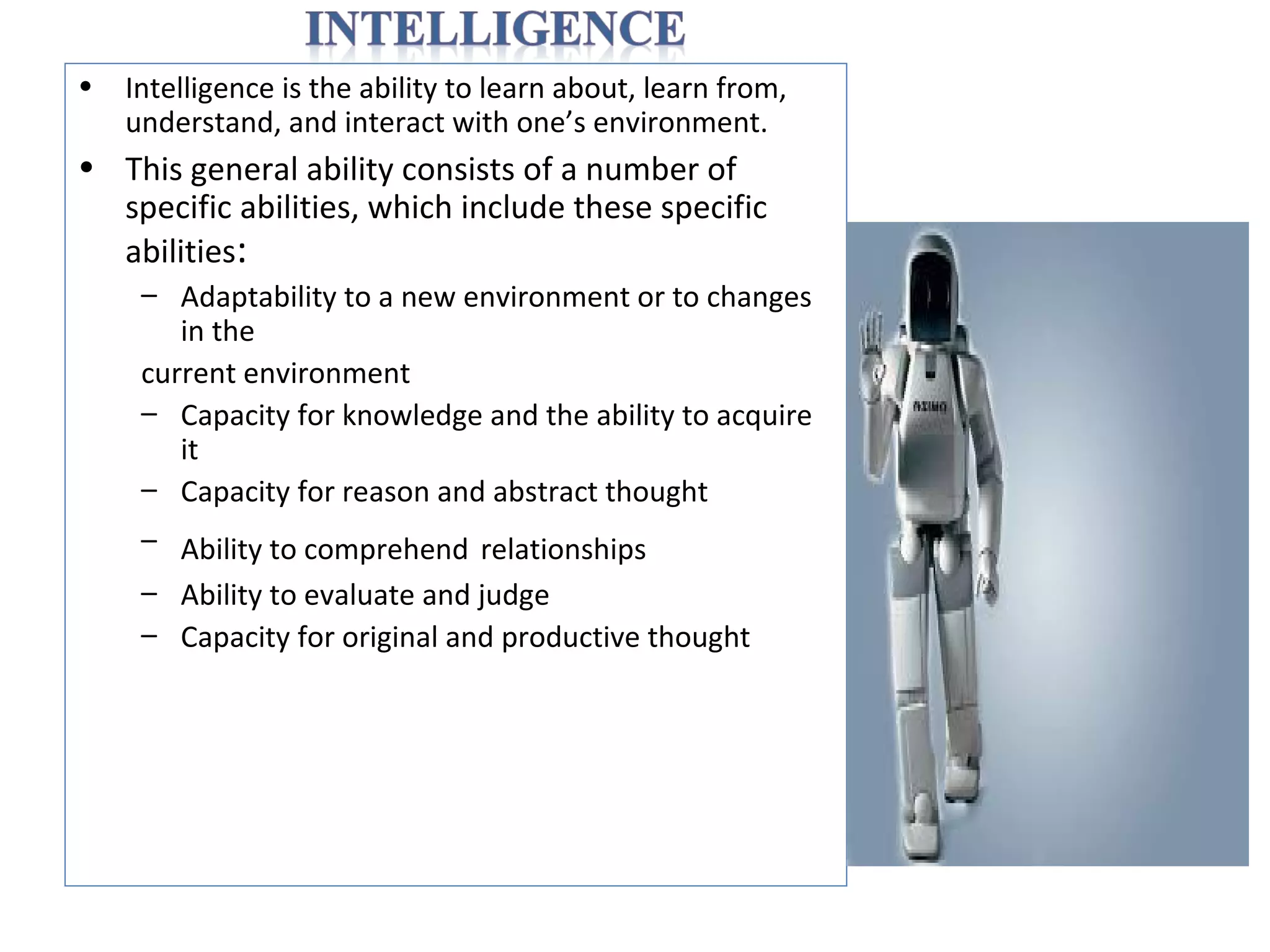
• Intelligence is the ability to learn about, learn from,
understand, and interact with one’s environment.
• This general ability consists of a number of
specific abilities, which include these specific
abilities:
– Adaptability to a new environment or to changes
in the
current environment
– Capacity for knowledge and the ability to acquire
it
– Capacity for reason and abstract thought
– Ability to comprehend relationships
– Ability to evaluate and judge
– Capacity for original and productive thought
What Is Artificial Intelligence???
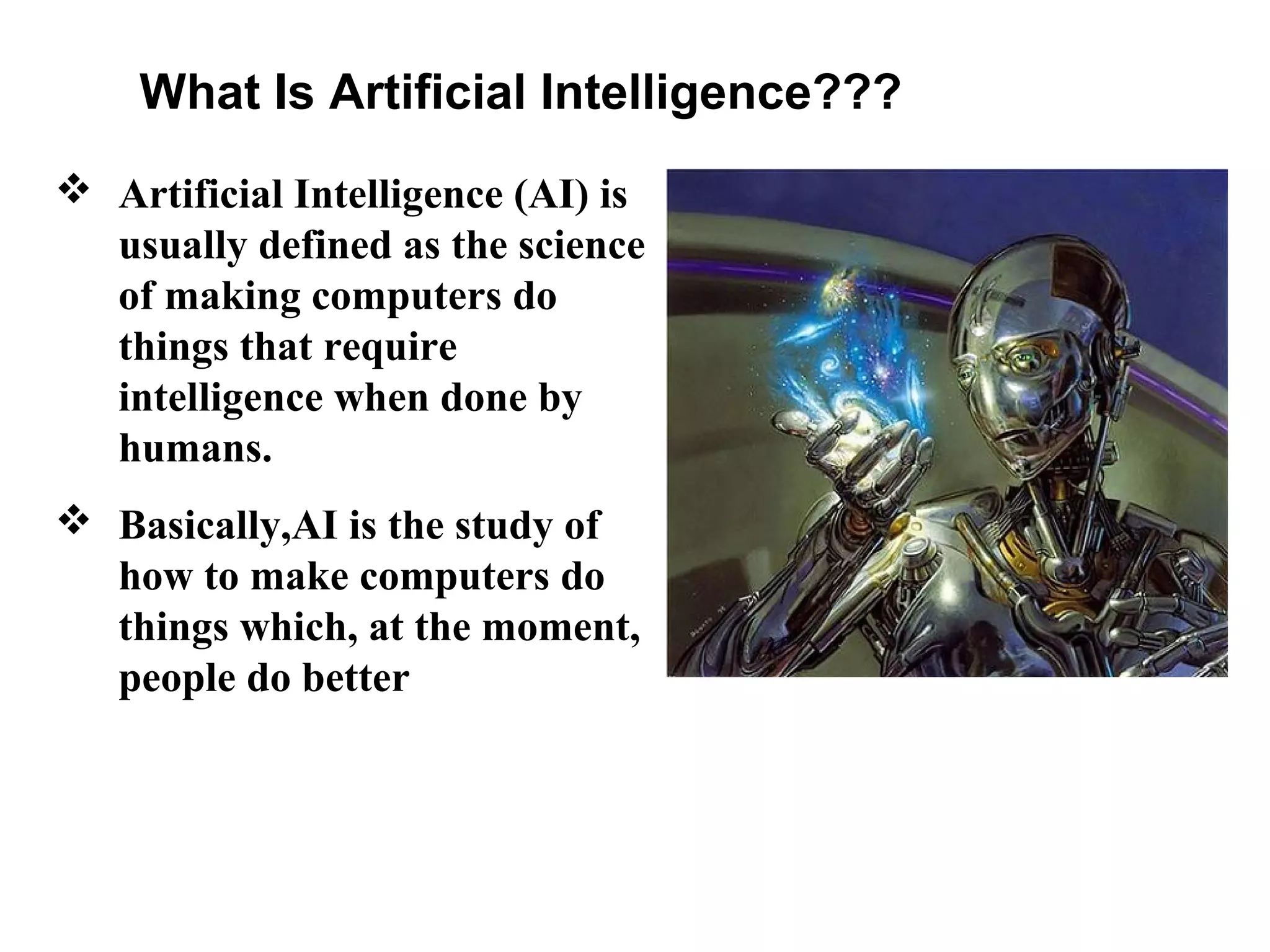
 Artificial Intelligence (AI) is
usually defined as the science
of making computers do
things that require
intelligence when done by
humans.
 Basically,AI is the study of
how to make computers do
things which, at the moment,
people do better
A Brief History of AI
1956: John McCarthy coins phrase “artificial intelligence”
1952-62: Arthur Samuel writes the first AI game program
to challenge a world champion, in part due to learning.
1950’s-60’s: Masterman et. al at Cambridge create
semantic nets that do machine translation.
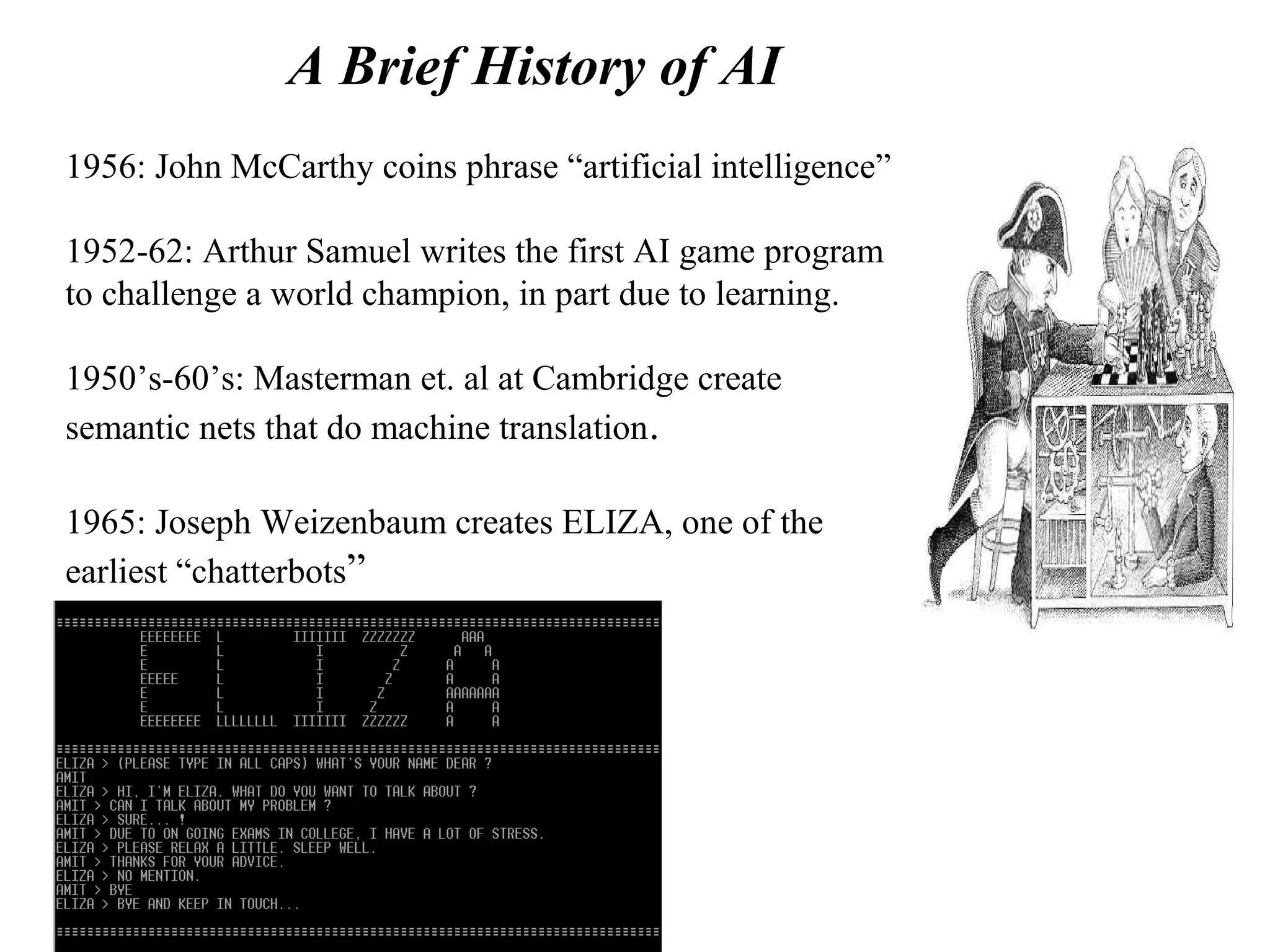
1965: Joseph Weizenbaum creates ELIZA, one of the
earliest “chatterbots”
1967: Feigenbaum et. al create Dendral, the first useful
knowledge-based agent that interpreted mass
spectrographs.
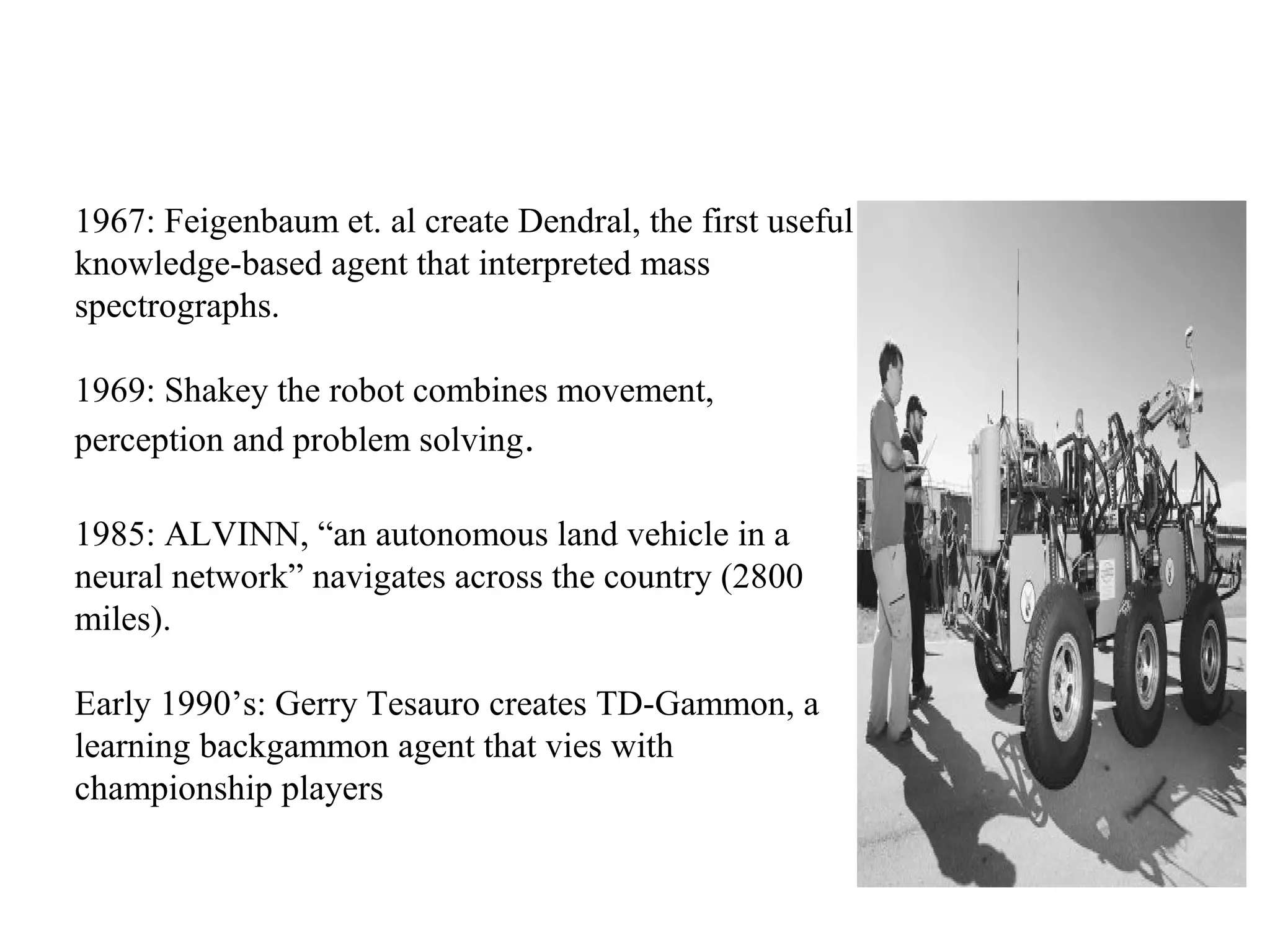
1969: Shakey the robot combines movement,
perception and problem solving.
1985: ALVINN, “an autonomous land vehicle in a
neural network” navigates across the country (2800
miles).
Early 1990’s: Gerry Tesauro creates TD-Gammon, a
learning backgammon agent that vies with
championship players
How Does AI Works??
Artificial intelligence works
with the help of
• Artificial Neurons (Artificial
Neural Network)
And
• Scientific theorems(If-Then
Statements, Logics)
What is Neural Networking??
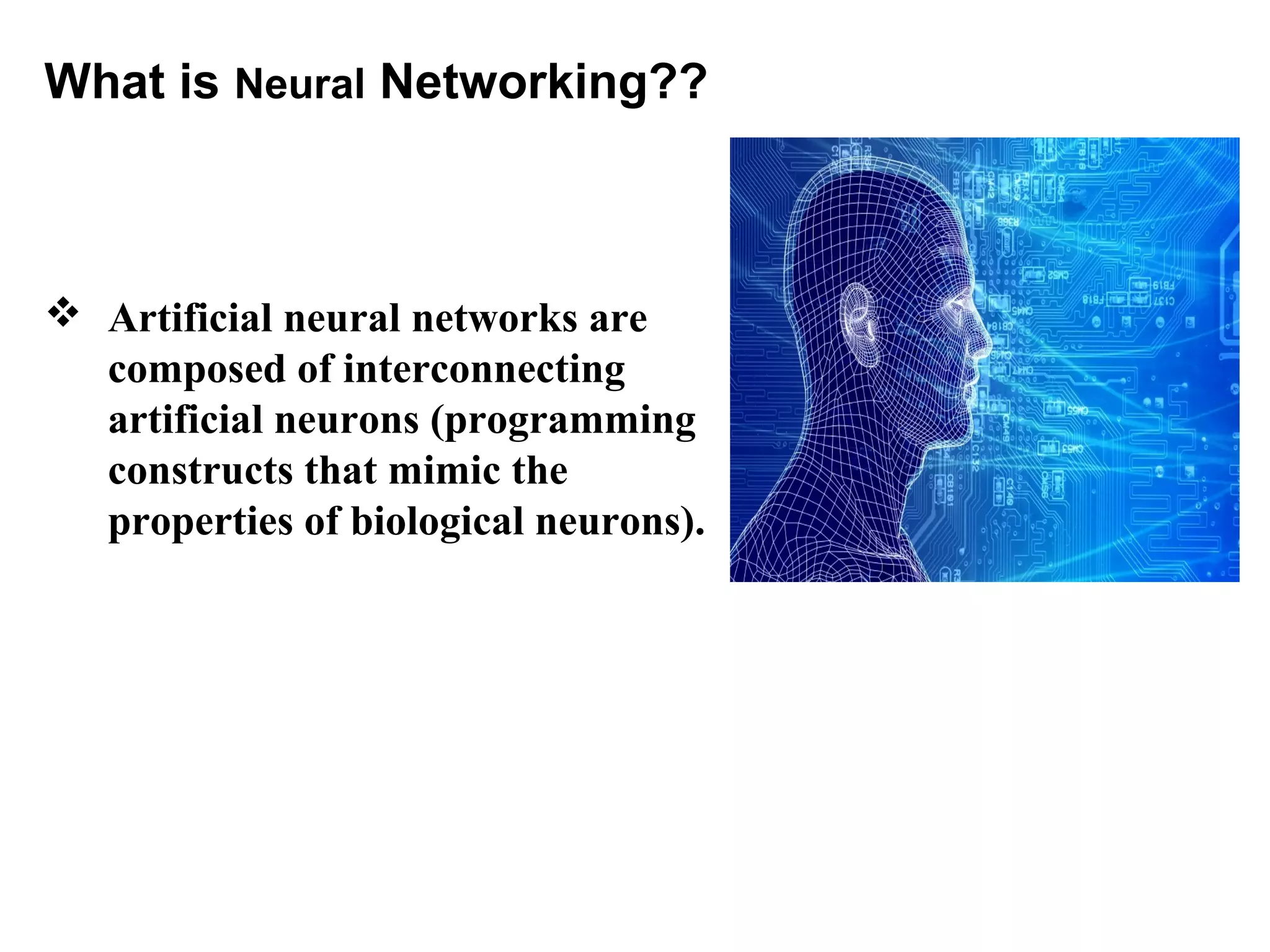
 Artificial neural networks are
composed of interconnecting
artificial neurons (programming
constructs that mimic the
properties of biological neurons).
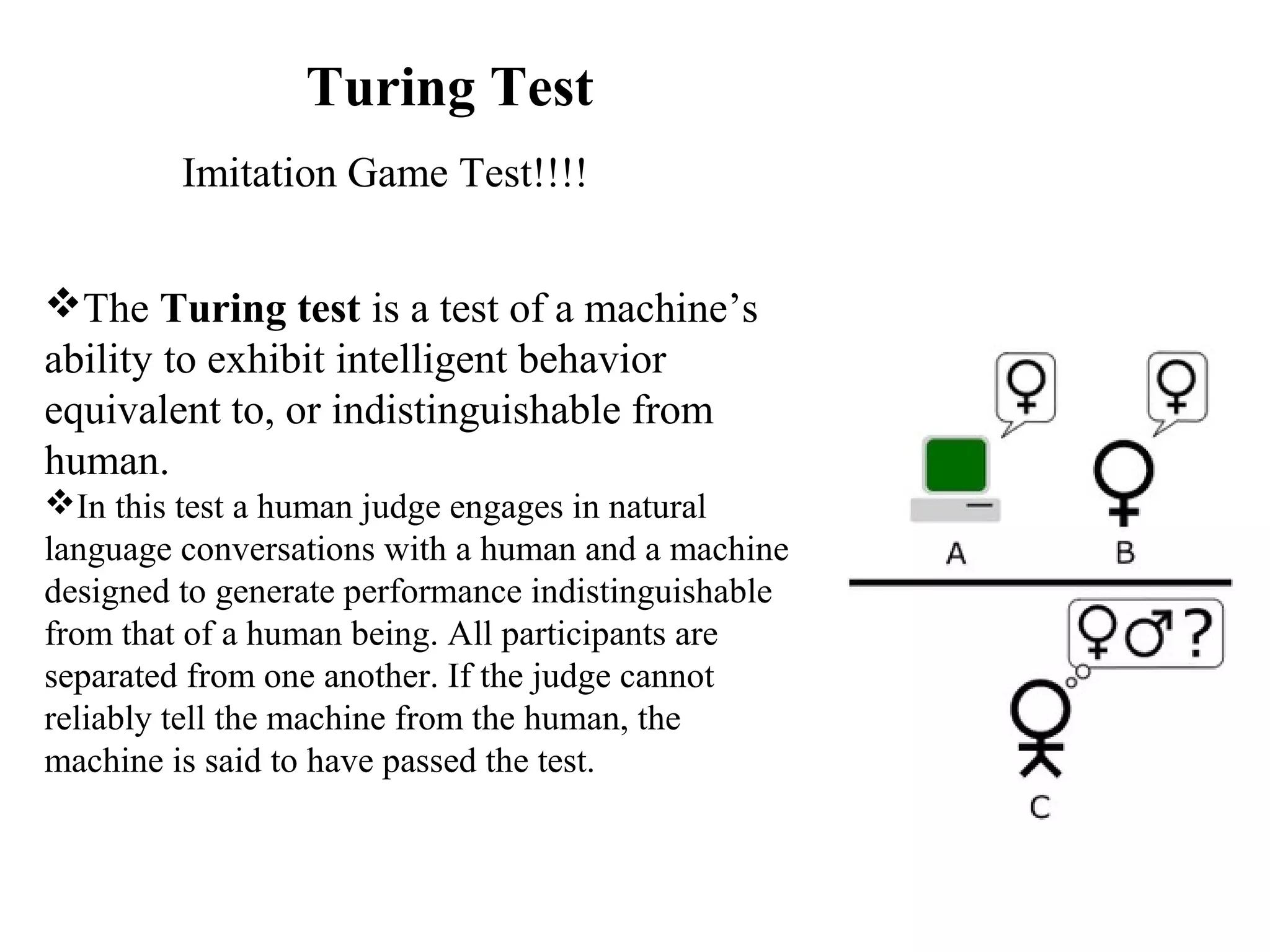
Turing Test
The Turing test is a test of a machine’s 
ability to exhibit intelligent behavior 
equivalent to, or indistinguishable from 
human.
In this test a human judge engages in natural 
language conversations with a human and a machine 
designed to generate performance indistinguishable 
from that of a human being. All participants are 
separated from one another. If the judge cannot 
reliably tell the machine from the human, the 
machine is said to have passed the test.
Imitation Game Test!!!!
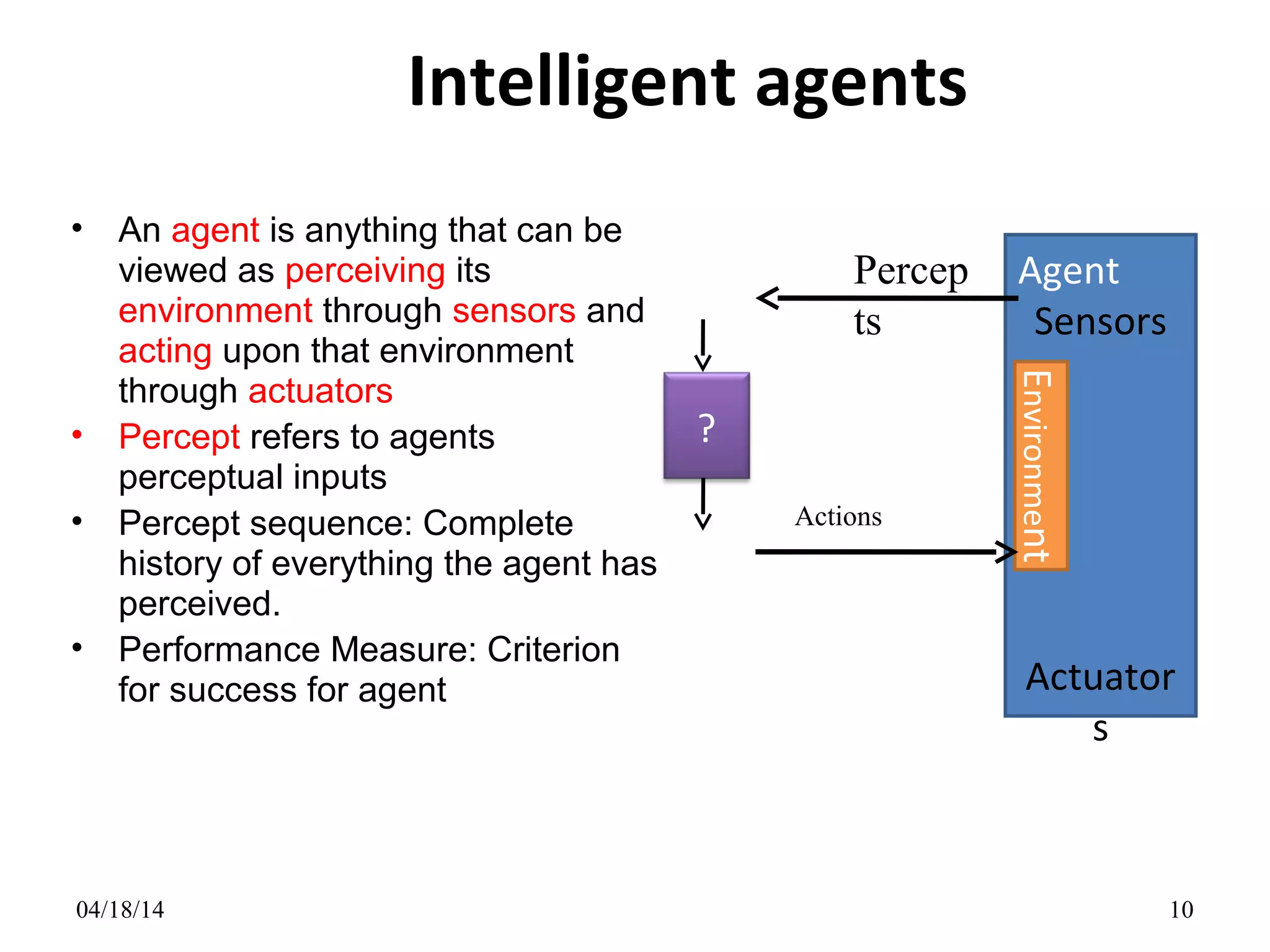
Intelligent agents
04/18/14 10
Actions
Agent
Sensors
Actuator
s
?
Environment
Percep
ts
• An agent is anything that can be
viewed as perceiving its
environment through sensors and
acting upon that environment
through actuators
• Percept refers to agents
perceptual inputs
• Percept sequence: Complete
history of everything the agent has
perceived.
• Performance Measure: Criterion
for success for agent
• The agent function maps from percept
histories to actions:
[f: P*  A]
Agents and environments
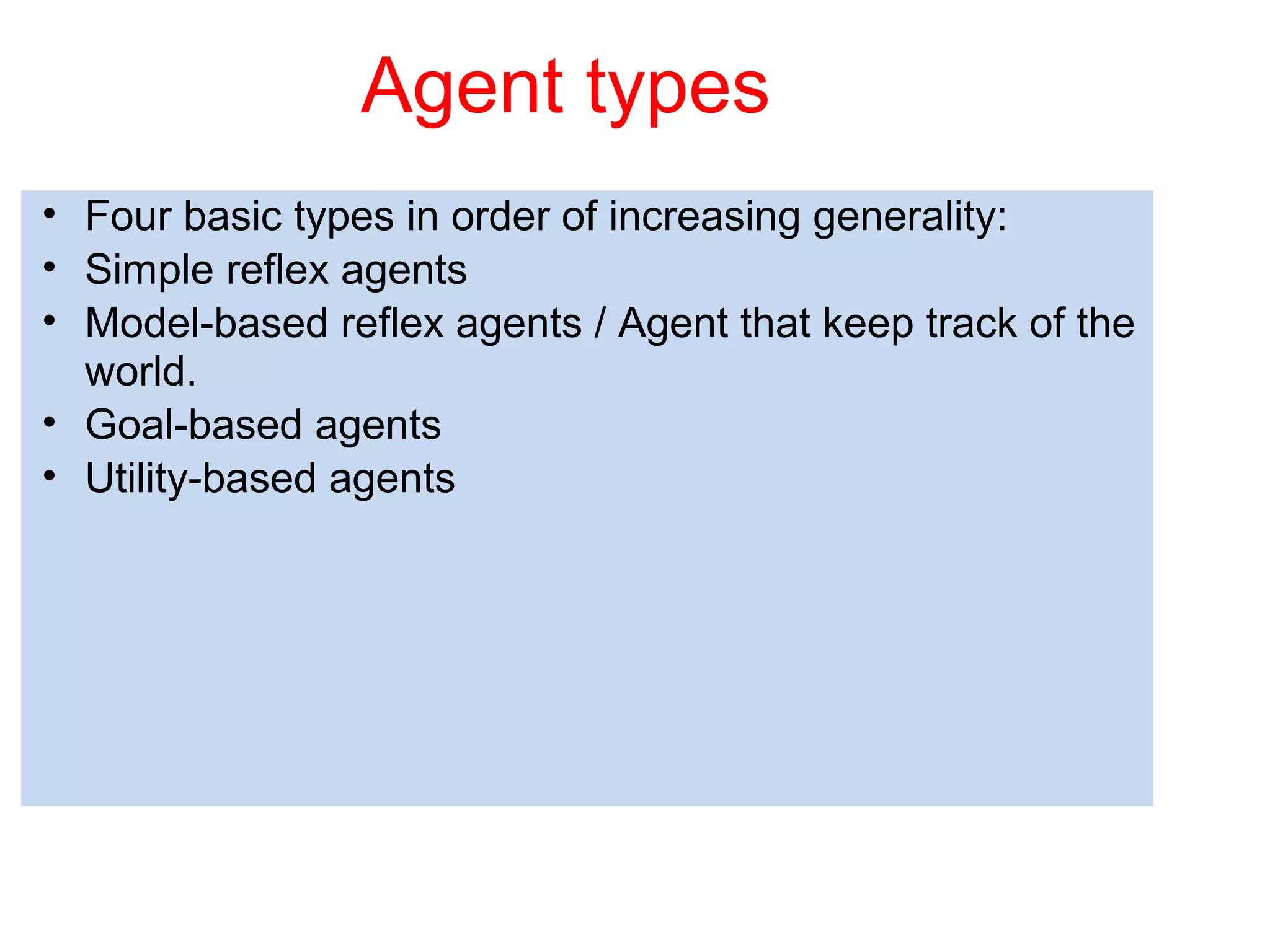
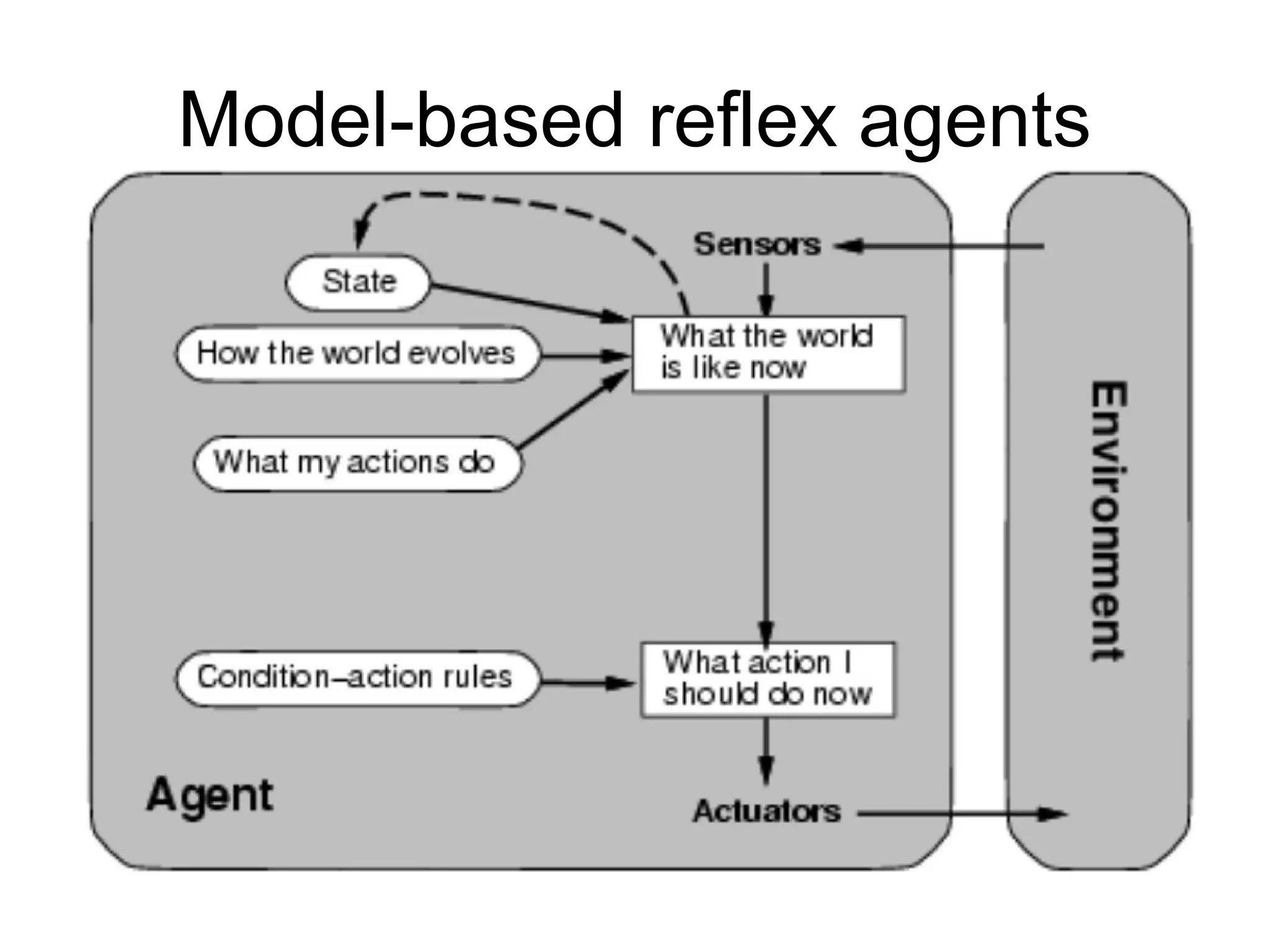
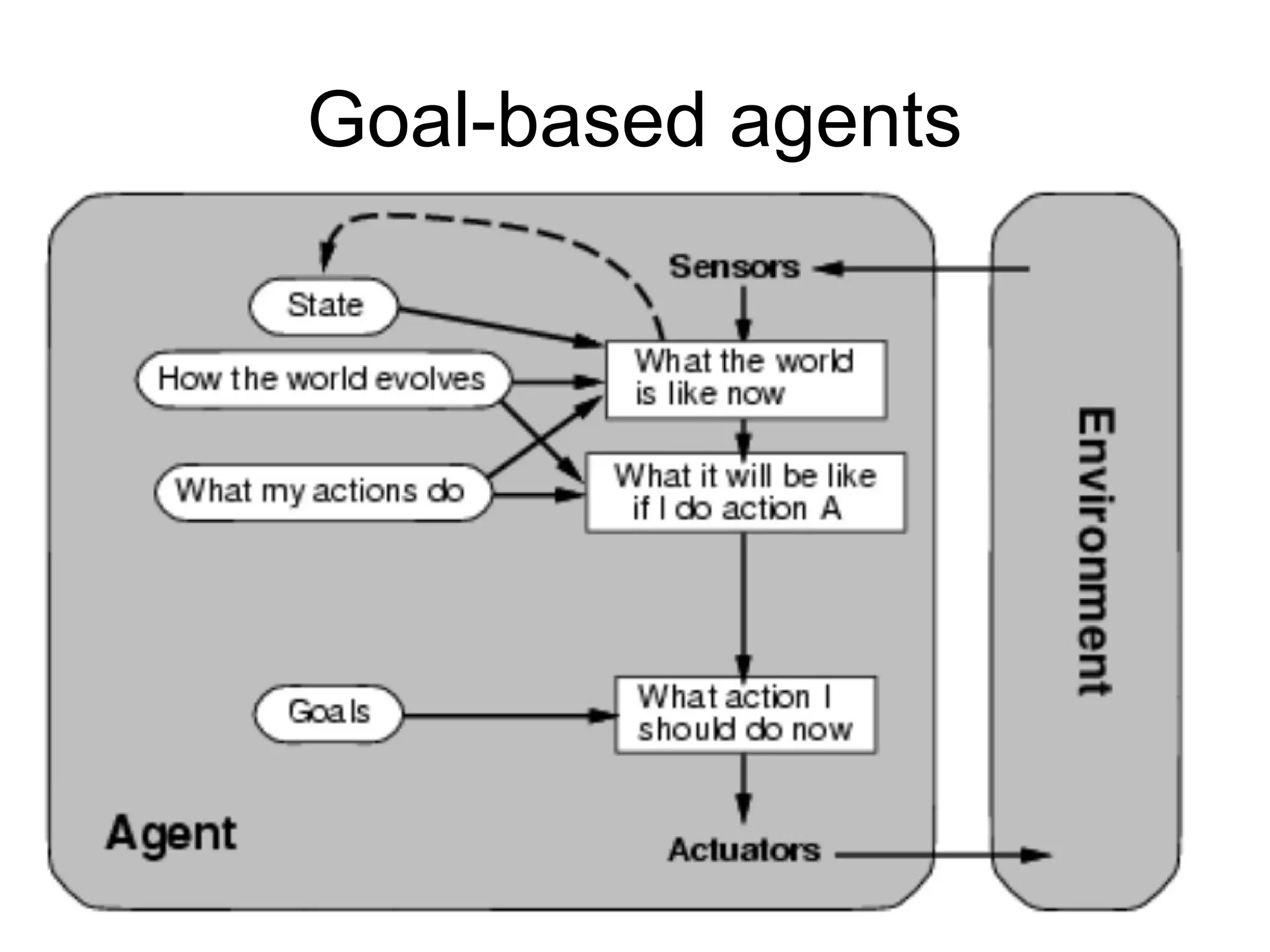
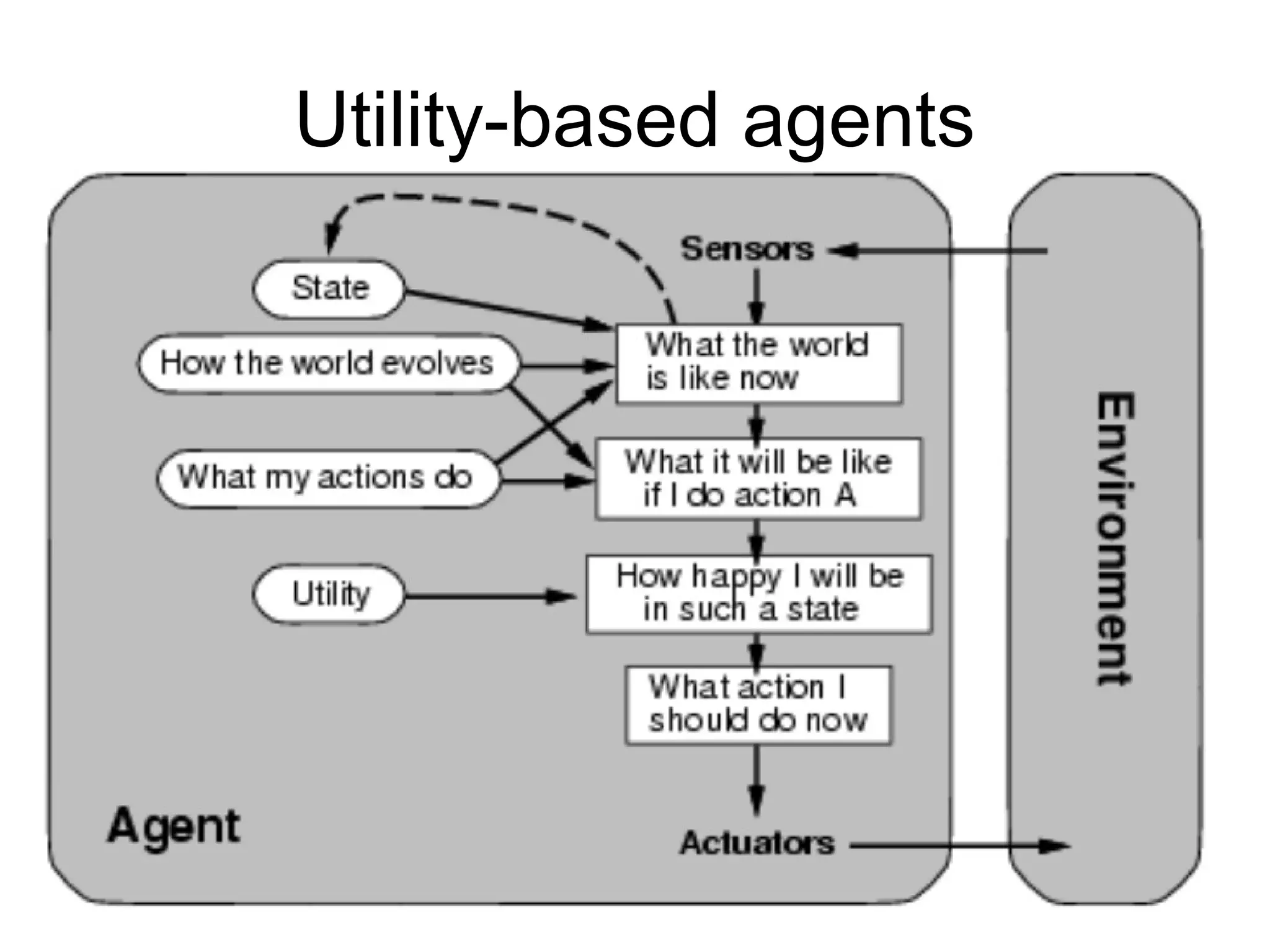
• Four basic types in order of increasing generality:
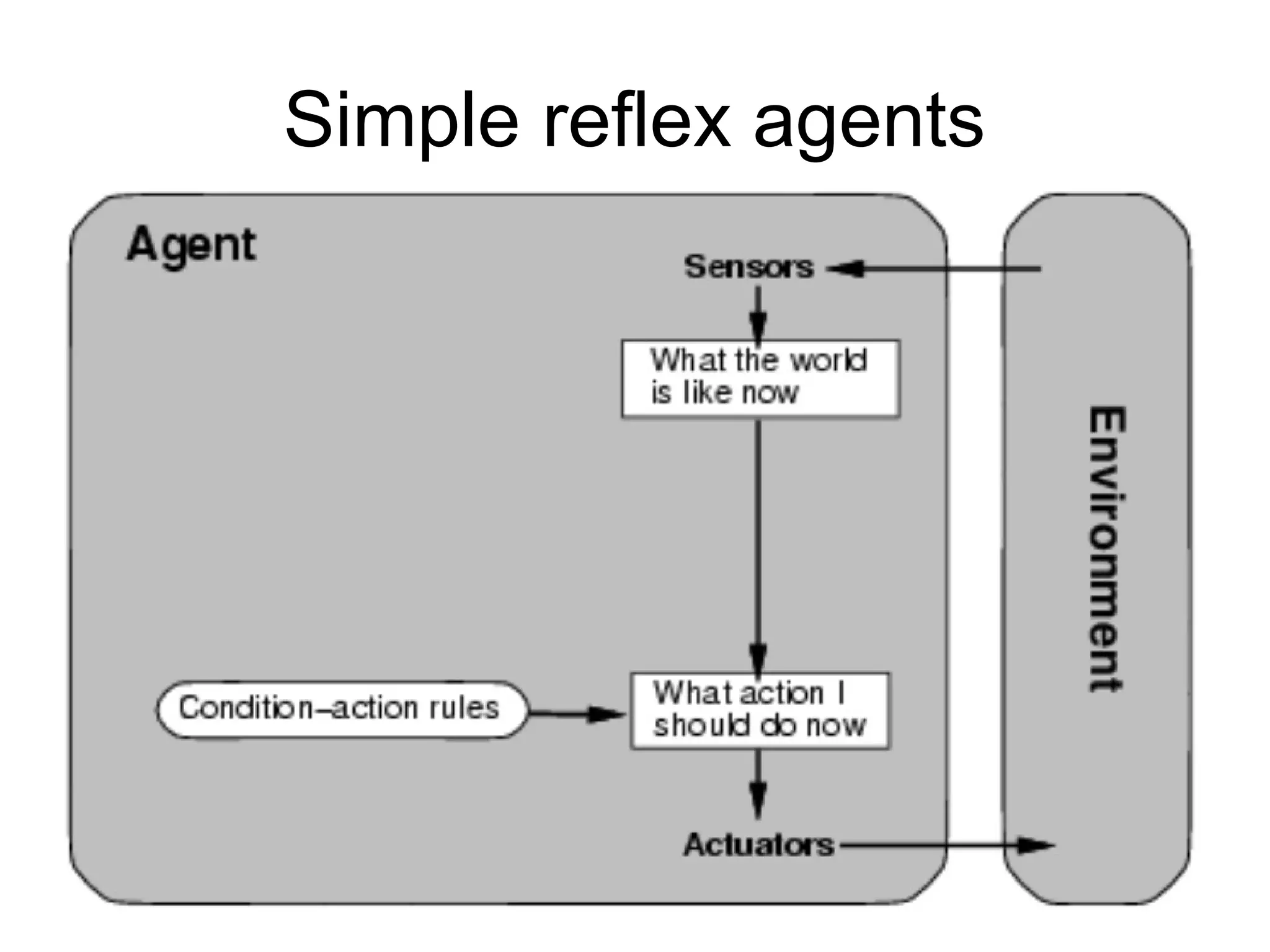
• Simple reflex agents
• Model-based reflex agents / Agent that keep track of the
world.
• Goal-based agents
• Utility-based agents
Agent types
Simple reflex agents
Model-based reflex agents
Goal-based agents
Utility-based agents
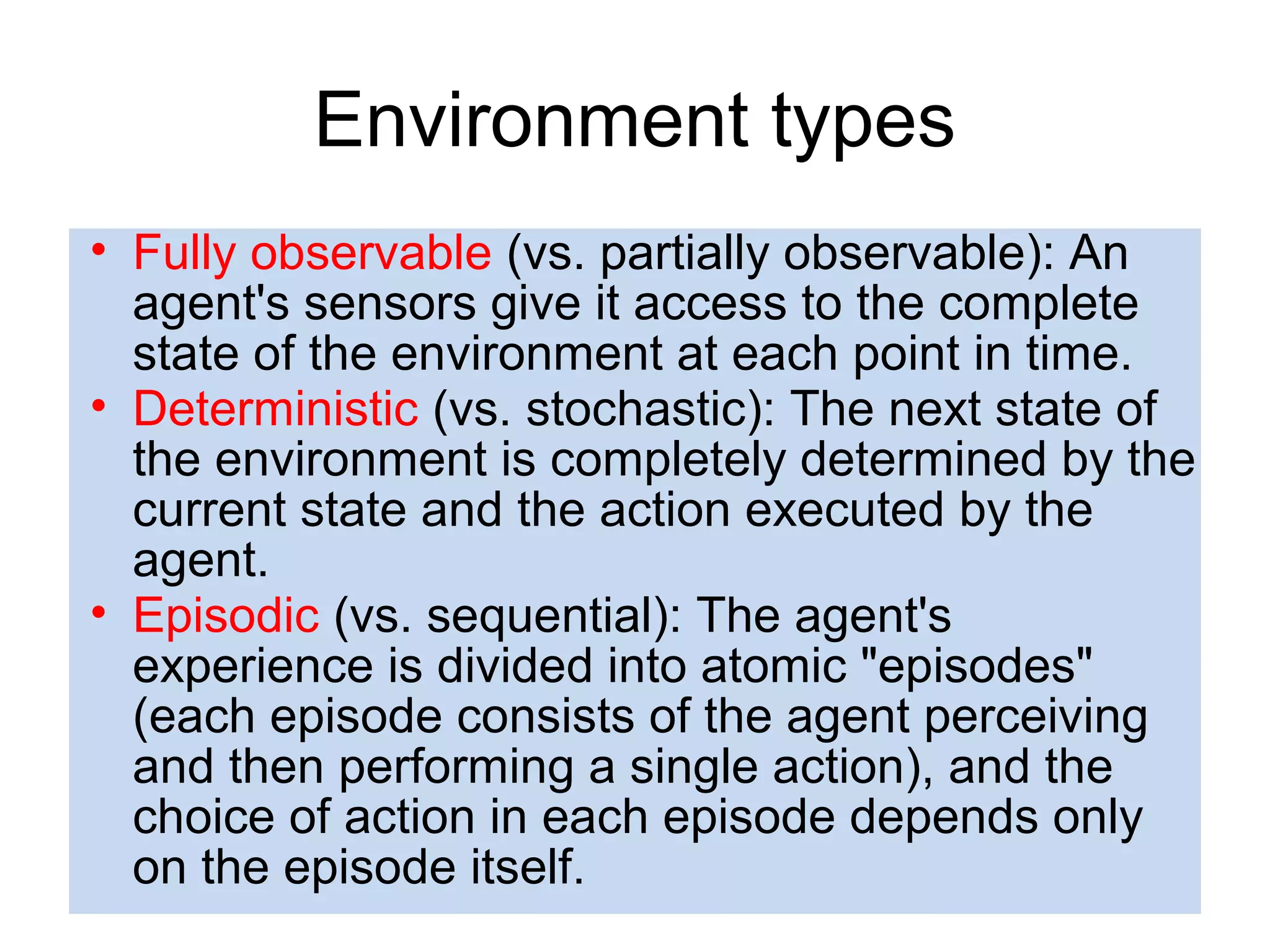
• Fully observable (vs. partially observable): An
agent's sensors give it access to the complete
state of the environment at each point in time.
• Deterministic (vs. stochastic): The next state of
the environment is completely determined by the
current state and the action executed by the
agent.
• Episodic (vs. sequential): The agent's
experience is divided into atomic "episodes"
(each episode consists of the agent perceiving
and then performing a single action), and the
choice of action in each episode depends only
on the episode itself.
Environment types
*PEAS
• PEAS: Performance measure, Environment, Actuators,
Sensors
• Consider, e.g., the task of designing an automated taxi driver:
o Performance measure
o Environment
o Actuators
o Sensors
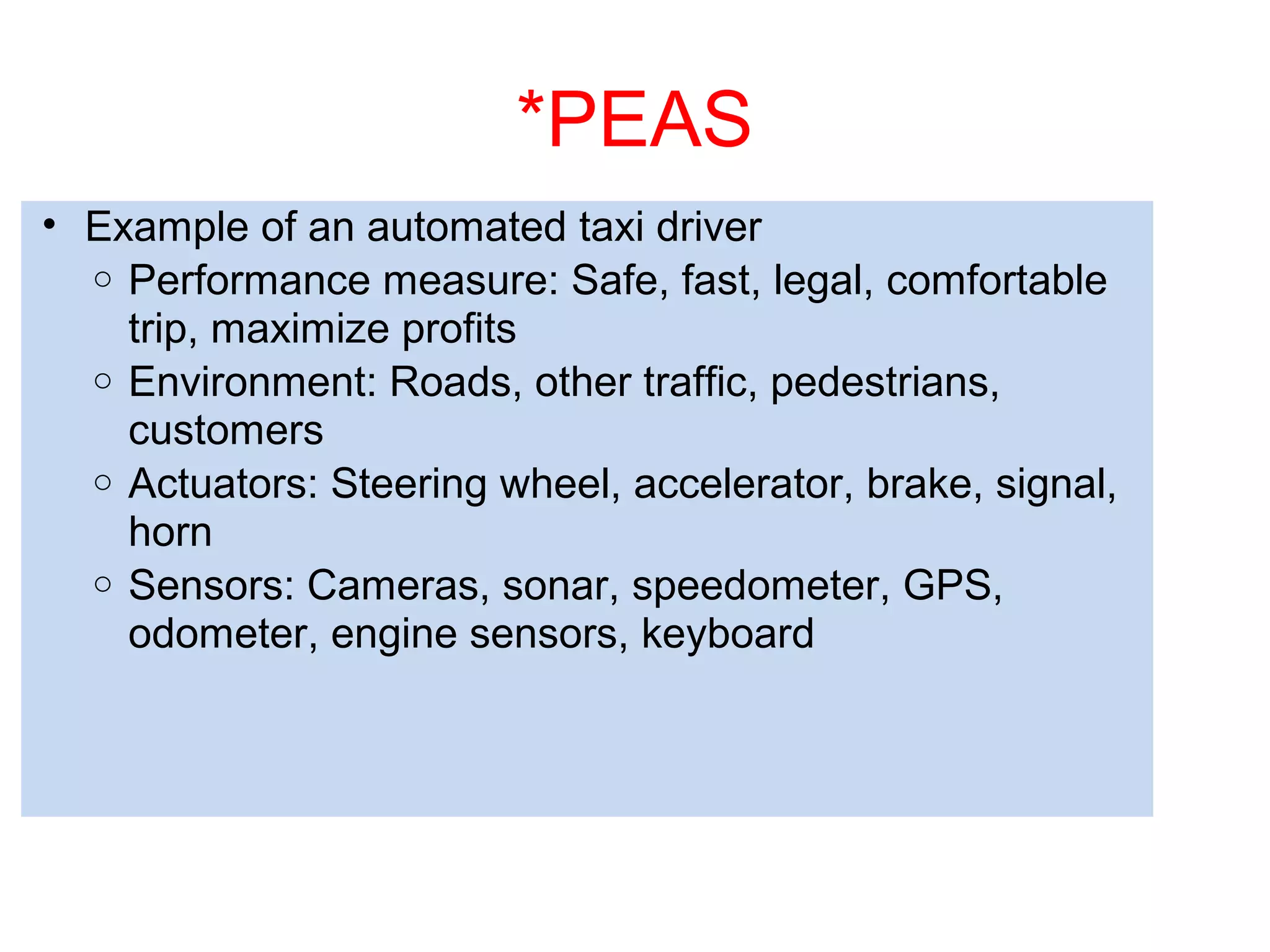
*PEAS
• Example of an automated taxi driver
o Performance measure: Safe, fast, legal, comfortable
trip, maximize profits
o Environment: Roads, other traffic, pedestrians,
customers
o Actuators: Steering wheel, accelerator, brake, signal,
horn
o Sensors: Cameras, sonar, speedometer, GPS,
odometer, engine sensors, keyboard
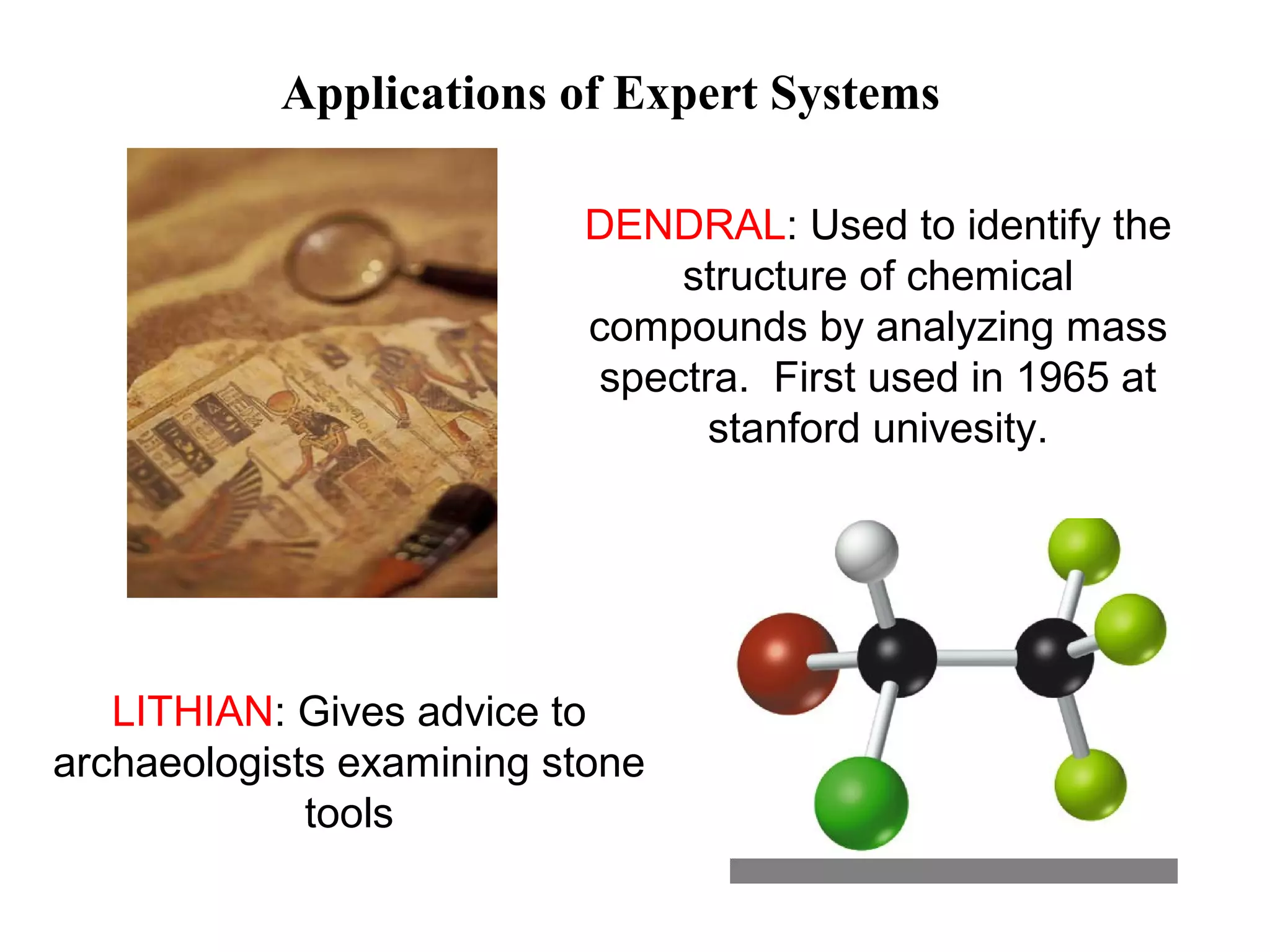
Applications of Expert Systems
LITHIAN: Gives advice to
archaeologists examining stone
tools
DENDRAL: Used to identify the
structure of chemical
compounds by analyzing mass
spectra. First used in 1965 at
stanford univesity.
There are Three ways that A.I learns
Failure Driven Learning
Learning by being Told
Learning by Exploration
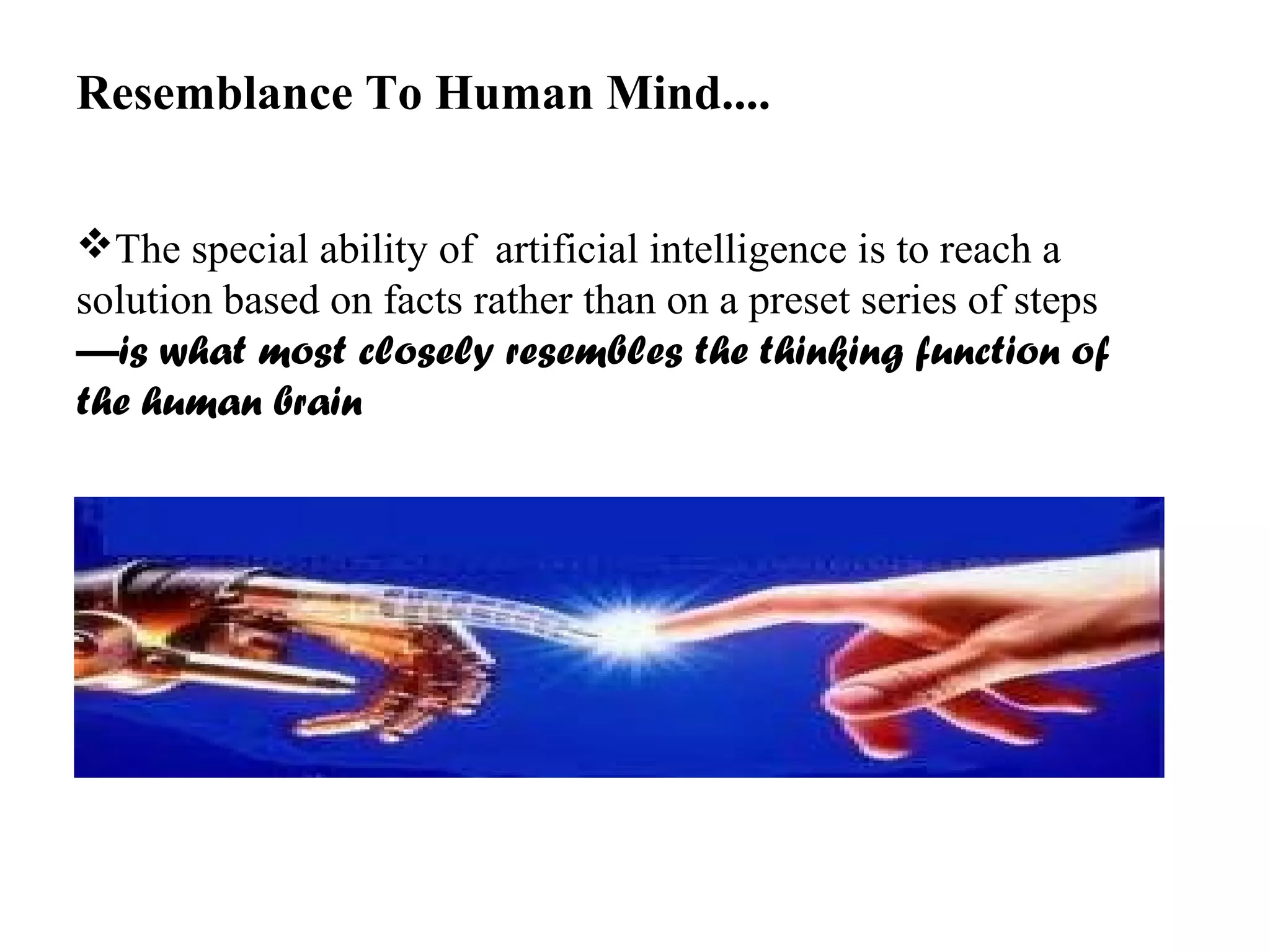
Resemblance To Human Mind....
The special ability of artificial intelligence is to reach a
solution based on facts rather than on a preset series of steps
—is what most closely resembles the thinking function of
the human brain
Human Intelligence VS Artificial Intelligence
Human Intelligence
• Intuition, Common sense,
Judgement, Creativity,
Beliefs etc
• The ability to demonstrate
their intelligence by
communicating effectively
• Plausible Reasoning and
Critical thinking
Artificial Intelligence
• Ability to simulate human
behavior and cognitive
processes
• Capture and preserve
human expertise
• Fast Response. The ability
to comprehend large
amounts of data quickly.
Pros
Human Intelligence VS Artificial Intelligence
Human Intelligence
• Humans are fallible
• They have limited
knowledge bases
• Information processing of
serial nature proceed very
slowly in the brain as
compared to computers
• Humans are unable to
retain large amounts of
data in memory.
Artificial Intelligence
• No “common sense”
• Cannot readily deal with
“mixed” knowledge
• May have high
development costs
• Raise legal and ethical
concerns
Cons
Artificial Intelligence VS Conventional Computing
Artificial Intelligence
• AI software uses the
techniques of search and
pattern matching
• Programmers design AI
software to give the
computer only the problem,
not the steps necessary to
solve it
Conventional Computing
• Conventional computer
software follow a logical
series of steps to reach a
conclusion
• Computer programmers
originally designed software
that accomplished tasks by
completing algorithms
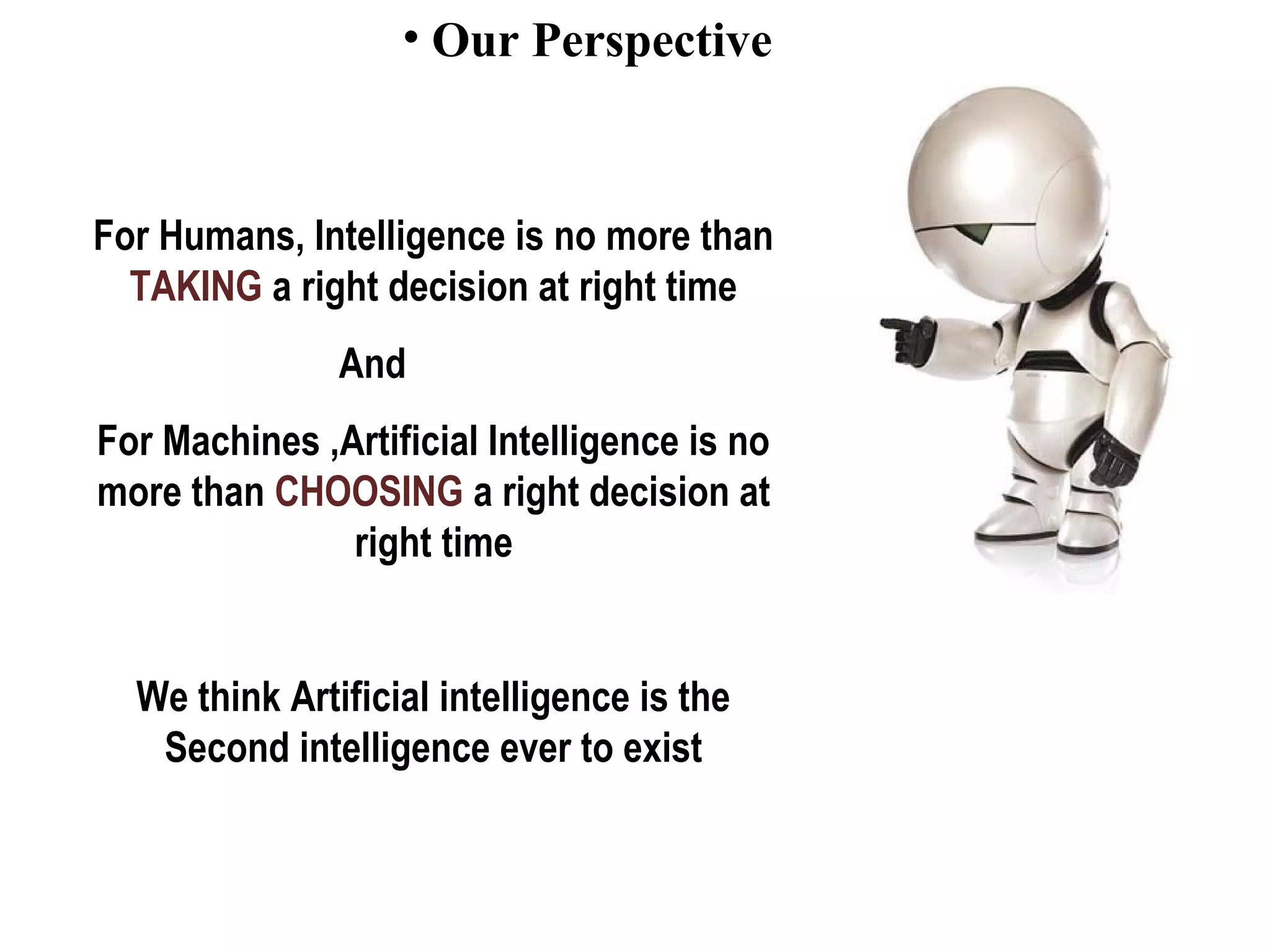
• Our Perspective
For Humans, Intelligence is no more than
TAKING a right decision at right time
And
For Machines ,Artificial Intelligence is no
more than CHOOSING a right decision at
right time
We think Artificial intelligence is the
Second intelligence ever to exist
Conclusion
• AI is at the centre of a new enterprise to build
computational models of intelligence.
• The main assumption is that intelligence
(human or otherwise) can be represented in
terms of symbol structures and symbolic
operations which can be programmed in a
digital computer.
Thank You
Artificial Intelligence
Our Attempt To Build Models Of
Ourselves
Submitted by -
Kaushalendra Singh Rajput
(2k12/EC/89)

Artificial Intelligence Introduction

  • 1.
  • 2.
    Agenda • What isintelligence? • What is artificial intelligence? • History of A.I. • Type of A.I. • Turing test & Chinese room test • Intelligent agents • Agents & Environment • Human intelligence Vs A.I. • A.I. Vs Conventional computing • A.I and our society • Our personal opinion • Conclusion
  • 3.
    • Intelligence isthe ability to learn about, learn from, understand, and interact with one’s environment. • This general ability consists of a number of specific abilities, which include these specific abilities: – Adaptability to a new environment or to changes in the current environment – Capacity for knowledge and the ability to acquire it – Capacity for reason and abstract thought – Ability to comprehend relationships – Ability to evaluate and judge – Capacity for original and productive thought
  • 4.
    What Is ArtificialIntelligence???  Artificial Intelligence (AI) is usually defined as the science of making computers do things that require intelligence when done by humans.  Basically,AI is the study of how to make computers do things which, at the moment, people do better
  • 5.
    A Brief Historyof AI 1956: John McCarthy coins phrase “artificial intelligence” 1952-62: Arthur Samuel writes the first AI game program to challenge a world champion, in part due to learning. 1950’s-60’s: Masterman et. al at Cambridge create semantic nets that do machine translation. 1965: Joseph Weizenbaum creates ELIZA, one of the earliest “chatterbots”
  • 6.
    1967: Feigenbaum et.al create Dendral, the first useful knowledge-based agent that interpreted mass spectrographs. 1969: Shakey the robot combines movement, perception and problem solving. 1985: ALVINN, “an autonomous land vehicle in a neural network” navigates across the country (2800 miles). Early 1990’s: Gerry Tesauro creates TD-Gammon, a learning backgammon agent that vies with championship players
  • 7.
    How Does AIWorks?? Artificial intelligence works with the help of • Artificial Neurons (Artificial Neural Network) And • Scientific theorems(If-Then Statements, Logics)
  • 8.
    What is NeuralNetworking??  Artificial neural networks are composed of interconnecting artificial neurons (programming constructs that mimic the properties of biological neurons).
  • 9.
  • 10.
    Intelligent agents 04/18/14 10 Actions Agent Sensors Actuator s ? Environment Percep ts •An agent is anything that can be viewed as perceiving its environment through sensors and acting upon that environment through actuators • Percept refers to agents perceptual inputs • Percept sequence: Complete history of everything the agent has perceived. • Performance Measure: Criterion for success for agent
  • 11.
    • The agentfunction maps from percept histories to actions: [f: P*  A] Agents and environments
  • 12.
    • Four basictypes in order of increasing generality: • Simple reflex agents • Model-based reflex agents / Agent that keep track of the world. • Goal-based agents • Utility-based agents Agent types
  • 13.
  • 14.
  • 15.
  • 16.
  • 17.
    • Fully observable(vs. partially observable): An agent's sensors give it access to the complete state of the environment at each point in time. • Deterministic (vs. stochastic): The next state of the environment is completely determined by the current state and the action executed by the agent. • Episodic (vs. sequential): The agent's experience is divided into atomic "episodes" (each episode consists of the agent perceiving and then performing a single action), and the choice of action in each episode depends only on the episode itself. Environment types
  • 18.
    *PEAS • PEAS: Performancemeasure, Environment, Actuators, Sensors • Consider, e.g., the task of designing an automated taxi driver: o Performance measure o Environment o Actuators o Sensors
  • 19.
    *PEAS • Example ofan automated taxi driver o Performance measure: Safe, fast, legal, comfortable trip, maximize profits o Environment: Roads, other traffic, pedestrians, customers o Actuators: Steering wheel, accelerator, brake, signal, horn o Sensors: Cameras, sonar, speedometer, GPS, odometer, engine sensors, keyboard
  • 20.
    Applications of ExpertSystems LITHIAN: Gives advice to archaeologists examining stone tools DENDRAL: Used to identify the structure of chemical compounds by analyzing mass spectra. First used in 1965 at stanford univesity.
  • 21.
    There are Threeways that A.I learns Failure Driven Learning Learning by being Told Learning by Exploration
  • 22.
    Resemblance To HumanMind.... The special ability of artificial intelligence is to reach a solution based on facts rather than on a preset series of steps —is what most closely resembles the thinking function of the human brain
  • 23.
    Human Intelligence VSArtificial Intelligence Human Intelligence • Intuition, Common sense, Judgement, Creativity, Beliefs etc • The ability to demonstrate their intelligence by communicating effectively • Plausible Reasoning and Critical thinking Artificial Intelligence • Ability to simulate human behavior and cognitive processes • Capture and preserve human expertise • Fast Response. The ability to comprehend large amounts of data quickly. Pros
  • 24.
    Human Intelligence VSArtificial Intelligence Human Intelligence • Humans are fallible • They have limited knowledge bases • Information processing of serial nature proceed very slowly in the brain as compared to computers • Humans are unable to retain large amounts of data in memory. Artificial Intelligence • No “common sense” • Cannot readily deal with “mixed” knowledge • May have high development costs • Raise legal and ethical concerns Cons
  • 25.
    Artificial Intelligence VSConventional Computing Artificial Intelligence • AI software uses the techniques of search and pattern matching • Programmers design AI software to give the computer only the problem, not the steps necessary to solve it Conventional Computing • Conventional computer software follow a logical series of steps to reach a conclusion • Computer programmers originally designed software that accomplished tasks by completing algorithms
  • 26.
    • Our Perspective ForHumans, Intelligence is no more than TAKING a right decision at right time And For Machines ,Artificial Intelligence is no more than CHOOSING a right decision at right time We think Artificial intelligence is the Second intelligence ever to exist
  • 27.
    Conclusion • AI isat the centre of a new enterprise to build computational models of intelligence. • The main assumption is that intelligence (human or otherwise) can be represented in terms of symbol structures and symbolic operations which can be programmed in a digital computer.
  • 28.
    Thank You Artificial Intelligence OurAttempt To Build Models Of Ourselves Submitted by - Kaushalendra Singh Rajput (2k12/EC/89)

Editor's Notes

  • #24 The important aspects of human intelligence seem to following the use of intuition, common sense, judgment, creativity, goal directedness, plausible reasoning, knowledge and beliefs. Meaning of intelligence is not human brain’s information processing ability but the ability of humans to demonstrate their intelligence by communicating effectively.