ARTIFICIAL INTELLIGENCE
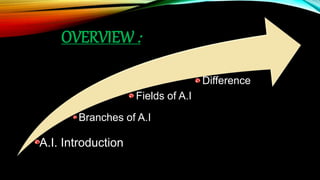
OVERVIEW:
A.I. Introduction
Branches of A.I
Fields of A.I
Difference
A.I INTRODUCTION
• It is the science and engineering of making intelligent
machines, especially intelligent computer programs.
• AI is generally associated with Computer Science, but it has many
important links with other fields such as:
Maths, Psychology, Cognition, Biology and Philosophy, among
many others. Our ability to combine knowledge from all these
fields will ultimately benefit our progress in the quest of creating
an intelligent artificial being.
BRANCHES
OF
ARTIFICIAL
NTELLIGENCE
SYMBOLIC A.I:
• Symbolic artificial intelligence is the collective name for all methods in artificial
intelligence research that are based on high-level "symbolic" (human-readable)
representations of problems, logic and search.
• Symbolic AI was intended to produce general, human-like
intelligence in a machine, whereas most modern research is
directed at specific sub-problems. Research into general
intelligence is now studied in the sub-field of
Artificial general intelligence.
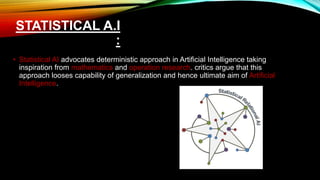
STATISTICAL A.I
:
• Statistical AI advocates deterministic approach in Artificial Intelligence taking
inspiration from mathematics and operation research. critics argue that this
approach looses capability of generalization and hence ultimate aim of Artificial
Intelligence.
COMPUTATIONAL INTELLIGENCE
:
• Computational Intelligence aims to solve real world problems that are
computationally expensive or not at all possible to solve by traditional means
(mathematical models)..Common branches of Computational Intelligence are but
not limited to.
• Artificial Neural Networks
• Fuzzy Logic
• Heuristic Search
• Pattern Recognition
FIELDS
OF
ARTIFICIAL
INTELLIGENCE
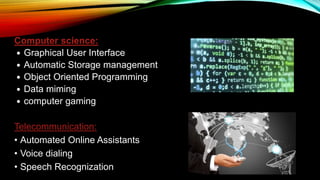
Computer science:
 Graphical User Interface
 Automatic Storage management
 Object Oriented Programming
 Data miming
 computer gaming
Telecommunication:
• Automated Online Assistants
• Voice dialing
• Speech Recognization
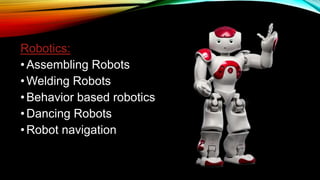
Robotics:
•Assembling Robots
•Welding Robots
•Behavior based robotics
•Dancing Robots
•Robot navigation
DAILY LIFE APPLICATIONS
• Home Security
• Bank
• Post office
• Websites
• Digital cameras
• News and publishing
• Financial trades
• Health and medicine
• Games and toys
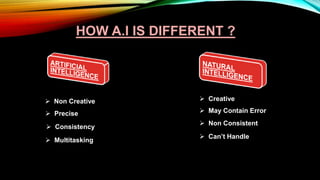
HOW A.I IS DIFFERENT ?
 Non Creative
 Consistency
 Precise
 Multitasking
 Creative
 May Contain Error
 Non Consistent
 Can’t Handle
THE DESTINED FUTURE
FORTH
Artificial intelligence

Artificial intelligence

  • 1.
  • 2.
    OVERVIEW: A.I. Introduction Branches ofA.I Fields of A.I Difference
  • 3.
    A.I INTRODUCTION • Itis the science and engineering of making intelligent machines, especially intelligent computer programs. • AI is generally associated with Computer Science, but it has many important links with other fields such as: Maths, Psychology, Cognition, Biology and Philosophy, among many others. Our ability to combine knowledge from all these fields will ultimately benefit our progress in the quest of creating an intelligent artificial being.
  • 4.
  • 5.
    SYMBOLIC A.I: • Symbolicartificial intelligence is the collective name for all methods in artificial intelligence research that are based on high-level "symbolic" (human-readable) representations of problems, logic and search. • Symbolic AI was intended to produce general, human-like intelligence in a machine, whereas most modern research is directed at specific sub-problems. Research into general intelligence is now studied in the sub-field of Artificial general intelligence.
  • 6.
    STATISTICAL A.I : • StatisticalAI advocates deterministic approach in Artificial Intelligence taking inspiration from mathematics and operation research. critics argue that this approach looses capability of generalization and hence ultimate aim of Artificial Intelligence.
  • 7.
    COMPUTATIONAL INTELLIGENCE : • ComputationalIntelligence aims to solve real world problems that are computationally expensive or not at all possible to solve by traditional means (mathematical models)..Common branches of Computational Intelligence are but not limited to. • Artificial Neural Networks • Fuzzy Logic • Heuristic Search • Pattern Recognition
  • 8.
  • 9.
    Computer science:  GraphicalUser Interface  Automatic Storage management  Object Oriented Programming  Data miming  computer gaming Telecommunication: • Automated Online Assistants • Voice dialing • Speech Recognization
  • 10.
    Robotics: •Assembling Robots •Welding Robots •Behaviorbased robotics •Dancing Robots •Robot navigation
  • 11.
    DAILY LIFE APPLICATIONS •Home Security • Bank • Post office • Websites • Digital cameras • News and publishing • Financial trades • Health and medicine • Games and toys
  • 12.
    HOW A.I ISDIFFERENT ?  Non Creative  Consistency  Precise  Multitasking  Creative  May Contain Error  Non Consistent  Can’t Handle
  • 13.