Introduction 
Market structure is the focus real-world 
competition. 
Market structure refers to the 
physical characteristics of the 
market within which firms interact. 
Market structure involves the 
number of firms in the market 
and the barriers to entry.
Introduction 
Monopolistic competition is a 
market structure in which there are 
many firms selling differentiated 
products. 
There are few barriers to entry. 
Oligopoly is a market structure in 
which there are a few 
interdependent firms. 
There are often significant barriers to 
entry.
What is Monopolistic Competition? 
Monopolistic competition is a 
market structure in which: 
There are a large number of firms 
The products produced by the 
different firms are differentiated 
Entry and exit occur easily
Characteristics of Monopolistic Competition 
Four distinguishing characteristics: 
1. Many sellers that do not take into account rivals’ 
reactions 
2. Product differentiation where the goods that are 
sold aren’t homogenous 
3. *Multiple dimensions of competition make it 
harder to analyze a specific industry, but these 
methods of competition follow the same two 
decision rules as price competition 
4. Easy of entry of new firms in the long run because 
there are no significant barriers to entry
MANY SELLERS 
When there are many sellers, 
they do not take into account 
rivals’ reactions. 
The existence of many sellers 
makes collusion difficult. 
Monopolistically competitive 
firms act independently.
PRODUCT DIFFERENTIATION 
Product differentiation implies that 
the products are different enough 
that the producing firms exercise a 
“mini-monopoly” over their product. 
The firms compete more on product 
differentiation than on price. 
Entering firms produce close 
substitutes, not an identical or 
standardized product.
MULTIPLE DIMENSIONS OF COMPETITION 
One dimension of competition is 
product differentiation. 
Another is competing on perceived 
quality. 
Competitive advertising is another. 
Others include service and 
distribution outlets.
EASY ENTRY OF NEW FIRMS IN THE 
LONG RUN 
There are no significant barriers to 
entry. 
Barriers to entry prevent competitive 
pressures. 
Ease of entry limits long-run profit.
OUTPUT, PRICE, AND PROFIT OF 
A MONOPOLISTIC COMPETITOR 
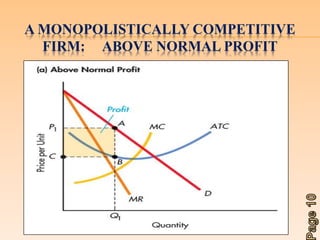
A monopolistically competitive firm 
prices in the same manner as a 
monopolist—where MC = MR. 
But the monopolistic competitor is 
not only a monopolist but a 
competitor as well.
A MONOPOLISTICALLY COMPETITIVE 
FIRM: ABOVE NORMAL PROFIT
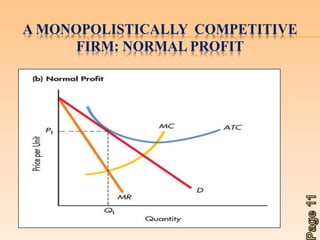
A MONOPOLISTICALLY COMPETITIVE 
FIRM: NORMAL PROFIT
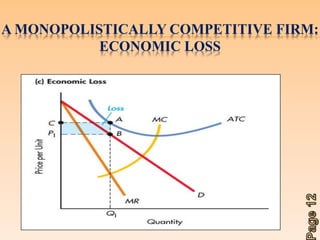
A MONOPOLISTICALLY COMPETITIVE FIRM: 
ECONOMIC LOSS
OUTPUT, PRICE, AND PROFIT OF A 
MONOPOLISTIC COMPETITOR 
At equilibrium, ATC equals price and 
economic profits are zero. 
This occurs at the point of tangency of 
the ATC and demand curve at the 
output chosen by the firm.
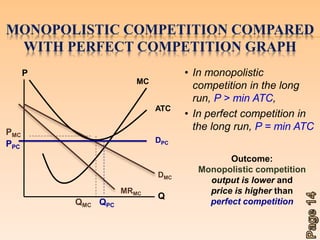
MONOPOLISTIC COMPETITION COMPARED 
WITH PERFECT COMPETITION GRAPH 
• In monopolistic 
competition in the long 
run, P > min ATC, 
• In perfect competition in 
the long run, P = min ATC 
Outcome: 
Monopolistic competition 
output is lower and 
price is higher than 
perfect competition 
Q 
P 
ATC 
QMC 
MC 
DMC 
MRMC 
PMC 
PPC 
DPC 
QPC
COMPARING MONOPOLISTIC 
COMPETITION WITH MONOPOLY 
It is possible for the monopolist to make economic 
profit in the long run because of the existence of 
barriers to entry 
No long-run economic profit is possible in 
monopolistic competition because there are no 
significant barriers to entry 
For a monopolistic competitor in long-run 
equilibrium, (P = ATC) ≥ (MC = 
MR)
NON PRICE COMPETITION 
The firm attempts to establish its product 
as a different product from that offered 
by its rivals. 
Differentiation means that in the 
consumer’s mind, the product is not the 
same. Marketing is often the key to 
successful differentiation.
NON PRICE COMPETITION 
Firms may differentiate products by 
perceived quality, reliability, color, style, 
safety features, packaging, purchase 
terms, warranties and guarantees, 
location, availability (hours of operation) 
or any other features. 
Brand names may signal information 
regarding the product, reducing consumer 
risk.
ADVERTISING AND MONOPOLISTIC 
COMPETITION 
Perfectly competitive firms have no incentive to 
advertise, but monopolistic competitors do 
The goals of advertising are to increase demand 
and make demand more inelastic 
The increase in cost of a monopolistically 
competitive product is the cost of “differentness” 
Advertising increases ATC
GOALS OF ADVERTISING 
The goals of advertising include shifting 
the demand curve to the right and 
making it more inelastic. 
Advertising shifts the ATC curve up.
DOES ADVERTISING HELP OR 
HURT SOCIETY? 
There is a sense of trust in buying 
brands we know. 
If consumers are willing to pay for 
“differentness,” it’s a benefit to them.
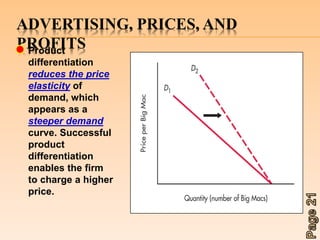
ADVERTISING, PRICES, AND 
PROFITS Product 
differentiation 
reduces the price 
elasticity of 
demand, which 
appears as a 
steeper demand 
curve. Successful 
product 
differentiation 
enables the firm 
to charge a higher 
price.
BRAND NAME 
A brand name is valuable to a firm; it makes 
the demand less elastic and can enable the 
firm to earn higher profits. 
Once a consumer has had a positive 
experience with a good, the price elasticity of 
demand for that good typically decreases— 
the consumer becomes loyal to the product.
SUMMARY 
A monopolistically competitive market 
is characterized by three attributes: 
many firms, differentiated products, and 
free entry. 
The equilibrium in a monopolistically 
competitive market differs from perfect 
competition in that each firm has excess 
capacity and each firm charges a price 
above marginal cost.
SUMMARY 
Monopolistic competition does not have 
all of the desirable properties of perfect 
competition. 
There is a standard deadweight loss of 
monopoly caused by the markup of 
price over marginal cost. 
The number of firms can be too large or 
too small.
SUMMARY 
The product differentiation inherent in 
monopolistic competition leads to the 
use of advertising and brand names. 
Critics argue that firms use advertising and 
brand names to take advantage of 
consumer irrationality and to reduce 
competition. 
Defenders argue that firms use advertising 
and brand names to inform consumers and 
to compete more vigorously on price and 
product quality.
Monopolistic competition

Monopolistic competition

  • 2.
    Introduction Market structureis the focus real-world competition. Market structure refers to the physical characteristics of the market within which firms interact. Market structure involves the number of firms in the market and the barriers to entry.
  • 3.
    Introduction Monopolistic competitionis a market structure in which there are many firms selling differentiated products. There are few barriers to entry. Oligopoly is a market structure in which there are a few interdependent firms. There are often significant barriers to entry.
  • 4.
    What is MonopolisticCompetition? Monopolistic competition is a market structure in which: There are a large number of firms The products produced by the different firms are differentiated Entry and exit occur easily
  • 5.
    Characteristics of MonopolisticCompetition Four distinguishing characteristics: 1. Many sellers that do not take into account rivals’ reactions 2. Product differentiation where the goods that are sold aren’t homogenous 3. *Multiple dimensions of competition make it harder to analyze a specific industry, but these methods of competition follow the same two decision rules as price competition 4. Easy of entry of new firms in the long run because there are no significant barriers to entry
  • 6.
    MANY SELLERS Whenthere are many sellers, they do not take into account rivals’ reactions. The existence of many sellers makes collusion difficult. Monopolistically competitive firms act independently.
  • 7.
    PRODUCT DIFFERENTIATION Productdifferentiation implies that the products are different enough that the producing firms exercise a “mini-monopoly” over their product. The firms compete more on product differentiation than on price. Entering firms produce close substitutes, not an identical or standardized product.
  • 8.
    MULTIPLE DIMENSIONS OFCOMPETITION One dimension of competition is product differentiation. Another is competing on perceived quality. Competitive advertising is another. Others include service and distribution outlets.
  • 9.
    EASY ENTRY OFNEW FIRMS IN THE LONG RUN There are no significant barriers to entry. Barriers to entry prevent competitive pressures. Ease of entry limits long-run profit.
  • 10.
    OUTPUT, PRICE, ANDPROFIT OF A MONOPOLISTIC COMPETITOR A monopolistically competitive firm prices in the same manner as a monopolist—where MC = MR. But the monopolistic competitor is not only a monopolist but a competitor as well.
  • 11.
    A MONOPOLISTICALLY COMPETITIVE FIRM: ABOVE NORMAL PROFIT
  • 12.
    A MONOPOLISTICALLY COMPETITIVE FIRM: NORMAL PROFIT
  • 13.
    A MONOPOLISTICALLY COMPETITIVEFIRM: ECONOMIC LOSS
  • 14.
    OUTPUT, PRICE, ANDPROFIT OF A MONOPOLISTIC COMPETITOR At equilibrium, ATC equals price and economic profits are zero. This occurs at the point of tangency of the ATC and demand curve at the output chosen by the firm.
  • 15.
    MONOPOLISTIC COMPETITION COMPARED WITH PERFECT COMPETITION GRAPH • In monopolistic competition in the long run, P > min ATC, • In perfect competition in the long run, P = min ATC Outcome: Monopolistic competition output is lower and price is higher than perfect competition Q P ATC QMC MC DMC MRMC PMC PPC DPC QPC
  • 16.
    COMPARING MONOPOLISTIC COMPETITIONWITH MONOPOLY It is possible for the monopolist to make economic profit in the long run because of the existence of barriers to entry No long-run economic profit is possible in monopolistic competition because there are no significant barriers to entry For a monopolistic competitor in long-run equilibrium, (P = ATC) ≥ (MC = MR)
  • 17.
    NON PRICE COMPETITION The firm attempts to establish its product as a different product from that offered by its rivals. Differentiation means that in the consumer’s mind, the product is not the same. Marketing is often the key to successful differentiation.
  • 18.
    NON PRICE COMPETITION Firms may differentiate products by perceived quality, reliability, color, style, safety features, packaging, purchase terms, warranties and guarantees, location, availability (hours of operation) or any other features. Brand names may signal information regarding the product, reducing consumer risk.
  • 19.
    ADVERTISING AND MONOPOLISTIC COMPETITION Perfectly competitive firms have no incentive to advertise, but monopolistic competitors do The goals of advertising are to increase demand and make demand more inelastic The increase in cost of a monopolistically competitive product is the cost of “differentness” Advertising increases ATC
  • 20.
    GOALS OF ADVERTISING The goals of advertising include shifting the demand curve to the right and making it more inelastic. Advertising shifts the ATC curve up.
  • 21.
    DOES ADVERTISING HELPOR HURT SOCIETY? There is a sense of trust in buying brands we know. If consumers are willing to pay for “differentness,” it’s a benefit to them.
  • 22.
    ADVERTISING, PRICES, AND PROFITS Product differentiation reduces the price elasticity of demand, which appears as a steeper demand curve. Successful product differentiation enables the firm to charge a higher price.
  • 23.
    BRAND NAME Abrand name is valuable to a firm; it makes the demand less elastic and can enable the firm to earn higher profits. Once a consumer has had a positive experience with a good, the price elasticity of demand for that good typically decreases— the consumer becomes loyal to the product.
  • 24.
    SUMMARY A monopolisticallycompetitive market is characterized by three attributes: many firms, differentiated products, and free entry. The equilibrium in a monopolistically competitive market differs from perfect competition in that each firm has excess capacity and each firm charges a price above marginal cost.
  • 25.
    SUMMARY Monopolistic competitiondoes not have all of the desirable properties of perfect competition. There is a standard deadweight loss of monopoly caused by the markup of price over marginal cost. The number of firms can be too large or too small.
  • 26.
    SUMMARY The productdifferentiation inherent in monopolistic competition leads to the use of advertising and brand names. Critics argue that firms use advertising and brand names to take advantage of consumer irrationality and to reduce competition. Defenders argue that firms use advertising and brand names to inform consumers and to compete more vigorously on price and product quality.