Market Structures
Market Structures
• Type of market structure
influences how a firm behaves:
⚬ Pricing
⚬ Supply
⚬ Barriers to Entry
⚬ Efficiency
⚬ Competition
Market Structures
• Degree of competition in the
industry
• High levels of competition –
Perfect competition
• Limited competition – Monopoly
• Degrees of competition in
between
Market Structure
• Determinants of market structure
⚬ Freedom of entry and exit
⚬ Nature of the product – homogenous
(identical), differentiated?
⚬ Control over supply/output
⚬ Control over price
⚬ Barriers to entry
Market Structure
• Perfect Competition:
⚬ Free entry and exit to industry
⚬ Homogenous product – identical so no
consumer preference
⚬ Large number of buyers and sellers – no
individual seller can influence price
⚬ Sellers are price takers – have to accept the
market price
⚬ Perfect information available to buyers and
sellers
Market Structure
• Examples of perfect competition:
⚬ Financial markets – stock
exchange, currency markets,
bond markets?
⚬ Agriculture?
• To what extent?
Market Structure
• Advantages of Perfect Competition:
• High degree of competition helps
allocate resources to most efficient use
• Price = marginal costs
• Normal profit made in the long run
• Firms operate at maximum efficiency
• Consumers benefit
Market Structure
• What happens in a competitive
environment?
⚬ New idea? – firm makes short term
abnormal profit
⚬ Other firms enter the industry to take
advantage of abnormal profit
⚬ Supply increases – price falls
⚬ Long run – normal profit made
⚬ Choice for consumer
⚬ Price sufficient for normal profit to be made
but no more!
Market Structure
• Imperfect or Monopolistic Competition
⚬ Many buyers and sellers
⚬ Products differentiated
⚬ Relatively free entry and exit
⚬ Each firm may have a tiny ‘monopoly’
because of the differentiation of their
product
⚬ Firm has some control over price
⚬ Examples – restaurants, professions –
solicitors, etc., building firms – plasterers,
plumbers, etc.
Market Structure
• Oligopoly – Competition amongst the
few
⚬ Industry dominated by small number of large firms
⚬ Many firms may make up the industry
⚬ High barriers to entry
⚬ Products could be highly differentiated – branding
or homogenous
⚬ Non–price competition
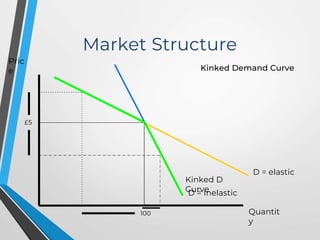
⚬ Price stability within the market - kinked demand
curve?
⚬ Potential for collusion?
⚬ Abnormal profits
⚬ High degree of interdependence between firms
Market Structure
• Examples of oligopolistic
structures:
⚬ Supermarkets
⚬ Banking industry
⚬ Chemicals
⚬ Oil
⚬ Medicinal drugs
⚬ Broadcasting
Market Structure
• Measuring Oligopoly:
• Concentration ratio – the proportion of
market share accounted for by top X
number of firms:
⚬ E.g. 5 firm concentration ratio of 80% -
means top 5 five firms account for 80% of
market share
⚬ 3 firm CR of 72% - top 3 firms account for
72% of market share
Market Structure
• Duopoly:
• Industry dominated by two large
firms
• Possibility of price leader
emerging – rival will follow price
leaders pricing decisions
• High barriers to entry
• Abnormal profits likely
Market Structure
• Monopoly:
• Pure monopoly – industry is the
firm!
• Actual monopoly – where firm has
>25% market share
• Natural Monopoly – high fixed
costs – gas, electricity, water,
telecommunications, rail
Market Structure
• Monopoly:
⚬ High barriers to entry
⚬ Firm controls price OR output/supply
⚬ Abnormal profits in long run
⚬ Possibility of price discrimination
⚬ Consumer choice limited
⚬ Prices in excess of MC
Market Structure
• Advantages and disadvantages of
monopoly:
• Advantages:
⚬ May be appropriate if natural monopoly
⚬ Encourages R&D
⚬ Encourages innovation
⚬ Development of some products not likely
without some guarantee of monopoly in
production
⚬ Economies of scale can be gained –
consumer may benefit
Market Structure
• Disadvantages:
⚬ Exploitation of consumer – higher
prices
⚬ Potential for supply to be limited -
less choice
⚬ Potential for inefficiency –
X-inefficiency – complacency
over controls on costs
Market Structure
Kinked Demand Curve
Pric
e
Quantit
y
D = elastic
D = Inelastic
£5
100
Kinked D
Curve

Economics Project on Market Structure Class 11

  • 2.
  • 3.
    Market Structures • Typeof market structure influences how a firm behaves: ⚬ Pricing ⚬ Supply ⚬ Barriers to Entry ⚬ Efficiency ⚬ Competition
  • 4.
    Market Structures • Degreeof competition in the industry • High levels of competition – Perfect competition • Limited competition – Monopoly • Degrees of competition in between
  • 5.
    Market Structure • Determinantsof market structure ⚬ Freedom of entry and exit ⚬ Nature of the product – homogenous (identical), differentiated? ⚬ Control over supply/output ⚬ Control over price ⚬ Barriers to entry
  • 6.
    Market Structure • PerfectCompetition: ⚬ Free entry and exit to industry ⚬ Homogenous product – identical so no consumer preference ⚬ Large number of buyers and sellers – no individual seller can influence price ⚬ Sellers are price takers – have to accept the market price ⚬ Perfect information available to buyers and sellers
  • 7.
    Market Structure • Examplesof perfect competition: ⚬ Financial markets – stock exchange, currency markets, bond markets? ⚬ Agriculture? • To what extent?
  • 8.
    Market Structure • Advantagesof Perfect Competition: • High degree of competition helps allocate resources to most efficient use • Price = marginal costs • Normal profit made in the long run • Firms operate at maximum efficiency • Consumers benefit
  • 9.
    Market Structure • Whathappens in a competitive environment? ⚬ New idea? – firm makes short term abnormal profit ⚬ Other firms enter the industry to take advantage of abnormal profit ⚬ Supply increases – price falls ⚬ Long run – normal profit made ⚬ Choice for consumer ⚬ Price sufficient for normal profit to be made but no more!
  • 10.
    Market Structure • Imperfector Monopolistic Competition ⚬ Many buyers and sellers ⚬ Products differentiated ⚬ Relatively free entry and exit ⚬ Each firm may have a tiny ‘monopoly’ because of the differentiation of their product ⚬ Firm has some control over price ⚬ Examples – restaurants, professions – solicitors, etc., building firms – plasterers, plumbers, etc.
  • 11.
    Market Structure • Oligopoly– Competition amongst the few ⚬ Industry dominated by small number of large firms ⚬ Many firms may make up the industry ⚬ High barriers to entry ⚬ Products could be highly differentiated – branding or homogenous ⚬ Non–price competition ⚬ Price stability within the market - kinked demand curve? ⚬ Potential for collusion? ⚬ Abnormal profits ⚬ High degree of interdependence between firms
  • 12.
    Market Structure • Examplesof oligopolistic structures: ⚬ Supermarkets ⚬ Banking industry ⚬ Chemicals ⚬ Oil ⚬ Medicinal drugs ⚬ Broadcasting
  • 13.
    Market Structure • MeasuringOligopoly: • Concentration ratio – the proportion of market share accounted for by top X number of firms: ⚬ E.g. 5 firm concentration ratio of 80% - means top 5 five firms account for 80% of market share ⚬ 3 firm CR of 72% - top 3 firms account for 72% of market share
  • 14.
    Market Structure • Duopoly: •Industry dominated by two large firms • Possibility of price leader emerging – rival will follow price leaders pricing decisions • High barriers to entry • Abnormal profits likely
  • 15.
    Market Structure • Monopoly: •Pure monopoly – industry is the firm! • Actual monopoly – where firm has >25% market share • Natural Monopoly – high fixed costs – gas, electricity, water, telecommunications, rail
  • 16.
    Market Structure • Monopoly: ⚬High barriers to entry ⚬ Firm controls price OR output/supply ⚬ Abnormal profits in long run ⚬ Possibility of price discrimination ⚬ Consumer choice limited ⚬ Prices in excess of MC
  • 17.
    Market Structure • Advantagesand disadvantages of monopoly: • Advantages: ⚬ May be appropriate if natural monopoly ⚬ Encourages R&D ⚬ Encourages innovation ⚬ Development of some products not likely without some guarantee of monopoly in production ⚬ Economies of scale can be gained – consumer may benefit
  • 18.
    Market Structure • Disadvantages: ⚬Exploitation of consumer – higher prices ⚬ Potential for supply to be limited - less choice ⚬ Potential for inefficiency – X-inefficiency – complacency over controls on costs
  • 19.
    Market Structure Kinked DemandCurve Pric e Quantit y D = elastic D = Inelastic £5 100 Kinked D Curve

Editor's Notes