MACHINE
LEARNING
RAJAB SSEMWOGERERE
MS-CS
MAKERERE UNIVERSITY
Your best quote that
reflects your
approach… “It’s one
small step for man,
one giant leap for
mankind.”
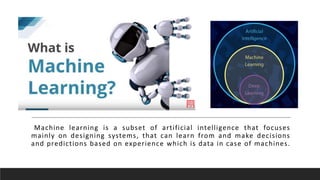
-Machine learning is a subset of artificial intelligence that focuses
mainly on designing systems, that can learn from and make decisions
and predictions based on experience which is data in case of machines.
Strong
Different types
Machine learning.
 Supervised learning
 Unsupervised learning
 Reimforcement learning
SUPERVISED LEARNING.
Supervised learning, you train the machine using data which is well
"labeled”. It can be compared to learning which takes place in the
presence of a supervisor or a teacher. Supervised learning is done
using a ground truth or an idea of what the values of the output of a
given sample will be.
Your best quote that reflects your
approach… “It’s one small step for
man, one giant leap for mankind.”
- NEIL ARMSTRONG
Example 1:
Speech Automation
in laptops and
Mobile phones.
Cortana in laptops and siri in phones, is trained using your voice,
and once trained it starts operating basing on the training.
Example 2:
Weather Application.
Data is fed into the machine whenever its Sunny the temperature
should go high, and whenever its cloudy the humidity should be
high.
Example 3:
Biometrics.
You train the machine and after a couple of biometric inputs (Iris,
voice and thumb.), the machine can validate your feature input
and identify you.
What are two
techniques in
supervised
learning?
 Linear Regression (predicts, forecasts and finds relationships
between quantitative data.)
 Classification techniques(Many kinds of classifiers like, Logistic
regression, K-NN, decision trees, SVM, Neural networks etc.)
UNSUPERVISED
LEARNING.
Here you don’t need to supervise the model. Instead, you need to
allow the model to work on its own to discover information. It
mainly uses data that is neither classified nor labeled. Helps you
to finds all kind of unknown patterns in data.
Unsupervised learning.
Here the machine is not taught but it learns from the presented
data, which is not the case with supervised learning. Here the
machine categorizes the data according to the data according to
the features, similarities, patterns, and differences
Types of
Unsupervised
learning.
 Clustering
 Association
Clustering.
Defines the structure or pattern in a collection of uncategorized data.
Involves the process of organizing objects into groups whose members are
similar, still these members are dissimilar in other clusters.
What are the
Different types of
Clustering?
 Hierarchical Clustering
 K-Means clustering
 Principal component Analysis
 K-NN (k nearest neighbors) etc.
Association.
Is a rule-based machine learning technique that discovers interesting
relations between variables in large datasets. For example, people that buy a
new home are most likely to buy new furniture, secondly, the market basket
analysis which increases customer engagement and sales.
Applications of
Unsupervised ML
techniques.
 Banks to find fraudulent transactions.
 Online movie grouping by ratings given by the viewers.
 Grouping shoppers based on their purchasing power and histories.
 Grouping cancer patients based on their gene expression.
LOGISTIC
REGRESSION
Logistic regression is a supervised classification algorithm used to
assign observations to a discrete set of classes. Some of the examples
of classification problems are Email spam or not spam, Online
transactions Fraud or not Fraud, a mushroom is poisonous or edible.
LOGISTIC
REGRESSION
Classification and regression tasks are both types of supervised
learning, but the output variables of the two tasks are different.
For regression, the output variable is a numerical value (integer
or floating point value) that exists on a continuous scale.
LOGISTIC
REGRESSION
For a Classification task, the classification model attempts to
predict the output value when given several input variables,
placing the example into the correct category.
EXAMPLE
REGRESSION
&
CLASSIFICATION
TASKS
Given a dataset full of detail about different houses and you want
to predict the price the house will sell for.
FOR A
REGRESSION
TASK
In a regression task, the model takes in the features (like the
number of rooms, land area, house age, etc.) and tries to predict
a numerical value, like $95, 825.
FOR A
CLASSIFICATION
TASK
In a classification task, the outputs would fall into one of a few
different discrete categories for the price. (Much lower than expected
price, lower than expected price, approximately expected price, higher
than expected price, much higher than expected price).
LOGISTIC
REGRESSION
Logistic regression uses a cost function defined as a sigmoid
function that ranges between 0 and 1.
Types of Logistic
regression.
 Binary Logistic regression.(two independent variables are used to
predict the value of the dependent variable )
 Multi-linear Logistic regression (two or more independent variables are
used to predict the value of the dependent variable )
LINEAR
REGRESSION
Linear regression may be defined as the statistical model that
analyzes the linear relationship between a dependent variable
with given set of independent variables.
LINEAR
REGRESSION
When the value of one or more independent variables change
(increase or decrease), the value of dependent variable will also
change accordingly (increase or decrease).

Presentation machine learning

  • 1.
  • 2.
    Your best quotethat reflects your approach… “It’s one small step for man, one giant leap for mankind.” -Machine learning is a subset of artificial intelligence that focuses mainly on designing systems, that can learn from and make decisions and predictions based on experience which is data in case of machines. Strong
  • 3.
    Different types Machine learning. Supervised learning  Unsupervised learning  Reimforcement learning
  • 4.
    SUPERVISED LEARNING. Supervised learning,you train the machine using data which is well "labeled”. It can be compared to learning which takes place in the presence of a supervisor or a teacher. Supervised learning is done using a ground truth or an idea of what the values of the output of a given sample will be.
  • 5.
    Your best quotethat reflects your approach… “It’s one small step for man, one giant leap for mankind.” - NEIL ARMSTRONG
  • 6.
    Example 1: Speech Automation inlaptops and Mobile phones. Cortana in laptops and siri in phones, is trained using your voice, and once trained it starts operating basing on the training.
  • 7.
    Example 2: Weather Application. Datais fed into the machine whenever its Sunny the temperature should go high, and whenever its cloudy the humidity should be high.
  • 8.
    Example 3: Biometrics. You trainthe machine and after a couple of biometric inputs (Iris, voice and thumb.), the machine can validate your feature input and identify you.
  • 9.
    What are two techniquesin supervised learning?  Linear Regression (predicts, forecasts and finds relationships between quantitative data.)  Classification techniques(Many kinds of classifiers like, Logistic regression, K-NN, decision trees, SVM, Neural networks etc.)
  • 10.
    UNSUPERVISED LEARNING. Here you don’tneed to supervise the model. Instead, you need to allow the model to work on its own to discover information. It mainly uses data that is neither classified nor labeled. Helps you to finds all kind of unknown patterns in data.
  • 11.
    Unsupervised learning. Here themachine is not taught but it learns from the presented data, which is not the case with supervised learning. Here the machine categorizes the data according to the data according to the features, similarities, patterns, and differences
  • 12.
  • 13.
    Clustering. Defines the structureor pattern in a collection of uncategorized data. Involves the process of organizing objects into groups whose members are similar, still these members are dissimilar in other clusters.
  • 14.
    What are the Differenttypes of Clustering?  Hierarchical Clustering  K-Means clustering  Principal component Analysis  K-NN (k nearest neighbors) etc.
  • 15.
    Association. Is a rule-basedmachine learning technique that discovers interesting relations between variables in large datasets. For example, people that buy a new home are most likely to buy new furniture, secondly, the market basket analysis which increases customer engagement and sales.
  • 16.
    Applications of Unsupervised ML techniques. Banks to find fraudulent transactions.  Online movie grouping by ratings given by the viewers.  Grouping shoppers based on their purchasing power and histories.  Grouping cancer patients based on their gene expression.
  • 17.
    LOGISTIC REGRESSION Logistic regression isa supervised classification algorithm used to assign observations to a discrete set of classes. Some of the examples of classification problems are Email spam or not spam, Online transactions Fraud or not Fraud, a mushroom is poisonous or edible.
  • 18.
    LOGISTIC REGRESSION Classification and regressiontasks are both types of supervised learning, but the output variables of the two tasks are different. For regression, the output variable is a numerical value (integer or floating point value) that exists on a continuous scale.
  • 19.
    LOGISTIC REGRESSION For a Classificationtask, the classification model attempts to predict the output value when given several input variables, placing the example into the correct category.
  • 20.
    EXAMPLE REGRESSION & CLASSIFICATION TASKS Given a datasetfull of detail about different houses and you want to predict the price the house will sell for.
  • 21.
    FOR A REGRESSION TASK In aregression task, the model takes in the features (like the number of rooms, land area, house age, etc.) and tries to predict a numerical value, like $95, 825.
  • 22.
    FOR A CLASSIFICATION TASK In aclassification task, the outputs would fall into one of a few different discrete categories for the price. (Much lower than expected price, lower than expected price, approximately expected price, higher than expected price, much higher than expected price).
  • 23.
    LOGISTIC REGRESSION Logistic regression usesa cost function defined as a sigmoid function that ranges between 0 and 1.
  • 24.
    Types of Logistic regression. Binary Logistic regression.(two independent variables are used to predict the value of the dependent variable )  Multi-linear Logistic regression (two or more independent variables are used to predict the value of the dependent variable )
  • 25.
    LINEAR REGRESSION Linear regression maybe defined as the statistical model that analyzes the linear relationship between a dependent variable with given set of independent variables.
  • 26.
    LINEAR REGRESSION When the valueof one or more independent variables change (increase or decrease), the value of dependent variable will also change accordingly (increase or decrease).