A
Seminar
on
MACHINE LEARNING
RAJKIYA ENGINEERING COLLEGE AMBEDKAR NAGAR (U.P.)
Under the supervision of:
MR. SHOBHIT KUMAR
(Asst. Professor)
Submitted by:
AMIT KUMAR
ROLL NO. :- 1573713003
Submitted to:
MR. PRINCE RAJPOOT
(Asst. Professor)
Department- Information technology
CONTENTS
• Introduction
• Types of Learning Algorithms
• Supervised Learning
Classification
Regression
• Classification vs Regression
• Unsupervised Learning
Clustering
• Machine Learning Applications
• Conclusion
• References
INTODUCTION
• Machine learning is a field of computer science that uses
statistical techniques to give computer systems the ability to
‘learn’ with data, without being explicitly programmed.
• It provides systems the ability to automatically learn and improve
from experience.
• Machine learning focuses on the development of computer
programs that can access data and use it learn for themselves.
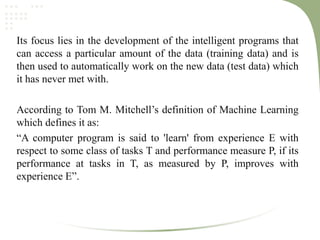
Its focus lies in the development of the intelligent programs that
can access a particular amount of the data (training data) and is
then used to automatically work on the new data (test data) which
it has never met with.
According to Tom M. Mitchell’s definition of Machine Learning
which defines it as:
“A computer program is said to 'learn' from experience E with
respect to some class of tasks T and performance measure P, if its
performance at tasks in T, as measured by P, improves with
experience E”.
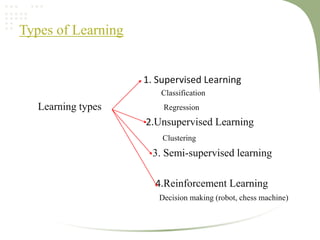
Types of Learning
1. Supervised Learning
Classification
Learning types Regression
2.Unsupervised Learning
Clustering
3. Semi-supervised learning
4.Reinforcement Learning
Decision making (robot, chess machine)
How Machine Learning Works
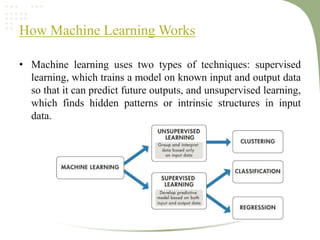
• Machine learning uses two types of techniques: supervised
learning, which trains a model on known input and output data
so that it can predict future outputs, and unsupervised learning,
which finds hidden patterns or intrinsic structures in input
data.
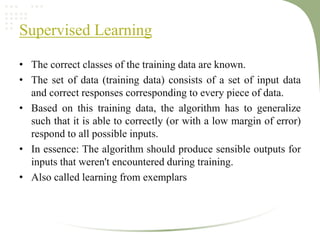
Supervised Learning
• The correct classes of the training data are known.
• The set of data (training data) consists of a set of input data
and correct responses corresponding to every piece of data.
• Based on this training data, the algorithm has to generalize
such that it is able to correctly (or with a low margin of error)
respond to all possible inputs.
• In essence: The algorithm should produce sensible outputs for
inputs that weren't encountered during training.
• Also called learning from exemplars
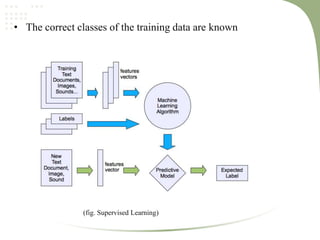
• The correct classes of the training data are known
(fig. Supervised Learning)
Classification
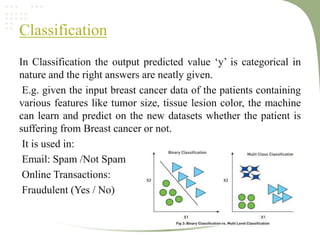
In Classification the output predicted value ‘y’ is categorical in
nature and the right answers are neatly given.
E.g. given the input breast cancer data of the patients containing
various features like tumor size, tissue lesion color, the machine
can learn and predict on the new datasets whether the patient is
suffering from Breast cancer or not.
It is used in:
Email: Spam /Not Spam
Online Transactions:
Fraudulent (Yes / No)
Regression
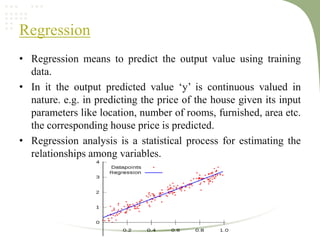
• Regression means to predict the output value using training
data.
• In it the output predicted value ‘y’ is continuous valued in
nature. e.g. in predicting the price of the house given its input
parameters like location, number of rooms, furnished, area etc.
the corresponding house price is predicted.
• Regression analysis is a statistical process for estimating the
relationships among variables.
Classification vs Regression
• Classification means to
group the output into a
class.
• classification to predict
the type of tumor i.e.
harmful or not harmful
using training data.
• if it is categorical
variable, then it is
classification problem.
• Regression means to
predict the output value
using training data.
• regression to predict the
house price from training
data.
• if it is a real continuous,
then it is regression
problem.
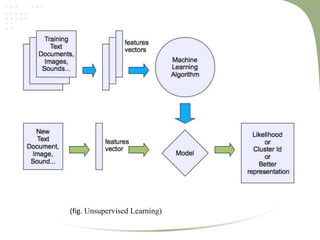
Unsupervised Learning
• The correct classes of the training data are not known.
• The aim of unsupervised learning is to find clusters of similar
inputs in the data without being explicitly told that some data
points belong to one class and the other in other classes. The
algorithm has to discover this similarity by itself.
• It is used in Google News, Social Network Analysis, Market
Segmentation, Astronomical Data Analysis.
(fig. Unsupervised Learning)
Clustering
• Clustering is the task of grouping a set of objects in such a
way that objects in the same group (called a cluster) are more
similar to each other.
• objects are not predefined
• For e.g. these keywords
– “man’s shoe”
– “women’s shoe”
– “women’s t-shirt”
– “man’s t-shirt”
 can be cluster into 2 categories “shoe” and “t-shirt” or “man”
and “women”
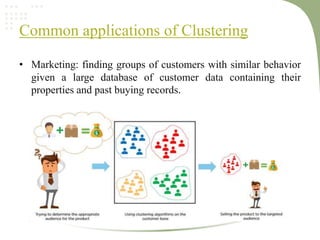
Common applications of Clustering
• Marketing: finding groups of customers with similar behavior
given a large database of customer data containing their
properties and past buying records.
Machine Learning Applications
• Virtual Personal Assistants
• Social Media Services
• Image Recognition
• Speech Recognition
• Medical Diagnosis
• Classification
• Prediction
• Extraction
Virtual Personal Assistants
• Siri, Alexa, Google Now are some of the popular examples of
virtual personal assistants. As the name suggests, they assist in
finding information, when asked over voice.
• Machine learning is an important part of these personal assistants as
they collect and refine the information on the basis of your previous
involvement with them. Later, this set of data is utilized to render
results that are tailored to your preferences.
• Virtual Assistants are integrated to a variety of platforms. For
example:
• Smart Speakers: Amazon Echo and Google Home
• Smartphones: Samsung Bixby on Samsung S8
• Mobile Apps: Google Allo
Social Media Services
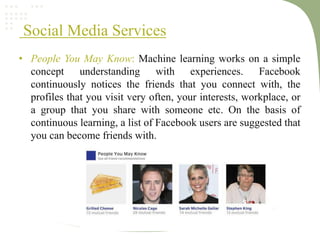
• People You May Know: Machine learning works on a simple
concept understanding with experiences. Facebook
continuously notices the friends that you connect with, the
profiles that you visit very often, your interests, workplace, or
a group that you share with someone etc. On the basis of
continuous learning, a list of Facebook users are suggested that
you can become friends with.
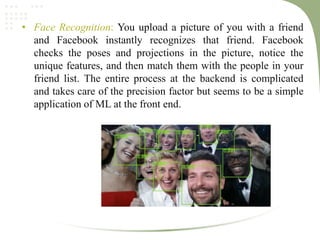
• Face Recognition: You upload a picture of you with a friend
and Facebook instantly recognizes that friend. Facebook
checks the poses and projections in the picture, notice the
unique features, and then match them with the people in your
friend list. The entire process at the backend is complicated
and takes care of the precision factor but seems to be a simple
application of ML at the front end.
Conclusion
Machine learning is an incredible breakthrough in the field of
artificial intelligence. While it does have some frightening
implications when you think about it, these Machine Learning
Applications are several of the many ways this technology can
improve our lives.
References
• Major journals/conferences: CSIC, ICML, NIPS, UAI,
ECML/PKDD, JMLR, MLJ, etc.
• Machine learning video lectures:
http://videolectures.net/Top/Computer_Science/Machine_Le
arning/
• Machine Learning (Theory):
http://hunch.net/
• LinkedIn ML groups: “Big Data” Scientist, etc.
• https://groups.google.com/forum/#!forum/women-in-
machine-learning
Machine Learning

Machine Learning

  • 1.
    A Seminar on MACHINE LEARNING RAJKIYA ENGINEERINGCOLLEGE AMBEDKAR NAGAR (U.P.) Under the supervision of: MR. SHOBHIT KUMAR (Asst. Professor) Submitted by: AMIT KUMAR ROLL NO. :- 1573713003 Submitted to: MR. PRINCE RAJPOOT (Asst. Professor) Department- Information technology
  • 2.
    CONTENTS • Introduction • Typesof Learning Algorithms • Supervised Learning Classification Regression • Classification vs Regression • Unsupervised Learning Clustering • Machine Learning Applications • Conclusion • References
  • 3.
    INTODUCTION • Machine learningis a field of computer science that uses statistical techniques to give computer systems the ability to ‘learn’ with data, without being explicitly programmed. • It provides systems the ability to automatically learn and improve from experience. • Machine learning focuses on the development of computer programs that can access data and use it learn for themselves.
  • 4.
    Its focus liesin the development of the intelligent programs that can access a particular amount of the data (training data) and is then used to automatically work on the new data (test data) which it has never met with. According to Tom M. Mitchell’s definition of Machine Learning which defines it as: “A computer program is said to 'learn' from experience E with respect to some class of tasks T and performance measure P, if its performance at tasks in T, as measured by P, improves with experience E”.
  • 5.
    Types of Learning 1.Supervised Learning Classification Learning types Regression 2.Unsupervised Learning Clustering 3. Semi-supervised learning 4.Reinforcement Learning Decision making (robot, chess machine)
  • 6.
    How Machine LearningWorks • Machine learning uses two types of techniques: supervised learning, which trains a model on known input and output data so that it can predict future outputs, and unsupervised learning, which finds hidden patterns or intrinsic structures in input data.
  • 7.
    Supervised Learning • Thecorrect classes of the training data are known. • The set of data (training data) consists of a set of input data and correct responses corresponding to every piece of data. • Based on this training data, the algorithm has to generalize such that it is able to correctly (or with a low margin of error) respond to all possible inputs. • In essence: The algorithm should produce sensible outputs for inputs that weren't encountered during training. • Also called learning from exemplars
  • 8.
    • The correctclasses of the training data are known (fig. Supervised Learning)
  • 9.
    Classification In Classification theoutput predicted value ‘y’ is categorical in nature and the right answers are neatly given. E.g. given the input breast cancer data of the patients containing various features like tumor size, tissue lesion color, the machine can learn and predict on the new datasets whether the patient is suffering from Breast cancer or not. It is used in: Email: Spam /Not Spam Online Transactions: Fraudulent (Yes / No)
  • 10.
    Regression • Regression meansto predict the output value using training data. • In it the output predicted value ‘y’ is continuous valued in nature. e.g. in predicting the price of the house given its input parameters like location, number of rooms, furnished, area etc. the corresponding house price is predicted. • Regression analysis is a statistical process for estimating the relationships among variables.
  • 11.
    Classification vs Regression •Classification means to group the output into a class. • classification to predict the type of tumor i.e. harmful or not harmful using training data. • if it is categorical variable, then it is classification problem. • Regression means to predict the output value using training data. • regression to predict the house price from training data. • if it is a real continuous, then it is regression problem.
  • 12.
    Unsupervised Learning • Thecorrect classes of the training data are not known. • The aim of unsupervised learning is to find clusters of similar inputs in the data without being explicitly told that some data points belong to one class and the other in other classes. The algorithm has to discover this similarity by itself. • It is used in Google News, Social Network Analysis, Market Segmentation, Astronomical Data Analysis.
  • 13.
  • 14.
    Clustering • Clustering isthe task of grouping a set of objects in such a way that objects in the same group (called a cluster) are more similar to each other. • objects are not predefined • For e.g. these keywords – “man’s shoe” – “women’s shoe” – “women’s t-shirt” – “man’s t-shirt”  can be cluster into 2 categories “shoe” and “t-shirt” or “man” and “women”
  • 15.
    Common applications ofClustering • Marketing: finding groups of customers with similar behavior given a large database of customer data containing their properties and past buying records.
  • 16.
    Machine Learning Applications •Virtual Personal Assistants • Social Media Services • Image Recognition • Speech Recognition • Medical Diagnosis • Classification • Prediction • Extraction
  • 17.
    Virtual Personal Assistants •Siri, Alexa, Google Now are some of the popular examples of virtual personal assistants. As the name suggests, they assist in finding information, when asked over voice. • Machine learning is an important part of these personal assistants as they collect and refine the information on the basis of your previous involvement with them. Later, this set of data is utilized to render results that are tailored to your preferences. • Virtual Assistants are integrated to a variety of platforms. For example: • Smart Speakers: Amazon Echo and Google Home • Smartphones: Samsung Bixby on Samsung S8 • Mobile Apps: Google Allo
  • 18.
    Social Media Services •People You May Know: Machine learning works on a simple concept understanding with experiences. Facebook continuously notices the friends that you connect with, the profiles that you visit very often, your interests, workplace, or a group that you share with someone etc. On the basis of continuous learning, a list of Facebook users are suggested that you can become friends with.
  • 19.
    • Face Recognition:You upload a picture of you with a friend and Facebook instantly recognizes that friend. Facebook checks the poses and projections in the picture, notice the unique features, and then match them with the people in your friend list. The entire process at the backend is complicated and takes care of the precision factor but seems to be a simple application of ML at the front end.
  • 20.
    Conclusion Machine learning isan incredible breakthrough in the field of artificial intelligence. While it does have some frightening implications when you think about it, these Machine Learning Applications are several of the many ways this technology can improve our lives.
  • 21.
    References • Major journals/conferences:CSIC, ICML, NIPS, UAI, ECML/PKDD, JMLR, MLJ, etc. • Machine learning video lectures: http://videolectures.net/Top/Computer_Science/Machine_Le arning/ • Machine Learning (Theory): http://hunch.net/ • LinkedIn ML groups: “Big Data” Scientist, etc. • https://groups.google.com/forum/#!forum/women-in- machine-learning