Machine Learning
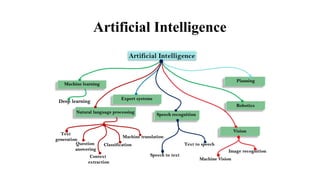
Artificial Intelligence
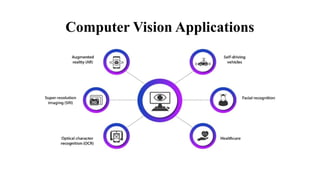
Computer Vision Applications
Natural Language Processing Applications
Machine Learning
Machine learning is a branch of artificial
intelligence and computer science which focuses on
the use of data and algorithms to imitate the way
that humans learn, gradually improving its
accuracy.
Types of Machine Learning
Supervised
ML
Unsupervised
ML
Semi-
supervised
ML
Reinforcement
Learning
Supervised ML
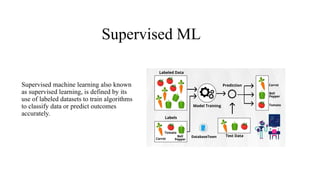
Supervised machine learning also known
as supervised learning, is defined by its
use of labeled datasets to train algorithms
to classify data or predict outcomes
accurately.
Unsupervised ML
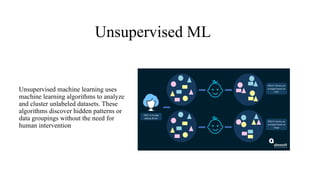
Unsupervised machine learning uses
machine learning algorithms to analyze
and cluster unlabeled datasets. These
algorithms discover hidden patterns or
data groupings without the need for
human intervention
Semi-supervised
learning:
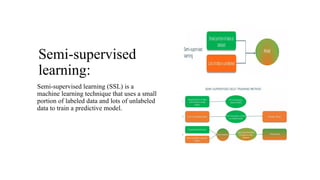
Semi-supervised learning (SSL) is a
machine learning technique that uses a small
portion of labeled data and lots of unlabeled
data to train a predictive model.
Reinforcement Learning
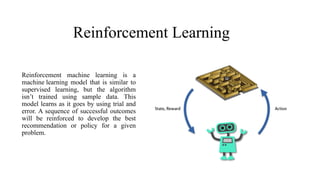
Reinforcement machine learning is a
machine learning model that is similar to
supervised learning, but the algorithm
isn’t trained using sample data. This
model learns as it goes by using trial and
error. A sequence of successful outcomes
will be reinforced to develop the best
recommendation or policy for a given
problem.
Types of Supervised Learning
Classification
• The Classification algorithm is a Supervised
Learning technique that is used to identify the
category of new observations on the basis of
training data.
• In Classification, a program learns from the
given dataset or observations and then
classifies new observation into a number of
classes or groups.
• Such as, Yes or No, 0 or 1, Spam or Not
Spam, cat or dog, etc. Classes can be called
as targets/labels or categories.
Regression
• Regression analysis is a statistical method to
model the relationship between a dependent
(target) and independent (predictor) variables
with one or more independent variables.
• More specifically, Regression analysis helps
us to understand how the value of the
dependent variable is changing corresponding
to an independent variable when other
independent variables are held fixed.
• It predicts continuous/real values such
as temperature, age, salary, price, etc
Classification Algorithms:
• Logistic Regression
• Naive Bayes
• K-Nearest Neighbors
• Decision Tree
• Support Vector Machines
Regression Algorithms:
• Linear Regression
• Polynomial Regression
• Ridge Regression
• Lasso Regression
• SV Regression
• Decision tree for regression
• Random forest regression
• KNN regression
Unsupervised Learning Algorithms
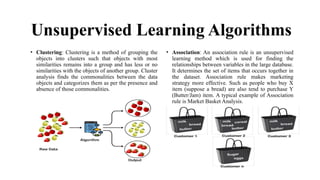
• Clustering: Clustering is a method of grouping the
objects into clusters such that objects with most
similarities remains into a group and has less or no
similarities with the objects of another group. Cluster
analysis finds the commonalities between the data
objects and categorizes them as per the presence and
absence of those commonalities.
• Association: An association rule is an unsupervised
learning method which is used for finding the
relationships between variables in the large database.
It determines the set of items that occurs together in
the dataset. Association rule makes marketing
strategy more effective. Such as people who buy X
item (suppose a bread) are also tend to purchase Y
(Butter/Jam) item. A typical example of Association
rule is Market Basket Analysis.
Traditional programming vs ML
ML Project Workflow
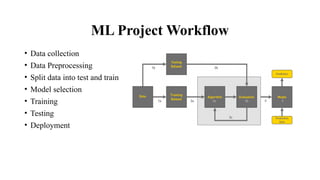
• Data collection
• Data Preprocessing
• Split data into test and train
• Model selection
• Training
• Testing
• Deployment
Thank You

578_Machine _learning @_presentationnn_12

  • 1.
  • 2.
  • 3.
  • 4.
  • 5.
    Machine Learning Machine learningis a branch of artificial intelligence and computer science which focuses on the use of data and algorithms to imitate the way that humans learn, gradually improving its accuracy.
  • 6.
    Types of MachineLearning Supervised ML Unsupervised ML Semi- supervised ML Reinforcement Learning
  • 7.
    Supervised ML Supervised machinelearning also known as supervised learning, is defined by its use of labeled datasets to train algorithms to classify data or predict outcomes accurately.
  • 8.
    Unsupervised ML Unsupervised machinelearning uses machine learning algorithms to analyze and cluster unlabeled datasets. These algorithms discover hidden patterns or data groupings without the need for human intervention
  • 9.
    Semi-supervised learning: Semi-supervised learning (SSL)is a machine learning technique that uses a small portion of labeled data and lots of unlabeled data to train a predictive model.
  • 10.
    Reinforcement Learning Reinforcement machinelearning is a machine learning model that is similar to supervised learning, but the algorithm isn’t trained using sample data. This model learns as it goes by using trial and error. A sequence of successful outcomes will be reinforced to develop the best recommendation or policy for a given problem.
  • 11.
    Types of SupervisedLearning Classification • The Classification algorithm is a Supervised Learning technique that is used to identify the category of new observations on the basis of training data. • In Classification, a program learns from the given dataset or observations and then classifies new observation into a number of classes or groups. • Such as, Yes or No, 0 or 1, Spam or Not Spam, cat or dog, etc. Classes can be called as targets/labels or categories. Regression • Regression analysis is a statistical method to model the relationship between a dependent (target) and independent (predictor) variables with one or more independent variables. • More specifically, Regression analysis helps us to understand how the value of the dependent variable is changing corresponding to an independent variable when other independent variables are held fixed. • It predicts continuous/real values such as temperature, age, salary, price, etc
  • 12.
    Classification Algorithms: • LogisticRegression • Naive Bayes • K-Nearest Neighbors • Decision Tree • Support Vector Machines Regression Algorithms: • Linear Regression • Polynomial Regression • Ridge Regression • Lasso Regression • SV Regression • Decision tree for regression • Random forest regression • KNN regression
  • 13.
    Unsupervised Learning Algorithms •Clustering: Clustering is a method of grouping the objects into clusters such that objects with most similarities remains into a group and has less or no similarities with the objects of another group. Cluster analysis finds the commonalities between the data objects and categorizes them as per the presence and absence of those commonalities. • Association: An association rule is an unsupervised learning method which is used for finding the relationships between variables in the large database. It determines the set of items that occurs together in the dataset. Association rule makes marketing strategy more effective. Such as people who buy X item (suppose a bread) are also tend to purchase Y (Butter/Jam) item. A typical example of Association rule is Market Basket Analysis.
  • 14.
  • 15.
    ML Project Workflow •Data collection • Data Preprocessing • Split data into test and train • Model selection • Training • Testing • Deployment
  • 16.