This document presents a research study on estimating housing prices using machine learning algorithms, specifically linear regression, to create accurate predictions based on various influencing features. The study emphasizes the importance of understanding the housing market dynamics and proposes a methodology utilizing real transaction data to enhance prediction accuracy. Additionally, the approach integrates location-based factors and demonstrates improved performance compared to traditional methods.
![International Journal of Trend in Scientific Research and Development (IJTSRD)
Volume 5 Issue 4, May-June 2021 Available Online: www.ijtsrd.com e-ISSN: 2456 – 6470
@ IJTSRD | Unique Paper ID – IJTSRD42367 | Volume – 5 | Issue – 4 | May-June 2021 Page 795
House Price Estimates Based on Machine Learning Algorithm
Jakir Khan1, Dr. Ganesh D2
1Student, 2Assistant Professor,
1,2Department of MCA, School of CS & IT, Jain University, Bangalore, Karnataka, India
ABSTRACT
Housing prices are increasing every year, necessitating the creation of a long-
term housing price strategy. Predicting a home's price will assist a developer
in determining a home's purchase price, as well as a consumer in determining
the best time to buy a home. The sale price of real estate in major cities
depends on the specific circumstances.Housingpricesare constantlychanging
from day to day and are sometimes fired rather than based on estimates.
Predicting real estate prices by real factors is a key element as part of our
analysis. We want to make our test dependent on all of the simplemetricsthat
are taken into account when deciding the significance. In this research weuse
linear regression techniques pathway and our results are not self-inflicted
process rather is a weighted method of various techniques to give the most
accurate results. There are fifteen features in the data collection. In this
research. There has been an effort to build a forecasting model for
determining the price based on the variables that influence the price.The
results have proven to be effective lower error and higher accuracy than
individual algorithms are used.
KEYWORDS: Machine Learning, Linear Regression algorithm
How to cite this paper: Jakir Khan | Dr.
Ganesh D "House Price Estimates Based
on Machine Learning
Algorithm"Published
in International
Journal of Trend in
Scientific Research
and Development
(ijtsrd), ISSN: 2456-
6470, Volume-5 |
Issue-4, June 2021, pp.795-799, URL:
www.ijtsrd.com/papers/ijtsrd42367.pdf
Copyright © 2021 by author (s) and
International Journal ofTrendinScientific
Research and Development Journal. This
is an Open Access article distributed
under the terms of
the Creative
Commons Attribution
License (CC BY 4.0)
(http://creativecommons.org/licenses/by/4.0)
I. INTRODUCTION
Identification House prices continue to change for the day
and going out for a day and sometimes smoking rather than
based on estimates. Machine learningalgorithmsareusedfor
modeling, in which the machine learns data and uses what it
has learned to predict new data. The most well-known
paradigm of forecasting research is backstage. The proposed
model for accurately predicting future outcomes has
economic, financial, banking, health, commercial,
recreational,sportandothersectors.Manyvariablesareused
in a single way to predict house prices. Forecasting houses
prices with real features are our main crux research project.
We use various how to get back on track, too our results are
not self-determined process rather is a weighty method of
various techniques to give the most accurate results. The
results have proven to be effective lower error and higher
accuracy than individual algorithms are used. The aim ofthis
research is to gain a useful understanding of the housing
market in the United States by analyzing the actual historical
data of the transaction. Looking for models that can estimate
the worth of a house based on a set of features. Practical
models can help home buyers and for real estate brokers to
make informed decisions. In addition, it can assist in
predicting home rates in the future and the process of
formulating housing market policy. In comparison to other
traditional methods, our work can achieve a better
performance by experimenting with real-world property
transaction data. With our research project, consider USA as
our main and predictable location prices of real estate in
various locations around USA.
II. LITERATURE REVIEW
A large number of scholars have participated tothiswork on
the analysis of house price prediction in the past. The
following is a review of the text related to the study of house
price prediction.
In paper [1] 4,000 unprocessed datasets fromeightcounties
were collected from real estate agents' Services with
Multiple Listings (MLS) in Washington, DC. Three separate
learning algorithms was put to the test the hedonic
hypothesis (PCR, SVR and K-NN). For component analysis
and decomposition, PCA was used. The Chi-SquareQuantile-
Quantile plot and Henze-Multivariate Zirkler's Normality
Test were used to perform the normality test. Model
performance has shown that PCR has side effects for SVR
and K-NN. The suitability and replacement of PCR, SVR, and
K-NN in the application of the hedonic pricing policy was
also confirmed in this report.
In paper [2] investigating price redistributiona combination
of Sale Price for each variety and present many new
variables For example, Fig. 1 shows the log conversion
Individual price distribution neighbors. The purpose of the
engineering features is to improve data familiarity and
equity, while setting the highest parameter Iteration times
are used to improve data consistency.
In paper [3] to improve interpretation and improve
performance of predictive models, data reduction strategies
like Stepwise and Boosting are exploited to get more
important predictions. In addition, PCA, data conversion
technique, used to find things that are important to combine
with SVM. There are 34,857 observationsand21variablesin
the original dataset. From 2016 to 2018, each observation
depicts a real sold house transaction in Melbourne. The aim
of this research is to analyze real history a transaction
database to gain valuable insightsintoreal estateata market
IJTSRD42367](https://image.slidesharecdn.com/128housepriceestimatesbasedonmachinelearningalgorithm-210716094048/85/House-Price-Estimates-Based-on-Machine-Learning-Algorithm-1-320.jpg)
![International Journal of Trend in Scientific Research and Development (IJTSRD)
Volume 5 Issue 4, May-June 2021 Available Online: www.ijtsrd.com e-ISSN: 2456 – 6470
@ IJTSRD | Unique Paper ID – IJTSRD42367 | Volume – 5 | Issue – 4 | May-June 2021 Page 795
House Price Estimates Based on Machine Learning Algorithm
Jakir Khan1, Dr. Ganesh D2
1Student, 2Assistant Professor,
1,2Department of MCA, School of CS & IT, Jain University, Bangalore, Karnataka, India
ABSTRACT
Housing prices are increasing every year, necessitating the creation of a long-
term housing price strategy. Predicting a home's price will assist a developer
in determining a home's purchase price, as well as a consumer in determining
the best time to buy a home. The sale price of real estate in major cities
depends on the specific circumstances.Housingpricesare constantlychanging
from day to day and are sometimes fired rather than based on estimates.
Predicting real estate prices by real factors is a key element as part of our
analysis. We want to make our test dependent on all of the simplemetricsthat
are taken into account when deciding the significance. In this research weuse
linear regression techniques pathway and our results are not self-inflicted
process rather is a weighted method of various techniques to give the most
accurate results. There are fifteen features in the data collection. In this
research. There has been an effort to build a forecasting model for
determining the price based on the variables that influence the price.The
results have proven to be effective lower error and higher accuracy than
individual algorithms are used.
KEYWORDS: Machine Learning, Linear Regression algorithm
How to cite this paper: Jakir Khan | Dr.
Ganesh D "House Price Estimates Based
on Machine Learning
Algorithm"Published
in International
Journal of Trend in
Scientific Research
and Development
(ijtsrd), ISSN: 2456-
6470, Volume-5 |
Issue-4, June 2021, pp.795-799, URL:
www.ijtsrd.com/papers/ijtsrd42367.pdf
Copyright © 2021 by author (s) and
International Journal ofTrendinScientific
Research and Development Journal. This
is an Open Access article distributed
under the terms of
the Creative
Commons Attribution
License (CC BY 4.0)
(http://creativecommons.org/licenses/by/4.0)
I. INTRODUCTION
Identification House prices continue to change for the day
and going out for a day and sometimes smoking rather than
based on estimates. Machine learningalgorithmsareusedfor
modeling, in which the machine learns data and uses what it
has learned to predict new data. The most well-known
paradigm of forecasting research is backstage. The proposed
model for accurately predicting future outcomes has
economic, financial, banking, health, commercial,
recreational,sportandothersectors.Manyvariablesareused
in a single way to predict house prices. Forecasting houses
prices with real features are our main crux research project.
We use various how to get back on track, too our results are
not self-determined process rather is a weighty method of
various techniques to give the most accurate results. The
results have proven to be effective lower error and higher
accuracy than individual algorithms are used. The aim ofthis
research is to gain a useful understanding of the housing
market in the United States by analyzing the actual historical
data of the transaction. Looking for models that can estimate
the worth of a house based on a set of features. Practical
models can help home buyers and for real estate brokers to
make informed decisions. In addition, it can assist in
predicting home rates in the future and the process of
formulating housing market policy. In comparison to other
traditional methods, our work can achieve a better
performance by experimenting with real-world property
transaction data. With our research project, consider USA as
our main and predictable location prices of real estate in
various locations around USA.
II. LITERATURE REVIEW
A large number of scholars have participated tothiswork on
the analysis of house price prediction in the past. The
following is a review of the text related to the study of house
price prediction.
In paper [1] 4,000 unprocessed datasets fromeightcounties
were collected from real estate agents' Services with
Multiple Listings (MLS) in Washington, DC. Three separate
learning algorithms was put to the test the hedonic
hypothesis (PCR, SVR and K-NN). For component analysis
and decomposition, PCA was used. The Chi-SquareQuantile-
Quantile plot and Henze-Multivariate Zirkler's Normality
Test were used to perform the normality test. Model
performance has shown that PCR has side effects for SVR
and K-NN. The suitability and replacement of PCR, SVR, and
K-NN in the application of the hedonic pricing policy was
also confirmed in this report.
In paper [2] investigating price redistributiona combination
of Sale Price for each variety and present many new
variables For example, Fig. 1 shows the log conversion
Individual price distribution neighbors. The purpose of the
engineering features is to improve data familiarity and
equity, while setting the highest parameter Iteration times
are used to improve data consistency.
In paper [3] to improve interpretation and improve
performance of predictive models, data reduction strategies
like Stepwise and Boosting are exploited to get more
important predictions. In addition, PCA, data conversion
technique, used to find things that are important to combine
with SVM. There are 34,857 observationsand21variablesin
the original dataset. From 2016 to 2018, each observation
depicts a real sold house transaction in Melbourne. The aim
of this research is to analyze real history a transaction
database to gain valuable insightsintoreal estateata market
IJTSRD42367](https://image.slidesharecdn.com/128housepriceestimatesbasedonmachinelearningalgorithm-210716094048/75/House-Price-Estimates-Based-on-Machine-Learning-Algorithm-1-2048.jpg)
![International Journal of Trend in Scientific Research and Development (IJTSRD) @ www.ijtsrd.com eISSN: 2456-6470
@ IJTSRD | Unique Paper ID – IJTSRD42367 | Volume – 5 | Issue – 4 | May-June 2021 Page 796
in downtown Melbourne. Looking for useful models to
predict that a house's worth is determined by its location
given a set of its features.
In paper [4] estimate each parameter according to its value
in determining the pricing of the system and this has led us
to increase the value saved by each parameter system. We
rated 3 different machines algorithms to learn and test our
system with a different combination that can guarantee the
best possibly the reliability of our results. A program that
aims to provide accurate predictions housing prices have
been built. The program makes good use of Linear
Regression, Forest retreat, magnified magnitude. Efficiency
of algorithm added more with the use of Neural Networks.
consider it Mumbai as our main and predictable location
prices of real estate in various locations around Mumbai
consider a certified database .
In paper [5] develop the industrial revolution's fourth stage
over time with the growing popularity of in big data
technology, ithadmovedimportanceandrapiddevelopment
in the field of data science. The dataset contain 171,155
property transaction record from 2013 to 2017. Because
there are missing data of features. The proposed in-
convolution learning model providesa bettersolutiontoreal
estate price forecasts with higher accuracy and faster
integration rate, and that the proposed prediction process
can increase the robustness of the convolutional neural
network model.
In paper [6] There are five standard machine learning
processes in place used in this study namely Random Forest
Regressor, Decision
Tree Director, Ridge, Lasso and Regular Linear. Before
confirming the predictable results of each, appropriate
algorithm suspensions are identified first based on training
database by to call the best estimator method. The dataset
contain 15 columns of 4066 records, which3252fortraining
and 814 for validation.
In paper [7] from June 1996 to August 2014, the data
preparation processresulted in39,554housingtransactions.
This collection program can be done inside a single element
or by combining features in a very high-end aircraft. Noble
(2006) suggests that the details are more easily separated
from high-resolution spaces because there is a kernel
function that can be applied to any data set divided equally.
However, locating the kernel is a difficult challengefunction.
In paper [8] study provides insight into machine learning
skills as well geographical methods of molding in complex
urban areas using a huge volume of information from many
geospatial sources. There are21,928 homes, 125,000 house
portraits, and approximately 470,000 street view pictures.
In paper [9] with a simple drop in line we try to minimize
error, and in SVR we try to match his error withinsomething
the limit. It is a retrieval algorithm and uses the same
Support Vector Machines (SVM) retrieval method analysis.
The train data set consists of 11200 records with 9
explanatory variables. In test data set, there were around
1480 records with 9 variables.
In paper [10] more than 300,000 data points are includedin
this dataset, which includes 26 variables thatreflecthousing
prices exchanged between 2009 and 2018.Analysis of
experimental data is an important step before building a
retrospective model. In this way, theresearcherscansto find
data patterns, which helps to select appropriatemethodsfor
machine learning. Three types ofMachineLearningmethods
include Random Forest, XGBoost, and LightGBM and two
machine learning techniques including. Three types of
Machine LearningmethodsincludeRandomForest, XGBoost,
and LightGBM and two machine learning techniques
including proven to be effective in a variety of computer-
aided applications (He et al., 2016)
III. EXISTING MODEL
Our findings show how multiple geo-data sources can be
used in machine learning applications to demonstrate
housing pricing patterns and policy makers to assist in
understanding human settlements. The sale price of real
estate in major cities depends on the specific circumstances.
Although a macro viewpoint of the real estate appreciation
rate could be more useful, consistency of performance is not
the only metric to consider when determining the right
model.
IV. PROPOSED MODEL
The proposed model for accurately predicting future
outcomes has applications in real state. The aim of this
statistical study is to aid in our understanding of the the
house-to-house partnership features and how these
variables are used to forecast house price. To develop the
proposed method for calculating rates of increase in house
prices generalisation and replicability. The aim of this
research is to through analyzing a real historical
transactional dataset to derive valuable insight into the
housing market in USA. Our dataset contains a wide rangeof
critical parameters, and data mining is at the heart of our
system. We started by cleaning up the entire dataset and
truncating the outlier values. Similarly, we weighted each
parameter based entirely on its importance in determining
the system's pricing, which resulted in an increase in the
weight that each parameter retainsinthesystem.Wechoose
three outstanding system learningalgorithmsandtested our
system with excellent combinations that will ensure the
accuracy and consistency of our effects [5].Even after that,
we used a totally new approach to improve precision. Even
after that, we took a novel approach to improve the quality
of our survey, which revealed that the real estate fee is often
influenced by local facilities such as a train station, grocery
store, college, pharmacy, temple, parks, and so on. And now
we'd like to present our specific approach to addressing this
need. We use the Google Maps API to narrow down a
distance of 0.5 km based on localityseek.Now,ifwediscover
certain public places in the circle, the value ofthebelongings
rises in proportion. We tested this with manual scenarios,
and the results were excellent in terms of prediction
accuracy [8].](https://image.slidesharecdn.com/128housepriceestimatesbasedonmachinelearningalgorithm-210716094048/85/House-Price-Estimates-Based-on-Machine-Learning-Algorithm-2-320.jpg)
![International Journal of Trend in Scientific Research and Development (IJTSRD) @ www.ijtsrd.com eISSN: 2456-6470
@ IJTSRD | Unique Paper ID – IJTSRD42367 | Volume – 5 | Issue – 4 | May-June 2021 Page 798
Figure: A.4.1
B. Model defining
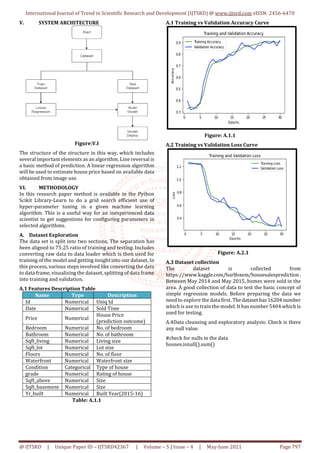
Creating a Linear Regression model, training function and
optimizing the hyper parameters like learning rate, number
of epochs. simple linearregressionisa mathematical method
of modeling the correlation between the predictor X and the
Y response variable. It assumes that there may be a direct
correlation between these two variables and we use that to
expect a limited output. simple line deceleration is a
completely simple way to do supervised mastering. but,
while it may be the end of the road and the most
straightforward, it is an important starting point for all the
regression strategies, so it is important to fully understand
what it is about for miles. It is also widely used and smooth
translation: it helps to gain a better understanding of the
connection between feedback and prediction.
Mathematically, we are able to document these specific
relationships as: y = -0 + β1x + e; therey output flexibility
(also called response, targeting or systematic flexibility). e.g.
housing costsx input variables(alsocalledactive,descriptive
or non-descriptive) e.g. the height of the house is square
meters β0 capture (price y when x = 0)β1 is the coefficient x
and the slope of the return line (“normal boom in Y
associated with the increase of one unit in X”)e is a time of
error when using linear regression, the algorithm produces
the best live path using the coefficients version zero and β1,
such as miles as close as possible to the actual facts (reduces
the ratio of distances twice between all data and road). as
soon as we find ero zero and β1 we will use the model to
wait for a response.
The blue line — line of first-class stable — is the line
that minimises the number of squared defects.
The black circles are the found values of x and y (actual
facts).
The errors (or residuals) are the vertical distances
between the discovered values (the real statistics) and
the pleasant suit lane.
the blue line's slope is 1; the intercept (the value of y
when x=0) is 0The most straightforward method of
estimation is linear regression. It uses two variables as
variables: a predictor variable and a variable that is the
most important one first, if the predictor variable and
su. This regression estimates are used to explain the
relationship between one known variable and one or
more unobservable variables. Thecomponentsdescribe
the equation of the regression equation with one
dependent and one unbiased variable [6].b = y + x*a,
where a = ranking on the independent variable, y =
normal, x = regression coefficient, and b = approximate
existing variable score.
Figure: B.1 Linear regression scatter plot
C. Implementation
The implementation is done in Python 3. To develop and
train the Linear Regression model, the Ker as library, which
operates on top of Tensor flow, is used. The Anaconda
package manager is used to import all dependencies.
D. Classification
Includes prediction on the test dataset, visualizing the
performance of our model and seeing how our model is
performing.
D.1 Any correlations between variables:
Figure:D.1.1](https://image.slidesharecdn.com/128housepriceestimatesbasedonmachinelearningalgorithm-210716094048/85/House-Price-Estimates-Based-on-Machine-Learning-Algorithm-4-320.jpg)
![International Journal of Trend in Scientific Research and Development (IJTSRD) @ www.ijtsrd.com eISSN: 2456-6470
@ IJTSRD | Unique Paper ID – IJTSRD42367 | Volume – 5 | Issue – 4 | May-June 2021 Page 799
VII. RESULT
Figure: VII.I Final outcome
VIII. CONCLUSION
A system has been developed that seeks to provide reliable
forecasts for housing prices, and allows for theoptimaluseof
the Linear Regression algorithm. The use of neural networks
has improved algorithm performance even more. Customers
will be content because the device have the right results and
eliminate the chance of finding the wrong structure. In asset
analysis, new mechanical calculation methods can be used.
Compared to a simple model, we can useonetopredicthouse
price.
IX. FUTURE WORK
The machine's accuracy should be improved. As the gadget's
scale and computing power grow, it would be possibletoadd
even more cites. Furthermore, we will incorporate
exceptional UI/UX techniques for improvedsimulationofthe
outcomes in a more interactive way by the use of Augmented
truth [eleven]. Also, a mastering device may be developed to
collect user feedback and documents so that the gadget
would display the most suitable effects to the user based on
his choices.
Acknowledgment
I should to pass on my genuine propensity and commitment
to Dr MN. Nachappa and Asst. Prof: Dr Ganesh D and
undertaking facilitators for their compelling steerage and
steady motivations all through my evaluation work. Their
optimal bearing, total co-activity and second insight have
made my work productive.
References
[1] Oladunni, T. and Sharma, S., 2016. Hedonic Housing
Theory — A Machine Learning Investigation. 2016
15th IEEE International Conference on Machine
Learning and Applications (ICMLA),.
[2] Lu, S., Li, Z., Qin, Z., Yang, X. and Goh, R., 2017. A
hybrid regression technique for house prices
prediction. 2017 IEEE International Conference on
Industrial Engineering and Engineering Management
(IEEM),.
[3] Phan, T., 2018. Housing Price Prediction Using
Machine Learning Algorithms:TheCaseofMelbourne
City, Australia. 2018 International Conference on
Machine Learning and Data Engineering (iCMLDE),.
[4] Varma, A., Sarma, A., Doshi, S. and Nair, R., 2018.
House Price Prediction Using Machine Learning and
Neural Networks. 2018 Second International
Conference on Inventive Communication and
Computational Technologies (ICICCT),.
[5] Piao, Y., Chen, A. and Shang, Z., 2019. Housing Price
Prediction Based on CNN. 2019 9th International
Conference on Information Science and Technology
(ICIST),.
[6] [6]Masrom, S., Mohd, T., Jamil, N., Rahman, A. and
Baharun, N., 2019. Automated Machine Learning
based on Genetic Programming: a case studyona real
house pricing dataset. 2019 1st International
Conference on Artificial Intelligence and Data Sciences
(AiDAS),.
[7] Ho, W., Tang, B. and Wong, S., 2020. Predicting
property prices with machine learning
algorithms. JournalofPropertyResearch,38(1),pp.48-
70.
[8] Kang, Y., Zhang, F., Peng, W., Gao, S., Rao, J., Duarte, F.
and Ratti, C., 2020. Understanding house price
appreciation using multi-source big geo-data and
machine learning. Land Use Policy, p.104919.
[9] Manasa, J., Gupta, R. and Narahari, N., 2020. Machine
Learning based Predicting House Prices using
Regression Techniques. 2020 2nd International
Conference on Innovative Mechanisms for Industry
Applications (ICIMIA),.
[10] Truong, Q., Nguyen, M., Dang, H. and Mei, B., 2020.
Housing Price Prediction via Improved Machine
Learning Techniques. ProcediaComputerScience,174,
pp.433-442](https://image.slidesharecdn.com/128housepriceestimatesbasedonmachinelearningalgorithm-210716094048/85/House-Price-Estimates-Based-on-Machine-Learning-Algorithm-5-320.jpg)


