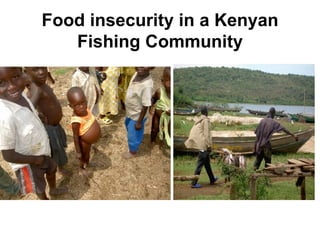
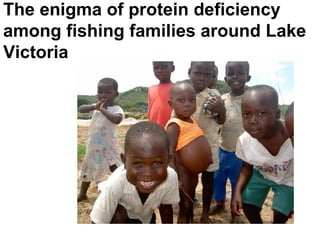
Food insecurity in a Kenyan Fishing Community
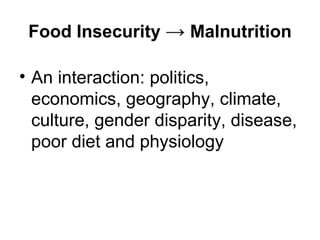
The enigma of protein deficiency among fishing families around Lake Victoria
Food Insecurity  ->  M alnutrition An interaction: politics, economics, geography, climate, culture, gender disparity, disease, poor diet and physiology
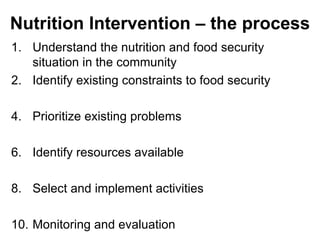
Understand the nutrition and food security situation in the community Identify existing constraints to food security Prioritize existing problems  Identify resources available  Select and implement activities  Monitoring and evaluation Nutrition Intervention – the process
Protein Availability Per Person Kenya 61 g/day
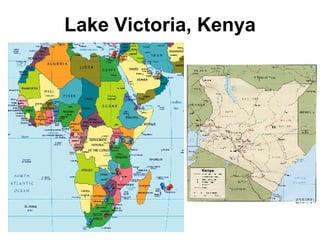
Lake Victoria, Kenya
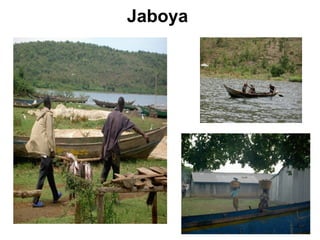
Jaboya
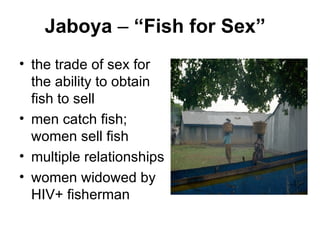
Jaboya  –  “Fish for Sex” the trade of sex for the ability to obtain fish to sell men catch fish; women sell fish  multiple relationships  women widowed by HIV+ fisherman
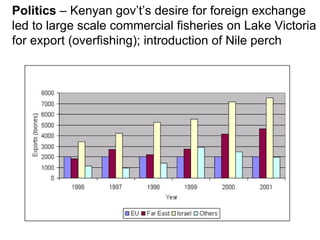
Politics  – Kenyan gov’t’s desire for foreign exchange led to large scale commercial fisheries on Lake Victoria for export (overfishing); introduction of Nile perch
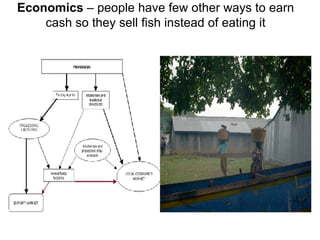
Economics  – people have few other ways to earn cash so they sell fish instead of eating it
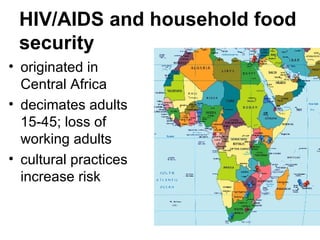
HIV/AIDS and household food security   originated in Central Africa decimates adults 15-45; loss of working adults cultural practices increase risk
Impact of HIV/AIDS on household food security large numbers of orphans increase in household size  children caring for children loss of traditional nutrition knowledge
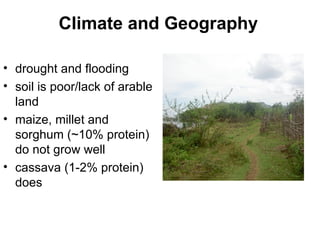
Climate and Geography   drought and flooding  soil is poor/lack of arable land maize, millet and sorghum (~10% protein) do not grow well  cassava (1-2% protein) does
Other Agricultural Issues soil degradation crop diseases desertification/climate change
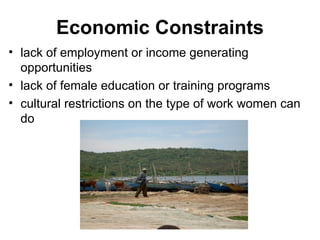
Economic Constraints lack of employment or income generating opportunities lack of female education or training programs cultural restrictions on the type of work women can do
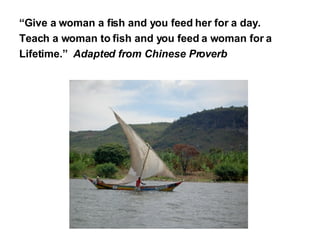
“ Give a woman a fish and you feed her for a day.  Teach a woman to fish and you feed a woman for a  Lifetime.”  Adapted from Chinese Proverb
Understand the nutrition and food security situation in the community Identify existing constraints to food security Prioritize existing problems  Identify resources available  Select and implement activities  Monitoring and evaluation Nutrition Intervention – the process
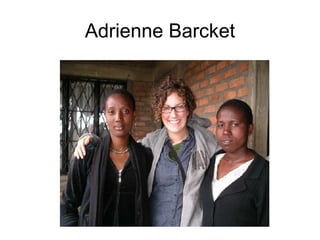
Adrienne Barcket
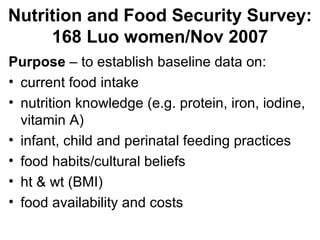
Nutrition and Food Security Survey: 168 Luo women/Nov 2007 Purpose  – to establish baseline data on: current food intake  nutrition knowledge (e.g. protein, iron, iodine, vitamin A) infant, child and perinatal feeding practices food habits/cultural beliefs ht & wt (BMI) food availability and costs
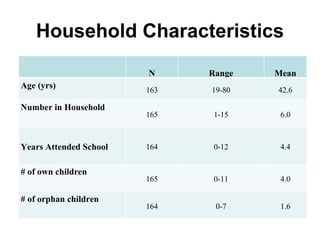
Household Characteristics N Range Mean Age (yrs) 163 19-80 42.6 Number in Household 165 1-15 6.0 Years Attended School 164 0-12 4.4 # of own children 165 0-11 4.0 # of orphan children 164 0-7 1.6
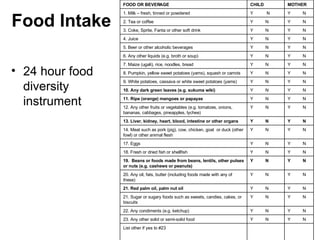
24 hour food diversity instrument Food Intake FOOD OR BEVERAGE CHILD MOTHER 1. Milk – fresh, tinned or powdered Y  N  Y  N  2. Tea or coffee Y  N  Y  N  3. Coke, Sprite, Fanta or other soft drink Y  N  Y  N  4. Juice Y  N  Y  N  5. Beer or other alcoholic beverages  Y  N  Y  N  6. Any other liquids (e.g. broth or soup) Y  N  Y  N  7. Maize (ugali), rice, noodles, bread  Y  N  Y  N  8. Pumpkin, yellow sweet potatoes (yams), squash or carrots Y  N  Y  N  9. White potatoes, cassava or white sweet potatoes (yams) Y  N  Y  N  10. Any dark green leaves (e.g. sukuma wiki) Y  N  Y  N  11. Ripe (orange) mangoes or papayas Y  N  Y  N  12. Any other fruits or vegetables (e.g. tomatoes, onions, bananas, cabbages, pineapples, lychee) Y  N  Y  N  13. Liver, kidney, heart, blood, intestine or other organs Y  N  Y  N  14. Meat such as pork (pig), cow, chicken, goat  or duck (other fowl) or other animal flesh Y  N  Y  N  17. Eggs Y  N  Y  N  18. Fresh or dried fish or shellfish Y  N  Y  N  19.  Beans or foods made from beans, lentils, other pulses or nuts (e.g. cashews or peanuts) Y  N  Y  N  20. Any oil, fats, butter (including foods made with any of these) Y  N  Y  N  21. Red palm oil, palm nut oil Y  N  Y  N  21. Sugar or sugary foods such as sweets, candies, cakes, or biscuits Y  N  Y  N  22. Any condiments (e.g. ketchup) Y  N  Y  N  23. Any other solid or semi-solid food Y  N  Y  N  List other if yes to #23
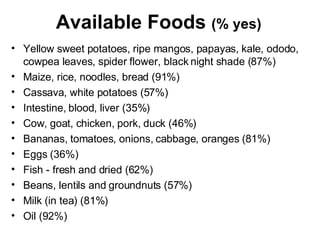
Available Foods  (% yes) Yellow sweet potatoes, ripe mangos, papayas, kale, ododo, cowpea leaves, spider flower, black night shade (87%) Maize, rice, noodles, bread (91%) Cassava, white potatoes (57%) Intestine, blood, liver (35%) Cow, goat, chicken, pork, duck (46%) Bananas, tomatoes, onions, cabbage, oranges (81%) Eggs (36%) Fish - fresh and dried (62%) Beans, lentils and groundnuts (57%) Milk (in tea) (81%) Oil (92%)
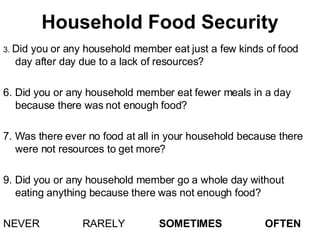
Household Food Security 3.  Did you or any household member eat just a few kinds of food day after day due to a lack of resources? 6. Did you or any household member eat fewer meals in a day because there was not enough food? 7. Was there ever no food at all in your household because there were not resources to get more? 9. Did you or any household member go a whole day without eating anything because there was not enough food? NEVER  RARELY  SOMETIMES  OFTEN
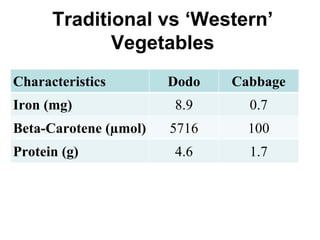
Traditional vs ‘Western’ Vegetables Characteristics Dodo Cabbage Iron (mg) 8.9 0.7 Beta-Carotene (µmol) 5716 100 Protein (g) 4.6 1.7
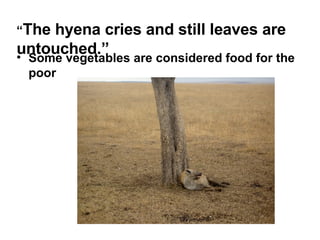
“ The hyena cries and still leaves are untouched.” Some vegetables are considered food for the poor
Cultural Constraints Gender  - not acceptable for men to gather vegetables or prepare them men who cook are referred to as “half or lesser men” Food can’t be gathered from deserted homesteads due to the presence of malevolent spirits
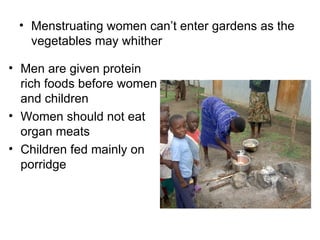
Menstruating women can’t enter gardens as the vegetables may whither Men are given protein rich foods before women and children  Women should not eat organ meats Children fed mainly on porridge
Nutrition Knowledge Have you heard of anemia or iron deficiency?  82% Yes If yes, do you know what foods can help to prevent or treat iron deficiency? blood, liver, beans cabbage, oranges, papaya
Do you know of any foods that are good sources of protein?  58% yes List those foods meat, fish, chicken grains and beans mixed (2) cabbages, white potatoes
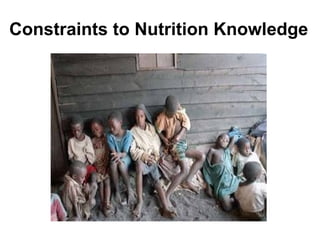
Constraints to Nutrition Knowledge
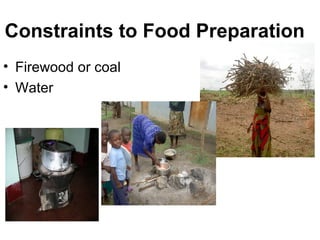
Constraints to Food Preparation  Firewood or coal Water
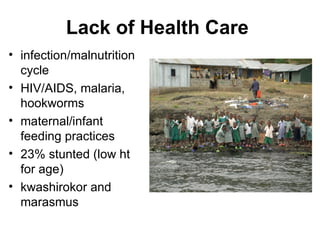
Lack of Health Care   infection/malnutrition cycle HIV/AIDS, malaria, hookworms maternal/infant feeding practices 23% stunted (low ht for age) kwashirokor and marasmus
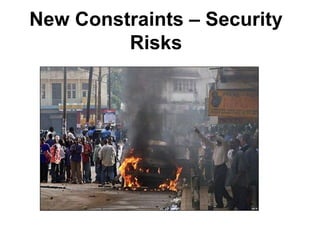
New Constraints – Security Risks
Understand the nutrition and food security situation in the community Identify existing constraints to food security Prioritize existing problems  Identify resources available  Select and implement activities  Monitoring and evaluation Nutrition Intervention – the process
Prioritize existing problems  People are unable to grow, produce, preserve or purchase adequate amounts of culturally acceptable, nutritionally adequate food People lack sufficient knowledge of the nutritional qualities of the food that is available and who needs certain foods the most (e.g. iron rich foods) Culture limits women’s ability to provide for their families
Purpose  - To develop a participatory, community based nutrition intervention program for the Kanyawegi region in Kenya to help reduce the high incidence of protein/energy and micronutrient malnutrition. Challenge:  Recommendations must be culturally appropriate, nutritionally adequate, sustainable, affordable and agriculturally viable. Nutrition Intervention Project (GSI)
Possibilities School Garden Education  School feeding program Nutrition/agriculture club Nutrition Information, Assessment and Training Center Distribute information, visual and audio aids Anthropometry, dietary evaluation (refer) Train community nutrition workers (level 1 & 2) Provide supplements and other nutritional support (Sprinkles, RTUF ?)
Community Outreach to the most at risk (orphans, elderly, HIV/AIDS) Demonstration garden Nutrition fair/days Workshops Small scale agriculture projects to increase yields OTHER???

Food Security in Kenya

  • 1.
    Food insecurity ina Kenyan Fishing Community
  • 2.
    The enigma ofprotein deficiency among fishing families around Lake Victoria
  • 3.
    Food Insecurity -> M alnutrition An interaction: politics, economics, geography, climate, culture, gender disparity, disease, poor diet and physiology
  • 4.
    Understand the nutritionand food security situation in the community Identify existing constraints to food security Prioritize existing problems Identify resources available Select and implement activities Monitoring and evaluation Nutrition Intervention – the process
  • 5.
    Protein Availability PerPerson Kenya 61 g/day
  • 6.
  • 7.
  • 8.
    Jaboya – “Fish for Sex” the trade of sex for the ability to obtain fish to sell men catch fish; women sell fish multiple relationships women widowed by HIV+ fisherman
  • 9.
    Politics –Kenyan gov’t’s desire for foreign exchange led to large scale commercial fisheries on Lake Victoria for export (overfishing); introduction of Nile perch
  • 10.
    Economics –people have few other ways to earn cash so they sell fish instead of eating it
  • 11.
    HIV/AIDS and householdfood security originated in Central Africa decimates adults 15-45; loss of working adults cultural practices increase risk
  • 12.
    Impact of HIV/AIDSon household food security large numbers of orphans increase in household size children caring for children loss of traditional nutrition knowledge
  • 13.
    Climate and Geography drought and flooding soil is poor/lack of arable land maize, millet and sorghum (~10% protein) do not grow well cassava (1-2% protein) does
  • 14.
    Other Agricultural Issuessoil degradation crop diseases desertification/climate change
  • 15.
    Economic Constraints lackof employment or income generating opportunities lack of female education or training programs cultural restrictions on the type of work women can do
  • 16.
    “ Give awoman a fish and you feed her for a day. Teach a woman to fish and you feed a woman for a Lifetime.” Adapted from Chinese Proverb
  • 17.
    Understand the nutritionand food security situation in the community Identify existing constraints to food security Prioritize existing problems Identify resources available Select and implement activities Monitoring and evaluation Nutrition Intervention – the process
  • 18.
  • 19.
    Nutrition and FoodSecurity Survey: 168 Luo women/Nov 2007 Purpose – to establish baseline data on: current food intake nutrition knowledge (e.g. protein, iron, iodine, vitamin A) infant, child and perinatal feeding practices food habits/cultural beliefs ht & wt (BMI) food availability and costs
  • 20.
    Household Characteristics NRange Mean Age (yrs) 163 19-80 42.6 Number in Household 165 1-15 6.0 Years Attended School 164 0-12 4.4 # of own children 165 0-11 4.0 # of orphan children 164 0-7 1.6
  • 21.
    24 hour fooddiversity instrument Food Intake FOOD OR BEVERAGE CHILD MOTHER 1. Milk – fresh, tinned or powdered Y N Y N 2. Tea or coffee Y N Y N 3. Coke, Sprite, Fanta or other soft drink Y N Y N 4. Juice Y N Y N 5. Beer or other alcoholic beverages Y N Y N 6. Any other liquids (e.g. broth or soup) Y N Y N 7. Maize (ugali), rice, noodles, bread Y N Y N 8. Pumpkin, yellow sweet potatoes (yams), squash or carrots Y N Y N 9. White potatoes, cassava or white sweet potatoes (yams) Y N Y N 10. Any dark green leaves (e.g. sukuma wiki) Y N Y N 11. Ripe (orange) mangoes or papayas Y N Y N 12. Any other fruits or vegetables (e.g. tomatoes, onions, bananas, cabbages, pineapples, lychee) Y N Y N 13. Liver, kidney, heart, blood, intestine or other organs Y N Y N 14. Meat such as pork (pig), cow, chicken, goat or duck (other fowl) or other animal flesh Y N Y N 17. Eggs Y N Y N 18. Fresh or dried fish or shellfish Y N Y N 19. Beans or foods made from beans, lentils, other pulses or nuts (e.g. cashews or peanuts) Y N Y N 20. Any oil, fats, butter (including foods made with any of these) Y N Y N 21. Red palm oil, palm nut oil Y N Y N 21. Sugar or sugary foods such as sweets, candies, cakes, or biscuits Y N Y N 22. Any condiments (e.g. ketchup) Y N Y N 23. Any other solid or semi-solid food Y N Y N List other if yes to #23
  • 22.
    Available Foods (% yes) Yellow sweet potatoes, ripe mangos, papayas, kale, ododo, cowpea leaves, spider flower, black night shade (87%) Maize, rice, noodles, bread (91%) Cassava, white potatoes (57%) Intestine, blood, liver (35%) Cow, goat, chicken, pork, duck (46%) Bananas, tomatoes, onions, cabbage, oranges (81%) Eggs (36%) Fish - fresh and dried (62%) Beans, lentils and groundnuts (57%) Milk (in tea) (81%) Oil (92%)
  • 23.
    Household Food Security3. Did you or any household member eat just a few kinds of food day after day due to a lack of resources? 6. Did you or any household member eat fewer meals in a day because there was not enough food? 7. Was there ever no food at all in your household because there were not resources to get more? 9. Did you or any household member go a whole day without eating anything because there was not enough food? NEVER RARELY SOMETIMES OFTEN
  • 24.
    Traditional vs ‘Western’Vegetables Characteristics Dodo Cabbage Iron (mg) 8.9 0.7 Beta-Carotene (µmol) 5716 100 Protein (g) 4.6 1.7
  • 25.
    “ The hyenacries and still leaves are untouched.” Some vegetables are considered food for the poor
  • 26.
    Cultural Constraints Gender - not acceptable for men to gather vegetables or prepare them men who cook are referred to as “half or lesser men” Food can’t be gathered from deserted homesteads due to the presence of malevolent spirits
  • 27.
    Menstruating women can’tenter gardens as the vegetables may whither Men are given protein rich foods before women and children Women should not eat organ meats Children fed mainly on porridge
  • 28.
    Nutrition Knowledge Haveyou heard of anemia or iron deficiency? 82% Yes If yes, do you know what foods can help to prevent or treat iron deficiency? blood, liver, beans cabbage, oranges, papaya
  • 29.
    Do you knowof any foods that are good sources of protein? 58% yes List those foods meat, fish, chicken grains and beans mixed (2) cabbages, white potatoes
  • 30.
  • 31.
    Constraints to FoodPreparation Firewood or coal Water
  • 32.
    Lack of HealthCare infection/malnutrition cycle HIV/AIDS, malaria, hookworms maternal/infant feeding practices 23% stunted (low ht for age) kwashirokor and marasmus
  • 33.
    New Constraints –Security Risks
  • 34.
    Understand the nutritionand food security situation in the community Identify existing constraints to food security Prioritize existing problems Identify resources available Select and implement activities Monitoring and evaluation Nutrition Intervention – the process
  • 35.
    Prioritize existing problems People are unable to grow, produce, preserve or purchase adequate amounts of culturally acceptable, nutritionally adequate food People lack sufficient knowledge of the nutritional qualities of the food that is available and who needs certain foods the most (e.g. iron rich foods) Culture limits women’s ability to provide for their families
  • 36.
    Purpose -To develop a participatory, community based nutrition intervention program for the Kanyawegi region in Kenya to help reduce the high incidence of protein/energy and micronutrient malnutrition. Challenge: Recommendations must be culturally appropriate, nutritionally adequate, sustainable, affordable and agriculturally viable. Nutrition Intervention Project (GSI)
  • 37.
    Possibilities School GardenEducation School feeding program Nutrition/agriculture club Nutrition Information, Assessment and Training Center Distribute information, visual and audio aids Anthropometry, dietary evaluation (refer) Train community nutrition workers (level 1 & 2) Provide supplements and other nutritional support (Sprinkles, RTUF ?)
  • 38.
    Community Outreach tothe most at risk (orphans, elderly, HIV/AIDS) Demonstration garden Nutrition fair/days Workshops Small scale agriculture projects to increase yields OTHER???