By:
Ms. Josie D. Buenaventura, RND
Cardinal Santos Medical Center
Clinical Dietitian
FOOD SAFETY
 is the assurance/guarantee
that food will not cause harm
to the consumers when it is
prepared and/or eaten
according to its intended use.
According to DOH
FOOD
Food refers to any substance
or product whether
processed, partially
processed or unprocessed
that is intended for human
consumption.
FOOD
It includes drinks, chewing
gum, water and other
substances which are
intentionally incorporated into
the food during its
manufacture, preparation and
treatment.
Food and Safety Act of 2013 (Republic Act No. 10611)
FOOD & WATER BORNE
DISEASE
Illnesses resulting from the
consumption of contaminated food
and water, pathogenic bacteria,
viruses, or parasites that contaminate
food, as well as chemical or natural
toxins produced by harmful algal
species such as Diarrhea, Cholera,
Typhoid, Hepatitis A.
Food Safety Standards
Refers to the formal documents
containing the requirements that
foods or food processors have to
comply with to safeguard human
health.
They are implemented by authorities
and enforced by law; and are usually
developed and published under the
auspices of a national standards body.
Food and Safety Act of 2013 (Republic Act No. 10611)
Food Laws of the
Philippines
The Food Safety Act of 2013
Republic Act No. 10611 and The
Code on Sanitation of the
Philippines Presidential
Decree No.856.
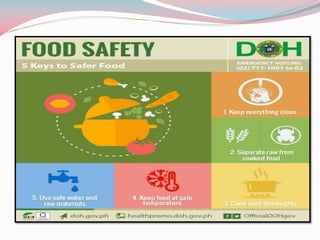
5 KEYS TO SAFER FOOD
By: WHO
 Key 1: Keep clean
 Key 2: Separate raw and cooked food
 Key 3: Cook food thoroughly
 Key 4: Keep food at safe temperatures
 Key 5: Use safe water and raw materials.
“Food safety is a shared responsibility. It is important
to work all along the food production chain – from
farmers and manufacturers to vendors and
consumers”
Key 1: Keep clean
A. Clean hands and surfaces often
 Why it matters:
 Illness-causing bacteria can survive
in many places around your kitchen,
including your hands, utensils, and
cutting boards.
Foodsafety.gov
Unless you wash your
hands, utensils, and
surfaces the right way,
you could spread bacteria
to your food, and your
family.
Foodsafety.gov
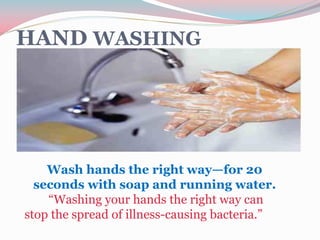
HAND WASHING
Wash hands the right way—for 20
seconds with soap and running water.
“Washing your hands the right way can
stop the spread of illness-causing bacteria.”
PROPER HAND WASHING WITH
SOAP AND WATER
 Wet your hands with warm, running water and apply
liquid soap or use clean bar soap. Lather well.
 Rub your hands vigorously together for at least 15 to
20 seconds.
 Scrub all surfaces, including the backs of your hands,
wrists, between your fingers and under your
fingernails.
 Rinse well.
 Dry your hands with a clean or disposable towel.
 Use a towel to turn off the faucet.
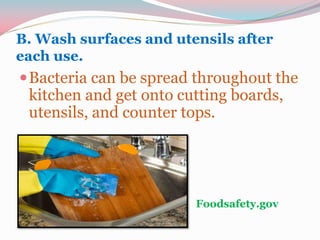
B. Wash surfaces and utensils after
each use.
Bacteria can be spread throughout the
kitchen and get onto cutting boards,
utensils, and counter tops.
Foodsafety.gov
• It is important to prevent cross-
contamination from raw meat or
poultry juices by washing counter
tops and sinks with hot, soapy water.
• Cutting boards, utensils, and
countertops can be sanitized by using
a solution of 1 tablespoon of
unscented, liquid chlorine bleach in 1
gallon of water.
USDA
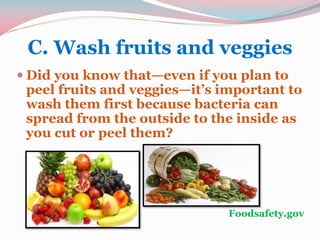
C. Wash fruits and veggies
 Did you know that—even if you plan to
peel fruits and veggies—it’s important to
wash them first because bacteria can
spread from the outside to the inside as
you cut or peel them?
Foodsafety.gov
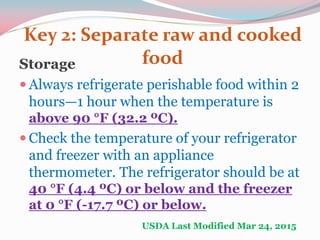
Key 2: Separate raw and cooked
foodStorage
 Always refrigerate perishable food within 2
hours—1 hour when the temperature is
above 90 °F (32.2 ºC).
 Check the temperature of your refrigerator
and freezer with an appliance
thermometer. The refrigerator should be at
40 °F (4.4 ºC) or below and the freezer
at 0 °F (-17.7 ºC) or below.
USDA Last Modified Mar 24, 2015
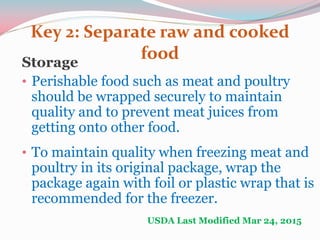
Key 2: Separate raw and cooked
foodStorage
• Perishable food such as meat and poultry
should be wrapped securely to maintain
quality and to prevent meat juices from
getting onto other food.
• To maintain quality when freezing meat and
poultry in its original package, wrap the
package again with foil or plastic wrap that is
recommended for the freezer.
USDA Last Modified Mar 24, 2015
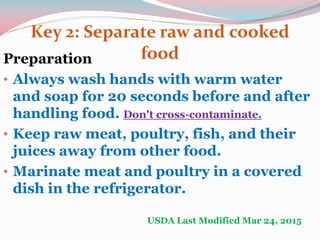
Key 2: Separate raw and cooked
foodPreparation
• Always wash hands with warm water
and soap for 20 seconds before and after
handling food. Don't cross-contaminate.
• Keep raw meat, poultry, fish, and their
juices away from other food.
• Marinate meat and poultry in a covered
dish in the refrigerator.
USDA Last Modified Mar 24, 2015
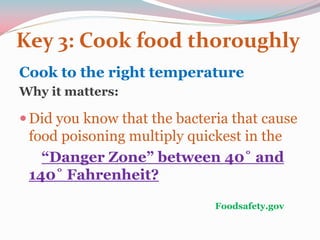
Key 3: Cook food thoroughly
Cook to the right temperature
Why it matters:
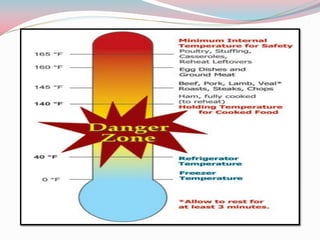
Did you know that the bacteria that cause
food poisoning multiply quickest in the
“Danger Zone” between 40˚ and
140˚ Fahrenheit?
Foodsafety.gov
Key 3: Cook food thoroughly
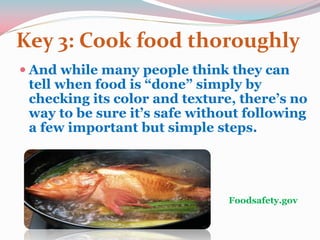
 And while many people think they can
tell when food is “done” simply by
checking its color and texture, there’s no
way to be sure it’s safe without following
a few important but simple steps.
Foodsafety.gov
Key 4: Keep food at safe temperatures
Follow these top tips to keep your family safe
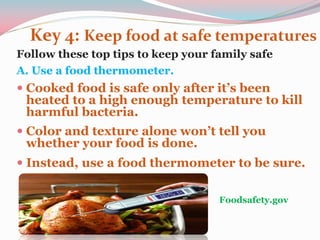
A. Use a food thermometer.
 Cooked food is safe only after it’s been
heated to a high enough temperature to kill
harmful bacteria.
 Color and texture alone won’t tell you
whether your food is done.
 Instead, use a food thermometer to be sure.
Foodsafety.gov
B. Keep food hot after cooking
(at 140 ˚F or above)
 The possibility of bacterial growth actually
increases as food cools after cooking because
the drop in temperature allows bacteria to
thrive.
 But you can keep your food above the safe
temperature of 140˚F by using a heat source
like a chafing dish, warming tray, or slow
cooker.
Foodsafety.gov
• All readily perishable foods and food supplies
shall be kept in controlled temperature of
7ºC (45ºF) or below.
• Meat, poultry, fish & shellfish shall be kept in the
freezer with a temperature of
0-3ºC (32-38ºF).
• Cold cuts and frozen products of fruits and
vegetables shall be stored at temperature of
-6ºC (0-20 ºF).
Foodsafety.gov
 Milk and milk products such as cheese
and butter shall be kept at temperature
40-45 ºF (5-7 ºC)
 Eggs shall be kept at temperature of
45 ºF (7 ºC).
 Vegetables and fruits shall be kept at
44- 50 ºF ( 6- 10 ºC.)
 Banana, potato, sweet potato,
cassava, and onion shall be kept in
dry, well ventilated & coolest part of
the storeroom area (50 ºF), not in
the refrigerator.
 Non-perishable dry foods shall be
kept below 50-60 ºF (10-15 ºC)
except where dry foods are for
immediate use.
Key 5:
Use safe water and raw
materials.
Examples of Contamination in
Processing
If contaminated water or ice
is used to wash, pack, or chill
fruits or vegetables, the
contamination can spread to
those items.
CDC – Center for Disease Control and Prevention – March 24, 2015
Peanut butter can become
contaminated if roasted peanuts
are stored in unclean conditions
or come into contact with
contaminated raw peanuts.
CDC – Center for Disease Control and Prevention – March 24, 2015
During the slaughter process,
pathogens on an animal’s hide
that came from the intestines
can get into the final meat
product.
CDC – Center for Disease Control and Prevention – March 24, 2015
Examples of Contamination in
Distribution
If refrigerated food is left on a
loading dock for long time in
warm weather, it could reach
temperatures that allow
bacteria to grow.
CDC – Center for Disease Control and Prevention – March 24, 2015
Fresh produce can be
contaminated if it is loaded into
a truck that was not cleaned
after transporting animals or
animal products.
CDC – Center for Disease Control and Prevention – March 24, 2015
The contents of a glass jar that
breaks in transport can
contaminate nearby foods.
CDC – Center for Disease Control and Prevention – March 24, 2015
Examples of Contamination in
Production
 If a hen’s reproductive organs are
infected, the yolk of an egg can be
contaminated in the hen before it is
even laid.
 Fish in some tropical reefs may
acquire a toxin from the smaller sea
creatures they eat.
If the fields are sprayed with
contaminated water for
irrigation, fruits and
vegetables can be
contaminated before harvest.
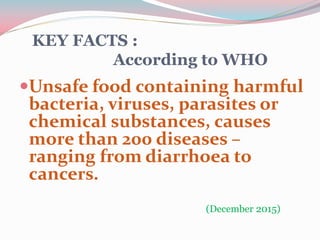
KEY FACTS :
According to WHO
Unsafe food containing harmful
bacteria, viruses, parasites or
chemical substances, causes
more than 200 diseases –
ranging from diarrhoea to
cancers.
(December 2015)
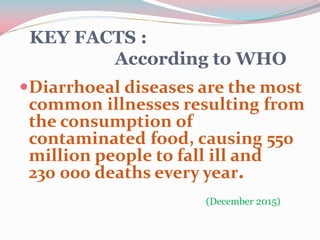
KEY FACTS :
According to WHO
Diarrhoeal diseases are the most
common illnesses resulting from
the consumption of
contaminated food, causing 550
million people to fall ill and
230 000 deaths every year.
(December 2015)
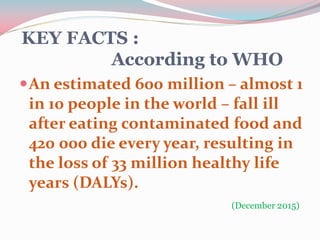
KEY FACTS :
According to WHO
An estimated 600 million – almost 1
in 10 people in the world – fall ill
after eating contaminated food and
420 000 die every year, resulting in
the loss of 33 million healthy life
years (DALYs).
(December 2015)
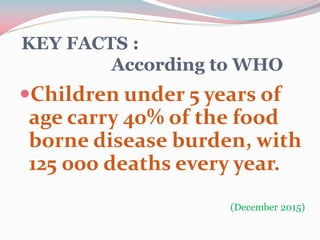
KEY FACTS :
According to WHO
Children under 5 years of
age carry 40% of the food
borne disease burden, with
125 000 deaths every year.
(December 2015)
KEY FACTS :
According to WHO
Access to sufficient amounts of safe
and nutritious food is key to
sustaining life and promoting good
health.
Unsafe food creates a vicious cycle of
disease and malnutrition,
particularly affecting infants, young
children, elderly and the sick.
(December 2015)
KEY FACTS :
According to WHO
Food supply chains now cross
multiple national borders.
Good collaboration between
governments, producers and
consumers helps ensure food
safety.
(December 2015)
Common Causes of Food and
Water Borne Diseases
• unsafe sources of drinking water
• improper disposal of human waste
• unhygienic practices like spitting
anywhere, blowing or picking the nose
• unsafe food handling and preparation
practices i.e. street vended foods
According to DOH
In case of Suspected Food borne
Illnesses
1. Preserve the evidence. If a portion of the
suspected food is available, wrap it
securely “danger” and freeze it.
2. Seek treatment as necessary. If symptoms
persists or are severe (i.e. bloody diarrhea,
excessive nausea and vomiting or high
temperature), immediately consult a
doctor.
3. Report the incidence to the local health
department.
According to DOH
Who are accountable for Food
Safety Regulation?
 The Food Safety Regulatory Agencies
(FSRAs) of the Department of
Agriculture (DA) and the Department of
Health (DOH), in coordination with the
LGUs, shall be responsible in ensuring
food safety at various stages of the food
supply chain within their specified
mandates.
Dietary (Food Safety)

Dietary (Food Safety)

  • 1.
    By: Ms. Josie D.Buenaventura, RND Cardinal Santos Medical Center Clinical Dietitian
  • 2.
    FOOD SAFETY  isthe assurance/guarantee that food will not cause harm to the consumers when it is prepared and/or eaten according to its intended use. According to DOH
  • 4.
    FOOD Food refers toany substance or product whether processed, partially processed or unprocessed that is intended for human consumption.
  • 5.
    FOOD It includes drinks,chewing gum, water and other substances which are intentionally incorporated into the food during its manufacture, preparation and treatment. Food and Safety Act of 2013 (Republic Act No. 10611)
  • 6.
    FOOD & WATERBORNE DISEASE Illnesses resulting from the consumption of contaminated food and water, pathogenic bacteria, viruses, or parasites that contaminate food, as well as chemical or natural toxins produced by harmful algal species such as Diarrhea, Cholera, Typhoid, Hepatitis A.
  • 7.
    Food Safety Standards Refersto the formal documents containing the requirements that foods or food processors have to comply with to safeguard human health. They are implemented by authorities and enforced by law; and are usually developed and published under the auspices of a national standards body. Food and Safety Act of 2013 (Republic Act No. 10611)
  • 8.
    Food Laws ofthe Philippines The Food Safety Act of 2013 Republic Act No. 10611 and The Code on Sanitation of the Philippines Presidential Decree No.856.
  • 9.
    5 KEYS TOSAFER FOOD By: WHO  Key 1: Keep clean  Key 2: Separate raw and cooked food  Key 3: Cook food thoroughly  Key 4: Keep food at safe temperatures  Key 5: Use safe water and raw materials. “Food safety is a shared responsibility. It is important to work all along the food production chain – from farmers and manufacturers to vendors and consumers”
  • 10.
    Key 1: Keepclean A. Clean hands and surfaces often  Why it matters:  Illness-causing bacteria can survive in many places around your kitchen, including your hands, utensils, and cutting boards. Foodsafety.gov
  • 11.
    Unless you washyour hands, utensils, and surfaces the right way, you could spread bacteria to your food, and your family. Foodsafety.gov
  • 12.
    HAND WASHING Wash handsthe right way—for 20 seconds with soap and running water. “Washing your hands the right way can stop the spread of illness-causing bacteria.”
  • 13.
    PROPER HAND WASHINGWITH SOAP AND WATER  Wet your hands with warm, running water and apply liquid soap or use clean bar soap. Lather well.  Rub your hands vigorously together for at least 15 to 20 seconds.  Scrub all surfaces, including the backs of your hands, wrists, between your fingers and under your fingernails.  Rinse well.  Dry your hands with a clean or disposable towel.  Use a towel to turn off the faucet.
  • 14.
    B. Wash surfacesand utensils after each use. Bacteria can be spread throughout the kitchen and get onto cutting boards, utensils, and counter tops. Foodsafety.gov
  • 15.
    • It isimportant to prevent cross- contamination from raw meat or poultry juices by washing counter tops and sinks with hot, soapy water. • Cutting boards, utensils, and countertops can be sanitized by using a solution of 1 tablespoon of unscented, liquid chlorine bleach in 1 gallon of water. USDA
  • 16.
    C. Wash fruitsand veggies  Did you know that—even if you plan to peel fruits and veggies—it’s important to wash them first because bacteria can spread from the outside to the inside as you cut or peel them? Foodsafety.gov
  • 17.
    Key 2: Separateraw and cooked foodStorage  Always refrigerate perishable food within 2 hours—1 hour when the temperature is above 90 °F (32.2 ºC).  Check the temperature of your refrigerator and freezer with an appliance thermometer. The refrigerator should be at 40 °F (4.4 ºC) or below and the freezer at 0 °F (-17.7 ºC) or below. USDA Last Modified Mar 24, 2015
  • 18.
    Key 2: Separateraw and cooked foodStorage • Perishable food such as meat and poultry should be wrapped securely to maintain quality and to prevent meat juices from getting onto other food. • To maintain quality when freezing meat and poultry in its original package, wrap the package again with foil or plastic wrap that is recommended for the freezer. USDA Last Modified Mar 24, 2015
  • 19.
    Key 2: Separateraw and cooked foodPreparation • Always wash hands with warm water and soap for 20 seconds before and after handling food. Don't cross-contaminate. • Keep raw meat, poultry, fish, and their juices away from other food. • Marinate meat and poultry in a covered dish in the refrigerator. USDA Last Modified Mar 24, 2015
  • 20.
    Key 3: Cookfood thoroughly Cook to the right temperature Why it matters: Did you know that the bacteria that cause food poisoning multiply quickest in the “Danger Zone” between 40˚ and 140˚ Fahrenheit? Foodsafety.gov
  • 21.
    Key 3: Cookfood thoroughly  And while many people think they can tell when food is “done” simply by checking its color and texture, there’s no way to be sure it’s safe without following a few important but simple steps. Foodsafety.gov
  • 22.
    Key 4: Keepfood at safe temperatures Follow these top tips to keep your family safe A. Use a food thermometer.  Cooked food is safe only after it’s been heated to a high enough temperature to kill harmful bacteria.  Color and texture alone won’t tell you whether your food is done.  Instead, use a food thermometer to be sure. Foodsafety.gov
  • 23.
    B. Keep foodhot after cooking (at 140 ˚F or above)  The possibility of bacterial growth actually increases as food cools after cooking because the drop in temperature allows bacteria to thrive.  But you can keep your food above the safe temperature of 140˚F by using a heat source like a chafing dish, warming tray, or slow cooker. Foodsafety.gov
  • 24.
    • All readilyperishable foods and food supplies shall be kept in controlled temperature of 7ºC (45ºF) or below. • Meat, poultry, fish & shellfish shall be kept in the freezer with a temperature of 0-3ºC (32-38ºF). • Cold cuts and frozen products of fruits and vegetables shall be stored at temperature of -6ºC (0-20 ºF). Foodsafety.gov
  • 25.
     Milk andmilk products such as cheese and butter shall be kept at temperature 40-45 ºF (5-7 ºC)  Eggs shall be kept at temperature of 45 ºF (7 ºC).  Vegetables and fruits shall be kept at 44- 50 ºF ( 6- 10 ºC.)
  • 26.
     Banana, potato,sweet potato, cassava, and onion shall be kept in dry, well ventilated & coolest part of the storeroom area (50 ºF), not in the refrigerator.  Non-perishable dry foods shall be kept below 50-60 ºF (10-15 ºC) except where dry foods are for immediate use.
  • 28.
    Key 5: Use safewater and raw materials.
  • 29.
    Examples of Contaminationin Processing If contaminated water or ice is used to wash, pack, or chill fruits or vegetables, the contamination can spread to those items. CDC – Center for Disease Control and Prevention – March 24, 2015
  • 30.
    Peanut butter canbecome contaminated if roasted peanuts are stored in unclean conditions or come into contact with contaminated raw peanuts. CDC – Center for Disease Control and Prevention – March 24, 2015
  • 31.
    During the slaughterprocess, pathogens on an animal’s hide that came from the intestines can get into the final meat product. CDC – Center for Disease Control and Prevention – March 24, 2015
  • 32.
    Examples of Contaminationin Distribution If refrigerated food is left on a loading dock for long time in warm weather, it could reach temperatures that allow bacteria to grow. CDC – Center for Disease Control and Prevention – March 24, 2015
  • 33.
    Fresh produce canbe contaminated if it is loaded into a truck that was not cleaned after transporting animals or animal products. CDC – Center for Disease Control and Prevention – March 24, 2015
  • 34.
    The contents ofa glass jar that breaks in transport can contaminate nearby foods. CDC – Center for Disease Control and Prevention – March 24, 2015
  • 35.
    Examples of Contaminationin Production  If a hen’s reproductive organs are infected, the yolk of an egg can be contaminated in the hen before it is even laid.  Fish in some tropical reefs may acquire a toxin from the smaller sea creatures they eat.
  • 36.
    If the fieldsare sprayed with contaminated water for irrigation, fruits and vegetables can be contaminated before harvest.
  • 37.
    KEY FACTS : Accordingto WHO Unsafe food containing harmful bacteria, viruses, parasites or chemical substances, causes more than 200 diseases – ranging from diarrhoea to cancers. (December 2015)
  • 38.
    KEY FACTS : Accordingto WHO Diarrhoeal diseases are the most common illnesses resulting from the consumption of contaminated food, causing 550 million people to fall ill and 230 000 deaths every year. (December 2015)
  • 39.
    KEY FACTS : Accordingto WHO An estimated 600 million – almost 1 in 10 people in the world – fall ill after eating contaminated food and 420 000 die every year, resulting in the loss of 33 million healthy life years (DALYs). (December 2015)
  • 40.
    KEY FACTS : Accordingto WHO Children under 5 years of age carry 40% of the food borne disease burden, with 125 000 deaths every year. (December 2015)
  • 41.
    KEY FACTS : Accordingto WHO Access to sufficient amounts of safe and nutritious food is key to sustaining life and promoting good health. Unsafe food creates a vicious cycle of disease and malnutrition, particularly affecting infants, young children, elderly and the sick. (December 2015)
  • 42.
    KEY FACTS : Accordingto WHO Food supply chains now cross multiple national borders. Good collaboration between governments, producers and consumers helps ensure food safety. (December 2015)
  • 43.
    Common Causes ofFood and Water Borne Diseases • unsafe sources of drinking water • improper disposal of human waste • unhygienic practices like spitting anywhere, blowing or picking the nose • unsafe food handling and preparation practices i.e. street vended foods According to DOH
  • 44.
    In case ofSuspected Food borne Illnesses 1. Preserve the evidence. If a portion of the suspected food is available, wrap it securely “danger” and freeze it. 2. Seek treatment as necessary. If symptoms persists or are severe (i.e. bloody diarrhea, excessive nausea and vomiting or high temperature), immediately consult a doctor. 3. Report the incidence to the local health department. According to DOH
  • 45.
    Who are accountablefor Food Safety Regulation?  The Food Safety Regulatory Agencies (FSRAs) of the Department of Agriculture (DA) and the Department of Health (DOH), in coordination with the LGUs, shall be responsible in ensuring food safety at various stages of the food supply chain within their specified mandates.